Ephrat Livni on Recent Psylocibin Research →
In addition to the article at the link above, see my related post “Hope in Returning to the Road Not Taken in Psychiatry”
How Does This Pandemic End?
Note: Don’t miss the related post “Avoiding Economic Carnage from the Coronavirus: There are Better Policies than Sending Everyone $1000.”
The novel coronavirus behind COVID-19 is extremely good at spreading. It is likely to take a long time to get an effective vaccine. Restrictions on interaction that apply to the vast bulk of the population quickly come to seem quite onerous. As a result, the most serious part of the pandemic is likely to end only when a substantial fraction of the population has had COVID-19 and is immune. (As of today, it is still not known for sure how strong the immunity is from having had COVID-19. I’ll assume the best on that score—that having had COVID-19, even asymptomatically, confers immunity.)
The idea that a large fraction of the population will end up getting infected may seem grim. Is it possible, though, that
those who have only a small risk of dying if they get the disease—the young and otherwise healthy—will get exposed and become immune, ultimately bringing the pandemic under control because of their immunity, but
those who have a higher risk of dying if they get the disease—the old or already compromised—could largely escape?
To answer this question, I need to modify the SIR model that divides people into the Susceptible, the Infectious and the Recovered. Above and at this link is a wonderful video that provides a primer on the SIR model. I need to modify the SIR model into a model that tracks the fraction of the population in each of these categories within group A and within group B. I will think of group A as the young and otherwise healthy, who are less careful about social distancing but also at lower risk of death should they get infected by the coronavirus. Group B is then the old or compromised, who I assume understand the risk they face and so are more careful at social distancing. (The old or compromised may also suffer a lower economic and lifestyle cost of social distancing.)
With six subgroups (SIR within group A and SIR within group B) the dynamic solution to the differential equation for the modified SIR model is quite complex, but the conditions for the number of infected in group A and the number of infected in group B to be shrinking can be readily analyzed. Define this notation. First, notation for population shares:
SA = share of the overall population that is both in group A and is susceptible
IA = share of the overall population that is both in group A and is infectious
RA = share of the overall population that is both in group A and is recovered (or dead)
SB = share of the overall population that is both in group B and is susceptible
IB = share of the overall population that is both in group B and is infectious
RB = share of the overall population that is both in group B and is recovered (or dead)
Note that SA + IA + RA + SB + IB + RB = 1. Second, notation for constants of transmission:
KAA = constant indicating the risk of transmission between two people in group A
KAB = constant indicating the risk of transmission from someone in group A to someone in group B
KBA = constant indicating the risk of transmission from someone in group B to someone in group A
KBB = constant indicating the risk of transmission between two people in group B
Third, the rate of resolution of an infection:
C = rate at which those who are infectious make the transition to “recovered” which includes being dead, since the dead, like the recovered, will not contribute to further transmission.
All of these are nonnegative quantities.
The two crucial inequalities in this modified SIR model are the conditions for the number of infected within a group to be shrinking. Those two inequalities are:
d IA/dt = KAA * IA * SA + KBA * IB * SA - C * IA < 0
d IB/dt = KBB * IB * SB + KAB * IA * SB - C * IB < 0
Let’s divide each inequality by the share of infected in the corresponding group to get the logarithmic growth rates:
d log(IA)/dt = (1/IA) d IA/dt = [KAA + KBA * (IB/IA)] * SA - C < 0
d log(IB)/dt = (1/IB) d IB/dt = [KBB + KAB * (IA/IB)] * SB - C < 0
Now, let’s define x as the key ratio IB/IA:
x = IB/IA
Substituting into the logarithmic form of the crucial inequalities yields:
d log(IA)/dt = [KAA + x KBA] * SA - C < 0
d log(IB)/dt = [KBB + (1/x) KAB] * SB - C < 0
Note that
d log(x)/dt = d log(IB)/dt - d log(IA)/dt = [KBB + (1/x) KAB] * SB - [KAA + x KBA] * SA.
There will be a (temporary) steady-state level of x when
d log(x)/dt = [KBB + (1/x) KAB] * SB - [KAA + x KBA] * SA = 0.
We can solve this for a temporary-steady-state level of x that might be a good approximation. Let’s plug in some plausible numbers to get some sense of what will happen.
First, let’s start with almost everyone susceptible. In particular, assume that, approximately,
SA = 2/3
SB = 1/3
Let’s use a week as the time unit. A two-week course of the disease can be represented by C = .5/week. And the idea that someone infected infects roughly 3 other people when not putting much effort into social distancing can be represented by KAA = 1.5/week. Let’s imagine that KBB = KAB = KBA = .3/week because those in group B are putting great effort into social distancing. (This is optimistic.)
This yields a quadratic equation in x. It is the positive root that is relevant: .108 with these parameters.
By contrast, suppose that no one was doing social distancing so that KAA = KBB = KAB = KBA = 1.5. Then the temporary-steady-state level of x is .616.
At the temporary-steady-state level of x, looking at either of the crucial inequalities will give us an equivalent answer for when the number of infectious people will begin declining. Let’s look at the first of the crucial inequalities, plugging in the numbers when almost everyone is still susceptible and when group B is making strenuous efforts to do social distancing but group A isn’t:
d log(IA)/dt = [(1.5/week) + .108 (.3/week)] * 2/3 - (.5/week) = .522
This clearly fails to satisfy the inequality for a shrinking number of infectious people of group A, and the number of infectious people of group is an approximately a constant ratio to this.
If half of group A had the disease (many perhaps asymptomatically) and became immune, that would reduce SA to 1/3, and the inequality would be close to being satisfied. Not quite, because x would go up from .108 because of the influence of SA getting lower faster than SB gets lower on the quadratic equation. But when a bit more than half of group A becomes immune, then the number of those who are infectious will begin to drop.
The bottom line is that if these parameters are in the right ballpark, things will only end when a large fraction of group A has had the disease and becomes immune or dies, which will also involve a substantial but considerably smaller fraction of group B has had the disease and becomes immune or dies.
Note that this ending of the pandemic doesn’t require continuing restrictions on group A. Indeed, the assumption was that group A never really took the restrictions seriously in the first place. Restrictions on group B may be necessary for quite a while.
The Key Question
The biggest unknown about COVID-19 right now is what fraction of people have already had the disease and become immune. We may know within a couple of weeks: scientists are eager to deploy tests for antibodies to the virus (which would be a good indication of immunity) on random samples of the population.
Because we know quite well how many people have died from COVID-19, it would be good news in several ways if we find that a large fraction of the population has already had the disease and has become immune. First, and most important, it would mean that the fatality rate when infected is lower than people have been thinking. Second, it would mean the symptoms are often too mild for people to have gotten diagnosed already during a period when, for the most part, only those who seemed quite sick were tested. Third, if a large fraction of people have already had the disease and have become immune, it means we are closer to the moment when it is safe to lift restrictions on the bulk of the population, which would lessen the economic impact of measures to control the pandemic.
Note that a large fraction of the population already having had the disease and having become immune would go along with the coronavirus having been fiendishly good at spreading, which is quite possibly true.
One thing that doesn’t depend on knowing how many people have already been infected is the disaster of overloaded hospitals in the next few weeks. For the next few weeks, the number of people who are in critical condition and the growth rate are enough to enable prediction. (However, one does need to guess how effective any change in social distancing measures will be.)
Discussion of Similar Perspectives in the News and the News as It Relates to Likely Values of the Relevant Parameters and Values of State Variables for the Coronavirus
Clive Cookson in the Financial Times: “Coronavirus may have infected half of UK population — Oxford study: New epidemiological model suggests the vast majority of people suffer little or no illness”
The new coronavirus may already have infected far more people in the UK than scientists had previously estimated — perhaps as much as half the population — according to modelling by researchers at the University of Oxford.
If the results are confirmed, they imply that fewer than one in a thousand of those infected with Covid-19 become ill enough to need hospital treatment, said Sunetra Gupta, professor of theoretical epidemiology, who led the study. The vast majority develop very mild symptoms or none at all.
Max Colchester and Denise Roland in the Wall Street Journal: “U.K. Trials Coronavirus-Immunity Tests for Home Use: The tests, if successful, would ease disruptions and lockdowns, but some experts have doubts”
In Britain, the government said Wednesday it is trialing personal blood-testing kits that it hopes to distribute as soon as next week. The test—if it functions—could clear the way for people who have caught and recovered from Covid-19 to return to work or volunteer to help others, potentially easing the disruption caused by the pandemic.
Across the world, laboratories and diagnostics companies are racing to fine-tune a cheap, portable, mass-testing device that can quickly show if a person has acquired immunity to the virus. The U.S. Centers for Disease Control and Prevention has said it is also working on its own antibody test for the virus.
…
If the test does work, it could not only help a portion of the population go back to work but also help answer questions about the virus itself including how widespread it is.
“In China, why is it going down? Is it because the virus is dying out or is it because many more people are getting infected than we think and are developing antibodies?” said Mr. Wraith.
Rebecca Ballhaus and Stephanie Armour in the Wall Street Journal: “Trump Says Parts of U.S. Could Go Back to Work in a Few Weeks: White House weighs proposing workplace coronavirus testing, but capacity remains limited; governors suggest they will go their own way”
Tedros Adhanom Ghebreyesus, director-general of the World Health Organization, warned in a briefing Wednesday that in the absence of necessary preparations, the virus could resurge once restrictions are eased. “The last thing any country needs is to open schools and businesses, only to be forced to close them again because of a resurgence,” he said.
Feliz Solomon, Betsy McKay and Jon Emont in the Wall Street Journal: “When Will It Be Safe to Loosen Coronavirus Lockdowns? Governments prepare for the long haul as authorities grapple with how much economic pain countries can endure”
Months of isolation, social distancing and economic distress could lead to more health problems than Covid-19 itself, said David Katz, founding director of Yale University’s Prevention Research Center. Job losses lead to lack of health insurance, food insecurity, stress, and sometimes drug and alcohol abuse and suicides, he said.
He has proposed a stratified approach in which those most vulnerable to Covid-19—people ages 75 and older, and those of any age with heart disease or another serious underlying condition—would remain isolated or maintain social distancing. Meanwhile, people under age 60 would largely go back to their daily lives after a few weeks, while following hand-washing and other precautions.
“What I’ve been concerned about is we can hurt people if we let them get this infection, and we can hurt people with an all-out war that destroys their lives in other ways,” said Dr. Katz, who said he has spoken with two U.S. governors about his proposal. “I’m saying how about we do this in phases.”
The first phase is the current one: strict social distancing for a few weeks to avoid sharp peaks of infection and prevent the health-care system from being overwhelmed, he said. Testing should be expanded in the U.S. to figure out how many people are sick, he said.
Then experts in epidemiology, virology, mathematical modeling and other fields should analyze the data and figure out a way to protect the vulnerable while allowing others to get on with their lives, he said.
Holman Jenkins in the Wall Street Journal: “The Happy Few Are the Cured: Now let’s get on with saving the economy while protecting the vulnerable.”
The giddiest among us soon will be those who tested positive and now have it behind them. The world will be their oyster. A Craigslist page will soon appear for coronavirus antibody-positive personal services. People will get paid hundreds of dollars an hour if they can document their immunity. Starbucks is opening up again in Wuhan. In the U.S., Seattle or New York will get the first antibody-positive Starbucks: Every barista will be able to prove they’ve had the coronavirus.
Eran Bendavid and Jay Bhattacharya in the Wall Street Journal: “Is the Coronavirus as Deadly as They Say? Current estimates about the Covid-19 fatality rate may be too high by orders of magnitude.”
Eran Bendavid and Jay Bhattacharya do a good job of assembling the shreds of evidence relevant to how many people are infected but don’t have serious symptoms. But they dramatically overinterpret this evidence. When comprehensive samples certain classes of people are tested for the coronavirus, the infection will be detected, on average, several days before it would have been detected if they were only tested after showing symptoms. With prevalence growing so fast, that makes the numbers from comprehensive samples comparable only after adjusting for how early in an infection something is detected.

Plots like the one just above suggest the incidence of the virus was doubling every two or three days when the data was collected, so a difference of a little over a week in how early an infection is detected could reduce the adjustment factors Eran and Jay adduce by a factor of ten. That is, the mortality rates and serious symptom rates might need to be adjusted upward by a factor of ten to account for growth over a little more than a week to make the numbers comparable. Still, these numbers give some hope that COVID-19 is better at spreading and less deadly given infection than most people have been thinking. Here are the shreds of evidence Eran and Jay assemble:
Population samples from China, Italy, Iceland and the U.S. provide relevant evidence. On or around Jan. 31, countries sent planes to evacuate citizens from Wuhan, China. When those planes landed, the passengers were tested for Covid-19 and quarantined. After 14 days, the percentage who tested positive was 0.9%. If this was the prevalence in the greater Wuhan area on Jan. 31, then, with a population of about 20 million, greater Wuhan had 178,000 infections, about 30-fold more than the number of reported cases. The fatality rate, then, would be at least 10-fold lower than estimates based on reported cases.
Next, the northeastern Italian town of Vò, near the provincial capital of Padua. On March 6, all 3,300 people of Vò were tested, and 90 were positive, a prevalence of 2.7%. Applying that prevalence to the whole province (population 955,000), which had 198 reported cases, suggests there were actually 26,000 infections at that time. That’s more than 130-fold the number of actual reported cases. Since Italy’s case fatality rate of 8% is estimated using the confirmed cases, the real fatality rate could in fact be closer to 0.06%.
In Iceland, deCode Genetics is working with the government to perform widespread testing. In a sample of nearly 2,000 entirely asymptomatic people, researchers estimated disease prevalence of just over 1%. Iceland’s first case was reported on Feb. 28, weeks behind the U.S. It’s plausible that the proportion of the U.S. population that has been infected is double, triple or even 10 times as high as the estimates from Iceland. That also implies a dramatically lower fatality rate.
The best (albeit very weak) evidence in the U.S. comes from the National Basketball Association. Between March 11 and 19, a substantial number of NBA players and teams received testing. By March 19, 10 out of 450 rostered players were positive. Since not everyone was tested, that represents a lower bound on the prevalence of 2.2%. The NBA isn’t a representative population, and contact among players might have facilitated transmission. But if we extend that lower-bound assumption to cities with NBA teams (population 45 million), we get at least 990,000 infections in the U.S. The number of cases reported on March 19 in the U.S. was 13,677, more than 72-fold lower. These numbers imply a fatality rate from Covid-19 orders of magnitude smaller than it appears.
John Cochrane in the Wall Street Journal: “Flatten the Coronavirus Curve at a Lower Cost: A total shutdown could cost the economy $1 trillion a month. We need more tailored measures.”
A blanket lockdown can’t go on. Keeping every business closed and every worker at home until a vaccine is available won’t work. Replacing the private economy with borrowed federal money for months on end won’t work. If this were the plague, with 50% of the infected dying, it might be a different story. But people won’t put up with losing many trillions of dollars to flatten the curve of this virus.
…
State and local governments need to work with businesses to figure out a satisfactory combination of personal distance, self-isolation, frequent testing, stricter rules for those who must interact with customers, cleaning protocols and so on. Each industry will likely be different. Even onerous rules, which can be eased as officials and businesses gain information and experience, are better than a blanket ban.
…
Government officials need to work with a scalpel, not a sledgehammer. Isolate old people and those with pre-existing health conditions, who are much more likely to end up needing emergency care, while letting the young and healthy get back to work, carefully. Retired people have income streams that aren’t as disrupted by the virus. They can stay home. Lock down hotspots, but not entire states. Follow the Taiwan, South Korea and Singapore models: extensive testing, contact tracing, detailed people tracking. But keep the economy open, subject to stringent safety rules.
Wall Street Journal Editorial Board: “Parks and Virus Recreation: Cutting off access to outdoor space strains the cooped-up public.”
Officials seeking to slow the spread of coronavirus have imposed sweeping restrictions on roughly one in four Americans. Several states have closed churches, restaurants and bars, gyms and other businesses. Some governors and mayors are now moving to limit access to parks and other outdoor spaces. The goal as always is to slow the virus’s spread, but with cabin fever raging for shut-ins, we have to wonder whether closing down large open spaces does more harm than good.
…
Mr. Cuomo also suggested opening some streets to pedestrians only. Increasing the amount of outdoor space would be helpful in highly populated cities like New York, and it’s feasible now that vehicle traffic has fallen amid the shutdowns. But other officials have threatened or acted to decrease the amount of outdoor space.
…
Surely some middle ground can be found between asking for public compliance with personal distancing and then making large public spaces inaccessible. Compared to grocery stores or pharmacies, outdoor spaces are lower-risk for contagion. Especially in big cities, people can’t be expected to stay cooped up in their tiny apartments indefinitely. The phrase “stir crazy” comes to mind. If officials push too far, many people will ignore both reasonable and unreasonable restrictions.
Fasting Helps Avoid Collateral Damage in Fighting Bacterial Infections; Glucose Helps Avoid Collateral Damage in Fighting Viral Infections

The experiment flagged above about the effect of diet on fighting infection was only “performed on a single mouse strain (C57BL/6J) in one mouse facility,” but its results are striking. The three-minute video abstract is well done. (You can see it at the bottom of the image above.) The brief summary from that video is:
When the mice are not fed, or glucose is blocked, the mice with the bacterial infection live, while those with the viral infection live.
When the mice are fed glucose, the mice with the bacterial infection die, while those with the viral infection live.
If I understand the discussion section at the end of the paper, the issue is not effectiveness at killing the bacteria or viruses, but rather the damage to one’s own cells of the immune response. Ketones seemed to help protect cells from collateral damage when fighting bacteria, while glucose seemed to help protect cells from collateral damage when fighting viruses.
Note that collateral damage of this sort is only likely to be occurring in a big way if one is feeling symptoms. But if one is feeling symptoms of a viral infection, it might be OK to have some carbs, while if one is feeling symptoms of a bacterial infection, fasting might be helpful.
Again, this is one study in one laboratory using one strain of mice, but this shred of evidence might be useful given our current state of ignorance.
For annotated links to other posts on diet and health, see:
The Federalist Papers #7 B: Without Union, Economic Disagreements Would Drive the States toward Conflict with One Another—Alexander Hamilton

In the second half of The Federalist Papers #7, Alexander Hamilton shows a keen understanding of psychology when discussing the animosity between the states that could be engendered by economic disagreements if the states are not united.
Alexander Hamilton points to three areas of potential economic disagreement. Quoting him in each case,
Each State, or separate confederacy, would pursue a system of commercial policy [that is, tariff policy] peculiar to itself.
The public debt of the Union would be a further cause of collision between the separate States or confederacies. The apportionment, in the first instance, and the progressive extinguishment afterward, would be alike productive of ill-humor and animosity.
How would it be possible to agree upon a rule of apportionment satisfactory to all?
There are even dissimilar views among the States as to the general principle of discharging the public debt.
Laws in violation of private contracts, as they amount to aggressions on the rights of those States whose citizens are injured by them, may be considered as another probable source of hostility.
The psychological reaction to these disagreements is similar whatever the particular cause among these three. Here are some of the key passages Alexander Hamilton pens on that score:
… distinctions, preferences, and exclusions … would beget discontent.
The habits of intercourse, on the basis of equal privileges, to which we have been accustomed since the earliest settlement of the country, would give a keener edge to those causes of discontent than they would naturally have independent of this circumstance.
WE SHOULD BE READY TO DENOMINATE INJURIES THOSE THINGS WHICH WERE IN REALITY THE JUSTIFIABLE ACTS OF INDEPENDENT SOVEREIGNTIES CONSULTING A DISTINCT INTEREST. [All caps is in the original]
It is not at all probable that this unbridled spirit would pay much respect to those regulations of trade by which particular States might endeavor to secure exclusive benefits to their own citizens. The infractions of these regulations, on one side, the efforts to prevent and repel them, on the other, would naturally lead to outrages, and these to reprisals and wars.
There is scarcely any that can be proposed which is entirely free from real objections. These, as usual, would be exaggerated by the adverse interest of the parties.
The procrastinations of the former would excite the resentments of the latter.
The citizens of the States interested would clamour; foreign powers would urge for the satisfaction of their just demands, and the peace of the States would be hazarded to the double contingency of external invasion and internal contention.
Their refusal would be too plausible a pretext to the complaining States to withhold their contributions, not to be embraced with avidity; and the non-compliance of these States with their engagements would be a ground of bitter discussion and altercation.
… delinquencies in payments on the part of some of the States would result from a diversity of other causes--the real deficiency of resources; the mismanagement of their finances; accidental disorders in the management of the government; and, in addition to the rest, the reluctance with which men commonly part with money for purposes that have outlived the exigencies which produced them, and interfere with the supply of immediate wants. Delinquencies, from whatever causes, would be productive of complaints, recriminations, and quarrels.
… there is nothing men differ so readily about as the payment of money.
We are not authorized to expect that a more liberal or more equitable spirit would preside over the legislations of the individual States hereafter, if unrestrained by any additional checks, than we have heretofore seen in too many instances disgracing their several codes.
We have observed the disposition to retaliation excited in Connecticut in consequence of the enormities perpetrated by the Legislature of Rhode Island …
Below is the relevant section of The Federalist Papers #7 in full, showing the context for these points:
The competitions of commerce would be another fruitful source of contention. The States less favorably circumstanced would be desirous of escaping from the disadvantages of local situation, and of sharing in the advantages of their more fortunate neighbors. Each State, or separate confederacy, would pursue a system of commercial policy peculiar to itself. This would occasion distinctions, preferences, and exclusions, which would beget discontent. The habits of intercourse, on the basis of equal privileges, to which we have been accustomed since the earliest settlement of the country, would give a keener edge to those causes of discontent than they would naturally have independent of this circumstance. WE SHOULD BE READY TO DENOMINATE INJURIES THOSE THINGS WHICH WERE IN REALITY THE JUSTIFIABLE ACTS OF INDEPENDENT SOVEREIGNTIES CONSULTING A DISTINCT INTEREST. The spirit of enterprise, which characterizes the commercial part of America, has left no occasion of displaying itself unimproved. It is not at all probable that this unbridled spirit would pay much respect to those regulations of trade by which particular States might endeavor to secure exclusive benefits to their own citizens. The infractions of these regulations, on one side, the efforts to prevent and repel them, on the other, would naturally lead to outrages, and these to reprisals and wars.
The opportunities which some States would have of rendering others tributary to them by commercial regulations would be impatiently submitted to by the tributary States. The relative situation of New York, Connecticut, and New Jersey would afford an example of this kind. New York, from the necessities of revenue, must lay duties on her importations. A great part of these duties must be paid by the inhabitants of the two other States in the capacity of consumers of what we import. New York would neither be willing nor able to forego this advantage. Her citizens would not consent that a duty paid by them should be remitted in favor of the citizens of her neighbors; nor would it be practicable, if there were not this impediment in the way, to distinguish the customers in our own markets. Would Connecticut and New Jersey long submit to be taxed by New York for her exclusive benefit? Should we be long permitted to remain in the quiet and undisturbed enjoyment of a metropolis, from the possession of which we derived an advantage so odious to our neighbors, and, in their opinion, so oppressive? Should we be able to preserve it against the incumbent weight of Connecticut on the one side, and the co-operating pressure of New Jersey on the other? These are questions that temerity alone will answer in the affirmative.
The public debt of the Union would be a further cause of collision between the separate States or confederacies. The apportionment, in the first instance, and the progressive extinguishment afterward, would be alike productive of ill-humor and animosity. How would it be possible to agree upon a rule of apportionment satisfactory to all? There is scarcely any that can be proposed which is entirely free from real objections. These, as usual, would be exaggerated by the adverse interest of the parties. There are even dissimilar views among the States as to the general principle of discharging the public debt. Some of them, either less impressed with the importance of national credit, or because their citizens have little, if any, immediate interest in the question, feel an indifference, if not a repugnance, to the payment of the domestic debt at any rate. These would be inclined to magnify the difficulties of a distribution. Others of them, a numerous body of whose citizens are creditors to the public beyond proportion of the State in the total amount of the national debt, would be strenuous for some equitable and effective provision. The procrastinations of the former would excite the resentments of the latter. The settlement of a rule would, in the meantime, be postponed by real differences of opinion and affected delays. The citizens of the States interested would clamour; foreign powers would urge for the satisfaction of their just demands, and the peace of the States would be hazarded to the double contingency of external invasion and internal contention.
Suppose the difficulties of agreeing upon a rule surmounted, and the apportionment made. Still there is great room to suppose that the rule agreed upon would, upon experiment, be found to bear harder upon some States than upon others. Those which were sufferers by it would naturally seek for a mitigation of the burden. The others would as naturally be disinclined to a revision, which was likely to end in an increase of their own incumbrances. Their refusal would be too plausible a pretext to the complaining States to withhold their contributions, not to be embraced with avidity; and the non-compliance of these States with their engagements would be a ground of bitter discussion and altercation. If even the rule adopted should in practice justify the equality of its principle, still delinquencies in payments on the part of some of the States would result from a diversity of other causes--the real deficiency of resources; the mismanagement of their finances; accidental disorders in the management of the government; and, in addition to the rest, the reluctance with which men commonly part with money for purposes that have outlived the exigencies which produced them, and interfere with the supply of immediate wants. Delinquencies, from whatever causes, would be productive of complaints, recriminations, and quarrels. There is, perhaps, nothing more likely to disturb the tranquillity of nations than their being bound to mutual contributions for any common object that does not yield an equal and coincident benefit. For it is an observation, as true as it is trite, that there is nothing men differ so readily about as the payment of money.
Laws in violation of private contracts, as they amount to aggressions on the rights of those States whose citizens are injured by them, may be considered as another probable source of hostility. We are not authorized to expect that a more liberal or more equitable spirit would preside over the legislations of the individual States hereafter, if unrestrained by any additional checks, than we have heretofore seen in too many instances disgracing their several codes. We have observed the disposition to retaliation excited in Connecticut in consequence of the enormities perpetrated by the Legislature of Rhode Island; and we reasonably infer that, in similar cases, under other circumstances, a war, not of PARCHMENT, but of the sword, would chastise such atrocious breaches of moral obligation and social justice.
In the first half or The Federalist Papers #7, Alexander Hamilton talks about the likelihood of territorial disputes if the states are not part of a union. (See “The Federalist Papers #7 A: Divided, the States Would Fall into Territorial Disputes Likely to Lead to War Between the States—Alexander Hamilton.”) In the final paragraph of The Federalist Papers #7 Alexander Hamilton goes in a bit different direction, repeating an argument given by John Jay in The Federalist Papers #5. (See “The Federalist Papers #5: Unless United, the States Will Be at Each Others' Throats.”) Here is how he seconds that argument:
The probability of incompatible alliances between the different States or confederacies and different foreign nations, and the effects of this situation upon the peace of the whole, have been sufficiently unfolded in some preceding papers. From the view they have exhibited of this part of the subject, this conclusion is to be drawn, that America, if not connected at all, or only by the feeble tie of a simple league, offensive and defensive, would, by the operation of such jarring alliances, be gradually entangled in all the pernicious labyrinths of European politics and wars; and by the destructive contentions of the parts into which she was divided, would be likely to become a prey to the artifices and machinations of powers equally the enemies of them all. Divide et impera [divide and command] must be the motto of every nation that either hates or fears us. [In order that the whole subject of these papers may as soon as possible be laid before the public, it is proposed to publish them four times a week--on Tuesday in the New York Packet and on Thursday in the Daily Advertiser.]
PUBLIUS.
Here are links to my other posts on The Federalist Papers so far:
The Federalist Papers #1: Alexander Hamilton's Plea for Reasoned Debate
The Federalist Papers #3: United, the 13 States are Less Likely to Stumble into War
The Federalist Papers #4 B: National Defense Will Be Stronger if the States are United
The Federalist Papers #5: Unless United, the States Will Be at Each Others' Throats
The Federalist Papers #6 A: Alexander Hamilton on the Many Human Motives for War
Avoiding Economic Carnage from the Coronavirus: There are Better Policies than Sending Everyone $1000
I had a chance to talk through economic policy responses to Covid-19 in my graduate business cycle class yesterday. I very much like Donald Marron’s take on it, which you can see in this Twitter thread, whose first tweet is shown above. I think what I have to say is very much consistent with what he says. He writes that while the epidemic is raging, we want to reduce economic activity in sectors such as restaurants, travel and in-person entertainment in order to reduce transmission of the coronavirus. I am on the side favoring very strong social-distancing measures. I am glad our republic is taking things more seriously than it did 10 days ago. Strong social-distancing measures should result in an intentional sharp recession of an unusual type: things that can be done remotely or at low enough human densities to be reasonably safe, or are essential, such as groceries, will continue, and health-care-related activities will increase, but other virus-unsafe and not-absolutely-essential sectors will basically shut down or contract markedly.
After we have brought the epidemic under enough control to allow economic activity to resume in almost all sectors, a big issue we face is that many people will have lost their jobs or self-employment income but still face bills such as the rent, mortgage payments, groceries, etc. There are many people of low and moderate incomes who would face serious economic hardship without aid. We should help them. Legally requiring forbearance by landlords and creditors is probably appropriate, but then puts a financial strain on those landlords and creditors which might need to be addressed in some cases.
More generally, small businesses and nonprofits that were totally sound in the absence of the epidemic may be facing bankruptcy. Personally, I don’t want my favorite restaurants to go under financially simply because they have to keep paying rent during the epidemic but have almost no revenue. Since the financial hit from the epidemic is not their fault, I am very sympathetic to the idea of bailing out small businesses that would fail without help only because of the coronavirus.
Note that I am not so worried about big businesses. For them, bankruptcy simply means that they end up owned by the bondholders instead of the stockholders, who are wiped out, but they can continue in operation. The government should only bail them out if their operations would be affected by the financial hit. Note that banks should be OK if appropriate aid is given to the people who owe money to banks and would be drive to bankruptcy in the absence of aid.
But how can we get aid to people quickly and still have time to carefully think through how to target it? Here is my proposal:
Instead of mailing $1000 check to each person as is being discussed, mail each adult a government credit card with a $5000 line of credit. Mail similar government credit cards with lines of credit that are a certain percentage of previous revenue to small businesses that would be most strongly affected by the coronavirus. (Businesses that have filed a tax return at least once would be eligible according to a formula. Businesses newer than that would have to apply.) This allows households and business to meet their immediate bills to a much greater extent than a mere $1000.
Couple the issuance of these government credit cards with their associated lines of credit with an announcement that the government would do means-tested loan forgiveness according to criteria that the government will take the needed time to work out.
This proposal is a version of my “Federal Lines of Credit” proposal. I have links to my posts on this proposal collected at the bottom of my post “Helicopter Drops of Money Are Not the Answer.” There is, however carefully targeted transfers in the form of loan forgiveness added to the Federal Lines of Credit.
The Federal Lines of Credit combined with the promise of means-tested loan forgiveness should go a long way toward supporting aggregate demand after the worst of the epidemic is over. But it may be necessary for the Fed to support aggregate demand by cutting interest rates further—into negative territory. My judgment of Fed performance so far in this epidemic is that they are doing a good job except for too much reluctance to consider negative interesting rates. (For example, they are doing a good job of keeping the functioning of the financial markets reasonably normal, and cut interest rates quickly to near zero.) I have links to my posts on negative interest rate policy here:
Also, I wrote a major post about negative interest rate policy just last Thursday:
Right now, the focus for fighting the coronavirus is appropriately on public health and medical interventions. But economists are tasked with thinking ahead to how we can avoid long-lasting economic carnage from the Covid-19 epidemic.
Update March 26, 2020: Ed Glaeser says in a Wall Street Journal op-ed that you can do the equivalent of loans through the tax system. Here is the relevant passage:
One way to do this would be to offer the payments to every American regardless of income, but then assess each recipient’s need after the fact and recoup the expense in a progressive manner. Everyone could get $2,000 right away, but if their household income exceeded $200,000 the following year they would be charged for 100% of the payment in taxes. Households below $100,000 might pay no tax, and intermediate earners could pay something in between. That way the money would be conditional, but people wouldn’t have to worry about it until the next tax season.
For the US, most of the details of a $2 trillion package are already baked in, but the policy for economic policy response to the novel coronavirus is likely still in flux in some other countries, and there is a chance additional economic policy response packages will be necessary in both the US and elsewhere. Economically, a lot depends on how long the unsafe, non-essential sector is shut down (as well as how broadly “essential” is interpreted). I discuss some relevant issues in today’s post “How Does this Pandemic End?”
On My Pattern of Fasting (click here, then on ‘show this thread’) →
For annotated links to other posts on diet and health, see:
The QJE Religion and Economics Collection →
For a limited time these articles from the Quarterly Journal of Economics about Economics and Religion are ungated.
A Peek at Japan's Edo Period through its Art →
The visuals are of uncommonly high quality for online.
Responding to Negative Coverage of Negative Rates in the Financial Times

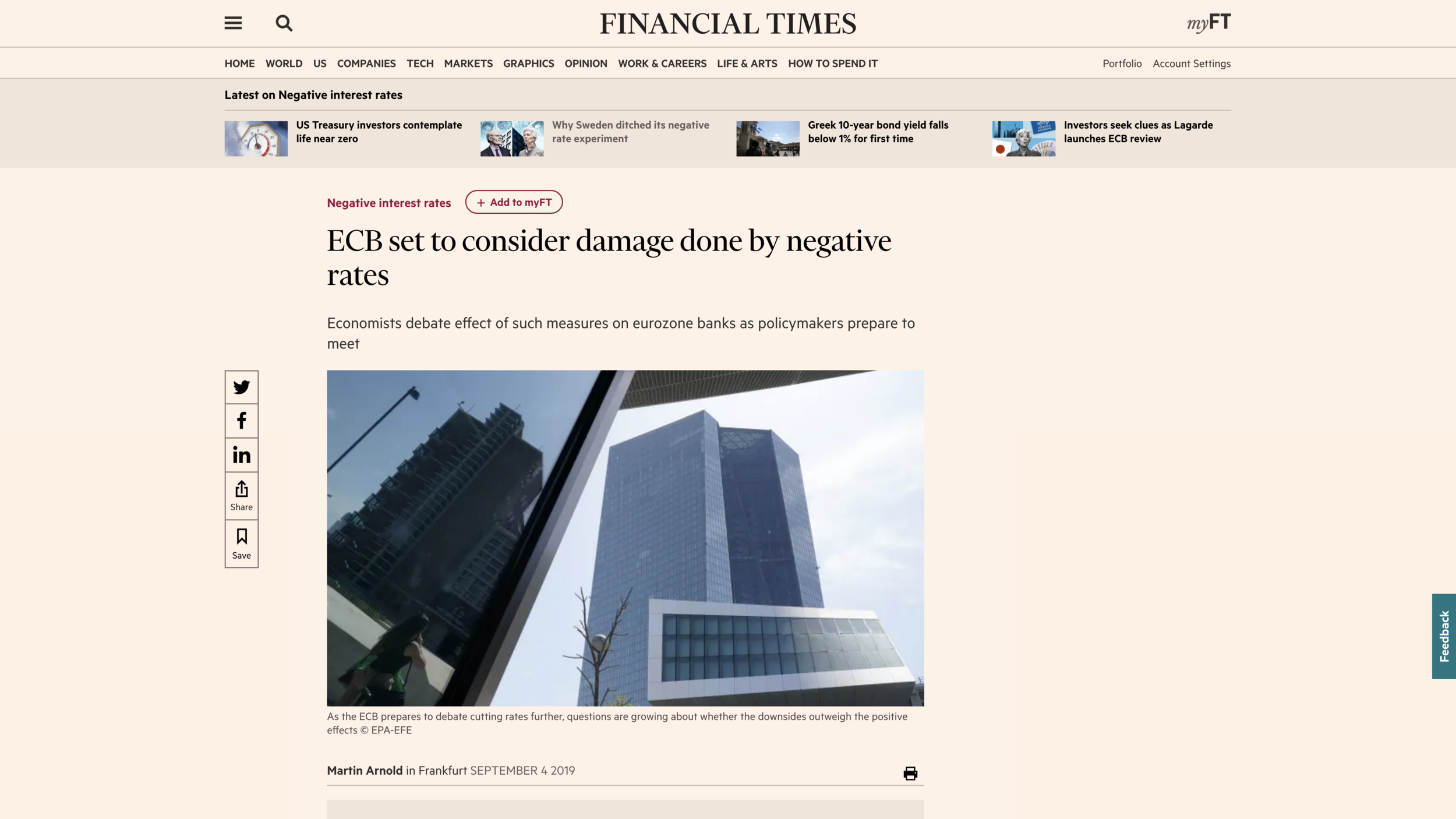
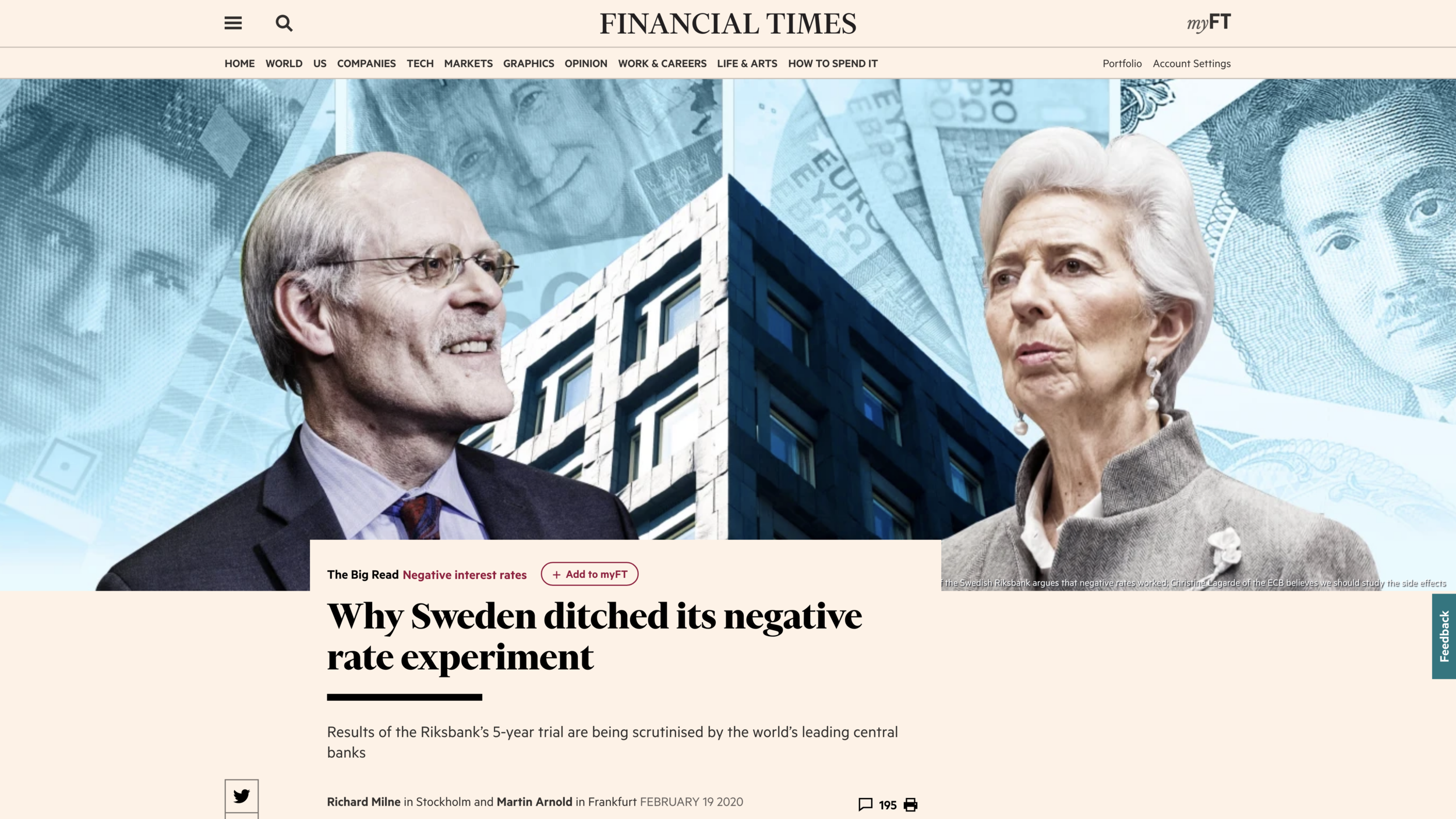
In this post, let me present a solution before more fully presenting a problem for negative interest rate policy that shows up in news articles such as the three Financial Times articles shown above.
The Solution
It is time for the next step in negative interest rate policy. Even without any change in paper currency policy, it is possible to go to quite deep negative rates if banks are compensated financially for the difficulty of having negative rates on small checking and saving accounts.
Central banks are quite attentive to the strains on bank profits that can result from commercial banks’ understandable reluctance to make rates negative in modest-sized checking and saving accounts. There are two main ways that they help banks financially to make up for that. The most common is to have some amount of reserves kept with the central bank that can earn a positive or zero rate even though reserves held with the central bank beyond that are subject to a negative rate. The other way central banks help commercial banks financially is by lending to them at below-market interest rates (under certain conditions).
I see the next step in negative interest rate policy as more explicitly tying the financial help central banks give to commercial banks under negative rate policy to the provision by those commercial banks of nonnegative rates to households’ small checking and savings accounts.
Here is how it might work. In “How to Handle Worries about the Effect of Negative Interest Rates on Bank Profits with Two-Tiered Interest-on-Reserves Policies” I write:
A “two-tiered system” in which a certain amount of deposits at the central bank get a zero interest rates and amounts above that get a lower interest rate seems hard to some of the ECB’s central bankers because that might hit banks harder in some countries than others. To me, the basic solution if a two-tiered system is desired is fairly straightforward: the two-tiered system should be designed to be equivalent to a subsidy to the deposit rates for household accounts below a certain size–say enough to provide a zero interest rate on an average balance over a month of 1000 euros worth of bank deposits per adult, for that adult’s main bank. (Those with more than one bank would have to designate one bank for this effective subsidy.)
The value of tying the amount of deposits with the European Central Bank that a private bank can get zero interest rates on to the amount of household balances from accounts with 1000 euros or less is that this makes it natural for the private banks to pass on the negative interest rates to commercial and to the excess over 1000 euros in large accounts (which is helpful for transmission of the effects of the negative interest rates) while small household account are shielded from the negative interest rates (which is helpful politically). And it is easy enough to understand the rule and its intent that banks will be able to explain why they need to transmit negative interest rates to those with large accounts. (Of course, the cutoff could be set at some other level than 1000 euros, if desired.) And this policy is fully consistent with keeping bank profits unharmed by negative interest rates as long as they do pass on negative interest rates to large accounts and commercial accounts as they are supposed to.
Experience in Switzerland, Denmark and Sweden suggests that the more sophisticated bank customers who have large accounts or have commercial accounts adjust quickly to negative interest rates after a few weeks of bitter complaining. The objective of a two-tiered system is to have negative interest rates prevail generally in the markets, but shield from negative interest rates those who are the least able to understand negative interest rates and perhaps to accomplish a bit of redistribution as well–though clearly not redistribution toward the poorest of the poor, who may not have bank accounts at all.
I expand on this in “Ben Bernanke: Negative Interest Rates are Better than a Higher Inflation Target”:
I have advocated arranging part of the multi-tier interest on reserves formula to kill two birds with one stone: not only support bank profits but also subsidize zero interest rates in small household accounts at the same time–the provision of which is an important part of the drag on bank profits as it is now. I think being able to tell the public that no one with a modest household account would face negative rates in their checking or saving account would help nip in the bud some of the political cost to central banks.
To avoid misunderstanding, it is worth spelling out a little more this idea of using a tiered interest on reserves formula to subsidize provision of zero interest in small household checking and savings accounts. To make it manageable, I would make the reporting by banks entirely voluntary. The banks need to get their customers to sign a form (maybe online) designating that bank as their primary bank and giving an ID number (like a social security number) to avoid double-dipping. In addition to shielding most people from negative rates in their checking and savings accounts, this policy also has the advantage of setting down a marker so that it is easier for banks to explain, say, that amounts above $1500 average monthly balance in an individual checking+saving accounts or a $3000 average monthly balance in joint couple checking+saving accounts would be subject to negative interest rates. That is, the policy is designed to avoid pass-through of negative rates to small household accounts but encourage pass-through to large household accounts, in a way that reduces the strain on bank profits.
Ruchir Agarwal and I expand on this even further in our IMF Working Paper “Enabling Deep Negative Rates to Fight Recessions: A Guide” in the subsection “Using the Interest on Reserves Formula to Subsidize Zero Rates for Small Households.” Here is the text of that subsection, in full:
The bank profitability problem arises in large measure from the difficulty banks face in passing on negative rates to their small retail depositors, which squeezes net interest margins. Experience with negative interest rates in Switzerland, Sweden, Denmark, and the eurozone indicates that as rates are cut below zero, negative interest rates are not immediately passed through to the small-scale bank accounts held by the typical household.
Banks are likely to make a distinction in their strategy towards legacy customers and hot-money customers. Legacy customers with de facto loyalty to a given bank are a long-run source of profits; if their accounts are not too large, shielding them from modest negative interest rates may not cost that much and may be worth a lot in not alienating them. Hot-money customers have little loyalty; the fact that they take advantage of a bank’s above-market zero deposit rate today doesn’t mean they will be there generating profits next year. So, there is relatively little lost from making new customers who are more likely to be hot-money customers face negative deposit rates. In addition, customers who have very large accounts are expensive to give a zero deposit rate in a negative rate environment. Moreover, those who are most expensive to give an above-market rate to tend to be more sophisticated and so less likely to quit a bank out of sheer emotional pique over negative rates. The upshot is that in an environment of negative interest rates, banks may shield most retail depositors (but not large, sophisticated depositors) from negative rates. Shielding retail depositors from negative rates may hurt banks’ profitability.
The bank profitability problem can be readily handled by transferring funds to banks when necessary, using existing central banking tools. For example, several central banks have already been doing this using a tiered interest-on-reserves formula. Danmarks Nationalbank has a negative interest rate on its certificates of deposit (CDs) but allows banks to place amounts up to a certain limit in their current account at a zero interest rate. The current account limit is set low enough to ensure transmission from the CDs to the money-market rates. The Swiss National Bank (SNB) allows a similar exemption from negative interest rates on any amount of deposits a bank holds below an exemption threshold. The SNB sets the exemption threshold at twenty times the minimum reserve requirements in reporting period 2014, minus the net increase in cash holdings since then. The Bank of Japan (BoJ) uses a three-tier system: reserves up to a certain balance earn 0.1 percent (basic balance), the next tier earns 0 percent (macro-add on), while the rest is subject to negative interest rates (policy-rate balance).
As mentioned above, another tool that has been used to transfer funds to banks is the European Central Bank’s negative lending rate through its targeted longer-term refinancing operations (TLTROs). Under TLTRO II, banks are able to borrow at the deposit facility rate (-0.4 percent) up to a limit, as long as they meet certain benchmarks for lending targets.
Building on these precedents, we recommend that central banks pursuing any approach to negative interest rate policy—including the clean approach—use the interest-on-reserves formula to subsidize banks in providing zero rates to small household deposit accounts. For example, a two-tiered system could be designed to be equivalent to a subsidy to the deposit rates for household accounts below a certain size–say enough to provide a zero interest rate on an average balance over a month of, say, 5000 euros for a couple or 2500 euros for an individual, for an adult’s main bank. Such a system could be based on fully voluntary reporting by banks after individuals voluntarily sign up to get the subsidy. (Those with more than one bank would have to designate one bank for this effective subsidy.) Rogoff (2016) has advocated similar mechanisms to shield small depositors from negative rates.
We see four virtues to tying the amount of deposits with the central bank that a private bank can get zero interest rates on to the amount of household balances up to a given per-adult limit:
It takes care of the bank profitability problem, or the bulk of the bank profitability problem.
The limit defining what amounts of money are over the limit provides a marker for banks in explaining to customers that large accounts will have the over-the-limit amount subject to negative interest rates. This should make pass-through to large accounts a bit easier for the banks.
Being able to get zero interest rates on small-scale deposit accounts should reduce the incentive for households to do small-scale paper currency storage.
Avoiding negative interest rates on small deposit accounts avoids a potential political problem for the central bank. Because this would also be a customer relations problem for the commercial banks, the central bank should be able to rely on the commercial banks to avoid negative deposit rates as long as those banks can do so without hurting the bottom line. The subsidy through the interest-on-reserves formula ensures that banks can provide zero rates for small deposit accounts without hurting their bottom line.
If (i) the central bank is successful at avoiding massive paper currency storage, with its attendant disintermediation (a key objective in most of the policies discussed in this paper) and (ii) the central bank subsidizes the provision of zero rates to small deposit accounts, banks should only have a profitability problem if they fail to pass on negative rates to those with large deposit accounts. Fortunately, experience in Switzerland, Denmark, and Sweden suggests that the more sophisticated bank customers who have large accounts or have commercial accounts adjust quickly to negative interest rates after a few weeks of bitter complaining. The objective of a two-tier system is to have negative interest rates prevail generally in the markets, but shield from negative interest rates those who are the least able to understand negative interest rates—and perhaps to accomplish a bit of redistribution as well
(though clearly not redistribution toward the poorest of the poor, who may not have bank accounts at all).
[The following is the footnote at the end of the subsection:] Note that worrying about redistribution per se is typically not a mandated central bank objective in the context of monetary policy. Monetary policy actions do have redistributive effects. For example, there has been criticism of the regressive redistributive effects of quantitative easing (QE). By contrast, the policies proposed here do not present such concerns—and in fact have the opposite impact by redistributing towards lower-income households (although not redistribution towards the poorest of the poor, who may not have bank accounts at all.)
The Problem
This post is mainly about the bank profits problem, but I should mention the other two problems raised by negative interest rate policy, the paper currency problem and the political problem.
Martin Arnold’s September 4, 2019 article “ECB set to consider damage done by negative rates” has this to say about the paper currency problem:
Even if it launches these mitigation measures, some analysts believe the ECB is rapidly approaching the point at which the economics shift in favour of hoarding cash.
Klaus Wiener, chief economist at the German Insurance Association, said one insurer had recently been quoted a price for storing its cash of 0.2 per cent of its value, including insurance — half the cost of the ECB’s deposit rate.
There is some evidence that hoarding has already started. The amount of physical cash held in vaults and safes has swelled 57 per cent to €81.5bn since negative rates were introduced five years ago, ECB data shows — though that remains tiny compared to the over €6tn in eurozone bank deposits.
I doubt this quote of a 1/5 % all-in per year storage cost for paper currency is accurate, or we would likely see much more paper currency storage in the euro zone than we do see. If the ECB did see a more serious rise in paper currency storage, it could inhibit it with a version of the policy the Swiss National Bank and the Bank of Japan use: arranging the interest on reserves formula to penalize commercial banks that make net withdrawals of paper currency at the central bank’s cash window.
Leaving aside the political opposition of banks, which can be muted by anything that solves the bank profits problem, Richard Milne and Martin Arnold’s February 19, 2020 article “Why Sweden ditched its negative rate experiment” has this to say about the political problem:
One of the reasons the Riksbank gave for its decision to end negative rates was that the public struggled to understand the policy and thought it “strange”.
Lack of understanding can certainly contribute to the political flak a central bank will get from negative interest rate policy. (To help people understand, I have a children’s story about negative interest rate policy.)
“Why Sweden ditched its negative rate experiment” also recounts Isabel Schnabel’s efforts to deal with the political problem:
Isabel Schnabel, a German economist who recently joined the ECB board, says that criticism of its monetary easing policies in her country “is all too often combined with claims and accusations that have no basis in fact”. While the average German saver is €500 out of pocket because of negative rates, Ms Schnabel says an average borrower is €2,000 better off and the overall gains outweigh the losses, with Berlin saving billions of euros on interest payments.
On the bank profits problem, Clair Jones lays out the perspective of banks in her April 3, 2019 article “Draghi’s ECB tackles negatives of contentious interest rate policy”:
ECB president Mario Draghi pushed the world’s leading central banks into uncharted territory in 2014 when the eurozone deposit rate — what commercial banks pay to hold money at the ECB — went negative. Further cuts have pushed the rate to minus 0.4 per cent since 2016, part of a policy to spur banks to lend money rather than sit on it. Banks were dismayed at what has been in effect a tax on their activities, which ECB insiders say amounts to €7.5bn a year.
Similarly, in “ECB set to consider damage done by negative rates” Martin Arnold writes:
Critics say that negative rates weaken the eurozone’s already struggling banking system, discouraging lending and motivating insurers, banks and savers to hoard physical cash. Volker Hofmann at the Association of German Banks said eurozone lenders pay €7.5bn a year in negative rates on the excess deposits they hold at the ECB, adding: “It is a remarkable burden for banks who find it more or less impossible to convey this cost to retail savers.”
And in “Why Sweden ditched its negative rate experiment” Richard Milne and Martin Arnold write:
Eurozone banks say they have paid €25bn in negative rates to the ECB since it cut rates below zero in June 2014, eating into their already weak profits.
…
The Association of German Banks said in a recent report that negative rates had cost eurozone lenders a total of €25bn since they were introduced. “This burden is depressing the profitability of the banks and will ultimately even constrain their lending capacity,” it warned.
The same article mentions Markus Brunnermeier and Yann Koby’s paper with its brilliant title for marketing purposes: “The Reversal Interest Rate.” Richard and Martin write:
Much of the debate about negative rates hinges on the idea of a “reversal rate” below which lending activity by banks is subdued and starts to fall.
Research published last year by Princeton University economists Markus Brunnermeier and Yann Koby found that many of the benefits of negative rates are front-loaded — such as gains in asset prices on bank balance sheets — while the corrosive side-effects last longer.
The idea of a “reversal rate” beyond which interest rate cuts are contractionary is simply a theoretical restatement of the bank profits problem. (See “Markus Brunnermeier and Yann Koby's ‘Reversal Interest Rate’.”) If a central bank did nothing to address the bank profits problem, then at some point further interest rate cuts would weaken banks enough to be counterproductive. Fortunately, real-world central banks are quite attentive to the bank profits problem.
Tiered Interest on Reserves and Below-Market-Rate Lending as Remedies to the Bank Profits Problem. So far, the two main central bank policies to deal with the bank profits problem are tiered interest-on-reserves formulas and lending to commercial banks at below-market rates. Let’s look at both of them.
Claire Jones writes this in “Draghi’s ECB tackles negatives of contentious interest rate policy”:
One consideration is a three-tiered system, with part of each bank’s deposits at the ECB paying zero interest, and another portion attracting a positive rate.
…
A change to a tiered system on deposit rates would help him to win the argument for changing forward guidance from council members such as Mr Villeroy de Galhau, who are concerned that keeping expansionary monetary policy in place for so long will harm the region’s banks, already under pressure from sluggish growth.
…
Frederik Ducrozet, of Pictet Wealth Management, said Mr Draghi and other ECB doves, with the tacit support of Mr Villeroy de Galhau, appeared to be laying the ground for a change. “This does look like a mini coup,” he said. “[They are] forcing a discussion …Come September, if for some reason the ECB needs to extend forward guidance, a tiered reserves system is likely to emerge as an option to mitigate the cost of negative rates.”
In “ECB set to consider damage done by negative rates” Martin Arnold writes:
Christine Lagarde, who is set to succeed Mr Draghi at the helm of the ECB, last week said that “while I do not believe that the ECB has hit the effective lower bound on policy rates, it is clear that low rates have implications for the banking sector and financial stability more generally”.
The ECB should “closely monitor whether adverse side effects may emerge in the future, the longer low interest rates are in place”, she added.
…
One option is a tiering system in which a portion of banks’ excess deposits are exempt from negative rates. Other countries with negative deposit rates, including Switzerland, Denmark and Japan, have similar systems. And the ECB has another option: subsidised lending.
There is a geographical difference between the effects that these two mitigating measures have across Europe. Tiering is likely to provide more relief to German, French and Dutch banks, which hold more excess deposits; cheap loans help southern European banks, which have higher funding costs.
Why There Is a Bank Profits Problem. Since banks live on spreads (differences between interest rates), they wouldn’t be a bank profits problem if all interest rates went do in tandem, with spreads unaffected. And indeed, declines in interest rates—including declines in the negative region—tend to result in net capital gains because banks have long-term assets and short-term liabilities. So what is the problem? It is that rates on bank deposits such as checking and savings accounts may not go down smoothly. Evidence suggests that the bank profits problem is more severe for banks that rely heavily on retail deposits as a source of funds. Here, from “ECB set to consider damage done by negative rates”:
Research published last month by economists from the US Treasury department, the University of Bath, the University of Sharjah and Bangor University found “robust” evidence that bank lending growth was weaker in countries with negative rates.
The impact was greatest on banks funded mainly by retail deposits, they said. It has become more common for European banks to charge fees for current accounts, but they only mitigate a fraction of the extra cost of negative rates.
It is important to realize that the stickiness of retail deposit rates at zero is worse for small accounts. Richard Milne and Martin Arnold write in “Why Sweden ditched its negative rate experiment”:
Negative rates turn the principles of finance on their head by forcing commercial banks to pay to store money at the central bank rather than earn interest on it. At the same time, some countries and companies have been paid to borrow. Most recently, some individuals across Europe have begun paying to deposit large sums of money in banks, while mortgage borrowers in Denmark have received money from their house loans rather than having to pay interest.
There is a way to make this stickiness of retail deposit rates worse. From the same article:
Olaf Scholz, Germany’s finance minister, said recently that he would examine whether it was possible to protect savers by banning banks from passing on the cost of what he called the ECB’s “penalty rates”.
By contrast, if banks are given an incentive to maintain nonnegative deposit rates for small savers in a way that supports bank profits, as I discuss in the first half of this post, Olaf Scholz can get a big chunk of what he wants without worsening the bank profits problem.
How the Paper Currency Problem Contributes to the Bank Profits Problem. Note that an important part of banks’ reluctance to lower retail deposit rates comes from their fear that small depositors would simply use paper currency instead of putting their money in the bank. Lowering the rate of return on paper currency is a good way to combat this. But trying to make sure that banks continue to provide nonnegative rates to small checking and saving accounts can also combat this. Paper currency is convenient in small amounts, but becomes less convenient for large sums of money. And the government has miscellaneous ways to discourage massive paper currency storage by the very wealthy or by large organizations. So getting those with small amounts of money to keep much of their money in the bank is an important win in the effort to avoid excessive paperization of the economy.
Note that I have written extensively on how in practice to lower the rate of return on paper currency. See “How and Why to Eliminate the Zero Lower Bound: A Reader’s Guide” for an organized bibliography.
Answering Two Other Attacks on Negative Interest Rate Policy.
Beyond the genuine problems raised by paper currency policy—the bank profits problem, the paper currency problem and the political problem—there are problems blamed on a central bank’s use of negative interest rates that are either (a) arguments against any interest rate cut, even in the positive region, or (b) pointing to problems arising from the decline in the long-run natural interest rate, which is beyond central banks’ control.
One of the most important arguments against interest rate cuts in general, even when they are needed to fight a recession, is that they might cause asset bubbles. For example, Richard Milne and Martin Arnold write in “Why Sweden ditched its negative rate experiment”:
Another risk from negative rates is that they inflate asset price bubbles, while also keeping alive zombie companies that without cheap money would collapse. In Sweden, the big concern has been the housing market, with Mr Ingves repeatedly issuing warnings about record levels of household debt.
A series of measures to make mortgages harder to access have eased Swedish fears.
I have written several responses to this concern about asset bubbles:
One key problem caused by the decline in the long-run natural interest rate is the greater difficulty people have in saving for retirement—often pointed out by pension funds that have the responsibility of helping people save for retirement. This is a genuine problem, one I am very concerned about for my personal retirement saving. But it is a problem beyond the power of a central bank to affect—other than by avoiding the downward drag on long-term rates from long-lasting negative output gaps. Here is some of what I have written on this issue:
Conclusion
As a central bank goes to deeper negative rates, at some point it will have to address the paper currency problem—at least by penalizing commercial banks for withdrawing extra paper currency at the cash window as the Swiss National Bank and the Bank of Japan do, and ideally be taking paper currency temporarily off par, as I have long advocated as a key measure in the monetary policy toolkit. But as I say in “What is the Effective Lower Bound on Interest Rates Made Of?” it is currently worries about the bank profits problem—not the paper currency problem directly—that is most inhibiting central banks at negative rates from using deeper negative rates.
Using the interest-on-reserves formula to give banks incentives to provide nonnegative rates for small checking and saving accounts and keep banks from suffering for doing so is a way to take care of by far the biggest piece of the bank profits problem and help a great deal with the political problem at the same time. If there are headlines about negative deposit rates for regular people it is an unforced error for a central bank. They should get out ahead of any such headline by volunteering that they have a policy to encourage banks to avoid negative rates for small accounts.
David Ludwig's 6-Minute Summary of the Carbohydrate-Insulin Model of Obesity →
For annotated links to other posts on diet and health, see: