John Locke: Foreign Affairs Are Still in the State of Nature

For many people, foreign affairs have a real fascination. John Locke explains some of that fascination in section 14 of his 2d Treatise on Government: On Civil Government:
It is often asked as a mighty objection, where are, or ever were there any men in such a state of nature? To which it may suffice as an answer at present, that since all princes and rulers of independent governments all through the world, are in a state of nature, it is plain the world never was, nor ever will be, without numbers of men in that state. I have named all governors of independent communities, whether they are, or are not, in league with others: for it is not every compact that puts an end to the state of nature between men, but only this one of agreeing together mutually to enter into one community, and make one body politic; other promises, and compacts, men may make one with another, and yet still be in the state of nature. The promises and bargains for truck, &c. between the two men in the desert island, mentioned by Garcilasso de la Vega, in his history of Peru; or between a Swiss and an Indian, in the woods of America, are binding to them, though they are perfectly in a state of nature, in reference to one another: for truth and keeping of faith belongs to men, as men, and not as members of society.
Because foreign affairs are still in the state of nature, we can see the state of nature in the daily news. Moreover, in foreign affairs, we see the contours of the basic ethical obligations that human beings owe to one another. When almost all other nations agree that nation A has acted badly, it reveals part of the law of nature on which John Locke bases so much of his analysis. More generally, paying attention to when a nation comes under general criticism in foreign affairs will teach you much about the law of nature.
As a somewhat lame example, think of the interpretive principle that foreign affairs are in the state of nature in relation to the duty of helping those in distress that is part of the law of nature. If Nation B, which had done no great wrong to its neighbors suffered a catastrophic earthquake, and its neighboring nations who were in a position to do so quickly were reluctant to help, appropriate opprobrium would fall upon those neighboring nations. Just so, if you as an individual are the one on the spot available to help someone who is drowning, it is incumbent upon you to help to the limit of your abilities.
Section 14 of the 2d Treatise would be remarkable for the insight that we see the state of nature before us in the daily news alone. But what I love most of all in this section is its evocation of promise-keeping as part of the law of nature: "... truth and keeping of faith belongs to men, as men, and not as members of society." The making and keeping of promises is a key part of what makes us human. If we are, indeed, made in the image of God (contrary to my teleotheistic credo that it is our job to build God) this making and keeping of promises, compacts, treaties and covenants is surely one of the most important ways in which we are made in God's image.
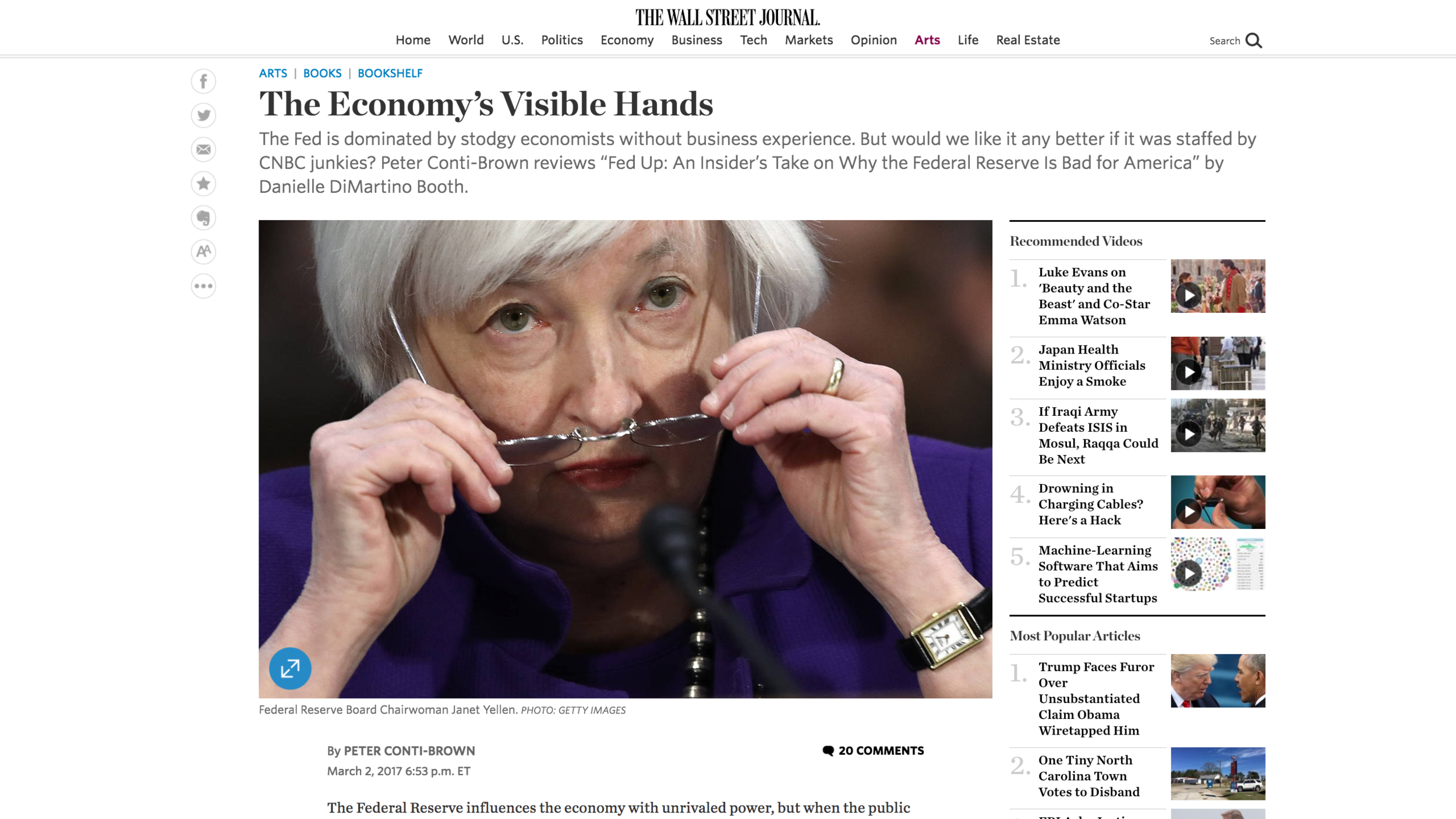
Peter Conti-Brown's Takedown of Danielle DiMartino Booth's Book ‘Fed Up: An Insider's Take on Why the Federal Reserve is Bad for America’
Peter Conti-Brown, my coauthor on a paper-in-the-works on negative interest rate law, has appeared on supplysideliberal.com many times:
Peter Conti-Brown on Marriner Eccles and the Refounding of the Fed
How to Keep a Zero Interest Rate on Reserves from Creating a Zero Lower Bound
Peter Conti-Brown on the Complexity of the Idea of “Independence” of a Central Bank
Peter Conti-Brown: More Checks and Balances Are Needed for the Fed's General Counsel
I am grateful for Peter's permission to post here his review Danielle DiMartino Booth's book Fed Up, which, like the last post above, "More Checks and Balances Are Needed for the Fed's General Counsel," also appeared in the Wall Street Journal.
Peter wrote his own preamble to his review--a preamble that is not in the Wall Street Journal. It is Peter's words from here on:
Over the last two weeks, I published two pieces in the Wall Street Journal. In the first, I argued that the technical work of the Fed's general counsel actually reflects a great deal more policy making than many have assumed. We should think harder about how that work retains its democratic legitimacy, including whether we should subject the Fed's lawyer to the appointments process (as is done with some other agencies).
But in the second (copied below), I reviewed a new book that seems to be broadly sympathetic to this idea. The book, Danielle DiMartino Booth's Fed Up, is a polemic against the very idea of technocratic expertise. She would fire most of the Fed's economists and require more of its staff and leadership to have business experience, rather than just central banking or policy experience (although, to be clear, she is not always consistent in this position: she frequently mistakenly refers to Fed economists as "academics" when most are not, and she can't decide whether Wall Street experience is a good thing or a bad thing). As you will see below, I didn't like the book and think its implications for central bank policy are very dangerous.
What gives? How can I be both in favor of greater inexpert participation in selecting the Fed's general counsel but not in favor of Booth's inexpert manifesto?
The answer is in favor of a radical center that is under increasing attack in this age of certainty. In critiquing Booth's book, I'm not arguing that Fed economists are perfect, nor that there is no ideological content to their analyses, nor that homogeneity in our intellectual culture--wherever it exists--is a good thing. In my book, The Power and Independence of the Federal Reserve, I argue firmly against each of these propositions.
The argument, instead, is that one can be both expert and ideological, and that we should recognize, promote, and seek to understand these twin features of central banking. Ideology and expertise are both why Fed governance matters so much. When we have public debates about who should fill the two (soon-to-be three) vacancies on the Fed's Board of Governors, those debates should center on both aspects: we want central bankers who will know what they are doing and not simply parrot back what they heard on CNBC that morning. But we will also want to recognize that a central banker's world view will matter enormously for how she will resolve questions under conditions of uncertainty. Those questions, after all, are by far the most important ones a central banker is tasked to answer.
In other words, those who insist that central banking is done in a world free of ideology or values—that it's expertise all the way down—are wrong. But those like Ms Booth who think there is no such thing as expertise in monetary policy are also wrong. We should resist both impulses.
The Federal Reserve influences the economy with unrivaled power, but when the public puzzles over its operations, the focus is at the top: Janet Yellen today, Ben Bernanke and Alan Greenspan before, and, still earlier, Paul Volcker, the pioneer target of this obsession. Danielle DiMartino Booth’s memoir, “Fed Up: An Insider’s Take on Why the Federal Reserve Is Bad for America,” aims to pull those wonky Fed leaders off of their remote thrones and educate readers on what the true nature of Fed power is—and what it should be. She argues that the Fed is overly dominated by stodgy economists and needs, along with more staff members with business experience, an infusion of charismatic figures who can relate to the public and resist getting lost in the naïve hopes of technocratic expertise.
Ms. DiMartino Booth was an adviser to Richard Fisher, who was the president of the Federal Reserve Bank of Dallas between 2005 and 2015, and her strong views often come sheathed in sarcastic anger. In Ms. DiMartino Booth’s ideal world, wits trump expertise, anecdotes defeat data and the school of hard knocks will always triumph over Ivy League “brainiacs.” Ms. DiMartino Booth’s two master’s degrees, one in business and the other in journalism, were never enough to satisfy her economist colleagues. “As far as [Fed economists] were concerned,” she writes, “I had nothing interesting or valuable to say.” Later she writes: “I didn’t qualify to breathe their air.” She repeats variations on this theme dozens of times.
Against this tide of condescension stands Mr. Fisher, her boss and the book’s main figure. Ms. DiMartino Booth is the Sancho Panza to Mr. Fisher’s Don Quixote. Mr. Fisher, the author writes, “gave new meaning to the word charismatic—old-school manners; impeccably dressed in an expensive suit and French cuffs, with cufflinks shaped like dollar signs.” The book is a paean to his ability to stand up to the Fed’s “MIT Mafia.”
If Mr. Fisher is the hero, Ms. Yellen is the villain. Part of this critique is substantive, if familiar. Like her boss, Ms. DiMartino Booth is a monetary hawk who cannot abide by a central bank that does anything but fight inflation. Indeed, as the book’s subtitle suggests, she barely likes the idea of the Federal Reserve at all. Ms. Yellen does not share such views, and the accommodative monetary policies that she supported over Mr. Fisher’s dissents, such as dropping interest rates to zero at the height of the 2008 crisis or the Fed’s quantitative easing programs, are the Fed’s great failure in this Greek tragedy.
But Ms. DiMartino Booth’s Janet Yellen is much more than wrong: She is a “preening dove” whose “drumbeat for more stimulus” in 2010-13 as vice chair of the Fed was an effort to curry favor with President Barack Obama so that she could gain her long-desired prize of the big chair. Once in that office, she maintained Mr. Bernanke’s “radical policies with gusto.” Ms. Yellen is also presented as a fuzzy echo of her husband, the Nobel Prize-winning economist George Akerlof, whose “strident Keynesian” ideas are invoked as evidence of what Ms. Yellen must surely believe, even though “Yellen rarely says anything dramatic in her public speeches, unlike her husband.” Finally, in a description that sounds more like a game played over beer pong at a frat party, Ms. DiMartino Booth declares that on a charisma scale of 1 to 10 “Yellen barely registered at 0.7. (For comparison, Fisher would score a 9, former President Bill Clinton an off-the-chart 11.)”
Where to start? This account of Ms. Yellen’s careerism is wrong: She was notably reserved, even silent, during the 2013 debate over who should succeed Mr. Bernanke. And while she certainly supported the Bernanke Fed’s expansionary policies, there has been no quantitative easing, no lowering of interest rates during her tenure (indeed, the very opposite). There are ways to criticize the Yellen Fed that are rigorous, but these jabs are something else entirely.
By book’s end, Ms. DiMartino Booth concludes that “the Federal Reserve’s radical monetary policy—imposed by academics with no experience in the business world—has proved a disaster on an unprecedented scale.” That may or may not be true. But for readers not predisposed to these conclusions, there is little in “Fed Up” that will persuade them: The book is full of dramatic assertions but mostly cursory evidence and no convincing analysis.
Perhaps the most remarkable theme is a cri de coeur for making monetary policy based not on sober economic analysis but on cable television. What begins as an aside claiming that the early-morning market-watching show “Squawk Box” is must-see TV becomes a consuming need for Ms. DiMartino Booth to be close to CNBC during nearly all of the memoir’s critical junctures. For example, one of the worst accusations she makes against Fed economists is that “none of them watched CNBC in the morning.” Where CNBC enters the narrative, the reader can expect to see Ms. DiMartino Booth portraying herself as a commentator who understands how things work in the real world, as opposed to those Ph.D.s who probably couldn’t pick Jim Cramer out of a lineup.
What Ms. DiMartino Booth ultimately proposes isn’t a different vision of evidence-based policy but central banking based on ideological imperatives and gut instincts. Even if Ms. DiMartino Booth’s conclusions are congenial to one’s worldview, the frame she introduces is dangerous. If the Fed becomes the exclusive battleground for the superiority of my gut instincts over yours, we will reduce monetary policy to the whims of the political crowd. There is likely a coming confrontation between the president’s inflationary fiscal policy and a central bank charged with defending the currency. In that event, the result of throwing the experts out, as Ms. DiMartino Booth proposes, will be the opposite of her intent.
FocusEconomics Top Blogs in Economics and Finance

...
I am pleased to have supplysideliberal.com named one of the top economics and finance blogs by FocusEconomics. To see why, I hope you'll poke around in my list of "Key Posts," at the link that is always at the top of each blog page, and here.
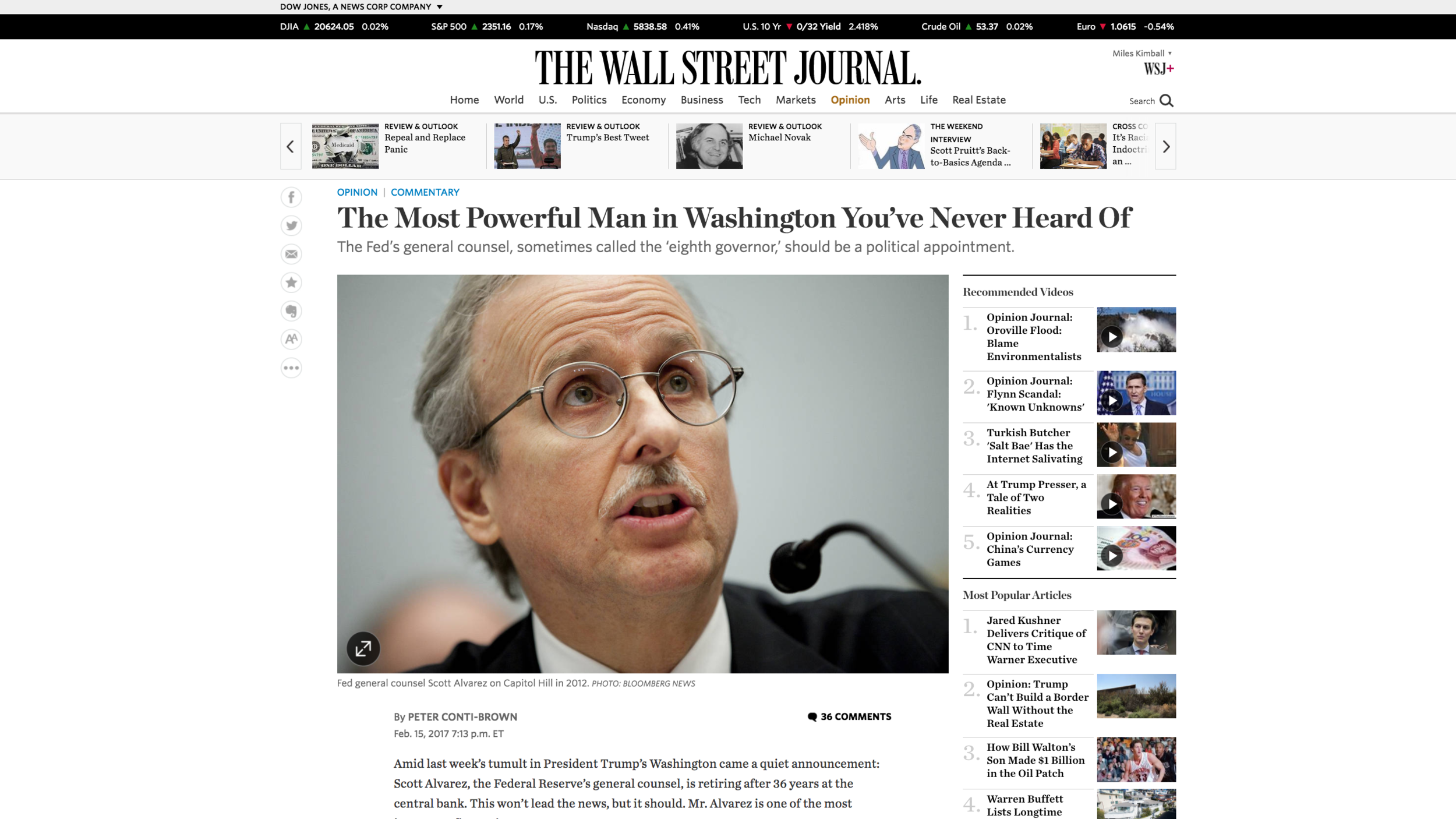
Peter Conti-Brown: More Checks and Balances Are Needed for the Fed's General Counsel
Peter Conti-Brown, my coauthor on a paper-in-the-works on negative interest rate law, has appeared on supplysideliberal.com many times:
- Peter Conti-Brown on Walter Bagehot
- Peter Conti-Brown on Marriner Eccles and the Refounding of the Fed
- On Making the Fed’s Governance Constitutional
- How to Keep a Zero Interest Rate on Reserves from Creating a Zero Lower Bound
- Ulysses, the Sirens and the Punch-Bowl
- Peter Conti-Brown on the Decentralized Fed, Circa 1934
- Peter Conti-Brown on the Complexity of the Idea of “Independence” of a Central Bank
- Peter Conti-Brown on Law
You can see some of the relevance of the legal arguments Peter and I are talking about in my post "Ezra Klein Interviews Ben Bernanke about Miles Kimball’s Proposal to Eliminate the Zero Lower Bound."
I am grateful for Peter's permission to post here his essay on the importance of the Federal Reserve's chief lawyer, which also appeared as an op-ed in the Wall Street Journal on February 15, 2017. Here are Peter's words:
Amid last week’s tumult in President Trump’s Washington came a quiet announcement: Scott Alvarez, the Federal Reserve’s general counsel, is retiring after 36 years at the central bank. This won’t lead the news, but it should. Mr. Alvarez is one of the most important figures in government.
Public discussions of the Fed mostly start and stop with Chair Janet Yellen. Yet the Fed isn’t simply the lengthened shadow of a single person. It is a complex system of people and institutions, and few figures within the central bank command as much authority as Mr. Alvarez. The Fed’s chief lawyer is sometimes referred to as an honorary “eighth governor.”
Experts may blanch at that characterization. The theory is that the Fed’s general counsel should have little influence on policy. Instead he should be a mere technician facilitating the central bank’s work.
Wrong. The Fed’s top lawyer is a policy maker par excellence, whose judgment can direct trillions of dollars and the bank’s extraordinary power. This was true before the financial crisis, as Fed lawyers whittled away the statutory constraints that Congress had placed on financial firms. It was true during the crisis, as Fed lawyers organized the response. And it has been especially true after the crisis, as Fed lawyers designed the new financial regulatory framework. As one regulator put it in 2013, Mr. Alvarez is “a major player in everything. You can’t overstate his role.”
Lawyers were even responsible for the decision to allow Lehman Brothers to collapse, according to former Fed Chairman Ben Bernanke. “We did everything we could think of to avoid it,” Mr. Bernanke wrote in his 2015 memoir. But he said that the law forbade an emergency loan to an institution as far gone as Lehman was. That legal conclusion, however, is far from indisputable—meaning that if Mr. Bernanke’s account is correct, lawyers were driving the policy bus.
How did Mr. Alvarez, who was appointed by the Fed’s Board of Governors, get so much power? First, there is essentially no judicial oversight of the Fed’s monetary-policy making. Courts as far back as 1929 have called the idea of imposing judicial review “almost grotesque” and “an unthinkable burden upon any banking system.” The Dodd-Frank Act extends that protection by making some of the Fed’s most important decisions all but unreviewable by courts. That gives lawyers like Mr. Alvarez the last word, whether the subject is international swaps with foreign central banks, quantitative easing or taking over a failing major bank.
Second, the Fed is dominated by economists ill-equipped to supervise the bank’s lawyers. It may be true, as one former central banker once remarked, that “the Fed’s staff will run technical rings” around any non-economist. But the reverse is true of the Fed’s chief lawyer, who presides over a legal apparatus without significant oversight.
Finally, the Fed’s lawyers are so secretive that there is little outside accountability. Banking lawyers in academia or the private sector cannot check the Fed’s legal work. For example, the Fed has a notorious document called the “Doomsday Book” that is a collection of legal opinions to justify the Fed’s authority if extraordinary measures are required during the next financial crisis. The book’s existence was disclosed in litigation and memoirs, but we have no idea what it says, because the Fed has prevented its release. Is the central bank’s interpretation of its congressionally granted authority justified? Does it conform to a common understanding among lawyers? We don’t know.
As Mr. Alvarez exits the job, this combination of expansive power and minimal accountability should make his office ripe for reform. There are benefits from insulating the Fed’s policy making from daily partisan pressures. But insulation can be thick or thin, and the Fed lawyer’s needs trimming.
The most obvious approach would be to convert the general counsel into a political appointment. The top lawyers at the Defense Department and the Central Intelligence Agency—Mr. Alvarez’s counterparts—are nominated by the president and confirmed by the Senate. Putting the Fed’s chief lawyer through the same process would provide democratic accountability and give the public a chance to evaluate the candidate’s expertise, values and worldview.
Critics may object that this would “politicize” the Fed, but the Fed already is political. The question is: Politicized by whom? To adapt Churchill, subjecting the Fed’s top lawyer to the judgment of democracy may be a terrible idea. But whose judgment is better? The model has succeeded with the Pentagon and CIA.
Mr. Alvarez has been an admirable public servant. He could have left for Wall Street to earn many multiples of his public salary, yet he has stuck with the Fed and gained a reputation for integrity and expertise. That is not, however, an argument for the Fed’s general counsel to remain one of the most powerful and opaque positions in government.
Karthik Muralidharan, Abhijeet Singh, and Alejandro J. Ganimian: Disrupting Education? Experimental Evidence on Technology-Aided Instruction in India

Karthik Muralidharan
Last Friday, Karthik Muralidharan came to give a seminar at the University of Colorado Boulder on a very interesting experiment Karthik, Abhijeet Singh and Alejandro Ganimian had done in Delhi. Their paper "Disrupting Education? Experimental Evidence on Technology-Aided Instruction in India," has an appendix that surveys many experiments with using computers for education. In the talk, he summarized the message there as follows:
- Hardware by itself contributes very little to learning. The slogan "one laptop per child" is a slogan that may work well politically, but "one laptop per child" by itself doesn't do much to advance education.
- Teaching software designed to complement regular classroom instruction contributes little to learning. The likely reason is that most kids in India are far below grade level in their understanding. So both the regular classroom instruction and computerized instruction at that same level go over their heads.
- Teaching software designed to find what level a child is at and instruct them at that level has large effects. This is the implication of their experiment, which randomly gave vouchers to some kids to attend an existing after-school center in Delhi that had this kind of computerized instruction. (Other kids, the control group, didn't get this instruction, but took some tests and answered surveys with the promise of getting a voucher later on.)
An important methodological point was that the progress made by the students in the computerized instruction wouldn't have shown up in a test that focused on their understanding of grade-level material. They made great progress on material that was in the curriculum for lower grades, but grade-level material was by and large still above their heads even after three months of the computerized instruction. It would have been truly miraculous if the computerized instruction could have jumped them up several grades worth of competence in only three months. It wasn't that good! But the students made a lot of progress from where they were.
I find this research very exciting. It both backs up what I claimed in my column "The Coming Transformation of Education: Degrees Won’t Matter Anymore, Skills Will," and points to some of the pitfalls that can lead to false starts on the road to computer-driven learning.
The other lesson I draw from this research is that computer-driven learning has plenty of paths in which to progress. Even if all progress in computer-driven learning stopped in the US, it would progress in other parts of the world. Indeed, computer-driven learning is likely to look much better in comparison to substandard instruction by humans than top-notch instruction by humans. So there are many niches in which computer-driven learning can flourish even before the day it becomes competitive with top-notch instruction by humans. In the Delhi context, adapting to the level of each child would have been a virtually impossibility for the human teacher of a large class of kids spanning many grade-levels of competence.
Besides having the capability to adapt to the level of each child, computer-driven learning has some other key advantages. First, the computer may show up more often than a human teacher will. Second, a computer program can push a child to constantly exercise herhis brain, in a way that sitting in a regular classroom may not. Even doing homework may typically involve a much greater fraction of time in dilly-dallying unproductive for learning than the fraction of time spent dilly-dallying when doing a computer learning program (assuming a low-skill human babysitter present in both cases to discourage flagrant shirking).
These days I am constantly amazed to realize how far we are inside the possibility frontier of what we can eventually accomplish with better social-science knowledge. Even if all progress in hardcore engineering, physical science and biological science (so that we had to make do with minor tweaks on current technology in those areas), progress in social science alone has the potential to generate massive improvements in human well-being. And the marginal contribution of social science is likely to be even greater if it leverages improvements in engineering, physical science and biological science. That is one reason "Economics Needs to Tackle All of the Big Questions in the Social Sciences." Karthik, Abhijeet and Alejandro are doing a praiseworthy job as part of that effort.
John Locke: People Must Not Be Judges in Their Own Cases
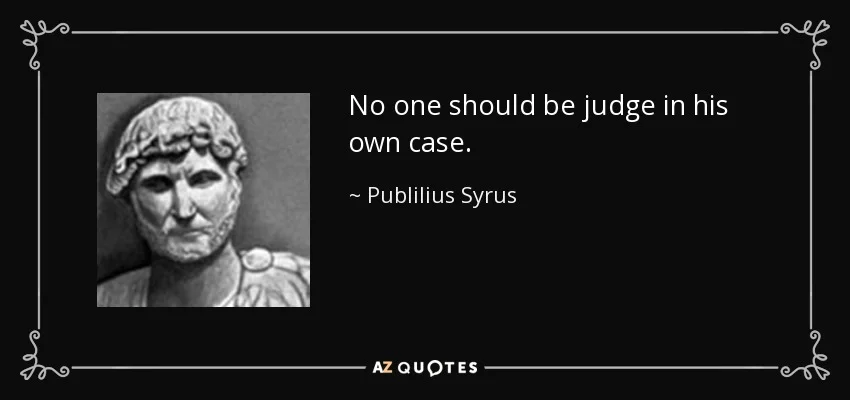
A while back, one of my colleagues at the University of Michigan complained about not having much power. I countered that he had plenty of power: in particular, he had the power to mint A's, a power that would be quite impressive to his students. What he was complaining about was a feature of any well-run society: he did not have the power to be judge in his own case. He did not have authority to grant himself a promotion, determine his own salary, or give himself a grant—power at least a part of himself sorely wanted. Instead he had the burdensome power and responsibility to be the judge in his students' cases.
The principle that no one should be judge in their own case was well enunciated more than 2050 years ago in Publilius Syrus's Latin maxim above. The principle that no one should be judge in their own case is then emphasized by John Locke in section 13 of his 2d Treatise on Government: On Civil Government:
To this strange doctrine, viz. That in the state of nature every one has the executive power of the law of nature, I doubt not but it will be objected, that it is unreasonable for men to be judges in their own cases, that self-love will make men partial to themselves and their friends: and on the other side, that ill-nature, passion and revenge will carry them too far in punishing others; and hence nothing but confusion and disorder will follow; and that therefore God hath certainly appointed government to restrain the partiality and violence of men. I easily grant, that civil government is the proper remedy for the inconveniences of the state of nature, which must certainly be great, where men may be judges in their own case, since it is easy to be imagined, that he who was so unjust as to do his brother an injury, will scarce be so just as to condemn himself for it; but I shall desire those who make this objection, to remember, that absolute monarchs are but men; and if government is to be the remedy of those evils, which necessarily follow from men’s being judges in their own cases, and the state of nature is therefore not to be endured, I desire to know what kind of government that is, and how much better it is than the state of nature, where one man, commanding a multitude, has the liberty to be judge in his own case, and may do to all his subjects whatever he pleases, without the least liberty to any one to question or control those who execute his pleasure? and in whatsoever he doth, whether led by reason, mistake or passion, must be submitted to? much better it is in the state of nature, wherein men are not bound to submit to the unjust will of another: and if he that judges, judges amiss in his own, or any other case, he is answerable for it to the rest of mankind.
In other words, with a bit of hyperbole, John Locke says that if we are going to let anyone be judge in his or her own case, we might as well go back to the state of nature.
One key place where the United States of America violates the principle that no one should be judge in their own case is having many administrative agency decisions (a) decided by agency officials, (b) sometimes reviewed by judges chosen by and paid by that agency and then (c) being reviewed by outside, more independent judges under what has come to be called the "Chevron doctrine," which insists that judges defer to an agency decision if there is any conceivable construction of the law that could justify that agency decision. (See "Jonathan Adler on Neil Gorsuch and Reconsidering the Degree of Judicial Deference to Government Agency Decisions" and the Wikipedia article "Chevron U.S.A., Inc. v. Natural Resources Defense Council, Inc." These two references are connected in an intriguing way: Supreme Court nominee Neil Gorsuch, who has eloquently questioned the Chevron doctrine, is the son of Anne McGill Gorsuch (Burford), who was the head of the EPA when its decided to focus on the amount of pollution from an entire industrial plant, rather than from each separate piece of equipment within a plant—the decision that was upheld by the Supreme Court back then.)
To the extent that the Chevron doctrine means in practice that almost all agency decisions are unreviewable, the doctrine effectively allows these agencies to be judges in their own cases. In such a situation, there not be quite as much of a self-interest bias as if one were deciding one's own salary, but enough decisions are made out of power-hunger, anger and extreme ideological interest that some mechanism of review is essential.
One of the practical difficulties with judicial review of agency decisions is that the agencies tend to have much greater expertise in the relevant areas than a judge typically does. If the Chevron doctrine is modified to allow more judicial review, it is crucial to give judges the intellectual resources they need to understand the issues involved in an agency decision. One approach that many countries follow to a greater or lesser degree is to have judges specialize in certain kinds of cases. That can help. But in the really important cases, more is needed.
I would like to see legislation passed that allows a judge reviewing an important agency decision to convene an expert panel. With the judge as moderator and the one to lead the final decision, the experts on the panel would freely discuss all of the relevant issues surrounding the agency decision. The expert panel, led by the judge, would function as a jury, conducting some parts of the proceedings with the litigants present and some parts of the proceedings without the litigants present.
There are several possible ways to work out the details of how expert panels would work. The basic principle is ensuring that review of the agency's decision is conducted with enough intellectual firepower that there is no presumption that the expert panel's decision is any less informed than the agency's original decision. With a system like this that allows judges of important agency decisions to convene expert panels, there would be no excuse for letting agencies be judges in their own cases to the extent that the current Chevron doctrine allows.
The Swiss National Bank May Need to Cut Its Target Rate Further Now That It Could Get In Trouble with the US If It Keeps Buying So Many Foreign Assets

The Swiss National Bank has been using two tools to keep the Swiss franc from rising more than they want: negative interest rates to discourage foreigners from purchasing Swiss assets and direct purchases of foreign assets by the Swiss National Bank itself. Within Switzerland, the purchase of foreign assets has been politically controversial because it exposes the Swiss National Bank to foreign exchange risk. (This controversy led to a referendum on whether the Swiss National Bank should be forced to hold more gold, that leaders of the Swiss National Bank went out on the hustings to defeat.) But negative interest rates are also quite controversial in Switzerland.
Now the balance between negative interest rates and foreign assets may shift because the direct purchase of foreign assets by a government is (appropriately) part of the US's formal definition of a "currency manipulator." The Wall Street Journal article linked above explains:
Mr. Trump vowed on the campaign trail to revive American manufacturing, in part by taking a hard line on Chinese trade practices and labeling the country a currency manipulator. ...
All three countries, which rank among the U.S.’s top five trading partners, have brushed off the Trump administration’s claims. ...
Still, some smaller economies appear to be taking notice, notably Taiwan and Switzerland. The U.S. Treasury in October found both had engaged in persistent, one-way currency intervention, essentially by buying foreign currencies such as the U.S. dollar and selling their own to maintain weak exchange rates.
Analysts say the central banks of Switzerland and Taiwan are now stepping back from those activities, perhaps to avoid closer scrutiny from the Trump administration. The upshot: The Swiss franc has advanced 1.6% against the U.S. dollar this year, while the new Taiwan dollar has surged 5%.
In my view, the direct purchase of foreign assets by an arm of a government should be considered the defining characteristic of currency manipulation. There can be sound reasons for governments to purchase foreign assets, but such purchases are a fit subject for international negotiation. For example, it makes a lot of sense for countries that have sovereign wealth funds to have their sovereign wealth funds internationally diversified. But then it is reasonable for the governments of all nations (or strictly speaking, currency blocs) thus invested in to be allowed to directly invest amounts of equal value in the country with that sovereign wealth. Such countervailing two-way investments would neutralize the effects on the exchange rate between those countries.
One reason the direct purchase of foreign assets by an arm of a government should be considered potential currency manipulation is that as an aggregate demand management method, the purchase of foreign assets can be a zero-sum game. If I sell my T-bills to buy your T-bills and you sell your T-bills to buy my T-bills, then we can both wind up back where we started.
By contrast, if you cut your interest rate, and I cut mine, we are not back where we started. Our two countries combined now have a more expansionary monetary policy. So a rule that allows interest rate cuts, despite their effect on exchange rates, but is suspicious of direct purchases of foreign assets by an arm of the government threads the needle of giving nations the tools they need for aggregate demand management without allowing zero-sum-game currency manipulation.
(Note that well-done aggregate demand management through interest rate policy, by stabilizing output at the natural level, gracefully keeps capital flows induced by market forces to a manageable level. For example, unless the production capacity of the economy has increased, a capital inflow that reduces aggregate demand will then be matched by an amount of extra investment, consumption or government purchases that uses that raises aggregate demand and uses the local resources released by that extra capital inflow. As long as the extra investment, consumption or government purchases is of high-priority items, as a well-regulated free market would tend to insure, that shouldn't be a big problem.)