John Locke: The Right to Enforce the Law of Nature Does Not Depend on Any Social Contract

It is often said that democratic governments rule by the consent of the governed. But this is wrong in two ways. First, many individuals do not consent to what the government is doing. Secondly, when it comes to basic things such as punishing murderers, there is no need for consent on the part of the offender. On this second point, in section 9 of his 2d Treatise on Government: “On Civil Government,” John Locke writes:
I doubt not but this will seem a very strange doctrine to some men: but before they condemn it, I desire them to resolve me, by what right any prince or state can put to death, or punish an alien, for any crime he commits in their country. It is certain their laws, by virtue of any sanction they receive from the promulgated will of the legislative, reach not a stranger: they speak not to him, nor, if they did, is he bound to hearken to them. The legislative authority, by which they are in force over the subjects of that commonwealth, hath no power over him. Those who have the supreme power of making laws in England, France or Holland, are to an Indian, but like the rest of the world, men without authority: and therefore, if by the law of nature every man hath not a power to punish offences against it, as he soberly judges the case to require, I see not how the magistrates of any community can punish an alien of another country; since, in reference to him, they can have no more power than what every man naturally may have over another.
In the prosecution of moral laws so basic (such as the prohibition of murder) that they can be legitimately enforced on those who have not consented to be subject to those laws, it may be reasonable to use a majority vote to determine the particulars of how that law will be enforced. But if a government has no legitimate right to enforce a law in the first place, no vote short of unanimity can make it legitimate to enforce that law.
Libertarianism and the quite prevalent statism in the world both take relatively extreme positions on what a government can legitimately do. It is logically possible to take an intermediate position: that there are many actions a government has no right to take no matter what supermajority (short of unanimity) is in favor—in particular, for the US, things the government has no right to do even if a constitutional amendment says it can—but that the set of actions permitted to a democratic government are broader than those sanctioned by Libertarian ideas. To me, the principle that there are at least some things no government has the right to do no matter what supermajority (short of unanimity) says it does is the most important principle. The boundary between legitimate and illegitimate actions of government can then be a matter of debate. But it is horrifying to say that a government can legitimately do anything that a large supermajority (short of unanimity) votes for. As Edmund Burke said:
All human laws are, properly speaking, only declaratory; they have no power over the substance of original justice.
Josef Adalian: What TV Did Americans Watch in 2016?

Link to Slate article Americans Love Fantastical Dramas, and More Trivia on What We Watched in 2016
This is a deep dive into Nielsen data on TV watching for 2016:
Keep reading to see what Dolly Parton and Toni Braxton have in common, which city’s residents really love John Oliver, and what show does surprisingly well with rich people.
Calculus is Hard. Women Are More Likely to Think That Means They’re Not Smart Enough for Science, Technology, Engineering and Math
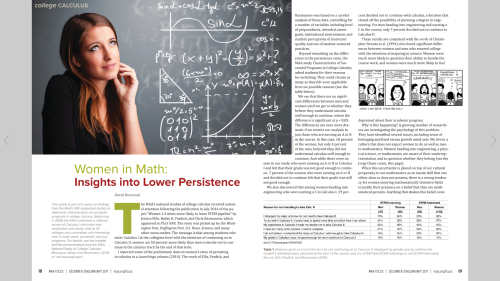
Believing that you can make it is an important ingredient in success. For women, that confidence is harder to come by when they are pursuing science, technology, engineering or math. A study by the Mathematical Association of America found that of those in Calculus I who initially intended to go on in science, technology, engineering or math,
... if we restrict our analysis to just those who are earning an A or B in the course ... 18 percent of the women, but only 4 percent of the men, believed they did not understand calculus well enough to continue.
I’ll bet the phenomenon of women who are objectively doing equally well as men having much less confidence than men extends to many other moments in education in technical subjects--including training in economics. Professors and other instructors can do a lot of good by bolstering the confidence of female students who are in fact doing well in a class or in independent research.
In my own experience, I have sometimes been quite surprised at how much my expressions of confidence in a female student in economics have meant to that student--as if that student were in a parched desert for such expressions of confidence, despite what seemed to me excellent skills.
In addition to discouragement, low confidence in oneself also causes other people to underestimate one’s skills. It is quite difficulty to know how skilled someone is, but typically quite easy to tell how skilled they think themselves to be. So people use a job candidate’s opinion of herself or himself as a shortcut for judging her or his skills.
For those who need to come across as more confident I highly recommend the weekend personal growth workshops conducted by Landmark Education Corporation, beginning with the Landmark Forum. In my view, almost everyone entering the dissertation writing and then job-hunting phases of getting a PhD in economics should do the Landmark Forum because of how much it will help the psychology of being able to focus on dissertation research and then the psychology of self-presentation for getting a job. I am sure that the same advice would apply to students in many other fields, at many stages of education.
Switching to Squarespace
Today I am switching supplysideliberal.com from Tumblr to Squarespace. The change should be mostly invisible to readers except for cosmetic differences. In particular, links to older posts should mostly still work.
My main reasons for the shift are:
- Squarespace should work better on mobile devices.
- Squarespace seems a more solid company for the future than Tumblr.
- I will be able to get better analytics on Squarespace.
- Squarespace has better functionality.
- Moving to Squarespace will restore the ability of readers to post comments—a capability that was broken using Disqus with Tumblr about 8 months ago.
Thanks to my daughter Diana for helping enormously with the migration.
Vincent Del Giudice and Wei Lu: America’s Best and Brightest Are Headed to Boulder

This chart says it: the cities marked in red are the “metropolitan areas with the greatest loss of advanced-degree holders, white-collar jobs and earnings generated by employment in computer, engineering and science occupations” while the cities marked in blue are those with the greatest gain. The Boulder Colorado metropolitan area, where I live (see “Miles Moves to the University of Colorado Boulder”) is number one in brain-gain in this chart. Maybe you, too, should join this migration to the Boulder area :)
Erin Lee Carr—My Dad, My Mentor: How Do You Say Goodbye to Your Father? →
I can’t remember who sent me this after I wrote about my own Dad and his death a few weeks ago, but I love it.
Joseph Ellsworth Kimball on Edward Lawrence Kimball

Bee Kimball, Joseph Kimball and Edward Kimball, in 1988
Below is my brother, Joseph’s tribute to my Dad, who died November 21, 2016. (My own tribute to my Dad appeared November 27, 2016. My brother Chris’s tribute appeared December 11, 2016.) Joseph is a big contributor to this blog behind the scenes with his discerning eye for interesting articles to flag here.
Here are Joseph’s words:
My father grew up in a home that had a well used dictionary by the table, and continued that practice in his own home. We used that dictionary often to look up definitions and pronunciations. He used language in his professional life making lessons for law students and writing books about law. He used language in his church service. He had a file full of talks he had written through the years on many different topics, and could pull one out and adapt it to whatever needed to be said in a meeting. He also spent time writing biographies and other works on church topics.
I remember him working on the Teachings of Spencer W. Kimball book. He had typed up all the quotes he was going to use, and cut each one out so he could shuffle them around on the pages as he worked out which went where. This was in the days before word processing was normal, so there were an awful lot of little slips of paper. He was willing to talk to me about many of the quotes.
After he completed his large biography about his father, he wrote a biography of his grandfather, Andrew Kimball, which his father asked him to do when the presidency meant he no longer had time to do it. I was very pleased that my father let me take a draft of the biography and make comments and editing suggestions. He listened to what I had to say, and I believe he used a number of my ideas in the book.
When he was in charge of punishing me, his method was to use reason and come to a mutually agreed arrangement to minimize the probability of future transgressions with self administered consequences if that failed. He controlled his temper exceptionally well--I only saw him lose his cool a very few times.
His use of language wasn’t all serious though. His sense of humor came through in his word choices. He was very fond of word play, and particularly puns. My own children have learned to endure puns from me since I learned them at my father’s knee. He also liked to do crossword puzzles, and regularly completed them until his eyesight got bad enough he was unable to read.
I will miss his reasoned and kind words that helped me many times in my life.
supplysideliberal.com Named 9th Best Macroeconomics Blog on the Planet, According to Feedspot


Link to Feedspot’s list of Top 20 Macro Blogs
I was pleased to be included in Feedspot’s list of Top 20 Macro Blogs, in the 9th spot. I added their badge to my sidebar.
As one of their inputs, Feedspot used the Alexa rank of my blog site. It took me a while to realize this was a rank, not a rating, so lower numbers are better and higher numbers are worse! Being the 1,168,514th ranked website according to Alexa is something, but it doesn’t sound that impressive! :)
Lauren Razavi: India Just Flew Past Us in the Race to E-Cash

Link to Lauren Razavi’s backchannel.com post “India Just Flew Past Us in the Race to E-Cash”. Hat tip to slashdot.com and Joseph Kimball
What India’s government did in demonetizing the 1000-rupee and 500-rupee notes was a mess. But it did have the helpful effect of spurring mobile payments, both by the current inconvenience for paper currency and, as people look toward the future, reducing trust in paper currency.
Two quotations from Lauren Razavi’s backchannel.com article linked above flesh out that story:
1. All of this has created a newfound system that practically incentives mobile payment. With so many people queuing up at banks every day — and a lot of Indian bureaucracy to wade through in order to open a traditional bank account or line of credit —the appeal of more convenient digital alternatives is easy to understand. According to a report in the Hindu Business Line, as many as 233 million unbanked people in India are skipping plastic and moving straight to digital transactions.“Cash has lost its credibility and payments are no longer perceived in the same way,” says Upasana Taku, the cofounder of Indian mobile wallet company MobiKwik, which reported a 40 percent increase in downloads and a 7,000 percent increase in bank transfers since demonetization. “There’s chaos at the moment but also relief that India will now be an improved economy,” she says.
2. Before last month, Paytm, a mobile app that allows users to pay for everything from pizza to utility bills, saw steady business—it was processing between 2.5 and 3 million transactions a day. Now, usage of the app has close to doubled. 6 million transactions a day is common; 5 million is considered a bad day.
Susan Glasser: Covering Politics in a ‘Post-Truth’ America →
This is an excellent long-read.
John Locke on Punishment

Most laws and rules are backed up by some form of punishment if not followed, even if the punishment is not fully regularized. When is punishment legitimate? And what kind of punishment is legitimate? John Locke gives an answer to that question in section 8 of his 2d Treatise on Government: “On Civil Government”:
And thus, in the state of nature, one man comes by a power over another; but yet no absolute or arbitrary power, to use a criminal, when he has got him in his hands, according to the passionate heats, or boundless extravagancy of his own will; but only to retribute to him, so far as calm reason and conscience dictate, what is proportionate to his transgression, which is so much as may serve for reparation and restraint: for these two are the only reasons, why one man may lawfully do harm to another, which is that we call punishment. In transgressing the law of nature, the offender declares himself to live by another rule than that of reason and common equity, which is that measure God has set to the actions of men, for their mutual security; and so he becomes dangerous to mankind, the tye, which is to secure them from injury and violence, being slighted and broken by him. Which being a trespass against the whole species, and the peace and safety of it, provided for by the law of nature, every man upon this score, by the right he hath to preserve mankind in general, may restrain, or where it is necessary, destroy things noxious to them, and so may bring such evil on any one, who hath transgressed that law, as may make him repent the doing of it, and thereby deter him, and by his example others, from doing the like mischief. And in this case, and upon this ground, every man hath a right to punish the offender, and be executioner of the law of nature.
John puts down serious limitations on punishment: First, punishment is only legitimate when someone has violated the preexisting “law of nature,” not when someone has violated an arbitrary rule that has been established against their opposition or otherwise without their consent, and without any promise they have freely made coming into play. The law of nature is given a new description in this section as “the tye, which is to secure them from injury and violence.”
Second, punishment should not be in proportion to the extreme anger it is easy to feel when someone crosses one of us in some regard. Third, punishment should be governed by the three legitimate purposes of punishment:
Reparation
Restraint
Deterrence
Although John uses the word “retribute” he seems to be excluding simply “getting back at someone” as a legitimate ground of punishment–a ground or motive that is sometimes called “retribution.”
By contrast, reparation, which improves the condition of the person originally harmed from its low ebb after that injury is an excellent purpose of punishment. It is important to search for ways to punish that accomplish at least some reparation at the same time that they work toward restraint or deterrence.
John’s concern about legitimate vs. illegitimate punishment is clear in his care to make the case for punishment at all instead of no punishment: those who violate “reason and common equity” are “dangerous to mankind,” and “every man upon this score, by the right he hath to preserve mankind in general, may restrain, or where it is necessary, destroy things noxious to them.” The concern to justify punishment that John exhibits here is a model for all of us. A minimum (though often far from sufficient) requirement for justifying punishment is this: Whenever one argues for punishment of an individual, or executes punishment on one’s own account, one should be prepared to point to some significant bad consequence that would occur if there were not a policy of punishment in a situation like that. That bad consequence needs to be “bad” in a reasonably objective sense, and greater than the badness of the punishment itself. If nothing bad would happen in the absence of punishment in a given type of situation, punishment should not be undertaken. (Note that this is a different standard than “absence of punishment in this one particular instance would do no harm, taking people’s expectation of the probability of punishment in similar future instances as fixed.”)
For links to other John Locke posts, see these John Locke aggregator posts:
John Locke's State of Nature and State of War (Chapters I–III)
On the Achilles Heel of John Locke's Second Treatise: Slavery and Land Ownership (Chapters IV–V)
John Locke Against Natural Hierarchy (Chapters VI–VII)
John Locke's Argument for Limited Government (Chapters VIII–XI)
John Locke Against Tyranny (Chapters XII–XIX)
Clive Crook: Trump Is Blessed With Weak Opponents →
This is a very interesting analysis.
Miles Becomes an Emeritus Professor of the University of Michigan
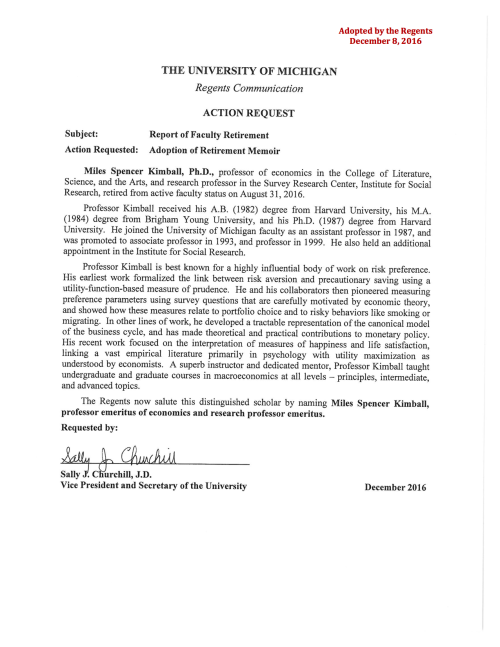
When I moved to the University of Colorado Boulder a few months ago, I had taught for 29 years at the University of Michigan. As a result, even though I was only 56 years old, I was able to retire instead of resign from the University of Michigan. I am now officially an Emeritus Professor of Economics and Emeritus Research Professor (in Survey Research) of the University of Michigan.
I post the official notice here partly because it gives an excellent–though perhaps a bit overly shiny–picture of my academic career to date. Someone who likes me must have written it. :)
I am proud of my long association with both the Economics Department and the Survey Research Center at the University of Michigan, and am glad to still have this official tie to the University of Michigan and my colleagues there.