Joseph Ellsworth Kimball on Edward Lawrence Kimball

Bee Kimball, Joseph Kimball and Edward Kimball, in 1988

Bee Kimball, Joseph Kimball and Edward Kimball, in 1988

Below is my brother, Joseph’s tribute to my Dad, who died November 21, 2016. (My own tribute to my Dad appeared November 27, 2016. My brother Chris’s tribute appeared December 11, 2016.) Joseph is a big contributor to this blog behind the scenes with his discerning eye for interesting articles to flag here. 

Here are Joseph’s words:


My father grew up in a home that had a well used dictionary by the table, and continued that practice in his own home.  We used that dictionary often to look up definitions and pronunciations.  He used language in his professional life making lessons for law students and writing books about law.  He used language in his church service.  He had a file full of talks he had written through the years on many different topics, and could pull one out and adapt it to whatever needed to be said in a meeting.  He also spent time writing biographies and other works on church topics.

I remember him working on the Teachings of Spencer W. Kimball book.  He had typed up all the quotes he was going to use, and cut each one out so he could shuffle them around on the pages as he worked out which went where.  This was in the days before word processing was normal, so there were an awful lot of little slips of paper.  He was willing to talk to me about many of the quotes.

After he completed his large biography about his father, he wrote a biography of his grandfather, Andrew Kimball, which his father asked him to do when the presidency meant he no longer had time to do it.  I was very pleased that my father let me take a draft of the biography and make comments and editing suggestions.  He listened to what I had to say, and I believe he used a number of my ideas in the book.

When he was in charge of punishing me, his method was to use reason and come to a mutually agreed arrangement to minimize the probability of future transgressions with self administered consequences if that failed.  He controlled his temper exceptionally well--I only saw him lose his cool a very few times.

His use of language wasn’t all serious though.  His sense of humor came through in his word choices.  He was very fond of word play, and particularly puns.  My own children have learned to endure puns from me since I learned them at my father’s knee.  He also liked to do crossword puzzles, and regularly completed them until his eyesight got bad enough he was unable to read.

I will miss his reasoned and kind words that helped me many times in my life.


supplysideliberal.com Named 9th Best Macroeconomics Blog on the Planet, According to Feedspot

Link to Feedspot’s list of Top 20 Macro Blogs

I was pleased to be included in Feedspot’s list of Top 20 Macro Blogs, in the 9th spot. I added their badge to my sidebar. 

As one of their inputs, Feedspot used the Alexa rank of my blog site. It took me a while to realize this was a rank, not a rating, so lower numbers are better and higher numbers are worse! Being the 1,168,514th ranked website according to Alexa is something, but it doesn’t sound that impressive! :)

Lauren Razavi: India Just Flew Past Us in the Race to E-Cash

Link to Lauren Razavi’s backchannel.com post “India Just Flew Past Us in the Race to E-Cash”. Hat tip to slashdot.com and Joseph Kimball

What India’s government did in demonetizing the 1000-rupee and 500-rupee notes was a mess. But it did have the helpful effect of spurring mobile payments, both by the current inconvenience for paper currency and, as people look toward the future, reducing trust in paper currency. 

Two quotations from Lauren Razavi’s backchannel.com article linked above flesh out that story: 

1. All of this has created a newfound system that practically incentives mobile payment. With so many people queuing up at banks every day — and a lot of Indian bureaucracy to wade through in order to open a traditional bank account or line of credit —the appeal of more convenient digital alternatives is easy to understand. According to a report in the Hindu Business Line, as many as 233 million unbanked people in India are skipping plastic and moving straight to digital transactions.“Cash has lost its credibility and payments are no longer perceived in the same way,” says Upasana Taku, the cofounder of Indian mobile wallet company MobiKwik, which reported a 40 percent increase in downloads and a 7,000 percent increase in bank transfers since demonetization. “There’s chaos at the moment but also relief that India will now be an improved economy,” she says.

2. Before last month, Paytm, a mobile app that allows users to pay for everything from pizza to utility bills, saw steady business—it was processing between 2.5 and 3 million transactions a day. Now, usage of the app has close to doubled. 6 million transactions a day is common; 5 million is considered a bad day.

John Locke on Punishment

Most laws and rules are backed up by some form of punishment if not followed, even if the punishment is not fully regularized. When is punishment legitimate? And what kind of punishment is legitimate? John Locke gives an answer to that question in section 8 of his 2d Treatise on Government: “On Civil Government”:

And thus, in the state of nature, one man comes by a power over another; but yet no absolute or arbitrary power, to use a criminal, when he has got him in his hands, according to the passionate heats, or boundless extravagancy of his own will; but only to retribute to him, so far as calm reason and conscience dictate, what is proportionate to his transgression, which is so much as may serve for reparation and restraint: for these two are the only reasons, why one man may lawfully do harm to another, which is that we call punishment. In transgressing the law of nature, the offender declares himself to live by another rule than that of reason and common equity, which is that measure God has set to the actions of men, for their mutual security; and so he becomes dangerous to mankind, the tye, which is to secure them from injury and violence, being slighted and broken by him. Which being a trespass against the whole species, and the peace and safety of it, provided for by the law of nature, every man upon this score, by the right he hath to preserve mankind in general, may restrain, or where it is necessary, destroy things noxious to them, and so may bring such evil on any one, who hath transgressed that law, as may make him repent the doing of it, and thereby deter him, and by his example others, from doing the like mischief. And in this case, and upon this ground, every man hath a right to punish the offender, and be executioner of the law of nature.

 John puts down serious limitations on punishment: First, punishment is only legitimate when someone has violated the preexisting “law of nature,” not when someone has violated an arbitrary rule that has been established against their opposition or otherwise without their consent, and without any promise they have freely made coming into play. The law of nature is given a new description in this section as “the tye, which is to secure them from injury and violence.”

Second, punishment should not be in proportion to the extreme anger it is easy to feel when someone crosses one of us in some regard. Third, punishment should be governed by the three legitimate purposes of punishment:

  • Reparation

  • Restraint

  • Deterrence

Although John uses the word “retribute” he seems to be excluding simply “getting back at someone” as a legitimate ground of punishment–a ground or motive that is sometimes called “retribution.” 

By contrast, reparation, which improves the condition of the person originally harmed from its low ebb after that injury is an excellent purpose of punishment. It is important to search for ways to punish that accomplish at least some reparation at the same time that they work toward restraint or deterrence.

John’s concern about legitimate vs. illegitimate punishment is clear in his care to make the case for punishment at all instead of no punishment: those who violate “reason and common equity” are “dangerous to mankind,” and “every man upon this score, by the right he hath to preserve mankind in general, may restrain, or where it is necessary, destroy things noxious to them.” The concern to justify punishment that John exhibits here is a model for all of us. A minimum (though often far from sufficient) requirement for justifying punishment is this: Whenever one argues for punishment of an individual, or executes punishment on one’s own account, one should be prepared to point to some significant bad consequence that would occur if there were not a policy of punishment in a situation like that. That bad consequence needs to be “bad” in a reasonably objective sense, and greater than the badness of the punishment itself. If nothing bad would happen in the absence of punishment in a given type of situation, punishment should not be undertaken. (Note that this is a different standard than “absence of punishment in this one particular instance would do no harm, taking people’s expectation of the probability of punishment in similar future instances as fixed.”)

For links to other John Locke posts, see these John Locke aggregator posts: 

Miles Becomes an Emeritus Professor of the University of Michigan

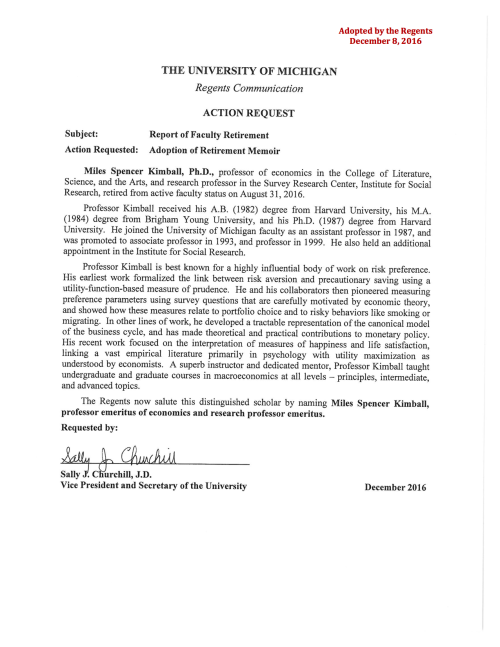
When I moved to the University of Colorado Boulder a few months ago, I had taught for 29 years at the University of Michigan. As a result, even though I was only 56 years old, I was able to retire instead of resign from the University of Michigan. I am now officially an Emeritus Professor of Economics and Emeritus Research Professor (in Survey Research) of the University of Michigan. 

I post the official notice here partly because it gives an excellent–though perhaps a bit overly shiny–picture of my academic career to date. Someone who likes me must have written it. :)

I am proud of my long association with both the Economics Department and the Survey Research Center at the University of Michigan, and am glad to still have this official tie to the University of Michigan and my colleagues there.

Reducing the Importance of Cash: Sweden and South Korea

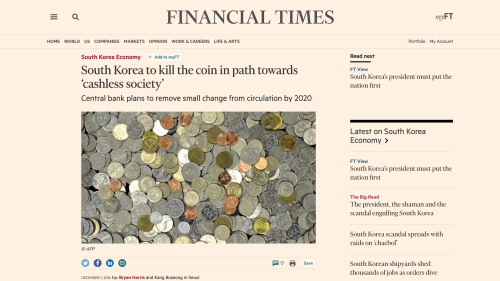
Link to Bryan Harris and Kang Buseong’s ft.com article “South Korea to Kill the Coin in Path towards ‘Cashless Society’”

Although deep negative interest rates are straightforward to handle even when a currency region uses paper currency intensively, the needed changes in paper currency policy are likely to be seen as less upsetting to people when cash usage is low. Thus, even when the time has not yet come for more dramatic changes in paper currency policy, it is useful for public policy to encourage the replacement of cash by other means of transactions. 

Some countries are much further along in reducing cash usage than others. The article above points in particular to Scandinavian countries and South Korea. Two quotations:

  1. Globally, Scandinavian countries are leading the charge towards cashless societies. More than half of Sweden’s 1,600 bank branches neither hold cash nor take cash deposits.
  2. South Korea is already one of the least cash-dependent nations in the world. It has among the highest rates of credit card ownership — about 1.9 per citizen — and only about 20 per cent of Korean payments are made using paper money, according to the BoK.

In Sweden, cash usage is low and declining–so much so that I could point out that it made no sense in Sweden to let the “tail wag the dog” by letting paper currency get in the way of otherwise optimal interest rate policy.  

There are three key factors in the decline in cash usage in Sweden. First, some time back, Sweden stopped subsidizing cash usage. There is only one place in Sweden for banks to get cash from the central bank: at a cash window near Arlanda airport near Stockholm. Carting cash to or from anywhere else in the country must be paid for by someone other than an arm of the government.

Second, Swedish kronor are not that useful for international crime. Finland provides an interesting natural experiment. Until it joined the euro zone, cash usage was declining in Finland, paralleling what was happening in Sweden. But since Finland joined the euro zone, cash withdrawals have increased greatly. Why? The Finnish markka was not very useful in international crime. The euro is. 

Third, electronic forms of payment are advancing quickly in Sweden. For example, the mobile app Swish now makes it very easy for people in Sweden to transfer funds to anyone else with the app on their phone. 

It is not necessary to eliminate paper currency entirely to make deep negative interest rates possible. But it makes things easier both politically and practically if cash usage is already seen of as something of only marginal importance.  

Update: JP Koning points out another big factor in the decline in cash usage in Sweden, which he lays out in his post “Thoughts on Rogoff’s ‘Curse of Cash'”:

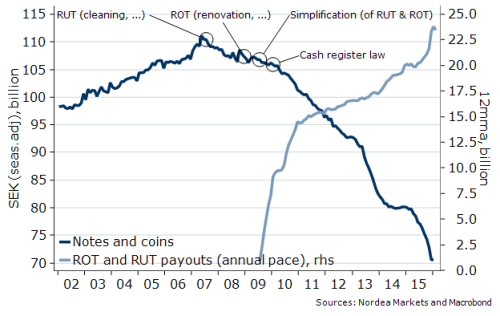
As discussed in this excellent post by Martin Enlund, the Swedes implemented a tax deduction in 2007 for the purchase of household-related services such as the hiring of gardeners, nannies, cooks, and cleaners. This initial deduction, called RUT-avdrag, was extended in 2008 to include labour costs for repairing and expanding homes and apartments, this second deduction called ROT-avdrag.

Enlund’s chart shows how the decline in krona outstanding closely coincides with the timing of the introduction of RUT and ROT:

Prior to the enactment of the RUT and ROT deductions, a large share of Swedish home-related purchases would have been conducted in cash in order to avoid taxes, but with households anxious to claim their tax credits, many of these transactions would have been pulled into the open. Note the rise in RUT and ROT payments on Enlund’s chart, for instance. Calleman reports that  the number of customers using registered domestic service companies rose from 92,000 in 2008 to 537,600 in 2013. Since the implementation of RUT and ROT, Swedish opinions on paying for undeclared work have changed dramatically. In 2006, 17% said it was completely wrong to to hire undeclared labour. In 2012, 47% felt it was completely wrong.

In passing, let me say that giving some kind of tax break or at least tax exemption for services provided at a low wage rate is also good for helping those near the bottom of the income distribution. It accords with many people’s intuitive notions of fairness. And it is helpful for efficiency as well–helping to make sure that ad hoc opportunities for gains from trade are not missed. And given the option of evading taxes by using cash, trying to tax such low-wage services may not in fact provide enough tax revenue to make current policies of trying to tax such services worth the bad side effects.

Christian Edward Kimball on Edward Lawrence Kimball

Thanks to Ralph Johnson for permission to use this picture here, which Ralph took in honor of Edward Lawrence Kimball. Picture copyright Ralph Johnson

Thanks to Ralph Johnson for permission to use this picture here, which Ralph took in honor of Edward Lawrence Kimball. Picture copyright Ralph Johnson

Below is my brother, Chris’s tribute to my Dad, who died November 21. (My own tribute to my Dad appeared two weeks ago. Chris has appeared several times before on this blog: 1,2,3.) Here are Chris’s words:


My son Chase says:

My grandfather Ed Kimball was my soft spoken hero. He was the man I want to be, in virtually every way: a dedicated teacher; a thoughtful disciple; a loyal son, father, and husband; a clear writer and honest historian. I love him, and I know he loves me.

The list of Dad’s attributes is long: kind, smart, dedicated, thoughtful, honest, funny, considerate. I would like to illustrate a few, including some for which stories tell and single words fail.  

A. Dad saw three-dimensional people. He did it in writing history and biography. He did it in serving on the parole board. He did it in serving as a bishop. He did it in parenting seven quite different children. He did not categorize or label people. He saw individuals and dealt with us as individuals.  

B. Behind the Clark Kentish mild-mannered demeanor, Dad thoughtfully and knowingly challenged the status quo. He did it by asking good questions. I have called him “subversive” in the kindest most affirming sense. He would have rejected the label but smiled with recognition. Dad was not didactic. He seldom preached or argued. Dad was subversive in the sense that Socratic dialogue is subversive of things as they are. He was subversive in the sense that good history is sometimes subversive of revealed religion. Dad took pleasure in asking good questions.

C. Dad would volunteer to act as scribe or secretary for faculty meetings. He explained to me that nobody wanted the job and it was a way to serve, and allowed him be more of a quiet listener than active participant. He was a modest, self-effacing man, always serving others. But the next sentence is important. He went on to say that when anyone wants to know what was discussed and decided, the minutes tell the story. By delivering the minutes in his voice, he had the last word.

D. When I was 14, Dad and I went to the Boundary Waters in northern Minnesota for a 50-mile canoe trip. We paddled across lakes, then portaged the canoe and our packs from one lake to the next. Dad was commanding in the canoe but struggled to carry a small pack over the portages. I carried a pack on my back, a second in front, and the canoe on my shoulders. With powerful arms and shoulders, but something like 1-½ legs, Dad did the almost impossible feat of paddling and walking 50 miles. That’s big. Dad took his son on a once-in-a-lifetime trip. That’s really big. But the most important part of the story is that Dad humbled himself to make the trip even knowing that his 14 year old son would have to carry the load.

No son should see his father that way. It ruins the hero myth. But every son should carry his father, at least once in his life.

E. In the context of a discussion about the nature of God and how we think about the God-Man relationship, I mentioned to my Jewish philosophy professor that one of my models was my father in that I knew about him that he loved me, without reserve, without regard to what I did or did not do. It was absolute bedrock certainty. The professor suggested that was valuable knowledge–unusual and to be treasured.

If I had one wish it would be that my children and grandchildren would enjoy that absolute assurance, that I love you, as my father loved me, as our Father and Mother love us.

F. Dad is rightly lauded for the two biographies of Spencer W. Kimball. The first one in particular (written with his nephew Andrew) broke the pattern of hagiography that characterized stories of Mormon leaders. The usual narrative is that he was a truth teller, essentially unable to do otherwise than tell it ‘warts and all.’ That is correct. But the deeper story is that he knew what he was doing–consciously, intentionally, using all the advantages at his disposal. He told me once that he felt a filial duty to write about his father, but he also recognized an opportunity to make a difference in the world of Mormon history and biography. He had unparalleled access to the life of a living Mormon Prophet. He was confident that he could persuade his father to give permission. And he knew that it would work out to everyone’s benefit because his father was a genuinely good man–not perfect, but good.

Dad would not say it about himself, but would have warmed to my saying it of him, as he did of his father: Edward Kimball, my father, was a good man.

Edward Lawrence Kimball, September 23, 1930–November 21, 2016

Edward Lawrence Kimball, September 23, 1930–November 21, 2016

India’s Assault on Cash

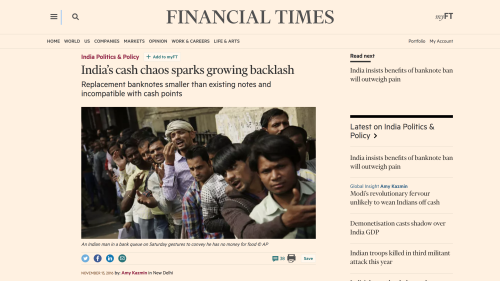
Link to Amy Kazmin’s article “India’s cash chaos sparks growing backlash” on ft.com (the Financial Times website)

Link to Wikipedia article “Indian 500 and 1000 rupee note demonetisation”

Link to Raymond Zhong’s Wall Street Journal article “India’s Money Launderers Soil Modi’s ‘Spring Cleaning’ of Cash”

India’s sudden declaration that its existing 500- and 1000-rupee notes were invalid and needed to be replaced by new notes, with severe restrictions on that conversion is so far afield from my proposals for taming paper currency that I have been slow to write about it. Nevertheless, there are some interesting lessons to be learned. In this post, I will assume you know the basics. For that, the Wikipedia article flagged above is actually much better than the news accounts. Here are some of the lessons to draw and theoretical insights sparked by thinking about this episode:

First, the details of any modification in paper currency policy matter a lot. Getting the details wrong can make a big mess. 

Second, central banks and governments do big unexpected things. With a bit of care, there is no reason they can’t do big things that are well-designed and have much smaller side-effects instead of big things that are badly designed and cause a great deal of trouble.

Third, a policy that doesn’t depend on surprising people is likely to be better implemented, since policies can be planned and executed better if the depth of secrecy required is less and therefore more people can be brought in on the planning.  

Fourth, keeping large cash hoards is inherently risky, since almost all of the reasons one might want to keep a large cash hoard are reasons the government is likely to frown upon. In practice, governments are unlikely to tolerate the equivalent of what in the US would be the trillions and trillions of dollars of hoarded cash needed to enforce a lower bound on interest rates. (See “How Negative Interest Rates Prevail in Market Equilibrium.”)

Fifth, reducing the expected rate of return on paper currency relative to the rate of return on bank money causes a flight away from paper currency, not a flight toward paper currency. People in India are not saying “If we can’t freely turn in paper currency without restrictions and without documentation at the bank, let’s just quit dealing with the banks and instead use the cash the government is trying to invalidate for transactions instead.”

Sixth, it is important to think through all of the ways that people might try to get around something. Approaches that leave no way around (such as a gradually changing effective exchange rate for paper currency that makes the return on paper currency equal to the return on safe, short-term electronic rates) have a real advantage. 

On the Consumer Financial Protection Bureau

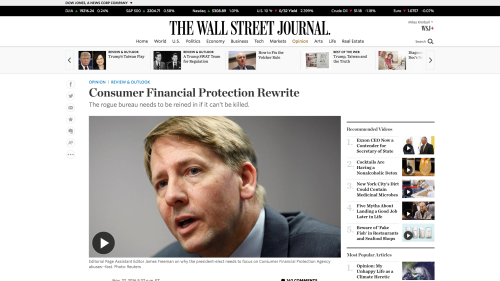
Link to James Freeman’s November 27, 2016 Wall Street Journal Article “Consumer Financial Protection Rewrite: The rogue bureau needs to be reined in if it can’t be killed.”

Election results have created great uncertainty about the future of the Consumer Financial Protection Bureau (CFPB). Having paid close attention to relevant articles, I can say that the editorial board of the Wall Street Journal has displayed a venomous hatred of the CFPB. Below, I will address some genuine constitutional questions about the CFPB, but the Wall Street Journal is wrong about the policy value and policy appropriateness of the CFPB’s actions. 

The Philosophical Basis for Consumer Financial Protection as Part of Limited Government

I can see three principles that can justify consumer financial protection beyond simple contract enforcement: 

Duping people is fraud even if they wouldn’t have been duped had they had infinite time and infinite intelligence. First let me argue that misleading people to their detriment by taking advantage of difficult-to-avoid finite cognition is a form of fraud. (See my post and paper “Cognitive Economics” on the argument that cognition is, in fact, finite and scarce.) Punishing fraud is viewed as a legitimate activity of limited government even in quite libertarian worldviews. For example, I recently read Robert Nozick’s Anarchy, State and Utopia. There, punishing fraud is viewed as something that careful vigilantes can legitimately do (see “Vigilantes in the State of Nature” on Robert Nozick’s views on vigilantes in general), and therefore something that the state can legitimately do. And I don’t think it is ultimately a winning argument to claim that something is not fraud because someone would have realized in advance all the flaws in the product that the seller knew if she or he had spent a wastefully large amount of time investigating something, or had had the acumen of Sherlock Holmes.

Facilitating gain for oneself and harm to others by taking advantage of preexisting confusion is predation of those who are especially vulnerable. A more difficult case than duping people by taking advantage of their finite intelligence and finite time is taking advantage of people who show up already confused. Here the issue is the mental competence of someone to make a particular decision. It is important that people have a decisive way to demonstrate their mental competence so that declaring someone confused doesn’t become a way to sneak in blanket paternalism. Fortunately, economic models identify in their common assumptions what knowledge is crucial for making key decisions. It should be possible to develop online tests of that knowledge that regular people can take (and have a good chance of passing if they are determined to pass) to demonstrate their competence to make complex financial decisions. 

It is legitimate to protect time-slices of people from serious injury by other time-slices of people. In blogging through John Stuart Mill’s On Liberty, I put forward the view that time-slices of individual’s can be viewed as relevant moral units, so that people can be legitimately protected from serious injury by their past selves: 

The analogy I made was to the rules we have for children. Because most parents care deeply about the welfare of their children, the state should ordinarily show great deference to decisions parents make that affect their own children. But occasionally, a parent demonstrates so little concern for her or his own child that the child must be protected from the parent. Similarly, most people care deeply about their future selves, so the state should ordinarily show great deference to decisions people make that affect their future selves. But occasionally, someone is willing to sell her or his future self down the river. The future self, which is not around to defend her or himself, has a right to get help in trying to deter such an injury.

Refuting Specific Allegations by Wall Street Journal Editorialist James Freeman

On November 27, 2016, James Freeman wrote this about the CFPB:

This lack of accountability has led to outrageous abuses, such as its attempts to regulate car dealers though Dodd-Frank expressly said that wasn’t a job for the bureau. Last year Rep. David Scott (D., Ga.) ripped the bureau’s “deceitful” attack on auto lenders for alleged racial bias based on “shamefully flawed” information. The bureau sued banks for discrimination after guessing the race of borrowers based on their last names and addresses. Internal documents reveal that the bureau gang knew their guesses were wildly inaccurate. So they discussed how to keep defendants they were smearing as racists from learning the truth.

Then there is its attack on payday lenders though government research showed borrowers want such services and suffer when they aren’t available. 

Racial discrimination by car dealers. As I understand it, the CFPB was put in an almost impossible spot by its originating legislation. (1) A legislative carve-out with no principled justification said it had no authority to prevent car dealers from duping people or taking advantage of their preexisting confusion, except that (2) the CFPB was supposed to investigate and work to prevent racial discrimination by car dealers. Finally, (3) the CFPB was prohibited from collecting information on the race of car buyers. What would you do if you had the job of investigating discrimination by car dealers without being able to ask about the race of car buyers is a very difficult task? You would have to use some kind of proxy for race. Using names and addresses could easily be close to the best you could do. (I have a hard time believing that the CFPB would only use last names, though. First names could be quite helpful in guessing race to provide evidence on racial discrimination.) I may be mistaken in my understanding, but if not, the fact that over quite a few editorials I have read in the Wall Street Journal on exactly this topic (of CFPB investigations of racial discrimination in car-buying), the Wall Street Journal never provided the background above is unconscionable. It make the editorials into hatchet jobs, not serious journalism. 

Payday lending. Many who do payday borrowing are not well-informed about the high frequency of people making their financial situation worse by payday-borrowing. This counts as a preexisting confusion that makes the borrower less than fully competent to undertake the contract. Sometimes payday-lenders have key contract provisions that make a lot of money for them to the detriment of the borrower that they try to get the borrower not to pay attention to. That counts as duping the borrower. And sometimes, a payday borrower is, in all knowledge, selling her or his future self out. In all of these three cases, the borrower might well express a desire for a payday loan. So the fact that people say they “want such services” is only the beginning of the argument. It functions only as a reminder of the gravity of making the decision to regulate the purchase of something.  

Indeed, if people are buying something without a gun to their heads, one already knows that they “want such services” in some sense. So there wouldn’t have been any discussion of regulation in the first place unless there was some reason to think regulation was appropriate even if, in some sense, people “want such services.” To put it even more bluntly, is even the most avid regulator ever even tempted to talk about regulating something that no one wants at all, so that even in the absence of regulation none is purchased? 

Constitutional Issues

Other than the possible issue of almost unfireable regional Fed Presidents who have not been confirmed by the Senate voting on monetary policy, the Fed has passed US constitutional muster. So it seems possible that the CFPB could be governed in a similar way without being unconstitutional. The court case against the CFPB in the article linked at the top suggests that if only the Chair of the Fed could vote, the Fed would be unconstitutional too. If that is, so, there could be more people appointed to govern the CFPB, just like the Fed. But in practice, the way the Fed is governed seems quite different in practice from the usual bipartisan board for government agencies. There is a real danger that with more governors the CFPB would become more like other agencies run by a “bipartisan” board rather than like the Fed. “Bipartisan boards” often seem in practice overly politicized, yet without real political accountability to the public because the party generating a result is obscured by the “bipartisan” nature of the boards. 

To me, the constitutional case should involve a close examination of how well bipartisan boards for government agencies actually function. And it should take into account the value of political accountability in that whatever Richard Cordray, current head of the CFPB does, is something that a Democratic president–Barack Obama–is to an important extent accountable for by virtue of appointing Richard Cordray. 

If there is a change to the CFPB’s governance in order to pass constitutional muster, I think it is better to make the head of the CFPB fireable by the President than to go to a bipartisan board or to put it under some other agency that has some other mission. Then the head or acting head of the CFPB still has some capacity for decisive action in an area that I believe still often needs decisive action and at least the measure of independence that comes from a president’s reluctance to have to go through an additional Senate confirmation process for a replacement.  

Update: An In-Depth Reaction from a Reader

Here’s another way to put your point about “infinite time and intelligence”: Pitting an ordinary consumer against a large financial firm that can hire the smartest graduates of Harvard or MIT to design their contracts and web interfaces, is like asking an ordinary tennis player to go up against Roger Federer (worse, actually, because unlike playing tennis, participating in financial transactions is unavoidable). Even if both consumer and firm have to abide by the same laws (“the rules of tennis are the same for Federer and his opponent”), it’s still not a fair contest.  Federer starts with enormous talent and then spends all of his time improving that skill (but, if he’s a bank, he can play a hundred million opponents at once). If there were an argument that enormous benefits accrued to society from having the financial firm (Federer) wipe the floor with the consumer, that would be one thing, but if it’s just a transfer from consumer to firm then it’s closer to theft than to commerce. There’s an interaction between this point and your second point about preexisting confusion. What the clever financial firm can do is to construct a “choice architecture” (otherwise known as a website) that deliberately leads people into making decisions that they don’t really need to make, but that are most likely to exploit areas of “preexisting confusion.” Or, even more perniciously, design their websites in ways that make it difficult for consumers to use tools that could help clear up their confusions or enlighten them about alternatives. In this last category, over the last year there has been a big push by many financial firms to make it hard or impossible for their clients to subscribe to services like Mint.com or Yodlee or Check.me; the banks say it is cybersecurity, but it’s very hard not to suspect that the real reason banks don’t want you to use Mint.com is because Mint.com sends you messages saying things like “hey, your bank just charged you a big fat fee that lots of other banks don’t charge.” In my view, this is one of the biggest consumer protection issues out there, but the press coverage of it has been mostly focused on terrifying people about “here’s another cyberthreat for you to worry about – your kindly bank is generously cutting you off from Mint.com so that the Russians won’t steal all your money.” The truth is that there are straightforward technological fixes to the security problems, but those fixes seem to have been deliberately blocked by specific firms who believe that it would hurt their bottom line to fix the security problems.
Finally, on the supposed constitutional issues. For the reasons you mention and others, making the CFPB head fireable by the President is better than a “bipartisan commission” in which the Democrats appoint commissioners from Goldman Sachs and Citibank while the Republicans appoint commissioners from Merrill Lynch and Goldman Sachs (see: Securities and Exchange Commission).  CFPB has been a pioneer in “evidence based” policymaking and in bringing rigorous analysis to its rulemaking and other processes. The really radical proposal would be to say that if there must be a commission, it should require a PhD in some relevant field and a record of relevant publications in academic journals, and a meaningful scholarly reputation.  Work on consumers’ cognitive processes relevant to financial decisions (e.g., risk aversion) has begun to be published not just in economics and finance journals but in Science and Nature, and the increasing availability of big data in consumer finance means it is increasingly possible to do pretty much unimpeachable empirical research. It’s hard to imagine the constitutional argument against requiring commissioners have relevant expertise.  And there are precedents in other branches of government: the National Science Foundation and the National Institutes of Health and the US Geological Survey are not mostly led by former industry lobbyists or congressional staffers or big campaign contributors.  Certainly, the CFPB should not be dominated by commissioners whose prior careers were entirely in the financial industry, or in politics, which is what would likely happen if some of the “reform” proposals currently circulating were to be adopted.