David Beckworth—The Balance Sheet Recession That Never Happened: Australia
I am grateful for permission from David Beckworth to mirror his post as a guest post here. Here is what David wrote:


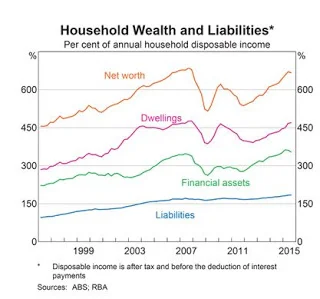
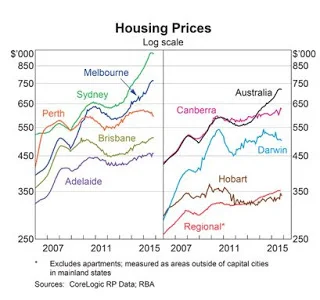
Probably the most common explanation for the Great Recession is the “balance-sheet” recession view. It says households took on took on too much debt during the boom years and were forced to deleverage once home prices began to tank. The resulting drop in aggregate spending from this deleveraging ushered in the Great Recession. The sharp contraction was therefore inevitable. But is this right? Readers of this blog know that I am skeptical of this view. I think it is incomplete and misses a deeper, more important story. Before getting into it, let’s visit a place that according to the balance sheet view of recessions should have had a recession in 2008 but did not.

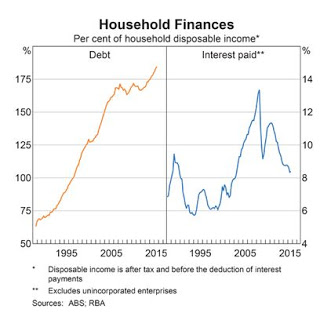
That place is Australia. It too had a housing boom and debt “bubble”. It too had a housing correction in 2008 that affected household balance sheets. This can be seen in the figures at the top of this post. 

Despite the balance sheet pains of 2008, Australia never had a Great Recession. In fact, it sailed through this period as one the few countries to experience solid growth. And, as Scott Sumner notes, it was also buffeted by a collapse in commodity exports during this time. If any country should have experienced a sharp recession in 2008 it should have been Australia.

So why did Australia’s balance sheet recession never happen? The answer is that the Reserve  Bank of Australia (RBA), unlike the Fed, got out in front of the 2008 crisis. It cut rates early and signaled an expansionary future path for monetary policy. It also helped that the policy rate in Australia was at 7.25 percent when it began to cut interest rates. This meant the central bank could do a lot of interest rate cutting before hitting the zero lower bound (ZLB). So between being more aggressive than the Fed and having more room to work,  the RBA staved off the Great Recession.

This experience in Australia speaks to why the balance sheet recession view miss the deeper, more important problem behind depressions: the ZLB. Unlike the RBA, the Fed was slow to act in 2008 and that allowed the market-clearing or “natural” interest rate to fall below the ZLB. Had the Fed acted sooner or had it been able to keep up with the decline in the natural interest rate once it passed the ZLB, the Great Recession may not have been so great (See Peter Ireland’s paper for more on this point).

Here is how I made this point in my review of Atif Mian and Amir Sufi’s book, House of Debt, in the National Review:

Why should the decline in debtors’ spending necessarily cause a recession?
Recall that for every debtor there is a creditor. That is, for every debtor who is cutting back on spending to pay down his debt, there is a creditor receiving more funds. The creditors could in principle provide an increase in spending to offset the decrease in debtors’ spending. But in the recent crisis, they did not. Instead, households and non-financial firms that were creditors increased their holdings of safe, liquid assets. This increased the demand for money. This problem was exacerbated by the actions of banks and other financial firms. When a debtor paid down a loan owed to a bank, both loans and deposits fell. Since there were fewer new loans being made during this time, there was a net decline in deposits [and thus] in the money supply. This decline can be seen in broad money measures such as the Divisia M4 measure. These developments—increase in money demand and a decrease in money supply—imply that an excess money-demand problem was at work during the crisis.
The problem, then, is as much about the excess demand for money by creditors as it is about the deleveraging of debtors. Why did creditors increase their money holdings rather than provide more spending to offset the debtors? …Mian and Sufi do briefly bring up a potential answer: the zero percent lower bound (ZLB) on nominal interest rates.
The ZLB is a floor beneath which interest rates cannot go. This is because creditors would rather hold money at zero percent than lend it out at a negative interest rate. This creates a big problem, because market clearing depends on interest rates’ adjusting to reflect changes in the economy. In a depressed economy, firms sitting on cash would start investing their funds in tools, machines, and factories if interest rates fell low enough to make the expected return on such investments exceed the expected return to holding money. Even if the weak economy means the expected return to holding capital is low, falling interest rates at some point would still make it more profitable to invest in capital than to hold money. Similarly, households holding large amounts of money assets would start spending more if the return on holding money fell low enough to make household spending worthwhile. This is a natural market-healing process that occurs all the time. It breaks down when there is an increase in precautionary saving and a decrease in credit demand large enough to push interest rates to zero percent. If interest rates need to adjust below zero percent to spur creditors into providing the offsetting spending, this process will be thwarted by the ZLB.
It is the ZLB problem, then, rather than the debt deleveraging, that is the deeper reason for the Great Recession.

Australia never hit the ZLB. That is why it avoided the Great Recession. If we want to avoid future Great Recessions we need to find better ways to avoid or work around the ZLB.


John Stuart Mill’s Defense of Freedom

I have finished blogging my way through John Stuart Mill’s On Liberty. I circled around to blog my way through the “Introductory” chapter last:

Chapter I: John Stuart Mill’s Introduction to a Defense of Freedom

These posts collect links for blog posts based on paragraphs in the other chapters:

Chapter II: John Stuart Mill’s Brief for Freedom of Speech

Chapter III: John Stuart Mill’s Brief for Individuality

Chapter IV: John Stuart Mill’s Brief for the Limits of the Authority of Society over the Individual

Chapter V: John Stuart Mill Applies the Principles of Liberty

I also have a few miscellaneous posts from when I first started writing posts inspired by On Liberty:

The Presumption in Favor of Any Belief Generally Entertained is Especially Weak in the Case of a Theory which Enlists the Support of Powerful Special Interests

It should be remembered, however, that the presumption in favour of any belief generally entertained has existed in favour of many beliefs now known to be entirely erroneous, and is especially weak in the case of a theory which, like that of protection, enlists the support of powerful special interests. The history of mankind everywhere shows the power that special interests, capable of organization and action, may exert in securing the acceptance of the most monstrous doctrines. We have, indeed, only to look around us to see how easily a small special interest may exert greater influence in forming opinion and making laws than a large general interest. As what is everybody’s business is nobody’s business, so what is everybody’s interest is nobody’s interest. Two or three citizens of a seaside town see that the building of a custom-house or the dredging of a creek will put money in their pockets; a few silver miners conclude that it will be a good thing for them to have the government stow away some millions of silver every month; a navy contractor wants the profit of repairing useless iron-clads or building needless cruisers, and again and again such petty interests have their way against the larger interests of the whole people.
— Henry George, Protection or Free Trade

How the Free Market Works Its Magic

Link to the Wikipedia article on “Harry Potter (character)”

Some people misunderstand free market principles. The free market depends on the establishment of property rights. That is the free market, not a departure from it. In particular, the free market yields good results only because after the obvious ways of getting ahead–lying, stealing and threatening violence–are outlawed, people have to exchange things that are valuable to other people in order to get ahead. 

Monetary policy is another interesting area to talk about. The logic saying that the free market yields good results comes from a model in which monetary policy doesn’t matter for anything important–have a central bank or not, it is all the same in that model. As soon as monetary policy matters, there is a genuine asterisk on the idea that the free market alone can do the job. As Milton Friedman recognized, some sensible monetary policy has to be appended to the establishment of property rights. 

Note: The timing of this post was inspired by yesterday’s post “Narayana Kocherlakota: Want a Free Market? Abolish Cash.”

Narayana Kocherlakota: Want a Free Market? Abolish Cash

Link to Narayana Kocherlakota’s column “Want a Free Market? Abolish Cash” on Bloomberg View

Narayana Kocherlakota has now joined me in advocating the complete elimination of the zero lower bound, and done it with a nice free-market argument. You can see the whole article at the link above. Let me quote my favorite passage and the bit about me:

… governments – by issuing cash and managing inflation – put a floor on how low interest rates can go and how high asset prices can rise. That’s hardly a free market.

Like any government interference, this causes inefficiencies. By preventing the future prices of goods and services from rising too far above the current prices, it constrains demand for current goods and services. The weak demand, in turn, leads companies to hire less and invest less in the development of new technologies, leaving the work force underutilized and productivity low. Sound familiar? …

The right answer is to abolish currency and move completely to electronic cash, an idea suggested at various times by Marvin Goodfriend of Carnegie-Mellon University, Miles Kimball of the University of Colorado and Andrew Haldane of the Bank of England. Because electronic cash can have any yield, interest rates would be able go as far into negative territory as the market required.

To clarify my own position, I have no objection to a cashless economy, but I think some nations may need to eliminate the zero lower bound in the near future, and a nonpar exchange rate between paper currency and electronic money (with electronic money as the unit of account) can be implemented on much shorter notice than arranging things so that the economy can easily do without paper currency entirely. So my own emphasis–as you can see from my bibliographic post “How and Why to Eliminate the Zero Lower Bound: A Reader’s Guide”–has been on what might be seen as the transitional system of a taking paper off par to eliminate the zero lower bound rather than the total elimination of paper currency itself. 

Deirdre McCloskey: What Kenneth Boulding Said Went Wrong with Economics, A Quarter Century On

Excerpts from this essay: 

1. It is appropriate to call economics since 1948 “Samuelsonian”

2. Science is about Mow Much. Existence theorems and tests of statistical significance have no connection to actual findings about How Much in actual economies”

3. There’s nothing, in short, unscientific about the humanities. Boulding spoke of the “inside track” we have as social scientists because we are the very thing we study, unlike the position of the physicist studying the atom or the biologist the cell or the geologist the mountain. “The outside track is frequently associated with scientific knowledge and the inside with folk or humanistic knowledge. The social scientist is frequently inclined to deprecate the inside track and to pretend that he operates only on the outside track. If we examine the social scientists carefully, however, we shall find that … their theoretical models owe a great deal to the power of man to known himself from the inside” (1964, p. 59). And how do we know ourselves from the inside? Through the arts and the humanities.

4. Many scientists mistakenly think that ethical categorization is not relevant to science: this is an echo of an attitude dating to Max Weber and adopted enthusiastically in economics during the middle of the twentieth century that fact and value are from different realms. Boulding did not agree. He realized, as many economists still do not, that “a process by which we detect errors in propositions of fact is not very different from that by which we detect error in propositions of value”

Tim Sablik: Subzero Interest

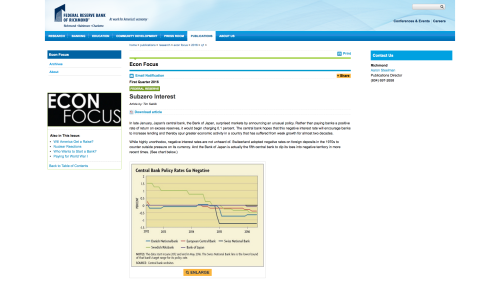
Link to the article on the Federal Reserve Bank of Richmond Econ Focus website

Tim Sablik interviewed me for a well-researched and well-written article “Subzero Interest” that he wrote for the Richmond Fed’s Econ Focus website. The entire article is a great piece for getting background on negative interest rates. As teasers, let me quote just the passages quoting me and a couple of very interesting passages quoting Marvin Goodfriend: 

Miles 1: “Cutting interest rates into negative territory stimulates the economy in exactly the ways that cutting interest rates stimulates the economy in positive territory, with very few difference,” says Miles Kimball, an economics professor at the University of Michigan who has advocated in favor of negative rate policy.

Miles 2: It may not be necessary to eliminate cash completely to achieve negative rates, however. Kimball has argued central banks could establish an exchange rate between physical currency and electronic currency at the cash window. For example, if the Fed wanted to adopt interest rates of negative 4 percent, the exchange rate for physical currency in terms of electronic currency would depreciate at 4 percent per year. Banks and financial markets would then pass along the nega­tive rates on physical currency as well as electronic accounts to the rest of the economy. To alleviate banks’ concerns about losing retail depositors, Kimball has said the Fed could reduce banks’ payments to the Fed of negative interest on reserves in order to subsidize their provision of zero interest rates to small-value bank accounts. This would shield most retail depositors from the effects of negative rates.

Additionally, he argues that the depreciation of paper currency would likely be invisible in most everyday trans­actions, at least to a point. “If you go to the grocery store now where they accept both credit cards and cash, they’re likely to accept both payments at par,” says Kimball. That’s despite the fact that both payment methods are not equal for merchants. They pay a fee to card networks for card transactions but don’t typically pass that charge on to cus­tomers. As a result, Kimball suspects many merchants would be willing to accept the “fee” of a small depreciation of cash without passing it on to customers.

“If merchants are still accepting cash at par at the store and you’re still getting a zero interest rate at your local bank, what do negative interest rates in the financial markets look like to you?” he says. “On things like car loans, they just look like lower positive rates. Most people wouldn’t personally see any negative interest rates.”

Marvin 1: In the long run, the likelihood that most countries move to all-electronic currency is quite high, Goodfriend argues. “If you give me a long time horizon of 150 or 200 years, I’d be absolutely shocked if societies did not move to eliminate the zero lower bound by making currency electronic,” says Goodfriend. “As society gets increasingly digitized, the inconvenience and costs of using paper currency will become glaringly high.”

Goodfriend also notes that while holders of digital cur­rency may lose money in times of negative rates, they could actually earn a positive return when rates are above zero, something paper money currently lacks. “If we expect that interest rates are going to be positive most of the time, then for most of the imaginable future, people are going to bene­fit from earning interest on currency.”

Marvin 2: This is why communication from central banks is criti­cal with these policies, says Goodfriend. “Any unorthodox move is complicated if the public has not been prepared for it. In that case, the central bank cannot be sure that these things will work as intended,” he says. But Goodfriend says most of the costs cited by critics of negative rates do not kick in only once rates fall below zero — they apply to all rate cuts. Cutting rates within positive territory also hurts savers and lessens the burden of public debt.

Still, negative rates represent largely uncharted territory for economists and policymakers, and many unanswered questions remain. The good news for monetary policymak­ers at the Fed and elsewhere is that they can wait and see how the experiments in Europe and Japan play out before making any decisions on negative rates. If it works, Goodfriend says he wouldn’t be surprised to see negative rate policy spread.

“If you’re standing around a pool and you don’t know what the temperature of the water is,” he says, “it’s a whole lot easier to jump in if somebody else goes first and tells you the water’s fine.”

How the Fed Could Use Capped Reserves and a Negative Reverse Repo Rate Instead of Negative Interest on Reserves

Link to the New York Fed’s webpage “FAQs: Reverse Repurchase Agreement Operations”

Charging banks for their reserve balances when the Fed decides someday to go to negative interest rates is probably within the Fed’s legal authority, since the Fed can charge fees related to expenses, and it can be argued that handing funds to the Fed requires the Fed to put those funds into other relative safe assets such as T-bills, which would have negative rates in that situation. But it is worth considering other options that might be even easier legally. 

In that vein, I want to refine what I wrote in “How to Keep a Zero Interest Rate on Reserves from Creating a Zero Lower Bound” by suggesting that after capping the amount of reserves (+ vault cash) banks are allowed to hold to a little above required reserves (plus an extra allowance for small accounts they hold, in line with “How to Handle Worries about the Effect of Negative Interest Rates on Bank Profits with Two-Tiered Interest-on-Reserves Policies”), allowing banks (along with other counterparties) to put funds into the Fed’s Reverse Repo Program, with a negative rate, is the natural way to have the same kind of economic effect as a negative interest rate on reserves while leaving the interest rate on reserves themselves at zero.

I suggested this possibility at Jackson Hole last Saturday as one of several reasons that the Fed should keep its Reverse Repo Program in operation. This was my comment after Jeremy Stein’s brilliantly clear presentation of how the Reverse Repo Program can enhance financial stability in  “The Federal Reserve’s Balance Sheet as a Financial-Stability Tool,” along with his coauthors Robin Greenwood and Sam Hanson.   

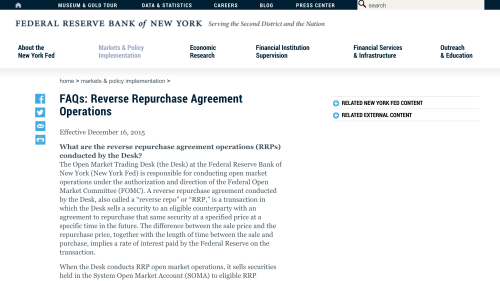
As you can see in the screenshot at the top of this post from the New York Fed’s website,  

A reverse repurchase agreement conducted by the Desk, also called a “reverse repo” or “RRP,” is a transaction in which the Desk sells a security to an eligible counterparty with an agreement to repurchase that same security at a specified price at a specific time in the future. The difference between the sale price and the repurchase price, together with the length of time between the sale and purchase, implies a rate of interest paid by the Federal Reserve on the transaction.

While only regulated banks are allowed to put funds into a reserve account, many other financial firms as well as banks are allowed to put funds into the Fed’s Reverse Repo Program. That clearly makes it different from reserves. But I want to argue that other than the more diverse set of participants allowed, the Reverse Repo Program can, in effect, act as if it were the second tier in a two-tier interest on reserves structure, while reserves themselves act as the first tier. As in any two-tiered interest on reserves policy, once the first tier fills up to its cap, it is the lower interest rate on the second tier that serves as the marginal interest rate that matters most for markets.  

There may be institutional and economic subtleties I don’t understand, which I would be glad to be corrected on. But let me write based on my current understanding of the Reverse Repo Program (RRP) until one of you corrects me. The reason funds in the Reverse Repo Program (RRP) can act, economically, as such close substitutes for reserves, is that during the day they become reserves, while at night, for the bank or other financial firm, they become something else that can earn a different interest rate from reserves. That is, with RRP, the Fed is borrowing money overnight using T-bills as collateral, and then repays the money in the morning by crediting the lender with funds that are reserves in some bank’s reserve account at the Fed. 

Above, I said that in the policy I envisioned, reserves would be capped, but that is only partly true: the reserves banks can hold are capped at night, but banks are allowed to have what is potentially a much larger amount of reserves during the day. At night, to meet their cap, banks both on their own account and on behalf of depositors have to sweep reserves above the reserve cap into RRP. An individual bank might find another alternative, but that just shuffles reserves around to another bank. So in the aggregate, the funds above the cap have to go into something with the Fed on the other side of the transaction, and RRP is what is available.

“During the day, reserves; during the night another alter ego that earns a different interest rate” sounds structurally a bit like the blurb for a superhero. The Reserve Repo Program may not be a superhero, but it could come in handy. I hope the Fed keeps it in operation, just in case it is more useful in some future situation than is now appreciated. 

Postscript: One reason the Fed is considering discontinuing the Reverse Repo Program in the future is the fear that too many funds might flee to it in a future crisis, allowing some other markets to collapse. The solution to this is already built into the structure of the Reverse Repo Program: over short horizons, there is a level at which the rate in the Reverse Repo Program adjusts by auction rather than the quantity adjusting with the same rate. Then over longer horizons–that is, as soon as the Fed can meet, which might be within a week during a crisis–the regular rate for the Reverse Repo Program should be adjusted downward sharply to avoid that rate becoming an obstructionist lower bound. 

John Stuart Mill on the Need to Make the Argument for Freedom of Speech

Link to the Wikipedia article on “Freedom of thought”

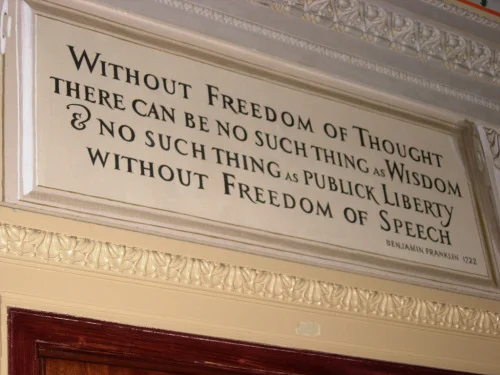
At the end of his “Introductory” chapter of On Liberty, in paragraph 16, John Stuart Mill writes:

It will be convenient for the argument, if, instead of at once entering upon the general thesis, we confine ourselves in the first instance to a single branch of it, on which the principle here stated is, if not fully, yet to a certain point, recognised by the current opinions. This one branch is the Liberty of Thought: from which it is impossible to separate the cognate liberty of speaking and of writing. Although these liberties, to some considerable amount, form part of the political morality of all countries which profess religious toleration and free institutions, the grounds, both philosophical and practical, on which they rest, are perhaps not so familiar to the general mind, nor so thoroughly appreciated by many even of the leaders of opinion, as might have been expected. Those grounds, when rightly understood, are of much wider application than to only one division of the subject, and a thorough consideration of this part of the question will be found the best introduction to the remainder. Those to whom nothing which I am about to say will be new, may therefore, I hope, excuse me, if on a subject which for now three centuries has been so often discussed, I venture on one discussion more.

To me, this is a reminder of the importance of making the argument for the things we believe in. If people take for granted the idea that freedom of speech is a good thing, without having ever made or heard the argument, their commitment to freedom of speech can easily wilt under the heat of the first temptation to abridge someone’s freedom of speech. If people take for granted the idea that free trade is good, without having ever made or heard the detailed arguments for that idea, they are likely to think free trade is good except in every special case that is actually at issue in public debate. If people say science has proved evolution without actually knowing all the powerful arguments in favor of evolution, they are just attempting to substitute one authority for another, without realizing that the essence of science is in the detailed reasons it gives for its claims, and in the ability to investigate those reasons more and more deeply. 

One of the most interesting arguments that John Stuart Mill gives for freedom of speech in the following chapter is that freedom of speech helps to force people to actually make arguments and keep the knowledge of those reasons alive, instead of letting those reasons become simply the reasons that dead men had for believing something, while our reason for believing it becomes simply that they did. 

Those of us who are teachers, and perhaps in especially great measure, those of us who are teachers in colleges and universities, are remiss in our duties if we do not give students the arguments for believing what we believe. We might be tempted to think that teaching them the right ideas without backing them up will do the trick, but at some point in the lives of college graduates, when something that was abstract in college becomes real and concrete, and the thinking begins in earnest, the trains of thought that back up an idea might be more robust in the face of those motivated to confuse an issue than the memory of a professor’s simple assertion of an idea and testing of the ability to memorize that idea for an exam. None of this is easy. But I fear that failing to give reasons builds an education on sand, and the house built on the sand will soon wash away.  

Proxima Centauri b

Link to the New York Times article “One Star Over, a Planet That Might Be Another Earth”

For any lover of science fiction, like me, it was a big day to have evidence of a planet circling Proxima Centauri announced on Wednesday–the closest known planet outside of our own solar system. (My son Jordan texted the news to me as soon as he learned it.) I hope all earthly schoolchildren from now on learn about this planet along with learning about the planets in our own solar system. It is a great thing to have one’s imagination stirred by a greater understanding of the vastness of the universe and how much is out there. 

This world has many troubles. Many of those troubles stem from the fact that we don’t always treat other human being as fellow human beings should be treated. Though Proxima Centauri is the closest star we know of, other than our Sun, in the context of the vast distance to Proxima Centauri and the planet or planets that surround it, everyone on earth is a close neighbor indeed. I hope that we can make progress in resolving our conflicts and overcoming our other troubles, so that we humans can more easily turn our thoughts to grand adventures, such as exploring the stars.  

Mark Carney: Central Banks are Being Forced Into Low Interest Rates by the Supply Side Situation

Link to Mark Carney’s August 4, 2016 Press Conference

The Natural Interest Rate. Mark Carney is remarkable in many ways. He was chosen as Governor of the Bank of England despite being a Canadian. He has been a leader in pushing up equity requirements for banks in the real world–a key for financial stability. And in his August 4, 2016 press conference, he has given the most articulate statement for the press and the public that I have heard for the view that central banks must now use a lower range of interest rates for economic stabilization than before because supply-side forces have brought down the natural rate of interest. Central bankers all over the world, including in the United States, would be well-advised to study carefully how Mark Carney handles the questions in this press conference, particularly on the issue of how hard low interest rates are on savers. 

I have no doubt that Mark Carney’s understanding of what is happening with the natural interest rate has been informed by the excellent report on this issue by Bank of England economists Lukasz Rachel and Thomas Smith: 

I highly recommend it. 

Conceptually, I write about the natural interest rate in these two posts:

Mark Carney’s particular point that central banks do not control the medium-run natural interest rate was also made by Mario Draghi. See this post:

Negative Interest Rates and Bank Profits. The one unfortunate note in Mark Carney’s August 4, 2016 press conference was his speaking against negative interest rates. But he did ably undercut his own reason for being against negative interest rates. Mark Carney’s reason for being against negative interest rates is that they are hard on banks, backing up my claim in “What is the Effective Lower Bound on Interest Rates Made Of?” that the effective lower bound is now primarily made of central bank concerns about bank profits. But there are many ways for central banks to support the profits of private banks. One is by reducing the rate at which the central bank lends to private banks. In his press conference, Mark Carney explained in some detail how the Bank of England had closely calculated how to use that kind of mechanism to cancel out the effects of other rate cuts on bank profits. So the Bank of England knows well how to support bank profits when interest rates are cut–and could do so even if rates were cut into the negative region. Another way for obvious way for central banks to support bank profits is to use a multi-tier interest on reserves formula. I write about this in 

A third way to support bank profits when interest rates are lowered is to reduce the paper currency interest rate, as I discuss in 

Banks live on spreads, so a good way to keep from adding stress to banks by central bank policy is to lower all government-controlled interest rates (including the paper currency interest rate) an equal amount. Then the government can avoid the problems that arise when the government effectively competes for funds with banks by having too high a paper currency interest rate. Beyond these three mechanisms, it is quite unlikely that a roomful of competent economists would have all that much trouble in thinking of other ways to throw funds to banks in order to keep them from being stressed out too much by rate cuts, if that is a genuine concern. For governments that have any substantial amount of short-term debt in the hands of the public, the budgetary savings from lower interest rates guarantee that such governments can easily afford such subsidies to banks should they think them necessary (though in many countries the budgetary savings may show up in the balance sheet of the non-central-bank part of the government).

As an aside, I should mention that in an effort to discourage other countries from using negative interest rates too freely, Mark Carney used some faulty analysis, as I discuss in 

The Need for Supply-Side Reform. The fact that unfavorable supply-side forces are pushing the natural interest rate down gives one more reason to pursue supply-side reform. I view stabilization through a vigorous interest rate policy–including use of negative interest rates where needed–as a complement to supply-side reform, not a substitute. Both are needed, and both reinforce each other.