Friends and Sparring Partners: The Skyline from My Corner of the Blogosphere

Intelligent Economist: Top 100 Economics Blogs of 2016

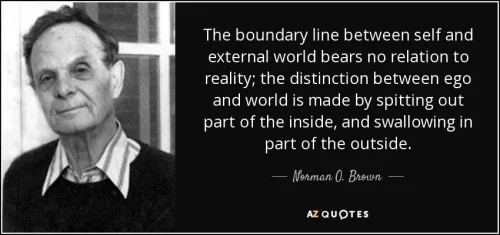
Keeping up with my personal life, teaching, research, writing my own blog, and reading from the Wall Street Journal and the Economist plus varied articles that I see on Twitter leaves me much less time to read economics blogs than I would like. Still, there are some blogs that I read with some frequency. The Intelligent Economist’s list “Top 100 Economics Blogs of 2016″  gives me to think about the blogs in this list that bulk largest in my consciousness and correspondingly have the most influence on me. My emphasis in this post is on the bloggers themselves rather than their blogs. And as my title suggests, this is a very personal view (some might even say egocentric–see my confession in “The Egocentric Illusion). 

I am mostly borrowing the fairly arbitrary order of the Intelligent Economist, but I have grouped people into “friends” and “sparring partners.” To make it into this post, a blogger had to be both in the Intelligent Economist’s list and someone who bulks large in my consciousness. 

Friends:

Noah Smith: Bloomberg View Economics

I was Noah’s principal dissertation advisor, but Noah was my advisor in starting my own blog. I am a great admirer of Noah’s vivid style, his wide-ranging command of ideas and his ability to penetrate to the heart of an issue. I analyzed Noah’s style in my post “Brio in Blog Posts” for the sake of my students, whom I asked to write close to 40 blog posts over a semester in my Monetary and Financial Theory class. There is very little daylight between Noah’s views and mine. In addition to his Bloomberg View columns, his own blog Noahpinion, and some popular Quartz columns coauthored with me (see for example #1 math, #4 econ PhD and #13 Minneapolis here), Noah has a hard-hitting series of guest posts on my blog about religion

Narayana Kocherlakota: Bloomberg View Economics

One of the most pleasant surprises this year has been Narayana Kocherlakota’s full-speed-ahead emergence as a major blogger and tweeter, not long after he stepped down as President of the Minneapolis Fed. Narayana is a strong proponent of negative interest rates, though I am not aware of his having the negative interest rates for paper currency that are the linchpin of my proposal for eliminating the zero lower bound.  

Ben Bernanke’s Blog

Other than reading his blog, Ben is too busy for me to have any meaningful interaction with him electronically, but I have known him a long time from NBER conferences, I had lunch with him twice at the Fed itself in the past few years (he made a habit of eating lunch in the Fed’s regular cafeteria), saw him when he came to speak at the University of Michigan, and expect to see him at a Brookings conference next month. You can see my disagreement with him about negative interest rate policy in “Ezra Klein Interviews Ben Bernanke about Miles Kimball’s Proposal to Eliminate the Zero Lower Bound.” I have declared Ben Bernanke a hero on many occasions for his actions mitigating the harm from the Financial Crisis of 2008 and making the Great Recession less severe than it might have been. However much better monetary policy might have been than what Ben achieved, I have some appreciation for how hard it is to figure out in real time what needs to be done in a crisis and how hard it is to persuade others in real time to support the actions that are needed. Ben did admirably in a tough situation. 

Tyler Cowen: Marginal Revolution

Tyler Cowen and I were graduate school classmates at Harvard. He wrote about our time in graduate school here. I appreciate Tyler’s thoughtful attention to the supply side of the economy in his blog, and I love the metaphor of a “Marginal Revolution,” which I play off of in my 2d anniversary post “Three Revolutions.” I have greatly admired Tyler’s longer pieces (some published in other venues), such as “The Inequality that Matters.” My favorite of Tyler’s recent posts is “What are the core differences between Republicans and Democrats?”

Alex Tabarrok: Marginal Revolution

I greatly appreciate Alex Tabarrok’s levelheaded commentary on a wide range of issues. And I like his emphasis on the importance of ideas for economic growth, very well expressed in his TED talk “How Ideas Trump Crises.”

Mark Thoma: Economist’s View

Right before I started blogging, I remember Bob Hall telling me that Mark Thoma’s blog “Economist’s View” was his one-stop shop for blogs to read. In addition to writing his own posts, Mark Thoma is the premier aggregator of economics blog posts in the world. This is a wonderful public good. 

Brad DeLong: Equitablog

Brad DeLong was a year or two ahead of me in graduate school at Harvard, and our research interests align closely enough that we have kept track of each other over the years. When Brad came to give a seminar at the University of Michigan a few years ago, I was struck by a powerful case of blog envy. That was one of the big things that made me realize that I needed to start a blog of my own. Brad and I are in agreement about most things–something I know because when he disagrees with me, he is quick to note what an exception that is. Brad digs deep in his analysis. For example I admire his post “Mr. Piketty and the “Neoclassicists”: A Suggested Interpretation.” But Brad is also willing to be an attack dog when he sees someone saying something he considers not only wrong, but dangerously wrong. Brad is someone I especially wish I could get to comment in depth on a wider range of the proposals I have made. 

Scott Sumner: The Money Illusion

When I was just about to start blogging, Noah Smith told me that Nominal GDP Level Targeting was very big in the blogosphere, and that I should write about it. I finally did in “Optimal Monetary Policy: Could the Next Big Idea Come from the Blogosphere?” Scott Sumner has changed a lot of minds with his advocacy of Nominal GDP Level Targeting. I have met many young and not-so-young economists, in and out of central banks, who have spoken enthusiastically of Nominal GDP Level targeting. That wouldn’t have happened without Scott. My emphasis is different from Scott’s (emphasizing negative interest rate policy), but we are in fundamental agreement on the substance, as you can see in “Miles Kimball and Scott Sumner: Monetary Policy, the Zero Lower Bound and Madison, Wisconsin.” In negative interest rate policy, Scott was an early proponent of a negative interest rate on reserves–a policy he ably defends in “The Media’s Blind Spot: Negative Interest on Reserves.” When he touches on topics outside of monetary policy, Scott is concerned about supply-side reform along the same lines I am. 

JP Koning: Moneyness

JP Koning is a deep thinker about monetary policy and about the nature of money. He has been a full-scale supporter of my proposal to eliminate the zero lower bound since early on. Other than my coauthor Ruchir Agarwal for “Breaking Through the Zero Lower Bound,” I would trust JP to accurately represent my views on negative interest rate policy more than anyone else in the world. Anyone who wants to understand money or monetary poiicy should read Moneyness. I also especially enjoy JP’s Twitter presence

David Beckworth: Macro and Other Market Musings

David Beckworth is one of the few other full-scale supporters of my proposals for negative interest rate policy in the blogosphere–as well as of Scott Sumner’s proposals. A nice example of this is “David Beckworth: “Miles and Scott’s Excellent Adventure” David Beckworth recently interviewed me at length in his Podcast series. I love his written introduction to that podcast. He writes:

Miles is a well-known advocate of breaching the zero lower bound via the adoption of negative interest rates. Moreover, he has shown how to do it without getting rid of physical cash. Miles sat down with me to discuss his ideas on this topic as well as how the macroeconomics profession has changed over the past few decades. I had a great time discussing these issues with Miles. You will enjoy the conversation too.

I would like to make several points on this controversial topic. First, if you believe in allowing markets to clear via the adjustment of prices, then you should in principle be supportive of negative interest rates. For an interest rate is just an intertemporal price–a price that clears resources across time–and sometimes a severe enough demand shock may require nominal rates to go negative for markets to clear. This is a point I have written about myself. 

Second, central banks that have lowered interest rates to zero and in some cases below zero are not necessarily “artificially” depressing interest rates. It could be that a central bank is simply following the market-clearing level of interest rates–or the natural interest rate–down to lower levels as the economy weakens. This, in my view, is what most central banks have been doing in recent years. Too many observes miss this point.

David and I had an interesting discussion a while back that I made into the post “David Beckworth and Miles Kimball: The Padding on Top of the Zero Lower Bound.” This discussion has become somewhat dated as central banks look for less and less padding on top of the zero lower bound–many going to a negative amount of padding!

Simon Wren-Lewis: Mainly Macro

I have only interacted with Simon Wren-Lewis, but I have greatly admired many of his posts. He is much more Keynesian than I am (I am a Neomonetarist who looks to monetary policy for economic stabilization), but his posts are full of incisive insights. I would be very glad for more substantial interaction between our blogs. 

Roger Farmer’s Economic Window

I have mainly connected with Roger Farmer over our mutual advocacy of sovereign wealth funds as a tool of macroeconomic policy. On that, see “Roger Farmer and Miles Kimball on the Value of Sovereign Wealth Funds for Economic Stabilization.” Roger’s views are interesting because they are so unique. You definitely won’t get the “same old thing” reading his blog. Roger and I interact quite a bit on Twitter.  

Nick Rowe: Worthwhile Canadian Initiative

Though still writing in words with few equations, Nick’s posts lean toward the technical. In that vein, I like his post on monetary dominance, “Fewer Fiscal Multipliers and more Clarity from the Bank of Canada.” I use an argument from Nick’s post “Money is Always and Everywhere a Hot Potato” in “International Finance: A Primer.” Also, Nick gives his own relatively formal treatment of what I cover in “The Medium-Run Natural Interest Rate and the Short-Run Natural Interest Rate” and “On the Great Recession” in his post “Upward-sloping IS curves after Miles Kimball.”

Matthew Martin: Separating Hyperplanes

Matthew Martin was one of the earliest and best commenters on my blog. His blog is very innovative. I am delighted to see it gaining more recognition. 

Bryan Caplan: Econlog

I really enjoyed meeting Bryan Caplan in person when I gave a seminar at George Mason University a little over a year ago. He is someone I could happily spend hours talking to. He is an extremely creative thinker, unafraid to go places that other people might disagree with if logic takes him there. He is a great fount of things you would be unlikely to think of on your own, but should be thinking about–with prompting from Bryan your only plausible path to considering them. 

Sparring Partners

Paul Krugman: Conscience of a Liberal

Paul Krugman is someone who floats in the air like a demigod, mostly untouchable by a mere mortal like me. As far as I know, he has never once responded to my repeated accusation that he treats the zero lower bound as if it were a law of nature, rather than the policy choice that it is. He has occasionally linked to one of my posts or columns when it suited his purposes. Paul Krugman ignored my discussion of breaking through the zero lower bound and of the power of national lines of credit in “How Italy and the UK Can Stimulate Their Economies Without Further Damaging Their Credit Ratings” and referenced the post (in “Another Attack of the 90% Zombie”) only to criticize my reliance on Carmen Reinhart and Ken Rogoff’s claims about the effects of debt on growth. On his chosen field of combat, Paul Krugman bested me, and I atoned for my mistake with “An Economist’s Mea Culpa: I Relied on Reinhart and Rogoff,” “After Crunching Reinhart and Rogoff’s Data, We Found No Evidence High Debt Slows Growth” and “Examining the Entrails: Is There Any Evidence for an Effect of Debt on Growth in the Reinhart and Rogoff Data?” More evidence that Paul Krugman knows of my work on eliminating the zero lower bound, but is unwilling to talk directly about it can be found in his post “Switzerland and the Inflation Hawks.” On other topics, Paul Krugman linked to my column with Noah Smith on Minnesota Macro and picked up on a serious error by a Wall Street Journal columnist from one of my posts and picked up on my criticism of John Taylor in “Contra John Taylor.” Leaving aside my frustrations over the parameters of Paul Krugman’s interactions with me, I find that he has a very interesting blog. I am almost always entertained, I quite often agree with him, and I find him a model of rhetorical skill even when I think he is wrong. 

John Cochrane: The Grumpy Economist

Unlike Paul Krugman, John Cochrane is happy to interact with me. Indeed, I have had some extended email discussions with John that he has agreed we can publish as soon as I have a spot of time to organize them into blog posts as I have volunteered to do. Sometimes John and I are on the same side of a question, as you can see from “Anat Admati, Martin Hellwig and John Cochrane on Bank Capital Requirements.” Other times we disagree, as you can see from our debate about whether things other than paper currency are likely to create an effective lower bound on interest rates. On that, see:

I have Twitter friends who think that John Cochrane has become a right-wing hack. But what I notice is that John Cochrane is regularly drawn by the internal logic of economic arguments to points of view and policy positions that have nothing to with the standard right-wing line. John Cochrane is not predictable in what he writes, unlike many other bloggers and columnists; and he is very very smart. So he is well worth reading. 

In saying what I said in the last paragraph, I realize I have a double standard: I hold center-right, center-left and left-wing bloggers and columnists to the standard of getting everything correct, while my standard for right-wing and heterodox left-wing bloggers and columnists is an easier one to meet: I look for interesting, useful ideas, even if the wheat is mixed in with off-the-mark chaff. This is less of a bilateral double standard viewing politics from an international perspective, where in rich countries generally, the US center-left is the international political center. (Personally, I am probably closer to the political center in the US than I am to the international political center.) 

Update on Female Bloggers: Anna Earl asks a great question on Twitter about female bloggers. None of them were on the list I was working from, but the female bloggers I interact with most are Frances Coppola, Izabella Kaminska and Claudia Sahm. I recommend all of them highly. Twitter is a great way to keep track of their online activities. Here is my tweet with links to their Twitter feedsFrances Coppola worries that banks will be hurt by negative interest rates, with deleterious effects on the economy. You can tap into that debate from our tweets to each other, with links. Izabella Kaminska is an advocate of electronic money. We share many common interests. Claudia Sahm is a very impressive former student and coauthor of mine who is one of the Fed’s top experts on consumption. Let me also recommend Bonnie Kavoussi, who wrote for the Huffington Post before coming to the University of Michigan as a student in our Masters of Applied Economics program. She has begun a career writing and editing economics books. I am hoping that Bonnie will help me write some books someday. Bonnie has a great Twitter feedHere is a link to Bonnie’s blog.
Peter Conti-Brown on Walter Bagehot

Link to Wikipedia article on Walter Bagehot

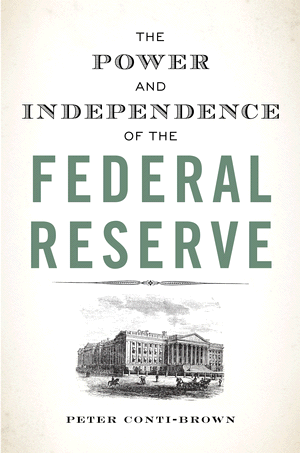
Here is Peter Conti-Brown’s description of Walter Bagehot, from the Preface to his marvelous book The Power and Independence of the Federal Reserve:

Finally, a word about the book’s epigraphs, all taken from the great Walter Bagehot. Bagehot—pronounced BADGE-it in American English, BADGE-ot in Britain, a shibboleth of sorts in central banking circles—is widely viewed as the intellectual godfather of modern central banking. Whether his world has much to say to ours is an open question, but there are few wordsmiths in financial history quite as able as he. He is the author of magnificent sentences, very interesting paragraphs, and sometimes frustratingly indeterminate books. But because of the power of those sentences, I borrow liberally from his iconic 1873 book, Lombard Street: A Description of the Money Market, for the epigraphs that introduce each chapter (except for chapter 4, which comes from his other famous book, The English Constitution). Bagehot obviously had nothing to say about the Federal Reserve System, which was founded decades after his death. And he barely had more to say about the U.S. financial system (he wasn’t very impressed with nineteenth-century U.S. finance). But his turns of phrases are too applicable and felicitous to pass by, even if the reader must change some of the proper nouns to make them relevant.

On Making the Fed’s Governance Constitutional

In his book “The Power and Independence of the Federal Reserve,” Peter Conti-Brown argues that Federal Reserve Bank Presidents are, in effect, important government officials, by virtue of voting on monetary policy, and so (a) should be chosen in a democratically accountable way and (b) to accord with the constitution, should  be either appointed by the President of the United States and confirmed by the Senate, or treated as “inferior officers.”

I am like Justin Fox and many others at a 2015 Brookings event that Justin reports on in thinking that the Federal Reserve Bank Presidents voting on monetary policy in a way close to the way things are now is good for monetary policy. In particular, it helps in allowing a diversity of views to make its way into monetary policy. Crucially, each Federal Reserve Bank President has the staff to really investigate different angles on monetary policy. And indeed, one of the most valuable reforms would be to give more staff and more independence of the Governors in Washington DC from the Chair of the Fed–as well as higher salaries more in line with the Federal Reserve Bank Presidents so that they would be less tempted to quit as Governors after only a few years. 

Despite thinking that the current de facto status of Federal Reserve Bank Presidents is good for monetary policy, and that indeed that the Governors’ status should be raised by giving them some of the attractive job characteristics that the Federal Reserve Bank Presidents have, I take the constitutional issue seriously. I wrote to Peter by email of an idea of how to make the Fed’s governance structure constitutional by clarifying that the Federal Reserve Bank Presidents’ are indeed inferior officers, de jure, and indeed making their appointment more consistent with being inferior officers, but otherwise keeping the role of Federal Reserve Bank Presidents essentially the same as now. Here is what I wrote, with a few words added for clarification:

I think it would be very interesting to investigate the extent to which–even without new legislation–a strong Chair, working with the Fed’s Chief Counsel, could implement the “Federal Reserve Bank Presidents as inferior officers” reform. 

As far as removal goes, I think a legal report could take your line that constitutionally, as inferior officers, the bank presidents must be removable by the board–whether the statute said so or not–and that that was the legal position of the board would take to the extent the question of whether the presidents were inferior officers or whether a president was removable ever came up. This would presumably be associated with reassurances that the board had no intentions of removing any president any time soon. It would cause some kerfuffle, but that would die down reasonably soon after repeated assurances that the board had no intention of actually removing any president any time soon, but that it was just forced to the conclusion of its ability to do so by the law.

As far as appointment goes, the rules already give the board a substantial role in the appointment process. As I understand it, it already requires both the assent of the Board of Governors and the assent of the board of the particular federal reserve bank to make a president. The Board of Governors could easily be much more assertive in this process than it is. And indeed I think the trend is in that direction. For example, I heard that the FRB took a big role in the selection of the SF Fed Bank’s current president. Of course, the place to start would be for the Board of Governors to be extremely assertive in the choice of the president of the NY Fed.

I disagree with you about bank presidents voting on the FOMC. Because they have their own staffs and an attractive job that they will continue in for some time, they provide important diversity in viewpoints–both on the hawkish side and on the dovish side. I think greater Board of Governors assertiveness in the selection of bank presidents solves the most important institutional design problem from the standpoint of good policy outcomes, while simply asserting that the constitution overrides the statute so that the Board of Governors can remove bank presidents if it comes to that solves the constitutional problem.

Let me add this: if, to smart lawyers, this interpretation of the law seems right, one can imagine the chief lawyer of one of the regional Feds replying to a query from its president by saying:

I have good news and bad news.

The good news is that you are constitutional.

The bad news is that you can be fired.

Tyler Cowen: The Rise and Fall of the Chinese Economy

The Chinese economy is not easy to understand. So I am always on the lookout for things that can help make it more understandable. This 12 and a half minute segment by Tyler Cowen is excellent. 

I have one disagreement and one thing to add. The disagreement is that I don’t think “capital flight” has to be a big problem for the Chinese economy. The Chinese Yuan may need to depreciate; they have been using up reserves at a rapid clip to try to prop it up, which has to stop at some point, despite the large reserves they start with. But because China’s government and Chinese firms owe relatively little debt in any foreign currency, such a depreciation due to outward capital flows shouldn’t cause any huge problems. Indeed, it will help increase net exports, in line with the principles I discuss in my post “International Finance: A Primer.” 

Nevertheless, the Chinese economy would be more balanced if Chinese households start doing more consumption spending. Many economists and foreign observers have recommended that China shore up its social safety net to reduce precautionary saving and thereby foster consumption. The additional point I wanted to make is that allowing higher interest rates on savings accounts might spur consumption in the Chinese case, where the marginal propensity to spend of the banks and their owners on the other side of that particular borrower/lender relationship might be lower than the households doing the saving–especially if the Chinese government tells those banks to keep doing a given quantity of lending, or if the rate at which Chinese banks lend is disconnected from the rate at which they pay interest to depositors. (In general, to see the effects of an interest rate change, try the kind of analysis I illustrate in “Even Central Bankers Need Lessons on the Transmission Mechanism for Negative Interest Rates.” This Chinese case is unusual. For almost all borrower-lender relationships, a cut in interest rates is stimulative and an increase in rates is contractionary.)

Maria Popova on the Virtue of Being Willing to Look Foolish

… there are few things we resist more staunchly, to the detriment of our own growth, than looking foolish for being wrong. The courageous … trip and fall, often in public, but get right back up and leap again.
— Maria Popova, in the Brain Pickings blog post “The Gutsy Girl: A Modern Manifesto for Bravery, Perseverance, and Breaking the Tyranny of Perfection.”

The Complexity of Liberty: How Equality Enters into a Good Definition of Liberty

Having blogged through to the end of On Liberty, I know that what John Stuart Mill claims in the 9th paragraph of the “Introductory” to On Liberty is simple is anything but simple. He writes:

The object of this Essay is to assert one very simple principle, as entitled to govern absolutely the dealings of society with the individual in the way of compulsion and control, whether the means used be physical force in the form of legal penalties, or the moral coercion of public opinion. That principle is, that the sole end for which mankind are warranted, individually or collectively, in interfering with the liberty of action of any of their number, is self-protection. That the only purpose for which power can be rightfully exercised over any member of a civilized community, against his will, is to prevent harm to others. His own good, either physical or moral, is not a sufficient warrant. He cannot rightfully be compelled to do or forbear because it will be better for him to do so, because it will make him happier, because, in the opinions of others, to do so would be wise, or even right. These are good reasons for remonstrating with him, or reasoning with him, or persuading him, or entreating him, but not for compelling him, or visiting him with any evil in case he do otherwise. To justify that, the conduct from which it is desired to deter him, must be calculated to produce evil to some one else. The only part of the conduct of any one, for which he is amenable to society, is that which concerns others. In the part which merely concerns himself, his independence is, of right, absolute. Over himself, over his own body and mind, the individual is sovereign.

The first complexity is that the idea of “self-protection” or preventing harm to oneself as a necessity for setting down a social rule  is not an adequate principle for preserving liberty. No doubt slaveholders felt they were harmed when Harriet Tubman helped slaves to escape on the Underground Railroad. That harm to their interests did not justify them in setting up rules requiring the return of runaway slaves. More generally, the principle of self-protection or preventing harm to oneself does not provide adequate guidance when someone’s actions harm one person and help another. In such cases, it matters how much one person is helped and how much another person is harmed. 

The slavery case may seem easy, but consider this one. If one homeowner rents out a basement that might create more noise and somewhat exacerbated parking problems for the neighbors. On the other hand, it might greatly help the person who is now able to find a place to live because of this opportunity to be a renter. Is the community justified in prohibiting renting out basements because of the negative externality to the neighbors, or does the benefit to the person who now can find an affordable place to live in someone’s basement outweigh that negative externality? 

On this first complexity, see for example “John Stuart Mill on Legitimate Ways to Hurt Other People.”

The second, related complexity is that the boundary between “self” and “other” for the purposes of establishing liberty is not always so easy to establish. Liberty is more than simply having one’s body untouched. At a minimum, some freedom of motion is needed for liberty; if one is confined to a prison, it is an affront to liberty no matter how well one’s body is taken care of. At another level, if one’s personal diary is confiscated every day and burned in the flames, that is an affront to liberty. Sometimes this kind of reasoning is taken to include all of the things an individual has produced as if they were a part of the person, with any affront to a person’s property being an affront to liberty.

But in some ways, an individual’s sensibility and feelings are a more central part of a person than that individual’s property. And yet, we dare not count an affront to someone’s sensibility as an affront to liberty in all cases since many people are quite offended by other people’s private behavior–for example, other people’s religious beliefs and worship practices or other people’s sexual expression. To treat an individual’s sensibility as an inviolable part of that person is to tread on other people’s liberty too much. So we dare not give an individual so wide a sphere of personal rights as to include too many sensibilities about other people’s actions.

The bottom line is that drawing lines between what is my personal sphere in which I have a broad freedom of action and what is your sphere in which you have a broad freedom of action is tricky. On this complexity, see for example my discussion in “John Stuart Mill on Being Offended at Other People’s Opinions or Private Conduct.” To me it seems that workable principles of liberty must draw boundaries for one’s own private interests–the extended “self”–that are (a) as nearly as possible the same size or extensiveness for each individual (equality in the size of extended self), (b) as large as possible, without (c) overlapping too severely. Thus, interestingly, equality comes in as part of the definition of liberty–not equality of result or even equality of opportunity, but equality of size of the extended self. That is, to the extent possible, there should be equality of the sphere of each individual’s interests that are recognized as that individual’s personal sphere in which shehe has great autonomy.  

See links to other John Stuart Mill posts collected here.

The Exchange Rate Between 500 Euro Notes and Smaller Notes

Link to “High-denomination banknotes: Cash talk”

In “An Underappreciated Power of a Central Bank: Determining the Relative Prices between the Various Forms of Money Under Its Jurisdiction” I write:

It Isn’t the Face Value that Determines How Much Each Type of Paper Currency is Worth. To see this role of a central bank clearly, consider a case where not only direct access to the central bank, but access to the banking system in general is problematic: the criminal underworld. Think of the standard scene in American mob movies in which the mobster demands a suitcase full of cash in tens and twenties. Why tens and twenties? Using the banking system often increases the chance that a criminal will get caught. Money can be laundered, but it is easier to launder tens and twenties. So, at least near the point of money laundering, ten ten-dollar bills are worth more than one hard-to-launder hundred-dollar bill. That means that if you bring me a suitcase full of one-hundred dollar bills with the same face value as a suitcase full of tens and twenties, you are bringing me less value—you have cheated me.

I was intrigued to read in the Economist article “High-denomination banknotes: Cash talk” about the exchange rate between different denominations when transportation is the immediate issue rather than laundering:

A report from Europol recounts how criminals will sometimes pay more than face value for high-value notes because of how convenient they are to transport.

This is one more example showing that it is not the face value that determines the relative price of different forms of money, but the rate at which they can be exchanged, whether at the cash window of the central bank, at a private bank or in the relevant market. For central banks, the possibility of modifying the exchange rate between different denominations is not particularly important, but the possibility of modifying the exchange rate between paper currency and electronic money is very important because it makes it easy to generate a negative rate of return on paper currency to match negative interest rates in bank accounts, and thereby eliminate any effective lower bound for interest rates.

How and Why to Eliminate the Zero Lower Bound (Part 2)

History of Thought and Economic History

Q&A, Discussion and Rebuttal

Storified Twitter Discussions

Reactions

Why Financial Stability Concerns Are Not a Reason to Shy Away from a Robust Negative Interest Rate Policy

Because the Great Recession was triggered by the Financial Crisis of 2008, financial stability concerns have been high on the agenda of central banks. Indeed, some central bankers now worry about avoiding financial instability every bit as much as they worry about avoiding inflation and unemployment. So it is worth directly addressing financial stability concerns that some central bankers have about a robust negative interest rate policy. 

The particular concern many people have is that lower interest rates might increase financial instability. There are several possible mechanisms for this: 

  • The simplest is that lower interest rates might make asset prices go up and this allows households and firms to borrow more without exceeding legal or customary ceilings on leverage. Then if the asset prices ever go back down, bankruptcy could be near at hand.
  • The second is “reaching for yield” caused by institutional settings or psychological mindsets in which there is effectively a target expected return or “yield,” and the amount of risk bearing is adjusted in order to meet that expected return target. (See “Contra John Taylor” and “Reaching for Yield: The Effects of Interest Rates on Risk-Taking.”)
  • The third is that low interest rates magnify the importance of the relatively distant future on the present value of an asset. Opinions on the relatively distant future are likely to differ from investor to investor and to change quite a bit over time even for the same investor. Because there is so little to go on, the human penchant for responding to stories can have relatively free play. (See “Robert Shiller: Against the Efficient Markets Theory” plus “Dr. Smith and the Asset Bubble.”)
  • The fourth is that as interest rates fall, it becomes attractive to banks and other financial institutions to provide credit to people who previously were not considered creditworthy.   

Although these are genuine concerns, it would be a mistake to let these concerns paralyze monetary policy–as they easily could: in “Monetary Policy and Financial Stability” I argue that central transmission mechanisms for monetary stimulus work through pushing up asset prices and relaxing credit constraints for those who previously had a hard time getting a loan. 

As I discussed in “Meet the Fed’s New Intellectual Powerhouse,” to the extent that risk premia go down, showing a greater appetite for risk–or less fear of risk–it is appropriate to raise the safe interest rate; and conversely it is appropriate to lower the safe interest rate when risk premia go up–even aside from financial stability concerns. But I want to argue that if unemployment is high and inflation is low, it is appropriate to cut interest rates (even into the negative region) to stimulate the economy even if risk premia stay the same.    

Three Arguments for a Robust Negative Interest Rate Policy Even in the Face of Financial Stability Concerns

1. High Equity Requirements are Powerful Enough to Mitigate Financial Stability Concerns. I view equity requirements (sometimes called “capital” requirements)–or equivalently leverage limits–as being powerful medicine to raise financial stability. If people are betting their own money by holding stock rather than borrowing money that someone expects back in full, any decline in the value of a bank, business, or other asset will be absorbed by the stockholders. Then there is no bankruptcy, no contagion, and no temptation for the government to do a bailout, because no debt is being defaulted on. I feel as passionately about the need for high equity requirements as I do about the need to have deep negative interest rates (including negative interest rates on paper currency) in the monetary policy toolkit. Here are links to some of what I have said about the importance of having high equity requirements: 

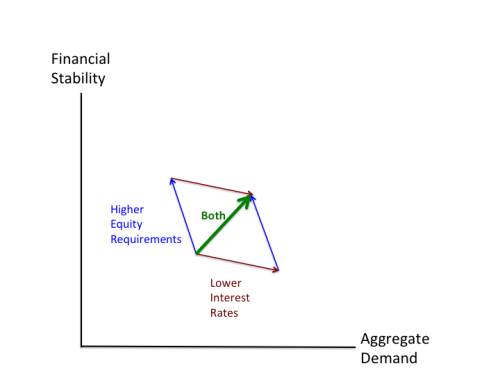
Why negative interest rates should be combined with high equity requirements: In times when unemployment is high, output is below its natural level, and inflation is coming down, low interest rates–and often negative interest rates–are called for. But negative interest rates are much safer in conjunction with high equity requirements. Conversely, when financial instability threatens, high equity requirements are called for, but they are safer when negative interest rates are ready to hand to deal with any negative aggregate demand effects of the high equity requirements. 

At the top of this post, I diagram the idea that high equity requirements have a big positive effect on financial stability, but some negative effect on aggregate demand, while negative interest rates (or more generally low interest rates) have a big positive effect on aggregate demand, but have some effect in reducing financial stability. This means that if high equity requirements and negative interest rates are combined, it is possible to get both more financial stability and more aggregate demand. Low interest rates can more than make up for the reduction in aggregate demand caused by higher equity requirements, while the high equity requirements more than make up for the reduction in financial stability from the negative interest rates. 

2. Negative Short-Term Interest Rates Raise Long-Term Interest Rates. Long-term interest rates matter more for asset prices than short-term interest rates. Therefore, those concerned about financial stability should worry most about low long-term interest rates. There are two reasons the ability to generate a brief period of deep negative short-term interest rates should raise long-term interest rates. The first is that a brief period of deep negative short-term rates is the path to economic recovery if the economy is in a deep recession or a potentially long-lasting slump. Businesses and households are much more eager to borrow when the economy looks healthy than when it looks sick. So interest rates tend to be higher when the economy is doing well than when it is doing badly. It may seem paradoxical that negative rates are the path to higher interest rates, but the paradox is dissolved when one realizes that economic recovery is in between. Because it is the long-term rates that matter most for asset prices, an extended period of years and years of zero interest rates is much more dangerous for financial stability than a brief period of deep negative rates followed by a return distinctly positive interest rates. One of the worst things for financial stability is an unending slump with the economy stuck at an unwisely maintained zero lower bound. 

The second reason having deep negative interest rates in the toolkit allows higher long-term interest rates is that eliminating the zero lower bound and thereby bringing the possibility of deep negative interest rates into the picture means that quantitative easing is no longer needed. As practiced in recent years in the US, the UK and Europe, quantitative easing has involved pushing down long-term interest rates relative to short-term interest rates. This gives a high ratio of pushing asset prices up (”asset price inflation”) relative to the aggregate demand it provides. I claim that cutting short-term rates has a better ratio of extra aggregate demand provided to effect on asset prices. (I owe you an entire post on this point.) 

3. Short of Monetary Policy that Allows a Perpetual Slump, the Medium- to Long-Run Real Interest Rate Situation is Not Affected by Monetary Policy. 

Because central banks operate in important measure by changing interest rates in the short-run, many people think that they determine real interest rates in the medium- and long-run. But unless a central bank allows a perpetual slump, with output continually below the natural level, what happens in the medium- and long-run in real terms is not much affected by what the central bank does. That includes not just what happens to economic growth in the medium- and long-run, but also what happens to the real interest rate. (See “Mario Draghi Reminds Everyone that Central Banks Do Not Determine the Medium-Run Natural Interest Rate.”) So whatever the effect of real interest rates in the medium- and long-run on financial stability, that effect real interest rates in the medium- and long-run is beyond the power of monetary policy to affect–except to the extent the central bank makes things worse for financial stability by allowing a perpetual slump or better for financial stability by escaping a perpetual slump (Argument 2 above). 

If medium- to long-run forces are causing financial instability, this must be fought with non-monetary tools. High equity requirements are the first line of defense. If greater financial stability is desired than high equity requirements (and perhaps a few complementary financial rules) alone can provide, another useful supplementary remedy is a contrarian sovereign wealth fund. (See “Roger Farmer and Miles Kimball on the Value of Sovereign Wealth Funds for Economic Stabilization.” Ever since I wrote “Q&A on the Financial Cycle” I have been aware that even if the economy is kept at the natural level of output at all times so that the business cycle has been stabilized, there would remain the issue of stabilizing the financial cycle if there are noise traders or other forces–such as some version Minsky mechanisms–that continue to cause a financial cycle even in the presence of high equity requirements.)

Conclusion

Negative interest rates are no panacea. They merely make it possible for decisive movements in short-term interest rates to accomplish the basic purpose of monetary policy: keeping the economy in medium-run equilibrium with output at the natural level. 

Negative interest rates are a marvelous solution to empowering monetary policy to do its job, but negative interest rates are no economic policy panacea because monetary policy can’t do everything. In addition to not being the answer to generating long-run economic growth, monetary policy alone can’t create financial stability except at the cost of a sluggish economy. High equity requirements and other approaches to gaining greater financial stability are needed in addition to monetary policy to get good results. Fortunately, since aggregate demand is no longer scarce when deep negative interest rates are available, any drag on aggregate demand from higher equity requirements is not a serious concern. So it is reasonable to push quite far toward higher equity requirements in order to ensure financial stability.

Update: “Long-Run” vs. “Long-Term.” In the discussion of interest rates in the medium- to long-run above, it would be easy to confuse “long-run” with “long-term” and to confuse “medium-run” with “medium-term,” which in turn would make the argument hard to understand. The “medium-run” as the economic concept I mean is a period from about 3 to 12 years out, while the “long-run” is a period beyond 12 years or so. Going toward brevity in my terminology, the short-run is a period from 1 to 3 years out, while the ultra-short run is a period from now to 1 year out.  

By contrast, according to the usual terminology in financial markets, “medium-term interest rates” might be interest rates available now covering a period from now to 2 years from now, or from now to 5 years from now. And interest rates available now covering a period from now to more than 5 years from now would typically be called “long-term” interest rates. Thus, most of the span covered by medium-term interest rates available now is what I would call the “short-run.” And the short-run is even an important part of the span covered by long-term interest rates available now. 

My claim is that short-term forward real (inflation-adjusted) rates from 3 to 12 years out, and certainly beyond 12 years out should be mostly unaffected by any predictable monetary policy unless the central bank is allowing a perpetual slump by not breaking through the zero lower bound.

The K-12 Roots of Moral Relativism

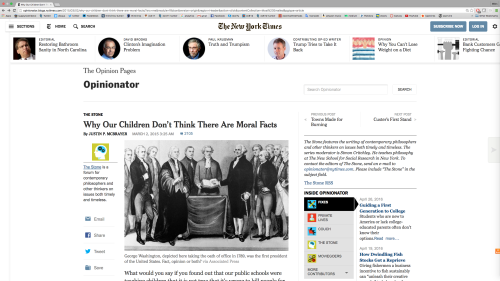
Link to the March 2, 2015 New York Times article “Why Our Children Don’t Think There are Moral Facts” by Justin P. McBrayer

When I was in college, I had many discussions over breakfast, lunch and dinner in Quincy House about whether there was any such thing as truth. My classmates were very quick to take a relativist line, while I argued that there was such a thing as truth. Justin McBrayer, in the article linked above, explains why not only my classmates, but most young adults are so well prepared to take the relativist line. He writes:

When I went to visit my son’s second grade open house, I found a troubling pair of signs hanging over the bulletin board. They read:

Fact: Something that is true about a subject and can be tested or proven.

Opinion: What someone thinks, feels, or believes. …

… students are taught that claims are either facts or opinions. …

Kids are asked to sort facts from opinions and, without fail, every value claim is labeled as an opinion. …

In summary, our public schools teach students that all claims are either facts or opinions and that all value and moral claims fall into the latter camp. The punchline: there are no moral facts. And if there are no moral facts, then there are no moral truths.

Thought of as abstract philosophy, this may not be a very deep position, but it may not seem much worse than many other areas of shallow teaching. But Justin argues that a simplistic belief in moral relativism can have a corrosive effect on moral judgments and even on behavior: 

The inconsistency in this curriculum is obvious. For example, at the outset of the school year, my son brought home a list of student rights and responsibilities. Had he already read the lesson on fact vs. opinion, he might have noted that the supposed rights of other students were based on no more than opinions. According to the school’s curriculum, it certainly wasn’t true that his classmates deserved to be treated a particular way — that would make it a fact. Similarly, it wasn’t really true that he had any responsibilities — that would be to make a value claim a truth. It should not be a surprise that there is rampant cheating on college campuses: If we’ve taught our students for 12 years that there is no fact of the matter as to whether cheating is wrong, we can’t very well blame them for doing so later on.

Indeed, in the world beyond grade school, where adults must exercise their moral knowledge and reasoning to conduct themselves in the society, the stakes are greater. There, consistency demands that we acknowledge the existence of moral facts. If it’s not true that it’s wrong to murder a cartoonist with whom one disagrees, then how can we be outraged? If there are no truths about what is good or valuable or right, how can we prosecute people for crimes against humanity? If it’s not true that all humans are created equal, then why vote for any political system that doesn’t benefit you over others?

The irony is that the urge to separate out facts from opinions or facts from values stems itself from an important value: the value on telling truth according to one’s best judgement of the science, even if telling the truth does not seem likely to move the debate about a political or moral issue in the direction one believes in. This in turn is grounded in the belief that involving many well-intentioned people who have different points of view in the attempt to grind out moral truth in a serious moral debate based on true facts is much more likely to home in on the relevant moral truth than short-circuiting the debate by deception in order to favor one’s own heartfelt views. In moral matters, telling the truth is a sign of respect for other human beings and the value of their views, too.

Mario Draghi Reminds Everyone that Central Banks Do Not Determine the Medium-Run Natural Interest Rate

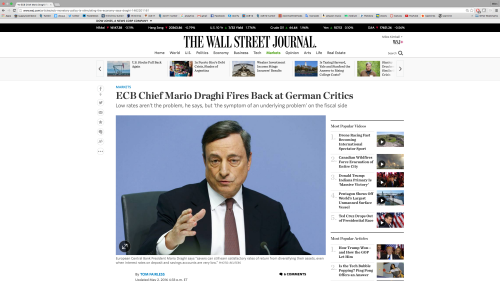
Link to the May 2, 2016 Wall Street Journal article “ECB Chief Mario Draghi Fires Back at German Critics” by Tom Fairless

Many complaints about central bank policy seem to assume that the medium-run natural interest rate is under a central bank’s control. It isn’t. 

In “The Medium-Run Natural Interest Rate and the Short-Run Natural Interest Rate” I define the medium-run natural interest rate as follows:

  • medium-run natural interest rate: the interest rate that would prevail at the existing levels of technology and capital if all stickiness of prices and wages were suddenly swept away. That is, the natural rate of interest rate is the interest rate that would prevail in the real-business cycle model that lies behind a sticky-price, sticky-wage, or sticky-price-and-sticky-wage model.

In the standard view of monetary policy, which is the view that I take, other than keeping the long-run level of inflation low, a central bank’s principle and crucial job is to get the economy as close as possible to the medium-run equilibrium that corresponds to what an economy would do if all prices and wages were perfectly flexible. That is, a central bank’s job is to (1) keep the long-run inflation rate low and (2) do as much as possible to undo the effects of sticky prices and sticky wages on the real variables of the economy. 

By this definition of the medium-run equilibrium, the central bank no control over the real variables in the medium-run equilibrium, other than things such as real money balances in the medium-run equilibrium. And since there is only one level of aggregate demand the gets the economy to the medium-run equilibrium–that is, saying “medium-run equilibrium” already stipulates a level of aggregate demand–the role of real money balances in the medium-run natural equilibrium is quite unexciting.

Using this terminology, hardcore “Real Business Cycle Theory” posits that the economy is always in the medium-run equilibrium, because prices and wages are almost perfectly flexible. But in discussing the nature of the medium-run equilibrium, the question of whether this is true or not is actually immaterial. The medium-run equilibrium is what would happen if the Real Business Cycle Theorists were right, whether they are or not. But the medium-run equilibrium is also close to what would happen if a central bank did a truly excellent job of monetary policy–better than any existing central bank so far, but within the range of possibility.   

If output is below its medium-run equilibrium level, the medium-run natural interest rate is likely to be above the current level of the interest rate. The reason is that businesses and households don’t like to invest when the economy is in a slump. Getting out of the slump tends to raise the interest rate. As I explain in “The Medium-Run Natural Interest Rate and the Short-Run Natural Interest Rate” and “On the Great Recession,” in a slump the path to raising the interest rate up to its higher medium-run equilibrium level is–somewhat paradoxically–through a path of cutting the interest rate in order to bring output up. Once output comes up, the interest rate will come up too. So Anyone who wants a higher interest rate should want the central bank to use a sharp reduction in interest rates for a few quarters in order to bring recovery and a sustainably higher interest rate. To try to go straight to a higher interest rate will push the economy into a worse slump and require lower interest rates to get on track–quite counterproductive from the point of view of those who want higher interest rates. 

Many people don’t understand the limitations of central banks. If they want higher interest rates, they think central banks can go there directly without serious side effects. That doesn’t work. In a slump, central banks need to get to higher interest rates by the proper path of cutting interest rates until the economy recovers; then interest rates can and should be raised. Raising interest rates first is like a sugar high for savers, that will lead to a crash when interest rates then have to be cut to stave off a double-dip recession.    

Just because central banks can’t affect the medium-run natural interest rate that is where things go if they do their jobs doesn’t mean there isn’t any reason to complain about low interest rates. In particular, low medium-run natural interest rates can be a symptom of a low rate of technological progress, which is definitely something to complain about–and something to do something about, by making sure that we fund basic research at a much higher level than we currently do and by making sure we don’t let regulations crush new firms doing new things in promising new ways. 

Less obviously a good thing, increases in government debt can raise the medium-run natural interest rate. And increases in the willingness to take risks can raise the medium-run natural interest rate, which I think is a good thing as long as people are really taking those risks themselves rather than angling to be bailed out by taxpayers. 

Draghi’s Speech

On his recent Asian trip, Mario Draghi, head of the European Central Bank (ECB), defended the ECB from attacks by the powerful argument that a central bank does not control the medium-run natural rate. Here are three key passages from the Wall Street Journal article linked at the top of this post:

1. “There is a temptation to conclude that…very low rates…are the problem,” Mr. Draghi said. “But they are not the problem. They are the symptom of an underlying problem.”

The global savings glut, Mr. Draghi said, is being perpetuated by economies in Asia and in the eurozone, notably Germany. “Our largest economy, Germany, has had a [current account] surplus above 5% of GDP for almost a decade,” Mr. Draghi said. 

2. In unusually blunt criticism last month, German Finance Minister Wolfgang Schäuble called for an end to easy-money policies … suggesting [the ECB’s] low interest rates had hurt savers.

Mr. Draghi directed criticism directly back at Berlin. “Those advocating a lesser role for monetary policy or a shorter period of monetary expansion necessarily imply a larger role for fiscal policy”

3. Mr. Draghi stressed that the ECB’s policies are helping savers, and said governments, not central banks, should address the underlying economic causes of low rates. He also urged savers in Germany to boost their returns by diversifying their investments, mimicking their counterparts across the Atlantic.

“U.S. households allocate about a third of their financial assets to equities, whereas the equivalent figure for French and Italian households is about one- fifth, and for German households only one-tenth,” Mr. Draghi said.

Let me interpret these statements. 1. Mario Draghi effectively says that medium-run international capital flows affect the medium-run natural interest rate. 2. Mario Draghi effectively says that to get the medium-run equilibrium requires closing the output gap either through monetary or fiscal policy. He criticizes German fiscal policy. But the criticism of German fiscal policy is not necessary for the point. The point is just that if fiscal policy doesn’t do it, then monetary policy needs to. As I have pointed out many times, monetary policy is more reliable, simply because it is not tangled up in politics. A sensible approach is to take what fiscal policy one can get politically (after whatever advice one wants to give), then do the rest of the job with monetary policy. 3. Mario Draghi effectively reminds savers that a healthy economy tends to raise interest rates compared to a slump, then makes the interesting point that expected rates of return can be raised by taking on more risk. There is a more subtle point Mario Draghi doesn’t make: if more people raised the expected rate of return on their savings by taking on more risks, then the risk-free rate for those who don’t want to take on those risks is also likely to be higher. The worst thing for savers is if they aren’t eager to take risks and no one else is eager to take risks either. Then everyone tries (unsuccessfully, given limited supply) to crowd into the risk-free assets and lowers their rate of return (or something even worse happens if the central bank doesn’t do its job of keeping the economy as close as possible to the medium-run equilibrium).  

The bottom line is that it is crucial to understand what central banks can and can’t do. Central banks can get the economy close to the medium-run equilibrum, which entails lowering interest rates to raise them (after recovery) and raising interest rates to lower them (after reining in an overheated economy). But central banks cannot determine the interest rate that prevails once they have done their job. To repeat, central banks cannot determine the interest rate that prevails in the medium-run equilibium any more than they can keep output permanently above its medium-run equilibrium. 

As I write in “The Deep Magic of Money and the Deeper Magic of the Supply Side,” the supply side is the place to turn to raise the natural level of output that prevails in the medium-run equilibrium. But those who agree about the supply-side roots of the natural level of output need to also remember that the supply side is the place to turn to raise the natural interest rate that prevails in the medium-run equilibrium. Monetary policy can’t do it. 

Note: The argument of this post is important in the later post “Why Financial Stability Concerns Are Not a Reason to Shy Away from a Robust Negative Interest Rate Policy.” In that later post, you may find the update at the end, “Long-Run” vs. “Long-Term” helpful.