Jacob Barnard: The Great Inversion

Link to Jacob Barnard’s Linked In homepage

I am pleased to host another student guest post, this time by Jacob Barnard. This is the 9th student guest post this semester. You can see all the student guest posts from my “Monetary and Financial Theory” class at this link.


Deciding to invert a corporation is a logical choice resulting from high corporate taxes, not from being a “bad corporate citizen.”

Recently, U.S.-based firm IHS Inc. and U.K.-based Markit Ltd. announced a merger to create a $13 billion data firm. The issue this brings up isn’t an anti-trust matter though, but rather, where its new headquarters is going to be. The current plan is for the new firm to be based out of London, which means it would only have to pay the 20% corporate tax rate used by the U.K. instead of the 35% corporate tax rate in the U.S. This process, known as inversion, has come under fire from many politicians. President Obama has even called corporations that undergo this process unpatriotic and likens it to not being a good corporate citizen. The process is completely reasonable, however, and is popular because of a high corporate tax rate, not a lack of patriotism.

The process of corporate inversion has been made more difficult by a law put in place in 2004, which was meant to eliminate the favorable tax treatment of “surrogate foreign corporations.” These occur if the stockholders of a former U.S. corporation own 60% of the stock in a merged foreign corporation as a result of their previous holdings in the U.S. corporation. The new parent country’s corporation must also account for less than 25% of the merged corporation’s employees, wages, assets, and income for it to be considered a surrogate. That amount is open to interpretation, however, and can be re-interpreted to make inversions harder, which is what the IRS did in 2015.

Clearly, the US government wants to fight inversion. Despite these efforts, however, corporations are still trying to leave. The reason is obvious: the corporate tax rate. The United States has the highest of all OECD countries and third-highest among all reporting countries. The federal corporate income tax rate combined with the average rate paid in each state is 39.1%. The world-wide average is 22.9% and has been dropping for over a decade. The U.S. rate, on the other hand, has stayed the same. As a result, corporations in the U.S. lose more and more money each year by not inverting and already pay an extra 16%. A corporation’s shareholders have the right to hire and fire directors, so they are, and should be, the directors’ main concern, not a country.

The argument some people like to make is that inverted corporations don’t pay their “fair share” because they are receiving the benefits of the U.S. government, military, markets, and infrastructure without paying taxes to the U.S. to pay for these things. The problem with that reasoning is quite simple: they are actually required, by law, to pay their fair share. Foreign corporations pay the U.S. tax on profits earned by their U.S. subsidiaries in the U.S. What is their fair share if not the amount that actually results from business generated in the U.S.? If anything, corporations that stay in the U.S. pay more than their fair shares because, unlike most other OECD countries, the U.S. requires corporations to pay the corporate tax on foreign-earned income in order to repatriate it, minus however much they already paid in foreign corporate taxes. This means the U.S. is taxing corporations on profits earned because of the benefits provided by foreign governments, military , markets, and infrastructures. If foreign corporations aren’t using accurate, “arms-length” transfer prices in order to artificially move income out of the U.S., then that’s a problem, but it’s a problem for almost all multinational corporations with subsidiaries in the U.S., not just inverted ones.

The problem comes right back to our significantly higher tax rate then. If our tax rate is high enough to cause firms to change their behavior this much, perhaps we should start considering whether it might be too high, possibly even decreasing our tax revenue. Even if it isn’t, lowering it would probably be a good idea at this point. Stricter inversion requirements might be enough to keep current corporations in the U.S., but how are we going to convince future corporations to incorporate in the U.S. if the only way to convince current ones to stay is by forcing them to?

John Stuart Mill on the Sources of Prejudice About What Other People Should Do

Many of us have occasion to argue against particular types of prejudice. But John Stuart Mill unmasks all prejudices in the 6th paragraph of the “Introductory” to On Liberty:

But though this proposition is not likely to be contested in general terms, the practical question, where to place the limit—how to make the fitting adjustment between individual independence and social control—is a subject on which nearly everything remains to be done. All that makes existence valuable to any one, depends on the enforcement of restraints upon the actions of other people. Some rules of conduct, therefore, must be imposed, by law in the first place, and by opinion on many things which are not fit subjects for the operation of law. What these rules should be, is the principal question in human affairs; but if we except a few of the most obvious cases, it is one of those which least progress has been made in resolving. No two ages, and scarcely any two countries, have decided it alike; and the decision of one age or country is a wonder to another. Yet the people of any given age and country no more suspect any difficulty in it, than if it were a subject on which mankind had always been agreed. The rules which obtain among themselves appear to them self-evident and self-justifying. This all but universal illusion is one of the examples of the magical influence of custom, which is not only, as the proverb says, a second nature, but is continually mistaken for the first. The effect of custom, in preventing any misgiving respecting the rules of conduct which mankind impose on one another, is all the more complete because the subject is one on which it is not generally considered necessary that reasons should be given, either by one person to others, or by each to himself. People are accustomed to believe, and have been encouraged in the belief by some who aspire to the character of philosophers, that their feelings, on subjects of this nature, are better than reasons, and render reasons unnecessary. The practical principle which guides them to their opinions on the regulation of human conduct, is the feeling in each person’s mind that everybody should be required to act as he, and those with whom he sympathizes, would like them to act. No one, indeed, acknowledges to himself that his standard of judgment is his own liking; but an opinion on a point of conduct, not supported by reasons, can only count as one person’s preference; and if the reasons, when given, are a mere appeal to a similar preference felt by other people, it is still only many people’s liking instead of one. To an ordinary man, however, his own preference, thus supported, is not only a perfectly satisfactory reason, but the only one he generally has for any of his notions of morality, taste, or propriety, which are not expressly written in his religious creed; and his chief guide in the interpretation even of that. Men’s opinions, accordingly, on what is laudable or blameable, are affected by all the multifarious causes which influence their wishes in regard to the conduct of others, and which are as numerous as those which determine their wishes on any other subject. Sometimes their reason—at other times their prejudices or superstitions: often their social affections, not seldom their antisocial ones, their envy or jealousy, their arrogance or contemptuousness: but most commonly, their desires or fears for themselves—their legitimate or illegitimate self-interest. Wherever there is an ascendant class, a large portion of the morality of the country emanates from its class interests, and its feelings of class superiority. The morality between Spartans and Helots, between planters and negroes, between princes and subjects, between nobles and roturiers, between men and women, has been for the most part the creation of these class interests and feelings: and the sentiments thus generated, react in turn upon the moral feelings of the members of the ascendant class, in their relations among themselves. Where, on the other hand, a class, formerly ascendant, has lost its ascendancy, or where its ascendancy is unpopular, the prevailing moral sentiments frequently bear the impress of an impatient dislike of superiority. Another grand determining principle of the rules of conduct, both in act and forbearance, which have been enforced by law or opinion, has been the servility of mankind towards the supposed preferences or aversions of their temporal masters, or of their gods. This servility, though essentially selfish, is not hypocrisy; it gives rise to perfectly genuine sentiments of abhorrence; it made men burn magicians and heretics. Among so many baser influences, the general and obvious interests of society have of course had a share, and a large one, in the direction of the moral sentiments: less, however, as a matter of reason, and on their own account, than as a consequence of the sympathies and antipathies which grew out of them: and sympathies and antipathies which had little or nothing to do with the interests of society, have made themselves felt in the establishment of moralities with quite as great force.

People often have feelings about the conduct of others. If person A is able to insist that another person B should do X because not doing X makes A feel bad, this could imply a tyrannical domination by A of others like B unless the scope of A’s legitimate sphere for concern and insisting about B’s and others’ actions is limited somehow. It won’t work to give each person a sphere of decisive influence over all the things that shehe cares about because those spheres of decisive influence would be overlapping–meaning they wouldn’t be spheres of decisive influence at all. Somehow, the legitimate sphere of decisive influence for each person must be delimited in a way that doesn’t lead to too much overlapping. 

Of course, it is possible to have decisions made jointly by several different people. But in cases of stubborn disagreement, there must be some mechanism for deciding–even if that mechanism is flipping a coin. Dividing up as much as possible into separate spheres of decisive influence in which one person is dominant has been a very useful strategy to minimize the need to use other social choice mechanisms like voting that tend to constantly raise the possibility of conflict. John Stuart Mill’s advocacy of both civil and social liberty can be seen as advocating an equitable division of spheres of decisive influence more or less in line with the physical body of each person and (for the most part) the fruits of each person’s labors.  

Economists have done some work on subtle social choice mechanisms that are not in such common use as the division of spheres of decisive influence and voting. In the case of each such social choice mechanism, a key question is how it could be made a staple of everyday social choice as voting, flipping a coin or the division of spheres of decisive influence are. Or to put it another way, a social choice mechanism has only fully come into its own as a general purpose method if children on the playground often use it to resolve their disputes.         

Chris Matthews on Negative Interest Rates

Link to the October 21, 2015  fortune.com article “Ben Bernanke sees the upside of negative rates.”

I was pleased to see, belatedly, the fortune.com article “Ben Bernanke sees the upside of negative rates” by Chris Matthews. Chris quotes from and links to my Quartz column “America’s huge mistake on monetary policy: How negative interest rates could have stopped the Great Recession in its tracks.”

Chris’s other link is also interesting: he links to Joshua Franklin’s October 16, 2015 reuters.com article “Swiss bank ABS plans negative interest rates for some depositors.” The key passages there are:

“On transactional accounts … there will be negative interest rates of -0.125 percent from the first franc,” the ABS spokeswoman said, adding that this would come into effect from the start of next year. …

Major banks like UBS and Credit Suisse have introduced deposit charges for some large clients but Swiss broadcaster SRF said ABS would be the first Swiss bank to introduce negative rates for smaller clients.

August Klatt: The Luck of the Draw

tumblr_inline_o4u5o3Jl5O1r57lmx_400.png

A college degree obtained during an expansion and a college degree obtained during a recession are two very different things.

I am pleased to host another student guest post, this time by August Klatt. This is the 8th student guest post this semester. You can see all the student guest posts from my “Monetary and Financial Theory” class at this link. This is the 2d guest post by August. Don’t miss his previous guest post: “Is the NFL Trying to Hide Something by Injecting Bias into Head Injury Science?”


Quick, graduate as fast as you can before another recession hits. The United States has made a full recovery from the Great Recession and there hasn’t been a better time to be a college grad. Josh Zumbrun of the Wall Street Journal reports that income for college graduates is at its highest levels since 2003. The median income for recent college graduates is now $43,000, (ages 22-27) which is $3000 more than the previous year’s median. In addition, the unemployment rate for recent college grads (4.9%) is almost down to pre-recession levels. These numbers seem refreshing as I am currently a junior in college, but as we learned from the Great Recession, things can change quickly. If you have the opportunity to graduate soon, take advantage of it!

How much does it really matter whether you graduate in good times or bad times? The short answer: a lot. The National Bureau of Economic Research conducted a study to determine the effects of graduating in a recession. They concluded that recent graduates lost 9% in their wages initially, which went down to 4.5% by fives years, and showing no loss in wages by the tenth year. 

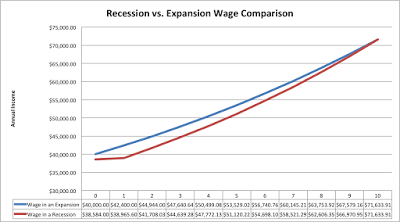
For the graph at the top, I created a projection of wages of an individual that graduates in a recession versus an expansion using the data that the National Bureau of Economic Research provided. The projection uses the most accurate data I could find, but I am not claiming that my assumptions used are perfect. I assumed a starting salary of $40,000 for the individual in the expansion, and an initial salary of $38,584 for the individual hired in the recession (9% less than the expansion individual). I also assumed the losses in wages from 9% to 0% in 10 years decreased at a linear rate. Both individuals obtained a 6% increase in wages annually, which is very reasonable considering most people see 70% of their wage increase in the first 10 years of working. One of the reasons behind these large wage increases has to do with the fact that younger professionals change jobs more frequently. According to Cameron Keng workers who stay in their jobs are getting raises of 3% on average, while workers who change companies are getting a 10% to 15% salary increase. I thought that 6% was a good middle ground to build the model off of.

The area between the two lines is the loss in wages for the individual who unluckily graduated in a recession. From this projection, the loss turns out to be a little more than a $20,000 over the 10 years. Keep in mind that I am assuming these two individuals are identical in every way, except for the timing of their graduation. That’s a lot of money to lose for being purely unlucky.

Many of these losses come from the lack of jobs available, which can lead to students taking jobs at smaller companies or ones that aren’t the best fit for them. These drops in wages also only account for the students who actually get jobs. It doesn’t account for the rise in the unemployment rate. In the Great Recession, the unemployment rate reached 7% for recent grads. That extra 2% rise in the unemployment rate represents recent grads that are making zero income that would have been making a wage in an expansion.

In the first 10 years of a career, it is likely to see 70% of the wage increases. As a college student with more than likely lots of debt, you want to take full advantage of this wage growth right out of school. There’s nothing you can do to affect the economic conditions when you graduate, but these differences in wages are real and unfortunate.

Zhi Ying Lin: Why Are People So Upset About Uber’s Surge Pricing—And Should They Be?

Link to Zhi Ying Lin’s Linked In homepage

I am pleased to host another student guest post, this time by Zhi Ying Lin. This is the 7th student guest post this semester. You can see all the student guest posts from my “Monetary and Financial Theory” class at this link.


People should not be upset about Uber’s surge pricing as it creates market efficiency. Uber though, should improve its model by representing some of the variation in pricing as a discount and creating a loyalty program to reduce passengers’ dissatisfaction.

There has been an outrage against Uber for charging its passengers more than the normal rate on busy days. On this past New Year’s Eve, many passengers posted their receipts from Uber on social media websites to complain about the “ridiculously” inflated fare. There were some riders who paid more than $200 for a 20-minute ride, but Matthew Lindsay from Canada, probably paid the highest price of all - $800 for a 60-minute ride.

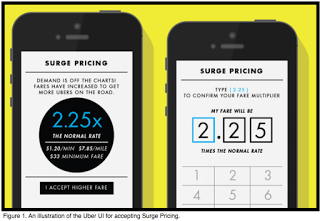
This happened because Uber adopts surge pricing as its core business strategy. This model uses an algorithm that calculates the fare multiplier based on the supply and demand for rides. When the demand exceeds the supply in a particular area, the base fare gets multiplied to attract more driver-partners. 

People feel upset about surge pricing because they treat the base fare as a reference point. So, when there is a price surge, they feel that they get ripped off because to them, the base fare is the price that they “should” be paying. After all, most traditional taxis and buses have fixed pricing schemes with predetermined prices regardless of time. Why should Uber surge its prices during peak hours?

First, it ensures adequate supply of driver-partners on busy days. As we all know, it is always hard to hail a cab on rainy days or during peak hours because drivers, who are limited to a 20% wage hike, face very little incentive to drive. Like Princeton economist Henry Farber put it, some drivers stop driving simply because it is less pleasant to drive in the rain, and there is no additional benefit in continuing to drive.

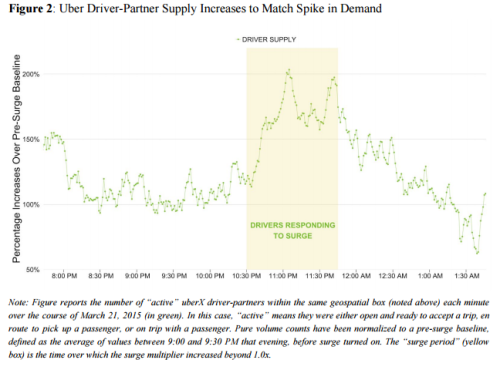
To increase driver’s incentives, Uber allows surge pricing, which essentially removes the price cap. Though this strategy is still not perfect, Uber’s economists managed to prove that there is a high correlation between surge pricing and a rise in driver-partners supply.

In addition, due to a technical glitch, they managed to demonstrate the negative effects of not having surge pricing on busy days. Findings show that as fares dropped to normal, completion rates fell dramatically and waiting times increased.

Besides increasing the supply of driver-partners, surge pricing also helps to control the demand for rides. It makes sure that those who value the service more are able to secure rides. Though some people might argue that surge pricing is a form of price gouging, it creates much-needed incentives for people to think harder about what they really need. This means that those who really, really need a ride–and are willing to pay the surge prices–will always be able to get a ride. 

Given the benefits of surge pricing, it would be great if Uber could find a way to reduce customer discontent about surge pricing, rather than abandon surge pricing. One way to do this would be represent some of the variation in prices as a discount, rather than a premium. As mentioned earlier, riders treat the base fare as a reference point, so prices that are higher than the reference point are considered as losses, while prices below that seem like gains. As suggested by this paper, Uber could charge its passengers inflated prices during peak hours and give large discounts during off-peak hours, with the reference price somewhere in between. When the higher regular price becomes the reference point, passengers will not feel the losses that they experience under the current system. They will feel like they gain something from the discounted prices on regular days. The right level for the reference price between the minimum and maximum prices can be chosen by the kind of experimentation that an online platform like Uber is well set up to do. Of course, Uber should do this in the context of educating customers about the benefits of having a price that adjusts to equate supply and demand in real time. 

Another, complementary approach that can be combined with an intermediate reference price is for Uber to give loyalty points to frequent app users that can be used to pay for surge pricing. Customers who have enough loyalty points might then even experience the surge prices as a gain, since they can feel satisfaction that they accumulated enough loyalty points to pay for the surge pricing. Customers who don’t have enough loyalty points to pay for the above-reference part of the price will at least then have hope that they can have enough loyalty points to pay for surge prices in the future. This can help to shift a part of the responsibility in a customer’s mind from the company to the customer her- or himself. It also has the usual benefits of loyalty points–the encouragement to use the app more frequently. Isn’t it great to kill two birds with one stone?

The economic argument for surge pricing is strong: bring out more drivers when they are needed and help make sure those who need a ride most can still get one, even during peak times. The problem is customer dissatisfaction with surge pricing, due to the principle of loss-aversion and notions of fairness that fail to take these benefits of surge pricing into account. So Uber should keep its surge pricing, but raise the reference price so that sometimes the price variation looks like a discount, and let customers pay for the part of surge prices above the reference price with loyalty points. Making surge pricing work better psychologically can preserve the benefits of real-time price variation to match supply and demand. 

Ki Bum Kim: The Economic Craziness of Korean Marriages

Link to Ki Bum Kim’s Linked In homepage

I am pleased to host another student guest post, this time by Ki Bum Kim. This is the 6th student guest post this semester. You can see all the student guest posts from my “Monetary and Financial Theory” class at this link.


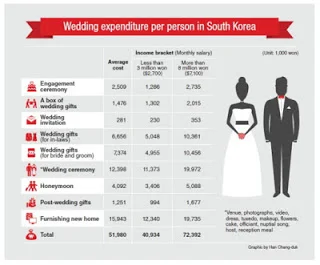
Getting married in Korea is not easy. So much money has to be spent and the unique Korean marriage culture of gift giving is the place to point the finger. In Korea, the groom’s side and the bride’s side both present gifts to each other’s families. “Gift trading” goes all the way back until the ancient Joseon Dynasty of 1392. Traditionally, good silk for new clothes and simple jewelry were exchanged. Today in 2016, mink fur coats, luxury watches, jewelry, and expensive designer shoes are exchanged.

This continued tradition of gift exchanges has become a huge burden for young couples. To the point where marriages are called off. Many couples call them off because of the expected amount of money often differs between the two families. Ms. Park, a 30 year old Korean woman who recently cancelled her marriage a week before the wedding, confided to the Korean Herald that she could not handle the stress from her fiancé’s mother. She said the problem initially arose when the mother-in-law asked for a $70,000 Mercedes-Benz car for her son in return for the house her fiance’s family bought.  

Park’s family eventually made a loan and bought the car because they were happy in getting a lawyer son-in-law. However , Park’s mother-in-law criticized her for not buying luxury watches for the in-laws, saying, “This is because you were not well educated in your family.” Ms. Park decided then she could no longer continue with the wedding.

Along with the power duels, the “show-off” mentality that some Korean parents have adds onto the pile of stress for couples. Parents want to boast their wealth and power by holding lavish weddings. Data shows that “the average cost for a wedding in 2011 rose about 270 percent from 1999.” The average cost of weddings is $90,000. The hefty fee poses no problem for rich people who can manage to do that. However, the problem lies within the normal people whose average income is roughly $42,400 according to government data.

Ewha Woman’s University Professor Harris Kim in his explanation of why Koreans financially strain themselves over weddings blame the Korea’s social stigma surrounding weddings. “Korean society is very tightly knit, and people here are very concerned about how others view them. The wedding works as a status symbol, like a marker of where you stand in the society.”  

The mentality is quite hard to understand. Ignoring the cost of a lavish wedding does not seem “forward-looking.” The youth unemployment rate is increasing each year, reaching a high time of 10% in 2015. Housing prices are also skyrocketing. The rent in Seoul, the capital of South Korea is growing and growing. Yet, some people contemplate about buying Rolex watches and Benz cars. 

Kisun Lee, a 29-year-old consultant at Impact Consulting, sums the situation up perfectly. “None of that expensive jewelry is actually useful or beautiful, and you know you’ll just regret using the money for that after you’re actually married and need money for your married life.

Fortunately, there is a budding trend among young couples who overpower their parents and spend frugally on weddings, who decide no gifts shall be exchanged. The government has also begun to help by turning its public buildings, town halls and service centers into inexpensive wedding venues during the weekends.

Tibor Scitovsky: Mankind is Desperately Anxious to Have an Index of Welfare

National account statisticians have long been aware, of course, of some of these problems and have warned against the use of national product or income estimates as an index of welfare. But since mankind is desperately anxious to have an index of welfare, such warnings have always fallen on deaf ears.

– Tibor Scitovsky, “The Place of Economics Welfare in Human Welfare,” May 17, 1973 David Kinley lecture at the University of Illinois at Urbana-Champaign. (Available as chapter 2 in Human Desires and Economic Satisfaction.)

Kfir Eliaz and Ran Spiegler: Incentive Compatible Advertising on a Social Network

My colleague here at the University of Michigan Kfir Eliaz and his coauthor Ran Spiegler have made the first ever theatrical trailer for a technical economics paper. He gave me permission to share this email with you:

Hi Miles,

I have a new paper with a colleague in tel-aviv (Ran Spiegler) called “incentive compatible advertising on a social network”. Though the paper is on a topic which is not related to your interests, we made a cinematic trailer for it (to the best of our knowledge, the FIRST EVER cinematic trailer for an academic paper), which you may still enjoy (full screen view and high volume is recommended). The trailer is posted here.

The actual paper is posted here.

Best, Kfir

William Wagner III: Scientific Cheating

Link to William Wagner III’s Linked In homepage

I am pleased to host another student guest post, this time by William Wagner III. This is the 5th student guest post this semester. You can see all the student guest posts from my “Monetary and Financial Theory” class at this link.


The importance that academics has placed on getting material published has led to bad science and even worse statistics.

The world of professional academics is a world unlike any other. With a laid back environment as well as a varying work schedule, the academic culture is very different than that of the typical corporate culture. Recently, there has been an aspect of the culture that has troubled many people. In 2014 on Inside Higher ED, Colleen Flaherty wrote a piece entitled Evaluating Evaluations where she discussed a study that displays the changing importance of different roles played by academics. She reports, “The study, out in the ‘American Association of University Professors’ journal Academe, also suggests that collegiality as a criterion for tenure and promotion is on the decline, and that value increasingly is being placed on research and publication – even for professors at teaching-oriented liberal arts institutions.” This usually comes as no surprise to most academics. They know that publishing is the most important part of their job. The term 'Publish or Perish" has become a colloquial term on campus due to this emphasis. This added pressure has put academics in a tough position, and has had troubling consequences.

When an academic is faced with either publishing or perishing they are left with few options. The first, and hopefully least utilized, is fraud. Make up a study, create fake data, and publish fake results. Most people agree that this type of academic fraud is not very common due to the strict penalties that have been put in place for people if found guilty. So what are the other options? NPR’s Planet Money explores what many academics are doing on Episode 677: The Experiment Experiment. They claim that–across a broad range of scientific fields–the push for publication has led many academics to cut corners and publish bad scientific findings. In particular, teasing data into being significant enough to publish. A simple, yet very helpful example they give on the podcast is studying flipping a coin. This coin is totally ordinary, with a 50-50 chance to land on either side, but–for argument’s sake–pretend we are ignorant of that fact. We start out by flipping the coin 10 times and 7 times it comes up heads. These results seem to indicate that there is a bias towards heads, but there isn’t enough proof to make a statistically significant finding. At this point the academic has a choice to either abandon the experiment and have nothing to show, or maybe continue on and see what else can happen. Maybe after flipping four more times–all of which happen to come up heads, boom, there is a “significant” result! Now the not-so-scientific scientific investigator has enough evidence to make a conclusion about coin flipping–a conclusion that in reality is false.

These kinds of practices have corrupted science, and lead to many false findings. These finding then go on to have real world implications, with potentially dangerous impacts on society. Brain Nosak, for example, pioneered the “Replication Project,” where replication of past successful psychology experiments was done to test their validity by testing their ability to be replicated. Following the original procedures in each case, they replicated 100 experiments. Out of those 100 they were only able to replicate the original findings 36 times. Similar problems exist in economics as well. 

What can be done? There are at least three schools of thought. The first is to force researchers to register each study in advance, reporting on their intended methods of data collection and analysis. This forces them to stick to their original procedure, and not keep altering it until a “significant” result is found.  the data. The second idea is to have institutions place less emphasis on publication and place a higher importance on other things such as student evaluations (which have their own problems). The third is to increase the professional rewards for trying to replicate other scientist’s results so the genuine results are more often sorted out from the spurious results. What is clear is that something needs to be done.


Update: In a comment on Miles’s Facebook post for this, Arthur Lewbel writes “A much simpler way to address much of the problem: use 4 sigma instead of 2 sigma as the standard of significance.” I (Miles) think that suggestion has a lot of merit to it. In any case, people should have to be much more apologetic about having a p-value (probability of a finding being the result of chance if there wasn’t any tinkering) as high as 5%, and only feel good about a result if the computed p-value is more like .1%, so that even if there was some tinkering there is a half-decent chance the result is genuine.

Taehyun Nam: South Korea on the Road to a Cashless Society

Link to Taehyun Nam’s Linked In homepage

I am pleased to host another student guest post, this time by Taehyun Nam. This is the 4th student guest post this semester. You can see all the student guest posts from my “Monetary and Financial Theory” class at this link.

Taehyun discusses South Korea’s goal to get to a “cashless society.” I want to emphasize that although abolishing cash might be a good idea, it is not necessary to abolish cash to eliminate the zero lower bound. My proposal for eliminating the zero lower bound would keep cash in the picture, but move cash further from the center of the monetary system. Abolishing cash is a separate decision from eliminating the zero lower bound. 


The South Korean government should not falter becoming a cashless society that opens the underground economy, solves the circulation problem, prevents crimes, and provides more monetary policy options.

Bill Gross from Janus Capital once said, “The cashless society which appears over the horizon may come sooner than the demise of the penny.” My home country, South Korea, is no exception. Cash in Korea is slowly losing its presence and getting replaced by credit/debit cards. The Bank of Korea has recently announced its plan to become a “cashless society.”

According to the Bank of Korea’s survey with 2,500 Koreans with age of 19 or older in last August and September, Koreans are gradually carrying less cash. On average, they had $61.29 cash in their wallets. Senior citizens in their 50s carried $70.40 per person, whereas people in their 20s had only $41.41 cash per person in their wallets. In fact, even the seniors are now using debit cards more. In recent five years, the number of payment in debit card by people with age of 50s and 60s increased by four times, while the ratio of payment in cash plunged from 51% in the mid 2000s to 17% today. Moreover, 90.2% and 96.1% of survey participants carried credit and debit cards, respectively.

As cash is losing its popularity as a payment method, the government plans to eliminate coin by 2020 and achieve the “cashless society” afterwards. My first initial reaction to this news was, “Dr. Miles Kimball [professor for my Monetary and Financial Theory class] will be thrilled with this news!” On the contrary, the general public in Korea ranted.

<Tirade of the General Public in Korea>

Screen Shot of Comments on the Related Article on FacebookComment #1: It’s obvious that the stock prices of credit card companies would skyrocket. Korean companies have low respects for privacy. Seems like Korean politicians do not even know whether…

Screen Shot of Comments on the Related Article on Facebook

Comment #1: It’s obvious that the stock prices of credit card companies would skyrocket. Korean companies have low respects for privacy. Seems like Korean politicians do not even know whether seniors use cards or cash. - 217 Likes

Comment #2: This is unacceptable… Cashless society… This is totally unacceptable. - 606 Likes

#3: Why would they bother to change? Cards are for convenience. They are not essential. - 294 Likes

Such outrageous reactions are understandable. I also see some downsides of the cashless society, what I call them “5Cs”:

  • Confusion in the society and negative reaction from the public. 
  • Card payment’s and fintech’s unfamiliarities to senior citizens.
  • Card transaction fee issue.
  • Concerns over security and privacy in Korea.
  • Contingency plan to temporary malfunctions of electronic money system is nonexistent.

With these pitfalls, however, I still argue that the Korean society should become cashless. The economic benefits are hard to be ignored.

1. Open the underground economy

Becoming cashless will legalize the underground loan market and prevent the related transactions of billions of dollars without proper tax payments. Moreover, because electronic transactions are tractable in the cashless society, significantly less number of people would get involved in illegal prostitutions. On average, each prostitute has approximately 5 clients per night, and some even have 20. In the cashless society, there will be less illegal cash transactions without proper tax payments in the prostitution market. Instead, the customers in this market will rather consume and invest on legal activities. In fact, McKinsey report says, “The cashless society will cut costs equivalent to between 0.1 and 1.1 percent of GDP.” The data present that countries with below 50% rate of payment in cash have the shadow economy taking only 12% of gross domestic product (GDP). In contrast, those with over 80% rate of payment in cash have the underground economy taking 32% of GDP. Therefore, by becoming cashless, not only the South Korean government can collect more tax, but also the Korean economy would be stimulated by higher consumptions and investments.

2. Solve the currency circulation problem

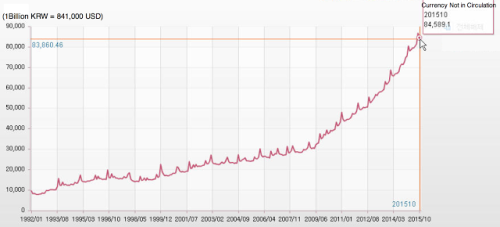
Since 2009, the Bank of Korea has issued 2.2 billion papers of 50,000-won notes (50,000 Korean Won = $42.04, as of March 14th 2016). However, 1.2 billion of them has not been returned yet. The total amount of currency not in circulation was near $310 billion in 2009, but it more than doubled to $718 billion in 2015. Once the society transitions into the cashless society, people will be forced to bring their slush funds out and make more consumptions and/or investments. Again, the government can assemble more tax and boost the economy.

<Currency Circulation Problem in South Korea>

3. Prevent crimes & Allow more monetary policy options

Many crimes involved with cash will dwindle considerably in the cashless society. These include tax evasion, violence or plunder over cash, tax evasion, and bribery. In addition, electronic money enables countries to adopt negative interest rates in order to spur the economic activities. Such monetary policy is not feasible in a cash society, as people might put their cash in their safes. More information about negative interest rates policy with electronic money could be found in Dr. Kimball’s blog post “How and Why to Eliminate the Zero Lower Bound: A Reader’s Guide.

Scott Sumner—The Media's Blind Spot: Negative Interest on Reserves

tumblr_inline_o4cu9zp7gt1r57lmx_250.jpg

Link to the original post on the Library of Economics and Liberty blog

Scott Sumner was one of the first people to suggest negative interest on reserves, back in early 2009. Although he has directed most of his energy toward promoting nominal GDP level targeting (which I discuss in “Optimal Monetary Policy: Could the Next Big Idea Come from the Blogosphere?”), Scott also argues forcefully that negative interest on reserves can stimulate the economy. I am grateful to Scott Sumner for permission to mirror this post here. Here is Scott:


The media has an agenda, which covers its reporting of negative interest on reserves (IOR). Let’s review the evidence:

In late January, the Bank of Japan cuts interest rates into negative territory and does a bit more QE. The yen plunges in value and the Nikkei soars higher. So negative IOR seems expansionary.

Here’s what happened next, according to commenter Mikio from Japan:

The story background is the same. There is a lot resistance in Japan against negative rates - and BOJ official soon after the decision started to “appease” critics of negative rates that “it’s not that bad, we are not really going to charge you interest, don’t worry, very little will change”.

Markets began to rally again only after BOJ Deputy Governor Hiroshi Nakaso on 12th Feb. in NY made clear that there is still “no limit” to QE and that BOJ can cut rates further into negative territory, and that those who think the BOJ has reached its limit are “wrong”.

In short:

1) Nikkei rose when the initial announcement was made

2) Fell when BOJ started blurring the message

3) Rose again when BOJ corrected the message

It’s funny how many people find it so difficult to see these things. That’s what’s “head-scratching”…

This all seems pretty clear to me, but just in case Mikio and I are wrong, let’s see how the European markets react to negative IOR.

European stocks soar and the euro falls on a 12:45 pm announcement by the ECB that the policy rate will be cut deeper into negative territory. Then at 1:56 Draghi seems to abandon his “whatever it takes” approach, and indicated that no further rate cuts were likely. The euro soars in value and stocks plunge. Then overnight, ECB officials rush to reassure investors that they are serious about monetary stimulus, and stocks soar the next day. Exact same story as in Japan.

But let’s say that even that is wrong. Early today the BOJ gives us another experiment, this time refusing to cut rates. The yen rises and Japanese stocks fall sharply. Zero Hedge suggested that the lack of rates cuts today was not a big surprise, but this was:

BOJ REMOVES LANGUAGE FROM ITS STATEMENT THAT IT WILL CUT INTEREST RATES FURTHER INTO NEGATIVE TERRITORY IF JUDGED

So all of these market moves suggest that negative IOR is clearly expansionary, just as economic theory would predict. But bankers don’t like negative IOR. So even as the markets are telling us (indeed screaming at us) that negative IOR is expansionary, the business press tells us the opposite, even though all of the natural experiments discussed above were accurately reported in the FT.

Today’s FT is an especially egregious example. Here’s the headline:

Equities slip as BoJ holds steady

When I see the headline I think to myself “Finally, the FT will get it right!”

The story starts off in a promising direction:

The yen is firmer, and stocks and commodity prices softer, after the Bank of Japan downgraded its view of the world’s third-biggest economy but made no change to monetary policy.

Then things start to go awry:

The central bank’s surprise move to push interest rates into negative territory on January 29 has had the opposite effect to what was desired for the yen.

What! Didn’t the yen plunge much lower on the January 29th announcement? Has the FT not heard of the Efficient Markets Hypothesis? The markets don’t react with a one-week lag to policy announcements. And didn’t today’s reaction to the lack of a rate cut further confirm that negative IOR is expansionary?

Then things start to get back on track:

Such fretting has boosted the “haven” yen, leaving it up more than 6 per cent for the year versus the US dollar.

OK, that’s good; the term ‘fretting’ clearly refers to Draghi’s suggestion that no more rate cuts are coming, and similar statements out of Japan.

But then everything falls apart:

“The empirical record indicates multiple episodes of central bank easing actions that resulted in large and opposite reactions to those intended. Those that succeeded either coincided with positive fundamental developments or were part of a package that led to expectations of such,” he said.

I’m sort of in a state of shock. Time after time after time the markets clearly signal that negative IOR is expansionary. Even the press can hardly fail to report the immediate market reaction to negative IOR. And yet they are somehow unable to actually report what is starring them in the face, and instead find Binky Chadha, who tells them that up is down and black is white.

P.S. I don’t know why Chadha is unable to see the obvious, but someone more cynical than me might note who employs him. If Upton Sinclair were alive today, he might have this to say:

It is difficult to get a man to understand something, when his salary depends on his not understanding it.

P.P.S. BTW, people often get confused by these posts. I’m not a big fan of negative IOR, or indeed any form of interest rate targeting. I prefer NGDPLT, or if not that then price level targeting, or if not that then QE. Negative IOR is way down my list.

HT: JP Koning


Let me add some more recent news that helps make Scott’s point about the effectiveness of negative rates, though fortunately not about media obtuseness. On March 18, 2016, Tom Fairless and Todd Buell reported in the Wall Street Journal 

ECB President Mario Draghi surprised investors last week by saying he doesn’t expect to cut rates again, shortly after unveiling a major new stimulus. His comments caused the euro to spike against the dollar after initially falling and sent financial markets sprawling after they initially surged in response to the stimulus.‎

But on Friday, ECB Chief Economist Peter Praet said fresh rate cuts were still on the table. That sent the euro lower against the dollar.‎

“A rate reduction remains in our armory,” Mr. Praet said in an interview published on the ECB’s website Friday. “We have not reached the physical lower bound.”

Although our emphases are different, Scott and I are in basic agreement about many things. Here are some other posts on supplysideliberal.com that involve Scott Sumner:

I also have these links on supplysideliberal.com because I liked the posts so much:

Darwin Hadley: Americans Moving to Europe for Free Tuition

Link to Darwin Hadley’s Linked In homepage

I am pleased to host another student guest post, this time by Darwin Hadley. This is the 3d student guest post this semester. You can see all the student guest posts from my “Monetary and Financial Theory” class at this link.


The costs of attending college in the United States are growing every year. The price of books, dorms, and tuition is very expensive. The College Board reports that a “moderate” college budget for an in-state public college for the 2015–2016 academic year averaged $24,061 and for a private school was $47,831. Many Universities in Europe offer low or even free tuition for citizens and international students. As student debt and the costs to attend college grow in the future more Americans will consider the possibility to attend school in Europe.

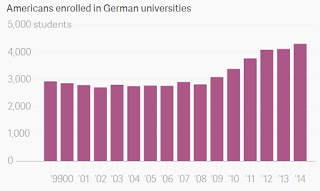
Americans are traveling to Germany, England, Finland, Sweden, and many other countries to attend college for free. In 2015, more than 4500 US students are fully enrolled at Germany universities, an increase of 20% over three years. The graph shows the growing trend of Americans enrolling in German universities. The main reason for the increase is the cheap cost of attending college and the quality education. Hunter Bliss, a South Carolina native, is attending Technical University of Munich (TUM), one of the most highly regarded universities in Europe. The tuition costs of Hunter attending school at TUM is $120 compared to South Carolina which costs $10,000. The cost savings just in tuition are enormous. Also, many of the programs at the German universities are taught in English. At Technical University in Munich 20% of students are non-German. The University president is keen to have every single graduate program offered in English, and only in English, by the year 2020. 

European colleges also have lower non-tuition expenses. Hunter, the South Carolina student, pays $20 a month as a semester fee which includes a transportation card around the city of Munich. Hunter pays only $280 in rent and $80 in health insurance. $280 for rent is cheap compared to many places in Ann Arbor where rent is around $800 or more a month. Another student, Katherine, a graduate of Pennsylvania State University, spent less than €500 ($570) a month in Cottbus, which included housing, transportation and healthcare. The chart shows the monthly costs for three students attending Universities in Germany.  

The costs savings for attending college outside the US are large, but the student may have a hard time coming back to America. Many students that attend college in Europe stay in Europe to work. Students may have a hard time finding a job in the US because of the small number of alumni connections. Also, many students don’t come back to the United States because they love living in Europe. 2 students interviewed by CNN stated they have no plans on returning to the United States in the future. Hannah Remo said, “I 100% have my heart set on staying in Europe. I disagree with the way a lot of things are run at home. It blows my mind that college is so expensive in the U.S., it makes me think that I don’t want to raise a family there.”

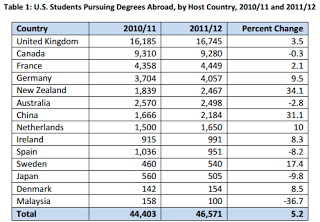
Students leaving the United States to pursue a degree abroad is gaining momentum. The Institute of International Education reported that in the school years 2010/2011 and 2011/2012 the percentage of US students pursuing degrees abroad increased 5.2%. Also, Ulrich Grothus, deputy secretary general of the German Academic Exchange Service, said that in Germany between 2003 and 2013 the number of Americans pursuing a degree increased by 56 percent. Americans pursuing a college education abroad is growing and will continue to grow as tuition increases.

The cost of education in the US is very expensive. Many individuals are attending universities in other countries because of cost savings and traveling opportunities. “The cost is what makes people think about going to college abroad, but then they start to see the other benefits like learning a new language, travel opportunities, and being prepared to work in a global economy”, said Jennifer Viemont, the founder of an advising service called Beyond The States. If the government does not come up with a solution to fix the high cost of education and high student debt more students will decide to leave the country for college. 

Social Liberty

image source;&nbsp;link to Wikipedia article on Bhimrao Ramji Ambedkar, who campaigned against social discrimination against Untouchables in India

image sourcelink to Wikipedia article on Bhimrao Ramji Ambedkar, who campaigned against social discrimination against Untouchables in India

Like B. R. Ambedkar, whose words you can see above, John Stuart Mill argued that protecting civil liberty is not enough; social liberty must also be protected. It is possible to force most people into conformity with prevailing opinion by criticism, disapproving glances, and mockery of nonconformity. Here is how John Stuart Mill puts it in the 5th paragraph of the “Introductory” to On Liberty:

Like other tyrannies, the tyranny of the majority was at first, and is still vulgarly, held in dread, chiefly as operating through the acts of the public authorities. But reflecting persons perceived that when society is itself the tyrant—society collectively, over the separate individuals who compose it—its means of tyrannizing are not restricted to the acts which it may do by the hands of its political functionaries. Society can and does execute its own mandates: and if it issues wrong mandates instead of right, or any mandates at all in things with which it ought not to meddle, it practises a social tyranny more formidable than many kinds of political oppression, since, though not usually upheld by such extreme penalties, it leaves fewer means of escape, penetrating much more deeply into the details of life, and enslaving the soul itself. Protection, therefore, against the tyranny of the magistrate is not enough: there needs protection also against the tyranny of the prevailing opinion and feeling; against the tendency of society to impose, by other means than civil penalties, its own ideas and practices as rules of conduct on those who dissent from them; to fetter the development, and, if possible, prevent the formation, of any individuality not in harmony with its ways, and compel all characters to fashion themselves upon the model of its own. There is a limit to the legitimate interference of collective opinion with individual independence: and to find that limit, and maintain it against encroachment, is as indispensable to a good condition of human affairs, as protection against political despotism.

As an academic, I notice how powerfully the opinion of other economists–whether right or wrong–operates in controlling the behavior and the research priorities of the typical academic. It is hard to think of many people who could be more safe from harsh practical consequences for a dissenting opinion than tenured professors, yet most still meekly follow the opinion of the crowd within their discipline. Is this the way it should be? Is this the way to best advance science? I don’t think so. Surely, a bit greater variance in expressed opinion would be more productive of scientific progress than the degree of conformity that prevails within most scientific disciplines, including economics. 

Turning to a non-scientific social norm in economics, to my mind there is too much emphasis on sheer quantity of mediocre publications within economics (at least if those mediocre publications are in top journals) relative to (a) the quality of work that comes from spending the time to think deeply about issues before trying to publish and (b) quantity of searching and wide-ranging discussion with other economists. 

Fortunately, I think the economics blogosphere is beginning to right this balance. The economics blogosphere is the kind of freewheeling domain that John Stuart Mill is recommending. I am willing to predict that the continued progress of the economics blogosphere will improve the ability of economics as a discipline to process ideas and to gain greater intellectual depth. 

Update: Bruce Bartlett emailed this and said I could share it with you:

… good point about social liberty today. This is an issue that today’s libertarians almost never mention because they are concerned with one aspect of liberty and one only—freedom from government coercion. Implicitly, all private coercion is okay as long as it is not illegal. Thus discrimination against blacks, women, immigrants, gays etc is all okay in the libertarian world. To admit otherwise would force libertarians to admit that government can play a positive role in expanding liberty. I have never once heard a libertarian praise the Civil Rights Act of 1964, which did more to expand liberty in this country than anything else in the last 50 years.

Bruce also sent the link to his Cato Unbound post “Freedom is More Than Small Government,” and wrote “Check out American Amnesia by Hacker & Pierson. Due out shortly.”

One thing this discussion makes me realize is that abridgements of social liberty are not just against intentional nonconformity but also against being born different, or simply being born in a group to which undesirable difference is imputed. 

Kevin Grier and Norman Maynard on the Economic Consequences of Hugo Chavez

We use the synthetic control method to perform a case study of the impact of Hugo Chavez on the Venezuelan economy. We compare outcomes under Chavez’s leadership and polices against a counterfactual of “business as usual” in similar countries. We find that, relative to our control, per capita income fell dramatically. While poverty, health, and inequality outcomes all improved during the Chavez administration, these outcomes also improved in each of the corresponding control cases and thus we cannot attribute the improvements to Chavismo. We conclude that the overall economic consequences of the Chavez administration were bleak.

– Kevin Grier and Norman Maynard, abstract for “The economic consequences of Hugo Chavez: A synthetic control analysis"

How Negative Interest Rates Prevail in Market Equilibrium

Many people have the intuition that even if paper currency were out of the picture, other things that pay a zero interest rate would still create a zero lower bound, so that an attempt to take the target rate into deep negative territory would fail. Among them is one of the greatest economics bloggers of them all: John Cochrane. In his Grumpy Economist post “Cancel Currency?” he writes:

Suppose we have substantially negative interest rates – -5% or -10%, say, and lasting a while. But there is no currency. How else can you ensure yourself a zero riskless nominal return?  

Here are the ones I can think of:  

  • Prepay taxes. The IRS allows you to pay as much as you want now, against future taxes.
  • Gift cards. At a negative 10% rate, I can invest in about $10,000 of Peets’ coffee cards alone. There is now apparently a hot secondary market in gift cards, so large values and resale could take off.
  • Likewise, stored value cards, subway cards, stamps. Subway cards are anonymous so you could resell them.
  • Prepay bills. Send $10,000 to the gas company, electric company, phone company.
  • Prepay rent or mortgage payments.
  • Businesses: prepay suppliers and leases. Prepay wages, or at least pre-fund benefits that workers must stay employed to earn.

My brother Chris and I answer this argument in “However Low Interest Rates Might Go, the IRS Will Never Act Like a Bank.” The set of things that can create a zero lower bound can be narrowed down considerably by the two key principles we explain there: 

  1. Giving a zero interest rate when market interest rates are in deep negative territory (say -5%) is a money-losing proposition. Private firms are unlikely to continue very long in providing such an above-market interest rate to individuals wanting to store money with them.
  2. Anything that can vary in price cannot create a zero lower bound: negative interest rates will either cause its price to go up enough that expected depreciation gives it a negative expected return, or potential price variation will make its return risky enough it is clear there is no risk-free arbitrage to be had. This rules out things such as gold or foreign assets from creating a zero lower bound, unless a credibly fixed exchange rate or an established price of gold is in play. 

What is left? The only other category I can see are opportunities to lend to a government within the central bank’s currency zone at a fixed interest rate. But even there, there is another logical proviso on what can create a zero lower bound. I explain in “How to Keep a Zero Interest Rate on Reserves from Creating a Zero Lower Bound”:

[3.]… a zero interest rate that only applies to a limited quantity of funds does not create a zero lower bound. The reason that our current paper currency policy creates a zero lower bound is that under current policy banks can withdraw an unlimited quantity of paper currencyand redeposit it later on at par. By contrast, within-year prepayment of taxes is possible but practically limited to the amount of the tax liability. (Between tax years a typically nonzero interest rate based on the market yield of short-term U.S. obligations applies.)

Thus, other than paper currency:

IRS interest rates between tax years are set by the Secretary of the Treasury in line with market short-term rates, such as the Treasury bill rate. They are no stickier than the Secretary of the Treasury wants them to be. It is true that a sufficiently determined Secretary of the Treasury could probably thwart a Fed move to negative interest rates by offering convenient saving at a zero interest rate through the tax system. But I don’t think the Fed would be likely to go to deep negative rates in any case without some degree of tacit backing from the Executive Branch. (I do think that with the Executive Branch’s tacit backing, the Fed might go to deep negative rates despite complaints in Congress if it thought that was necessary for the economy.)

Finally, suppose I am wrong about the willingness of private firms to lose money by continuing to offer a zero interest rate when many market rates have gone substantially negative. In “Banking at the IRS,” John Cochrane argues that private interest rates are sticky at zero. There is still a limit to how much a firm can allow individuals to store at an above-market zero interest rate without going bankrupt, and in practice, the quantity limit of how much value a firm will allow people to store at a zero interest rate is much tighter than that.   

Let’s get more concrete about the sheer magnitude of the task of finding zero interest ways of storing one’s money when the central bank is bidding up the price–and therefore down the interest rate–of Treasury bills as far as it can before investors sell over the whole stock of Treasury bills. To make the calculations easier, let me imagine that before going to negative rates, that a central bank has done enough quantitative easing that most of the national debt in private hands is in the form of short-term Treasury bills that have a negative rate. In that case, the net debt-to-GDP ratio (based on government debt in private hands) puts a floor on how much in funds private individuals will be trying to shift into zero interest rate opportunities. Actually, to this should be added the paper currency to GDP ratio too, since under my proposal, paper currency carries a negative rate of return because of its gradual depreciation against electronic money. (It is only because paper currency would have a negative rate of return under my proposed policy that the discussion in this post even arises.) Here are a few interesting net debt/GDP ratios rounded to the nearest full percent as of the latest update of the Wikipedia article “List of countries by public debt” in 2012. I doubt many of these numbers have gone down since then:

  • Australia: 17%
  • Austria: 51%
  • Belgium: 106%
  • Canada: 37%
  • Denmark: 8%
  • Finland: -51%
  • France: 84%
  • Germany: 57%
  • Greece: 155%
  • Ireland: 102%
  • Israel: 70%
  • Italy: 103%
  • Japan: 134%
  • Netherland: 32%
  • Norway: -166%
  • Portugal: 112%
  • Spain: 72%
  • Sweden: -18%
  • Switzerland: 28%
  • United Kingdom: 83%
  • United States: 88%

Certainly, in the eurozone, Japan, the United Kingdom, the US and Canada, the task of finding zero interest rate opportunities for all the funds that start out in government debt is daunting. Countries like Norway that have a substantial sovereign wealth fund show that the amount of money the public holds in government bills and bonds–surely a positive number–can be larger than the government debt with assets netted out–in Norway’s case, a negative number. So the net debt to GDP ratios above are only the start of how much people might face a negative interest rate in that they are trying to escape. 

The biggest single opportunity for getting a zero interest rate when rates in general are negative is typically tax system. I suspect that most countries have much less wiggle room for playing with the timing of tax payments than the US. For example, the rules for the timing of paying VAT taxes probably don’t have the same kind of wiggle room. And even in the US, the wiggle room on the timing of payments is probably much greater for households than for firms. In the US, tax revenue as a percentage of GDP is something like 27%.  But shifting tax payments from being paid each month as the income comes in to being paid on January 1, say, only shifts that 27% forward by 6.5 months on average, since some of the payments are already early in the year. Or for those who pay quarterly, things might be shifted forward by 7.5 months. (7.5/12) * 27% is less than 17%. (This is composed of up to 27% of GDP at a zero interest rate at the beginning of the year, and much less at a zero interest rate toward the end of the year.) 

That limit of 17% of annual GDP (averaged over the year) that can get a zero interest rate is far short of the 88% that individuals and firms in the US and abroad will want to find in zero US interest rates. Along the lines of “How to Handle Worries about the Effect of Negative Interest Rates on Bank Profits with Two-Tiered Interest-on-Reserves Policies,” throw in bank account assets amounting to 4% of annual GDP in individual bank accounts exempted from a negative interest rate supported by subsidies through the interest on reserves formula. (The effective subsidy needed is not 4% of GDP, but the absolute value of the interest rate times 4% of a year’s GDP, say |-4%| per year times 4% of yearly GDP, or .16% of GDP on a flow basis.) Beyond the bank accounts subsidized to have a zero interest rate, then throw in a generous several percent of annual GDP worth of prepayment opportunities that the private sector will allow, and still those now holding government debt will fall far short of finding enough zero interest opportunities to shift their liquid assets into. When I say that is generous, remember that the flow that can be prepaid needs to be multiplied by the length of time it can be prepaid to get the stock of wealth that can be shielded from zero interest rates. Other than prepayment of mortgages–which is already a big issue even at positive interest rates–most opportunities to prepay are limited to about 90 days, which is much lass than in the tax system. 

Even with substantial opportunities to get a zero interest rate, if individuals and firms have liquid assets left over that can’t get a zero interest rate, then the key market rates can go into deep negative territory as the central bank bids up the price of Treasury bills so that, say it costs $10,100 to buy a promise from the Treasury of $10,000 three months from now: a -4% annual yield.

So far, central banks that have gone to negative interest rates have done so tentatively. Still, interesting adjustments are beginning to happen. Here is a passage from Tommy Stubbington’s December 8, 2015 Wall Street Journal article “Less Than Zero: Living With Negative Interest Rates”:   

Danish companies pay taxes early to rid themselves of cash. At one small Swiss bank, customer deposits will shrink by an eighth of a percent a year.

But it isn’t all bad. Some Danes with floating-rate mortgages are discovering that their banks are paying them every month to borrow, instead of charging interest on their home loans. …

… other peculiar consequences are sprouting. In Denmark, thousands of homeowners have ended up with negative-interest mortgages. Instead of paying the bank principal plus interest each month, they pay principal minus interest.

“Hopefully, it’s a temporary phenomenon,” said Soren Holm, chief financial officer at Nykredit, Denmark’s biggest mortgage lender by volume. Mr. Holm said the administration of negative rates has gone smoothly, but he isn’t trumpeting the fact that some borrowers get paid. “We wouldn’t use it as a marketing tool,” he said.

Negative rates have cost Danish banks more than 1 billion kroner ($145 million) this year, according to a lobbying group for Denmark’s banking sector.

“It’s the banks that are paying for this,” said Erik Gadeberg, managing director for capital markets at Jyske Bank. If it worsens, Jyske might charge smaller corporate depositors, he said, then maybe ordinary customers. “One way or another, we would have to pass it on to the market,” Mr. Gadeberg said.

In Switzerland, one bank already has. In October, Alternative Bank Schweiz, a tiny lender, sent letters to customers with some bad news: They were going to be charged for keeping money in their accounts.

The Swiss central bank has a deposit rate of minus 0.75%, and Martin Rohner, chief executive of ABS, decided enough was enough. The costs were eating up the firm’s entire profit, he said. He set a rate of minus 0.125% on all accounts.