The Swiss National Bank and Bank of Japan’s New Tool to Block Massive Paper Currency Storage

The Bank of Japan’s New Negative Interest Rate Policy 

The Bank of Japan surprised the world by going to negative interest rates on January 29, 2016. You can read more about that move in Reporting on Japan’s Move to Negative Interest Rates and in these 3 news articles (1, 2, 3). But there are important aspects of the Bank of Japan’s new policy that are only now being appreciated. 

I have written a great deal about negative interest rate policy. (I have organized relevant links here.) But, thanks to Noah Smith pointing me to Martin Sandbu’s February 4, 2016 article in the Economics “Free Lunch: There is no lower bound on interest rates,” I realize that the Swiss National Bank–with the Bank of Japan following in its footsteps–has hit upon an additional tool for blocking massive paper currency storage that I hadn’t thought of. Here is how Martin Sandbu describes it:

But the Bank of Japan’s set-up for negative rates, which apparently follows the Swiss National Bank’s, casts doubt on the premise that the nominal cost of holding cash is zero. As we have explained, if a private Japanese bank wishes to exchange its central bank reserves for cash, the BoJ will adjust the portion of its reserves to which negative rates apply by the same amount. That means any extra cash that a bank wishes to hold will cost it as much as if it kept it on deposit at the central bank.

And here is the description from the Bank of Japan’s official statement about its new negative interest rate policy:

2. Adjustment concerning a significant increase in financial institutions’ cash holdings 

In order to prevent a decrease in the effects of a negative interest rate due to financial institutions’ cash holdings, if their cash holdings increase significantly from those during the benchmark reserve maintenance periods, the increased amount will be deducted from the macro add-on balance in (2). In cases where the increased amount is larger than the macro add-on balance, the amount in excess of the macro add-on balance will be further deducted from the basic balance in (1).

A Negative Paper Currency Interest Rate on Cumulative Net Withdrawals from the Cash Window

What is fascinating is this: a central bank can effectively impose a negative interest rate on additions to cash holdings by saying that any bank with access to the cash window is on the hook for whatever paper currency interest rate the central bank decides to charge on cumulative net withdrawals of paper currency by that bank after a certain date regardless of who actually ends up with that paper currency. Then it is up to the bank to figure out how and whether to pass on to its customers the negative paper currency interest rate it faces on that extra paper currency. Martin Sandbu’s article has a nice discussion of how pass-through might work. 

One chink in the armor of this mechanism for imposing negative interest rates on cumulative net withdrawals of paper currency would be if a bank went bankrupt after withdrawing a huge amount of cash at the cash window and handing off that cash to favored individuals. But that doesn’t seem like a big issue. Surely the number of banks that have access to the cash window willing to intentionally go bankrupt to help favored individuals get paper currency not subject to the negative interest rate is limited, and there may be some way for the government to prosecute the individuals who organized this scheme of using bankruptcy to circumvent the negative interest rate on additional paper currency.     

No Limit to How Low the Marginal Paper Currency Interest Rate Through the Negative Rate on Cumulative Net Cash Withdrawals Mechanism Can Go

One thing that the Bank of Japan may not yet have realized is that banks can be charged for net cash withdrawals even beyond an amount equal to the bank’s initial reserves. As it is now, the policy is represented as a policy about how much of reserves is exempted from the negative interest rates, or even receives a +.1% interest rate, but that need not be the case. Banks can be charged interest on cumulative net cash withdrawals quite apart from how their reserve accounts are handled. For now, the Bank of Japan has made a good choice to charge the negative paper currency interest rate through the formula for interest on reserves, but it should not stop there if very large amounts of paper currency are withdrawn. 

The Central Bank Can Limit Cash Withdrawals by Limiting the Total Size of the Monetary Base

Speaking of the possibility of cash withdrawals exceed initial reserves, another additional tool that I will mention only briefly is that if negative interest rates are adequate to get velocity up on a given monetary base, limits on the monetary base may limit the total amount of paper currency that can be withdrawn. This is a point I take from Martin Sandbu, who wrote in “Free Lunch: There is no lower bound on interest rates”:

And how could private banks honour mass withdrawals of cash even if they wanted to? No law provides for the central bank to swap client deposits for cash; only central bank reserves. And despite the huge growth of reserves in recent years, these still amount to only a fraction (about one-fifth in the UK) of bank deposits.

What If the Paper Currency Interest Rate is Lowered in the Future?

It might seem unfair for a central bank to lower the interest rate on cumulative net cash withdrawals that are already out there. There is a flavor of retroactivity to it. But if a bank only gets a -.2% rate on net withdrawals after a certain date and -.1% before, then it might try to withdraw a lot of paper currency right before it predicted the paper currency interest rate on further net withdrawals after would be cut. If it knows the rate can be cut on what is already out there, there is no such incentive to pull out cash under the wire. 

An alternative to making rate cuts on net paper currency withdrawals retroactive to the inception of the negative interest rate policy would be to have a schedule saying that, for example, a bank gets -.1% on the first 5% of its previous year’s reserve balance in cash, -.2% on the next 5%, -.3% on the next 5% after that, etc.  

A Warning: Side Effects of a Negative Paper Currency Interest Rate on Cumulative Net Withdrawals from the Cash Window

Although the central bank can easily do so to the private bank, it is probably not as easy for that private bank to keep charging a retail customer a negative interest rate month after month on cumulative net cash withdrawals. In principle, a bank could keep charging such a “rental fee” on net cash out to a customer, but what is to stop a customer from withdrawing a lot of cash, and then cutting all ties to the bank? (This is analogous to the intentional bankruptcy discussed above, but much easier.) Even if a contract still obligated the former customer to keep paying the rental fee on the net cash out, it is a lot of trouble for the bank to track that customer down and collect the fee–especially for modest amounts. 

As a result, private banks are likely to charge a substantial one-time fee on withdrawal of cash to make it worth their while to give out cash, or impose severe restrictions on cash withdrawals. This will interfere with the normal use of paper currency. This may not happen immediately, but is likely to emerge over time (and of course depends on exactly what interest rate the Bank of Japan is imposing, and how long banks expect negative interest rates to last). 

What is worse, restrictions or fees on withdrawals by themselves will tend to push the value of paper yen in circulation–on which fees have already been paid–above the value of electronic yen. If banks charge a fee for giving out paper currency, so can retailers. In Japan, many, many retailers only accept paper currency even now. If paper currency is going at a premium, more and more retailers are likely to declare that they only accept paper currency. This further paperization of the Japanese economy will make negative electronic interest rates less effective. (The negative paper currency interest rates don’t do the trick because they are not passed through; therefore, the burden falls on the negative electronic interest rates and on transactions made in electronic form.)

In addition to these serious problems from a paper currency policy that pushes paper currency above par, the exact exchange rate between paper currency and electronic money could be quite volatile. That is, the effective exchange rate between paper currency and electronic money that follows a jagged path over time like a stock price plot as people get new information about the future. 

By contrast, in my main proposal of a time-varying paper currency deposit fee at the cash window, if a private bank passes the time-varying paper currency deposit fee to retail customers (including extra cash upon withdrawal), the effective exchange rate between paper currency and electronic money at the bank will follow a very smooth, sedate path. I recommend that smooth, sedate path–with a below-par rather than above-par value for paper currency.    

How the Bank of Japan’s Policy Uses Two Key Innovations I Have Made in Negative Interest Rate Paper Currency Policy

In addition to giving a well-attended presentation on “Breaking Through the Zero Lower Bound” at the Bank of Japan on June 18, 2013 (and on June 24, 2013 at Japan’s Ministry of Finance), I spent 2 weeks each in the summers of 2008 and 2009 as a visiting research fellow at the Bank of Japan, and have several former students on staff there. I also made a point of arranging a seminar at the Bank of Japan on June 8, 2010 (on an unrelated paper) in order to have a chance to remind the staff at the Bank of Japan about the potential of negative interest rate policy. So I am confident that some staffers within the Bank of Japan have read my work carefully (including my work with Ruchir Agarwal on the IMF Working Paper “Breaking Through the Zero Lower Bound,” which is prominently featured here). 

I have no idea whether those who actually designed the Bank of Japan’s new policy have read my work or not. Nevertheless the Bank of Japan’s new policy has the two key features that are my innovations over the negative interest rate paper currency policy tools laid out by Willem Buiter

  1. Existing paper currency is used.
  2. The policy is focused on the central bank’s interaction with private banks. The private banks are left to decide pass-through on their own.

The advantage of using existing paper currency is obvious. The advantage of letting private banks handle pass through is that the private banks, for their own benefit, will be inventive at trying to minimize the annoyance to customers from the negative interest rate policy as much as possible given what the central bank has done. In addition, having the central bank focus only on its interaction with private banks makes the central bank’s job more manageable. It doesn’t need to think through quite as many things, since the private banks have, in effect, been deputized to work out the details of what happens at the retail level. (One limitation to this principle is that there has to exist some way for the private banks to pass the policy through–or not–that goes some distance toward achieving the macroeconomic goals without serious side effects.)  

How the Bank of Japan’s Paper Currency Policy is Different from the One I Recommend

In my presentations to central banks around the world, I warn of the problems that arise from trying to restrict or penalize withdrawal of paper currency. We may soon learn more about these problems from experience. And of course the details of the policy matter. In the case of the Bank of Japan’s policy, the emergence of an above-par, jagged price of paper currency and further paperization of the economy by more and more retailers only accepting paper currency are the most worrisome problems.

Note that–as discussed above–these problems have to do with the particular difficulties private banks will have in passing through the negative paper currency interest rates in the form that the Bank of Japan is imposing them on the banks. If the banks could pass the negative paper currency interest rates on in a similar form, there would be no great problem.   

The best course would be to follow my recommendation of a gradually changing below-par value for paper currency at the cash window of the central bank. If restrictions, penalties or fees on withdrawals–or what will result in private banks imposing restrictions, penalties or fees on withdrawals–must be used, they should be used in combination with other policies, including policies that tend to push the price of paper currency down. The possibility of second- or third-best negative interest rate paper currency policies that try to keep the relative price of paper currency close to par is the subject of an upcoming post. 

Why the Bank of Japan’s Move is So Remarkable

I thought it would be at least another year–into 2017–before the Bank of Japan went to negative interest rates–partly because to do so would be a tacit admission that its previous QE-only policy was not working as hoped. It was a genuine act of courage for the Bank of Japan’s monetary policy committee to admit that it needed something more. I applaud them. 

But what is even more remarkable is that they were willing to begin to modify paper currency policy. And make no mistake, as a practical matter, it is paper currency policy traditions that create the zero lower bound. So the Bank of Japan has made a small step down the road toward abolishing the zero lower bound–a small step that could ultimately be part of a giant leap for humankind.
Update 1: A reader points out that the Bank of Japan’s statement of its policy above can easily be interpreted as applying only to a bank’s own holdings of paper currency, which would not include paper currency it passed on to customers. (Many people have, in fact, interpreted it that way.) In that case, this would be a charge for storage of paper currency rather than a charge for cumulative net withdrawals of paper currency by banks. If that is the right interpretation, I am glad I misunderstood the statement so I could see the interesting possibility of a charge on cumulative net withdrawals. But I am also glad to be corrected about what the actual current policy is.  

In the event, if a bank made large paper currency withdrawals to pass paper currency on to customers, I suspect the Bank of Japan would try to do something to discourage that flow. Since the Bank of Japan is making the policy itself (and there is a tradition in Japan of administrative discretion) a private bank should worry about what the Bank of Japan would do if the private bank became a conduit for a large amount of paper currency to customers. 

Update 2: The Swiss National Bank’s corresponding statement for its policy (on which the Bank of Japan’s policy is probably modeled) is clearer:

Minimum reserve requirement of the reporting period 20 October 2014 to 19 November 2014 times 20 (static component). –/+ Increase/decrease in cash holdings resulting from comparison of cash holdings in current reporting period and corresponding reporting period in given reference period (dynamic component) = Exemption threshold

Thanks to JP Koning for this point.

Update 3: Makoto Shimizu gives an answer to Update 1. This is so important, it has its own post. Don’t miss “Makoto Shimizu Reports on the Bank of Japan’s New Tool to Block Massive Paper Currency Storage.”

John Stuart Mill on the Historical Origins of Liberty

In one sense, I have completed blogging my way through John Stuart Mill’s On Liberty. You can access the links to these posts from my post John Stuart Mill Applies the Principles of Liberty. But I realize that I did not discuss the “Introductory” first section of On Liberty with the same thoroughness that I did the later sections. And an introduction takes on a new meaning after carefully considering the remainder of a book. So I want to complete my treatment of On Liberty by circling back to the Introduction.

In the first words of On Liberty, John Stuart Mill briefly mentions the philosophical issue of free will, to distinguish it from his own topic of civil liberty and social liberty:

THE SUBJECT of this Essay is not the so-called Liberty of the Will, so unfortunately opposed to the misnamed doctrine of Philosophical Necessity; but Civil, or Social Liberty: the nature and limits of the power which can be legitimately exercised by society over the individual. 

For those who are interested in the philosophical topic of free will, I recommend Daniel Dennett’s book Elbow Room: The Varieties of Free Will Worth Wanting. Daniel’s Elbow Room helped me personally in dealing with the vertigo from confronting the issue of free will when my belief in the supernatural faded around 1999. (Unfortunately, it didn’t provide any help with my profound dismay caused by the fading of my belief in a supernatural afterlife.)

After distinguishing his topic from free will, John Stuart Mill launches into a history-in-a-nutshell of the origins of the idea of liberty. The starting point for this history, is the point made in Leveling Up: Making the Transition from Poor Country to Rich Country and echoed in The Government and the Mob

Designing strong but limited government that will prevent theft, deceit, and threats of violence, without perpetrating theft, deceit, and threats of violence at a horrific level is quite a difficult trick that most countries throughout history have not managed to perform. 

Or as I wrote in “Why Thinking about China is the Key to a Free World,”

Freedom is a rarity in human history, and still too much of a rarity in the world today. This should be no surprise. Would-be tyrants abound, and it is not easy to establish a system that keeps them all in check. 

Chaos and anarchy tend to make life nasty, brutish and short. So some kind of government is necessary (even if that government is called a “security firm” as in some discussions of anarcho-capitalism). But anyone or any institution strong enough to keep order is strong enough to be a potential danger to the freedom of everyone else from being bossed around or worse. Thus, a key aspect of liberty is what limits can be placed on the ruler. This is the gist of the rest of the remainder of the first two paragraphs of On Liberty:

A question seldom stated, and hardly ever discussed, in general terms, but which profoundly influences the practical controversies of the age by its latent presence, and is likely soon to make itself recognised as the vital question of the future. It is so far from being new, that, in a certain sense, it has divided mankind, almost from the remotest ages; but in the stage of progress into which the more civilized portions of the species have now entered, it presents itself under new conditions, and requires a different and more fundamental treatment.

The struggle between Liberty and Authority is the most conspicuous feature in the portions of history with which we are earliest familiar, particularly in that of Greece, Rome, and England. But in old times this contest was between subjects, or some classes of subjects, and the Government. By liberty, was meant protection against the tyranny of the political rulers. The rulers were conceived (except in some of the popular governments of Greece) as in a necessarily antagonistic position to the people whom they ruled. They consisted of a governing One, or a governing tribe or caste, who derived their authority from inheritance or conquest, who, at all events, did not hold it at the pleasure of the governed, and whose supremacy men did not venture, perhaps did not desire, to contest, whatever precautions might be taken against its oppressive exercise. Their power was regarded as necessary, but also as highly dangerous; as a weapon which they would attempt to use against their subjects, no less than against external enemies. To prevent the weaker members of the community from being preyed on by innumerable vultures, it was needful that there should be an animal of prey stronger than the rest, commissioned to keep them down. But as the king of the vultures would be no less bent upon preying upon the flock than any of the minor harpies, it was indispensable to be in a perpetual attitude of defence against his beak and claws. The aim, therefore, of patriots was to set limits to the power which the ruler should be suffered to exercise over the community; and this limitation was what they meant by liberty. It was attempted in two ways. First, by obtaining a recognition of certain immunities, called political liberties or rights, which it was to be regarded as a breach of duty in the ruler to infringe, and which, if he did infringe, specific resistance, or general rebellion, was held to be justifiable. A second, and generally a later expedient, was the establishment of constitutional checks, by which the consent of the community, or of a body of some sort, supposed to represent its interests, was made a necessary condition to some of the more important acts of the governing power. To the first of these modes of limitation, the ruling power, in most European countries, was compelled, more or less, to submit. It was not so with the second; and, to attain this, or when already in some degree possessed, to attain it more completely, became everywhere the principal object of the lovers of liberty. And so long as mankind were content to combat one enemy by another, and to be ruled by a master, on condition of being guaranteed more or less efficaciously against his tyranny, they did not carry their aspirations beyond this point.

Here, John Stuart Mill neglects another key part of the historical background for the concept of liberty. Until remarkably recently in human history, most people had some encounter with slavery–whether subjected to it, imposing it, or observing it. To those who know slavery first hand or even second hand, one of the foremost meanings of liberty is “not slavery.” And indeed, those fighting for political liberty of the sort John Stuart Mill describes above often used literal slavery as an analogy for how they would feel about a ruler who imposed his will on them too much. So any history of the idea of liberty should pay attention to slavery as well as to more overtly political activities. 

In the history of the United States, one of the most poignantly troubling moments was when agreement on the Constitution–that has done so much in the end to protect all of our liberties–was secured by sacrificing the liberty of enslaved Americans for an additional several generations. And in understanding the tragedy of that decision, consider that not only was the path of immediate emancipation not taken, even paths that would have taken at least a generation to end slavery–such as ending the importation of newly enslaved human beings and declaring that the children of slaves would be free–were roads not taken.

Remittances in International Finance

Link to the Economist article “Like manna from heaven: How a torrent of money from workers abroad reshapes an economy”

The recycling of currency to its home currency area is crucial to understanding international finance and trade balances. As I laid out in “International Finance: A Primer,” unless someone abroad–outside the US dollar zone–intends to accumulate a pile of dollar-denominated assets, then once dollars are abroad, the only way those dollars can get back home is by being used to buy exports from the US. And imports in the US send dollars back abroad, so it is only net exports that can get them back home to stay. So sending unwanted dollars abroad inevitably leads to more net exports from the US, with US dollar exchange rates doing whatever it takes to make that happen. 

It is theoretically possible that changes in the exchange rate might change what people want to do with their investments. But it seems much likely to me that exchange rates mainly cause the adjustment of dollar flows from net exports to balance out other dollar flows, while exchange rate movements cause relatively little adjustment of capital flows or other dollar flows. 

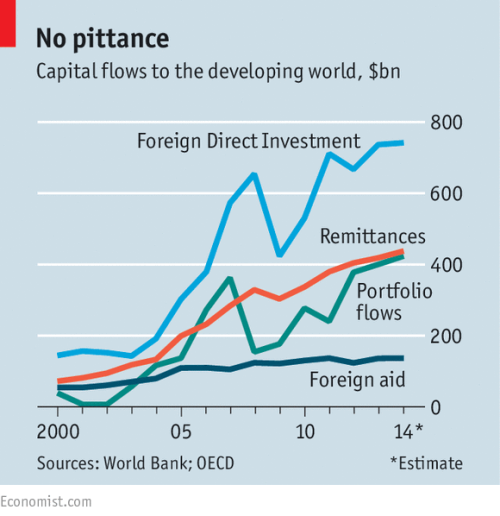
That currency tends to make its way back to its home currency area–and any exception is treated as a capital flow–is often expressed through the equation NCO = NX: net capital outflows equal net exports. But remittances–relatives sending money home from their work abroad–and to a lesser extent foreign aid, cause currency flows as well. The graph at the top, from the very interesting Economist article “Like manna from heaven,” shows the importance of remittances. 

Consider currency flows in and out of India. One could track the flow of rupees, but an alternative is to track the flow of all other currencies in and out of India. Except when Indians want to accumulate or decumulate piles of foreign-currency-denominated assets, foreign currency that comes in will go out to buy foreign goods as imports–or actually as net imports if some round trips from balanced bits of trade are ignored. For this, it doesn’t matter how the foreign currency comes in (unless it is from intentional selling foreign assets, which we are leaving aside). Whether the dollars or other foreign currency arrives from foreign direct investment in India (minus FDI going out of India), foreign portfolio investment (minus intentional portfolio investment going out of India), remittances or foreign aid, those dollars or other foreign currency will make their way back out buying net imports.  

Don’t assume that raising net imports is a bad thing. As “Like manna from heaven” indicates, the resources from remittances in particular allow many families to have nicer houses, buy more refrigerators and other appliances, and give them enough financial leeway that they are willing to let their daughters stay in school longer. Most of the money from abroad is spent on things that I personally applaud.

Density is Destiny

Economically, cities have a certain magic we don’t yet fully understand. In his Wall Street Journal piece Urban Planet: As World Crowds In, Cities Become Digital Laboratories, Robert Lee Hotz quotes some key urbanists thus: 

By studying dozens of per capita measures world-wide, Dr. Bettencourt and theoretical physicist Geoffrey West detected a fundamental pattern underlying the growth of all cities, from ancient Mexico to modern China. In studies over the past 12 years, they determined that every time the population of a city doubles, every individual measure of human interaction there also increases by 15% to 20%.

Not so long ago, futurists predicted that the ease of electronic connectivity would make big cities obsolete. Instead, Harvard University economist Edward Glaeser and others now say that improvements in information technology strengthen cities that are centers of innovation by speeding the flow of ideas. Urban density facilitates contact between smart people and fosters innovation, increasing urban incomes as new businesses take hold, they say.

“With cities, we increase the possibility of more interactions among ourselves, to create the buzz of a city, to create more ideas, more wealth. That is the attraction of a city and why they are so successful,” says Dr. West.

It stands to reason that whatever the magic of cities consists of, it has something to do with people being close to other people or people being close to things. And the way to have many people close to one another is to have a high density. (However good transit is, distance is always going to matter for travel times.) So a key goal for architects who want to build a prosperous future is to figure out ways to make high density both inexpensive and delightful. 

To my taste, to have high density be delightful, there are five key desiderata:

  1. plenty of floor space in the home
  2. no stairs within an individual family’s home (particularly important given the aging of the population)
  3. plenty of windows looking out
  4. excellent soundproofing
  5. plenty of green space nearby

All of these are compatible with very high density, given good design. The key is to have no height restrictions. Instead of the usual condos or other multifamily dwellings where one or two wall’s worth of windows are lost, and inhabitants would be either driven as they age or doomed to climbing stairs in their old age, build buildings in which each family has exactly one floor. Different buildings can have different sized cross-sections to allow for families at different income levels. Three or four such buildings can be arrayed around a common elevator shaft (that also has stairs for emergencies) without losing too many outward-looking windows.  

Of course, hearing the family above is no treat. So excellent soundproofing is a must. But modern technology has provided many materials that could be used between floors to provide very effective soundproofing. The key here is to provide enough information on noise levels in building to give builders and building owners enough incentive to put sound-proofing in and take other common-sense steps to keep noise down. What is needed is something that I think could make someone a tidy amount of money right now, relative to the cost of doing it: an app that lets people give noise ratings for their experience in a home they are renting. The business model is similar to a website such as rateyourprofessor.com. The one difference is that this would be ratethenoise.com. (I think that name might actually be available.) I would love to hear about any such app or website that already exists, and if it doesn’t exist, and anyone builds it, I will advertise it with a blog post here. 

Building up allows green space to be maintained on the ground. But the other way to provide a lot of green space in the city is to have green space on the roofs of buildings. It would be great if many of these green spaces on the roofs of buildings could be common areas for all of the residents of a building to enjoy, not just the family in the penthouse apartment.

Given a wise city policy to encourage such buildings and therefore essentially automatic approval for buildings designed on this basis that are fundamentally like other buildings that have already been built, the remainder of the task of making them inexpensive comes down to architectural and engineering innovation. As long as the buildings are tall enough, land prices shouldn’t be too big a problem. It is just a matter of being able to build the physical structure in an inexpensive way–partly through some degree of standardization, and partly through the use of stronger, cheaper materials.

Even as things are now, I think Manhattan is very pleasant. With residential buildings like the ones I am describing, almost any city could have high density and be even more pleasant than Manhattan is now–except for one thing: as long as each family gets plenty of floor space, no stairs to climb, plenty of windows, excellent soundproofing, and plenty of green space, when it comes to cities, bigger is better. And New York City has a head start.

Reporting on Japan’s Move to Negative Interest Rates

Link to the article on wsj.com

Link to the article on wsj.com

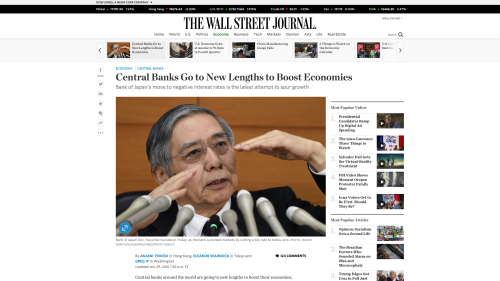
Anjani Trivedi, Eleanor Warnock and Greg Ip’s Wall Street Journal article “Central Banks Go to New Lengths to Boost Economies: Bank of Japan’s move to negative rates is the latest attempt to spur growth,” is a good example of the still inadequate reporting about negative interest rates. The revision noted that it had input from Tommy Stubbington, whom I praised in “The Wall Street Journal Gets It Right On Negative Interest Rate Policy, Thanks to Tommy Stubbington,” and was noticeably better, though in a spotty way. Let me give my reactions to some important passages.

Basic Reporting

The reporting at the beginning of the article is well done. I particularly appreciated the discussion of international linkages:

Japan’s move washed through currency markets, driving the yen down by as much as 2.2% against the dollar, and showed how easing by one central bank puts pressure for similar moves by others.

By strengthening the dollar, the continued loosening of monetary policy in Japan and Europe could complicate the Fed’s aim of gradually notching up interest rates this year. Measured against a basket of 16 currencies, the dollar this week hit its highest level in more than 13 years.

and how massive paper currency storage has not yet appeared in Europe:

… the move in Europe into negative rates has so far created no evident disruptions for money-market funds or a flight to cash by depositors, giving a green light for banks to consider going further.

“Adverse effects on money market functioning have been limited,” Stanley Fischer, the Fed’s vice chairman, said in a speech this month. “Cash holdings have not risen significantly in these countries, in part because of nonnegligible costs of insuring, storing, and transporting physical cash.”

I was surprised by how low Sweden has gone:

No one knows how low negative rates can get before those costs become an inducement to hold cash, but probably beyond the minus .75% rate now charged in Denmark and the minus 1.1% in Sweden.

And the article pointed out an important fact, which I discussed on Wednesday in relation to two-tiered negative deposit rates in the euro zone:

Few banks have so far passed on those negative rates to small retail depositors.

Looking forward, this is an interesting prediction:

In a note to clients Friday, Citigroup economists predicted the ECB and the Swedish and Danish central banks would cut their policy rates even further into negative territory in coming months, and their counterparts in Canada, Australia, Norway and even China may do so “should macroeconomic conditions turn out even weaker than currently expected.”

Analysis

As the article moved from reporting to more analysis, the quality declined. For example, the authors needed a counterpoint to Raghuram Rajan’s declaration

… stimulus doesn’t cut it anymore and certainly monetary policy has largely run its course. 

Guess what–monetary policy hasn’t run its course at all. In my most recent visits to central banks, my advice has been to choose the policy rate as if there were no zero lower bound–because there isn’t a zero lower bound for any central bank that knows what it is doing. And increasingly, central banks do know how to defeat the zero lower bound. My bibliographic post “How and Why to Eliminate the Zero Lower Bound: A Reader’s Guide” gets a steady stream of pageviews, many of which I am confident are from central bank staff around the world. And I have been to a fair number of central banks in person. For journalists to understand everything central bankers are thinking, they need to read some of what I have written. Otherwise, they will get things wrong.

Even more misleading is this quotation with no counterpoint:

Central bankers “are running out of things to do,” said Sean Yokota, head of Asia strategy at Nordic bank SEB.

This is first, false, since a lot remains to be done in the direction of negative interest rates. Secondly, it seems to suggest that negative interest rates are a last resort. No! Negative interest rates were always likely to be much more effective than quantitative easing. Quantitative easing was tried first primarily because the intellectual preparation for quantitative easing was further along than the intellectual preparation for negative interest rates when central banks felt the need for another tool.

The Power of Negative Rates

The reporting was fully appropriate in giving this quotation,

Despite the day’s surge, some investors remained skeptical about the lasting impact of the central banks’ efforts. “People are starting to feel more and more that central bank action is having less and less fire for effect,” said Ian Winer, head of equities at Wedbush Securities.

but I want to take issue with Ian Winer himself. I want to insist that the power of negative interest rates be judged per basis point. Given the mild negative interest rates so far, the effects have been substantial per basis point reduction. The size of the effects is especially impressive when one realizes that only the weak version of negative interest rates has been used so far. As I wrote in “The Swiss National Bank Means Business with Its Negative Rates,”

There is a world of difference between a central bank that cuts some of its interest rates, but keeps its paper currency interest rate at zero and a central bank that cuts all of its interest rates, including the paper currency interest rate. If a central bank cuts all of its interest rates, including that paper rate, negative interest rates are a much fiercer animal.

The ability to reduce the paper currency interest rate using the tools you can see discussed here makes it so that interest rates can be reduced by as many basis points as needed.

How Much More Slack Is There There in Japan’s Economy?

It is very difficult to know exactly how much slack is left in Japan’s economy. I lean toward the view that there is still substantial slack left. Try this thought experiment on for size. Suppose that, instead of trying with all its might to talk inflation up, the Bank of Japan were doing everything it could to keep inflation expectations down while using negative interest rates to stimulate the economy as much as it is being stimulated under current policy. Would inflation now be rising? If your answer is no, then you think the Japanese economy has slack. 

Even if, contrary to my own guess, the Japanese economy is already at its natural level of output or a little beyond, given the objective of raising inflation, it doesn’t make sense to think that monetary policy has been too stimulative until there is more inflation than desired, or a path that looks as if it will lead to more inflation than desired. One of the reforms mentioned in the article is really about trying to raise inflation:

Labor reforms that give benefits to contract workers so wages can rise more broadly

This seems like a reform aimed at getting more inflation. But given that as much monetary stimulus as desired can be provided by negative interest rates, there is really no reason to desire more inflation. Japan can stimulate its economy as much as desired without any extra inflation. It certainly should be willing to risk more inflation than the current level of inflation in order to learn more about what its natural level of output is, but if negative interest rate policy is fully embraced in the way I have recommended, there is no longer a strong reason to desire more inflation. Other than the neutering of monetary policy by the zero lower bound, low inflation has not caused Japan serious problems (perhaps in part because its annual bonus system reduces downward nominal rigidity of wages in Japan). And the zero lower bound is a dragon that can easily be slain now that the soft underbelly of the zero lower bound has become fully apparent.

Jesus’ Upside-Down Kingdom

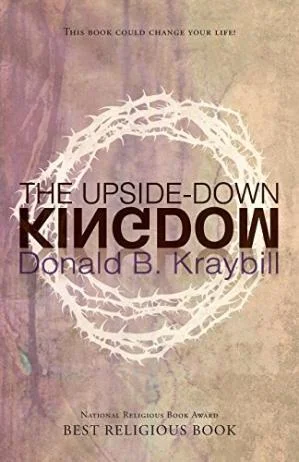
The Upside-Down Kingdom by Donald B. Kraybill

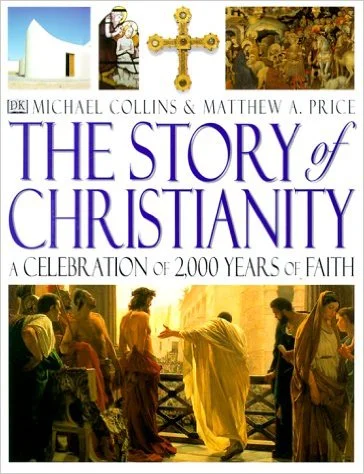
Another theme of Jesus’ teaching is the kingdom of God, or of heaven, a kingdom like no other where God is the ruler; here, the humble and meek are exalted and the mighty are brought down, and he who would be first must be the servant of all. One modern writer even referred to it as “The Upside-Down Kingdom,” because it reverses all the realities of human empires and kingdoms.

– Michael Collins and Matthew A Price, The Story of Christianity: A Celebration of 2,000 Years of Faithpp. 26-27.

Update: Dennis Wolfe offers the following reaction: 

Reviewing your brief post this morning reminded me of a sermon I heard about 5 years ago by the same name at this link.  Along with his many books, Tim Keller’s sermons have had a tremendous influence on my faith and view of organized religion.  My wife and I have visited his church in Manhattan a few times and feel drawn to his approach to Christ-centered ministry - something we want to help cultivate in our own Christian community.  I would really enjoy your thoughts.

Barack Obama: Football as the Best Sports Analogy for Politics

On Vox, Libby Nelson distilledJerry Seinfeld’s interview with Barack Obama. Here is the most interesting bit:

Seinfeld asks what sport politics is most like: “It’s probably most like football,” Obama said. “A lot of players. A lot of specialization. A lot of hitting. A lot of attrition. But then every once in awhile, you’ll see an opening, you hit the line, you get one yard, you try a play, you get sacked, now it’s like, third and 15… you have to punt a lot. But every once in awhile, you see a hole, and then there’s open field.”

I am reminded of the one time I used football as a political metaphor: 

The height of my actual football career was playing on a little league team back in 1974 with Kyle Wittingham, now head football coach for the University of Utah.

Thinking About New Financial Technologie—Izabella Kaminska and Gillian Tett on Excitement about Fintech Eclipses Basel III at Davos

Financial technology could take over an important part of the market fast. It is important that regulations not be used to stop progress. To make sure of that, there should be a regulatory safe harbor saying any financial technology that meets three conditions beyond the usual one of in fact doing what it seems to be telling users that it is doing should definitely be allowed: 

  1. The technology is based on accounts that are 100% backed by central bank reserves. Obviously, this means that central banks have to make reserve accounts readily available to new fintech companies. 
  2. All records of all transactions using the technology, and all complaints received by the company are immediately available in easy-to-read electronic form and can be freely inspected by the government without a warrant. That is, everyone using the technology signs a contract that makes everything they do with the technology totally transparent to the government.
  3. Funds held on behalf of customers have a nonzero interest rate tied to a market-based measure of prevailing short-term interest rates. (This is to make sure the technologies are robust to possible negative interest rate situations.) 

This is not at all to say that all new financial technologies must meet these three criteria. But there should be absolutely no prior restraint of anything that does meet these three conditions and the usual “doing what you seem to be saying you will do” condition. The “total transparency to the government” rule should make it easy to detect problems as they arise.

How to Handle Worries about the Effect of Negative Interest Rates on Bank Profits with Two-Tiered Interest-on-Reserves Policies

In a January 25, 2016 Goldman Sachs bulletin, analyst Dirk Schumacher writes:

We expect the ECB to ease monetary policy further at the March meeting via an extension of the APP programme until September 2017 and a cut in the deposit rate by 10bp to -0.4%.

I think it would be better policy for the ECB to go straight to the -.75% that has been pioneered by the Swiss National Bank, but every bit of interest rate cuts helps at least some in the current situation where the eurozone needs so much additional stimulus. 

The Goldman Sachs report also has a long discussion of the worries members of the European Central Bank’s monetary policy committee have about the effect of lower interest rates on bank profits. In the extreme, if bank profits go down too much, banks may exert their oligopoly power to raise lending rates to raise earnings in the short-run to compensate. The issue is that banks will want to shield some of their depositors from the negative rates, so they don’t want to fully pass through negative rates to their customers.

A “two-tiered system” in which a certain amount of deposits at the central bank get a zero interest rates and amounts above that get a lower interest rate seems hard to some of the ECB’s central bankers because that might hit banks harder in some countries than others. To me, the basic solution if a two-tiered system is desired is fairly straightforward: the two-tiered system should be designed to be equivalent to a subsidy to the deposit rates for household accounts below a certain size–say enough to provide a zero interest rate on an average balance over a month of 1000 euros worth of bank deposits per adult, for that adult’s main bank. (Those with more than one bank would have to designate one bank for this effective subsidy.) 

The value of tying the amount of deposits with the European Central Bank that a private bank can get zero interest rates on to the amount of household balances from accounts with 1000 euros or less is that this makes it natural for the private banks to pass on the negative interest rates to commercial and to the excess over 1000 euros in large accounts (which is helpful for transmission of the effects of the negative interest rates) while small household account are shielded from the negative interest rates (which is helpful politically). And it is easy enough to understand the rule and its intent that banks will be able to explain why they need to transmit negative interest rates to those with large accounts. (Of course, the cutoff could be set at some other level than 1000 euros, if desired.) And this policy is fully consistent with keeping bank profits unharmed by negative interest rates as long as they do pass on negative interest rates to large accounts and commercial accounts as they are supposed to.  

Experience in Switzerland, Denmark and Sweden suggests that the more sophisticated bank customers who have large accounts or have commercial accounts adjust quickly to negative interest rates after a few weeks of bitter complaining. The objective of a two-tiered system is to have negative interest rates prevail generally in the markets, but shield from negative interest rates those who are the least able to understand negative interest rates and perhaps to accomplish a bit of redistribution as well–though clearly not redistribution toward the poorest of the poor, who may not have bank accounts at all. 

Note that by buying enough bonds and crediting the sellers with reserves–or by lending reserves–the European Central Bank can guarantee that there are much more reserves in the system than would be subject to the zero interest rate. Thus, the other interest rate will be the marginal one. And it should go without saying that the rate on short-term bonds should be pushed close to the most negative deposit rate. Keeping the bond rate at zero would not be cutting rates enough.

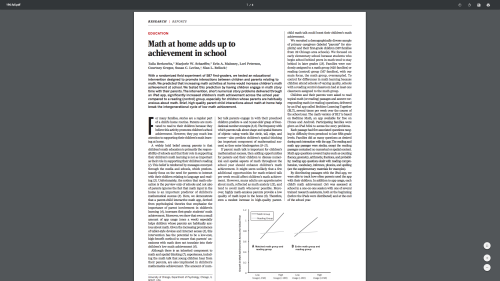
Examining the Statistics in “Math at Home Adds Up to Achievement in School” by Talia Berkowitz, Marjorie Schaeffer, Erin Maloney, Lori Peterson, Courtney Gregor, Susan Levine and Sian Beilock

Patrick Warren’s questioning of the evidence for the value of Bedtime Math in helping kids with math (see last Thursday’s post) motivates me to state more clearly what the evidence is. The result the authors highlight most is certainly vulnerable to serious criticism: the result that among those students using the math app, math performance has a substantial correlation with how often the app is used. As Patrick points out, there is a serious problem here of omitted variable bias: how much a child likes math is likely to have a positive effect on how often the child uses the app and to have a positive effect on math performance regardless of whether the app does anything to augment performance or not. That is, kids who like math will tend to be good at math whether or not they have a math app because they will find some way to do math and thereby get better at it. (See my column “How to Turn Every Child into a ‘Math Person’”.) So that result offers very little proof of the efficacy of the app. 

However, the article has another piece of evidence that the authors should have led with. Parents were categorized into those who were anxious about math and those who weren’t. Among those parents categorized as anxious about math, the overall difference between kids’ math performance of those who received the Bedtime Math app and those who received a reading app was substantial: extra math achievement equivalent to what students get from 3 months of school. This was enough to be quite unlikely to be due to chance. The authors report a 4.8% probability of this result being due to chance, but that is for a two-tailed test that is only appropriate if one would have taken seriously a seeming finding that the kids did worse in math because of having a math app. With a more appropriate one-tailed test, there would be only a 2.4% probability of this result being due to chance. 

In other words, of the 4.8% chance of declaring a fluke a real result that the authors report, only 2.4% is the chance of declaring a fluke in the positive direction a real result. The other 2.4% is the chance of declaring a fluke in the negative direction a real result. If one is bound and determined from the beginning not to declare a seeming result in the negative direction a real result, then the overall probability of declaring a fluke a real result is only the 2.4% chance coming from a seeming result in the positive direction. (See the Wikipedia article on “One- and two-tailed tests.”)

Of course, this 2.4% p-value is truly correct only if this hypothesis of an effect on math anxious parents had been the one and only central hypothesis spelled out in advance–as could be true in a replication of the experiment

Why is this better evidence that the app does the job it was intended to do than the relationship between how much the app is used and math performance? The difference is that assignment to the math app group as opposed to the reading app group was random, and has no reasonable causal path to affect math performance than through the effects of the app itself. But amount of time spent with the app is nonrandom, and can easily reflect characteristics of a child or a child’s parents that could affect math performance in ways that don’t depend on the app at all.  

The authors genuinely don’t seem to realize the effects of the assignment to the math app or the reading app–in interaction with math anxiety on the part of the parents–represents their only piece of solid evidence for the efficacy of the app. Not only is this result not clearly described in the abstract, it is not featured in a figure. The figures are reserved for the result about usage that, as discussed above, provides very little proof of the efficacy of the app. Their language instead suggests that they are going the extra mile by doing this intent-to-treat analysis. It wasn’t the extra mile. It was the first mile! But it was a good mile. 

Here is the key passage:

We expected the math achievement of children with high-math-anxious parents to be more affected by use of the math (versus reading) app because these children would not generally be provided with high-quality math input at home (6). Therefore, we first separated parents on the basis of whether they were lower or higher in math anxiety (median split). We then performed an “intent-to-treat” analysis in which we looked at the effect of group (math versus reading app) on children’s end-of-year math achievement (controlling for beginning-of-year math achievement) independent of actual app usage. For children of high-math anxious parents, we found a significant effect of group, with children in the math group outperforming those in the reading group by almost 3 months in math achievement by school year’s end [beta-hat_21 = 5.25; t=1.99; P=0.048]. We did not find this same pattern for children of low-math anxious parents [beta-hat_31 = −0.61; t = −0.27; P = 0.79] (Model S3). An intent-to-treat analysis allows us to rule out factors possibly related to app usage—such as motivation or interest—as explaining our findings. 

This is the heart of the paper, unbeknownst to the authors. You don’t need to read anything else. 

The one thing that would make one be suspicious of this result is the possibility that the authors tinkered in various ways–including the split by math anxiety–to get the results they wanted. But that is easily remedied simply by having another group of researchers replicate the experiment. Although the substantive size of the effect is large, there is enough random variation that the statistical precision in the Berkowitz-Schaeffer-Maloney-Peterson-Gregor-Levine-Beilock experiment with 420 families is none too large. So it would be wise for someone undertaking a replication to involve at least 1000 families. The importance of the scientific question amply deserves that kind of care.

Note: Besides “How to Turn Every Child into a ‘Math Person’”, which I cited above, don’t miss the column I coauthored with Noah Smith: “There’s One Key Difference Between Kids Who Excel at Math and Those Who Don’t” and my column “The Coming Transformation of Education: Degrees Won’t Matter Anymore, Skills Will.” Also, on Bedtime Math specifically, don’t miss “Laura Overdeck: Math for Pleasure” and “Laura Overdeck: Street Math.”

John Stuart Mill Applies the Principles of Liberty

Despite being written in 1869, the last chapter of John Stuart Mill’s On Liberty, titled Chapter V: Applications,” speaks directly to many 21st century controversies. I learned a lot from blogging my way through. Take a look: 

Also, don’t miss the posts I wrote on the earlier parts of On Liberty. I have collected the links by chapter in these bibliographic posts:

Chapter I: John Stuart Mill’s Defense of Freedom

Chapter II: John Stuart Mill’s Brief for Freedom of Speech

Chapter III: John Stuart Mill’s Brief for Individuality

Chapter IV: John Stuart Mill’s Brief for the Limits of the Authority of Society over the Individual

I actually blogged through Chapter I last after the other four chapters, completing the circle.