Michael Stevens on Zipf’s Law
Power laws appear all over. This is a fascinating video on Zipf’s Law and the Pareto Principle.
Thanks to my brother Joseph for recommending this video.
A Partisan Nonpartisan Blog: Cutting Through Confusion Since 2012
Power laws appear all over. This is a fascinating video on Zipf’s Law and the Pareto Principle.
Thanks to my brother Joseph for recommending this video.
I recently realized the importance of Google Scholar for how my academic work is perceived. So I signed up. At the top you see the link to my Google Scholar page. It is interesting because it ranks my papers by number of citations. You can see which were my biggest hits by that measure. Partly in response to that citation analysis, I am plotting how to carve out time to write more papers on the economics or risk in the coming years. I certainly have many things to say on that score, since for many years I have taught a class on advanced mathematical methods for the economics of risk and time.
If you dig into my REPEC ranking analysis, you can see that my rank is much higher when looking at influence as measures by citations–particularly citations in high-impact journals–than when looking at quantity-based measures such as total number of pages in academic journals. I also rank well in “Breadth of citations across fields,” reflecting my work in many different areas.
For those who are willing to count serious economic writing for a non-academic audience, the sheer quantity of my output looks considerably larger! If you want to take a look at that output, I recommend starting with the links collected in these 3 bibliographic posts:
How and Why to Eliminate the Zero Lower Bound: A Reader’s Guide
How and Why to Expand the Nonprofit Sector as a Partial Alternative to Government: A Reader’s Guide
Top 52 All-Time Posts and All My Columns Ranked by Popularity, as of May 23, 2014
In addition to my training in economics, I have a Master's degree in Linguistics. Here is a link to my Master's thesis: Language, Linguistics and Philosophy: A Comparison of the Work of Roman Jakobson and the Later Wittgenstein, with Some Attention to the Philosophy of Charles Saunders Peirce.
In my October 5, 2012 post Ryan Avent on the Fed’s Plans to Keep Rates Low Even After Recovery is Underway I wrote
I had an extended email discussion with an economist in the Federal Reserve System (whom I will not name) who argued passionately that, given our lack of knowledge about what will work and what won’t, the Fed should be using both large-scale asset purchases and promises that it will keep stimulating the economy even after it has reached the natural level of output—planning to push the economy above the natural level of output for a while.
Now that Gauti is at Brown rather than inside the Federal Reserve System and the Fed has raised rates, the identity of this economist can be revealed: Gauti Eggertsson. Gauti was delighted by the idea of publishing our correspondence when I suggested it the other day.
I think you will find this discussion interesting. For me, it is very close to the last moment before my efforts to advocate the elimination of the zero lower bound crowded out efforts to urge the merits of quantitative easing (though I did defend when Martin Feldstein criticized it the following June). For Gauti, these thoughts are a reflection of a large body of academic research he has done on these topics, as you can see from Gauti’s CV.
You can tell we are both thinking things through, because both of us often follow up an email with another one giving additional thoughts.
Gauti: Hi Miles,
So I just don’t get your objections to the Feds recent use of forward looking language and commitment. The Fed is after all legally mandated to trade off inflation and output (dual objective). It seems you base this objection is based upon that “Wallace Neutrality” does not hold and hence The Fed should focus on the balance sheet. This objection does not make sense to me.
So I think many people may be sympathetic to the notion that full neutrality may not hold – including myself – and I say this even as being one of the author of a proposition that extends Wallace original neutrality proposition to show that it even still holds in a DSGE model with New Keynesian frictions provided that we are at the zero bound (see first proposition in Eggertsson and Woodford Brookings Papers on Economic Activity (2003)
http://www.ny.frb.org/research/economists/eggertsson/BrookingsPaper.pdf.
In fact I think this proposition describes the neutrality people have in mind a bit better than Wallaces original one, as he was claiming it applied to all open market purchases even at positive interest rates).
The point is just that we just don’t know how much this proposition does not hold, i.e. all empirical evidence suggest that there is a great deal of uncertainty about by how much “buying stuff” increases demand.
The point in my original paper with Mike is that one important dimensions which the neutrality proposition DOES fails, is that you can affect demand by changing expectation about future interest rate, even in the New Keynesian model (but we assumed a fixed interest rate policy rule in our proposition). Moreover, this channel is extremely strong according to that model which we illustrate in a simple model.
It seems to me that given the dire situation we are in we should be doing everything we can to stimulate demand. Sure, that includes massive asset purchases (we are now at about 3 trillion and counting!). What I don’t understand is why you want to throw away one very effective tool, namely manipulating expectation about future interest rates and inflation, which many of our models suggest is very effective. That seems to me deeply counterproductive.
In other words you seem to be acting as if there are zero costs to balance sheet actions and infinite costs to using forward guidance and policy commitment about interest rates. I don’t know in what model that sort of policy making would be optimal. I think under any kind of reasonable type of model uncertainty it would make sense to be acting on all margins. If asset market purchases are not working, hopefully forward guidance is. If forward guidance is not, hopefully asset market purchases will. Etc.
Best – Gauti
PS. I like reading your blog, its great fun to read. Hope you keep it up!
Miles: Thanks for reading my blog!
I should clarify. Given the gaps in our knowledge, I don’t see any problem with forward guidance of the sort the Market Monetarists are recommending: here is our nominal GDP target (which can be adjusted upward if the growth rate of technology is higher than we expected or downward if not) and we will keep interest rates low until we are fully on track to hit it. This is more or less the same thing as price level targeting if adjusted for technology shocks as I said. I am worried about forward guidance that is promising to be more stimulative than that, which it was my understanding that some of the models recommend. Is that wrong?
The focus on lengths of time (as opposed to states of the economy) bothers me, since I think we should be doing enough QE that we get there fast enough that the dates they have set are after the economy has already been fully recovered for a while.
Actually, my understanding of the forward guidance as they are doing it now is that they are not making much of a precommitment. Is the Fed actually viewing it as a precommitment? If they want to go further in precommitting, I hope they would make commitments relative to the state of the economy and not for a length of time.
Monetary policy only has a lag of 9 to 12 months. If we do it right (many many more trillions of asset purchases) the economy should be fully recovered by Fall 2013. So it doesn’t make any sense to commit beyond then if one focuses on time. Focusing on the state of the economy the commitments could be quite helpful as you say because they would be a backup in case the QE doesn’t do the trick.
Am I missing something?
Miles: By the way, an important part of my argument that it should only take 9 to 12 months is that we should be just as willing to overshoot as to undershoot. Instrument uncertainty in relation to QE should make us a little conservative, but not too much.
Another part of my consideration in saying what I did is that I am pretty sure that I am a small enough fish at this point that nothing I say will reduce the confidence people have in the Fed’s forward guidance, which the Fed is going to do anyway. By the next recession after this one, I think we can have departures from Wallace neutrality much better figured out and either get *more* serious about forward guidance if QE is weak and costly or emphasize it less if QE is powerful and not too costly at the right dosages. So I am trying to provide more options for the Fed in the future.
Miles: One place I am coming from is that I think interest rate smoothing is a terrible idea. When we need to move the economy in some direction, the Fed funds rate should be moved very very fast in my view. I know you have a paper justifying interest rate smoothing to some degree, but it just seems to me that if I have a continuous-time model and turn up the power on the microscope the optimal fed funds rate has to look like a random walk at a high-enough magnification. I somehow doubt that that gets to be a bad approximation at an every-six-week frequency.
Am I missing something?
Gauti: Provided the target is high enough, the nominal GDP target maps relatively well into the optimal commitment, as least in the simple New Keynesian model, which is why people like Mike Woodford have been proposing it. What many have against it, is that actually it may be too stimulative relative to what that the current stance is as it they worry it may imply a commitment to lots of inflation, in case real growth does not pick up. The bottom-line of all these models, however, is that it is optimal to commit to some amount of future inflation and/or output boom beyond what a discretionary policy maker might like to do at that future date. Whether this is done via commitment to some price level, nominal GDP target, etc, is more a question of “communication”.
The calendar date has in my mind never been particularly elegant. The best thing I can say about it is that perhaps it created the perception that the Fed would be slow to raise rate, slower than people otherwise might have thought, and that putting that date down raised to cost of pre-emptive tightening. The problem is that those sort of announcements may just feed into pessimism, which I take to be your concern, as you give the impression you are keeping rates low for long, not to stimulate the economy, but because you think things will be crappy for a very long time.
As for firm commitment, I think this part of the last FOMC statement was at least helpful in that respect
“To support continued progress toward maximum employment and price stability, the Committee expects that a highly accommodative stance of monetary policy will remain appropriate for a considerable time after the economic recovery strengthens. ”
Regardless of intentions of the Fed, I think the market is interpreting this as a commitment to allow for inflation to overshoot it long-run target some as the economy starts recovering, since the Fed will be trading off inflation and output then in accordance with its dual mandate, as it is trading off inflation and output today (intra and intertemporally). You can actually see this pretty clearly in tips markets. That’s a good thing in my mind. It should reduce the real interest rate and make some of those firms sitting on piles of cash wonder if investing it is not better than sitting on the money .
With respect to more asset purchases, there are two issues as I see it. One, their effect is uncertain, which is of course no reason not to do them (in fact that may instead be a reason to do even more to make sure they are doing anything). The other is that in practice it is actually not all that trivial to design which assets to buy and communicating it to the public, since things like MBS are not in unlimited quantities. So one has to start buying bunch of privately issued paper that has risks. Moreover, I think one way in which these purchases have effect – perhaps even the only way they have an effect – is by signalling something about future policy stance, thus working through inflation expectations. If one takes that perspective, it seems much more straight forward to communicate directly what one is trying to achieve, in particular commit to some inflation. Ideally one should do both at the same time, and I think the last statement was a bit in that direction.
My main problem with how you were writing about this, was not so much that you were for asset purchases based upon you the “Wallace neutrality” failing. That’s all fine. I don’t know how much they will do, but by all means lets try. What troubles me, and perhaps I’m misreading your views, is that you seem to think that they are so effective that there is no reason to use any other tools that may very well work much better, such as committing to somewhat higher inflation and lower future nominal rates. Given the uncertainty of the effectiveness of all tools, I think a reasonable policy should be acting on all margins. There is also the issue that we should not pretend that balance sheet actions are not costly, there are certainly big risks there as well for tax payers (the Icelandic Central Bank, for example, lost approximately 30 percent of GDP due to having taken bad collateral in the crisis in Iceland).
Gauti: I think the instrument uncertainty can actually cut both ways (I gather you may here have in mind Brainard’s 67 paper?). In this case, I actually think it might point towards the direction of doing more.
Gauti: So the interest rate smoothing aspect of my work as it relates to this crisis is simply that even if you can’t cut the rate below zero, you can have an effect by making a commitment to keep rates low for some time in the future in a way that was different from your historical reaction function. I’m not quite sure what you mean with respect to the continuos time analog of the model, and that it would imply random walk. I’m not really seeing that. In the models I’m used to work with then usually the optimal thing to do is to make the nominal interest rate track the “natural rate of interest” as closely as possible, i.e. the real interest rate that would take place in absence of nominal frictions. To the extent that the natural rate is very volatile, then the nominal interest rate may also be quite volatile (I’ve a problem seeing it ever being a random walk, however, as it got to be bounded in some range given all the restrictions imposed by the model).
Miles: You haven’t been misreading me. I have been saying that the asset purchases are so effective that we should not be committing to something later on that would not be optimal from the perspective of later. The concern is about having more than the optimal inflation then. I don’t have any problem with buying risky assets, in fact I think that is much safer for the Fed than buying long-term Treasuries because of predictable capital gains and losses on those if the purchases are having any effect at all. There is a good argument to made that in this particular crisis we might need some precommitment–especially given the fact that the Fed has been so limited by law in the assets it can buy it can’t really do the asset purchases the way they should be done, but since I think I will have very little effect on what happens during the current crisis, I am focused on the underlying principles of how things should be done in general. But the worst of all worlds is for the Fed ex post to think it made a stronger precommitment than the markets read it as having. Since the Fed is, in fact, making fairly weak promises, I don’t want the Fed to think it is making strong promises while the markets thought it was making only weak promises.
What you are saying about instrument uncertainty pointing to doing more is important. Could you explain more?
Any diffusion process looks like a random walk when you turn up the power on the microscope because the drift gets small much faster than the fluctuations. I am claiming that 6 weeks is a short enough time that whether the Fed increased the Fed funds rate last meeting *ought* to have very low predictive power for which way it jumps this meeting. What happens this meeting to the Fed funds rate should be *mostly* about information that arrived in the last 6 weeks, which is equally likely to favor raising the rate as lowering it. There would be a little drift, but not much. This is away from the ZLB.
Miles: Two more things:
1. If asset purchases do affect expectations, then why not use them, since they won’t actually tie the Fed’s hands later on when we figure things out better? However, I want to avoid putting the Fed in a position of taking huge capital losses if and when it tightens if we can help it, so I don’t want to affect expectations through that channel. But if it affects expectations by showing everyone that the Fed isn’t excessively hawkish, that is great.
2. Is there any paragraph or two in existence that gives a good intuitive explanation of the virtues of price-level targeting as opposed to inflation targeting that really gets to the heart of what is going on mathematically as well as being intuitive? If not, it would be great if you could try to write that paragraph or two.
Gauti: What I find odd about your perspective, is the unwillingness to trade of some output by committing to some inflation, yet at the same time recommending very aggressive balance sheet action. It seems to me relatively clear that given the uncertainty about the effects here, we should do both, i.e. explicitly state we are willing to tolerate some inflation going forward and intervene in various asset market. My sense is that the latter is actually more costly than the former. (Was it very costly, for example, to bring down inflation from four percent to two in 1994-2004). I’m just not seeing the case against over-shooting inflation from the long term objective of the Fed, given what we know, and the dual objective that tells us to trade the two off.
What I was saying about doing more if you have instrument uncertainty just comes out of Brainard 1967 AER paper. I think people often misread his paper as saying that under uncertainty you should do less that compared to certainty equivalenve. But as he shows, this would only be the case of the uncertainty about your policy is uncorrelated with the size of the shock you are reacting to. If the effectiveness of policy is correlated with the severity of the real shock you can easily get that you should act more the more uncertain you are about policy effectiveness (imagine for example that in the states of the world in which output is very far away from potential is also the state of the world in which policy has very small effect. Then you want to do more the more uncertain you are about effectiveness…..)
Gauti: On those two points:
1. Well you may argue that asset purchases affect expectations because they directly change the asset composition of the fed, eg buying long term debt makes it now more costly to raise short rates due to the resulting balance sheet losses. Anticipating this, people expect lower nominal the more the fed holds of long term debt….
2. Mike Woodford and I discuss the price level target in our BPEA in 2003. The basic idea is just that a correctly specified price level target increases inflation expectations and thus reduces real rates, increasing demand. A nice feature of a PLT is that if you miss it, i.e. there is deflation, then inflation expectations will increase even more, as now you have accumulated a bigger “price-level gap” which you need to fill. Thus there is an “automatic stabilizer” element to it.
Miles: Two more things:
1. If asset purchases do affect expectations, then why not use them, since they won’t actually tie the Fed’s hands later on when we figure things out better? However, I want to avoid putting the Fed in a position of taking huge capital losses if and when it tightens if we can help it, so I don’t want to affect expectations through that channel. But if it affects expectations by showing everyone that the Fed isn’t excessively hawkish, that is great.
2. Is there any paragraph or two in existence that gives a good intuitive explanation of the virtues of price-level targeting as opposed to inflation targeting that really gets to the heart of what is going on mathematically as well as being intuitive? If not, it would be great if you could try to write that paragraph or two.
Miles: What about this point that I made, though:
But the worst of all worlds is for the Fed ex post to think it made a stronger precommitment than the markets read it as having. Since the Fed is, in fact, making fairly weak promises, I don’t want the Fed to think it is making strong promises while the markets thought it was making only weak promises.
In other words, I think there is a key issue of not interpreting a commitment as being any stronger than the markets think it is.
Miles: To answer your question about the overall perspective, since I think my voice is a small one, you should interpret the point I am making as a marginal adjustment point: I really do believe that *relatively speaking* people are overemphasizing forward guidance relative to making the asset purchases large enough. So I really do think there should be a shift toward larger asset purchases–large enough that the amount of forward guidance could be reduced somewhat. As you are saying, I don’t think I would take a strong stand in the current situation that forward guidance should be eliminated entirely given our uncertainty about how all the policies work. But it really does bother me how long into the future the forward guidance is extending. And I just don’t see why a full recover should take more than 12 months if we do enough asset purchases. If we made forward guidance conditional on how the economy is doing rather than timing, and did huge asset purchases that should make the forward guidance moot because the economy would recover anyway if I am right, of course there is no problem.
Miles: And I definitely am willing to risk extra inflation by doing asset purchases that *might* be too large. But it bothers me to *plan* to do something that will definitely be too much in the future.
Miles: As I think about it more. I think there is a big political cost of the precommitment to overstimulation. It would be remembered for a long time that the Fed overdid the cure and caused a lot of inflation that it did not bring down very fast because it had promised not to. So the whole idea of doing dramatic things to stimulate in a situation like now might be (inappropriately) discredited. People remember the end. (One of Danny Kahneman’s favorite results.)
By contrast, if we do big things in a way where we can reverse course very fast if needed, the end will look like it was being done well. That is true even if, say, there is a side effect of capital losses to the Fed, which is the side effect of large-scale asset purchases that I worry about.
Miles: Also, I worry a lot that the doves lose out to the hawks if the doves don’t include *some* hawkish statements in what they say. Precommitting to have too much inflation makes it very hard to maintain one’s credibility as someone who will keep inflation down.
Miles: I feel that the foreward guidance in 2001 or so, which led to low interest rates in 2003 had exactly this kind of discrediting political effect. If the Fed hadn’t felt bound by the foreward guidance it had given, wouldn’t it have raised interest rates faster in 2003? And then maybe there wouldn’t be the false canard about how the Fed caused the financial crisis by those low interest rates in 2003.
Miles: One more consideration I have is that I think we are still learning a lot about how to do monetary policy, fairly fast. Precommitment makes it harder to use the new things we learn in the meantime.
Gauti: I think there is always the risk that what a central bank says is not credible, and then it may be more costly to fulfill the pledge if you don’t manage to convince people. It seems to me that this is an important consideration, but should not be overdone since you have ways to back up your words. IF the Fed made clear statement about being willing to tolarate some overshooting of its inflation target, my sense is that it would widely be viewed as credible and expectations would adjust. But I agree there should be a backup plan about what to do if its not credible, e.g. as measured by market expectations. I see buying stuff (balance sheet actions) as playing mainly a role there. So the Fed says its going to overshoot on inflation…. the market does not believe it ….. the Fed buys stuff until the market gets the message….. (and note here that wallace equivalence type violations work in tandem with the objective of shifting expectations).
Gauti: I agree that the emphasis on time commitment is a bit problematic. With respect to if people over emphasize forward guidance versus quantitative easing, my sense is that it is exactly the other way around. We have expanded the balance sheet by 3 trillions, and done qe1, qe2 and qe3. And it is only in qe3 that there is any meaningful forward guidance (the “commitment” about time duration had much more the sound of a pessimistic forecast than any meaningful commitment).
Gauti: Ah, but that basically says that you are uncomfortable with anything that is not time consistent. But most things we do are not timeconsistent (most punishments mandated by law, for example….) And by the way, so is a commitment to low inflation……..
Gauti: Cost – yes. But the alternative — very high unemployment and a balance sheet expansion that may not accompolish anything is also a very costly affair.
Gauti: I think this is real concern, and why a commitment to a fixed price level target, for example, is problematic. But it seems like a problem you can solve by making the commitment a bit broader taking those considerations into account….
Miles: I think just saying that it wants to get prices on a track that would be a 2% annual increase since 2008 (even though that means tolerating some catchup inflation) would be a big step and a good one.
Even among blog posts expressing an intriguing, insightful idea, some are meandering messes, while others pack a powerful punch. What is the difference? The answer matters. I have the students in my “Monetary and Financial Theory” class write 3 posts a week on an internal class blog, and host many of the best of those as guest posts on supplysideliberal.com. Of course I am looking for a good idea at the heart of the post, as I explained in “On Having a Thesis.” But another quality is also crucial: what I will call brio.
What is “brio”? The dictionary definition “vigor or vivacity of style or performance” is a good start. But all the other words I went through looking for just the right one are also helpful:
drive
forward motion
momentum
energy
focus
relentlessness
Above all, brio is knowing exactly where one is going, then going there by the shortest possible path
Someone who sets a good example of writing with brio is Noah Smith. I admire his blog writing style, and have benefitted from seeing his writing in action in pieces the two of us have coauthored (1, 2, 3, 4). I studied brio by studying the structure of Noah’s Bloomberg View columns and posts on his blog Noahpinion. Here is what I learned.
First, a blog post should have one point. If two points can be treated separately, they should be made into two blog posts. There may be subpoints, but for a post to have brio, those subpoints have to feel like one point driven home in various ways.
The “five-paragraph essay” taught to students facing the AP English exam is not a good structure for a blog post. The trouble with the five-paragraph essay is that in between the introduction and the conclusion the three middle paragraphs have three different points often only distantly related to one another, though tied together somehow. If the same argument were made on a blog, it might be better made as three separate posts.
As is clear from Noah’s columns and posts, the rule of having a single point does not mean that the middle section of a blog post is necessarily short. It often takes a lot of explaining even to make one’s point clear, let alone back it up with half-decent arguments. In my own blog writing as well, many is the time I told myself “I’ll just write a quick blog post to make this point” only to see the post grow to a hefty size by the time I could adequately explain what I wanted to say. That is particularly true when writing in a technical field such as economics, where readers need to be given key background information in order to make sense of the main point.
In my analysis of Noah’s Bloomberg View columns, I was surprised by how often his thesis statement was not stated until the end of the middle section of his column–simply because many readers couldn’t have understood the thesis statement and why it might make sense until after a good deal of explanation. Thus, in many cases, the thesis statement came as a pulling-together of many ideas that Noah had systematically laid out in order to lead to that point. But in every case, once the point was made, it felt as if the structure of the whole column clicked into place.
Here is what I think of as the structure of a blog post with brio. There are three parts, which I will discuss in turn:
the hook
the point
the grand finale.
1. The Hook: The hook or introduction needs to answer the question readers implicitly come to a post with: “Why should I care about this?” or “What makes you think I would be at all interested in this.” The objective of a post’s title should be to get people to read the first few sentences–that is, to read the hook–while accurately reflecting the post’s contents. The objective of the hook is to get someone to read the rest of the post. Now that I have begun cross-posting many of my posts to Medium, it is humbling to see in Medium’s penetrating statistics how many people start reading, but do not finish. So getting someone to read on is a real issue.
2. The Point: The middle chunk of the post can be short or somewhat longer, but it has one primary objective: getting across the main point of the post. That is, it needs to answer the question “What is the point?” Beyond explaining the point, the second objective is to back it up–to answer the question “Why should I believe it?”
3. The Grand Finale: The last few sentences of a blog post should give the reader words worth remembering. They might be inspirational words, or thought-provoking words, or words that encapsulate the point one more time, but this time in a nutshell. But they should be memorable. The grand finale answers the question “What is the broader meaning of the point?” (Even the distillation of the point into a nutshell answers this question, since shorter statements inevitably become a bit more general and so connect with many other ideas.)
Although it can be tough on the ego, one of the easiest ways to add brio to a post is to subtract words from it. In the first pass, anything it takes to get the ideas down on the page is great. But then it pays to go through the draft a second time to see if there is any way to say things equally well or better in fewer words or simpler words. And take a good hard look at passages that lead off in an extraneous direction; they may need to chopped off and thrown into the pile of ideas for future posts.
“Less is more” can mean many things; among them is “Other things equal, using fewer words is better.”
Writing well is a source of power. It can be used for good or ill. For those who are good at heart and go to the strenuous effort needed to understand how the world works, writing well is a tool that can help to make the world a better place.
In the final paragraph of On Liberty (paragraph 23 of “Chapter V: Applications”) that I quote at the end of this post, John Stuart Mill contributes a twist on the debate about what is called “Federalism” in the US. He argues that while the central government should be slow to overrule regional and local governments, it should be quick to denounce actions that it thinks are bad. This is an idea I had not heard before. By and large, the debate I have heard about Federalism moves between the two alternatives of strengthening central government power or respecting regional and local government actions. The middle course of the central government strenuously criticizing what it sees as bad actions of regional and local governments is not something I have heard much discussion of.
Moreover, what criticism of state and local actions I have heard from the national government has been mostly either in the area of social policy such as gay rights or abortion, or has been a general criticism of a state or locality having policies too much in line with the opposing political party.
I can think of two areas where greater central government criticism of the actions of regional and local governments is called for: criticism of overly tight limits on construction and criticism of regulations that disadvantage the poor in the workplace. Let me address each of these in turn.
As lead-in, it is worth mentioning that in my travels to central banks around the world, many are very worried about financial stability; but a little inquiry reveals that their biggest worry about financial stability boils down to worrying about soaring house prices in the capital city and other large cities. As Matt Rognlie points out, soaring house prices also contribute a lot to inequality. There is an easy solution to soaring house prices: making construction easier. And with all all of the bureaucracy attending new construction in most big cities in rich countries around the world, it is not hard to think of bureaucratic reforms that could make construction much, much easier.
The problem boils down to a political economy problem so easy to understand and so important for social welfare that it deserves to be taught in every Economics 101 class: local governments, if they try to maximize the welfare of local residents, try to tilt rents, house prices, and other building prices too high because they don’t take into account the benefit to those not now living in the city of having low house prices and rents in the city. Pecuniary externalities only cancel out of calculations of total surplus if the surplus of everyone involved in a market is included.
Given issues of congestion, wind tunneling, shadows cast by tall buildings, etc., the exact optimal amount of construction in a city for a given social welfare function is a complex calculation. But what can be said with perfect confidence is that if a local government makes the complex calculations well and maximizes a social welfare function for local residents, it will definitely push prices too high by permitting too little construction relative to a criterion that appends to the same social welfare function for local residents some accounting of the welfare of those who do not now live in the city, but might want to in the future, who would benefit from low prices and rents in the city.
In other words, although local governments are likely to be quite good at deciding exactly where within a city and according to what building codes building should be allowed within a city for any give total amount of construction, local governments can’t be trusted to make the right decisions about the total amount of construction. The central government should therefore see it as part of its job to push for more construction at least by roundly criticizing local governments who don’t allow enough construction. At a minimum, the national government should make sure that the fundamental selfishness of most local governments in not allowing more construction should be exposed clearly to view.
I don’t see a principled reason why national government actions beyond criticism couldn’t be justified, but I think it makes sense to try criticism first.
I have written quite a bit about work restrictions that make it harder for the poor to get jobs. Take a look, for example at these:
Because those one rung up on the economic ladder are much more likely to vote than the very poor, there are many, many policies that favor those one rung up on the economic ladder at the expense of the very poor. And it can sometimes be easier to generate concern for the long-run interests of the very poor at the national level than at the local level, since localities can always hope to simply encourage the very poor to go find another locality to hang out in.
In both of the examples I have given: criticizing construction limitations and criticism impediments to the very poor getting jobs, it is not necessary to depend on the national government to do all of the criticizing. Each of us can raise our voices and contribute to the criticism. It is my hope that through our efforts the ugly self-interest in overly tight limitations on construction and in trying to drive out of existence jobs that are accessible to the very poorwill be exposed in each case where it arises. For extra inspiration, take a look at my post “Keep the Riffraff Out!” and my sermon “The Message of Jesus for Non-Supernaturalists.”
With those examples in mind, consider the way John Stuart Mill puts his argument:
To determine the point at which evils, so formidable to human freedom and advancement, begin, or rather at which they begin to predominate over the benefits attending the collective application of the force of society, under its recognised chiefs, for the removal of the obstacles which stand in the way of its well-being; to secure as much of the advantages of centralized power and intelligence, as can be had without turning into governmental channels too great a proportion of the general activity—is one of the most difficult and complicated questions in the art of government. It is, in a great measure, a question of detail, in which many and various considerations must be kept in view, and no absolute rule can be laid down. But I believe that the practical principle in which safety resides, the ideal to be kept in view, the standard by which to test all arrangements intended for overcoming the difficulty, may be conveyed in these words: the greatest dissemination of power consistent with efficiency; but the greatest possible centralization of information, and diffusion of it from the centre. Thus, in municipal administration, there would be, as in the New England States, a very minute division among separate officers, chosen by the localities, of all business which is not better left to the persons directly interested; but besides this, there would be, in each department of local affairs, a central superintendence, forming a branch of the general government. The organ of this superintendence would concentrate, as in a focus, the variety of information and experience derived from the conduct of that branch of public business in all the localities, from everything analogous which is done in foreign countries, and from the general principles of political science. This central organ should have a right to know all that is done, and its special duty should be that of making the knowledge acquired in one place available for others. Emancipated from the petty prejudices and narrow views of a locality by its elevated position and comprehensive sphere of observation, its advice would naturally carry much authority; but its actual power, as a permanent institution, should, I conceive, be limited to compelling the local officers to obey the laws laid down for their guidance. In all things not provided for by general rules, those officers should be left to their own judgment, under responsibility to their constituents. For the violation of rules, they should be responsible to law, and the rules themselves should be laid down by the legislature; the central administrative authority only watching over their execution, and if they were not properly carried into effect, appealing, according to the nature of the case, to the tribunals to enforce the law, or to the constituencies to dismiss the functionaries who had not executed it according to its spirit. Such, in its general conception, is the central superintendence which the Poor Law Board is intended to exercise over the administrators of the Poor Rate throughout the country. Whatever powers the Board exercises beyond this limit, were right and necessary in that peculiar case, for the cure of rooted habits of maladministration in matters deeply affecting not the localities merely, but the whole community; since no locality has a moral right to make itself by mismanagement a nest of pauperism, necessarily overflowing into other localities, and impairing the moral and physical condition of the whole labouring community. The powers of administrative coercion and subordinate legislation possessed by the Poor Law Board (but which, owing to the state of opinion on the subject, are very scantily exercised by them), though perfectly justifiable in a case of first-rate national interest, would be wholly out of place in the superintendence of interests purely local. But a central organ of information and instruction for all the localities, would be equally valuable in all departments of administration. A government cannot have too much of the kind of activity which does not impede, but aids and stimulates, individual exertion and development. The mischief begins when, instead of calling forth the activity and powers of individuals and bodies, it substitutes its own activity for theirs; when, instead of informing, advising, and, upon occasion, denouncing, it makes them work in fetters, or bids them stand aside and does their work instead of them. The worth of a State, in the long run, is the worth of the individuals composing it; and a State which postpones the interests of their mental expansion and elevation, to a little more of administrative skill, or that semblance of it which practice gives, in the details of business; a State which dwarfs its men, in order that they may be more docile instruments in its hands even for beneficial purposes—will find that with small men no great thing can really be accomplished; and that the perfection of machinery to which it has sacrificed everything, will in the end avail it nothing, for want of the vital power which, in order that the machine might work more smoothly, it has preferred to banish.
Note: This post is the latest in a series on John Stuart Mill’s “On Liberty” that begins on my Tumblr blog “Confessions of a Supply-Side Liberal.” Links to others can be found here:
Chapter II John Stuart Mill’s Brief for Freedom of Speech
Chapter III: John Stuart Mill’s Brief for Individuality
Chapter IV: John Stuart Mill’s Brief for the Limits of the Authority of Society over the Individual
More recents John Stuart Mill posts can be found in my
The link above is to the post in Japanese, translated by Takayuki Takinami. You can find the English version here.
The link above is to the post in Japanese, translated by Makoto Shimizu. You can find the English version here.
The link above is to the post in Japanese, translated by Makoto Shimizu. You can find the English version here.
Note: On Facebook, Carmi Turchick offered these interesting references:
Graef, P., & Mehlkop, G. (2002). The impact of economic freedom on corruption: different patterns for rich and poor countries. European Journal of Political Economy, 19, 605-620
Kotera, G., Okada, K., & Samreth, S. (2012). Government size, democracy, and corruption: An empirical investigation. Economic Modelling, 29(6), 2340-2348.
A number of papers show the expected negative effects of increased corruption on growth and these papers show that lower levels of regulation in well developed economies corresponds with higher levels of corruption. This is not the same in developing economies, there more regulation corresponds with more corruption, the regulations are excuses for bribery.
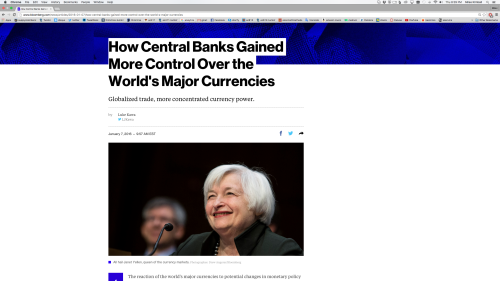
Link to the article on Bloomberg Business
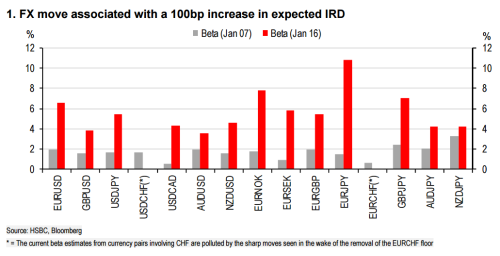
It was a very pleasant surprise when I received an email from Luke Kawa just a day after I put out “Why a Weaker Effect of Exchange Rates on Net Exports Doesn’t Weaken the Power of Monetary Policy” on Medium (the day before I posted it here) asking for clarification since he wanted to quote it in a Bloomberg Business article. He understood the point perfectly in his excellent article “How Central Banks Gained More Control Over the World’s Major Currencies.” You should read the whole thing, but here is a key graph, a key passage, and Luke’s quotation from my post:
The foreign exchange team determined that an expected change in interest rate differentials between two countries from the Group of 10 nations is now accompanied by a much bigger move in the exchange rate:
… The rising import content in exports, however, does not imply that the efficacy of monetary policy has deteriorated. In fact, it’s compatible with the increased responsiveness of currencies to expected interest rate differentials described by HSBC.
“If net exports are relatively insensitive to the exchange rate, the exchange rate will simply move more,” wrote Miles Kimball, professor of economics at the University of Michigan. “Large fluctuations in the exchange rate are exactly what one should expect if net exports are relatively insensitive to movements in the exchange rate.”

On New Year’s Day, 2016, I tweeted what you see above.
Let me explain at greater length. Paul Hannon is right in his Wall Street Journal article “Why Weak Currencies Have a Smaller Effect on Exports” in writing:
When a country loosens its monetary policy, interest rates fall and investors tend to pull their money out in search of higher yields elsewhere, pushing down the currency’s value.
And the article goes on to make a very interesting point about how global supply chains might be blunting the effect of a given change in the exchange rate on net exports:
Measuring the impact of global supply chains on trade flows is the task of a project undertaken by the Organization for Economic Cooperation and Development and the World Trade Organization. …
Economists at the International Monetary Fund and the World Bank have used those measures to assess whether currency movements have the same impact they once did on exports and imports. They found that the effect has in fact reduced over time, by as much as 30% in some countries.
But Paul Hannon’s overall subtext that this weakens the power of monetary policy is wrong. Start with the basic accounting identity of international finance that Paul alludes to and that I discuss in detail in my post “International Finance: A Primer”: the provision of domestic currency to those outside one’s currency zone through net capital outflows NCO (and through other channels as remittances of foreigners sending money to their families back home) must lead to an increase in net exports NX of equal magnitude. (Also see my column “How Increasing Retirement Saving Could Give America More Balanced Trade.”) The only wiggle room in this statement is that for whatever period of time someone abroad are willing to temporarily hold a growing pile of our domestic currency provided byintentional purchases of foreign assets that counts as an unintentional capital flow in the reverse direction. As soon as they want to unload our currency, our currency will make its way back home one way or another. (If people abroad decided to hold a pile of our currency more permanently, that rightly counts as an intentional capital flow in the reverse direction, canceling out all or part of the initial capital flow.)
Of course, the way the price system guarantees the return home of domestic currency that is unwanted abroad is through exchange rate movements. But the logic here means that exchange rates move as much as it takes to bring about the return of domestic currency that is unwanted abroad. So an increase in intentional capital outflow of $1 creates a $1 increase in net exports over whatever horizon it takes for domestic currency that is unwanted abroad to make its way back home. The relevant horizon is not instantaneous, but foreigners are unlikely to be willing to hold piles of unwanted domestic currency for very long. (Of course, governments sometimes choose to override this part of the prices system by imposing fixed exchange rates. Fixed exchange rates work by having the government equal and opposite capital flows to neutralize the effect of changes in intentional private capital flows on exchange rates.)
When the central bank cuts interest rates, the initial step in affecting international finance is in generating net capital flows of a certain size as domestic investors search for higher returns abroad, and potential foreign investors think better of sending their funds to a low-interest-rate country. These capital flows then have a 1-for-1 effect on net exports after the recycling of currency described above, regardless of the elasticity of net exports with respect to the exchange rate.
If net exports are relatively insensitive to the exchange rate, the exchange rate will simply move more. Indeed, many casual observers are struck by the large fluctuations often seen in the exchange rate. Large fluctuations in the exchange rate are exactly what one should expect if net exports are relatively insensitive to movements in the exchange rate, as I wrote about in“The J Curve.”
What would affect the potency of monetary policy is if the effect of a given movement in interest rates on international capital flows went down. But I don’t know of anyone claiming that is the case. (What I do hear a lot of is the speculation that cutting interest rates into the negative region would be especially salient to investors and so might have a particularly large effect on international capital flows — which would then increase the potency of monetary policy.)
One particular area where the discussion above matters is in assessing Japanese monetary policy. How much stimulus the Bank of Japan has achieved through the international finance channel is much better measured by the size of the international capital flows generated than by the size of the exchange rate movements that result. Because overall Japanese investors have a particularly strong home-bias, the effect of monetary policy on international capital flows may be weaker than in most other countries. But it is factors such as home-bias that matter for the contribution of international finance to the potency of monetary policy, not the elasticity of net exports with respect to the exchange rate. (On Japanese monetary policy, also see “Is the Bank of Japan Succeeding in Its Goal of Raising Inflation?”, “Japan Should Be Trying Out a Next Generation Monetary Policy” and “QE May or May Not Work for Japan; Deep Negative Interest Rates Are the Surefire Way for Japan to Escape Secular Stagnation.”)
To repeat: Weak effects of a given size of exchange rate movement on net exports does not blunt the effects of monetary policy because exchange rates do whatever it takes to make net exports equal to net international capital flows.
The link above is to the post in Japanese, translated by Makoto Shimizu. You can find the English version here.
Nathaniel Barr reports on some very interesting research he has been part of on who believes in BS and why.
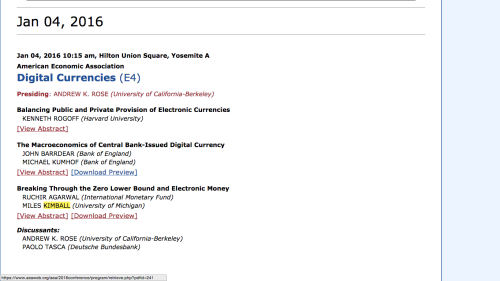
I wanted to invite all of you who are in San Francisco for the American Economics Association meetings to my presentation tomorrow (Monday) on how to eliminate the zero lower bound. You can see the details above.
I would love to meet and get a chance to talk in person to anyone who is a regular reader of this blog right after this session.
I trimmed down my Powerpoint file to this given the time constraints, and tried to get to the key idea quicker, even before getting to the “18 misconceptions.” Then it will be OK if I don’t manage to address all 18 misconceptions, especially since people are likely to ask questions that highlight some of the others.
If you want more background before coming, take a look at
How and Why to Eliminate the Zero Lower Bound: A Reader’s Guide.
Update: It was a great session. Ken Rogoff could not make it due to his wife’s illness; I highly recommend the other paper presented by the Bank of England’s John Barrdear and Michael Kumhof: “The Macroeconomics of Central Bank-Issued Digitial Currency.”Andrew Rose was my discussant. He was very positive but less optimistic than I am about how soon the zero lower bound will be effectively eliminated. I was tickled that–like Ken Rogoff at the Chief Economist’s Conference at the Bank of England last May–Andrew described me as “evangelical” about negative interest rate policy.

I have read that officials in the Roman Empire often described Christianity as a form or atheism, since Christians disbelieved in all gods but one (or all gods but three, as some observers of Christianity counted). In light of that description of Christianity, I found this story from the Middle Ages intriguing:
… encouraged by Pope Gregory II, Boniface traveled throughout the pagan lands of Germany on a new mission. In 723 Gregory II consecrated him a bishop so he could travel freely, ordaining priests and other bishops to establish new dioceses.
Boniface was soon to be famed for a courageous act he performed at Geismar in Hesse (in western Germany). The local community worshiped a great oak tree, believing it to be the sanctuary of the god Thor. They thought that showing disrespect to the three would cause an angry Thor to punish them, but when Boniface felled the great tree, nothing happened. Those who witnessed this were convinced that Boniface could only be right in preaching that the Christian God was stronger than their own. According to the story, Boniface built a chapel with the wood from the tree …
– Michael Collins and Matthew A Price, The Story of Christianity: A Celebration of 2,000 Years of Faith, p. 86.

This is a fascinating brief description of brainwashing techniques (linked above).
“… there is always pressure to block criticism: to shut off alternatives, shelter the familiar, stifle the imagination. Criticism is, after all, no fun for its targets. No one wants to be a failure, even a relative one. So reactionaries who fear disruption, technocrats who want to pick winners, and self-interested parties who want to shut out rivals can all be counted on to try to limit criticism and competition. The ability to resist this collusion against new ideas is perhaps the single most distinguishing feature of dynamic systems.”
– Virginia Postrel, The Future and Its Enemies