"Japan Should be Trying Out a Next Generation Monetary Policy" in Japanese: 日本は次世代の金融政策を試すべきだ →
The link above is to the post in Japanese, translated by Makoto Shimizu. You can find the English version here.
A Partisan Nonpartisan Blog: Cutting Through Confusion Since 2012
The link above is to the post in Japanese, translated by Makoto Shimizu. You can find the English version here.
Note: On Facebook, Carmi Turchick offered these interesting references:
Graef, P., & Mehlkop, G. (2002). The impact of economic freedom on corruption: different patterns for rich and poor countries. European Journal of Political Economy, 19, 605-620
Kotera, G., Okada, K., & Samreth, S. (2012). Government size, democracy, and corruption: An empirical investigation. Economic Modelling, 29(6), 2340-2348.
A number of papers show the expected negative effects of increased corruption on growth and these papers show that lower levels of regulation in well developed economies corresponds with higher levels of corruption. This is not the same in developing economies, there more regulation corresponds with more corruption, the regulations are excuses for bribery.
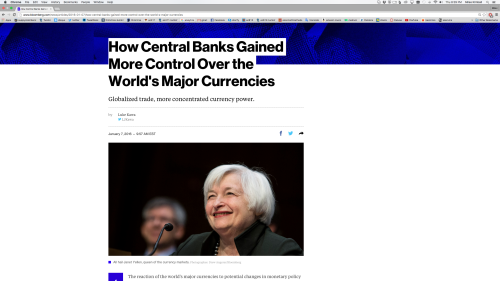
Link to the article on Bloomberg Business
It was a very pleasant surprise when I received an email from Luke Kawa just a day after I put out “Why a Weaker Effect of Exchange Rates on Net Exports Doesn’t Weaken the Power of Monetary Policy” on Medium (the day before I posted it here) asking for clarification since he wanted to quote it in a Bloomberg Business article. He understood the point perfectly in his excellent article “How Central Banks Gained More Control Over the World’s Major Currencies.” You should read the whole thing, but here is a key graph, a key passage, and Luke’s quotation from my post:
The foreign exchange team determined that an expected change in interest rate differentials between two countries from the Group of 10 nations is now accompanied by a much bigger move in the exchange rate:
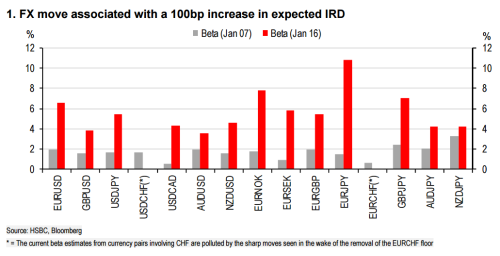
… The rising import content in exports, however, does not imply that the efficacy of monetary policy has deteriorated. In fact, it’s compatible with the increased responsiveness of currencies to expected interest rate differentials described by HSBC.
“If net exports are relatively insensitive to the exchange rate, the exchange rate will simply move more,” wrote Miles Kimball, professor of economics at the University of Michigan. “Large fluctuations in the exchange rate are exactly what one should expect if net exports are relatively insensitive to movements in the exchange rate.”

On New Year’s Day, 2016, I tweeted what you see above.
Let me explain at greater length. Paul Hannon is right in his Wall Street Journal article “Why Weak Currencies Have a Smaller Effect on Exports” in writing:
When a country loosens its monetary policy, interest rates fall and investors tend to pull their money out in search of higher yields elsewhere, pushing down the currency’s value.
And the article goes on to make a very interesting point about how global supply chains might be blunting the effect of a given change in the exchange rate on net exports:
Measuring the impact of global supply chains on trade flows is the task of a project undertaken by the Organization for Economic Cooperation and Development and the World Trade Organization. …
Economists at the International Monetary Fund and the World Bank have used those measures to assess whether currency movements have the same impact they once did on exports and imports. They found that the effect has in fact reduced over time, by as much as 30% in some countries.
But Paul Hannon’s overall subtext that this weakens the power of monetary policy is wrong. Start with the basic accounting identity of international finance that Paul alludes to and that I discuss in detail in my post “International Finance: A Primer”: the provision of domestic currency to those outside one’s currency zone through net capital outflows NCO (and through other channels as remittances of foreigners sending money to their families back home) must lead to an increase in net exports NX of equal magnitude. (Also see my column “How Increasing Retirement Saving Could Give America More Balanced Trade.”) The only wiggle room in this statement is that for whatever period of time someone abroad are willing to temporarily hold a growing pile of our domestic currency provided byintentional purchases of foreign assets that counts as an unintentional capital flow in the reverse direction. As soon as they want to unload our currency, our currency will make its way back home one way or another. (If people abroad decided to hold a pile of our currency more permanently, that rightly counts as an intentional capital flow in the reverse direction, canceling out all or part of the initial capital flow.)
Of course, the way the price system guarantees the return home of domestic currency that is unwanted abroad is through exchange rate movements. But the logic here means that exchange rates move as much as it takes to bring about the return of domestic currency that is unwanted abroad. So an increase in intentional capital outflow of $1 creates a $1 increase in net exports over whatever horizon it takes for domestic currency that is unwanted abroad to make its way back home. The relevant horizon is not instantaneous, but foreigners are unlikely to be willing to hold piles of unwanted domestic currency for very long. (Of course, governments sometimes choose to override this part of the prices system by imposing fixed exchange rates. Fixed exchange rates work by having the government equal and opposite capital flows to neutralize the effect of changes in intentional private capital flows on exchange rates.)
When the central bank cuts interest rates, the initial step in affecting international finance is in generating net capital flows of a certain size as domestic investors search for higher returns abroad, and potential foreign investors think better of sending their funds to a low-interest-rate country. These capital flows then have a 1-for-1 effect on net exports after the recycling of currency described above, regardless of the elasticity of net exports with respect to the exchange rate.
If net exports are relatively insensitive to the exchange rate, the exchange rate will simply move more. Indeed, many casual observers are struck by the large fluctuations often seen in the exchange rate. Large fluctuations in the exchange rate are exactly what one should expect if net exports are relatively insensitive to movements in the exchange rate, as I wrote about in“The J Curve.”
What would affect the potency of monetary policy is if the effect of a given movement in interest rates on international capital flows went down. But I don’t know of anyone claiming that is the case. (What I do hear a lot of is the speculation that cutting interest rates into the negative region would be especially salient to investors and so might have a particularly large effect on international capital flows — which would then increase the potency of monetary policy.)
One particular area where the discussion above matters is in assessing Japanese monetary policy. How much stimulus the Bank of Japan has achieved through the international finance channel is much better measured by the size of the international capital flows generated than by the size of the exchange rate movements that result. Because overall Japanese investors have a particularly strong home-bias, the effect of monetary policy on international capital flows may be weaker than in most other countries. But it is factors such as home-bias that matter for the contribution of international finance to the potency of monetary policy, not the elasticity of net exports with respect to the exchange rate. (On Japanese monetary policy, also see “Is the Bank of Japan Succeeding in Its Goal of Raising Inflation?”, “Japan Should Be Trying Out a Next Generation Monetary Policy” and “QE May or May Not Work for Japan; Deep Negative Interest Rates Are the Surefire Way for Japan to Escape Secular Stagnation.”)
To repeat: Weak effects of a given size of exchange rate movement on net exports does not blunt the effects of monetary policy because exchange rates do whatever it takes to make net exports equal to net international capital flows.
The link above is to the post in Japanese, translated by Makoto Shimizu. You can find the English version here.
Nathaniel Barr reports on some very interesting research he has been part of on who believes in BS and why.
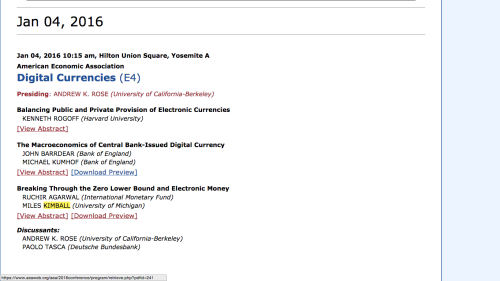
I wanted to invite all of you who are in San Francisco for the American Economics Association meetings to my presentation tomorrow (Monday) on how to eliminate the zero lower bound. You can see the details above.
I would love to meet and get a chance to talk in person to anyone who is a regular reader of this blog right after this session.
I trimmed down my Powerpoint file to this given the time constraints, and tried to get to the key idea quicker, even before getting to the “18 misconceptions.” Then it will be OK if I don’t manage to address all 18 misconceptions, especially since people are likely to ask questions that highlight some of the others.
If you want more background before coming, take a look at
How and Why to Eliminate the Zero Lower Bound: A Reader’s Guide.
Update: It was a great session. Ken Rogoff could not make it due to his wife’s illness; I highly recommend the other paper presented by the Bank of England’s John Barrdear and Michael Kumhof: “The Macroeconomics of Central Bank-Issued Digitial Currency.”Andrew Rose was my discussant. He was very positive but less optimistic than I am about how soon the zero lower bound will be effectively eliminated. I was tickled that–like Ken Rogoff at the Chief Economist’s Conference at the Bank of England last May–Andrew described me as “evangelical” about negative interest rate policy.

I have read that officials in the Roman Empire often described Christianity as a form or atheism, since Christians disbelieved in all gods but one (or all gods but three, as some observers of Christianity counted). In light of that description of Christianity, I found this story from the Middle Ages intriguing:
… encouraged by Pope Gregory II, Boniface traveled throughout the pagan lands of Germany on a new mission. In 723 Gregory II consecrated him a bishop so he could travel freely, ordaining priests and other bishops to establish new dioceses.
Boniface was soon to be famed for a courageous act he performed at Geismar in Hesse (in western Germany). The local community worshiped a great oak tree, believing it to be the sanctuary of the god Thor. They thought that showing disrespect to the three would cause an angry Thor to punish them, but when Boniface felled the great tree, nothing happened. Those who witnessed this were convinced that Boniface could only be right in preaching that the Christian God was stronger than their own. According to the story, Boniface built a chapel with the wood from the tree …
– Michael Collins and Matthew A Price, The Story of Christianity: A Celebration of 2,000 Years of Faith, p. 86.

This is a fascinating brief description of brainwashing techniques (linked above).
“… there is always pressure to block criticism: to shut off alternatives, shelter the familiar, stifle the imagination. Criticism is, after all, no fun for its targets. No one wants to be a failure, even a relative one. So reactionaries who fear disruption, technocrats who want to pick winners, and self-interested parties who want to shut out rivals can all be counted on to try to limit criticism and competition. The ability to resist this collusion against new ideas is perhaps the single most distinguishing feature of dynamic systems.”
– Virginia Postrel, The Future and Its Enemies
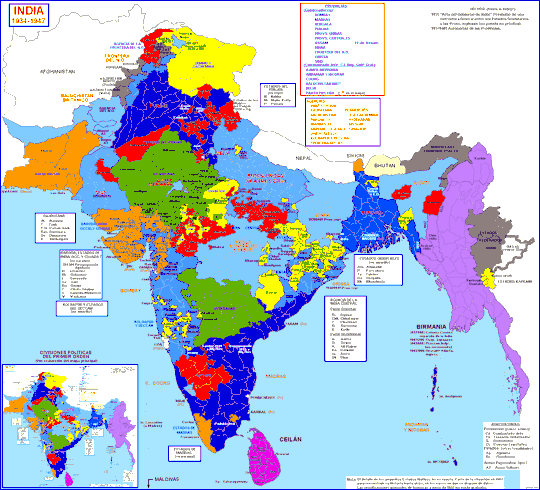
I received a comment on my post “Will Narendra Modi’s Economic Reforms Put India on the Road to Being a Superpower?” that I thought was important enough that I should make it into a guest post. It had a lot of information that I had been unaware of. The author chose to remain anonymous. Here is what shehe wrote:
I am surfing the web and chanced upon this site, nice blog. Since you are opened to revision in response to cogent arguments, I am going to take a stab here. I think you have a fundamental misunderstanding of India. Yes I know, India is a democracy and all that. But this is a rather superficial understanding of the country. You might not have heard of India’s territorial disputes in the news, but this doesn’t mean India does not have them. In fact India (with the possible exception of Bangladesh, since I read that India and Bangladesh have reached an agreement to settle their borders this January) has not settled its borders with any of its neighbors. And worst, India has the dubious distinction of annexing every single of its neighbors land since it was created by the British in 1947. I know this may come as a shock to you, but here are the links you may want to check out:
1947 Annexation of Kashmir
http://www.counterpunch.org/2015/02/06/indias-shame/
http://thediplomat.com/2015/08/kashmirs-young-rebels/
1949 Annexation of Manipur
http://www.tehelka.com/manipurs-merger-with-india-was-a-forced-annexation/
1949 Annexation of Tripura
1951 Annexation of South Tibet:
http://kanglaonline.com/2011/06/khathing-the-taking-of-tawang/
http://www.mainstreamweekly.net/article2582.html
1961 Annexation of Goa:
http://goa-invasion-1961.blogspot.in/2013/09/india-pirated-goa-china-is-regaining_16.html
1962 Annexation of Kalapani, Nepal:
http://www.eurasiareview.com/07032012-indian-hegemony-in-nepal-oped/
1962 Aggression against China:
http://gregoryclark.net/redif.html
http://asiapacific.anu.edu.au/news-events/podcasts/renewed-tension-indiachina-border-whos-blame
1971 Annexation of Turtuk, Pakistan:
http://www.openthemagazine.com/article/nation/suddenly-indian
1972 Annexation of Tin Bigha, Bangladesh
http://www.dhakatribune.com/op-ed/2014/feb/20/killing-fields
1975 Annexation of Sikkim (the whole country):
http://nepalitimes.com/issue/35/Nation/9621#.UohjPHQo6LA
http://www.amazon.com/Smash-Grab-Annexation-Sunanda-Datta-Ray/dp/9383260386
1983 (Aborted) Attempted invasion of Mauritius
http://thediplomat.com/2013/03/when-india-almost-invaded-mauritius/
1990 (Failed) Attempted annexation of Bhutan:
http://www.nytimes.com/1990/10/07/world/india-based-groups-seek-to-disrupt-bhutan.html
2006 Annexation of Duars, Bhutan:
http://wangchasangey.blogspot.in/2015/11/different-kind-of-anxieties-on.html#comment-form
2013 Annexation of Moreh, Myanmar
http://www.huffingtonpost.com/nehginpao-kipgen/easing-indiamyanmar-borde_b_4633040.html
If you talk to India’s neighbors, the words ‘bullying’, 'hegemonic’, 'meddling’, 'intrusive’…are probably some of the adjective its neighbors will use to describe India. A recent example is India rejection of Bhutan’s plan to build a highway in the southern part of Bhutan. An earlier example is India’s creation of the Tamil Tigers which plunged Sri Lanka into many years of civil war. You might not have aware of it, but India has a rather testy relations with almost all of its neighbors.
As to why India is such a misunderstood country, I pondered it for a long time and here are the reason I think may have something to do with it.
1) India was created under British auspices and hence British India relations have a sort of mentor protégé element to it. As such Britain is naturally protective of India and hence tacitly approved or at least tolerate India’s aggression. Britain, as one the key member of the West, set the tone of how India should be treated.
2) In the early years after India’s creation in 1947, Britain saw India as a kind of proxy that represents Britain’s interest in South Asia. As such India’s aggression was not viewed to be detrimental to the world’s order. In fact not many people know, after 1947 a lot of the British Raj officials stayed and served in the new government especially in the foreign policy department. Hence the expansionary instinct (in order words land grabbing) of the British Raj continues in the new country.
3) The subcontinent was colonized for two hundred years, when it gained independence, there were a lot of goodwill towards India all over the world, not less from Britain itself. The situation is not dissimilar to South Africa. Nehru was basically the Nelson Mandela of his time. India skillfully exploits this sentiment and assume a role of moral superiority in dealing with international affairs. Nehru is famous for his self-righteousness internationally. This makes it hard to criticize India.
4) India is a democracy. The notion that democracies are intrinsically peaceful is seldom challenged. In fact the belief is so strong that whatever India says are usually accepted as fact with no question asked. Take Sikkim as an example, fifteen years before Saddam Hussein annexed Kuwait, India annexed Sikkim. But how do India explain its act? According to India’s explanation, 97% of Sikkimese voted to join India, so India just spread its democracy to Sikkim by 'incorporating’ Sikkim into the India. I remembered when before the first gulf war when Saddam Hussein said he conducted an election and 99% of Iraqi voted for him, it was immediately dismissed as ridiculous (which it is). But when India says the same thing, it was accepted as fact.
5) Gandhi is a well-known icon of India. And Gandhi’s non-violence struggle against the British are well-known. This non-violence stereotype stick and people just assume that India is non-violence against its neighbors also. But of course nothing is further from the truth. Over seventy thousands Kashmiris disappeared without a trace in India occupied Kashmir with many show up in mass graves. A few years ago there was an uprising in Kashmir and in one demonstration Indian troops gunned down hundreds of Kashmiris. But the press seems not to be too bother about it. India gets away with murder, literally.
I found this passage from an email asking me to referee a paper very perceptive. The editor wrote:
From personal experience, there is a (growing?) tendency for referees to provide very long, detailed reports that sometimes read - with slight exaggeration - like an essay on the question “how I would have written this paper”. This is not always optimal - it costs the referee’s time, and it may result in a lengthy, non-converging refereeing process overall. Our main interest is in receiving advice on a. the overall significance of the findings and claims b. their technical correctness. In my experience, a relatively brief report containing a set of consecutively numbered paragraphs, each making one point, is most useful in reaching a final decision.
Update: This quotation received an extraordinarily positive reaction on my Facebook page (with 201 likes and counting, including many from well-known economists, plus several positive comments), as you can see here.
Unless it faces some form of competition, almost every institution becomes slovenly. The objective of minimizing violence overall often makes it appropriate for governments to monopolize the use of most forms of violence. But that is all the more reason that governments must face competition in the realm of ideas. A government not subject to vocal criticism is a government bound to do some part of its job very badly.
One of the downsides of a large government is that it leaves fewer people outside of government who are well equipped to give penetrating critiques of government habits and government actions. (This can be a big problem at the state, regional and local level as well as at the national level.) John Stuart Mill expresses this concern well in paragraph 22 of On Liberty “Chapter V: Applications”:
It is not, also, to be forgotten, that the absorption of all the principal ability of the country into the governing body is fatal, sooner or later, to the mental activity and progressiveness of the body itself. Banded together as they are — working a system which, like all systems, necessarily proceeds in a great measure by fixed rules — the official body are under the constant temptation of sinking into indolent routine, or, if they now and then desert that mill-horse round, of rushing into some half-examined crudity which has struck the fancy of some leading member of the corps: and the sole check to these closely allied, though seemingly opposite, tendencies, the only stimulus which can keep the ability of the body itself up to a high standard, is liability to the watchful criticism of equal ability outside the body. It is indispensable, therefore, that the means should exist, independently of the government, of forming such ability, and furnishing it with the opportunities and experience necessary for a correct judgment of great practical affairs. If we would possess permanently a skilful and efficient body of functionaries — above all, a body able to originate and willing to adopt improvements; if we would not have our bureaucracy degenerate into a pedantocracy, this body must not engross all the occupations which form and cultivate the faculties required for the government of mankind.
Note: This post is the latest in a series on John Stuart Mill’s “On Liberty” that begins on my Tumblr blog “Confessions of a Supply-Side Liberal.” Links to others can be found here:
Chapter II John Stuart Mill’s Brief for Freedom of Speech
Chapter III: John Stuart Mill’s Brief for Individuality
Chapter IV: John Stuart Mill’s Brief for the Limits of the Authority of Society over the Individual
More recents John Stuart Mill posts can be found in my
This is a heart-warming segment from the PBS newshour. But it is more than heartwarming. It is also very instructive. It suggests that the same principles that work in the “Knowledge is Power Program” or KIPP schools work for adults as well as children. As I wrote in “Magic Ingredient 1: More K-12 School” and quoted again in “The Coming Transformation of Education: Degrees Won’t Matter Anymore, Skills Will”:
“The secret recipe behind the “Knowledge is Power Program” or KIPP schools (which have been very successful even with highly disadvantaged kids) is this:
Abstracting a bit from the specifics, the recipe is
By this recipe, they can gain skills that will turn their lives around.
In line with what many other religious traditions have preached as well, Jesus said:
Do unto others as you would have them do unto you.
This has been called the Golden Rule. Not everyone feels ready to follow the Golden Rule. So I would like to propound the Aluminum Rule, framed as a less demanding version of Utilitarianism:
When acting collectively–or considering collective actions–put a weight on the welfare of human beings outside the in-group at least one-hundredth as much as the welfare of those in the in-group.
To make clear what this means, conducting cost-benefit analysis that put a weight of zero on non-citizens, for example, would violate the Aluminum rule.
It might seem that the Aluminum rule would not have much bite, but that is not so. In “Inequality Aversion Utility Functions: Would $1000 Mean More to a Poorer Family than $4000 to One Twice as Rich?” talked about results that indicate that there is actually quite wide agreement that a dollar means at least 4 times as much to someone who is living on half as much income. Extending that elasticity (of 2 or more) to lower levels of income, it means that a dollar would mean something like 100 times as much to someone who has only 1/10 the income. Thus, a weight of 1/100 on someone in the out-group can be counteracted by someone in the out-group having an income only 1/10 or less of those in the in-group. Given the enormous differences in income levels between the typical individual in various different countries, following the aluminum rule would then mean that the welfare of those in relatively poor nations would bulk large in overall Aluminum-Rule calculations.
One might think that this would recommend that we do more foreign aid. It isn’t that easy. As Angus Deaton argues in his wonderful book The Great Escape: Health, Wealth, and the Origins of Inequality, foreign aid is very often literally corrupting, by putting money in the hands of people who don’t necessarily have the welfare of other people in their nation at heart. No, the most reliable way to help people in poor countries is to let them in. As I wrote in “The Message of Jesus for Non-Supernaturalists”:
The essence of oppression is to run things for the benefit of an in-group at the expense of an out-group. In my post “‘Keep the Riffraff Out!’” I point out three ways in which we routinely use exclusion to run things for the benefit of an in-group at the expense of an out-group.
The first is to put up fences and guards to keep out immigrants desperate to become part of a well-run liberal democracy. Why do we keep them out? In order to benefit a subset of citizens—of the in-group—even at terrible cost to those being kept out. Or when they get in despite our best efforts, we keep them in constant fear of deportation and thereby keep them at the margins of society.
We are often moved to compassion when we see pictures of people suffering in other countries, and send money to help. But other than limited areas such as fighting illness, it is very difficult to make things better over there where evil rules. But if we focus on helping people rather than helping nations, it is simplicity itself to help the people in other nations: let them in! It is much easier to bring the people to good systems of governance than it is to bring good systems of governance to people where they are. Where they are, evil systems designed for oppression will fight us tooth and nail. Here at home, we only have to fight the evil in our own hearts, with a fundamentally good system designed to keep our own evil in check backing us up.
The cost-benefit calculus for more open borders is only strengthened by considering how it may save those of us already in well-run countries. As I wrote in “Why Thinking about China is the Key to a Free World”:
Strengthening the free world numerically
Bringing more people into the free world is easier than it sounds. The key is to focus on people, not patches of ground. Although it is hard to bring a patch of ground currently subject to an oppressive regime under free institutions, the economic importance of land—apart from what is on top of the land—continues to decline relative to the importance of people, education and training, ideas and capital. Once one focuses on people, the answer is clear: bring people to where freedom already rules. That is so easy it is hard to do the opposite. Many people in benighted countries seek freedom and the prosperity that full freedom enables. Standing in the way of those hopes, many otherwise free countries make strenuous efforts to keep those people seeking prosperity and freedom out.
Currently, there is much agonizing about the dangers of allowing refugees from war-torn Middle-Eastern countries to come into safe-haven countries for fear that this might let terrorists in, even after strenuous efforts to identify potential terrorists to keep them out while letting others from those war-torn countries in. I do not think a man who willingly allowed himself to be crucified in order to demonstrate the power of love would take such a position. But be that as it may, rest assured that even if one takes such a position, there are many, many people from other benighted countries who can be let in who pose no such danger.
I don’t mean to suggest at all that the only implications of the Aluminum Rule are for immigration policy. I would love to see the outcome of many calculations based on the Aluminum Rule. The principle of the Aluminum Rule can go far in illuminating what we should do, and may yet prove a stepping stone toward the Golden Rule itself.