Woo Chul Ro: Affirmative Action by US Colleges is Troubling, But Still a Net Plus for Social Justice

Link to Woo Chul Ro’s LinkedIn homepage

I am delighted to host another student guest post, this time by Woo Chul Ro. This is the 9th student guest post of this semester. You can see all the student guest posts from my “Monetary and Financial Theory” class at this link.


Affirmative action in the US colleges is inefficient to the economy and yet necessary for economic equality and social justice.

What is justice? A famous Korean law professor once told me “justice is something one cannot justify.” I was reminded of this saying after reading the article from the Economist called The Model Minority is Losing Patience. The article argues that Asian Americans are the most successful and hard working minority, but they are also the most discriminated in academia. As an example, an Asian American student from California is introduced. Being second in his class of over 1000, having perfect ACT scores, singing in President Obama’s inauguration, getting into third place in the national piano contest, being in the national debate finals multiple times was not good enough for him to get accepted into six of the seven ivy league schools he applied for. Many candidates, of a different race and much more under qualified than himself, got into the schools that he could not get into. Because of this, around 60 candidates like the student from California (Asian American & qualified) got together to sue Harvard for racial discrimination. The charge was denied by the Department of Education. Harvard practices affirmative action, and therefore the charge against them is invalid.

At first, as an Asian American myself, I definitely considered this an injustice to my ethnicity and inefficient to the economy. Through affirmative action, many Asian Americans are losing the opportunities they might have had if they were a different race. However, if they were a different race, would they have had the same opportunities? The article states that Asian Americans are the most “successful” race. As a matter of fact, Asian Americans have the highest average wage among any other category of race. This means that many Asian Americans were probably raised in a decent socioeconomic environment, where education is not scarce. And then there is the cultural side. Most Asian American parenting is considered to be much different from other races. Asian American parents tend to prioritize education more, and they also train their children to work very hard. As an Asian American, a lot of children are taught to work harder for education, and a lot of Asian American families are thought to invest more of their income on the children’s education.

So is this an unforgivable injustice? It definitely is discrimination; this is probably why affirmative action is also termed “positive discrimination.” In the Wall Street Journal article Poverty or Prosperity – Different Paths After College, the article shows a study of colleges in New York, which suggests that wages after colleges are indeed predictable through the college one attends. Although causality is hard to fully demonstrate, this suggests that prestigious colleges give students a return for their investment of time and money. Assuming this statement is true, it means that the rate of return on their investment in education before college for Asian Americans is indeed hurt by their greater difficulty in getting into prestigious colleges. But the high wages of Asian Americans suggest that they are still doing well despite that handicap. 

Could it be that the return to attending a prestigious college is greater for those who were initially disadvantaged?  A study by Stacy Dale and Alan Krueger suggested that the answer is yes: conditional on where students applied, there is little evidence that attending a prestigious college had high returns unless a student was initially disadvantaged. If this true, then affirmative action in college admissions would benefit those initially disadvantaged more than it hurt Asian Americans and raise social welfare. Some policies for welfare can be considered injustice, but it may be injustice for a larger justice.

Update: On Miles’s Facebook page, Robert Flood recommends this Journal of Economic Perspectives article on affirmative action:

Mario Draghi on Negative Interest Rates and Other Policy Tools—October 31, 2015 Interview by Alessandro Merli and Roberto Napoletano

Link to Wikipedia article on Mario Draghi

Mario Draghi gave a remarkable interview on October 31, 2015, labeled on an official webpage of the European Central Bank as “Interview with Il Sole 24 OreInterview with Mario Draghi, President of the ECB, conducted by Alessandro Merli and Roberto Napoletano.” I am grateful to Mike Bird and JP Koning for alerting me on Twitter to the importance of this interview.

To emphasize the points Mario Draghi is making about the role of various policy tools going forward, I have organized under my own headings what I consider the passages from the interview that I consider most important in their application to the future and to other central banks as well as the ECB. Mario Draghi has been head of the European Central Bank during a crucial period of time; I omit the parts of the interview focused primarily on reviewing that history, and focusing on the eurozone-specific issues.

To preview what is below, I include the Q&A about quantitative easing primarily as context. In the discussion of negative interest rates, Mario Draghi’s statement that 

  • The lower bound of the interest rate on deposits is a technical constraint and, as such, may be changed in line with circumstances. 

is especially important. Compare this to the exact words of the statement I have urged central bank officials to make: 

From a technical point of view, we know how to eliminate the zero lower bound. 

On the truth of that statement, see my IMF Working Paper with Ruchir Agarwal, “Breaking Through the Zero Lower Bound,” which came out on October 23, 2015. (Also see my bibliographic post “How and Why to Eliminate the Zero Lower Bound: A Reader’s Guide.”)

Mario Draghi makes many other important points in the interview with which I am in strong agreement:

  • international monetary policy coordination is not essential; it is OK if each central bank takes care of its own jurisdiction
  • government investments are the safest type of fiscal policy, but good government investments can be hard to find
  • supply-side reform is important; appropriate stimulative monetary policy is helpful to supply-side reform or in some cases neutral for supply-side reform

Here are the parts of the interview focusing on these issues:

Quantitative Easing

Q: You have always said that this outcome depends on the full implementation of your monetary policy and you have added on a number of occasions that there is flexibility in your asset purchase programme in terms of its size, composition and duration. You have also said that the next meeting on 3 December 2015 is when you will “re-examine” these aspects. The financial markets read this date as being decision time for the ECB. Is this interpretation correct? Have you started to consider the relative merits of these three types of action, which could have different effects? Do you envisage using them simultaneously?

Mario Draghi: If we are convinced that our medium-term inflation target is at risk, we will take the necessary actions. In the meantime we are assessing whether the change in the underlying scenario is temporary or less so. Moreover, after the meeting in Malta, we asked all the relevant committees and ECB staff to prepare analyses of the relative effectiveness of the different options for the December meeting. We will decide on this basis. We will see whether a further stimulus is necessary. This is an open question. The programmes that we have put together are all characterised by their capacity to be used with the necessary flexibility.

Negative Interest Rates

Q: However, for the first time you mentioned a cut in the ECB’s bank deposit rate and you said that “things have changed” since you had stated that -0.20% was the minimum lower bound. Can you explain what has changed?

Mario Draghi: The circumstances informing the decision to reduce the bank deposit rate to its current level actually consisted of a macroeconomic framework that has since changed. The price of oil and the exchange rate have changed. I would say that the global economic situation has changed. The interest rate on deposits could be one of the instruments that we use again. Now we have one more year of experience in this area: we have seen that the money markets adapted in a completely calm and smooth way to the new interest rate that we set a year ago; other countries have lowered their rate to much more negative levels than ours. The lower bound of the interest rate on deposits is a technical constraint and, as such, may be changed in line with circumstances. The main test of a central bank’s credibility is – as I have said before – the ability to achieve its objectives; it has nothing to do with the instruments.

Q: So, you see cutting the bank deposit rate as an instrument that can be used at the same time as the amendments to QE?

Mario Draghi: I would say that it is too early to make that judgement.

Q: In Malta, you also said you had discussed “some other monetary policy instruments”. What did you have in mind?

Mario Draghi: It would be too early at this stage to restrict the menu of instruments that will be assessed by the relevant committees and ECB staff. The existing menu is nevertheless extensive – you only have to look at what has been done in the past three years. However, it is too early to say in any case that “this is the menu” and that “there is nothing to add”.

International Monetary Policy Coordination

Q: You spoke earlier about the global macroeconomic environment which is changing. The Vice Chairman of the Federal Reserve System, Stanley Fisher, said that the Fed today takes much greater account of international factors than it did up until a few years ago. Is this true of the ECB as well? And does the Fed’s delay in starting to raise rates influence in some way your decisions, considering that the exchange rate is not a policy target?

Mario Draghi: As I said, external circumstances, the assumptions underlying our forecasts, are important because they influence inflation expectations, and therefore the profile of the return towards price stability and of the growth rate. They form part of the set of information that we, like the other policy-makers, use to take our decisions. As far as the Fed is concerned, there’s no direct link between what we are doing and what they are doing. Both central banks have their mandate defined by the jurisdiction in which they operate, for them it’s the United States, for us it’s the euro area.

Fiscal Policy

Q: In Lima you said that high-debt countries had to prepare for the day when they suffer from the impact of higher yields. At the same time, these countries suffer but also from the fact that inflation is very low, making debt reduction complicated. Isn’t this an even more serious risk? In Europe an increase in yields is not imminent, while too low inflation is making itself felt.

Mario Draghi: Low inflation has two effects. The first one is negative because it makes debt reduction more difficult. The second one is positive because it lowers interest rates on the debt itself. The path on which fiscal policy has to move is narrow, but it’s the only one available: on the one hand ensuring debt sustainability and on the other maintaining growth. If interest rate savings are used for current spending the risk increases that the debt becomes unsustainable when interest rates go up. Ideally, the savings are instead spent on public investments whose rates of return permit repayment of the interest when it rises. Growth is maintained today and future public finances are not destabilised when rates go up.

Obviously it’s not simple because, as we know, there aren’t many public investments with a high rate of return.

Supply-Side Reform

Q: Precisely on the subject of fiscal policy, there’s a lot of discussion in Europe at the political level. You are one of the first to use the expression “fiscal compact” in the European debate. Do you think now, looking back, that the degree of budget restrictions in the euro area was too strong after the crisis, in other words that there has been excessive austerity which has held back the recovery in the euro area?

Mario Draghi: First of all, there are countries which don’t have the scope for fiscal expansion according to the rules which we have given ourselves. Secondly, where this is possible, fiscal expansion must be able to take place without harming the sustainability of the debt. The high-debt countries have less scope to do this. But the fiscal space is not a fact of nature, it can be expanded, even a high-debt country can do it. How? By making the structural reforms which push up potential output, the participation rate, productivity, all factors which substantially boost the potential for future tax revenues. Increasing revenues on a permanent basis expands the possibilities for repaying debt tomorrow and at the same time creates the conditions for fiscal expansion today. The structural reforms are not popular because they involve paying a price today for benefits tomorrow, but if the government’s commitment is real and the reforms are credible, the benefits are gained more quickly and they include fiscal space.

Stimulative Monetary Policy and Supply-Side Reform are Complements or Separable, Not Substitutes

Q: The ECB’s Governing Council stands ready to increase monetary stimulus, should this be necessary. Your critics claim that this reduces the incentive to implement reforms.

Mario Draghi: I think that this is wrong for a number of reasons. First, if we look at the time frame of the main structural reforms implemented in the euro area over the past five years, it shows that this has no correlation with the level of interest rates on government debt in the countries concerned. Labour market reforms, for example, were implemented in both Spain and Italy when interest rates were already very low, and the same is also true in other cases. Second, the structural reforms cover a very wide range of areas. I do not believe, for example, that reform of the legal system has anything to do with interest rate developments. Third, recent experience shows that also when interest rates are high because a country’s fiscal credibility is threatened, this does not increase governments’ propensity to carry out reforms.

Q: How do structural reforms correspond to low interest rates?

Mario Draghi: Structural reforms and low interest rates complement each other: carrying out structural reforms means paying a price now in order to obtain a benefit tomorrow; low interest rates substantially reduce the price that has to be paid today. There is, if anything, a relationship of complementarity. There are also other more specific reasons: low interest rates ensure that investment, the benefits from investment and from employment, materialise more quickly. Structural reforms reduce uncertainty regarding macroeconomic and microeconomic prospects. Therefore, it is the opposite, rather than seeing an increase in moral hazard, I see a relationship of complementarity, of incentive. But it should never get to the point of having to consolidate the government budget when market conditions have become hopeless. Experience over recent years has shown that, in these circumstances, governments often make mistakes in designing economic policies, dramatically hike taxes and reduce public investment, without significantly reducing current spending, and postpone the structural reforms that require social consensus. In this way, they exacerbate the recessionary effects of the high interest rates and slow the fall of the debt-to-GDP ratio.

To conclude, in the euro area the markets do not typically influence the propensity of governments to carry out structural reforms; when this happens, because the governments have delayed the reforms for too long, and owing to the deterioration in the general conditions, the resulting economic policy action does not foster growth.


Steven Landsburg, Using Utilitarian Reasoning, Upholds the Right to Bear Children Against John Stuart Mill

Unlike the US Supreme Court and typical opinion on most rich countries, John Stuart Mill does not recognize bearing a child as within the sphere of personal liberty. He argues in paragraph 15 of On Liberty “Chapter V: Applications” that many other people are involved: the child itself, as well as everyone whose wage might be affected by having more people in the country: 

It is not in the matter of education only, that misplaced notions of liberty prevent moral obligations on the part of parents from being recognised, and legal obligations from being imposed, where there are the strongest grounds for the former always, and in many cases for the latter also. The fact itself, of causing the existence of a human being, is one of the most responsible actions in the range of human life. To undertake this responsibility—to bestow a life which may be either a curse or a blessing—unless the being on whom it is to be bestowed will have at least the ordinary chances of a desirable existence, is a crime against that being. And in a country either over-peopled or threatened with being so, to produce children, beyond a very small number, with the effect of reducing the reward of labour by their competition, is a serious offence against all who live by the remuneration of their labour. The laws which, in many countries on the Continent, forbid marriage unless the parties can show that they have the means of supporting a family, do not exceed the legitimate powers of the State: and whether such laws be expedient or not (a question mainly dependent on local circumstances and feelings), they are not objectionable as violations of liberty. Such laws are interferences of the State to prohibit a mischievous act—an act injurious to others, which ought to be a subject of reprobation, and social stigma, even when it is not deemed expedient to superadd legal punishment. Yet the current ideas of liberty, which bend so easily to real infringements of the freedom of the individual in things which concern only himself, would repel the attempt to put any restraint upon his inclinations when the consequence of their indulgence is a life or lives of wretchedness and depravity to the offspring, with manifold evils to those sufficiently within reach to be in any way affected by their actions. When we compare the strange respect of mankind for liberty, with their strange want of respect for it, we might imagine that a man had an indispensable right to do harm to others, and no right at all to please himself without giving pain to any one.

Taken at his word, John Stuart Mill seems to give moral support to the cruel one-child policy that China has just abandoned in favor of a looser, but still heavy-handed two-child policy

I think John Stuart Mill is quite wrong for reasons that Steven Landsburg explains best. In his book More Sex is Safer Sex: The Unconventional Wisdom of Economics, Steven writes:

The reason you are wealthier than your grandparents, and the reason your grandchildren will be wealthier than you, is that each generation free-rides on the inventiveness of its ancestors. A generation ago, your parents were free to choose among three television channels, probably broadcasting in black and white, showing programs that could not be taped for later viewing. They used electric typewriters, of which the latest models featured a marvelous innovation: a “delete” key that enabled you automatically to erase the last character you had typed. If you wanted to erase the character before that one you were out of luck.

For many of the comforts we enjoy today, we can be grateful to the inventors of cable television, video recorders, and the personal computer–and to the stroke of good fortune that prevented their parents from joining Zero Population Growth. 

The engine of prosperity is technological progress, and the engine of technological progress is people. The more people, the more ideas. The more ideas, the more we prosper. [pp. 25,26]

There are some big benefits of population growth. Most importantly, they’re spillover benefits: when I decided to have a child, you were a winner. To decide whether the earth is over- or under-populated, we’ll want to weigh those spillover benefits against any spillover costs we can think of. 

But first let’s acknowledge the benefits and costs that don’t spill over. The day my daughter was born, my family’s per capita income fell by one-third (because it was now shared among three people instead of two). Without offsetting benefits, that would have been one of the worst days of my life. Instead, it was the best. (Indeed, the economist Peter Bauer once observed that if per capita income were the only measure of human happiness, then the birth of a farm animal would be a blessing and the birth of a child would be a curse.)

Large as they are, these private (nonspillover) costs and benefits are quite irrelevant to the population issue, because people already have every incentive to account for them when they calibrate their family sizes. And they do. Family sizes are quite sensitive to changes in economic conditions. [p. 33]

Steven Landsburg goes on to show that (short of theft) resource usage is not a spillover cost, since those resources come from one’s own family or one’s own paid contributions to the world. Extra crowding is by and large not a spillover cost, since many places are not crowded, and people choose to live in cities because of the benefits of high density. Affecting prices (including any effects on wages) has countervailing spillovers–helping those for whom one direction of price change is beneficial and hurting those on the other side of those transactions–including those affected indirectly–say as customers of the firms that pay the workers.   

Indeed, in a rare lapse, when talking about children, John Stuart Mill forgets the point he made just a few paragraphs earlier in, in paragraph 3 of On Liberty “Chapter V: Applications”–a paragraph I discussed in “John Stuart Mill on Legitimate Ways to Hurt Other People”:

Whoever succeeds in an overcrowded profession, or in a competitive examination; whoever is preferred to another in any contest for an object which both desire, reaps benefit from the loss of others, from their wasted exertion and their disappointment. But it is, by common admission, better for the general interest of mankind, that persons should pursue their objects undeterred by this sort of consequences. In other words, society admits no right, either legal or moral, in the disappointed competitors, to immunity from this kind of suffering; and feels called on to interfere, only when means of success have been employed which it is contrary to the general interest to permit—namely, fraud or treachery, and force.

So overall, I think Steven Landsburg easily got the better of John Stuart Mill in this tussle.

Matt Ridley: Patent Reform is More Important for Technological Progress than Government Funding of Basic Science

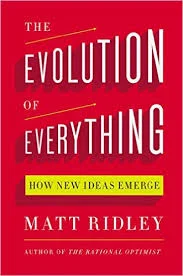
Because we economists, too, feed at the trough of government-funded scientific research, it is important for us to make a special effort to seriously consider arguments that government funding of basic science is not socially optimal. Matt Ridley gives such an argument in his Wall Street Journal op-ed “The Myth of Basic Science,” based on his new book, The Evolution of Everything: How New Ideas Emerge. Let me quote four key passages from the his essay, then give my reaction. I can’t encompass all the ways in which Matt backs up his argument within a set of quotations of reasonable length here, so if you want to argue against Matt, you should read his whole article.

Matt Ridley:

1. Simultaneous discovery and invention mean that both patents and Nobel Prizes are fundamentally unfair things. And indeed, it is rare for a Nobel Prize not to leave in its wake a train of bitterly disappointed individuals with very good cause to be bitterly disappointed.

Patents and copyright laws grant too much credit and reward to individuals and imply that technology evolves by jerks. Recall that the original rationale for granting patents was not to reward inventors with monopoly profits but to encourage them to share their inventions. A certain amount of intellectual property law is plainly necessary to achieve this. But it has gone too far. Most patents are now as much about defending monopoly and deterring rivals as about sharing ideas. And that discourages innovation.

2. When you examine the history of innovation, you find, again and again, that scientific breakthroughs are the effect, not the cause, of technological change. It is no accident that astronomy blossomed in the wake of the age of exploration. The steam engine owed almost nothing to the science of thermodynamics, but the science of thermodynamics owed almost everything to the steam engine. The discovery of the structure of DNA depended heavily on X-ray crystallography of biological molecules, a technique developed in the wool industry to try to improve textiles.

Technological advances are driven by practical men who tinkered until they had better machines; abstract scientific rumination is the last thing they do.

3. In 2003, the Organization for Economic Cooperation and Development published a paper on the “sources of economic growth in OECD countries” between 1971 and 1998 and found, to its surprise, that whereas privately funded research and development stimulated economic growth, publicly funded research had no economic impact whatsoever. None. This earthshaking result has never been challenged or debunked. It is so inconvenient to the argument that science needs public funding that it is ignored.

4. … if the government spends money on the wrong kind of science, it tends to stop researchers from working on the right kind of science. …

… we can never know what discoveries were not made because government funding crowded out philanthropic and commercial funding, which might have had different priorities. In such an alternative world, it is highly unlikely that the great questions about life, the universe and the mind would have been neglected in favor of, say, how to clone rich people’s pets.

Miles: On patent reform, I am in agreement with Matt: current patent law and copyright law errs too far in the direction of giving monopolies that are longer-term than necessary to give adequate incentives for innovation and get in the way of progress in other ways. I address this on the copyright side in several posts:

On government support for basic scientific research, I think there is value to understanding the universe even aside from aiding technological progress, and our understanding of the universe is a public good. If indeed it is true that privately funded research is more productive than publicly funded research, the government can still help by requiring high levels of charitable contributions from people–as I proposed in 

and discussed further in 

Finally, with a clear warning that self-interest could be distorting my views here, I think a good argument can be made that social science research directed at policy-relevant questions will often be underprovided by the private market because it isn’t valuable for making money by those who discover it (that is, it is relatively hard to monetize) but only useful from improving the quality of public policy and literally or figuratively enriching many people a little bit. Of course, there is a real danger of having only the government fund policy-relevant research, because then research on what the government is doing badly wrong is likely to be underprovided. So it is important for private individuals and foundations of a wide variety of ideological stripes to fund social science research.    

Update: Many letters came in to the Wall Street Journal from very smart people disputing Matt Ridley’s contention, collected under the heading “Fundamental Science and Useful Applications.” Among other things, these arguments point out why many empirical approaches would fail to detect all the contributions of basic science. Of course, the issue is whether the subsidization of basic science is important. Other arguments are relevant to that. Here are some of the key points:

  • Len Fisher and Ibo van de Poel: Without the very abstract general theory of relativity, your GPS navigation system wouldn’t work. Without the abstract ideas of quantum mechanics, we wouldn’t have lasers and CD players. And without a basic understanding of the structure of the DNA molecule, we would have no chance of tackling many genetically based diseases.
  • Leon Cooper: It would have been difficult to predict that the investigations of Maxwell, Lorentz and Einstein in electromagnetic theory would lead to improvements in communications. Few would have expected that Schrödinger and Heisenberg’s quantum mechanics would lead to the transistor and computers, that Townes’s work on millimeter radiation would give us laser surgery. Premature targeted programs to obtain these technologies would have failed.
  • Standish M. Fleming: I have worked in venture capital for the past 29 years, primarily in the life sciences. Venture capital, biopharmaceutical and other high-tech industries cluster about major research centers because basic science drives innovation. Venture capitalists literally “walk the halls” of major research institutes in search of breakthroughs, embodied in patents and published papers, around which to build companies. Government financing supports those centers.
  • Bob Ward: Matt Ridley neglects to mention that in many advanced economies it is government funding for postgraduate students that ensures successive generations of highly skilled scientists for both the public and private sectors.
  • Val Dusek: One major exception to the lack of corporate funding of truly pure scientific research whose payoff, if any, lay many decades in the future is Bell Labs. [I think Val Dusek’s point is that Bell Labs was government-like support of basic research.]

Jong Beom Park-The $28 Trillion Per Year Woman: Benefits of Full Participation of Women in the World Economy

Link to Jong Beom Park’s Facebook homepage

I am delighted to host another student guest post, this time by Jong Beom Park. This is the 8th student guest post of this semester. You can see all the student guest posts from my “Monetary and Financial Theory” class at this link.


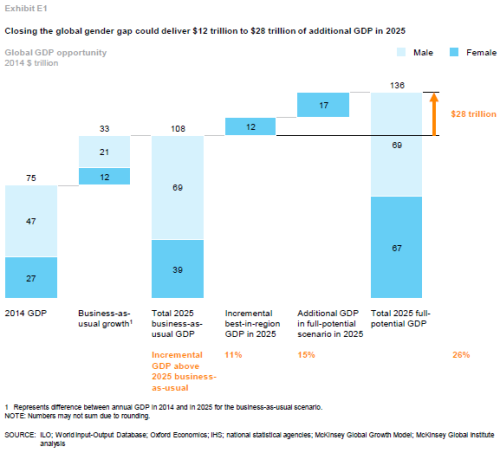
Gender inequality is most often thought more of as a social phenomenon. However, The McKinsey Global Institute, in its September report, has conducted a gender equality assumption study in which a mouth-dropping number was concluded as the potential economic implications of gender inequality: by promoting and achieving gender equality, global GDP could potentially increase by $28 trillion in 2025. It turns out that the economic loss, arising from gender inequality, is enormous.

Here is a figure taken from the McKinsey’s full report:

The research selected women in 95 countries, which together account for 37 percent of global GDP, for this analysis. The last category of the figure above, full-potential GDP, is a prediction that assumes work participation, in terms of labor-force participation rate, of men and women in chosen countries as equal. First, the study looks at the “best-in-region” scenario, which assumes that all countries achieve the same level of gender parity as best-performing countries in their respective continents. For example, India, one of the poorest performing countries in terms of gender equality, is performing well below its fellow countries in South Asia, and this scenario assumes that India is at the same level as other South Asian countries. And then, other potential GDP measures were calculated, taking economic drivers, such as gender wage gap and work hours, into account. Adding all these numbers results in an enormous increase, $28 trillion, in potential GDP by 2025.

So, how exactly was $28 trillion calculated? In this number, all unwaged work, such as housework, and lower-waged work taken by women were replaced by higher-wage work to be equal to those of men, thereby boosting the potential GDP. This means that women working in unpaid jobs, which is more prevalent in developing economies, were included in calculating labor participation rate until the figure was identical for men and women. In order to calculate the economic costs of gender inequality, McKinsey has created its own Gender Parity Score (GPS) of over 90% of men and women around the world and compared which region or country performed well in relative to others (the strongest scoring region is North America and Oceania at 0.74). It is clearly stated in the study that rich economies, though far from perfect, performed significantly better than developing and poor economies, which can then be concluded as the presence of a strong correlation between gender equality and economic performance. And then, calculating the productions from newly-assumed jobs taken by women in the study, new potential GDP was forecasted, resulting in $28 trillion at full potential and $12 trillion in the “best-in-region” scenario.

On contrary to the result that strong economies show relatively more gender equality, South Korea is an example of an advanced country with deeply-rooted gender discrimination (scoring 0.65 on GPS). Here are some statistics: in the World Economic Forum’s gender gap index, an index measuring gender equality, the 14th largest economy in the world, South Korea is ranked 117th with only 53% of South Korean women currently in the active workforce. South Korea is also rated poorly in other figures, such as gender wage gap. The situation is certainly improving with new measures, such as guaranteeing longer maternity leave. A larger population of highly educated women also contributes to less gender discrimination. South Korea has had a long journey, from the ashes of the Korean War to a today’s high-income developed country. But, with further measures towards gender equality, according to the McKinsey report, could lead South Korea to another “Miracle on the Han River.”

Going back to the McKinsey report, McKinsey offers several measures that can be initiated to improve this global problem, such as favorable laws and financial support. Personally, I believe that the roles of new businesses are extremely important. Gender equality might not be achieved in a short time in businesses that have long history and deep-rooted corporate culture. However, newly-formed firms have opportunities to start anew with gender equality. As more newly-formed businesses, with fair mindsets, enter the market, I believe, it could ultimately lead to a society with no or little gender discrimination.

Maybe, it is time that we start taking gender inequality issues seriously as a remedy for the ailing global economy.

Debating the Morality of Immigration Restrictions

Olivia Goldhill had an interesting rundown of different philosophies on immigration in her Quartz article “Philosophers can’t agree on how much we should help refugees—or even whether we should.” It won’t surprise any of my loyal readers that my position is closest to Joseph Caren’s position in the passage Olivia quotes:

Citizenship in Western liberal democracies is the modern equivalent to feudal privilege—an inherited status that greatly enhances one’s life chances. Like feudal birthright privileges, restrictive citizenship is hard to justify when one thinks about it closely.

Peter Singer’s position, as explained in 16 paragraphs in “The Drowning Child and the Expanding Circle,” also has a lot of merit to it. A Utilitarian counterpart argument that comes to the same conclusion is that, even if one puts a welfare weight on distant strangers that is only a fraction of the welfare weight one puts on oneself or on people in one’s own community or nation, there are many people in such desperate straits that it makes sense to do a lot to help them. 

Because there are so many people who need help, it makes sense to look for ways to help that will leaves one still in a position to help yet more people. Relatively open borders are exactly such a way of helping one set of people while maintaining the ability to do more to help yet others. So Peter Singer’s position comes closer to Joseph Caren’s practical recommendation than might be immediately apparent. The general principle is that helping others by giving them more liberty (in this case, the freedom to cross national borders) is a way of helping that replenishes itself.

Is It a Problem for Negative Interest Rate Policy If People Hang On to Their Paper Currency?

I teach how to break through the zero lower bound in my “Monetary and Financial Theory” class. I got an interesting question from one of my students, Matthew Hoffman (who chose fame over anonymity when I told him I wanted to write this Q&A post. Here are his questions and my answers. 

Matthew: I understand that electronic money would be the unit of account, and that the deposit fee, in a time of negative interest rates, would eliminate the ZLB as the paper currency is charged roughly the value of the negative rate upon deposit. So my question is what stops people from just taking all of their money out and holding it as cash? You give three ways to act against paper currency storage, but since you advocate the third method (the fee on deposits) why can’t people still withdraw all of their money in cash and then not re-deposit until the deposit fee is “allowed to shrink when the interest rate is positive?”

Is the answer to my question explained in part “B. The Paper Currency Interest Rate,” in that since the electronic money is the unit of account, then the deposit fee still affects the value of paper currency regardless of whether it’s in the bank or under the mattress? For example, if I take a $100 bill out of the bank when the deposit fee is 2%, then is the value of my bill only $98 if I go to the mall? Or is it still worth $100, but when I go to re-deposit it, at that point it will be worth only $98 and I essentially lost $2 by putting it in the bank? 

Miles: Excellent questions!

  1. Note that over the horizon where paper currency earns a zero interest rate, money in the bank also does. So that creates no incentive to take out paper currency–though it also provides no disincentive. 
  2. At retail, paper currency will be at par for a while. If I take out cash and spend it, that stimulates the economy. So that is OK. It doesn’t stop the policy from working.
  3. The interest rate for small checking and saving accounts may stay zero if interest rates are not too low, and to somewhat lower interest rates if the central bank subsidizes zero interest rates in small checking and saving accounts. If so, then those folks wouldn’t have any temptation to withdraw paper currency in any case.

Notice that in no case is there an arbitrage that stops interest rates from being deeply negative.

Matthew: One follow up question…so would cash that was already under the mattress when the Fed increases the deposit fee still be worth its face value? It would only be worth less if it were deposited? This is like your second point in your previous email I believe…the value will stay at par for awhile and that cash can stimulate the economy if spent.

Miles: If used for purchases reasonably promptly, paper currency households already had could probably be spent at par. And most business try to deposit their paper currency in the bank quickly, while the exchange rate changes very slowly. So paper currency on hand at the beginning of the electronic money system should not be a big deal for them.

Brian Blackstone: Deflation Holds No Terrors for Those Who Know How to Use Negative Interest Rates

I have criticized Wall Street Journal reporter Brian Blackstone in the past for not appreciating the power of negative interest rate policy: 

But Brian Blackstone is beginning to show a greater appreciation for negative interest rates in his October 18, 2015 Wall Street Journal article

Here are some of the key passages:

1. Consumer prices in Switzerland have fallen on an annual basis for most of the past four years. … Even after food and energy prices are stripped out, core prices fell 0.7%.

“It’s hard not to call that deflation,” said Jennifer McKeown of Capital Economics …

And yet evidence of deflation’s pernicious side effects—recession, weak employment, rising debt burdens—is pretty much nonexistent in Switzerland. Its economy is expected to expand this year and next, albeit slowly, in the 1% to 1.5% range. Unemployment was just 3.4% in September. Government debt is low.

2. Some of that success is due to the shattering of another long-held maxim: that central-bank policy rates can’t go negative to offset the effects of falling prices.

3. Major central banks prefer annual inflation of about 2% to provide a cushion against deflation.

4. To keep the franc in check, the central bank may be forced to cut the deposit rate even further, analysts say, particularly if the ECB eases policy more.

Brian asks the following question, 

So why aren’t central banks embracing the Swiss example? 

The answer he gives is this:

Analysts note that it’s difficult to distinguish between good and bad deflation until it’s too late.

But to me the answer is simpler. Deflation is not a good thing, but deflation holds no terrors if a central bank understands how to use negative interest rates. To me, this is the message of Brian’s article, though he doesn’t say it himself.

Although it hasn’t done so yet, because the Swiss National Bank knows how to make the rate of return on paper currency negative if people ever started storing large amounts of paper Swiss francs, it can dare push interest rates lower than other central banks that do not fully understand how to break through the zero lower bound.

You might be interested in the other things I have said about the Swiss National Bank and negative interest rate policy:

Quartz #66—>Japan Should Be Trying Out a Next Generation Monetary Policy

Link to the Column on Quartz

Here is the full text of my 66th Quartz column, “Japan Should Be Trying Out a Next Generation Monetary Policy,” now brought home to supplysideliberal.com. It was first published on September 11, 2015. Links to all my other columns can be found here.

This column was written in conjunction with two other closely related posts that you might want check out as well:

  1. Is the Bank of Japan Succeeding in Its Goal of Raising Inflation?
  2. An Underappreciated Power of a Central Bank: Determining the Relative Prices between the Various Forms of Money Under Its Jurisdiction

If you want to mirror the content of this post on another site, that is possible for a limited time if you read the legal notice at this link and include both a link to the original Quartz column and the following copyright notice:

© September 11, 2015: Miles Kimball, as first published on Quartz. Used by permission according to a temporary nonexclusive license expiring June 30, 2020. All rights reserved.


After twenty years of slow economic growth, Japan’s Sept. 26, 2012 election centered on Shinzo Abe’s promise to shake up monetary policy. Once in office, Abe appointed Haruhiko Kuroda to head the Bank of Japan. In short order, the Bank of Japan went from defending its monetary policy during those two lost decades of slow growth and bragging about the number of different types of assets it was buying to a serious program of quantitative easing on steroids, with a commitment to buying bonds and other securities equal in value to over half of GDP every year.

One of the announced objectives for this massive asset purchase program is to bring inflation quickly up to 2% per year. The idea is that the zero interest rate the Bank of Japan has maintained for a long time would be a more powerful stimulative for the economy if businesses and consumers were comparing it to a higher inflation rate. The logic is similar to the logic driving economists such as Olivier Blanchard, Larry Ball, and Paul Krugman to recommend raising inflation target to 4% in other countries in order to supercharge the stimulative effect of zero interest rates.

The key concept is that of a “real interest rate,” or an interest rate stated in terms of a basket of goods instead of the usual interest rate stated in terms of money.

Japan is wasting its time trying to raise inflation

Japan may succeed at bringing annual inflation up to 2%; indeed, it has made some real progress toward that goal. But suppose Japan succeeds in getting inflation up to 2%; would that be enough? The US economy has struggled mightily despite the fact that it went into the Great Recession with a 2% annual rate of core inflation. Japan could try to target an even higher rate of inflation, as Blanchard, Ball and Krugman recommend, or Japan could leave behind quantitative easing and higher inflation targets to make the leap to next-generation monetary policy.

The key to next-generation monetary policy is to cut interest rates directly instead of trying to supercharge a zero interest rate by raising inflation. Of course, cutting interest rates below zero pushes them into negative territory. But Switzerland, Denmark, Sweden and the euro zone have already shown that can be done. There is a widespread myth that cutting interest rates much deeper than -0.75% would inevitably cause people and firms to do an end run around those negative interest rates by taking their money out of the banking system as paper currency. Not so!

It is easy to neuter cash taken out of the bank as a way to defeat negative interest rates simply by removing the guarantee that the Bank of Japan will take that cash back at face value. You can find the details of how such a cash-neutralizing policy works here, here and here. This is an idea I have taken on the road that has withstood close examination and grilling by central bankers and economists all over the world. A common reaction is surprise at how easy the practical details are relative to the many much more difficult things central banks already do.

If the guarantee that the Bank of Japan (or other central bank) will always take cash back at face value is removed, it leaves no way to avoid negative interest rates without stimulating the economy. If people take cash out of the bank, store it, and then spend it, that stimulates the economy. If a firm takes a pile of money facing a negative interest rate out of the bank to build a new factory, that stimulates the economy. And even if, say, Japanese households take money that would otherwise earn a negative interest rate out of the bank to buy foreign stocks and bonds, it stimulates the Japanese economy, when excess yen in the hands of the foreigners who sold those stocks and bonds ultimately make their way back to Japan to buy Japanese products, boosting net exports.

Japan is wasting time by trying to raise inflation because it doesn’t need to raise inflation. Raising inflation is an indirect way to get the same effect that can be achieved directly by cutting interest rates. Switzerland, Denmark, Sweden and the euro zone have gingerly dipped their toes in the water of negative interest rates. Japan should go all in.

The alternatives to negative interest rates all have serious downsides. For example, increasing government spending is a bad idea: Japan already has more debt in comparison to its GDP than any other major economy—more than two years worth of GDP. (And saying that the Bank of Japan can just keep buying all that debt ad infinitum should be a last resort.) Worse, Japan has already been down the path of high government spending and has already exhausted most attractive government investment opportunities.

What about ramping up quantitative easing even more? Quantitative easing works in the right direction, but to get the needed effects requires dosages so large that no one knows what side effects it might have. By contrast, economic theory is reasonably clear about how interest rates affect the economy, even when they are negative.

Addressing Japan’s supply-side

Even if Japan makes the leap to next-generation monetary policy, it will still have serious economic problems. Many economists and politicians argue that monetary stimulus is a distraction from necessary supply-side reforms (often called “structural reforms”).

But it is a lot easier to move workers and capital from low productivity activities to higher productivity activities in a boom, than in a stagnant economy in which people worry about getting the next job or finding the next business opportunity.

Having an economy made worse by monetary policy is not a very reliable aid to jumping over political hurdles to supply-side reform. Instead, a substandard economy due to substandard monetary policy is often a temptation to more government spending and more debt. Japan should fix its monetary policy first, by eliminating any floor on interest rates. Then it can and should face its supply-side problems squarely.

John Stuart Mill: Certification, Not Licensing

Miles’s Certificate for the highest level of training for the Bowen Technique

Miles’s Certificate for the highest level of training for the Bowen Technique

As I do, John Stuart Mill felt a close connection between education policy and certification and licensing policy. I am leery of the overgrowth of licensing requirements for relatively safe occupations, but if we are unable to eliminate them, at least we should make the requirements simple enough that it possible for students to graduate from high school with several licenses–something I proposed in “Magic Ingredient 1: More K-12 School.” 

If we can improve evaluation methods, it is much better to certify skills than it is to certify that someone has taken a certain number of classes with passing grades, as I argue in “The Coming Transformation of Education: Degrees Won’t Matter Anymore, Skills Will.” 

As for licensing itself, although they are often spoken of in the same breath, there is a world of difference between certification and licensing. Certification requirements say that you have to inform customers of your level of qualifications or lack of qualifications in unmistakable ways, according to a well-defined terminology established by the government. They are based on the principle of telling the truth and not deceiving, but do entail some details to make sure no one misunderstands. 

By contrast, licensing requirements say you can be thrown in jail for getting paid for something that someone with an absolutely crystal clear idea of your lack of qualifications is perfectly happy to pay you to do. For example, I would run afoul of the law in Michigan if I cut someone else’s hair for pay–a law ultimately backed up by the threat of throwing me in jail, even if the initial penalty is only a fine. The real reason for that stipulation is that barbers want that barrier to entry in place (I think at least a year and a half of training), not any danger that I will seriously harm someone with a basic haircut. I express some of how wrong I think the overgrowth of licensing requirements is in my post “When the Government Says “You May Not Have a Job.”

Up at the top you see my certificate for the highest level of training in a form of bodywork called the Bowen Technique, which I wrote about in my post “Tom Bowen’s Gift to Humanity: A Powerful Australian Technology.” It is not as if I have time in any case, but a few years ago, I could have hung up a shingle as a bodyworker (the category of someone who has not jumped through any state-defined hoops) and treated people without violating the law. Michigan seems to be going in the direction of many states and requiring a license for any body work, which in some places would require a large amount of training in other modes of body work such as massage therapy (about a year’s worth of additional training). 

John Stuart Mill, in paragraph 14 of “On Liberty “Chapter V: Applications” (which I preface with the last sentence of paragraph 13 for context) explains how to get the benefits of certification without having the government force conformity in education or saying one cannot do a job without jumping through hoops that often have little to do with what one’s skill would be at doing a job. Here are the ground rules John suggests: 

But in general, if the country contains a sufficient number of persons qualified to provide education under government auspices, the same persons would be able and willing to give an equally good education on the voluntary principle, under the assurance of remuneration afforded by a law rendering education compulsory, combined with State aid to those unable to defray the expense.

The instrument for enforcing the law could be no other than public examinations, extending to all children, and beginning at an early age. An age might be fixed at which every child must be examined, to ascertain if he (or she) is able to read. If a child proves unable, the father, unless he has some sufficient ground of excuse, might be subjected to a moderate fine, to be worked out, if necessary, by his labour, and the child might be put to school at his expense. Once in every year the examination should be renewed, with a gradually extending range of subjects, so as to make the universal acquisition, and what is more, retention, of a certain minimum of general knowledge, virtually compulsory. Beyond that minimum, there should be voluntary examinations on all subjects, at which all who come up to a certain standard of proficiency might claim a certificate. To prevent the State from exercising, through these arrangements, an improper influence over opinion, the knowledge required for passing an examination (beyond the merely instrumental parts of knowledge, such as languages and their use) should, even in the higher classes of examinations, be confined to facts and positive science exclusively. The examinations on religion, politics, or other disputed topics, should not turn on the truth or falsehood of opinions, but on the matter of fact that such and such an opinion is held, on such grounds, by such authors, or schools, or churches. Under this system, the rising generation would be no worse off in regard to all disputed truths, than they are at present; they would be brought up either churchmen or dissenters as they now are, the State merely taking care that they should be instructed churchmen, or instructed dissenters. There would be nothing to hinder them from being taught religion, if their parents chose, at the same schools where they were taught other things. All attempts by the State to bias the conclusions of its citizens on disputed subjects, are evil; but it may very properly offer to ascertain and certify that a person possesses the knowledge, requisite to make his conclusions, on any given subject, worth attending to. A student of philosophy would be the better for being able to stand an examination both in Locke and in Kant, whichever of the two he takes up with, or even if with neither: and there is no reasonable objection to examining an atheist in the evidences of Christianity, provided he is not required to profess a belief in them. The examinations, however, in the higher branches of knowledge should, I conceive, be entirely voluntary. It would be giving too dangerous a power to governments, were they allowed to exclude any one from professions, even from the profession of teacher, for alleged deficiency of qualifications: and I think, with Wilhelm von Humboldt, that degrees, or other public certificates of scientific or professional acquirements, should be given to all who present themselves for examination, and stand the test; but that such certificates should confer no advantage over competitors, other than the weight which may be attached to their testimony by public opinion.

The US Treasury has a report out on Occupational Licensing Reform that I hope to talk about in some detail in a later post. But you might want to read it before then. Here is the link.

Hannah Katz: The Pros and Cons of Tipping Culture

Link to Hannah Katz’s LinkedIn Homepage

I am delighted to host another student guest post by Hannah Katz. This is the 7th student guest post of this semester. You can see all the student guest posts from my “Monetary and Financial Theory” class at this link.


Evidence shows that although the tipping culture is actually an economic advantage for those who can take full advantage of the system, not every waiter is able to do so due to discriminatory factors.

Tipping expectations around the world are vastly different, depending on who you ask. Any U.S. waiter would answer 20% of the total bill, while a Japanese citizen might be confused on what tipping even means. In the United States there exists a federal minimum wage for most careers, but waiting tables is not technically one of them. Although employers are technically supposed to pay the difference if a waiter does not clear minimum wage with his/her tips, in most cases the cost of waiters’ wages is passed on to the consumer in the form of a tip. The tipping culture is actually an economic advantage for those who can take full advantage of the system, but not every waiter is able to do so due to discriminatory factors.

In the Southern Economic Journal article“The Effect of the Tipped Minimum Wage…”, authors William Even and David Macpherson study the effect of a raised tipped minimum wage on full-service restaurant employees. Even and Macpherson studied national data and concluded that if the minimum wage for servers was increased and the expectation for tips was decreased, then full-service employees would suffer reduced employment by restaurants. This indicates that if the cost of servers’ wages were forced onto restaurant owners, effectively raising the minimum wage that most restaurants have to pay their servers, the same result would occur. Clearly, reducing the burden on restaurants by maintaining the practice of tipping is advantageous to waiters.

Another huge advantage of tipping to waiters is that cash tips often go unreported. Anecdotally, I know many waiters that do not fully report their tips to the IRS. Somehow, this is considered normal practice although it is certainly tax fraud. The IRS estimated a $290 billion gap in self and true reported income last year, according to BakerTilly’s article “IRS Targets Tip Income..”, and the gap may be even higher.

Although tipping culture may be beneficial to servers, the practice isn’t exactly fair. As Freakonomics radio host Stephen Dubner points out in “Should Tipping be Banned?”, tips that servers receive correlate to their race, attractiveness, and other discriminatory factors. Basically, the customer of a restaurant has the power to determine the wages of a server and discriminatory practice is unregulated. There is no Human Resources department in restaurants that a waiter can appeal to if he/she feels undercompensated because of discrimination. This data is supported in Tipping Research’s paper Predictorsof Male and Female’s Average Tip Earnings, which found that servers received more tips if they were rated as more attractive, as opposed to years of experience and friendliness, which were uncorrelated with tips.  

The tipping culture in the United States and other Western countries is not going away any time soon. Restaurants and waiters both benefit from the system, and customers are so used to it that no widespread action will be taken anytime soon. But perhaps it is time to question this system that causes such a huge gap in true and reported income, and can be discriminatory in nature.