Why Thinking about China is the Key to a Free World

blog.supplysideliberal.com tumblr_inline_nqxhtu5g5m1r57lmx_500.png

Here is a link to my 65th column on Quartz: “An economist explains why the key to a free world lies with China.” This is my July 4th column, arriving a little early. 

Update: Don’t miss the robust discussion in the comments below. I make some important clarifications there. Also, there is an interesting set of comments here on Facebook with a reply from me. 

Update July 9, 2015: On the military technology dimensions, John L. Davidson tweeted a link to this interesting article on the important work on unmanned submarines.

Next Year’s Momentous Supreme Court Decision: Reining in Public Sector Unions?

immediate image source (ultimate source is the Wall Street Journal)

immediate image source (ultimate source is the Wall Street Journal)

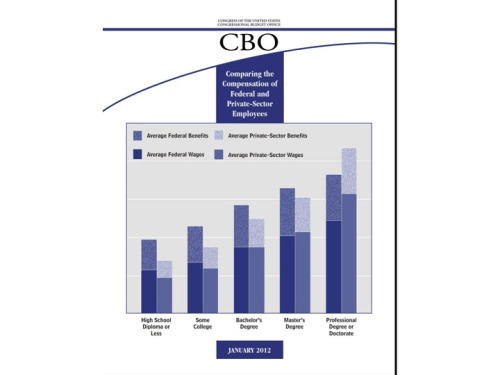
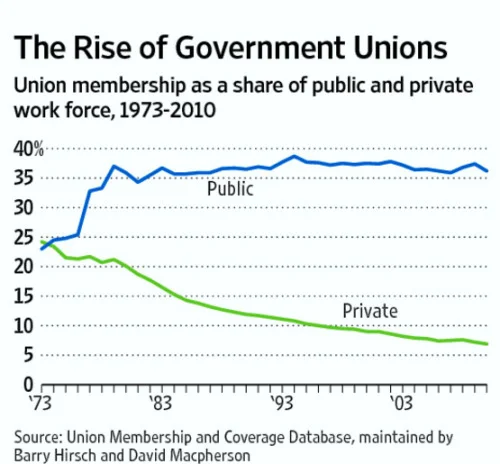
After its momentous decisions this year legalizing gay marriage throughout the US, saving Obamacare one more time, and preserving the option of nonpartisan redistricting, the Supreme Court of the United States said it will decide next year on whether public sector unions can legally force those who work for the government to pay union dues even if they disagree with what the union is doing. If the Supreme Court addresses this question squarely, this will be a momentous decision because public sector unions are where the action is in unionization. In the last three decades, unionization fell dramatically in the private sector, but rose dramatically in the public sector (see above). The most likely reason is that public sector unions can offer political foot-soldiers to garner votes for those of their bosses who behave themselves as well as labor peace, while private sector unions can only provide labor peace. Without the combination of a political weapon and a strike weapon, I don’t see how public sector unions could have been so much more successful than private unions. Thus, I think the challengers’ contention the public sector unions are inherently political is quite reasonable.

I am cheering for the challengers because I think a reduction in the power of public sector unions would be a big boon to the US economy. It is often very valuable to for the government to provide additional public goods. But it is not so great to pay a higher price for the same level of government-provided goods and services, simply because public sector unions have effectively brandished their two weapons: the political weapon and the strike weapon. Our concern for income distribution should always be focused on the lot of the very poorest.

So whenever workers who are already typically paid more than comparable workers in the private sector have their wages go up further, it pushes the income distribution in the wrong way. And raising the cost of government employees who help the poor can easily lead to lower levels of service provided to the poor. This can often happen not only from price effects, but also from overall government budget pressures, as when overly generous delayed pension payments from a corrupt bargain between public sector unions and politicians that were never subjected to voter approval come due. And of course, government unions can often obstruct innovations (particularly in education) as well as draining limited government funds with wage demands that go beyond comparable private sector wages.

(Of course, I myself am officially a government employee, since the University of Michigan is a state university, but my salary owes nothing to a union. And part of my salary comes ultimately from the federal government, in the form of research support; I earnestly try to produce enough valuable research to make that a good bargain.)

Nonpartisan Redistricting

blog.supplysideliberal.com tumblr_inline_nqsbdi93iT1r57lmx_500.png

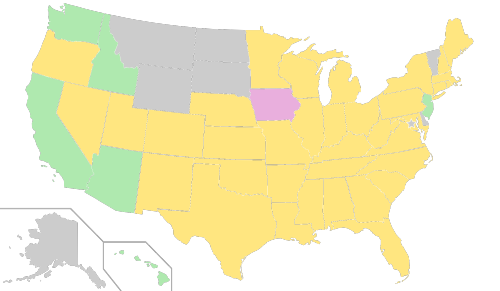
From the Wikipedia article “Redistricting Commision”: 

Legislatures control redistricting in states marked yellow, while commissions control redistricting in states marked green. In states marked purple, non-partisan staff proposes the maps, but the state legislature votes on the proposal. States marked grey have only one representative.

Since at least August 19, 2012, in my post “Persuasion,” I have been an enthusiastic proponent of nonpartisan. There I wrote:

Many people may not realize the extent to which political polarization in the House of Representatives arises from partisan and pro-incumbent redistricting. When electoral districts are designed to be either safe Republican or safe Democratic districts, then the main fear for a politician seeking reelection is losing in the primary. That typically pulls members of the House of Representatives toward the extremes. Nonpartisan redistricting is a way to have more districts be competitive in the general election and so make those running for Congress worry more about the general election relative to how much they worry about the primary. I believe this would pull politicians toward to center and toward a greater willingness to work with those in the other party. Getting change to happen in this area will be hard, but there are groups already working on this. I believe the long-run value to our Republic of nonpartisan redistricting would be substantial.

In other words since most (all but about 40 of 435) Congressional districts are designed to be safe for one party or the other, those in Congress often take actions to please their bases rather than the center. That in turn tends to push Congress toward being more of an arena of posturing rather and less of an arena for deliberating about helpful legislation.  

So I am pleased that the Supreme Court upheld the constitutionality of redistricting commissions. (I am not sure the text of the Constitution fully supports this decision, so ideally it would be good to have a constitutional amendment declaring them legal–and going beyond that, requiring them for all states.)

I hope with the issue of constitutionality settled that more and more states adopt redistricting commissions. Though this may involve short-run sacrifices of reelection probabilities, I think this is actually even in the long-run interest of a party in control of a given state, since parties that get used to appealing to the center to a greater degree are likely to grow in influence.

Bob Willis Honored with the 2015 Jacob Mincer Award for Lifetime Contributions to the Field of Labor Economics

My University of Michigan colleague and coauthor was given the Society of Labor Economist’s lifetime achievement award at the joint meeting of the Society for Labor Economics and the European Association of Labour Economists in Montreal (Fourth SOLE|EALE World Meetings, June 26-28, 2015). Let me copy from the note I received about this: 

“SOLE’s Lifetime Achievement Award was first awarded in 2004 to Gary Becker and Jacob Mincer and was henceforth named the Jacob Mincer Award.  Subsequent winners are: Orley Ashenfelter, Richard Freeman, Dale Mortensen, Reuben Gronau, Claudia Goldin, Ronald Ehrenberg and Daniel Hammermesh.  I am honored to be included in such distinguished company that includes three Nobel Prize winners (Becker, Heckman and Mortensen), three Presidents of the American Economic Association (Becker, Ashenfelter and Goldin) and a Chair of the President’s Council of Economic Advisors (Lazear).

Here is the full citation:

Robert J. Willis is Professor of Economics at the University of Michigan and Research Professor at the Institute for Social Research and the Population Studies Center, University of Michigan.  He is a Fellow and past President of the Society of Labor Economics, and is this year’s recipient of the Jacob Mincer Prize, the Society’s Career Achievement Award for lifetime contributions to the field of labor economics.

In the 1970s, Willis was one of the young labor economists who ushered in the modern era of the field with work that combined rigorous modeling and econometric sophistication and that emphasized the tight links between theory and empirical analysis that characterize labor economics.  Following his path-breaking work on the economic modelling of fertility, Willis published a number of innovative papers, including collaborations with Jim Heckman, Lee Lillard, and Sherwin Rosen, on the econometrics of longitudinal labor supply models and the treatment of self-selection in estimating the returns to education.  His many contributions to family economics, several coauthored with Yoram Weiss, include work on surprises as determinants of divorce, the inefficiency of child support payments, and an economic model of non-marital childbearing.  Working with multidisciplinary teams of researchers, Willis has examined intergenerational ties in Asian countries, including the effect of credit constraints on child investments and exchange motives for intergenerational transfers.  His work is well-known among demographers, and in 2002 he received the prestigious Mindel C. Sheps Award for outstanding contributions to mathematical demography and demographic methodology from the Population Association of America.

Willis’ contributions to labor economics include his long service (1995-2007) as Director of the Health and Retirement Study (HRS), a pivotal piece of social science infrastructure that has provided data on aging Americans and their employment, assets, health and family ties for three decades.  Under his leadership, the HRS has introduced many new survey instruments, including measures of cognitive functioning and dementia.  His latest work studies the extent of cognitive declines with aging and their implications for issues such as retirement planning, earnings, and the caregiving needs of the elderly.  This research continues the commitment to innovation, rigorous measurement, and conceptual clarity that characterizes Robert Willis’ long career in labor economics.”
John Stuart Mill on Public and Private Actions

I am always intrigued when I see John Stuart Mill arguing for less freedom than I expect. While expansive in the degree of freedom he argues for behind closed doors, In paragraph 7 of On Liberty “Chapter V: Applications,” paragraph 7, he argues for much tighter limitations on what can be done in public:

Again, there are many acts which, being directly injurious only to the agents themselves, ought not to be legally interdicted, but which, if done publicly, are a violation of good manners, and coming thus within the category of offences against others, may rightfully be prohibited. Of this kind are offences against decency; on which it is unnecessary to dwell, the rather as they are only connected indirectly with our subject, the objection to publicity being equally strong in the case of many actions not in themselves condemnable, nor supposed to be so.

I find this troubling when one considers that many actions for which it is contested whether they are injurious or not. And doing something in public as performance art can be a form a free speech. 

On the other hand, I don’t see how to make society work without some significant limitations on what one can do in public that go beyond any limitations on what one can do in private. 

I am actually quite puzzled about how to draw the line in a principled way between things that should be allowed both in public and private and those that should be allowed only in private. And it occurs to me that any serious classroom discussion of On Liberty should wrestle with this question.

The nature of injustice is that we may not always see it in our own times.

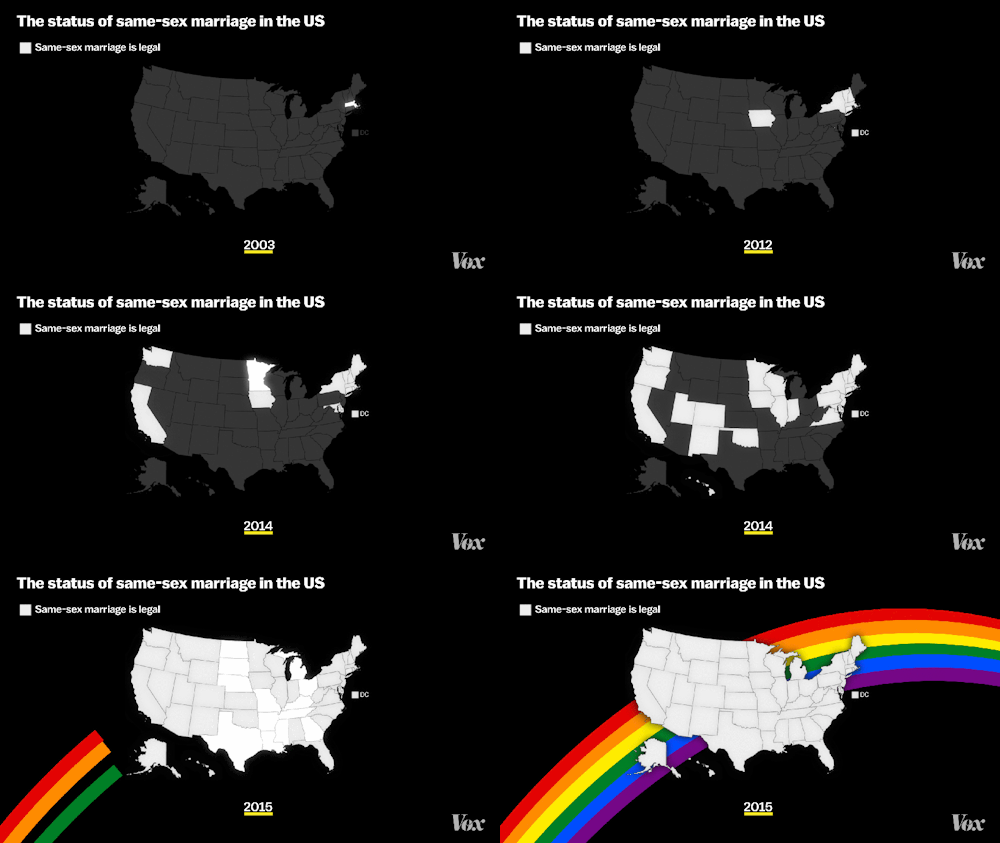
Anthony Kennedy, joined by Ruth Bader Ginsburg, Stephen Breyer, Sonia Sotomayor and Elena Kagan, in Obergefell et al. v. Hodges, the June 26, 2015 Supreme Court decision making gay marriage legal throughout the United States (p. 11).

Related reading:

The Case for Gay Marriage is Made in the Freedom of Religion

“The Hunger Games” Is Hardly Our Future—It’s Already Here

Bruce Greenwald: The Death of Manufacturing & the Global Deflation

This is a fascinating discussion by Bruce Greenwald of

  1. the difficulties of shifting people from working in sectors like agriculture and manufacturing where employment is declining because productivity is going up faster than demand,

  2. the efforts of some countries to export this problem to other countries, and

  3. the effect of these forces on interest rates, and therefore, implicitly, their interaction with the zero lower bound.

It is very interesting to think about how these issues could play out if there had been no zero lower bound and their had been aggressive negative interest rate policy. Regardless of the low interest rates, it still doesn’t work to have more manufacturing output that people want to buy any more than it makes sense to have more food grown than people can possibly eat. So at the end of the day, manufacturing capacity would get high enough to put a brake on further investment in manufacturing despite very low interest rates. Either people will start consuming a lot more because of the low interest rates, or more likely there would end up being extra investment in something else. A good possibility is education. Education is a form of investment that can easily absorb a huge amount of resources simply in student time, even if in the future it doesn’t need much in the way of buildings or professors because it has gone electronic. Standard human capital theory suggests that a low enough long-run real interest rate can have a big effect on the amount of education chosen.