John Stuart Mill on Public and Private Actions

I am always intrigued when I see John Stuart Mill arguing for less freedom than I expect. While expansive in the degree of freedom he argues for behind closed doors, In paragraph 7 of On Liberty “Chapter V: Applications,” paragraph 7, he argues for much tighter limitations on what can be done in public:
Again, there are many acts which, being directly injurious only to the agents themselves, ought not to be legally interdicted, but which, if done publicly, are a violation of good manners, and coming thus within the category of offences against others, may rightfully be prohibited. Of this kind are offences against decency; on which it is unnecessary to dwell, the rather as they are only connected indirectly with our subject, the objection to publicity being equally strong in the case of many actions not in themselves condemnable, nor supposed to be so.
I find this troubling when one considers that many actions for which it is contested whether they are injurious or not. And doing something in public as performance art can be a form a free speech.
On the other hand, I don’t see how to make society work without some significant limitations on what one can do in public that go beyond any limitations on what one can do in private.
I am actually quite puzzled about how to draw the line in a principled way between things that should be allowed both in public and private and those that should be allowed only in private. And it occurs to me that any serious classroom discussion of On Liberty should wrestle with this question.
“The nature of injustice is that we may not always see it in our own times.”
Anthony Kennedy, joined by Ruth Bader Ginsburg, Stephen Breyer, Sonia Sotomayor and Elena Kagan, in Obergefell et al. v. Hodges, the June 26, 2015 Supreme Court decision making gay marriage legal throughout the United States (p. 11).
Related reading:
The Case for Gay Marriage is Made in the Freedom of Religion
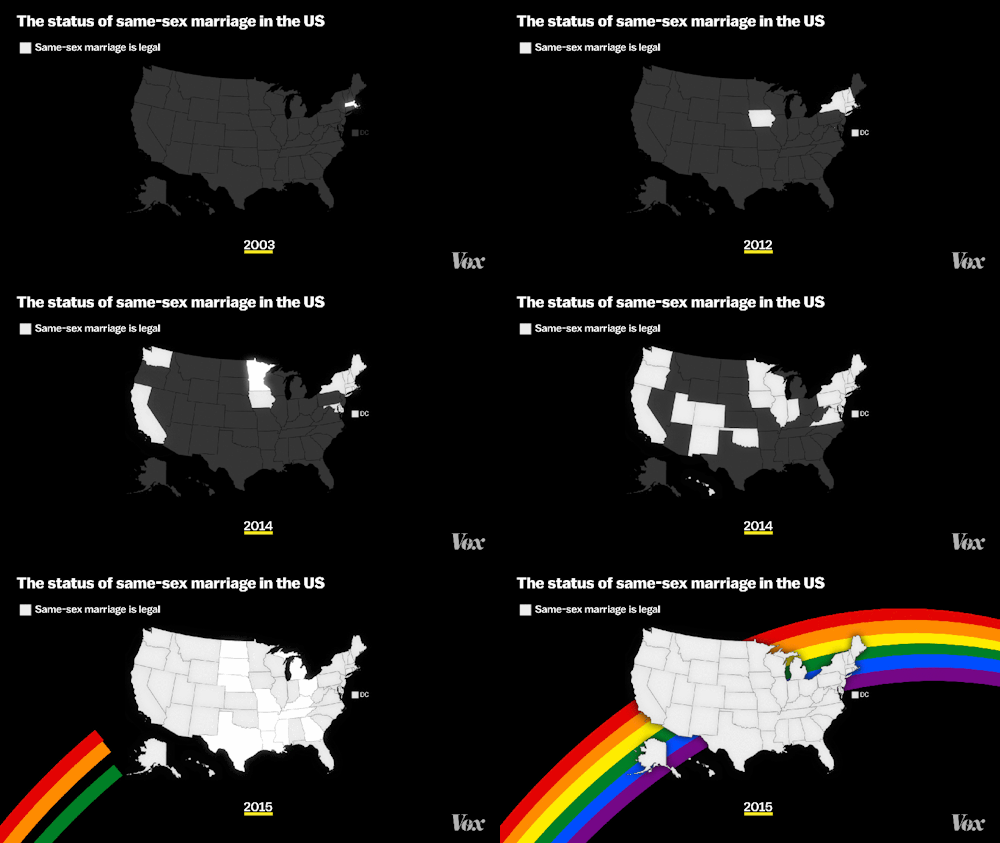
Dynamic Graph of Gay Marriage Rights in the United States
Today the Supreme Court legalized same-sex marriage across the US.
Reblogged from vox.
Radical Banking: The World Needs New Tools to Fight the Next Recession
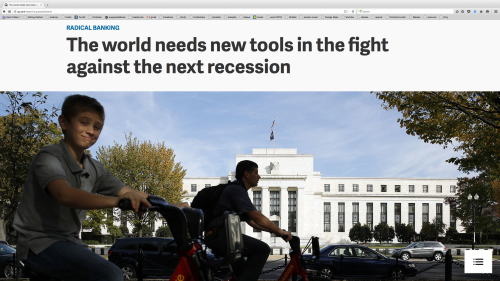
Here is a link to my 64th column on Quartz, “Radical Banking: The World Needs New Tools to Fight the Next Recession.” Among other things, this column gives a report about two amazing conferences in London about eliminating the zero lower bound.
"Swiss Pioneers! The Swiss as the Vanguard for Negative Interest Rates" in Japanese: 先駆者スイス! スイスは負の利子率政策の先陣だ →
The link above is to the post in Japanese, translated by Makoto Shimizu. You can find the English version here.
"The Swiss National Bank Means Business with Its Negative Rates" in Japanese: スイス国立銀行は負の利子率に本気です。 →
The link above is to the post in Japanese, translated by Makoto Shimizu. You can find the English version here.
"Righting Rogoff on Monetary Policy" in Japanese: 金融政策に関してRogoffを正す →
The link above is to the post in Japanese, translated by Makoto Shimizu. You can find the English version here.
"David Beckworth and Miles Kimball: The Padding on Top of the Zero Lower Bound" in Japanese: David BeckworthとMiles Kimball:ゼロ下限の上の保護シート →
The link above is to the post in Japanese, translated by Makoto Shimizu. The English version can be found here.
"Why Scott Fullwiler Misses the Point in 'Why Negative Nominal Interest Rates Miss the Point'" in Japanese: 何故Scott Fullwilerは「何故負の名目利子率が的外れか」で的外れか →
The link above is to the post in Japanese, translated by Makoto Shimizu. The English version can be found here.
Bruce Greenwald: The Death of Manufacturing & the Global Deflation
This is a fascinating discussion by Bruce Greenwald of
the difficulties of shifting people from working in sectors like agriculture and manufacturing where employment is declining because productivity is going up faster than demand,
the efforts of some countries to export this problem to other countries, and
the effect of these forces on interest rates, and therefore, implicitly, their interaction with the zero lower bound.
It is very interesting to think about how these issues could play out if there had been no zero lower bound and their had been aggressive negative interest rate policy. Regardless of the low interest rates, it still doesn’t work to have more manufacturing output that people want to buy any more than it makes sense to have more food grown than people can possibly eat. So at the end of the day, manufacturing capacity would get high enough to put a brake on further investment in manufacturing despite very low interest rates. Either people will start consuming a lot more because of the low interest rates, or more likely there would end up being extra investment in something else. A good possibility is education. Education is a form of investment that can easily absorb a huge amount of resources simply in student time, even if in the future it doesn’t need much in the way of buildings or professors because it has gone electronic. Standard human capital theory suggests that a low enough long-run real interest rate can have a big effect on the amount of education chosen.
Smoking Out the Essence of Minimum Wage Effects

I want to try to smoke out what is problematic about the minimum wage. A minimum wage is saying a firm that wants to make a job offer and a worker who wants to accept that offer are not allowed to make a deal.
1. To clarify things, an interesting variant of a minimum wage policy that would avoid this would be to say that the minimum wage applies only to existing jobs, not to new hires. This limits the minimum wage increase to the already existing employment relationships that I think are the foundation of people’s intuition that the minimum wage is a good thing.
2. Going a little further, to avoid distortion, it might be necessary to allow a firm and a worker to agree to a contract that opts out of any possible higher minimum wage in the future.
To make this policy more realistic, almost all distortion can probably be avoided even if there is a time limit of a year or two from the moment of hiring on how long a contract can opt out of the minimum wage.
3. Going the other direction, it is interesting to consider a minimum wage that applied only to new hires and not to existing employment relationships. I think few people would be in favor of such a minimum wage. It is interesting to consider why.
Summing Up: Maybe there is a better way to lay things out: the objective is to separate out analytically the effect of the minimum wage on new hires from the effect of the minimum wage on existing workers.
Note: One can argue that telling someone shehe may not take a job a firm wants to give herhim will benefit other workers who do get jobs, but if that is the argument for a minimum wage, I would like to see it stated that baldly: “You must sacrifice and not take that job so that other workers can be paid more.”
Clay Christensen: Religion as a Foundation of Democracy
This is a nice video of Clay talking about the benefits of religion. An atheist group complained about it. But they don’t understand:
- People may not need God, but they do need religion.
- People don’t need faith in the supernatural, but they do need faith in something.
- People don’t necessarily need to attend a formal congregation, but it is important that they regularly hear or read encouragements to do good.
“… an unintended effect is a real effect, which may be welcomed without prejudice to intended effects. … facing such an unintended effect and sensing the presence of an intrusive subjectivity, modernist historical criticism, like virtually all modernist criticism, catches itself in time, and muffles its inclination to join in the discussion as one might muffle one’s inclination to join in a laugh at a funeral. The critic may find the joke funny, but to laugh at it would interrupt the ceremony—or, in this instance, retard the collective enterprise. Postmodern criticism—going nowhere, we might say—feels no such inhibition. More important, it has time to linger over distractions and chance arrangements that, like a sunset, are intended by nobody, but may lift the spirits of anybody willing to be led outdoors for a look.”
– Jack Miles, in Christ: A Crisis in the Life of God, pp. 331-332.
Bring Turkey into the European Union

The day before the Turkish election on June 7, I posted a link to the Economist’s editorial “Why Turks Should Vote Kurd: It Is the Best Way of Stopping Their Country’s Drift Towards Autocracy,” with the note
True democracy can be lost. Turks need to protect theirs.
So it was good news indeed when Turks voted resoundingly to stop Recep Tayyip Erdogan’s hopes to create a powerful presidency for himself.
I find myself again in full agreement with the Economist in its June 13th editorial “Sultan at Bay,” in which the editorial staff wrote:
The European Union, too, should do more. It was partly because Turkey’s membership talks, begun in 2005, seemed to go nowhere that Mr Erdogan drifted towards autocracy. Now that Turks have so thrillingly demonstrated their democratic credentials, the EU should revive the negotiations. There is also new hope that the age-old Cyprus problem might be solved (see article). Turkey matters hugely for the future of Europe. Resurrecting its aspirations for EU membership would be a fine reward for its admirable voters.
As I preached in my sermon the day of the Turkish election, “The Message of Jesus for Non-Supernaturalists,” including others in things that are working relatively well is one of the most powerful ways of making the world a better place. The European Union is far from perfect, but in a global context it counts as something that is working relatively well.
Extending the blessings of the European Union into the Middle East seems especially valuable in trying to foster stability in this volatile area of the world. It is a bit optimistic, but it is not too much to hope that from now on, electoral competition in Turkey will make the Turkish government more pro-Kurd, which could be especially valuable in shifting the balance in the Middle East in a favorable direction.
Stephanie Shimko Interviews Miles Kimball about His Earliest and Latest Research

Stephanie Shimko interviewed me for the May 2015 issue of the Survey Research Center’s monthly newsletter at the University of Michigan. I thought I would share it. It used the same picture I use now as my avatar.
When we asked Miles Kimball how he became interest-ed in macroeconomics, he told us that it began in his second year of Harvard’s Economic PhD program. Miles referred us to his blog post “Why I am a Macroeconomist.” Miles’ dissertation contained three topics, which is usual for economic dissertations. His first topic was two-sided altruism (the economic consequences of children caring about parents, as well as parents caring about children) that was suggested by his professor Andy Abel. His classmate, Alan Krueger (who was later Assistant Secretary of the Treasury and head of the Council of Economic Advisers) suggested Miles’ second topic, efficiency wages. The third topic, precautionary saving, developed when Miles presented his economic history paper “Farmers Cooperatives as Behavior Towards Risk” in a seminar and his colleague, Greg Mankiw, told him it reminded him of a paper he had written on precautionary saving. Miles told us: “In each case, I just tried to write down the economic model that seemed sensible to me in that topic area, and found that each economic model had interesting implications.” We also asked Miles about his ongoing research questions. He gave us five of his critical research questions.
- How can we make deep negative interest rates possible for central banks in the way that is politically easiest for them?
- How can we obtain good survey measures and ways of combining them into an index to given an accurate summary measure of how well off people are in the full range of things they care about?
- How should we adjust for inequality in making public policy recommendations?
- How can we measure what people’s objectives are when they face risk when their answers to questions about risk attitudes initially seem inconsistent?
- How important is improvement in the pleasantness of work as a part of economic growth?
For the future, Miles said: “Going forward, in addition to continuing to pursue the kinds of questions I mention above, I want to pursue research that shows that I can back up key proposals I make on my blog, ‘Confessions of a Supply-Side Liberal’, with more formal academic arguments. And I would like to find time to lay out the methods I teach in my class on ‘Advanced Mathematical Methods for Dynamic, Stochastic Models’.” We asked if there were any exciting upcoming projects, and he responded: “My proposal for making deep negative interest rates possible seems to be getting some traction. I am looking forward to some conferences on this, and visits to the central banks of Sweden, Norway, and New Zealand this summer (as well as the Bank of Finland).” Miles also spoke to us about his work in subjective well-being: “Along with Dan Benjamin, Ori Heffetz, and other coauthors, I have published several papers in the American Economic Review about how subjective well-being data relate to the goal of measuring how well-off people are in the full range of things they care about. Dan and Ori and I attended a High Level Expert Group Workshop on Multidimensional Subjective Well-being in Turin last October; our basic approach was very well-received”. At the end of our session, we noticed how often his blog was central to his answers to our questions. He said: “My blog is both an important part of my professional career and a hobby. You can see there all kinds of other things going on in my life and things I am thinking about. On Sundays I alternate between blogging about religion and blogging about philosophy (so far, blogging my way through John Stuart Mill’s On Liberty). I frequently host guest posts on my blog, so it is not a one-man show.”
21 GIFs That Explain Mathematical Concepts | IFLScience →
Thanks to Laura Overdeck for pointing me to these gifs.