It is no accident that US president Barack Obama asked for fast track trade promotion authority after he had faced his last election. Free trade is good for economic growth. Economic theory predicts that the value to consumers, workers and owners of firms gained from free trade outweighs the value lost. So why do so many politicians see free trade as toxic politically?
One reason rightfully given for the political toxicity of free trade is that the concentrated losers from free trade are more obvious, more vocal, and better organized than the widely dispersed winners from free trade. During recessions, another factor in the opposition to free trade is that people blame trade for what is primarily a failure of monetary policy or a failure of financial stability policy. When the poor in other countries are out of mind, a concern about the effect of free trade on the poor in one’s own country can be a reason to oppose free trade. And one can cogently worry that free trade might adversely affect sectors of the economy that start out being stunted by product market and labor market distortions more than the sectors of the economy that would be helped by free trade (one of the few things that can overturn the theoretical prediction that the value gained from free trade outweighs the value lost).
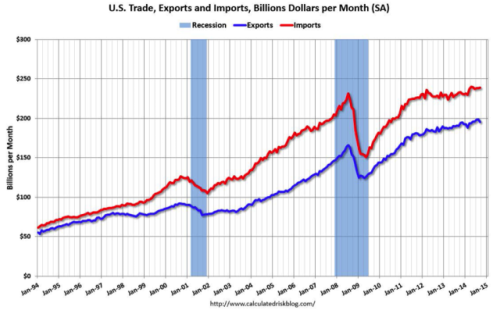
Yet despite all these factors, I wonder if many who think of themselves as opposing free trade are really opposed to trade deficits. Let me speak as if the home country at issue is the US, but a similar question can be asked for many countries. How many people would be against free trade if it were balanced trade in which people and firms in other countries buy just as much from Americans as Americans buy from them?
If trade were balanced, it would mean that every dollar of imports would be balanced by a dollar of exports. Intuitively, freer trade means that people in the US can do more of what they are best at and less of what they are worst at—but with this subtlety: in producing goods and services people in the US are better at almost everything than people in other countries. So to have balanced trade, out of all the things people in the US are better at, some at the bottom of the list of US advantage (whether in ability to produce quantity or to produce quality) have to be imported in order to give people in other countries the US dollars they need to buy the things near the top of the list of US absolute advantage.
All of this gets thrown off when trade is not balanced. How can that happen? To simplify, when Americans buy Chinese goods with borrowed Chinese yuan, while the Chinese people and the Chinese government save the US dollars they get instead of spending them on American goods, and Americans follow the same pattern with many other countries, then the US will run a trade deficit. Running a chronic trade deficit results in less employment in a way that goes beyond the business cycle.
What is the remedy for unbalanced trade? It isn’t trade restrictions. Regardless of trade restrictions, as long as Americans are borrowing more from other countries than they are borrowing from us, the simple fact that they are directly or indirectly (when doing the foreign exchange transaction) handing Americans their currency when they lend guarantees that one way or another Americans will end up spending more on foreign goods and services than the other way around. Thus, the equation is that if you borrow from foreigners, you will buy more from foreigners than they will from you. (I explain this principle more on my blog.)