Bring Turkey into the European Union

The day before the Turkish election on June 7, I posted a link to the Economist’s editorial “Why Turks Should Vote Kurd: It Is the Best Way of Stopping Their Country’s Drift Towards Autocracy,” with the note

True democracy can be lost. Turks need to protect theirs.

So it was good news indeed when Turks voted resoundingly to stop Recep Tayyip Erdogan’s hopes to create a powerful presidency for himself. 

I find myself again in full agreement with the Economist in its June 13th editorial “Sultan at Bay,” in which the editorial staff wrote:

The European Union, too, should do more. It was partly because Turkey’s membership talks, begun in 2005, seemed to go nowhere that Mr Erdogan drifted towards autocracy. Now that Turks have so thrillingly demonstrated their democratic credentials, the EU should revive the negotiations. There is also new hope that the age-old Cyprus problem might be solved (see article). Turkey matters hugely for the future of Europe. Resurrecting its aspirations for EU membership would be a fine reward for its admirable voters.

As I preached in my sermon the day of the Turkish election, “The Message of Jesus for Non-Supernaturalists,” including others in things that are working relatively well is one of the most powerful ways of making the world a better place. The European Union is far from perfect, but in a global context it counts as something that is working relatively well.   

Extending the blessings of the European Union into the Middle East seems especially valuable in trying to foster stability in this volatile area of the world. It is a bit optimistic, but it is not too much to hope that from now on, electoral competition in Turkey will make the Turkish government more pro-Kurd, which could be especially valuable in shifting the balance in the Middle East in a favorable direction.

Stephanie Shimko Interviews Miles Kimball about His Earliest and Latest Research

blog.supplysideliberal.com tumblr_inline_npfu8lg2CJ1r57lmx_500.jpg

Stephanie Shimko interviewed me for the May 2015 issue of the Survey Research Center’s monthly newsletter at the University of Michigan. I thought I would share it. It used the same picture I use now as my avatar. 


When we asked Miles Kimball how he became interest-ed in macroeconomics, he told us that it began in his second year of Harvard’s Economic PhD program. Miles referred us to his blog post “Why I am a Macroeconomist.” Miles’ dissertation contained three topics, which is usual for economic dissertations. His first topic was two-sided altruism (the economic consequences of children caring about parents, as well as parents caring about children) that was suggested by his professor Andy Abel. His classmate, Alan Krueger (who was later Assistant Secretary of the Treasury and head of the Council of Economic Advisers) suggested Miles’ second topic, efficiency wages. The third topic, precautionary saving, developed when Miles presented his economic history paper “Farmers Cooperatives as Behavior Towards Risk” in a seminar and his colleague, Greg Mankiw, told him it reminded him of a paper he had written on precautionary saving. Miles told us: “In each case, I just tried to write down the economic model that seemed sensible to me in that topic area, and found that each economic model had interesting implications.” We also asked Miles about his ongoing research questions. He gave us five of his critical research questions.

  1. How can we make deep negative interest rates possible for central banks in the way that is politically easiest for them?
  2. How can we obtain good survey measures and ways of combining them into an index to given an accurate summary measure of how well off people are in the full range of things they care about?
  3. How should we adjust for inequality in making public policy recommendations?
  4. How can we measure what people’s objectives are when they face risk when their answers to questions about risk attitudes initially seem inconsistent?
  5. How important is improvement in the pleasantness of work as a part of economic growth?

For the future, Miles said: “Going forward, in addition to continuing to pursue the kinds of questions I mention above, I want to pursue research that shows that I can back up key proposals I make on my blog, ‘Confessions of a Supply-Side Liberal’, with more formal academic arguments. And I would like to find time to lay out the methods I teach in my class on ‘Advanced Mathematical Methods for Dynamic, Stochastic Models’.” We asked if there were any exciting upcoming projects, and he responded: “My proposal for making deep negative interest rates possible seems to be getting some traction. I am looking forward to some conferences on this, and visits to the central banks of Sweden, Norway, and New Zealand this summer (as well as the Bank of Finland).” Miles also spoke to us about his work in subjective well-being: “Along with Dan Benjamin, Ori Heffetz, and other coauthors, I have published several papers in the American Economic Review about how subjective well-being data relate to the goal of measuring how well-off people are in the full range of things they care about. Dan and Ori and I attended a High Level Expert Group Workshop on Multidimensional Subjective Well-being in Turin last October; our basic approach was very well-received”. At the end of our session, we noticed how often his blog was central to his answers to our questions. He said: “My blog is both an important part of my professional career and a hobby. You can see there all kinds of other things going on in my life and things I am thinking about. On Sundays I alternate between blogging about religion and blogging about philosophy (so far, blogging my way through John Stuart Mill’s On Liberty). I frequently host guest posts on my blog, so it is not a one-man show.”

Quartz #62—>How Increasing Retirement Saving Could Give America More Balanced Trade

blog.supplysideliberal.com tumblr_inline_npozk1kApo1r57lmx_500.png

Link to the Column on Quartz

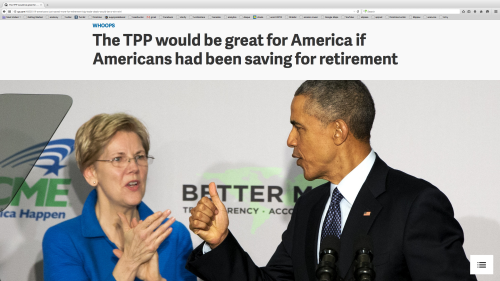
Here is the full text of my 62d Quartz column, “The TPP would be great for America if Americans had been saving for retirement,” now brought home to supplysideliberal.com. It was first published on May 14, 2015. Links to all my other columns can be found here.

In the column, I write:

Using back-of-the-envelope calculations based on the effects estimated in this research, they agreed that requiring all firms to automatically enroll all employees in a 401(k) with a default contribution rate of 8% could increase the national saving rate on the order of 2 or 3 percent of GDP.

Here is a rough idea of the kind of simple calculation that could back that claim up:

  • Suppose current 401(k)’s give only one-quarter or less of the amount of saving if everyone had an 8% contribution rate–partly because many people aren’t covered at all. Then if no one opted out, the new regulation would add 6% to saving as a fraction of labor income. Multiply that by 2/3 for labor’s share, that is 4% more of GDP if no one opted out. Then the opt-out assumption is that 25% to 50% of people opt out.

If you want to mirror the content of this post on another site, that is possible for a limited time if you read the legal notice at this link and include both a link to the original Quartz column and the following copyright notice:

© May 14, 2015: Miles Kimball, as first published on Quartz. Used by permission according to a temporary nonexclusive license expiring June 30, 2017. All rights reserved.


It is no accident that US president Barack Obama asked for fast track trade promotion authority after he had faced his last election. Free trade is good for economic growth. Economic theory predicts that the value to consumers, workers and owners of firms gained from free trade outweighs the value lost. So why do so many politicians see free trade as toxic politically?

One reason rightfully given for the political toxicity of free trade is that the concentrated losers from free trade are more obvious, more vocal, and better organized than the widely dispersed winners from free trade. During recessions, another factor in the opposition to free trade is that people blame trade for what is primarily a failure of monetary policy or a failure of financial stability policy. When the poor in other countries are out of mind, a concern about the effect of free trade on the poor in one’s own country can be a reason to oppose free trade. And one can cogently worry that free trade might adversely affect sectors of the economy that start out being stunted by product market and labor market distortions more than the sectors of the economy that would be helped by free trade (one of the few things that can overturn the theoretical prediction that the value gained from free trade outweighs the value lost).

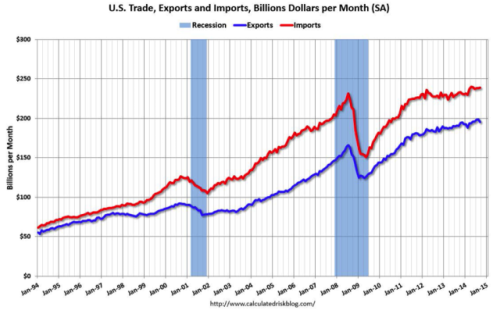
Yet despite all these factors, I wonder if many who think of themselves as opposing free trade are really opposed to trade deficits. Let me speak as if the home country at issue is the US, but a similar question can be asked for many countries. How many people would be against free trade if it were balanced trade in which people and firms in other countries buy just as much from Americans as Americans buy from them?

If trade were balanced, it would mean that every dollar of imports would be balanced by a dollar of exports. Intuitively, freer trade means that people in the US can do more of what they are best at and less of what they are worst at—but with this subtlety: in producing goods and services people in the US are better at almost everything than people in other countries. So to have balanced trade, out of all the things people in the US are better at, some at the bottom of the list of US advantage (whether in ability to produce quantity or to produce quality) have to be imported in order to give people in other countries the US dollars they need to buy the things near the top of the list of US absolute advantage.

All of this gets thrown off when trade is not balanced. How can that happen? To simplify, when Americans buy Chinese goods with borrowed Chinese yuan, while the Chinese people and the Chinese government save the US dollars they get instead of spending them on American goods, and Americans follow the same pattern with many other countries, then the US will run a trade deficit. Running a chronic trade deficit results in less employment in a way that goes beyond the business cycle.

What is the remedy for unbalanced trade? It isn’t trade restrictions. Regardless of trade restrictions, as long as Americans are borrowing more from other countries than they are borrowing from us, the simple fact that they are directly or indirectly (when doing the foreign exchange transaction) handing Americans their currency when they lend guarantees that one way or another Americans will end up spending more on foreign goods and services than the other way around. Thus, the equation is that if you borrow from foreigners, you will buy more from foreigners than they will from you. (I explain this principle more on my blog.)

blog.supplysideliberal.com tumblr_inline_npp03olrLB1r57lmx_500.png

For a country running a trade deficit as the US is, given open financial markets, the only way to get to more balanced trade is for the American people, American firms or the US government to save more, or for Americans to shift their net financial investments toward lending to foreigners.

It might seem that it would be hard to raise the US saving rate given the limited success of past attempts. But the conjunction of psychology and economics has identified a powerful and underappreciated lever for raising saving, waiting to be used. In remarkable research initiated by Brigitte Madrian (now a professor at Harvard’s Kennedy school) and continued with the help of many coauthors, it has been found that when people are automatically enrolled in 401(k)’s, they save a lot more than when they have to actively set up 401(k) contributions themselves. Some people opt out of doing that extra saving, but many don’t.

I talked to Madrian and David Laibson, the incoming chair of Harvard’s Economics Department (who has worked with her on studying the effects of automatic enrollment) on the sidelines of a Consumer Financial Protection Bureau research conference last week. Using back-of-the-envelope calculations based on the effects estimated in this research, they agreed that requiring all firms to automatically enroll all employees in a 401(k) with a default contribution rate of 8% could increase the national saving rate on the order of 2 or 3 percent of GDP.

The regulation I am talking about would not require any change to the rate at which firms match their employee’s contributions. One of the biggest benefits would be helping people arrive at retirement well prepared financially. But it would also have a major effect on the US trade balance. If the US ran smaller trade deficits, employment would go up beyond any particular business cycle. If Americans were saving too much and had too many available jobs tempting them to work too much, that wouldn’t be a good thing for them. But right now, in this economy, more jobs and more savings are appropriate, so it would help them.

Automatic enrollment in retirement savings plans is so powerful that some economists will worry that its spread will help exacerbate a global glut of saving. But if paper currency policy gets out of the way of the appropriate interest rate adjustments, financial markets will find the appropriate equilibrium. They will balance the supply and demand for saving, and companies will realize the extent to which an abundance of saving makes available the funds they need to dream big by creating new markets and technologies that the future of America depends on.

John Stuart Mill’s Answer to the Diminished Capacity Argument

Both in law and in our less formal judgments of others’ actions and our own, we recognize the idea of “diminished capacity”: at the moment of doing the bad thing, not being able to think straight. But there are many things that predictably lead to not being able to think straight: alcohol, too little sleep, titanic anger, strong sexual arousal, etc. Because these predictably affect our judgment, we each bear a responsibility to make sure that at each moment we are either (a) avoiding such states at that moment or (b) set things up–say by prearranging many key things–so as to minimize any harm that might come from distorted judgments in those states. It is appropriate to hold people to account on that responsibility. 

John Stuart Mill alludes to that principle in On Liberty “Chapter V: Applications,” paragraph 6:

The right inherent in society, to ward off crimes against itself by antecedent precautions, suggests the obvious limitations to the maxim, that purely self-regarding misconduct cannot properly be meddled with in the way of prevention or punishment. Drunkenness, for example, in ordinary cases, is not a fit subject for legislative interference; but I should deem it perfectly legitimate that a person, who had once been convicted of any act of violence to others under the influence of drink, should be placed under a special legal restriction, personal to himself; that if he were afterwards found drunk, he should be liable to a penalty, and that if when in that state he committed another offence, the punishment to which he would be liable for that other offence should be increased in severity. The making himself drunk, in a person whom drunkenness excites to do harm to others, is a crime against others. So, again, idleness, except in a person receiving support from the public, or except when it constitutes a breach of contract, cannot without tyranny be made a subject of legal punishment; but if, either from idleness or from any other avoidable cause, a man fails to perform his legal duties to others, as for instance to support his children, it is no tyranny to force him to fulfil that obligation, by compulsory labor, if no other means are available.

It would be too great a burden on freedom to punish people for not (a) avoiding states of impaired judgment if they might well be pursuing strategy (b) of arranging things careful so impaired judgment does no harm. But once someone has committed an offense under impaired judgment, the presumption that they are pursuing strategy (b) cannot be held as strongly.

Stepping back, one can consider the human condition in general as one of impaired judgment. Therefore, along the lines of strategy (b), it is our duty to set up social arrangements so that our impaired judgment causes as little trouble as possible. Foremost among such social arrangements is to avoid giving too much power to any one individual. Dictatorship is like drunkenness without any precautions.

CEPR Interview: Miles Kimball—Practical Details of Negative Interest Rates

CEPR Interview of Miles Kimball at the Imperial College-Brevan Howard Centre-CEPR-Swiss National Bank Conference on “Removing the Zero Lower Bound on Interest Rates,” May 18, 2015 in London

The CEPR (Centre for Economic Policy Research) staff did a brilliant job editing this interview. I can’t recommend this enough. If you could only look at one post of mine on eliminating the zero lower bound, this video post is the one to look at. 

You can see the other interviews done at the conference here. 

You can also see links to the many things I have written on this here.

Florida, Cuba and the Bahamas from SpaceThis is a beautiful picture from space, via the canadian-space-agency. It is the harbinger for my newest column–with the working title “Is the value-added tax really regressive?”–which should come …

Florida, Cuba and the Bahamas from Space

This is a beautiful picture from space, via the canadian-space-agency. It is the harbinger for my newest column–with the working title “Is the value-added tax really regressive?”–which should come out sometime this morning. 

South #Florida, #Cuba, #Bahamas. From my view, the most beautiful and colorful waters and reefs in the world. April 27, 2015.

Credit: NASA Astronaut Terry Virts’ Twitter Account

The Message of Jesus for Non-Supernaturalists

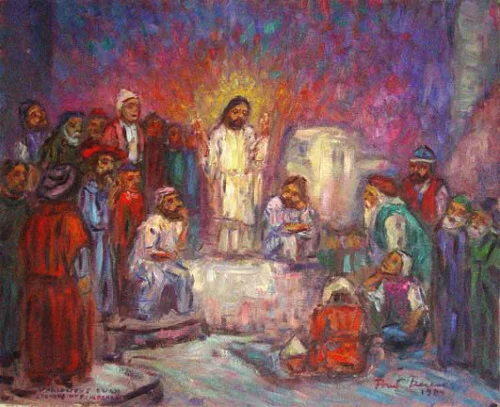
This is my latest sermon, to be given today at the Community Unitarian Universalists in Brighton.  Here is the abstract:

Abstract: Many preachers have quoted the New Testament question: “What think ye of Christ?” For a non-supernaturalist, this is not an easy question. Both the historical Jesus and the additional stories that grew up around him seem remarkable. How could all of this have come together without a miracle? And what does it mean for us now if there were no miracles involved? Among the foremost answers to the last question must be the idea of the dignity of every human being–as against both other human beings of high social status, and as against the universe.

After the sermon, I add some links you might be interested in.

Update: You can now see a video of the sermon here.


Introduction

In his book Mere Christianity, C. S. Lewis wrote:

I am trying here to prevent anyone saying the really foolish thing that people often say about Him: I’m ready to accept Jesus as a great moral teacher, but I don’t accept his claim to be God. That is the one thing we must not say. A man who was merely a man and said the sort of things Jesus said would not be a great moral teacher. He would either be a lunatic—on the level with the man who says he is a poached egg—or else he would be the Devil of Hell. You must make your choice. Either this man was, and is, the Son of God, or else a madman or something worse. You can shut him up for a fool, you can spit at him and kill him as a demon or you can fall at his feet and call him Lord and God, but let us not come with any patronizing nonsense about his being a great human teacher. He has not left that open to us. He did not intend to.

I am not willing to accept any of the three choices C. S. Lewis offers. As a non-supernaturalist, the claim that Jesus was God, or the Son of God, in any traditional sense doesn’t work for me. Demons and the Devil too are supernatural. And although some degree of mental illness can be consistent with great creativity, insight and enlightenment, Jesus certainly was not crazy in a way that should cause us to dismiss all of his key messages.

The specific words in the gospels that C. S. Lewis points to in which Jesus is said to claim divinity may or may not have actually been said by Jesus. I think statements that a charismatic individual was divine are particularly likely to be added by followers later on. In the case of Jesus, there is no reason to doubt that his followers genuinely believed he came back from the grave; belief in Jesus’ resurrection would make them especially likely to add claims of divinity. 

Jesus himself seems to have been given to enigmatic sayings that could have been taken as lending credence to those claims. Jesus could have genuinely felt that God was acting through him to such an extent that he could be considered “God with us” without the full weight of the later Christology. Or it is also possible that Jesus, for his own purposes, may have actually been willing to claim godhood, perhaps in an ironic sense.

This does not mean we can dismiss the historical Jesus. Even with the later boost by the efforts of his followers, including the apostle Paul, one cannot explain Christianity without a remarkable individual at the root of it all: Jesus. I think of Jesus and the beginnings of Christianity what I think of Joseph Smith and the beginnings of the Mormonism I grew up in: one way or another, something unusual happened back then. Therefore, judging what happened is a matter of comparing the relative likelihood of various different chains of unlikely events.  

For Christianity itself was remarkable. Even a non-supernaturalist should recognize that the words and deeds of the early Christians changed the world. And it is those words and deeds of early Christians that are the most reliable clue to the non-supernatural part of the message of Jesus.

Justice

In the end, I take the key non-supernatural message of Jesus to be in line with something my college classmate and friend Peter Lake said: that John Rawls’s book A Theory of Justice is a philosophically reworked restatement of what Jesus taught.

In A Theory of Justice, John Rawls asks each of us to imagine how we would decide to arrange society if we were deciding behind a “veil of ignorance,” not knowing who each of us would be and therefore not knowing the station in society that you or I would have.

Not knowing who one would be, one would have to be concerned about the possibility that one might be put in the position of wanting to do something very badly and not being allowed to do it. So John Rawls argues that the first thing we would decide behind the veil of ignorance would be to build guarantees of freedom into the society we would end up in. The essence of freedom—as laid out, for example, by John Stuart Mill in “On Liberty”—is to define a sphere of action for each person that allows us to tend the things that we each are likely to care most about. A good example is the decision of whom to marry. Despite the emotional energy behind many people’s opposition to gay marriage, I still think that those actually getting married to the one they love tend to care more than those trying to stop them from getting married. So this is an issue of freedom.

Once freedom is guaranteed, John Rawls argues that behind the veil of ignorance, we would arrange for the level of material resources available to the worst-off member of society to be as high as possible. Here, I think John Rawls oversimplifies a little. The risk aversion we would apply behind the veil of ignorance would not be infinite. So we might put some weight on how well off higher stations in society were; but as a practical matter, the interaction of even modest levels of risk aversion or inequality aversion with the wide range of inequality in the world we live in puts so much weight on the welfare of the worst off individuals, that John Rawls’s focus on the very worst off is an excellent approximation.

The Problem

In the real world, most of human history has been a story of violence and oppression. Violence came first; oppression requires more organization.

Violence: Hunter-gatherer tribes, like chimpanzees, tend to have extremely high murder rates, as Stephen Pinker discusses in his book The Better Angels of Our Nature: Why Violence Has Declined.

One person who has thought deeply about the psychology of violence is René GirardRené Girard is an Emeritus Professor of French Literature at Stanford University who in his other role as anthropological philosopher puts Jesus at the center of history as the beginning of the end for human violence driven by envy, scapegoating and sacrifice. 

The beginning of René Girard’s account is also the foundation of culture itself: the ability to copy others. In both his literary criticism and anthropological philosophy, René Girard emphasizes a key thing we copy from one another: our notion of what is desirable. This is fine when there are many items of the same type available in the local surroundings. But when certain items are scarce, seeing that others value those items encourages us to see them as valuable and envy those that have them.

Joseph Epstein argues persuasively in his book Envy that envy is all around us:

So endemic did these and other philosophers [Kierkegaard, Kant, Nietzsche, Schopenhauer, etc.] find envy… it becomes clear that one must factor in envy in considering our judgments of our own and of others’ actions. If one’s judgments are to be straight and honorable, one must be certain that they are not infected by envy.

Envy is something people are seldom willing to admit to; so it is dangerous to assume there is only as much envy in the world as people talk about.

Envy is a powerful emotion. Unlike Disney movies that often leave the evil of the villain unmotivated, the Bible gives an excellent motivation for Satan’s evil in envy. (Some say pride, but I think it is easy to detect the envy being papered over by the pride in the stories of Satan.)

When envy leads many to want the same thing without external restraints, violence is a common outcome. René Girard argues that before the development of more elaborate cultural mechanisms to restrain violence, the violence of all against all is often put on pause by scapegoating. If people can copy desires from others, they can also copy hatreds. If everyone copies a hatred toward some individual who is different enough to become a focal point, that individual becomes a scapegoat. In the olden days such a human scapegoat was often murdered. Then, René Girard argues, the people in the local community felt a catharsis great enough that they often felt oddly grateful toward the individual who was killed and began to talk of the scapegoated individual as a demigod, despite the fact that along the way to being murdered, the scapegoat had been thoroughly slandered. Turning the slandered, murdered human scapegoat into a demigod transformed the murder in memory to a human sacrifice.

At one level, Jesus’ sacrifice seems like a reenactment of the primeval pattern of a human scapegoat being slandered, murdered, and then made into a god. But René Girard argues that it is different in a momentous way: the gospels are adamant that Jesus was actually innocent. And the thought that the human scapegoat might be innocent has put sand in the gears of this primeval practice of “piling on” against a human scapegoat ever since Jesus.

Fear and Intolerance: Violence inspires fear. And in addition to violence, the scapegoating mechanism helps to enforce conformity. Though there is some randomness in who is chosen as the scapegoat in any situation, sticking out and being different is a definite risk factor. So it often seems safer to conform rather than risk being made into a scapegoat. And everyone’s fear of the dangers of nonconformity gets expressed as intolerance.

Oppression: When societies become more centralized, chaotic violence is replaced by violence as a fallback tool to enforce oppression. A week ago, I finished reading Daron Acemoglu and James Robinson’s book Why Nations Fail. They argue that most nations throughout history have been either domains of chaotic violence or domains of organized oppression. They use the terms “extractive institutions” and “extractive economics” to mean politics and economics organized to enable the in-group to make themselves as well off as possible at the expense of everyone else. This is still the way half the world is organized, and it is the root cause of poor nations being poor. Those on top in those countries would like their countries to be richer, since that would mean more to steal. Unfortunately, there are not many ways to make a country richer without running into the danger of empowering people in a way that jeopardizes one’s control. In particular, it is hard to allow much innovation, since innovation often brings with it creative destruction of existing structures—especially innovation of the kind most crucial for prosperity.

So what stands in the way of poor countries becoming rich is not ignorance, but evil—evil of the very most human kind. Evil that you and I have in our hearts too, that will cause us trouble too if we don’t restrain it.

The Solution

Violence and oppression are central human problems. Christianity brought tools helpful in the solution.

Tools to Break Down “Us vs. Them” Thinking: Three key characteristics of the early Christians helped to keep in check the human tendency toward seeing things as us versus them. The early Christians were:

1. Proselyting. They tried to win converts. Jesus was said to have given this charge after his resurrection: “Therefore go and make disciples of all nations, baptizing them in the name of the Father and of the Son and of the Holy Spirit.”

2. Inclusive. Seeking converts, they brought into their group outsiders of all ethnicities, gave women high status relative to the standards of the times, and told stories of Jesus having been kind to people in despised groups such as prostitutes and tax collectors. Inclusiveness was not a foregone conclusion for Christianity, even given what Jesus had done and said. The biggest political struggle within Christianity during its early years was over the question of whether to allow people to become Christians without taking on all the ethnic markers of Judaism. But Paul won the victory for greater inclusiveness.

3. Humble.Many of the early Christians were from relatively high social classes. But they remembered Jesus honoring not the high and mighty, but the poor in spirit, those who mourn, the meek, those who hunger and thirst for righteousness, the merciful, the pure in heart, the peacemakers, and those who are persecuted for righteousness’ sake. And they remembered his story of the king who said “Truly I tell you, whatever you did for one of the least of these brothers and sisters of mine, you did for me.”

Tools to Break Down “I vs. We” Thinking: Three more characteristics of the early Christians helped to keep in check the human tendency toward thinking of self first instead of the welfare of the group, and paradoxically helped them to go beyond fear-induced conformity. They were:

4. Bookish. The early Christians and the Christians that followed them later on in history revered a remarkable collection of books containing much of the Jewish tradition as well as their own new tradition. These writings helped individual Christians identify with the Christian movement as a whole. And as Jack Miles’s book “God: A Biography” makes clear, the Jewish tradition, which had to explain everything that happened in terms of one God, already included both sides of many deep debates, and the new Christian additions to scripture only broadened the range with arguments for both sides of such tensions as order vs. revolution, rules vs. forgiveness, mastering nature vs. standing in awe of nature, and even supernatural vs. natural. This helped ensure that although many false and harmful things could be argued from scripture that almost all true and helpful things could also be argued from scripture. And they were.

5. Fearless in the Face of Death. In addition to many facing martyrdom with bravery, early Christians showed fearlessness in the face of death by nursing one another back to health during epidemics, even at the risk of their own health. Fearlessness in the face of death is an area where supernatural beliefs obviously played a role. But the ability to imagine the welfare of others and the welfare of all instead of just one’s own welfare also played a role.

6. Idealistic. The grand sweep of the Christian narrative and the emphasis on faith helped the Christians to think big, including thinking big about the welfare of the whole.

Tools to Break Down “I vs. You” Thinking: At the more intimate, person-to-person level, three beliefs of the early Christians helped to keep in check the human tendency to put self first over a particular other person. They believed in:

7. Forgiveness.

8. Love.

9. Fidelity.

The importance of forgiveness and love in Christianity are so well known I don’t need to add anything there. But on fidelity, it is worth noting how unusual the Christian rejection of a sexual double standard was within the Roman Empire. To insist that husbands be true to their wives as well as wives being true to their husbands was an idea the Christians shared with non-Christian Jews, but otherwise it was quite unusual. And I should mention that along with marital fidelity, Christianity had some basic rules for family life that were missing for the Romans, such as “Don’t kill infant daughters.”

The Result

History is convoluted, and causality is hard to demonstrate beyond a shadow of a doubt. But, influenced in part by the books the sociologist Rodney Stark has written about the influence of Christianity on history, I see the characteristics of Christianity I have laid out as being crucial in getting us to the favorable spot in history that we stand at now.

Restraining Violence: Forgiveness, love and fidelity, plus seeing others as not so different from oneself, constitute a partial antidote to violence. It took many years for such ideas to have much effect on violence, but the trend has been down, as Stephen Pinker so ably documents in The Better Angels of Our Nature.

Restraining Oppression: A week and a day from now is the 800th anniversary of the Magna Carta—a key step toward the Anglosphere escaping from extractive political and economic arrangements. When I read Daniel Hannan’s celebration of the Magna Carta in the May 29th Wall Street Journal, I found myself choking up at reading the words “800 years of the Crown’s acceptance of the rule of law.” The logic of power is strong; it takes a lot to tip the balance towards liberty. I can’t help but think that some ideas within Christianity made a difference:

  • If God came down to earth, maybe the King should also show some humility.

  • If other human beings are brothers and sisters, maybe a few people here and there hesitated at inflicting the tortures needed to shore up the arbitrary rule of the king.

  • Later on, when those who don’t have a vote clamor for one, it is hard to dismiss them as totally different from oneself.

  • If death is far from the worst thing, maybe it is worth it to oppose a tyrant, even if it might lead to death.

  • If one is part of some grand overarching story, then it is worth trying to make the world a better place.

  • Like the revered book, there is hope that opposing forces can all be regulated and corralled into a whole that works.

What Remains Undone

It is obvious that much remains to be done to restrain violence. But I want to end by talking about what remains to be done to restrain oppression. The essence of oppression is to run things for the benefit of an in-group at the expense of an out-group. In my post “‘Keep the Riffraff Out!’” I point out three ways in which we routinely use exclusion to run things for the benefit of an in-group at the expense of an out-group.

The first is to put up fences and guards to keep out immigrants desperate to become part of a well-run liberal democracy. Why do we keep them out? In order to benefit a subset of citizens—of the in-group—even at terrible cost to those being kept out. Or when they get in despite our best efforts, we keep them in constant fear of deportation and thereby keep them at the margins of society. 

We are often moved to compassion when we see pictures of people suffering in other countries, and send money to help. But other than limited areas such as fighting illness, it is very difficult to make things better over there where evil rules. But if we focus on helping people rather than helping nations, it is simplicity itself to help the people in other nations: let them in! It is much easier to bring the people to good systems of governance than it is to bring good systems of governance to people where they are. Where they are, evil systems designed for oppression will fight us tooth and nail. Here at home, we only have to fight the evil in our own hearts, with a fundamentally good system designed to keep our own evil in check backing us up.    

The second way in which we run things for the benefit of an in-group at the expense of an out-group is by making unnecessary licensing requirements to keep those at the bottom of the heap from competing against us with lower quality versions of the professional work that we do. We feel it is OK to deny someone else a livelihood if it keeps our own wages a bit higher. (See my post “When the Government Says ‘You May Not Have a Job.’”)

The third way we run things for the benefit on an in-group at the expense of an out-group is by tightly restricting the building of new housing in the most desirable cities to keep up the scarcity value of our own property. I saw last night an article in the Atlantic by Alana Semuels “Where Should Poor People Live?” with this summary at the top: 

Studies say that lower-income people do better when they live in affluent neighborhoods, but rich people don’t want them there. A few states are seeking ways around that resistance.

All of these impulses can be summarized under the heading of “Keep the Riffraff Out.” But if there is one key message of Jesus, it is that there is no riffraff—only human beings, who deserve to be treated with dignity. The New Testament is witness that when the early Christians invited a wide variety of people into their congregations they had to deal with a variety of behavior problems. But they let them in anyway, and worked with them.

I know I don’t have all the answers, but one thing I know is that human beings are human beings. It is not OK to talk about the pluses and minuses of any policy without talking about the effects of that policy on all human beings. If someone wants to say, “It will hurt those folks over there, but we should do it anyway,” at least that is forthright, and they may win the day. But it is within our power to keep anyone from getting away with not mentioning the welfare of the outsiders at all.

In many ways the human world is an ugly place. But it used to be much uglier. Credit for an important part of the improvement goes to the message of Jesus that all human beings should be treated with dignity—in how we think about them as well as in our direct dealings with them. It is a lesson that we have learned in part. We have further to go.


Mayuram Krishnan, Min-Seok Pang and Ali Tafti: Every $1 of Extra Information Technology Spending by States Predicts $3.49 Less Overall Spending

University of Michigan business professor Mayuram Krishnan and his two coathors Min-Seok Pang and Ali Tafti found what I thought was an interesting correlation in their paper “"Do CIO IT Budgets Explain Bigger or Smaller Governments? – Theory and Evidence from U.S. State Governments” (forthcoming in Management Science) suggesting that goverment investment in information technology is underdone. In particular, $1 more of information technology spending predicts $3.49 less in overall spending. You can find a news article on this by Greta Guest in the University of Michigan’s University Record here: “Do government technology investments pay off?”

Rodney Stark: Historians Ought to Count—But Often Don’t

I found this story about historiography from Rodney Stark’s book Cities of God: The Real Story of How Christianity Became an Urban Movement and Conquered Rome (pp. 209-211) fascinating, and wanted to share it with you. Here is the quotation: 

In 1962, Arthur Schlesinger Jr.–on leave from the Harvard history department to serve as a White House intellectual for John F. Kennedy–told an assembled audience of American scholars that “almost all important [historical] questions are important precisely because they are not susceptible to quantitative answers.” Such arrogance thrilled many of his listeners, as clever nonsense so often does. For others it prompted reflections on how someone so poorly trained had risen so high in the profession of history. In truth, many of the really significant historical questions demand quantitative answers. They do so because they involve statement of proportion: they turn on words such as none, few, some, many, most, all, along with never, rarely, seldom, often, usually, always, and so on.
… let us turn back, to Arthur Schlesinger and the book that made his reputation: The Age of Jackson. For decades before Schlesinger wrote, the central question posed about “Jacksonian democracy” was how Old Hickory had managed to motivate millions more Americans to vote in his presidential elections than ever had done so before. All the stars of American historiography had addressed the matter, including Charles and Mary Beard, Richard Hofstadter, and John Back McMasters. A remarkable jumble of explanations had been offered, but everyone agreed with the Beards that Jackson was swept into office by “the roaring flood of the new democracy.” Thus, Schlesinger launched his career by attempting to explain the “immense popular vote” received by Jackson in 1828 when he was elected by a “mighty democratic uprising.” Notice that Schlesinger was not content simply to assert that Jackson was elected. He stressed the proportion of the victory–it was “immense” and “mighty.” His book was awarded the Pulitzer Prize in 1946 because reviewers found Schlesinger’s explanation of Jackson’s huge appeal to the ‘common man’ so convincing.
But trouble soon arose. In 1960, two years before Schlesinger’s expressions of contempt for quantification, Richard P. McCormick bothered to count the votes. He demonstrated conclusively that what was notable about the Jacksonian elections was low voter turnout! There was no “mighty” or “immense” outpouring. More votes had been cast in many previous elections. What seems to have so misled historians for so long was that these were apparently the first presidential elections in which attention was paid to the total popular vote, as opposed to merely reporting the results of the electoral college. Confronted with large numbers of votes, no one bothered to calculate whether these were many more or fewer than usual. As a result, generations of historical analysis was patent nonsense, having been devoted to explaining something that hadn’t happened!
… although McCormick’s expose was published in the American Historical Review, the most distinguished journal in the field, it was generally ignored, and many textbooks continued for several more decades to discuss Jackson’s immense appeal. To the best of my knowledge, Schlesinger never recanted.
When hiring, leaders need to resist the temptation to bring in high-performing but selfish partners, who might be a toxic influence, and instead seek candidates who have a track record of working across boundaries.

– “When Senior Managers Won’t Collaborate,” by Heidi K. Gardner, Harvard Business Review, March 2015, p. 81.