Could the European Central Bank be Preparing to Break Through the Zero Lower Bound?

Photo of one of the European Central Bank buildings that I took when I visited. I give full permission to anyone to use this photo as long as they link to this post.

Photo of one of the European Central Bank buildings that I took when I visited. I give full permission to anyone to use this photo as long as they link to this post.

In Brian Blackstone’s November 6, 2014 Wall Street Journal article “ECB Unites on Possible Further Stimulus,” after discussing the planned $1 Trillion euro chunk of balance sheet expansion that is on its way, Brian says this:

The ECB left its main rate—the rate that it charges commercial banks on its regular loans—at a record low 0.05% as expected.

However, Mr. Draghi said ECB staff and committees have been asked to ensure “the timely preparation of further measures to be implemented, if needed.” He added that ECB staff and committees have a proven record of delivering what they have been asked to do, an indication that the ECB is prepared to act on their recommendations if necessary.  

Could these further measures being prepared by the staff include a negative paper currency interest rate (implemented by a time-varying paper currency deposit window at central bank cash windows)? I hope so. Key staff members were certainly there in my ECB seminar on “Breaking Through the Zero Lower Bound” in July.    

Let me say that if the ECB does break through the zero lower bound, those who are influential in making that happen within the ECB will easily deserve a supplysideliberal.com designation as heroes of humanity if they pursue such a policy resolutely, as called for.

Note: My bibliographic post “How and Why to Eliminate the Zero Lower Bound: A Reader’s Guide” now has a section on “News and Trends.”

John Stuart Mill on Raising the Next Generation

In the nature vs. nurture debate it is common to look at the fraction of the variation in outcomes due to genetic factors “nature”), and the fraction of variation in outcomes due to other factors (“nurture” + other things). Noah Smith and I discuss these kinds of comparisons in “There’s One Key Difference Between Kids Who Excel at Math and Those Who Don’t” and I look at them even more closely in “How to Turn Every Child into a ‘Math Person.’” The thing people often don’t realize is that how much of the variation in outcomes is due to genes and how much is due to upbringing are as much a reflection of how much genes and upbringing vary in the population of interest as it is about the strength of the effects of genes and upbringing.

For example, the fraction of the variation accounted for by genes is much, much larger if one is looking at many species than if one is only looking only at members of one species: homo sapiens. The reason racist views about the genes of different ethnic groups are wrong is that Homo sapiens descended from a small group of common ancestors not that long ago at a time when only a few humans were left, and there has been a lot of mixing of the gene pool in the thousands of years since. The otherwise tragic extinction of Homo floresiensis 12,000 or so years ago saves us from serious racism against a relative much closer than chimpanzees, but distant enough that claims of substantial genetic differences would actually be true. 

Focusing in on nurture, the fraction of the variation accounted for by upbringing is less if one is looking at the population of adopted kids (say identical twins adopted into different families), simply because adoption agencies try and to some extent succeed at screening out the lower tail of people who would be bad parents (along with screening out many people who would be great parents). At the other extreme, the striking differences in human behavior across cultures have to be attributed mostly to differences in upbringing.

Differences in human behavior are so large between different cultures because the influences of everyone else in the society–and the structure of the society itself–are added to the influences of parents. Psychologists often emphasize how much people’s behavior is affected by the situations they are in. But the situations they are in have a lot to do with the culture they are in. 

I emphasized in my column “Why You Should Care about Other People’s Children as Much as Your Own” that how we set up our culture has a big effect on how children turn out. It is our responsibility as adults to make sure that the next generation is better than we are. This view is one I share with John Stuart Mill. He emphasizes the importance of how a society raises its children and how effective its power can be in that child-rearing in On LibertyChapter IV, “Of the Limits to the Authority of Society over the Individual” paragraph 11:

But with regard to the merely contingent, or, as it may be called, constructive injury which a person causes to society, by conduct which neither violates any specific duty to the public, nor occasions perceptible hurt to any assignable individual except himself; the inconvenience is one which society can afford to bear, for the sake of the greater good of human freedom. … But I cannot consent to argue the point as if society had no means of bringing its weaker members up to its ordinary standard of rational conduct, except waiting till they do something irrational, and then punishing them, legally or morally, for it. Society has had absolute power over them during all the early portion of their existence: it has had the whole period of childhood and nonage in which to try whether it could make them capable of rational conduct in life. The existing generation is master both of the training and the entire circumstances of the generation to come; it cannot indeed make them perfectly wise and good, because it is itself so lamentably deficient in goodness and wisdom; and its best efforts are not always, in individual cases, its most successful ones; but it is perfectly well able to make the rising generation, as a whole, as good as, and a little better than, itself. If society lets any considerable number of its members grow up mere children, incapable of being acted on by rational consideration of distant motives, society has itself to blame for the consequences. Armed not only with all the powers of education, but with the ascendancy which the authority of a received opinion always exercises over the minds who are least fitted to judge for themselves; and aided by the natural penalties which cannot be prevented from falling on those who incur the distaste or the contempt of those who know them; let not society pretend that it needs, besides all this, the power to issue commands and enforce obedience in the personal concerns of individuals, in which, on all principles of justice and policy, the decision ought to rest with those who are to abide the consequences.

In other words, society should fight self-destructive behavior with good education and child-rearing.

Stupid Criminals

My Dad is an emeritus law professor who specialized in criminal law. One thing I often heard from him is that criminals don’t always fully optimize. The video above, via isomorphismes, is in that vein. Also, but googling “stupid criminals,” I quickly found this entertaining post

Here are the musings of isomorphismes on the video above:

If people are rational and self-interested, why do they incriminate themselves after being Mirandised?

After minute 31 an experienced Virginia Beach interrogator-cum-3L explains how he convinces criminals to confess, against their interest, even after advising them that “Anything you say may be used in court”.

Especially after minute 34, 36, 38, 39, 40, 45, 47 he explains how he has outsmarted several criminal archetypes over 28 years.

Also check the interrogator’s view (at min 45) on cultural prejudice and presumption of guilt in Virginia Beach criminal court.

ASSET BUBBLES

In a 1985 paper, [Jean Tirole] offered three conditions needed to create a bubble: durability, scarcity and common beliefs. ‘The possibility of creating too much’ of an asset ‘may prevent bubbles,’ he wrote. ‘The scarcity requirement explains why, at first sight, bubbles often affect assets that for historical reasons cannot be reproduced.’

– Nick Timiraos and Charles Duxbury, in the Wall Street Journal article “5 Contributions to Economics from Nobel Winner Jean Tirole

Ricardo Hausman: The Tacit Knowledge Economy

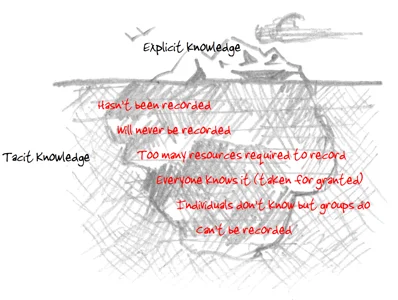
The trouble with this illustration from Shawn Callahan’s post “What do we mean by tacit knowledge” is that it emphasizes only the difficulties of recording knowledge. Economically, the difficulties of getting knowledge into someone’s head are a…

The trouble with this illustration from Shawn Callahan’s post “What do we mean by tacit knowledge” is that it emphasizes only the difficulties of recording knowledge. Economically, the difficulties of getting knowledge into someone’s head are at least as important a difficulty and getting knowledge out of someone’s head.

 I highly recommend Ricardo Hausman’s post “The Tacit Knowledge Economy.” Ricardo poses the following revealing puzzle:

Brazil in 2010 was 84.3% urban; its fertility rate was 1.8 births per woman; its labor force had an average of 7.2 years of schooling; and its university graduates accounted for 5.2% of potential workers. These are better social indicators than the United Kingdom had in 1960. …

Brazil is not a unique case: Colombia, Tunisia, Turkey, and Indonesia in 2010 compare favorably to Japan, France, the Netherlands, and Italy, respectively, in 1960. Not only did these countries achieve better social indicators in these dimensions; they also could benefit from the technological innovations of the past half-century: computers, cellphones, the Internet, Teflon, and so on. …

So today’s emerging-market economies should be richer than today’s advanced economies were back then, right?

Wrong – and by a substantial margin. …

Why can’t today’s emerging markets replicate levels of productivity that were achieved in countries with worse social indicators and much older technologies?

Ricardo proposes this answer to the puzzle: 

The key to this puzzle is tacit knowledge. To make stuff, you need to know how to make it, and this knowledge is, to a large extent, latent – not available in books, but stored in the brains of those who need to use it.

Getting it there is really tough. 

You can see my take on this theme of difficult-to-transfer knowledge in one of my favorite posts, “Two Types of Knowledge: Human Capital and Information.” Here is the key idea there:

Human capital is knowledge that is hard to transfer.

Information is knowledge that is easy to transfer.

Electronic Money: The Travelogue

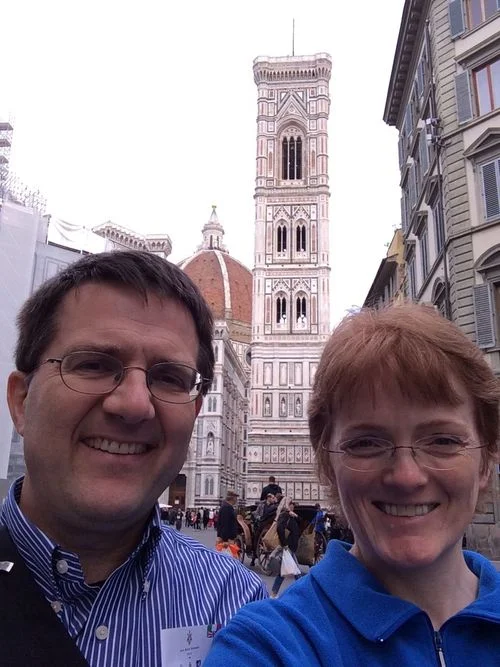
Link to Gail’s blog on Tumblr: gailkimball.tumblr.com. Photo of Miles and Gail in front of the Basilica di Santa Maria del Fiore in Florence.

Link to Gail’s blog on Tumblr: gailkimball.tumblr.com. Photo of Miles and Gail in front of the Basilica di Santa Maria del Fiore in Florence.

Unlike the case for my ancestors, who crossed land and sea to preach Mormonism without purse or scrip, traveling the world to urge the abolition of the zero lower bound has not been a personal hardship for me. On the contrary, it has been a very pleasant experience, both because of the people I have met and the cities I have been able to see.

I have been especially lucky to have my wife Gail travel with me on many of my journeys. In her own blog, Gail has documented many of the journeys we have taken together. Below, I copied over the list from “Electronic Money: The Powerpoint File” of places I have given my presentation “Breaking Through the Zero Lower Bound,” with links to Gail’s posts on the relevant cities for which she has written a post. I plan to keep the list below update as we continue our travels and as Gail has a chance to write more posts. 

  • Bank of England (London, 1,2,3,4), May 20, 2013
  • Bank of Japan (Tokyo, 1,2,3,4,5,6,7), June 18, 2013
  • Keio University, June 21, 2013
  • Japan’s Ministry of Finance, June 24, 2013
  • University of Copenhagen, September 5, 2013
  • National Bank of Denmark, September 6, 2013
  • Ecole Polytechnique (Paris), September 10, 2013
  • University of Paris, September 12, 2013
  • Banque de France, September 13, 2013
  • Federal Reserve Board, November 1, 2013
  • US Treasury, May 19, 2014
  • European Central Bank, July 7, 2014
  • Bundesbank, July 8, 2014
  • Bank of Italy, July 11, 2014
  • Swiss National Bank, July 15, 2014
  • Society for the Advancement of Economic Theory Conference in Tokyo (1,2,3,4,5,6,7,8,9,10,11), August 20, 2014
  • Princeton University (1,2), October 13, 2014
  • Federal Reserve Bank of New York (1,2,3,4,5,6,7,8,9), October 15, 2014
  • New York University (1,2,3), October 17, 2014
  • European University Institute, (Florence1,2,3,4,5,6,7), October 29, 2014
  • Qatar Central Bank and Texas A&M University at Qatar joint seminar, November 17, 2014

For completeness, let me mention that Gail has posts on several cities where we traveled without me presenting “Breaking Through the Zero Lower Bound.” Here is the list. For those of you interested in the Economics of Happiness, I put in bold the cities where I gave my presentation on “Utility and Happiness” (related to work I write about on my happiness sub-blog): 

Brian Blackstone Doubles Down on a Big Mistake in Reporting on Monetary Policy

I think it is a pity that (with the possible exception of his transitive flagging of “Larry Summers Just Confirmed that He is Still a Heavyweight on Economic Policy” through Brad DeLong in his op-ed “A Permanent Slump”) Paul Krugman continues to talk as if the zero lower bound is a law of nature, rather than a policy choice. At least Paul has the potential excuse that he is writing on the opinion page, and is making a strategic choice about how he can best affect policies in the directions he wants to affect them. But Brian Blackstone is the Wall Street Journal’s news reporter in Frankfurt, who specializes in reporting on the actions of the European Central Bank; when he says uncritically in his November 2 article “European Central Bank’s Bond Conundrum” that 

ECB interest rates can’t go lower.

without any qualification, that is just bad reporting.

When I gave my presentation “Breaking Through the Zero Lower Bound” at the ECB in July, the staff there took very seriously the idea that a time-varying paper currency deposit fee as I advocate in that presentation could allow the ECB to cut its target rate to -1.25% immediately. They realized that was a big deal and not an easy policy choice to make, both because it would be something unprecedented, and because it touches several political nerves. But there was much less dispute over whether it would work than I see about whether quantitative easing can stimulate the eurozone economy enough. And if there are any limitations on the ECB’s authority that would prevent such an action, no one there pointed to such a limitation. 

Brian was within the scope of my previous criticism of reporting in my post “The Wall Street Journal’s Big Page One Monetary Policy Mistake,” which makes the case for the newsworthiness of my proposal to make deep negative interest rates possible for the ECB with a time-varying paper currency deposit fee at the cash windows in the ECB and other banks in the European System of Central Banks. I would be delighted to talk to him directly about that proposal.

In general, reporting what government agencies can do, but choose not to, is helpful by holding them to account. Just so, I believe that matter-of-fact reporting that the ECB could make deep cuts in its interest rate, but so far chooses not to, would help make the ECB accountable–which in turn would better policy more likely. And if the ECB faces any limitations on its authority that would prevent the kind of policy I advocate, reporting on those limitations would help people understand what the issue is. So it matters.  

See my annotated bibliography on what I have written about employing negative interest rates in my post “How and Why to Eliminate the Zero Lower Bound.”

Adam Mossoff: The “Common Law Property” Myth in the Libertarian Critique of IP Rights, Part 1

I am posting this link to Part 1 of Adam Mossoff’s post on the history of copyright law because I think our copyright law is too restrictive. My interest in copyright policy can also be seen in my post “Copyright,” and from the link post that I am reproducing in full below: 

The Wonderful, Now Suppressed, Republican Study Committee Brief on Copyright Law

This is an excellent policy brief that is a well-written, fast, easy read. You can still see it thanks to Maryland Pirates.  Alex Tabarrok flagged it here. And Matthew Yglesias has a great discussion of the politics and the economic merits in his post “The Case of the Vanishing Policy Memo.” But on the economic merits, the policy brief speaks well for itself.

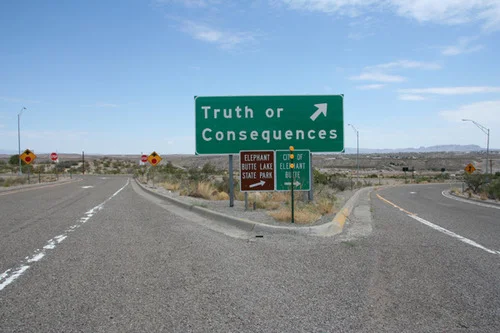
Truth or Consequences

One of my highest allegiances is to truth. (Except in the title and at the beginning of sentences, and toward the end of this one, I will use the lowercase “truth” because many groups capitalize “Truth” to refer to things that are not true at all.) The Mormonism I was raised in teaches that fidelity to truth is a higher value even than fidelity to Mormonism. It does so in a way many Mormons don’t recognize by the frequent avowal that “The Church is true.” If truth can validate Mormonism, then truth can judge Mormonism; and if there is ever a parting of ways between truth and a religion, so much the worse for that religion.

This past week, I thought again about allegiance to truth when I heard that there was a ban on federal funding on research about the effects of guns. I was relieved to find that President Barack Obama had lifted that ban in January, 2013, But there are many who would like to reinstate a ban on federal funding of gun research.

In my personal life, in order to keep myself from avoiding the truth, I often say to myself: “Whatever you decide is true, you don’t necessarily have to do anything about it,” lest fear of what I should do given certain findings tempt me to not find out the truth. In this context, let me say clearly that even if we find that guns are very damaging, it doesn’t mean that we have to tighten controls over them, and even if we find that guns are not very damaging at all, it doesn’t mean we have to loosen controls over them even further. Let’s find out what is true, and then argue over what to do about it. 

Also, let’s not let our own failings in relation to the truth compromise our allegiance to the truth. We are all imperfect, and most of us at least occasionally tell lies. But let us nevertheless strive to set up social structures that avoid leading us into the temptation to tell lies, and that make it less likely that others will tell us lies.  

Though no one is perfect, a simple way to increase one’s incentives to tell the truth is to advocate in favor of truth-telling: the costs of lying oneself are higher when one has scolded others for lying. If your psychological makeup is of the standard variety, putting oneself at risk of the accusation of hypocrisy, one is likely to think twice about telling a lie in any particular circumstance.   

As I wrote in my column “Judging the Nations: Wealth and Happiness Are Not Enough,” in a stiff competition of well over 100 different characteristics of a nation, Dan Benjamin, Ori Heffetz, Nichole Szembrot and I found that the one people on average valued the most was

freedom from injustice, corruption, and abuse of power in your nation

and eighth most valued characteristic was 

people’s freedom from being lied to, deceived or betrayed.

People hate being lied to, and they hate the injustice, corruption and abuse of power that tend to go along with official lying. 

In order to find out the truth, careful research is often necessary. In some cases, that research is done by journalists. In other cases, it is done by scientists. When scientists make the case that they should be supported in their efforts to discover the truth, it is important that they in fact be devoted to finding out the truth, regardless of whether the truth fits in with their personal ideology or not. Given the subtle ways in which our subconscious minds steer us toward reinforcing our own preexistent biases, if we ever allow ourselves to consciously suppress things in order to further our side of the debate, we are in deadly quicksand. And whenever we lie in public to further our side of a scientific debate, we have gone far, far over the line, and deserve to be reprimanded severely. (And having previously subjected oneself to a financial temptation to lie in public debate provides no valid excuse for lying.)

Though it doesn’t always work this way, I think a fascination with the math behind applied statistics can be an aid in keeping one honest in empirical research. The love of that math can distract one at crucial moments from the temptation to follow one’s ideological prejudices. Also, it may well be that having just a touch of Asperger’s syndrome on the autism spectrum is protective against the temptation to follow one’s own ideological biases. And having techy friends to answer to who care more about getting the statistics right than getting the ideologically correct answer can also help.

As economists (speaking to those of you who are economists), let us work to strengthen the social pressure we put on each other to tell the truth in both shallow and deep ways. And as human beings, let us work to reduce the temptation we and others face to tell lies. I think we make ourselves less than we might otherwise be when our allegiance to the truth wavers. Let us instead make ourselves more.

How and Why to Avoid Mixing Monetary Policy and Fiscal Policy

When Raymond Reddington (played by James Spader) burns a pile of US paper currency in the second season opening of “The Blacklist,” he is giving a gift to the Federal Reserve (the “Fed”), and through the Fed, to the US government. To see this, notice that right after the US paper money is burned, the Fed can ask the US Mint to print an equal amount of paper currency for its vaults, and other than the cost of the paper and ink themselves, get the same result as if Raymond Reddington had given the paper currency directly to the Fed. This would be income to the Fed, and unless the Fed increased its expenses, would ultimately be added to the check that the Fed sends to the US Treasury every year.  

Similarly, if the Fed mails money to every US citizen, instead of using the money it creates to buy US Treasury bills, as it usually does, then the US Treasury ends up selling those bonds to someone else and the US government ends up owing that amount to someone else who won't ultimately send the interest it earns back to the US Treasury as the Fed does. 

Indeed, if the Fed mails every citizen money–a so-called “helicopter drop”–it is equivalent to the Fed doing its usual thing of buying US Treasury bills, plus the US Treasury issuing treasury bills to finance sending money to every citizen. The reason treating a helicopter drop as the combination of these two operations is useful is that the first (the Fed buying US Treasury bills) is the normal way that the Fed changes interest rates (when the zero lower bound doesn’t get in the way), while the second (the US Treasury selling bonds to finance sending money to every citizen) brings in all the complexity of fiscal policy. In the present, it takes money from those who buy the new bonds (who presumably like to save) and gives it to all the citizens (among whom there are some who like to spend). From a long-run perspective, having the US Treasury sell bonds to finance sending money to every citizen takes money from future taxpayers, in proportion to who would be asked to pay extra future taxes, to spread it out relatively evenly to citizens now. So there is redistribution. And the overall amount of redistribution that takes place through fiscal policy is an object of fierce debate between the major political parties.

I think the debate about how much redistribution should take place should be carried out in as open and transparent a way as possible. But if there are to be any obfuscations in this area, leave the Fed out of those obfuscations! If you think it is a good idea to mail money to every citizen, let the US Treasury do it; then no one will mistake what is going on, and the argument can be in the open.   

Now, when the economy needs stimulus, and monetary policy is seriously constrained in a way that can’t be helped, mailing a credit card to every citizen with a $2000 line of credit as I have advocated is somewhere between regular fiscal policy and regular monetary policy, and might be appropriate to put under the Fed’s jurisdiction. Such a policy strives not to redistribute, though it unavoidably does to some degree when some fraction of people fail to repay the loan from the government. 

In addition to thinking that arguments about redistribution should be out in the open (as they are on my blog), I think it is important that the Fed be shielded from politics as much as possible in order to allow it to do its job of economic stabilization (keeping output at the natural level as that natural level shifts around in response to technological progress, and keeping the price level steady). That is why I argued in my column “Why the US Needs Its Own Sovereign Wealth Fund” that instead of having the Fed engaged in “quantitative easing,” buying anything other than 3-month Treasury bills should be left to another, new government agency:

… isn’t it a bit much to expect the Fed to both choose the right amount of stimulus for the economy and decide which financial investments are the most likely to turn a profit for a government that faces remarkably low borrowing costs?

Why not create a separate government agency to run a US sovereign wealth fund? Then the Fed can stick to what it does best—keeping the economy on track—while the sovereign wealth fund takes the political heat, gives the Fed running room, and concentrates on making a profit that can reduce our national debt.

I collected links to other posts I have written about sovereign wealth funds as an instrument of economic policy here

Through Roger Farmer, who also endorses sovereign wealth funds as an instrument of economic policy, I heard about Mark Blythe and Eric Lonergan’s plan, heartily endorsed by Matt Miller, to either (a) mail money to consumers, or (b) earn returns through the central bank acting as a sovereign wealth fund and then send the funds earned out to people: 

Central banks could issue debt and use the proceeds to invest in a global equity index, a bundle of diverse investments with a value that rises and falls with the market, which they could hold in sovereign wealth funds. The Bank of England, the European Central Bank, and the Federal Reserve already own assets in excess of 20 percent of their countries’ GDPs, so there is no reason why they could not invest those assets in global equities on behalf of their citizens. After around 15 years, the funds could distribute their equity holdings to the lowest-earning 80 percent of taxpayers. The payments could be made to tax-exempt individual savings accounts, and governments could place simple constraints on how the capital could be used.

Of these two ideas, I think the second, (b) is better. The money for redistribution is coming not from raising taxes but from having the government do risk bearing it is actually rewarded for, instead of through implicit risk guarantees that benefit private, often wealthy individuals.

However,

  1. I think it is much better institutionally to separate the sovereign wealth fund from the central bank. A sovereign wealth fund, though immensely valuable, is inherently controversial. The Fed and other central banks face enough controversy even when they don’t act as sovereign wealth funds. They don’t need the added political burden.
  2. Although I like the idea of new revenue that doesn’t come from taxes being used for some form of redistribution, it is not clear to me that sending people money is the best form of redistribution. There should be a vigorous debate about the most effective ways to lift up the poor for a given amount of money used. This is the issue I have with basic income proposals as well. Are they really the most effective ways to help the poor per dollar spent? (For example, see 1 and 2.

Still, I am glad to see the idea of a sovereign wealth fund gain traction–not only

  • as a way to stabilize the financial cycle–which would continue to exist even if the Fed completely tamed the business cycle, other than those fluctuations that are an appropriate response to technology and other real shocks–but also
  • as an alternative way to add to government revenue on average without resort to taxes.

Notice that in the background I have a particular view on the rational level of risk aversion, which I plan to defend in a future post–though it is always hard to find time to write major, relatively technical posts.

I also want to be clear in saying that, after eliminating the zero lower bound (as it should), a central bank should only raise the amount of revenue that is consistent with maintaining zero inflation in the unit of account (except for a bare minimum of hard-to-avoid short-run fluctuations in inflation). In particular, inflation is a very costly way to renege on the promises a government makes when it issues bonds. That seems like a bad idea to me.


The ideas of economists and political philosophers, both when they are right and when they are wrong, are more powerful than is commonly understood. Indeed the world is ruled by little else. Practical men, who believe themselves to be quite exempt from any intellectual influence, are usually the slaves of some defunct economist. Madmen in authority, who hear voices in the air, are distilling their frenzy from some academic scribbler of a few years back. I am sure that the power of vested interests is vastly exaggerated compared with the gradual encroachment of ideas. Not, indeed, immediately, but after a certain interval; for in the field of economic and political philosophy there are not many who are influenced by new theories after they are twenty-five or thirty years of age, so that the ideas which civil servants and politicians and even agitators apply to current events are not likely to be the newest. But, soon or late, it is ideas, not vested interests, which are dangerous for good or evil.

– John Maynard Keynes, The General Theory of Employment, Interest and Money, Ch. 24 “Concluding Notes,” p. 383-384

John Stuart Mill: We Are Ethically Responsible for the Harm We Do to Others, Even When That Harm Stems from First Doing Harm to Ourselves

How can the idea of personal liberty survive the argument that we are all connected, so harm to oneself is harm to society? John Stuart Mill holds the line, strongly resisting the idea that the interconnectedness of people is an excuse for meddling. Only the actual harm we do to others–regardless of whether or not it is caused by harm to selfdeserves blame or if severe, punishment. Here is his argument, from On LibertyChapter IV, "Of the Limits to the Authority of Society over the Individual” paragraphs 8-10:

The distinction here pointed out between the part of a person’s life which concerns only himself, and that which concerns others, many persons will refuse to admit. How (it may be asked) can any part of the conduct of a member of society be a matter of indifference to the other members? No person is an entirely isolated being; it is impossible for a person to do anything seriously or permanently hurtful to himself, without mischief reaching at least to his near connexions, and often far beyond them. If he injures his property, he does harm to those who directly or indirectly derived support from it, and usually diminishes, by a greater or less amount, the general resources of the community. If he deteriorates his bodily or mental faculties, he not only brings evil upon all who depended on him for any portion of their happiness, but disqualifies himself for rendering the services which he owes to his fellow-creatures generally; perhaps becomes a burthen on their affection or benevolence; and if such conduct were very frequent, hardly any offence that is committed would detract more from the general sum of good. Finally, if by his vices or follies a person does no direct harm to others, he is nevertheless (it may be said) injurious by his example; and ought to be compelled to control himself, for the sake of those whom the sight or knowledge of his conduct might corrupt or mislead.

And even (it will be added) if the consequences of misconduct could be confined to the vicious or thoughtless individual, ought society to abandon to their own guidance those who are manifestly unfit for it? If protection against themselves is confessedly due to children and persons under age, is not society equally bound to afford it to persons of mature years who are equally incapable of self-government? If gambling, or drunkenness, or incontinence, or idleness, or uncleanliness, are as injurious to happiness, and as great a hindrance to improvement, as many or most of the acts prohibited by law, why (it may be asked) should not law, so far as is consistent with practicability and social convenience, endeavour to repress these also? And as a supplement to the unavoidable imperfections of law, ought not opinion at least to organize a powerful police against these vices, and visit rigidly with social penalties those who are known to practise them? There is no question here (it may be said) about restricting individuality, or impeding the trial of new and original experiments in living. The only things it is sought to prevent are things which have been tried and condemned from the beginning of the world until now; things which experience has shown not to be useful or suitable to any person’s individuality. There must be some length of time and amount of experience, after which a moral or prudential truth may be regarded as established: and it is merely desired to prevent generation after generation from falling over the same precipice which has been fatal to their predecessors.

I fully admit that the mischief which a person does to himself may seriously affect, both through their sympathies and their interests, those nearly connected with him, and in a minor degree, society at large. When, by conduct of this sort, a person is led to violate a distinct and assignable obligation to any other person or persons, the case is taken out of the self-regarding class, and becomes amenable to moral disapprobation in the proper sense of the term. If, for example, a man, through intemperance or extravagance, becomes unable to pay his debts, or, having undertaken the moral responsibility of a family, becomes from the same cause incapable of supporting or educating them, he is deservedly reprobated, and might be justly punished; but it is for the breach of duty to his family or creditors, not for the extravagance. If the resources which ought to have been devoted to them, had been diverted from them for the most prudent investment, the moral culpability would have been the same. George Barnwell murdered his uncle to get money for his mistress, but if he had done it to set himself up in business, he would equally have been hanged. Again, in the frequent case of a man who causes grief to his family by addiction to bad habits, he deserves reproach for his unkindness or ingratitude; but so he may for cultivating habits not in themselves vicious, if they are painful to those with whom he passes his life, or who from personal ties are dependent on him for their comfort. Whoever fails in the consideration generally due to the interests and feelings of others, not being compelled by some more imperative duty, or justified by allowable self-preference, is a subject of moral disapprobation for that failure, but not for the cause of it, nor for the errors, merely personal to himself, which may have remotely led to it. In like manner, when a person disables himself, by conduct purely self-regarding, from the performance of some definite duty incumbent on him to the public, he is guilty of a social offence. No person ought to be punished simply for being drunk; but a soldier or a policeman should be punished for being drunk on duty. Whenever, in short, there is a definite damage, or a definite risk of damage, either to an individual or to the public, the case is taken out of the province of liberty, and placed in that of morality or law.

Notice that this principle means that excusing one’s behavior by reduced capacity from, say, alcohol use, or not having gotten enough sleep, should not be given much weight. If allowing one’s capacity to be reduced is likely to lead one to harm others, one has the responsibility to avoid reducing one’s capacity when in the presence of others one might hurt.

In other words, allowing people freedom in their private lives means that we should allow fewer excuses for the effects of their interactions with others.

Economic Fiction (The Good Kind)

The day before yesterday, in “On Real and Fictional Economists” I posed the question of what books and movies have economists as heroes. In addition to the comments on the post itself (including several very promising book recommendations), I received many interesting tweets. For example, I learned from Diane Coyle’s post “Economists in Fiction” of several books, and from her and others that there are now foureconomic murder mysteries by Marshall Jevons:

  1. Murder at the Margin
  2. Fatal Equilibrium
  3. A Deadly Indifference
  4. The Mystery of the Invisible Hand

I loved the first two, which were all I knew existed. 

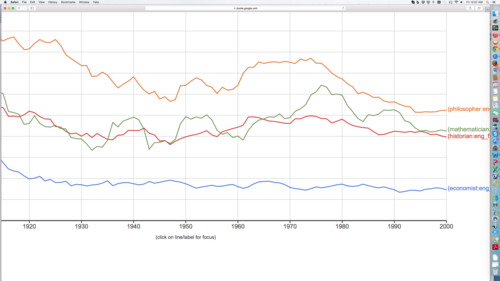
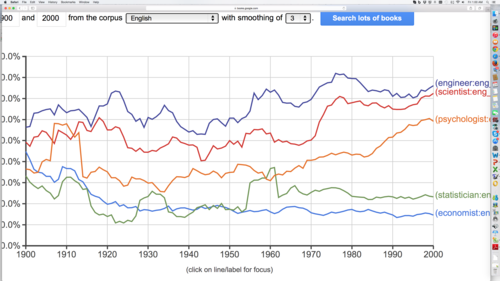
Diana Coyle recommends other books with economist heroes, but points out how many more philosopher heroes there are in fiction. Ian Preston provides evidence for how few economist heroes their are in fiction with these Ngram frequency graphs:

blog.supplysideliberal.com tumblr_inline_ndxn6aPCkR1r57lmx.png
blog.supplysideliberal.com tumblr_inline_ndxngmIVmo1r57lmx.png

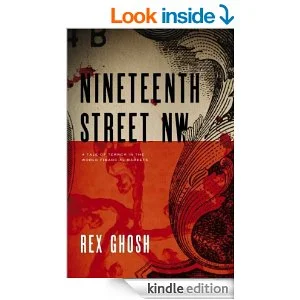
IMF economist Rex Ghosh has a book Nineteenth Street NW that was reviewed in the New York Times. That book review, “A Novel Whose Plot Seems Oddly Familiar” includes this grimly entertaining quotation from Rex:

When I was trying to shop the book around, originally in 2006, I could not get anyone interested. I remember a letter from a major publishing house saying, ‘It’s very nicely written, great characters, but the plot — a global financial crisis — is too implausible.’ 

On TV, “The Wire” includes a significant economics component, as pointed out by Ian Preston and JD Portes:

“The Wire”

Update: Michael W. Klein wrote to me on Facebook about his book:

Miles, I’ve been reading, with great interest, your posts for some time now. I saw your recent post on economists in novels; you might want to check out my 2011 satirical novel, Something For Nothing which is about a young economist’s first year post-PhD when he has an adjunct position at a small liberal arts college and faces personal and professional challenges after an article on teenage abstinence programs that he wrote as a grad student goes viral. Best wishes, Michael

On Real and Fictional Economists


My own interactions with John Nash have been limited to invoking Nash equilibrium or Nash bargaining, and seeing the movie and reading the book A Beautiful Mind. But when I was at Princeton last week, I heard that John Nash still comes to economics seminars.

I also heard the story that when they were filming a part of the movie in his office, he was told along with everyone else that he needed to wait until they were done filming to go into that area, and he waited patiently, unrecognized. 

The movie “A Beautiful Mind” is unusual in having an economist as the hero–and one who really sounds like an economist. Of course John Nash was also a mathematician. I think there are more mathematician heroes in film than economist heroes. 

On TV, the most prominent economist character I can think of is President Jed Bartlett in “The West Wing,” who was played by Martin Sheen. Unfortunately, although Jed Bartlett is supposed to have a Nobel prize in economics, one doesn’t have to listen very long to realize that he doesn’t think like an economist. So while, depending on your politics, Jed Bartlett may be a good role model for US presidents, he is not a good role model for economists.  

I suspect that the most influential fictional economist is actually Hari Seldon, from Isaac Asimov's Foundation series. I think of Hari Seldon’s “psychohistory” as very much like macroeconomics at its best: using the law of averages to make aggregate predictions even where it is hard to predict the behavior of any one individual. Although other scientific disciplines beckoned me along the way, I credit reading Isaac Asimov’s Foundation series with doing a lot to dispose me toward becoming an economist. I am not the only one for whom this was a big influence. Paul Krugman also credits the Foundation series as an important influence. The current version of the Wikipedia article on Hari Seldon reports that link this way:

At the 67th World Science Fiction Convention in Montréal, QuébecCanadaPaul Krugman, the Nobel Laureate in Economics, mentioned Hari Seldon. According to Krugman, his interest in economics began with Asimov's Foundation novels, in which the social scientists of the future use “Psychohistory” to attempt to save civilization. Since “Psychohistory” in Asimov’s sense of the word does not exist, Krugman turned to economics, which he considered the next best thing.[3] In his column he considers Ibn Khaldun having done “a pretty good job” of setting himself up as the Hari Seldon of medieval Islam.[4]

I would love to hear about other fictional economists and the influence of fictional economists in the world. Overall, I think our discipline is represented fairly positively in popular culture, given the many controversial things we deal with.  

In the real world, I think that for anyone wanting to build a better world, as Hari Seldon tried to make a better galaxy, making one’s case to young economists is one of the most promising ways to make it happen. That is a theme I have returned to often:

I have even tried to put together a bit of a strategy manual for trying to change the world in this way:

As I said in my post “Prioritization,” I would be glad for any helpful hints to improve on the kind of strategy I am pursuing beyond “do more."