On Real and Fictional Economists

My own interactions with John Nash have been limited to invoking Nash equilibrium or Nash bargaining, and seeing the movie and reading the book A Beautiful Mind. But when I was at Princeton last week, I heard that John Nash still comes to economics seminars.
I also heard the story that when they were filming a part of the movie in his office, he was told along with everyone else that he needed to wait until they were done filming to go into that area, and he waited patiently, unrecognized.

The movie “A Beautiful Mind” is unusual in having an economist as the hero–and one who really sounds like an economist. Of course John Nash was also a mathematician. I think there are more mathematician heroes in film than economist heroes.
On TV, the most prominent economist character I can think of is President Jed Bartlett in “The West Wing,” who was played by Martin Sheen. Unfortunately, although Jed Bartlett is supposed to have a Nobel prize in economics, one doesn’t have to listen very long to realize that he doesn’t think like an economist. So while, depending on your politics, Jed Bartlett may be a good role model for US presidents, he is not a good role model for economists.
I suspect that the most influential fictional economist is actually Hari Seldon, from Isaac Asimov's Foundation series. I think of Hari Seldon’s “psychohistory” as very much like macroeconomics at its best: using the law of averages to make aggregate predictions even where it is hard to predict the behavior of any one individual. Although other scientific disciplines beckoned me along the way, I credit reading Isaac Asimov’s Foundation series with doing a lot to dispose me toward becoming an economist. I am not the only one for whom this was a big influence. Paul Krugman also credits the Foundation series as an important influence. The current version of the Wikipedia article on Hari Seldon reports that link this way:
At the 67th World Science Fiction Convention in Montréal, Québec, Canada, Paul Krugman, the Nobel Laureate in Economics, mentioned Hari Seldon. According to Krugman, his interest in economics began with Asimov's Foundation novels, in which the social scientists of the future use “Psychohistory” to attempt to save civilization. Since “Psychohistory” in Asimov’s sense of the word does not exist, Krugman turned to economics, which he considered the next best thing.[3] In his column he considers Ibn Khaldun having done “a pretty good job” of setting himself up as the Hari Seldon of medieval Islam.[4]
I would love to hear about other fictional economists and the influence of fictional economists in the world. Overall, I think our discipline is represented fairly positively in popular culture, given the many controversial things we deal with.
In the real world, I think that for anyone wanting to build a better world, as Hari Seldon tried to make a better galaxy, making one’s case to young economists is one of the most promising ways to make it happen. That is a theme I have returned to often:
- Why I Write
- On Idealism Versus Cynicism
- On the Future of the Economics Blogosphere
- Paul Romer and Company on the Cashless Society
I have even tried to put together a bit of a strategy manual for trying to change the world in this way:
- So You Want to Save the World
- That Baby Born in Bethlehem Should Inspire Society to Keep Redeeming Itself
- Going Viral
- Three Revolutions
As I said in my post “Prioritization,” I would be glad for any helpful hints to improve on the kind of strategy I am pursuing beyond “do more."
Michael Hatcher and Patrick Minford: Inflation Targeting vs. Price-Level Targeting →
This excellent Vox piece was also highlighted by Mark Thoma
The Wall Street Journal's Big Page One Monetary Policy Mistake

Ian Talley and Brian Blackstone. (I couldn’t validate any Google image of Raymond Zhang)
Working at the Wall Street Journal, Ian Talley, Brian Blackstone and Raymond Zhang are near the top of the heap for reporters. And I evidenced in my post “Will the ECB Go Negative?” my admiration for Brian Blackstone’s reporting in “ECB Mulls Bolder Moves to Guard Against Low Inflation: Officials Indicate They Will Consider Negative Interest Rates, Asset Purchases.” So it is disappointing to see Ian, Brian and Raymond write last Monday in "Global Signs of Slowdown Ripple Across Markets, Vex Policy Makers“ something that is seriously misleading, whether from ignorance, depending too much on what central bank officials and other government officials say, or an unwillingness to complicate their narrative. (You can jump over the paywall just by googling the title.) They write:
More than five years after the recession, officials are facing a difficult policy environment: Major central banks, which stepped up repeatedly to ease fears and energize markets, are reaching the limits of their powers.
Except perhaps due to legal limitations that Ian, Brian and Raymond do not address, this is not true. As I told at attentive audience at the European Central Bank in July, the European Central Bank could cut its target rate to negative 1.25% immediately, as long as it charges a time-varying fee when private banks deposit paper currency at a cash window of the European System of Central Banks. The European Central Bank should do exactly that.
After the title, the first slide in my Powerpoint file "Breaking Through the Zero Lower Bound” says
The zero lower bound is a policy choice, not a law of nature.
Here is a list, copied from my post “Electronic Money: The Powerpoint File” of places I have presented or am slated to present this seminar (other than the University of Michigan, where I have presented it multiple times to different audiences):
- Bank of England, May 20, 2013
- Bank of Japan, June 18, 2013
- Keio University, June 21, 2013
- Japan’s Ministry of Finance, June 24, 2013
- University of Copenhagen, September 5, 2013
- National Bank of Denmark, September 6, 2013
- Ecole Polytechnique (Paris), September 10, 2013
- University of Paris, September 12, 2013
- Banque de France, September 13, 2013
- Federal Reserve Board, November 1, 2013
- US Treasury, May 19, 2014
- European Central Bank, July 7, 2014
- Bundesbank, July 8, 2014
- Bank of Italy, July 11, 2014
- Swiss National Bank, July 15, 2014
- Princeton University, October 13, 2014
- Federal Reserve Bank of New York, October 15, 2014
- New York University, October 17, 2014
- European University Institute (Florence), October 29, 2014
- Qatar Central Bank and Texas A&M University at Qatar joint seminar, November 17, 2014
There has also been quite a bit of discussion of my proposal in online journalism, including quite a few interviews listed in my bibliographical post “How and Why to Eliminate the Zero Lower Bound: A Reader’s Guide.” To quote Paul of Tarsus, “these things were not done in a corner."
I have now been to enough central banks that I can talk about their reaction without revealing inside information about any particular central bank. Both the staff in each central bank and the 7 members of monetary policy committees who heard my arguments took my proposal for a time-varying paper currency deposit fee very seriously. Some in each category want to take things to the next step of preparing for possible implementation. Everyone recognizes that subordinating paper currency to electronic money is a big step, and not one to be taken lightly.
There are two reasons why I think that the kind of thing I propose will in fact happen. The first is that technical progress will lead to an increased fraction of transactions happening in electronic form in the future–that is with credit cards, debit cards, electronic transfers, etc. The second is that there are many central banks in the world, each of which faces a different political situation. Once one central bank puts a time-varying paper currency deposit fee into its toolkit, it becomes much easier for other central banks to do so.
To understand how different the political situations faced by different central banks can be, consider a central bank in a nation that has been running about 6% inflation for quite some time that decides it is time to go down to a lower level of inflation. If as part of bringing its inflation rate to zero, that central bank puts in place the machinery for breaking through the zero lower bound with a time-varying paper currency deposit fee, it will be hard to accuse that central bank of following a "soft-money policy.” And it will be hard to complain about the possibility of future negative interest rates during a time when the central bank has raised interest rates to begin gradually reducing its inflation rate.
There are many practical reasons why people would want to know about the possibility of (a) negative interest rates, (b) an exchange rate or paper currency that is away from par, and © inflation targets well below 2% for major central banks at some point in the future. Investors in the stock market would care. Bond traders would care. Bankers would care. Anyone writing a debt contract would care. The Wall Street Journal should clue its readers in–as many other news organizations have.
The overall tenor of Ian, Brian and Raymond’s article is to talk about the many different approaches that are being discussed to deal with the persistent slump in Europe. But they missed the best and most straight forward approach: for the European Central Bank to cut it target rate to -1.25% with the help of a time-varying paper currency deposit fee.
The discussion in my seminar at New York University last Friday made me appreciate a little more the virtues of my very first column on eliminating the zero lower bound: “How Subordinating Paper Currency to Electronic Money Can End Recessions and End Inflation.” And you can see the later development of the ideas in the Powerpoint file and in the other posts I lay out in “How and Why to Eliminate the Zero Lower Bound: A Reader’s Guide.”
God in the Utility Function
I have been trying to figure out why I am moved by Amy Grant’s song by Sarah Hart and Chapin Hartford "Better than a Hallelujah.“ Some of the lyrics are
God loves a lullaby, in a mother’s tears in the dead of night, better than a Hallelujah sometimes
God loves the drunkard’s cry, the soldier’s plea not to let him die, better than a Hallelujah sometimes.
We pour out our miseries. God just hears a melody. Beautiful, the mess we are: the honest cries of breaking hearts are better than a Hallelujah.
In celebrating human life despite all of its suffering, it reminds me of the passage from Richard Dawkins’s book Unweaving the Rainbow that I quoted in my sermon "The Mystery of Consciousness”:
We are going to die, and that makes us the lucky ones. Most people are never going to die because they are never going to be born. The potential people who could have been here in my place but who will in fact never see the light of day outnumber the sand grains of Arabia. Certainly those unborn ghosts include greater poets than Keats, scientists greater than Newton. We know this because the set of possible people allowed by our DNA so massively outnumbers the set of actual people. In the teeth of these stupefying odds it is you and I, in our ordinariness, that are here. We privileged few, who won the lottery of birth against all odds, how dare we whine at our inevitable return to that prior state from which the vast majority have never stirred?
But I think that there is something more than this in “Better than a Hallelujah.” I see “Better than a Hallelujah”: pointing out how beautiful the good side of human utility functions is.
The good side of human utility functions is more than beautiful: in the terms of my view in “Teleotheism and the Purpose of Life,” the good side of human utility functions is our starting point for building God. I wrote:
let me do a riff on Anselm by defining God as “the greatest of all things that can come true.” God is the heaven—or in Mormon terms, the Zion, the ideal society—that we and our descendants can build, and god is a reasonable description of the kind of people who make up that society. But what does a heavenly society look like?
No doubt our descendants will have a clearer idea of the greatest of all things that can come true than we do, but only if we start moving in that direction based on the good side of human utility functions.
What is the good side of human utility functions? It is all of our desires that can, in principle, be satisfied without bringing others down–desires the likes of which we could logically wish to come true for all people. It is those desires that “Better than a Hallelujah” points to.
Paul Krugman: On the Neo-Paleo Phillips Curve →
This article has some very interesting graphs.
Edward Glaeser, Joshua Gottlieb and Oren Ziv: Maximizing Happiness Does Not Maximize Welfare

Ed Glaeser, Joshua Gottlieb and Oren Ziv have what I think you will find to be a very interesting Vox piece that features my research with Dan Benjamin, Ori Heffetz, Alex Rees Jones and Nichole Szembrot, as well as research of their own providing evidence that many people are willing to move to less happy cities (that seem to make movers less happy as well) for the sake of a higher income or a lower standard of living. Their description of our research is admirably clear:
Economists define utility as a measure of individuals’ preferences over potential choices. A rich tradition of welfare economics builds on this simple choice-based concept to understand how various policies affect social welfare, whether for better or for worse….
The appropriate interpretation of subjective wellbeing hinges on whether or not stated happiness measures utility. If it does not, then a policy to improve individuals’ stated happiness will not necessarily represent the choices those people would have made for themselves. In this case the policy cannot be justified based on traditional welfare analysis.
Empirical evidence on the relationship between happiness and utilityIn a series of novel experiments and surveys, Benjamin et al. (2011, 2012, 2013) conduct surveys about actual or hypothetical choices people make and measure the expected happiness associated with each choice. They find that actual choices and happiness-maximising choices are positively correlated. But they are not identical. Respondents are prepared to sacrifice happiness in furtherance of another objective, such as a higher income (Benjamin et al. 2011)….
You can see my own description of my coauthored research on the relationship of happiness and utility, including links to current, ungated copies of the papers, in my post “My Experiences with Gary Becker.” There are several important things Ed, Joshua and Orin don’t mention about that research. The most important is that our team is working hard to figure out how to do a National Well Being index right, including thinking through how to do interpersonal aggregation in a practical, but theoretically justifiable way.
I hope you have noticed that one of the sub-blogs I link to ad my sidebar is my Happiness Sub-Blog, that contains all of my posts (and only my posts) that are tagged “happiness.” For those of you reading on your smartphone, who don’t see the sidebar, here is that link:
Including this one, and counting each Quartz column once, there are now 20 posts in my Happiness Sub-Blog.
Terry Pratchett: How High Interest Rates Hurt the Poor
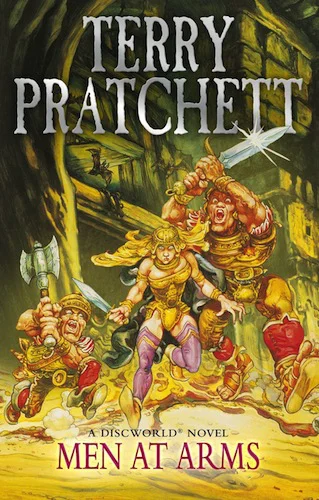
Part of the resistance to monetary policy remedies to serious recessions comes from the idea that high interest rates are inherently good. Not so. High interest rates are good for those earning them, and bad for those who are paying them. It is not clear that those who earn high interest rates are always morally more deserving than those who pay them. Through one of his fictional characters, Terry Pratchett gives this example of the suffering sometimes caused by high interest rates that make it hard to make good investments.
The reason that the rich were so rich, Vimes reasoned, was because they managed to spend less money.
Take boots, for example. He earned thirty-eight dollars a month plus allowances. A really good pair of leather boots cost fifty dollars. But an affordable pair of boots, which were sort of OK for a season or two and then leaked like hell when the cardboard gave out, cost about ten dollars. Those were the kind of boots Vimes always bought, and wore until the soles were so thin that he could tell where he was in Ankh-Morpork on a foggy night by the feel of the cobbles.
But the thing was that good boots lasted for years and years. A man who could afford fifty dollars had a pair of boots that’d still be keeping his feet dry in ten year’s time, while a poor man who could only afford cheap boots would have spent a hundred dollars on boots in the same time and would still have wet feet.
This was the Captain Samuel Vimes “Boots” theory of socioeconomic unfairness.
The upshot is that the good boots cost less if you can borrow to buy them at a reasonably low interest rate, but if you either can’t borrow at all, or can only borrow at a very high interest rates, you face high expenses either way: either paying high interest rates on the money you borrowed to buy good boots, or paying to replace the bad quality boots frequently. The rich effectively face low interest rates, while the poor face high interest rates.
Stepping away from the difference in interest rates the poor face as compared to the rich, whatever the level of interest rates, the poor are likely to suffer more from a given increase in all interest rates simply because they are more likely to have a negative wealth position that makes them pay interest on net, while the rich are more likely to have a positive wealth position that enables them to receive interest on net. So it takes more to justify high interest rates than to say that they are always better morally and ethically than low interest rates. If high interest rates make the economic system as a whole work better, that could be a good justification. But when low interest rates would help the economic system as a whole work better, any complaints by those earning low interest rates as a result need to be counterbalanced by the benefits to those paying low interest rates.
Hat tip to my brother, Joseph Kimball, for pointing me to this passage
Why You Should Care about Other People's Children as Much as Your Own
This column doesn’t just say we should care, it gives a plan for getting there. In particular, how we handle long-run fiscal policy can make a big difference to the level of altruism in our nation.
You can see links to all of my other Quartz columns lined up in reverse chronological order here, and in order of popularity here.
It's My Life; Let Me Live It!

The parts of political philosophy that make the biggest difference in the world are those that even kids know. When I was a kid, I often heard other kids say
It’s a free country, isn’t it?
What they meant was a distillation of what John Stuart Mill laid out in On Liberty, Chapter IV, “Of the Limits to the Authority of Society over the Individual” paragraph 7:
The distinction between the loss of consideration which a person may rightly incur by defect of prudence or of personal dignity, and the reprobation which is due to him for an offence against the rights of others, is not a merely nominal distinction. It makes a vast difference both in our feelings and in our conduct towards him, whether he displeases us in things in which we think we have a right to control him, or in things in which we know that we have not. If he displeases us, we may express our distaste, and we may stand aloof from a person as well as from a thing that displeases us; but we shall not therefore feel called on to make his life uncomfortable. We shall reflect that he already bears, or will bear, the whole penalty of his error; if he spoils his life by mismanagement, we shall not, for that reason, desire to spoil it still further: instead of wishing to punish him, we shall rather endeavour to alleviate his punishment, by showing him how he may avoid or cure the evils his conduct tends to bring upon him. He may be to us an object of pity, perhaps of dislike, but not of anger or resentment; we shall not treat him like an enemy of society: the worst we shall think ourselves justified in doing is leaving him to himself, if we do not interfere benevolently by showing interest or concern for him. It is far otherwise if he has infringed the rules necessary for the protection of his fellow-creatures, individually or collectively. The evil consequences of his acts do not then fall on himself, but on others; and society, as the protector of all its members, must retaliate on him; must inflict pain on him for the express purpose of punishment, and must take care that it be sufficiently severe. In the one case, he is an offender at our bar, and we are called on not only to sit in judgment on him, but, in one shape or another, to execute our own sentence: in the other case, it is not our part to inflict any suffering on him, except what may incidentally follow from our using the same liberty in the regulation of our own affairs, which we allow to him in his.
The only problem with the retort “It’s a free country, isn’t it” is that in some countries the answer is “No, it isn’t.” So it is worth having an alternative slogan that works even when a country is less free than it should be:
It’s my life; let me live it!
“We are, as a species, addicted to story. Even when the body goes to sleep, the mind stays up all night, telling itself stories.”
– The Storytelling Animal: How Stories Make Us Human, by Jonathan Gottschall (via readmill)
Why Economic Theory Predicts a Chronic Shortage of Nurses

The word “shortage” says more than you might realize. A shortage is when there is too little of something to clear the market at the going price. Thus, a shortage is a sign that the price is too low to clear the market. Usually, this is a temporary situation: the price adjusts upward and people quit complaining about a shortage and start complaining about high prices instead.
There are two general situations in which a price might be too low to clear the market for a long period of time. One case is when the government imposes a price ceiling. For example, rent control leads over time to a chronic shortage of apartments.
The other general situation in which a price is chronically too low to clear the market is when there is only one big buyer or only a few big buyers in the relevant market. Having only one buyer is called monopsony. Having only a few buyers is called oligopsony.
In any local commuting area, there are typically only a few hospitals, that account for a large share of all nursing employment–particularly for the higher-skill, higher-paid nursing jobs. Because each hospital is big enough to affect the wage in the local labor market, it worries about driving up the wage of nurses by hiring too many. That is, the cost of the last nurse a hospital hires is not just the wage of that one nurse, but also the cost of the rise in the wage to all the other nurses it employs due to that extra hiring.
In other words, the hospital might be willing to pay a little extra to get one more nurse who is a little more reluctant to come back into the labor force, say, except that paying that higher wage to the one nurse would force it to pay more to all of its other nurses.
Why doesn’t the same logic cause a doctor shortage? It is because doctors operate in a national labor market. Doctors make enough money that it is worthwhile for them to consider moving to other cities at some distance in order to take advantage of a modest percentage difference in pay. By contrast, nurses are often secondary earners in their families and so tied to one commuting area, or even when they are free agents,they make little enough money that the cost of moving to a whole new region to make a few percent more doesn’t seem very attractive.
Someone might object to my account of where chronic nursing shortages come from by saying it is a problem of too few spots available in programs that train nurses. Too few spots in programs training nurses would indeed reduce the supply of nurses, but should lead to complaints about nurses being expensive rather than complaints about a shortage of nurses. Yet for some reason, there are a lot more complaints about nurse “shortages” than about how expensive nurses are.
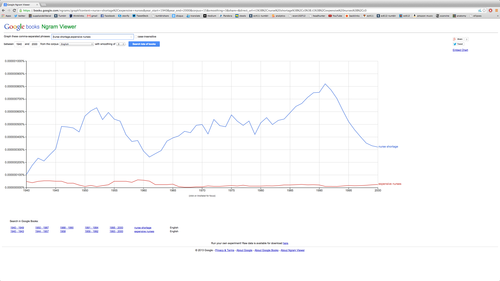
The blue line is the frequency of the phrase “nurse shortage” in ngram viewer. The red line is the frequency of the phrase “expensive nurses."
The Wall Street Journal Editorial Board Comes Out for a Straight 15% Equity Requirement

Carmen Segarra’s secret tapes from inside the New York Fed prompted a Wall Street Journal editorial about financial regulation. (You can jump over the paywall by googling the title: “Regulatory Capture 101: Impressionable journalists finally meet George Stigler.”) Here is one key passage:
The journalists have also found evidence in Ms. Segarra’s recordings that even after the financial crisis and the supposed reforms of the Dodd-Frank law, the New York Fed remained a bureaucratic agency resistant to new ideas and hostile to strong-willed, independent-minded employees. In government?
***Enter George Stigler, who published his famous essay “The Theory of Economic Regulation” in the spring 1971 issue of the Bell Journal of Economics and Management Science. The University of Chicago economist reported empirical data from various markets and concluded that “as a rule, regulation is acquired by the industry and is designed and operated primarily for its benefit.”
But what is most striking is the Wall Street Journal's endorsement of a simple 15% equity requirement:
Once one understands the inevitability of regulatory capture, the logical policy response is to enact simple laws that can’t be gamed by the biggest firms and their captive bureaucrats. This means repealing most of Dodd-Frank and the so-called Basel rules and replacing them with a simple requirement for more bank capital—an equity-to-asset ratio of perhaps 15%.
This is much more important than any of the Wall Street Journal’s other recommendations in the article. I favor an equity requirement of 50%, implemented as a capital conservation buffer prohibiting firms with less equity and more leverage than from paying dividends, buying back stock or bailing out foreign subsidiaries under looser rules until the bank reachs that 50% equity to assets ratio. But a straight 15% would be a good start.
"The Geography of Financial Misconduct," by Christopher A. Parsons, Johan Sulaeman, Sheridan Titman →
The badness you do is not only bad in itself, it has offspring. This paper is interesting in providing some empirical evidence that being bad encourages others around you to be bad as well. Here is the abstract:
We find that a firm’s tendency to engage in financial misconduct increases with the misconduct rates of neighboring firms. This appears to be caused by peer effects, rather than exogenous shocks like regional variation in enforcement. Effects are stronger among firms of comparable size, and among CEOs of similar age. Moreover, local waves of financial misconduct correspond with local waves of non-financial corruption, such as political fraud.
Noah Smith: Render unto Ceasar
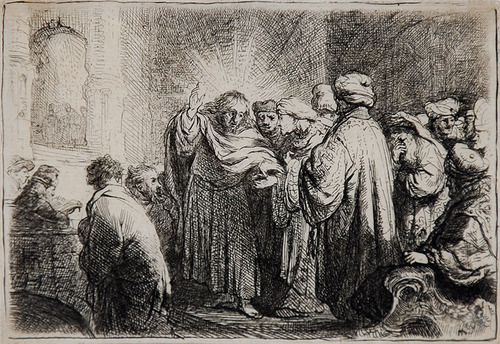
Rembrandt’s etching “The Tribute Money,” depicting the moment Jesus said “Render unto Caesar the things which are Caesar’s, and unto God the things which are God’s.”
I am pleased to be able to put up another guest religion post by Noah Smith. I find this post especially interesting because it raises deep issues of individual libertarianism vs. group libertarianism vs. Utilitarianism.
This is Noah’s 8th guest religion post on supplysideliberal.com. Don’t miss the other seven days’ worth of Noah’s creations!
- God and SuperGod
- You Are Already in the Afterlife
- Go Ahead and Believe in God
- Mom in Hell
- Buddha Was Wrong About Desire
- Noah Smith: Judaism Needs to Get Off the Shtetl
- Why Do Americans Like Jews and Dislike Mormons?
Here is Noah:
Recently, the radio show This American Life had an episode called “A Not-So-Simple Majority,” about Hasidic Jews is a town called Ramapo, about an hour north of New York. Apparently what happened was that the Hasidic Jews moved in until they were a majority, then threatened to strip funding for public schools unless the local school board didn’t investigate what was being taught – or not taught – in the religious private schools the Hasids were running. Naturally, the school board takeover was accompanied by copious references to Hitler and the Nazis.
Another incident I noticed recently was an incident in which a Hasidic Jew refused to sit next to a woman on a flight – ultra-Orthodox Judaism requires that men view women not in their family as “unclean,” because they might be menstruating – which caused the flight to be delayed. I realized that if this disruption had been caused for other, non-religious reasons – say, because someone refused to sit next to a fat person, or a person of another race – the offenders would likely have been thrown off the plane. (Because the airline is a corporation, this may not sound like a church/state issue, but the airline was no doubt worried about legal issues, which brings in the state. And separation of church from public corporation is important for some of the same kinds of reasons that separation of church and state is.)
These incidents illustrate the importance of separation of church and state, even in the case of religious minorities. The U.S. and other Western countries have a tendency to enforce separation of church and state more forcefully when the “church” in question is the nationally dominant religion (Christianity). This is a bad policy born of a good impulse – it’s important to protect minorities against the tyranny of the majority. But national dominance doesn’t equal local dominance, as the case of Ramapo shows. Another example is the battle over whether to allow Muslim communities to enforce sharia law in Canada.
This is a bad road to walk down. If religious minorities are given special license to violate the separation of church and state, there will be a number of negative consequences. First of all, it will provoke resentment among the religious majority, potentially leading to violent backlash or to the election of right-wing, intolerant politicians.
Second of all, it incentivizes the creation of more and more religious minorities, since these can expect to enjoy special rights and privileges. That in turn would lead to a Balkanized nation, in which religious communities rule everything, and very few people have a stake in civic life – imagine the airline brouhaha described above, but writ large, so that splintered religious communities simply refuse to allow public, cosmopolitan spaces to exist.
Finally, the Western value of equal treatment of individuals under the law is utterly violated if rights are accorded to groups rather than individuals. Affording rights to groups removes the government’s ability to protect individuals from “local bullies.” (In fact, I’ve argued that this is the big mistake modern American libertarianism makes.)
Yoram Bauman: Top 11 Funniest Papers in the History of Economics →
via Jose Miguel Torres and Ivan Werning