The Wall Street Journal Editorial Board Comes Out for a Straight 15% Equity Requirement

Carmen Segarra’s secret tapes from inside the New York Fed prompted a Wall Street Journal editorial about financial regulation. (You can jump over the paywall by googling the title: “Regulatory Capture 101: Impressionable journalists finally meet George Stigler.”)    Here is one key passage:

The journalists have also found evidence in Ms. Segarra’s recordings that even after the financial crisis and the supposed reforms of the Dodd-Frank law, the New York Fed remained a bureaucratic agency resistant to new ideas and hostile to strong-willed, independent-minded employees. In government?

***

Enter George Stigler, who published his famous essay “The Theory of Economic Regulation” in the spring 1971 issue of the Bell Journal of Economics and Management Science. The University of Chicago economist reported empirical data from various markets and concluded that “as a rule, regulation is acquired by the industry and is designed and operated primarily for its benefit.”

But what is most striking is the Wall Street Journal's endorsement of a simple 15% equity requirement:

Once one understands the inevitability of regulatory capture, the logical policy response is to enact simple laws that can’t be gamed by the biggest firms and their captive bureaucrats. This means repealing most of Dodd-Frank and the so-called Basel rules and replacing them with a simple requirement for more bank capital—an equity-to-asset ratio of perhaps 15%.

This is much more important than any of the Wall Street Journal’s other recommendations in the article. I favor an equity requirement of 50%, implemented as a capital conservation buffer prohibiting firms with less equity and more leverage than from paying dividends, buying back stock or bailing out foreign subsidiaries under looser rules until the bank reachs that 50% equity to assets ratio. But a straight 15% would be a good start.

"The Geography of Financial Misconduct," by Christopher A. Parsons, Johan Sulaeman, Sheridan Titman

The badness you do is not only bad in itself, it has offspring. This paper is interesting in providing some empirical evidence that being bad encourages others around you to be bad as well. Here is the abstract:

We find that a firm’s tendency to engage in financial misconduct increases with the misconduct rates of neighboring firms. This appears to be caused by peer effects, rather than exogenous shocks like regional variation in enforcement. Effects are stronger among firms of comparable size, and among CEOs of similar age. Moreover, local waves of financial misconduct correspond with local waves of non-financial corruption, such as political fraud.

Noah Smith: Render unto Ceasar

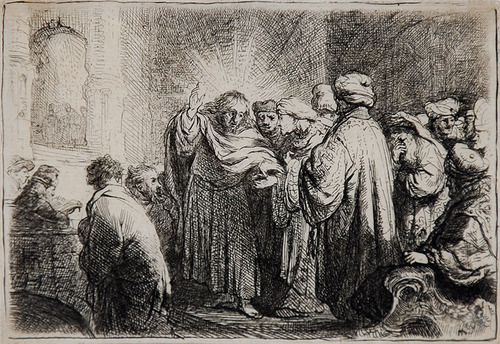
Rembrandt’s etching “The Tribute Money,” depicting the moment Jesus said “Render unto Caesar the things which are Caesar’s, and unto God the things which are God’s.”

Rembrandt’s etching “The Tribute Money,” depicting the moment Jesus said “Render unto Caesar the things which are Caesar’s, and unto God the things which are God’s.”

I am pleased to be able to put up another guest religion post by Noah Smith. I find this post especially interesting because it raises deep issues of individual libertarianism vs. group libertarianism vs. Utilitarianism.

This is Noah’s 8th guest religion post on supplysideliberal.com. Don’t miss the other seven days’ worth of Noah’s creations!

  1. God and SuperGod
  2. You Are Already in the Afterlife
  3. Go Ahead and Believe in God
  4. Mom in Hell
  5. Buddha Was Wrong About Desire
  6. Noah Smith: Judaism Needs to Get Off the Shtetl
  7. Why Do Americans Like Jews and Dislike Mormons?

Here is Noah:


Recently, the radio show This American Life had an episode called “A Not-So-Simple Majority,” about Hasidic Jews is a town called Ramapo, about an hour north of New York. Apparently what happened was that the Hasidic Jews moved in until they were a majority, then threatened to strip funding for public schools unless the local school board didn’t investigate what was being taught – or not taught – in the religious private schools the Hasids were running. Naturally, the school board takeover was accompanied by copious references to Hitler and the Nazis.

Another incident I noticed recently was an incident in which a Hasidic Jew refused to sit next to a woman on a flight – ultra-Orthodox Judaism requires that men view women not in their family as “unclean,” because they might be menstruating – which caused the flight to be delayed. I realized that if this disruption had been caused for other, non-religious reasons – say, because someone refused to sit next to a fat person, or a person of another race – the offenders would likely have been thrown off the plane. (Because the airline is a corporation, this may not sound like a church/state issue, but the airline was no doubt worried about legal issues, which brings in the state. And separation of church from public corporation is important for some of the same kinds of reasons that separation of church and state is.) 

These incidents illustrate the importance of separation of church and state, even in the case of religious minorities. The U.S. and other Western countries have a tendency to enforce separation of church and state more forcefully when the “church” in question is the nationally dominant religion (Christianity). This is a bad policy born of a good impulse – it’s important to protect minorities against the tyranny of the majority. But national dominance doesn’t equal local dominance, as the case of Ramapo shows. Another example is the battle over whether to allow Muslim communities to enforce sharia law in Canada.

This is a bad road to walk down. If religious minorities are given special license to violate the separation of church and state, there will be a number of negative consequences. First of all, it will provoke resentment among the religious majority, potentially leading to violent backlash or to the election of right-wing, intolerant politicians.

Second of all, it incentivizes the creation of more and more religious minorities, since these can expect to enjoy special rights and privileges. That in turn would lead to a Balkanized nation, in which religious communities rule everything, and very few people have a stake in civic life – imagine the airline brouhaha described above, but writ large, so that splintered religious communities simply refuse to allow public, cosmopolitan spaces to exist.

Finally, the Western value of equal treatment of individuals under the law is utterly violated if rights are accorded to groups rather than individuals. Affording rights to groups removes the government’s ability to protect individuals from “local bullies.” (In fact, I’ve argued that this is the big mistake modern American libertarianism makes.)

Jo Craven McGinty: Easy to Lose and Expensive to Produce: Is the Penny Worth It?

Like my graduate school advisor Greg Mankiw, I am for the abolition of the penny. This Wall Street Journal article gives good reasons why. If you hit the paywall, googling the title like this jumps over it. 

The problem with pennies isn’t just the cost of producing them, it is the extra time it takes to handle them. My former student Ed Knotek provides some evidence that there are costs to non-round transaction amounts in this paper. (There is no problem with individual items having non-round prices, if the total transaction amount rounded off. Ed’s evidence is that items that are often purchased individually, rather than as part of a basket, often are given round prices. Establishing that it is legally OK to round off transactions amounts to the nearest or next nickel is what getting rid of the penny is all about.)  

American Wizards

In H. W. Brand’s excellent book American Colossus: The Triumph of Capitalism, 1865-1900he retells this story from Lee Chew, “The Life Story of a Chinaman” (in the collection The Life Stories of Undistinguished Americans, as Told by Themselves, pp. 178-179). The moral of the story is that technology matters, and differences in per capita income matter.   


Even more compelling than letters were the actions of emigrants who returned home. Lee Chew grew up on a farm near Canton during the 1860s. Some of the neighbors had left for California, but Lee Chew’s father wished to keep him home and so told him stories of what “foreign devils” the Americans were. They were powerful, with great fire-belching ships and a kind of sorcery that allowed them to light the darkest night and communicate over long distances, but they lacked anything that passed for civilization. Their language was barbaric, they practiced all manner of violence, and they disrespected their ancestors. No correct-thinking Chinese should wish to go to America. Lee Chew had little reason to doubt his father, and he resigned himself to life as a Chinese farmer–until new evidence surfaced.

I was about sixteen years of age when a man of our tribe came back from America and took ground as large as four city blocks and made paradise of it. He put a large stone wall around and led some streams through and built a palace and summer house and about twenty other structures, with beautiful bridges over the streams and walks and roads. Trees and flowers, singing birds, water fowl and curious animals were within the walls. … When his palace and grounds were completed he gave a dinner to all the people, who assembled to be his guests. One hundred pigs roasted whole were served on the tables, with chickens, ducks, geese and such an abundance of dainties that our villagers even now lick their fingers when they think of it. He had the best actors from Hong Kong performing, and every musician for miles around was playing and singing. At night the blaze of lanterns could be seen for miles.

The lesson was lost on no one there, least of all Chew.

The man had gone away from our village a poor boy. Now he returned with unlimited wealth, which he had obtained in the country of the American wizards. … The wealth of this man filled my mind with the idea that I, too, would like to go to the country of the wizards and gain some of their wealth.

Barbara Oakley: How We Should Be Teaching Math

Given my efforts in “How to Turn Every Child into a ‘Math Person’" to figure out something helpful to say about math education, I was delighted not too long after to run across Barbara Oakley's Wall Street Journal op-ed

How We Should Be Teaching Math: Achieving 'conceptual’ understanding doesn’t mean true mastery. For that, you need practice.

(As with all Wall Street Journal articles, if you hit the paywall, just google the title. The Wall Street Journal lets you jump the paywall if you come from Google.) Here is the key passage:

True experts have a profound conceptual understanding of their field. But the expertise built the profound conceptual understanding, not the other way around. There’s a big difference between the "ah-ha” light bulb, as understanding begins to glimmer, and real mastery.

As research by Alessandro Guida, Fernand Gobet, K. Anders Ericsson and others has also shown, the development of true expertise involves extensive practice so that the fundamental neural architectures that underpin true expertise have time to grow and deepen. This involves plenty of repetition in a flexible variety of circumstances. In the hands of poor teachers, this repetition becomes rote—droning reiteration of easy material. With gifted teachers, however, this subtly shifting and expanding repetition mixed with new material becomes a form of deliberate practice and mastery learning.

I also especially like her conclusion:

Understanding is key. But not superficial, light-bulb moment of understanding. In STEM, true and deep understanding comes with the mastery gained through practice.

For anyone learning math, the key to learning is patience–patience with both with the mental training needed to become good at working through details and with moments of confusion that come along the way. Believe me, those who do math for a living (as I do in important measure) face many moments of confusion in our work. What makes a mathematician is patience and persistence through those moments–and often hours or days, and sometimes months–of confusion, as well as the hours of honing skills for getting mathematical details straight.  

John Stuart Mill on Other-Regarding Character Flaws (as Distinct from Self-Regarding Character Flaws)

One of the things people forget about John Stuart Mill's On Liberty is that he lays down rules for when society can appropriately apply social pressure against bad behavior as well as when society can appropriately use the apparatus of law to punish people. When what is at issue is the appropriate use of the powerful apparatus of social pressure, John feels it is appropriate to act against a wide range of anti-social acts and character flaws. The following passage from  On LibertyChapter IV, “Of the Limits to the Authority of Society over the Individual” paragraph 6, is an important list of antisocial acts and character flaws. I think we would have a better society if we all took seriously this list of things for which society can appropriately apply “moral reprobation”: 

What I contend for is, that the inconveniences which are strictly inseparable from the unfavourable judgment of others, are the only ones to which a person should ever be subjected for that portion of his conduct and character which concerns his own good, but which does not affect the interests of others in their relations with him. Acts injurious to others require a totally different treatment. Encroachment on their rights; infliction on them of any loss or damage not justified by his own rights; falsehood or duplicity in dealing with them; unfair or ungenerous use of advantages over them; even selfish abstinence from defending them against injury—these are fit objects of moral reprobation, and, in grave cases, of moral retribution and punishment. And not only these acts, but the dispositions which lead to them, are properly immoral, and fit subjects of disapprobation which may rise to abhorrence. Cruelty of disposition; malice and ill-nature; that most anti-social and odious of all passions, envy; dissimulation and insincerity, irascibility on insufficient cause, and resentment disproportioned to the provocation; the love of domineering over others; the desire to engross more than one’s share of advantages (the pleonexia of the Greeks); the pride which derives gratification from the abasement of others; the egotism which thinks self and its concerns more important than everything else, and decides all doubtful questions in its own favour;—these are moral vices, and constitute a bad and odious moral character: unlike the self-regarding faults previously mentioned, which are not properly immoralities, and to whatever pitch they may be carried, do not constitute wickedness. They may be proofs of any amount of folly, or want of personal dignity and self-respect; but they are only a subject of moral reprobation when they involve a breach of duty to others, for whose sake the individual is bound to have care for himself. What are called duties to ourselves are not socially obligatory, unless circumstances render them at the same time duties to others. The term duty to oneself, when it means anything more than prudence, means self-respect or self-development; and for none of these is any one accountable to his fellow creatures, because for none of them is it for the good of mankind that he be held accountable to them.

Suicidal depression is a state of cold, agitated horror and relentless despair. The things that you most love in life leach away. Everything is an effort, all day and throughout the night. There is no hope, no point, no nothing.

Leaving Dead Presidents in Peace: Callum Williams of the Economist Picks Up on Ken Rogoff's Pitch for Abolishing Cash

This is a nice article by Callum Williams in the Economist, picking up on Ken Rogoff’s pitch for abolishing cash.  

For clarity, I wanted to distinguish my approach from Ken Rogoff’s.  I wrote in “Q&A: Apple Pay and the Future of Electronic Money" 

I think physical cash is likely to play a minor role for a long time after it has been mostly eclipsed by electronic payment. For example, I think the strong demand for anonymity for certain kinds of purchases will make it very hard to eliminate paper money entirely. (If we tried to abolish paper dollars entirely, people would start using paper euros or yen or pounds for the purchases they wanted to make anonymously.)

So it is important to make some provision for what happens with paper currency rather than just assuming it can be abolished.

Uwe Reinhardt: Does Occupational Licensing Deserve Our Approval? A Review of Work by Morris Kleiner

I was impressed with Uwe Reinhardt when I met him in person some years ago. And I like what he says in this abstract about occupational licensing. You can get Uwe’s full review at the link above. 

Abstract: The licensing of occupations—a very forceful intervention in markets—is pervasive and growing in modern economies. Yet the attention paid to it by economists and economics textbooks has been small. Highly welcome, therefore, has been the extensive and intensive work on this subject by Morris Kleiner. Kleiner’s latest book, titledStages of Occupational Regulation: Analysis of Case Studies(2013), explores the progression of occupational regulation, from mere registration to certification to outright licensing—three distinct stages. Kleiner carefully selects for his analysis a series of occupations representing the stages of regulation, devoting a chapter to each occupation. He uses a variety of statistical approaches to tease out, from numerous databases, what the impact of mild to heavy regulation on labor markets appears to be. Kleiner’s work leads him to call for a pervasive review of occupational regulation in the United States, with a view towards replacing occupational licensure, which introduces the most inefficiency and welfare loss, with mere certification of occupations. That recommendation gains plausibility in an age where cheap computation and data mining makes it possible to protect consumers from low-quality and possibly dangerous services by providing robust, user-friendly information on the quality of services delivered by competing occupations, such as doctors and nurse practitioners.

‘Keep the Riffraff Out!’

Mormonism is a proselyting religion. Close to 35 years ago, I was one of many Mormon missionaries trying to persuade people in Tokyo to become Mormons. And most of you will one time or another see Mormon missionaries at your door, wherever you are in the world. 

One of the positive features of a proselyting religion that is not always fully appreciated is that newcomers are fully welcome, as long as they make even a minimal attempt to fit in. And if they so choose, it is not hard for them to become full members of the community.

Sometimes, members of the Mormon Church question the virtue of bringing someone into the community who has enough needs that they are likely to require more help from the community than the amount they are able to help others. But the young women and men serving for a year and a half or two as full-time missionaries and higher Mormon Church authorities quickly overrule such sentiments.

I don’t believe in the supernatural anymore, so I don’t believe in Mormonism. But I do believe in America. 

I wish America were a proselyting nation, eager to bring newcomers into the fold. I believe it would be a better world if more of the world’s 7 billion people were Americans. There are many people who would be willing converts to being Americans, but we keep them out.  

I have written a lot about immigration policy. For example, see “The Hunger Games is Hardly Our Future: It’s Already Here” and “You Didn’t Build That: America Edition.” But the sentiment “Keep the riffraff out!” shows up in other contexts as well. It is also an important motivating force behind the lobbying for occupational licensing, which I wrote about in “When the Government Says “You May Not Have a Job.” And the sentiment “Keep the riffraff out!” is a serious barrier to affordable housing, as it leads many cities to impose regulations that severely limit the construction of new housing, as Ryan Avent and Matthew Yglesias talk about in their respective books:

To me, a central ethical principle is that people are people, and all human beings deserve to be treated as human beings. “Keep the riffraff out!” should not be our first impulse in relation to other human beings.

Richard Serlin: In Theory (but Not in Practice) the Minnows Counter the Whale to Yield Wallace Neutrality

Wallace Neutrality says that in theory, quantitative easing (QE) should do almost nothing. (See “Wallace Neutrality Roundup: QE May Work in Practice, But Can It Work in Theory?”) In the Twitter discussion I storified as “Noah Smith, Brad DeLong and Miles Kimball on Wallace Neutrality,” Noah raised a question of how Wallace Neutrality works. Richard Serlin, who has made himself one of the world’s experts on Neil Wallace’s original paper, was good enough to  agree to write a guest post giving his answer:


Miles kindly asked me to comment on the recent Twitter discussion he had with Berkeley economist Brad DeLong and Stony Brook economist Noah Smith on Wallace neutrality. He was specifically concerned with how I would answer this question which comes up in the discussion: Does Wallace neutrality result from (in theory) fiscal policy canceling out the Fed, or many private agents (the minnows) canceling out the Fed (the whale)?

My answer is that in the Wallace model it is the minnows (agents, investors, people) all working to completely undo what the whale (the government) does.

Some specifics from the tweets:

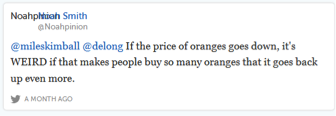
Sumner Critique: Monetary reaction cancels out fiscal policy. Wallace Neutrality: Fiscal reaction cancels out monetary policy. Hmm…

— Noah Smith (@Noahpinion) August 8, 2014

I won’t get into the Sumner part, but, like Miles, I think the Wallace neutrality part is wrong. If you look at the irrelevance proposition on page 270 of the AER paper, it holds even if taxes and transfers (w(t)) are unchanged; you are allowed to select that option in the proposition, which is proven to hold. And, government consumption is required to be unchanged. Moreover, the choice of taxes and transfers is, in any case, restricted to not be any different in net present value, based on the original state prices, by the condition (a).

This really doesn’t even happen. It’s, the government starts printing money and buying more oranges, and storing them until next period, when it will sell all these extra oranges back again. All agents know this, and they immediately sell an equal amount out of their stores because they know they won’t need as many next period with the government storing more and planning to sell them next period. So, the price never moves. People in this model are all superhumans. They have perfect foresight, expertise, and optimization, and act instantly.

@Noahpinion@delong It only works in theory, not in practice. I love Brad’s “Washington Super-Whale” analogy: http://t.co/wFgE6LiQlN

— Miles Kimball (@mileskimball) August 9, 2014

I think one big difference here with the world of Wallace’s model is that in Brad’s story the hedge fund managers could not be that sure what the whale would do in the future. In Wallace’s model they know precisely, and with 100% certainty, what Bernanke (the government) will do at every point in the future. They can trade with confidence and hold the line. By contrast, the hedge fund managers in Brad’s story got hurt badly because they did not, in fact, predict well how Bernanke (the government) would behave.

Basically, I discussed this in my recent post on Wallace neutrality, The Intuition behind Wallace Neutrality, Attempt 3.

In Wallace’s model, the government is like a big MM firm. And the citizens are shareholders of the government. When the government does the Wallace version of a QE, it basically is like it borrows more money (really lends, but let’s look at the converse for now). That makes its citizens overall debt level higher than they like, so they borrow less by an equal amount to get back to their optimal overall debt level. The total demand for debt in the market remains unchanged. Government demand goes up by X, and private demand goes down by X, so the interest rate remains the same…

But why wouldn’t this work in the real world?

Well, first off, people are far from perfectly expert (especially in the super complex modern world), with perfect public information that they can gather, digest, and analyze at zero time, effort, or money cost…

So, when the government “firm” starts to lend a lot more, almost no one thinks, MM style, or Wallace style, I’m going to start selling some of my bonds to compensate in equal measure as I see them doing that. And so total lending in the market does, in fact, go up, and market interest rates drop. People just don’t react that way. And it won’t be nearly enough if a savvy minority do. They won’t control enough money to drive us to Wallace neutrality.

It’s like in Miller and Modigliani’s model if the firms start borrowing a lot more, but the shareholders are mostly not really paying attention, and/or don’t know well the implications, so for the most part they don’t borrow any less to compensate. In that case, aggregate demand for borrowing would not remain unchanged. The aggregate demand curve for borrowing would, in fact, shift out, and the interest rate would rise.

Other issues: In the real world there are a lot more different kinds of financial assets than just money, and borrowing and lending the single consumption good risk-free, like in Wallace’s model. So, if the government does QE in just some types of assets, people, even if they are perfect at optimizing, won’t be able to funge their portfolios to relieve completely price pressure on those assets. Markets are not complete, and far from it, so that you could construct a synthetic for any asset. I talk about this in an earlier post on Wallace neutrality when I ask “What if the government did a QE intervention where they printed up dollars and used them to purchase 100 million ounces of gold?”

Next, Miller-Modigliani irrelevance doesn’t hold if investors face different borrowing costs and liquidity constraints than the firm. Likewise, Wallace irrelevance will not hold if individuals and firms face different borrowing costs and liquidity constraints than the federal government. Do they?

Finally, Wallace’s model assumes that with 100% certainty the central bank will completely reverse the QE one period later, and everyone knows this…In the real world, investors cannot be completely certain a QE will be 100% reversed in the future.

And empirically we see Wallace neutrality not holding. UCLA economist Roger Farmer recently wrote, “A wealth of evidence shows not just that quantitative easing matters, but also that qualitative easing matters. (see for example Krishnamurthy and Vissing-Jorgensen, Hamilton and Wu, Gagnon et al). In other words, QE works in practice but not in theory. Perhaps its time to jettison the theory.”