Q&A: Apple Pay and the Future of Electronic Money

In the wake of Apple’s announcement of Apply Pay last week I had two different journalists contact me with questions about what this meant for the future of electronic money. I wanted to give the full text of my answers (very lightly edited) here. The journalists’ questions are in bold. My answers follow.
First Journalist’s Questions
Do you see Apple Pay taking us closer to the end of physical cash?
Apple Pay is a big step toward electronic payments being a bigger and bigger share of all payments. Already more than half of retail spending is by credit and debit card. With Apple pay as another, even more convenient form of electronic payment, that fraction should go up.
I think physical cash is likely to play a minor role for a long time after it has been mostly eclipsed by electronic payment. For example, I think the strong demand for anonymity for certain kinds of purchases will make it very hard to eliminate paper money entirely. (If we tried to abolish paper dollars entirely, people would start using paper euros or yen or pounds for the purchases they wanted to make anonymously.)
What are the key benefits for monetary policymakers that could arise from a cashless society?
Our monetary system now, with a paper dollar standard, makes it impossible for the Federal Reserve to stimulate the economy enough in a deep recession like the one we have just been through. That is why bad economic times have dragged on for so many years after the Financial Crisis in 2008. Even if paper currency remains in use, if people’s emotional attachment to the paper dollar standard dissipates with the further rise of electronic money, it is possible to free up monetary policy so that it can even very deep recessions. Some economists also worry about “secular stagnation,” which is the name for a situation in which monetary policy can’t help much for a long, long time. (The closest real-world example has been the economic doldrums Japan has been in for most of the last 20 years.) Taking the paper dollar off of its pedestal makes it possible to avoid secular stagnation as well.
I have written a lot about this. I collected links to it all here: “How and Why to Eliminate the Zero Lower Bound: A Reader’s Guide.” Most directly relevant is my article in Slate: “How governments can and should beat Bitcoin at its own game.”
I have been traveling to central banks around the world to explain the nuts and bolts of how modest policy measures that take physical cash off of its pedestal can empower monetary policy. I make the case for the negative interest rates that would make possible here: “America’s Big Monetary Policy Mistake: How Negative Interest Rates Could Have Stopped the Great Recession in Its Tracks.”And I wrote a children’s story (illustrated by Donna D'Souza) to explain the basic idea: “Gather ‘round, Children, Here’s How to Heal a Wounded Economy."
What wider benefits would you imagine electronic money offering?
The one thing Apple Pay doesn’t do, but we can look forward to in the future is a rise in our effective incomes as competition in the realm of electronic payment brings down the hefty fees that credit card and debit card companies charge. One way we might see the magic of this kind of competition would be through ever bigger rebates on credit cards. Already on my Quicksilver Visa card I get 1.5 % back on everything I buy–which is still a lot less than the fees Visa is charging, but it is a good start. As the cut taken by the credit card companies shrinks, more people will want to switch to using credit cards that give them several percent back instead of using cash. So the success of electronic money will build on itself.
Second Journalist’s Questions
Why do you believe we are moving towards a cashless society? What behaviours/trends is this transition resulting from, in your opinion?
It is the progress of computer hardware and software that is making this possible and attractive.
Do you think that seamless spending (i.e. e-wallets, Apple Pay, mobile integration) is a sustainable way for us to manage our finances and why/why not?
Yes. If security issues can be solved, there is no reason not to have most transactions happen electronically.
How do you see the future of our interaction with money and the way we make payments?
The advance of electronic payment systems will make it easy both practically and politically to demote paper currency to a minor supporting role in the monetary system (say, something like we think of traveler’s checks today). To the extent that people think of an electronic dollar as the real thing, it opens up new possibilities for monetary policy that could have dramatically cut short the Great Recession if they had been in place. I have been traveling to central banks around the world to talk about the mechanics of doing this, and explain it on my blog as well. You can see the relevant links here: "How and Why to Eliminate the Zero Lower Bound: A Reader’s Guide” Most relevant to your question is my piece in Slate: “How governments can and should beat Bitcoin at its own game.”
There I argue that we will still need central banks in the future, each of which will sponsor a digital currency: the e-dollar, e-euro, e-yen, e-pound, etc. For those who now pay mostly with credit and debit cards, it will actually look a lot like the current system on a day-to-day basis, but it will lead to a more stable world economy because of removing the stumbling block to monetary policy from our current privileging of paper currency. In terms of stabilizing the economy, subordinating paper currency to electronic money (as I advocated in my first column on this: “How Subordinating Paper Money to Electronic Money Can End Recessions and End Inflation”) would be the biggest advance in monetary policy since the basic idea of using monetary policy to stabilize the economy first took hold in earnest.
Do you believe that we will soon see a global digital currency emerging?
Unlike many other things that one might want to standardize around the whole world, there are real advantages to having different monetary units in different regions. If countries that are too dissimilar share the same type of money, they can’t have different monetary policies. This has caused a lot of problems in the eurozone, where the right monetary policy for Germany is often very different than the right monetary policy for France or Spain or Greece. So there are real advantages to having multiple types of money, each governed by a central bank.
John Stuart Mill on the Middle Way Between Criminalization and Acceptance
In our culture, we have a dangerous tendency to act as if a given pattern of conduct must be either criminalized or fully accepted. There are many things that are so self-destructive that they should not be simply accepted. Yet writing into the law statutes defining victimless crimes and jailing those who commit them has enormous costs. One of the costs is to freedom itself.
Given the difficulties our culture has in seeing clearly a middle way between criminalization and acceptance, in my post “Allison Schrager: The Economic Case for the US to Legalize All Drugs,” I argued for leaving narcotics use technically illegal, in a way that is mostly unenforceable, to set down a clear marker that society was not just accepting narcotics use as something OK. Here is what I wrote:
I agree with Allison that we need to legalize the production and sale of drugs in order to take revenue, and therefore power, away from criminal gangs. But I think it is important that we do whatever we can to drive down the usage of dangerous drugs consistent with taking the drug trade out of the hands of criminals:
- Taxes on dangerous drugs as high as possible without encouraging large-scale smuggling;
- Age limits on drug purchases as strict as consistent with keeping the drug trade out of the hands of illegal gangs;
- Free drug treatment, financed by those taxes;
- Evidence-based public education campaigns against drug use, financed by those taxes;
- Demonization in the media and in polite company of those who (now legally) sell dangerous drugs;
- Mandatory, gruesome warnings like those we have for cigarettes;
- Widespread mandatory drug testing and penalties for use of dangerous drugs—but not for drug possession;
- Strict penalties for driving under the influence of drugs.
If our culture were better at pursuing the middle path between criminalization and acceptance, the right answer to drugs might be more like what John Stuart Mill describes In On Liberty, Chapter IV, “Of the Limits to the Authority of Society over the Individual” paragraph 4 and 5:
In the conduct of human beings towards one another, it is necessary that general rules should for the most part be observed, in order that people may know what they have to expect; but in each person’s own concerns, his individual spontaneity is entitled to free exercise. Considerations to aid his judgment, exhortations to strengthen his will, may be offered to him, even obtruded on him, by others; but he himself is the final judge. All errors which he is likely to commit against advice and warning, are far outweighed by the evil of allowing others to constrain him to what they deem his good.
I do not mean that the feelings with which a person is regarded by others, ought not to be in any way affected by his self-regarding qualities or deficiencies. This is neither possible nor desirable. If he is eminent in any of the qualities which conduce to his own good, he is, so far, a proper object of admiration. He is so much the nearer to the ideal perfection of human nature. If he is grossly deficient in those qualities, a sentiment the opposite of admiration will follow. There is a degree of folly, and a degree of what may be called (though the phrase is not unobjectionable) lowness or depravation of taste, which, though it cannot justify doing harm to the person who manifests it, renders him necessarily and properly a subject of distaste, or, in extreme cases, even of contempt: a person could not have the opposite qualities in due strength without entertaining these feelings. Though doing no wrong to any one, a person may so act as to compel us to judge him, and feel to him, as a fool, or as a being of an inferior order: and since this judgment and feeling are a fact which he would prefer to avoid, it is doing him a service to warn him of it beforehand, as of any other disagreeable consequence to which he exposes himself. It would be well, indeed, if this good office were much more freely rendered than the common notions of politeness at present permit, and if one person could honestly point out to another that he thinks him in fault, without being considered unmannerly or presuming. We have a right, also, in various ways, to act upon our unfavourable opinion of any one, not to the oppression of his individuality, but in the exercise of ours. We are not bound, for example, to seek his society; we have a right to avoid it (though not to parade the avoidance), for we have a right to choose the society most acceptable to us. We have a right, and it may be our duty, to caution others against him, if we think his example or conversation likely to have a pernicious effect on those with whom he associates. We may give others a preference over him in optional good offices, except those which tend to his improvement. In these various modes a person may suffer very severe penalties at the hands of others, for faults which directly concern only himself; but he suffers these penalties only in so far as they are the natural, and, as it were, the spontaneous consequences of the faults themselves, not because they are purposely inflicted on him for the sake of punishment. A person who shows rashness, obstinacy, self-conceit—who cannot live within moderate means—who cannot restrain himself from hurtful indulgences—who pursues animal pleasures at the expense of those of feeling and intellect—must expect to be lowered in the opinion of others, and to have a less share of their favourable sentiments; but of this he has no right to complain, unless he has merited their favour by special excellence in his social relations, and has thus established a title to their good offices, which is not affected by his demerits towards himself.
There is a lot of overlap between John Stuart Mill’s recommendation and mine. I am willing to push somewhat past what he would be comfortable with. But I am much, much closer to John Stuart Mill’s recommendation than I am to current policy in the US.
Quartz #52—>How to Turn Every Child into a 'Math Person'

Here is the full text of my 52d Quartz column, ”How to turn every child into a ‘math person,'” now brought home to supplysideliberal.com. It was first published on August 11, 2014. Links to all my other columns can be found here.
This is now my 5th most popular column, edging out “After Crunching Reinhart and Rogoff’s Data, We Found No Evidence High Debt Slows Growth.” See the whole list of most popular columns and posts here.
If you want to mirror the content of this post on another site, that is possible for a limited time if you read the legal notice at this link and include both a link to the original Quartz column and the following copyright notice:
© August 11, 2014: Miles Kimball, as first published on Quartz. Used by permission according to a temporary nonexclusive license expiring June 30, 2017. All rights reserved.
Last month, the US Math Team took second place in the International Math Olympiad—for high school students—held in Cape Town, South Africa. Since 1989, China has won 20 out of 27 times (including this year), and in the entire history of the Olympiad, the US Math Team has won only 4 out of 55 times, so second place is a good showing. According to the American Mathematical Association website: “team leader Loh noted that the US squad matched China in the individual medal count and missed first place by only eight points.”
Reading about the US Math Team’s performance in the Olympiad this year takes me back to my senior year of high school in 1977 when, having taken 9th place in the US Math Olympiad, I was invited to travel to the International Math Olympiad in Belgrade as an alternate to the 8-member US Math Team. I chose not to go to Belgrade because the Olympiad conflicted with the National Speech Tournament, where my team couldn’t have tied on points for first place without me—while the US Math Team won without needing my help. This profoundly shaped my perception of myself as a “math person.”

Left: an article from 1976 when Miles placed 23rd in the US Math Olympiad; top: in 1977 Miles placed 9th in the competition; bottom: questions from the 1977 USA Math Olympiad.
More than 36 years later, I have come to the view that almost everyone should think of herself or himself as a “math person.” In our column “There’s one key difference between kids who excel at math and those who don’t,” Noah Smith and I wrote this about the often-heard statement: “I’m just not a math person.”
We hear it all the time. But the truth is, you probably are a math person, and by thinking otherwise, you are possibly hamstringing your own career. Worse, you may be helping to perpetuate a pernicious myth—that of inborn genetic math ability.
Not everyone agrees with us. Noah and I got some pushback for our rejection of the idea that inborn math ability is the dominant factor in determining math skill. So I did some more reading in the psychology literature on nature vs. nurture for IQ and for math in particular. The truth is even more interesting than the simple story that Noah and I told.
Math ability is not fixed at birth
Three facts run contrary to the idea that inborn mathematical ability is a dominant factor in determining whether or not someone is good at math compared to others of the same age.
First, it is a reasonable reading of the very inconsistent evidence from twin studies to think that genes account for only about half of the variation in mathematical skill among kids. For example, this 2007 National Institutes of Health Public Access twin study, using relatively transparent methods, estimates that genes account for somewhere in the range from 32% to 45% of mathematical skill at age 10. That leaves 55% to 68% of mathematical skill to be accounted for by other things—including differences in individual effort. (Other estimates of the percentage of variation of mathematical skill in kids due to genes range all the way from 19% to 90%. )
Second, a remarkable fact about IQ tests, including the mathematical components of IQ tests, is that every generation looks a lot smarter than the previous generation. This steady increase in performance on IQ tests is known as “the Flynn effect” after the political philosopherJames Flynn, who discovered this remarkable fact. The American Psychological Association’s official report “Intelligence: Knowns and Unknowns” says:
… performance has been going up ever since testing began. The “Flynn effect” is now very well documented, not only in the United States but in many other technologically advanced countries. The average gain is about 3 IQ points per decade.
At that rate, an IQ test from 100 years ago would put an average American today at an IQ of 130—in the top 2.5% of everyone back then. The American Psychological Association’s report goes on to say:
The consistent IQ gains documented by Flynn seem much too large to result from simple increases in test sophistication. Their cause is presently unknown, but three interpretations deserve our consideration. Perhaps the most plausible of these is based on the striking cultural differences between successive generations. Daily life and occupational experience both seem more “complex” (Kohn & Schooler, 1973) today than in the time of our parents and grandparents. The population is increasingly urbanized; television exposes us to more information and more perspectives on more topics than ever before; children stay in school longer; and almost everyone seems to be encountering new forms of experience. These changes in the complexity of life may have produced corresponding changes in complexity of mind.
In other words, although people a century ago were good at many things, many of them would have struggled with the kinds of abstract problems IQ tests focus on.
(As a simple example of how math standards have risen, my father tells me that when he was in high school, people thought calculus was too advanced for high school students. Nowadays, about one of every six high school students takes calculus in the US.)
Third (and I wish the research were clearer about this for math specifically), the fraction of differences in IQ that seem genetically linked increases dramatically with age. For children, about 45% of differences in IQ appear to be genetic, while for adults, about 75% of differences in IQ appear to be genetic. Think about that. How could it be that genes matter more and more as people get older—even though the older you get, the more environmental things have happened to you? What I think is the most plausible answer, is that the genes are influencing what people do and what they do in turn affects their IQ.
The “love it and learn it” hypothesis
No one yet knows exactly how genes, environment, and effort interact to determine mathematical skill. In light of the evidence above, let me propose what I call the “love it and learn it” hypothesis. This hypothesis has three elements:
For anyone, the more time spent thinking about and working on math, the higher the level of mathematical skill achieved.
Those who love math spend more time thinking about and working on math.
There is a genetic component to how much someone loves math.
Despite emphasizing time spent on math as the driver of math skill, this can explain why identical twins look more alike on math skills than fraternal twins. Since time spent dealing with math matters, it allows plenty of room for the average person to be better at math now than a hundred years ago. And the effect of loving math on math experience and therefore math skill is likely to only grow with time.
To get better at math, act like someone who loves math
If the “love it and learn it” hypothesis is true, it gives a simple recommendation for someone who wants to get better at math: spend more time thinking about and working on math. Best of all: spend time doing math in the kinds of ways people who love math spend time doing math. Think of math like reading. Not everyone loves reading. But all kids are encouraged to spend time reading, not just for school assignments, but on their own. Just so, not everyone loves math, but everyone should be encouraged to spend time doing math on their own, not just for school assignments. If a kid has a bad experience with trying to learn to read in school, or is bored with the particular books the teacher assigned, few parents would say “Well, maybe you just aren’t a reader.” Instead, they would try hard to find some other way to help their kid with reading and to find books that would be exciting for their particular kid. Similarly, if a kid has a bad experience trying to learn math in school, or is bored with some bits of math, the answer isn’t to say “Well maybe you just aren’t a math person.” Instead, it is to find some other way to help that kid with math and to find other bits of math that would be exciting for their particular kid to help build her or his interest and confidence.
The way a teacher presents a mathematical principle or method in class may not work for you—or, as Elizabeth Green suggested in the New York Times, the whole American pattern of K-12 math instruction may be fatally flawed. If you loved math, you would think about that principle or method from many different angles and look up and search out different mathematical resources, until you found the angle that made most sense to you. Even if you don’t love math, that would be a good way to approach things.
Many people think that because they can’t understand what their math teacher is telling them, it means they can’t understand math. What about the possibility that your teacher doesn’t understand math? Some people are inspired to a life-long love of math by a great math teacher; others are inspired to a life-long hatred of math by an awful math teacher. If you are unlucky enough to have an awful math teacher, don’t blame math for your teacher’s failings.
Cathy O’Neil—who blogs at mathbabe.org—describes well what I like to call “slow-cooked math”:
There’s always someone faster than you. And it feels bad, especially when you feel slow, and especially when that person cares about being fast, because all of a sudden, in your confusion about all sort of things, speed seems important. But it’s not a race. Mathematics is patient and doesn’t mind.
Being good at math is really about how much you want to spend your time doing math. And I guess it’s true that if you’re slower you have to want to spend more time doing math, but if you love doing math then that’s totally fine.
I was lucky to have a dad and older brother who showed me a bit of math early on, in a way that was unconnected to school. Then in school, I spent at least as much time on math when I wasn’t supposed to be doing math as when I was. It was a lot more fun doing math when I wasn’t supposed to be doing math than when I was.
For one thing, when I did it on my own, I could do it my own way. But also, there were no time limits. It didn’t matter if it took me a long time. And nothing seemed like a failure.
I spent a lot of time doing math. And very little of that math was done under the gun of a deadline. I spent some time on literal tangents in geometry and trigonometry. But I spent a lot more time on figurative tangents, running into mathematical dead ends. When Euclid told King Ptolemy “there is no Royal Road to geometry,” it had at least two meanings:
Everyone—even a king or queen—has to work hard if he or she wants to learn geometry or any other bit of higher math.
The path to learning geometry, or math in general, is not always a straight line. You may have to circle around a problem for a long time before you finally figure out the answer.
What can be done
I feel acutely my own lack of expertise in math education for students younger than the college students I teach. Fortunately, there are a wealth of practical suggestions for teaching and learning math by others who know more than I do, or have a different perspective from their own experience.
Noah and I received many comments in response to our post but the comments I learned the most from were from these people, who let me turn their comments into guest posts on my blog:
Matt Waite: How I Faced My Fears and Learned to Be Good at Math
Marjorie Drysdale: Even When You Can Do Math, You May Not Love It
Jing Liu: Show Kids that Solving Math Problems is Like Being a Detective
Matt Rognlie on Misdiagnosis of Difficulties and the Fear of Looking Foolish as Barriers to Learning
In Green’s article “Why Americans Stink at Math,” she talks about how differently math is taught in Japanese classrooms, and how we should hope that we might someday get that kind of math instruction in the US. The key difference is that in Japan, the students are led by very carefully designed lessons to figure out the key math principles themselves. That kind of teaching can’t easily be done without the right kind of teacher training—teacher training that is not easy to come by in the United States.
But some teachers at least encourage their students to follow a “slow-cooked math” approach where they can dig in and wrap their heads around what is going on in the math, without feeling judged for not understanding instantly. Elizabeth Cleland gives a good description here of how she does it.
Even when a student is lucky enough to have good teachers at school, a little extra math on the side can help a lot. Kids who arrive at school knowing even a tiny bit of math will have more confidence in their math ability and will probably start out liking math more. Even quite young kids will be interested in a Mobius strip made out of paper where a special twist makes what looks like two sides into just one side. And putting blocks of different lengths next to each other as in a Montessori addition strip board is exactly how I have always pictured addition in my head.
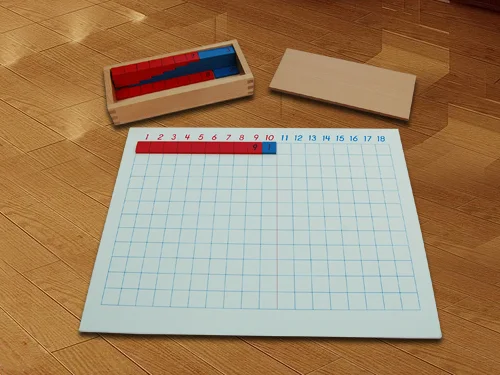
A Montessori addition strip board. Image via jsmontessori.com
Extra math doesn’t all have to come from parents. In some towns, enough Little League soccer coaches are found for almost every kid to be on a soccer team. And even I was once drafted as a Cub Scout Den Leader. If people realized the need, many more adult leaders for math clubs for elementary and middle school kids could be found. In addition to showing kids some things themselves, math club leaders can do a lot of good just by checking out and sorting through the growing number of great math videos and articles online, as well as old-style paper-and-ink books.
I use Wikipedia regularly as a math reference. (There is no reason to think Wikipedia is any less reliable than the typical math textbook; textbooks are not 100% error-free either.) I have a post on logarithms and percent changes that is one of the most popular posts on my blog. (Maybe it is the evocation of piano keyboards and slide rules, or the before and after pictures of Ronald Reagan.) And Susan Athey, the first woman to win the John Bates Clark Medal for best American economist under forty, highly recommends Glenn Ellison’s Hard Math for Elementary School as a resource for math clubs. All of that just scratches the surface of the resources that are out there.
The obvious issue raised by the “love it and learn it” hypothesis is that some people may not start out loving math, and some may never love math. Acting as if you love math when you don’t may work, but it can be painful. So it is important to figure out what can be done to instill a love of math. Even if they only know a little math themselves, people who can get kids who don’t start out loving math to come to love it are a national treasure. As the brilliant business guru Clay Christensen (among others) has pointed out, in an age when lectures from the best lecturers in the world can be posted online, the kind of help students need on the spot is the help of a coach.
For too long, we have depended too heavily on overburdened math teachers who have remarkably little time in school to actually teach math, and whom the system has deprived of the kind of training they need to teach math as well as it can be taught. It is time for all of us to take the responsibility for learning math and doing what we can to help others learn math–just as we all take responsibility for learning to read and doing what we can to help others learn to read.
Most of us who participated as kids in a sport or other competitive pursuit remember a coach who got us to put in a lot more effort than we ever thought we would. Math holds out the hope of victory not just in a human competition, but in understanding both the visible universe and the invisible Platonic universe. There is no impossibility theorem saying there can’t be math coaches in every neighborhood who make the average kid want to gain that victory.
That is the end of the column proper, but I have also collected here as a postscript a few memories, ideas and suggestions that had to be cut out of the Quartz column to make the column flow well. I added some headings to make it clear where each bit fits in.
I spent at least as much time on math when I wasn’t supposed to be doing math as when I was: The teacher might have been talking about social studies, but I was finding the prime factorizations of all the numbers from 1 to 400 by writing “2 ×” for every other number “3 ×” for every third number, “5 ×” for every fifth number, etc.—and then repeating that process for every other even number, every third multiple of 3, every fifth multiple of 5, and so on). The prime factorizations I learned from that satisfyingly tedious task I distracted myself with in elementary school came in handy when I took my SAT’s. And to this day, the way I get a hotel room number firmly into my memory is by doing its prime factorization.
Nothing seemed like a failure: At one point I knew just enough algebra to know that doing the same thing to both side of an equation left it a true equation. So for a long time, I transformed equations endlessly with no idea at all of where I was trying to go with those equations. Later on, when I actually had a purpose in mind for what I wanted to accomplish with a bit of algebra, I was able to draw on all of that experience just wandering around in algebra-land. And because I knew what it was like to do math without having any particular objective, I was able to appreciate how important it was keep the objective clearly in mind when there was an objective.
Proofs on other topics to get kids ready for proofs in Geometry class: Many kids who do well with arithmetic and algebra have trouble with geometry class in middle school or high school. It is often very hard to understand the idea of a proof when can’t see any reason to doubt the proposition to be proved in the first place. It is much better to get kids used to the idea of a proof earlier on in a context where the proof tells them something that doesn’t seem obvious. My favorite is the proof that there are an infinite number of primes. (There is a whole page of Youtube videos to choose from on this.) And a lot of kids wonder if imaginary numbers are numbers at all. The proof that complex numbers with an imaginary components obey all the rules of arithmetic and algebra and therefore can be treated as legitimate numbers not only answers a question kids really have, but uses concepts from “The New Math” that confused many kids in the 1960’s in a way that is obviously useful.
Math resources I found useful:
The “Hungarian Problem Books” of challenging math problems
Resources to check out that might be good but that I don’t have any experience with:
Khan Academy videos are at least free! Here is a set of videos about the Khan academy, including a TED talk by Salman Kahn and a “60 Minutes” segment and a talk by Bill Gates about the Khan Academy.
Hands-on Equations for algebra
PhotoMath: “Point your smartphone’s camera towards a mathematical expression and PhotoMath instantly displays a correct result, also showing the step by step process it used to arrive at the answer.”Suggested by Niels Andeweg
Note: if you want to advertise your tool or method for math instruction here, I encourage you to advertise it in a comment that you post in the comment box below. When I moderate the comments, I will approve comments that advertise tools or methods for math instruction like that unless I have reason to believe there is something wrong with that tool or method.
Quartz #51—>Italy Should Look to Ancient Rome to Reform Its Ineffective Senate
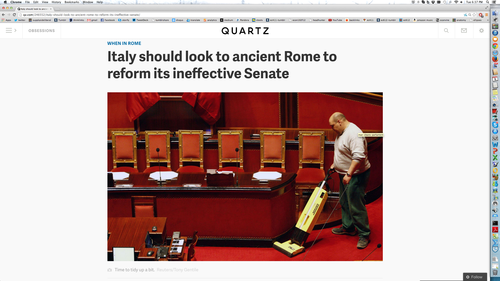
Here is the full text of my 51st Quartz column, "Italy should look to ancient Rome to reform its ineffective Senate,“ now brought home to supplysideliberal.com. It was first published on August 8, 2014. Links to all my other columns can be found here.
The idea for this column emerged during my trip to Rome, when I talked to Luigi Guiso about the economic and political situation in Italy. I wanted to thank him for all of his insights. Don’t construe that as his endorsement of my proposal, though!
If you want to mirror the content of this post on another site, that is possible for a limited time if you read the legal notice at this link and include both a link to the original Quartz column and the following copyright notice:
© August 8, 2014: Miles Kimball, as first published on Quartz. Used by permission according to a temporary nonexclusive license expiring June 30, 2017. All rights reserved.
The prime minister of Italy, Matteo Renzi, wants to miniaturize the Italian Senate—both in number of senators and in power. Under Renzi’s reform plan, senators would be appointed by regional councils and have no power to approve budgets, pass most national laws, or hold a no confidence vote on the government.
One of the touted motivations is to save money: the equivalent of about $58 million in salaries, plus pension benefits. But even if it all added up to $100 million a year total, that would be only .005% of Italy’s $2 trillion a year economy. Any pluses or minuses for governance have to vastly outweigh the direct cost savings, so the issue should be thought of primarily as a constitutional issue, not a budgetary issue.
Italian senators are resisting. They have introduced almost 8000 amendments to Renzi’s reform bill to put the brakes on this constitutional change. This trench warfare was predictable. Back in March, James Mackenzie explained in Reuters that Renzi’s plan “to transform the Senate into a non-elected chamber stripped of the power to approve budgets or hold votes of no-confidence in a government” would meet stiff opposition:
[Renzi’s] bill would scrap the current fragmented system, which grants equal powers to the Senate and the lower house Chamber of Deputies but elects them by different rules which make it hard for any group to win a stable overall majority in parliament. …
But despite loud public calls for change from all sides of the political spectrum, the reform is expected to encounter strong opposition from many in the 320-strong upper house who will have to vote to scrap their own jobs.
Italian blogger Roberta Damiani gives an excellent primer on Renzi’s reform plan for the Italian Senate. She explains:
Currently, Italy has a system known as “perfect bicameralism”: both chambers are directly elected during the same general election, and have exactly the same authority on every matter, including monetary ones. This is really rare, especially in parliamentary systems; Italy and Romania are indeed the only two countries in the EU with such a system.
Such a system makes it hard to pass legislation. Right after Italy’s Fascist era under Mussolini, it made sense to make it hard for the government to do anything big. But now, when Italy faces a host of economic problems, that need imaginative solutions, it is a problem.
Ancient Rome provides the inspiration for a very different reform of the Italian Senate—a reform that doesn’t save any money on senators’ salaries, because it would let the senators keep their jobs, but would:
- End the gridlock caused by the current system;
- Elevate the Italian Senate as a deliberative body;
- Maintain the equality of the Senate with the other house of Parliament, the Chamber of Deputies.
The highest officials in the Roman Republic were two consuls. The consuls took turns running the show, with one consul in charge one month and the other in charge the next month. The consul who was in charge was said to hold imperium. One consul could veto the actions of the other when the other was in charge, but used that power sparingly in order to avoid being checked in turn when it was his month.
For the modern Italian Parliament, here is what I am proposing: just as consuls in Ancient Rome took turns being in charge in alternate months, let the modern Italian Senate and the other house of Parliament, the Chamber of Deputies, be in charge in alternate years. Require an active vote by 55 percent of the house of Parliament that is not in charge to veto an action by the one that is. (To minimize opposition to this reform plan, leave the number of senators the same as it is now.)
Besides an occasional veto vote, what would a house of Parliament do during its off year? Although they might shirk in their duties, members of parliament in an off year would be expected to turn their house of Parliament into a kind of think tank, preparing and thinking through the actions they planned to take in the following year when they would again collectively be in charge. Having to watch the other house of Parliament be in charge during an off year would do a lot to stimulate creativity in putting together a program for the year when their house held imperium.
Under this system, the members of parliament could all keep their jobs, as long as the voters kept reelecting them. The fact that the house of Parliament in charge could pass legislation with a simple majority vote but the other house could veto only with an active vote of 55 percent would do a lot to reduce gridlock. The years each house of Parliament would go through having to sit on the sidelines would do a lot to foster deeper deliberation.
Italy has not been an easy country to govern. I think prime minister Renzi is trying to make things better, but he chose the wrong model for constitutional reform in Italy. For a better model—one that wouldn’t face the uphill battle of persuading senators to vote their own jobs out of existence—he can turn to the ancient Roman Republic, the source of so many of the world’s key democratic principles and traditions.
The Future of Dough: A Rap Video for Money20/20
This is an entertaining rap video about the dramatic changes coming for payment systems. One prediction I think is a bit off target is the second sentence in this part of the rap lyric:
You can pay by finger, by eye or Google glass. The next evolution: PayByAss. …
By the way, you can see my rap video about the monetary policy possibilities opened up by electronic money here (and here is Tom Grey’s better rendition of the same lyrics).
“May the day come when your life is half-full rather than half-empty.”
Act Like Someone Who Loves Math | Mathematical Association of America →
Via Mary O'Keeffe I saw this notice on the Mathematical Association of America website about my column “How to turn every child into a ‘math person.’”
Shark Tank Markups

For an economist, one of the most educational and entertaining shows on TV these days is Shark Tank, which lies squarely in the intersection between venture capital and reality TV. The judges, called "sharks” are shown as choosing whether or not to invest their own money in ventures on the spot as entrepreneurs make their pitch during the taping of the show. There are also some follow-up segments about how ventures one or more of the sharks invested in previously have been doing.
It is well worth hearing the incisive questions and opinions given by the sharks. Among the inevitable questions are “How much do you sell it for?” and “How much does it cost to make and deliver?” or in the case of a service “How much does it cost you to do it?” The intriguing thing to me about that is being able to get a measure of the actual markup ratio
Actual Markup Ratio = Price/Marginal Cost
for a wide variety of goods and services. I think a great undergraduate economics thesis could be written by watching all of the episodes of Shark Tank, compiling all the data on price and marginal cost and then analyzing the determinants of the markup ratio (such as sector and how different the product is from competing products–something that could be coded up systematically from the televised discussion in the show).
Once price has had a chance to adjust optimally, the markup ratio should equal the target markup ratio
Target Markup Ratio = Price/Marginal Revenue = ε / (ε - 1)
where ε is the price elasticity of demand seen by the firm. The price elasticity of demand seen by a typical firm (or a typical firm’s target markup ratio) is a key parameter for macroeconomics as well as for industrial organization. For example, the value of ε tells how close things are to perfect competition. and ε is important for optimal monetary policy, as you can see in my discussion of Michael Woodford and Vasco Curdia’s paper at a conference at the Bank of Japan. Macroeconomists typically assume a value of 1.1 for the markup ratio, which implies ε = 11. To me, that seems too low a markup ratio and correspondingly, too high a firm-level price elasticity of demand. In any case, the value of typical markup ratios is a central issue that should be disputed in the light of as many different types of relevant information as we can get hold of.
Sometimes the sharks also ask about marketing costs. It is important to recognize that marketing costs (for example, “customer acquisition costs”) should not be included in marginal cost. They are a different animal. When price is above marginal cost, then there is a reward to marketing that pushes out the demand curve the firm faces. If a firm is optimizing, then it should be true that
Marginal Cost to Make and Deliver + Marginal Marketing Cost of Raising Demand by 1 Unit at the Going Price = Price
So if one (in my view mistakenly) includes marginal marketing cost as part of “marginal cost” then the markup ratio should always look like 1 for an optimizing firm. This obscures the key forces arising from a markup of price over the marginal cost of making and delivering a product.
Avik Roy: A Conservative Case for Universal Coverage →
Avik argues that Switzerland and Singapore may provide a good model for conservative health care reform.
“Too many people spend too much time trying to perfect something before they actually do it. Instead of waiting for perfection, run with what you’ve got, and fix it along the way.”
Kim Schoenholtz and Stephen Cechetti: Has Paper Money Outlived Its Purpose?
Link to Kim Schoenholtz’s and Stephen Cechetti’s post “Has paper money outlived its purpose?”
This is a nice article that speaks favorably of my proposal for enabling negative interest rates. In the end, they come down in favor of keeping paper money.
I wish Kim and Stephen had made it clearer that my proposal in “How Subordinating Paper Currency to Electronic Money Can End Recessions and End Inflation” involves keeping paper money in a subordinate role that retains the positive aspects of paper money they mention. Indeed, during periods of time in which negative interest rates haven’t been necessary for a while, the monetary system I propose would look very much like the current system. That makes it very different from proposals to abolish paper money entirely.
John Cochrane: Larry Summers' Martin Feldstein Speech →
I love this post by John Cochrane.
John Stuart Mill: People Should Be Allowed to Govern Their Own Lives Because They Care More and Know More about Themselves Than Anyone Else Does

Image source: “Self-knowledge, A Path to Happiness” by Karem-Barrett
Even if the self is an illusion, what we call the self reflects a fundamental fact about the aggregate of all human consciousness: informational links are much thicker within a human being than between human beings. Even a Utilitarian social planner who has no doctrinal attachment to Libertarianism should take advantage of those dense informational links within a human being by allowing each person to make decisions about his or her own life.
John Stuart Mill makes that case in On Liberty, Chapter IV, “Of the Limits to the Authority of Society over the Individual” paragraph 4:
But neither one person, nor any number of persons, is warranted in saying to another human creature of ripe years, that he shall not do with his life for his own benefit what he chooses to do with it. He is the person most interested in his own well-being: the interest which any other person, except in cases of strong personal attachment, can have in it, is trifling, compared with that which he himself has; the interest which society has in him individually (except as to his conduct to others) is fractional, and altogether indirect: while, with respect to his own feelings and circumstances, the most ordinary man or woman has means of knowledge immeasurably surpassing those that can be possessed by any one else. The interference of society to overrule his judgment and purposes in what only regards himself, must be grounded on general presumptions; which may be altogether wrong, and even if right, are as likely as not to be misapplied to individual cases, by persons no better acquainted with the circumstances of such cases than those are who look at them merely from without. In this department, therefore, of human affairs, Individuality has its proper field of action.
John talks not just about an individual knowing more about his or her own situation but also about how the individual cares more about him or herself than others do. Letting people make decisions about their own lives does a lot to take care of bringing the the strongest preferences into social choice.
But in addition to simply making sure that all strong preferences are well represented in social choice, letting each individual make decisions about his or her own life makes sense also because each person also typically has a knowledge advantage not only with regard to circumstances, but also with regard to his or her own preferences. Without a great deal of tricky inference, one of the most difficult things for someone else to know about me without me telling them, is what I want and how much I want it. One of the most basic jobs of any adult is to carefully figure out what he or she wants. It is difficult for anyone else to do that for the individual, though software designers for websites like Amazon, Netflix, Pandora etc. are trying hard to be able to predict what someone will like.