Allan H. Meltzer: Don't Be Distracted by the Last 5+ Years—Massive Inflation is Coming →
There is a good reason to focus on nominal GDP as the best rough-and-ready measure of monetary policy rather than measures of the money supply: velocity is not constant. I give my views on that in my column “Optimal Monetary Policy: Could the Next Big Idea Come from the Blogosphere?" I also have a children’s storybook to explain why velocity drops dramatically when interest rates are stuck at zero rather than being able to go into negative territory: “Gather ’round, Children, Here’s How to Heal a Wounded Economy.”
Allan Meltzer, by contrast, has these thoughts:
Never in history has a country that financed big budget deficits with large amounts of central-bank money avoided inflation. Yet the U.S. has been printing money—and in a reckless fashion—for years.
The Fed focuses far too much attention on distracting monthly and quarterly data, while ignoring the longer-term effects of money growth.
We are now left with the overhang. Inflation is in our future. Food prices are leading off, as they did in the mid-1960s before the "stagflation” of the 1970s. Other prices will follow.
Postscript: I begged Brad DeLong in a tweet to show Allan Meltzer the error of his ways, but Brad didn’t want to repeat himself. So I have tried to do my bit.
“Once you start caring what the world thinks of you, you become locked in.”
– Mark Stevens, businessman and business writer, as quoted in Clutch, by Paul Sullivan
The Wall Street Journal Sneers at Wiccan →
If the Wall Street Journal Editorial Board wants to attack Wiccan, it should do so seriously, not in an offhand sneer like this one:
Even a Wiccan priestess was allowed to issue what we suppose was an anti-prayer.
There are religions worth criticizing, but it is not a light thing to criticize a religion. Humor can be an effective way to criticize a religion, but this is not substantive humor on the part of the Wall Street Journal, only prejudice.
Paul Krugman--On the Asymmetry of Booms and Slumps, and David Andolfatto—The Most Obvious Source of Cyclical Asymmetry is Relationship Destruction →
The link above is to Paul’s post. Here is the link to David’s: “The most obvious source of cyclical asymmetry is not a nominal rigidity.”
My Experiences with Gary Becker
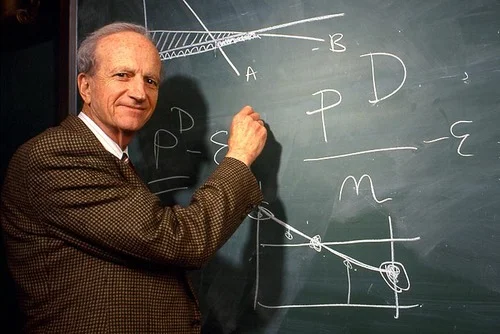
In my life, I crossed paths with Gary Becker in a significant way twice. Once was the Fall of 1986, when I was on the job market. Gary invited me to come to Chicago to present my paper “Making Sense of Two-Sided Altruism”–a paper Robert Barro arranged to have published in a Carnegie-Rochester volume not long after. At lunch with Gary and other Chicago economists, I was impressed with how seriously they took economics as the key to understanding everything. I am glad I got to see that.
The second time I crossed paths with Gary was as someone who does research on the economics of happiness. In two papers,
- Rayo, Luis, and Gary Becker. 2007. “Evolutionary Efficiency and Happiness,”Journal of Political Economy, 115:2, pp. 302-337
- Becker, Gary S., and Luis Rayo. 2008. “Comment on ‘Economic growth and subjective wellbeing: Reassessing the Easterlin Paradox’ by Betsey Stevenson and Justin Wolfers.” Brookings Papers on Economic Activity, Spring: 88-95
Gary and his coauthor Luis Rayo took a view of happiness very close to my own, in the paper “Utility and Happiness,” coauthored with Bob Willis, and so close in time to Bob Willis’s and my work that it took an uncomfortable, but ultimately gracious email exchange with Gary and Luis to come to agreement on Bob’s and my priority. The two key ideas for the economics of happiness that Gary and Luis and Bob and I agree on are
- The Price Theory of Happiness: Felt happiness, as measured in surveys, is only one of the many things that people care about. There are many other arguments in the utility function. Thus, the happiness studied in the economic of happiness is not the same thing as utility. In particular, people will trade off happiness for other things they want.
- The Elation Theory of Happiness: Here there are differences in detail between the two theories. Bob Willis’s and mine emphasizes that on top of longer lasting and routine influences on happiness, there is an impulse response of happiness to good news and bad news, where by “news” we mean a rational expectations innovation to lifetime utility.
A large share of my research effort in the last few years has been working with coauthors–of whom Dan Benjamin and Ori Heffetz deserve special note–to back up the price theory of happiness and the elation theory of happiness. Below are our papers published so far (all of the ones below are in the American Economic Review). So far, they are all about the price theory of happiness.
- What Do You Think Would Make You Happier? What Do You Think You Would Choose? (Dan Benjamin, Ori Heffetz, Miles Kimball and Alex Rees Jones)
- Can Marginal Rates of Substitution Be Inferred from Happiness Data? Evidence from Residency Choices (Dan Benjamin, Ori Heffetz, Miles Kimball and Alex Rees Jones)
- Beyond Happiness and Satisfaction: Toward Well-Being Indices Based on Stated Preference (Dan Benjamin, Ori Heffetz, Miles Kimball and Nichole Szembrot)
- Aggregating Local Preferences to Guide Marginal Policy Adjustments (Dan Benjamin, Ori Heffetz, Miles Kimball and Nichole Szembrot)
We have been glad to have Gary Becker and Luis Rayo fighting with us for this new view of happiness.
Brenda Cronin: Gary Becker, a Nobel Prize-Winning Economist, Dies at 83 - WSJ.com →
Gary Becker had a long and full life. It is sad that he is gone, but I am glad to have a chance to read more about his life. Here are some of my favorite passages in the article linked above:
“His impacts were felt well beyond economics,” said Justin Wolfers, a professor at the University of Michigan and a senior fellow at the Brookings Institution. “My personal judgment is that he was the most important social scientist in the second half of the 20th century.” …
Mr. Becker was “much of the intellectual heart and soul of the Chicago tradition,” Mr. Wolfers said. “He was the next generation of the Chicago tradition after Friedman.”
Mr. Becker described the complexity of how humans make decisions: “Along with others, I have tried to pry economists away from narrow assumptions about self interest. Behavior is driven by a much richer set of values and preferences.” …
His early blending of economics and sociology was novel at the time. For years, he wrote in his short biography for the Nobel Prize, “my type of work was either ignored or strongly disliked by most of the leading economists. I was considered way out and perhaps not really an economist.”
I tweeted that
Gary Becker shifted the default assumption of economics from rational pursuit of self-interest to rationality, period.
Disputing over exactly how rational people are is a key battleground for economics going forward, as Noah Smith and I discuss in our column “The Shakeup at the Minneapolis Fed and the Battle for the Soul of Macroeconomics,” and as I touched on in relation to financial markets more recently in “Robert Shiller: Against the Efficient Markets Theory.”
Although I think Gary was right about the complexity of human motivation (see “Judging the Nations: Wealth and Happiness Are Not Enough”), I consider the study of irrationality much more important than Gary. Brenda’s Wall Street Journal article calls Gary “a critic of the field known as behavioral economics, which found human behavior irrational.” For all of the flaws of behavioral economics, I think the border between psychology and economics that has gotten the label “behavioral economics” is where much of the progress in economics in the next few decades will come from. That is the more true if one is focused on progress in understanding the real world within the next few decades.
“This can be the inflection point for the new Africa, a time and place where Africans bend the arc of history towards reform, and not retribution; towards peace and prosperity, not revenge and resentment.”
– John Kerry, May 3, 2014 as reported in “John Kerry Says Violence Threatens Africa’s Prosperity,” by Heidi Vogt in the Wall Street Journal
The Wisdom of Gary Becker - WSJ.com →
Above is a link to the Wall Street Journal's editorial in honor of Gary Becker, who died Saturday, consisting of quotations from Gary. Here are my favorites among those quotations:
Other countries, too, should liberalize their policies toward the immigration of skilled workers. I particularly think of Japan and Germany, both countries that have rapidly aging, and soon to be declining, populations that are not sympathetic (especially Japan) to absorbing many immigrants. These are decisions they have to make. But America still has a major advantage in attracting skilled workers, because this is the preferred destination of the vast majority of them. So why not take advantage of their preference to come here, rather than force them to look elsewhere?
“But when Milton [Friedman] was starting out,” [Becker] continues, “people really believed a state-run economy was the most efficient way of promoting growth. Today nobody believes that, except maybe in North Korea. You go to China, India, Brazil, Argentina, Mexico, even Western Europe. Most of the economists under 50 have a free-market orientation. Now, there are differences of emphasis and opinion among them. But they’re oriented toward the markets. That’s a very, very important intellectual victory. Will this victory have an effect on policy? Yes. It already has. And in years to come, I believe it will have an even greater impact.”
My Missionary Companion on the Reconstruction of Faith

From September 1979 to August 1981, I preached Mormonism as a proselyting missionary in the Tokyo North Mission. Although I no longer believe in Mormonism, looking back I don’t think I did any serious harm by preaching Mormonism during that time. For the most part, those I helped influence to join the Mormon Church for whom Mormonism was a minus in their lives have probably left Mormonism long ago. And in one of the paradoxes of religion that I keep puzzling over, it is easy to assemble a group of people for whom it is (A) hard to deny that believing in a supernatural religion is a plus in each of their lives, even though (B) the group is diverse enough in supernatural beliefs that there is no logical way all of those supernatural beliefs can be true. At best, I provided more choices for people through my proselyting. The one plausible way I can think of that I might have harmed someone’s life is if they married a spouse who continues to believe when they themselves ceased to believe–always a tricky and often a difficult situation to be in, and one that I, thankfully, have not had to contend with personally.
Leaving aside any possible harm I did from preaching something that I do not now believe is not objectively true, for me, the missionary experience was well worth the two years. One of the most basic lessons I learned is that you are very big in the world, or you have to worry about violence, it doesn’t matter how many strangers say “no” when you make a pitch. It only matters how many say “yes.” The pain we almost all feel at rejection far exceeds the actual practical danger one faces from being rejected in a modern environment.
I also made some good friends on my mission. For most of my life, I have not been very good at keeping up with old friends living in other cities. But Facebook has allowed me to reconnect with old friends as well as new friends. I have good memories of those I taught about Mormonism, but the closest friendships on my mission were with my missionary companions. As most people know from direct observation, Mormon missionaries go around in twos. A pair of Mormon missionaries, called “companions” come remarkably close to spending 24 hours a day, seven days a week in each others company. Needless to say, it is easy to get to know someone well under those circumstances. Today’s moving guest post is from one of my missionary companions. He asked for a bit of anonymity given the personal nature of some of the things he will share, but was glad to share the substance of what he has to say here.
For those of you who want to better understand the institutional aspects of Mormonism and Mormon missions a little better, you might want to read my post “The Message of Mormonism for Atheists Who Want to Stay Atheists” as background, either before or after reading why my missionary companion has to say. (This was a sermon I gave at the Unitarian-Universalist congregation in Brighton, Michigan, on May 20, 2012, when they asked me to talk about Mormonism in relation to Mitt Romney.) I am also putting Wikipedia links on “Stake President” and “Bishop."
Here is my missionary companion’s guest post:
Thank you for linking me to your post ”The Unavoidability of Faith.“ From there, I ended up reading most of your blog posts in your Religion, Humanities and Science sub-blog, with particular interest in your UU sermons. Your thoughts, ideas and experiences inspire me to learn and grow and continue to improve and strengthen my own faith and understanding. I was impressed by how diligently you continue to seek for God, spirituality and faith; yet do not believe in the supernatural.
My son struggles with belief in the supernatural. Like you, he is thoughtful, direct and honest. We probably should have had a clue to how his mind worked when he expressed profound betrayal at the age of 7 when, after constant questioning, we finally told him Santa Claus was not a real person. His immediate response was “so, have you been lying about God, too?” During his teenage years, our relationship had a few ups and downs, but nothing we could not easily manage, or so we thought. He was and continues to be a good student and enthusiastically loves to learn. But, until the last few years, what we really didn’t understand (or refused to admit) was that he is not a natural believer in God, faith and religion. To borrow terminology from a book I recently finished by Adam Miller: Sometimes, it’s like the existence of God is so unlikely and runs so counter to his common sense that wishful thinking is all he can credibly muster.
Throughout his teenage years, we continued to devoutly follow the Mormon pattern with the expectation that things would change. Often, we would insist that he “just believe” as he advanced through Priesthood offices, earned his Eagle Scout, left for BYU and then a mission. Regarding his struggle to believe, he was remarkably honest and direct with his church leaders and us. In a discussion with the Stake President on the night before he left for a 2-year mission assignment, he again acknowledged his difficulty believing in God and the church but believed what he was doing was “good and right” because he trusted his parents and extended family members who had served missions. He expressed a sincere hope that his mission experience would be his “quest for faith”. At the time, we all felt that was good enough and all we could reasonably ask. For more than a year, he had many good experiences. He developed strong foreign language skills, many close relationships and a genuine affection for the people and culture. However, after moving into a position of leadership, he felt a crushing responsibility to help develop the faith of others and baptize them yet felt somewhat dishonest because of his own beliefs and the methods he was sometimes asked to use. Unable to adjust and teach with the conviction required, he faced a crisis of belief and many more doubts crept into his mind. Like many missionaries, he felt uncomfortable with the reward systems in place for missionaries with the best “numbers”. He sometimes wondered if he was really doing God’s work or just participating in another competitive event like sports or business. Most sadly, he felt disappointed with God who he believed would not personally respond to his pleas for an increase in faith and the kind of amazing spiritual experiences frequently described by other missionaries. When he had those feelings, it sometimes made it emotionally easier to believe God might not exist. Eventually, he went through an unexpected period of anxiety and depression. For a few months, we tried to help him work through it but his condition did not ultimately improve and was made worse by poor handling and support at the mission level. Fearing his situation would spiral further downward and despite his objections, I eventually made the decision to bring him home before he finished his full 24-month term. I continue believe it was the right decision, but it was not without consequence to our relationship.
After returning home, he was initially devastated by a personal sense of failure and struggled to “stay” in the church. We arranged private counseling to help him better understand what happened. We all struggled to understand to what degree his anxiety was caused by his attitude or beliefs about God, faith and religion or to what degree an anxiety condition itself was the root cause of his agitation. We encouraged him to consider schools other than BYU where he might feel more comfortable, but he had a scholarship and wanted to be with his friends so he returned the next year. The good news is he has made a degree of peace with his beliefs and is more aware of how common this experience is in the church – an experience that seems to be increasing in recent years. Like you, he sees the goodness and beauty of many church teachings and wants to believe. My continuing concern for him centers on the possibility that this experience might cause him to develop apathy, avoid the struggle to overcome and get caught in the “low-effort trap” you described in your blog. Until coming home for help, it’s like he was unable to find or even consider a space for developing faith between the extremes of orthodox Mormonism’s culture of certainty and a Nietzsche-like nihilism, which most likely contributes to more episodes of anxiety and depression. He is moving forward with his education. He married a wonderful girl he met at school and he continues to work on his education and life goals. Marriage has been an affirming boost to his faith by providing a deeper realization of the source and meaning of love and beauty.
During all this time, I started to see how my failure to not thoughtfully work out my own faith issues (especially related to the church) might have affected my ability to sensitively help him process difficult questions. No doubt, that created tension in our relationship. After returning from my own mission in the 1980s, I remember my first real “crisis” of faith early in college. For a history class, we read Fawn Brodie’s book Thomas Jefferson – An Intimate History and that led me to her book No Man Knows My History about Joseph Smith. Among other things, some of the documented facts in that book started a chain reaction of skeptical questions, minor feelings of betrayal and doubts more credible and substantive than anything I’d experienced or considered. I spoke to my father and my Bishop about my experience. Although sensitive to my concerns, both suggested I stop “chasing my tail” and move on with my life. Ultimately, my father presented me with a choice similar to Pascal’s wager and so I made my bet on belief. I put my doubts “on the shelf” and moved forward with a more practical approach to life by diligently pursuing a successful career, marriage and being dutiful to the pattern of certainty I saw in the church. With the benefit of hindsight, I now see that my efforts became more of a plan of self-improvement and competitive achievement more than development of a healthy and genuine faith.
After coming to this realization, I decided the best way to help my son would be to repent and reexamine and repair my own issues with faith. So I began a process of deconstructing my faith and then attempting to put it back together in a healthier, genuine way. While doing this, I painfully discovered many faults in my way of thinking, believing and parenting (e.g. believing more of a fear narrative than a grace narrative with regard to religion, relying more on conformity than developing and following my own spiritual convictions, believing that God favors the successful over the unsuccessful and those with a gift to believe over those that struggle to believe). After much effort over the past few years, I am now much more happy with the direction, quality and progress of my faith despite being less certain about many things related to it. My relationship with my son is also much improved. It’s as if my spirit, intellect, psychology and emotions are now awake, in focus and working together in greater harmony. I am now more of a Christian than a Mormon rather than the reverse. I became less certain about the “one true church” claim. At the same time, I began to feel a much stronger sense of faith and trust in God and his approval of my efforts to grow, which at first seemed like a paradox. Despite remaining doubts about church and religion, I am more settled and have decided it is right for me to stay. I consider my family, large extended family and Mormon friends as “my people” and feel that is where I am primarily called to seek truth and practice Christianity in a community – to develop more skillful faith, repentance, forgiveness, tolerance, love and ultimately become what God wants me to become and help others do the same.
Which leads me to what I really wanted to share with you. A few years ago, during my faith “reconstruction” process and while considering the real possibility that God might be leading me away from the Mormon faith, I came across a Mormon Stories podcast featuring your father. Among many things, I felt his sense of goodness and genuine wisdom and was impressed by his healthy views on education and a reasoned faith – especially his thoughts on how to reconcile reason, faith and the spiritual. It was an approach and attitude I had not been exposed to growing up. My home and church experience was one of certainty, obedience, conformity, absolute trust for authority, yet much of love, friendship, support and good intentions. What was really missing was an open discussion of difficult questions and quality education. I listened to the podcast several times and even watched it again with my wife on YouTube (1, 2). Most of all, your father helped me feel confident and see the value of staying in the church even with my doubts. His words encouraged me to better distinguish between what I know, what I really don’t know, what I believe and what I really don’t believe. He also shared his thoughts on how to develop a healthy and reasoned trust and obedience in scripture, church leaders and church doctrine as a humility check of sorts - in the absence of certainty. Finally, he helped me understand that, if we are honest, we are all somewhat agnostic, to some degree or another, on different points of faith, doctrine, church history, church leadership, etc. – and sometimes we just need to face it, own it and say “I don’t know”. His thoughts put me on a more confident track to read, study, pray and wrestle for a more genuine faith that is more realistic about doubt. Shortly after that, I friend-requested you on Facebook hoping to reconnect with you at some point.
Sorry to ramble on and on as I try to patch my thoughts together. Basically, I feel some people come into my life for a reason. I know we were just young kids when we worked a few months of our life together as missionaries. I remember and appreciate what you taught me then and I enjoy and appreciate what I’ve learned from your blog posts now. I hope we can be friends and continue to discuss faith and grow more together. Thank you for your friendship. I appreciate the amazing effort, hope and genuine optimism in your faith. I look forward to staying in touch and learning more.
In addition to your father’s podcast, the following is a brief list of a few books, essays, talks, etc. that have been a tremendous help and important support to me during my struggle:
- The Reason for God; The Prodigal God – Dr. Timothy Keller.
- Disappointment with God; What’s so Amazing about Grace?; The Jesus I Never Knew; Soul Survivor – Philip Yancey.
- Mere Christianity; Letters to Malcolm; Till We Have Faces – C.S. Lewis.
- The God Who Weeps; People of Paradox; When Souls had Wings; Letter to a Doubter – Dr. Terryl Givens
- Reformed Christians and Mormon Christians; Comments at BYU Symposium on Salvation in Christ; BYU World Religions Text – Dr. Roger Keller
- The Other Prodigal; Lord, I Believe; Like a Broken Vessel – Elder Jeffrey Holland
- Four Titles; The Love of God; Grateful in Any Circumstances – President Dieter Uchtdorf
- The Challenge to Become – Elder Dallin Oaks
- Why the Church is as True as the Gospel – Dr. Eugene England
- Letters to a Young Mormon; Rube Goldberg Machines – Dr. Adam Miller
- “Believest thou…?”: Faith, Cognitive Dissonance, and the Psychology of Religious Experience - Wendy Ulrich, Ph.D.
Chris Chegash: Michigan Should Fix Its Potholes
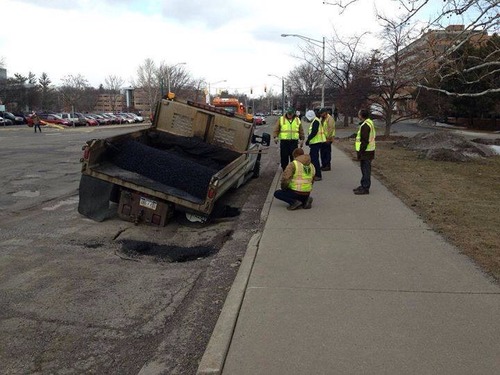
This is a guest post from my student Chris Chegash. He also had an earlier guest post here: “College Athletes Deserve a Better Deal.” I agree 100 percent with Chris’s policy recommendation that Michigan should fix its potholes. Indeed, Noah Smith and I make a similar recommendation at the national level in “One of the Biggest Threats to America’s Future Has the Easiest Fix.” But Chris makes the issue much more vivid.
One of the sure ways to know that something is important is when politicians actually agree on something. With the current state of American politics, both conservatives and liberals rarely agree on anything. Yet, when it comes to the current state of the infrastructure in Michigan, everyone seems to agree: The roads in Michigan are awful.
I grew up thinking that the thump-thump you hear when driving down the highway was normal, but as I’ve grown older, I’ve realized this isn’t true. Sad as it is to say, I don’t mind when I cross the Ohio border and finally get some peace and quiet while driving. The data about Michigan’s roads backs this up. The American Society of Civil Engineers gave Michigan’s infrastructure a D in 2009, 2011 and 2013 (they gave the U.S. a D+ nationally). According to the ASCE, about 30% of the bridges in Michigan are either “structurally deficient” or “functionally obsolete” and 38% of Michigan’s roads are in either poor or medicare condition. More importantly, they believe that the poor conditions of the roads in Michigan costs the average motorist an additional $357 dollars per year in car repairs and traffic problems. Some people fear that poor road conditions could drive both new business investment and tourism away.
The fact is that all roads face some deterioration over time, and will need to be replaced eventually, but Michigan has two key factors that enlarge this problem. The most obvious factor is the weather. Driving around in the past few weeks has been an absolute nightmare in Michigan; potholes are everywhere as a result of an extremely cold and snowy winter. When water seeps into cracks and later freezes, it expands and enlarges the cracks. This is why the potholes have been especially prevalent and dangerous after this prolific winter season. The second major factor that causes increased wear and tear on Michigan’s roads is a poor public transportation system. The most often cited cause for a subpar public transit system in Michigan is the local interests of the major car manufacturers. Since better public transit means less cars, the major car companies like Ford, GM, and Chrysler all have an interest in opposing public transit. Over time, this has lead to woeful public options in Michigan (Ann Arbor is probably far better than most areas).
The real question lies in where the money to fund road improvements will come from. In 2013 Michigan governor Rick Snyder proposed a $1.2 billion increase in road funding, funded through either an increase in the gas tax and other fees, or an increase in the state income tax. The Michigan Infrastructure and Transportation Association thinks the true cost of fixing Michigan’s roads is around $2 billion per year in additional funding, far more than the number governor Snyder has proposed (there are some great graphics in the full report here). However, the proposals in the Michigan legislator fall well short of that funding level, there are new proposals in state Congress to increase road funding by $450 million per year. The additional funding would come from diverting 1% of our of Michigan’s current 6% sales tax to roadwork andthrough eliminating the flat gas tax and instead taxing it at 6%. Thus, if prices rise higher than $3.55 per gallon, the tax will be more expensive than the previous 18 cent per gallon tax. Proponents of this tax are eager to point out that a gas tax makes people who drive more pay more in taxes, which seems smart.
This proposal has two major issues:
- Coming up with the $450 million per year: Lawmakers putting together this proposal had to find $400 million dollars to take from other parts of the budget, because actual revenues are expected to increase by only about $50 million. This means that if the proposal is adopted, some other project is losing $400 million.
- $450 million per year is not enough: The amount of new funding is still well short of the additional funding governor Snyder proposed and is well short of what experts think is necessary to solve this problem.
Another option that people frequently talk about is the use of toll roads to generate revenue. Unfortunately, most of Michigan’s highways aren’t eligible to be used as toll roads. Since the federal government funded a significant portion of the costs of state highways, those roads cannot be used as toll roads without repaying the government for their original investment. Although there are some ways around these rules, trying to convert Michigan’s road into toll roads wouldn’t be financially viable.
The problem of poor roads isn’t going away any time soon, and so lawmakers must act to better fund the roads in Michigan; waiting will only make the roads worse. Although difficult, I believe that residents must accept a slight tax increase in order to improve Michigan’s dilapidated road network.
Italy's Supply-Side Troubles
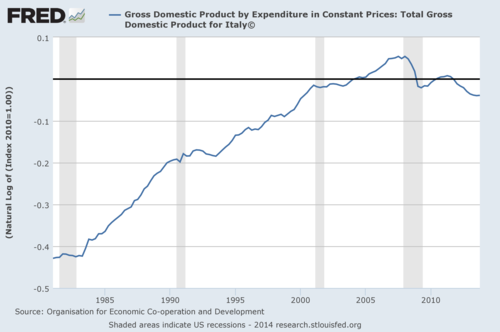
Italy’s immediate crisis is a demand-side crisis. The financial crisis in late 2008 and insufficiently stimulative monetary policy on the part of the European Central Bank since then have led to lower output and bigger budget deficits.
But Italy has longer run problems as well. The graph above shows the natural logarithm of real GDP in Italy relative to its value in mid-2004. When people talk about “bending the curve” of medical costs, they are talking about the kind of falling growth rate that this graph shows for Italy’s GDP, long before the Great Recession.
I am always on the lookout for articles that give a bit more vivid picture of what can go wrong on the supply side of an economy. “Can Italy Find Its Way? Resistance to Change Means Slow Recovery” by Marcus Walker and Deborah Ball in the April 29, 2014 Wall Street Journal is an excellent example of just such an article. All quotations below are from Marcus and Deborah.
Taxes
Sometimes people think of the supply side as primarily a matter of taxes. In Italy, there are high taxes, but they are high partly because other taxes are not paid:
Taxes on labor are particularly high. One reason is that taxes that would normally help spread the burden—including on the incomes of small businesses and the self-employed—are widely dodged.
Italian entrepreneurs evade over 50% of the income taxes they owe, while people living off investment income skip over 80%, the country’s central bank estimates. The heavy taxes on payrolls deter companies from hiring and weaken consumers’ spending power, economists say.
Slow Permits
A big factor in Italy’s supply-side malaise is the difficulty of establish any new shop. This issue is sprinkled throughout Marcus’s and Deborah’s article:
1. Bernardo Caprotti was a 45-year-old entrepreneur when he agreed to buy a suburban plot of land for a new supermarket.
Building permits recently came through. He’s now 88.
2. Red tape is one factor that deters businesses from growing. …
In 2012 British Gas PLC threw in the towel on a €500 million gas import terminal in southern Italy after struggling for over a decade to get the necessary permits.
It is a problem familiar to Mr. Caprotti. “If we start something today, it could take 15 years to finish,” he says. “Then you’re lost because you find that the size or the location doesn’t work anymore.”
Impaired Property Rights Because of Slow Courts
Property rights are crucial for economic efficiency, but property rights are created by law. A slow legal system impairs property rights:
Italy’s court system also spooks businesses: Routine contract disputes take more than three years on average to resolve in court—and much longer if there are appeals. Italy’s lawyers, who outnumber their French brethren fourfold, have resisted efforts to streamline a judicial system that offers rich opportunities for lengthy proceedings. At the end of 2012, there was a backlog of 9.7 million cases, according to the International Monetary Fund.
General Resistance to Change
Marcus and Deborah make the case that tolerance change is necessary for economic growth:
In societies whose populations aren’t growing, sustainable growth comes from improving productivity, or the efficiency of the economy’s supply side. And that requires constant change: Europe’s Achilles’ heel.
But the status quo is powerful in Europe, and in Italy particularly:
Entrenched interests and hardened habits have accumulated in Europe over decades, slowing once-dynamic economies to a crawl, and are now proving difficult to overcome. From bureaucrats to businesses, unions to pensioners, interest groups vigorously defend the status quo, even when it leaves no one satisfied. …
The roots of the problem, say many Italians, lie in how vested interests in the private and public sectors gum up the economy, preventing change that replaces old practices with new, more efficient ones, and repeatedly frustrating political attempts to shake up the country.
It adds up to “deep-seated cultural obstacles to growth,” says Tito Boeri, a professor at Milan’s Bocconi University who is one of Italy’s top economists. “In Italy you define your identity in terms of your membership of some specific interest group,” he says, making it hard to rally support for any notion of the common good.
Regulated professions such as lawyers and pharmacists consistently beat back efforts to break their cartels. Powerful bureaucrats bog down the implementation of new laws for years. And Rome’s political class is so quarrelsome that governments last little more than a year on average.
It used to matter less. Italy’s economy grew rapidly in the postwar era despite a stonewalling bureaucracy, legions of tiny companies and a fragmented, often corrupt political system. But growing was easier then: Relatively poor Southern European countries mainly had to copy technology from more-developed economies such as the U.S., and use it to churn out goods cheaply.
Making the wheels turn in an advanced economy requires the efficient rule of law, reliable public administration and more capital and expertise than many mom-and-pop businesses can muster, says Fabiano Schivardi, an economist at Rome’s Luiss University who has studied the stagnation of swaths of Italy’s business sector.
“Our institutions were good enough for an economy that was catching up, but they’re not good enough any more,” he says.
Family Businesses Resistant to Change
Not all resistance to change in Italy is at the collective decision-making level. Individual families running businesses also are often resistant to change at a level far beyond what is seen in the US:
Many family business owners prefer to stay small, sticking to the staff and customers they already know and trust, says Matteo Bugamelli, senior analyst at the Bank of Italy. “Often, all of the family wealth is in the firm, and there isn’t the risk appetite that you need to invest and grow,” he says. …
“The culture here is be the padrone in your own house,” he says, using the Italian for “boss.” Many family entrepreneurs “don’t trust outsiders and prefer to bring in their own son, even if he’s not well qualified,” he says.
Institutional Resistance to Change
Organized groups resist change in many ways.
Italian unions have also often dug in their heels to resist change. For years, union battles held up efforts to save the national airline, Alitalia, which struggled to get its labor costs down. Last fall, as the carrier faced imminent bankruptcy, unions agreed to pay cuts and more-flexible working terms.
Fear often lies behind unions’ defense of the status quo. Redundant blue-collar workers might never find jobs again in Italy’s sclerotic jobs market.
Some foreign entrepreneurs are discovering just how tough it remains to penetrate the Italian market.
Uber, the app-based car service that launched in Italy last year, says traditional taxi drivers have verbally abused its drivers, who respond to customers’ orders sent by smartphone. The taxi union denies any aggression, and says its members have paid a fortune for their taxi licenses, which now trade at about €170,000, and offer a public service that needs to be protected.
“During a period of change, there are some whose jobs are under threat and a sense of protectionism sets in,” says Benedetta Arese Lucini, general manager of Uber in Italy. “Unfortunately, Italy is afraid of changing.”
Low Government Capability
Finally, in Italy, the national government often seems powerless in relation to the ability of local vested interests to resist change:
Even when leaders pass reforms into law, change doesn’t necessarily follow. Bureaucrats who must implement laws by issuing administrative decrees often stall, dilute them or render them incomprehensible, say reform-minded officials. When the government of Enrico Letta fell in February, about 500 laws had been passed but not implemented. Among them: a measure to reduce the number of permits required for companies to do business and a law to digitize certain processes to simplify dealing with the government.
“There is a great deal of difficulty in moving the bureaucracy and the whole machinery of the state,” said Graziano Delrio, undersecretary to the prime minister, in an interview. “There has been this approach of making modest changes, but we need to make a leap in how it all works.”
Former Premier Mario Monti tried to inject more free-market competition in service sectors where regulation protects incumbents’ profits. Striking taxi and truck drivers, railway workers, pharmacists, lawyers and gas-station owners protested his overhaul attempts and lobbied parliament to water them down. Even the weakened measures that passed into law have often made little difference, because the public administration hasn’t acted on them, Mr. Monti says.
Final Thoughts
It is not that easy to think of good solutions for Italy’s supply-side problems. I think I would start with
- Reforming the courts. This is a precondition for item 2.
- Firmly establishing the legal supremacy of the national government over local governments, especially when the national government is giving more freedom to entrepreneurs.
Robert L. Woodson Sr. on Helping the Poor
To the extent we worry about the distribution of income, the primary focus should always be on helping the poor, as I argued in my posts
- “Rich, Poor and Middle-Class” and
- “Inequality Aversion Utility Functions: Would $1000 Mean More to a Poorer Family than $4000 to One Twice as Rich?”
Toward thinking about that end, I wanted to follow up my posts
- “Bill Dickens on Helping the Poor,”
- “Magic Ingredient 1: More K-12 School” and
- “When the Government Says ‘You May Not Have a Job’”
with a discussion of Jason Riley’s April 18, 2014 Wall Street Journal Weekend Interview with Robert L. Woodson Sr.: “A Black Conservative’s War on Poverty.” Jason introduces Robert this way:
Mr. Woodson, who remains fit and energetic at age 76, founded the Center for Neighborhood Enterprise in 1981 after stints at the liberal National Urban League and conservative American Enterprise Institute. He is academically trained but wears his pragmatism on his sleeve. “We go around the country like a Geiger counter, looking at high-crime neighborhoods and asking the questions the poverty industry doesn’t.
Here is how Robert describes his own approach:
If we see that 70% of households are raising children out of wedlock, that means 30% are not. We want to know what the 30% are doing right. How are they raising kids who aren’t dropping out of school or on drugs or in jail? We seek them out—we call them the antibodies of the community—and put a microphone on them, and say, 'tell us how you did this.'
Robert points out one particular way that occupational licensing keeps many poor people poor:
… a lot of people coming out of prison have a hard time obtaining occupational licenses,” he says. Aspiring barbers, cabdrivers, tree-trimmers, locksmiths and the like, he notes, can face burdensome licensing requirements. Proponents of these rules like to cite public-safety concerns, but the reality is that licensure requirements exist mainly to shut out competition. In many black communities, that translates into fewer jobs and less access to quality goods and services.
Helping the poor is important enough, there should be competing liberal and conservative approaches. Here is Jason’s rendering of how Robert contrasts the two:
To illustrate the difference between his approach to community activism and a liberal’s, Mr. Woodson tells me about a pastor in Detroit who wanted to build 50 new homes in a ghetto neighborhood but couldn’t find financial backing or insurance. “If he had gone to someone on the left for help, they would have gotten their lawyers to sue the insurance company and the bank for redlining or something. What I did by contrast is arrange a meeting between the insurance executives and the pastor. They saw what he was trying to do, the people in the neighborhood he was employing. They saw someone developing human capital.” The insurance company got on board and a bank followed. With financing in place, the homes were built, as was a new restaurant currently run by a man who did 13 years in prison.
Robert describes one of the difficulties he faces in furthering a conservative approach to fighting poverty this way:
My challenge is to get more conservatives to understand that there are many people who are in poverty but not of it.
In other words, to the extent that culture is part of the cause of poverty, we should be pushing hard to find and empower the agents of changing the “culture of poverty,” not treating the “culture of poverty” as a given.
Robert is especially powerful in highlighting the way in which programs intended to help the poor are highjacked to help those already in the middle class:
Around 70 cents of every dollar designated to relieve poverty goes not to poor people but to people who serve the poor—social workers, counselors, et cetera, … We’ve created a poverty industry, turned poor people into a commodity. And the race hustlers play a bait-and-switch game where they use the conditions of low-income blacks to justify remedies … that only help middle-income blacks.
One cynical ploy in this vein is to use the language of civil rights to protect school teachers against the interests of the poor children they are supposed to serve. In Jason’s words:
A recent study from UCLA’s Civil Rights Project criticized charter schools for being too racially segregated. Never mind that many of these charters outperform the surrounding neighborhood schools and that excellent all-black schools have long existed and predate Brown. Liberals remain convinced that black children must sit next to white children in order to learn. The Obama Justice Department currently is trying to shut down a Louisiana voucher program for low-income families on the grounds that it may upset the racial balance of public schools in the state.
One of the last notes in the writeup of the interview is about the effects of religious experiences on addiction and crime. Robert talks about that this way:
The most effective community leaders that I’ve seen and worked with all over the country agree that it’s transformation and redemption that changes the heart. They take you into communities and introduce you to hundreds of people who were former drug addicts and criminals, who tell you that prison couldn’t change them and a psychiatrist couldn’t change them but a religious or spiritual experience did. I don’t understand why it works. It’s irrational. But it works.
To me, a key research question should be how religious experiences do this trick. I believe that religious experiences help people out of addiction and criminality without the help of any supernatural forces. I want to know how they do work. This is the research agenda I discuss in my sermon “Godless Religion.”
North Carolina Clergy Bring Religious Freedom Lawsuit against State’s Same-Sex Marriage Ban →
I don’t mean to claim I had any effect, but I am interested to see that the argument I made in my column “The Case for Gay Marriage is Made in the Freedom of Religion” is being pursued in North Carolina. My thanks to John Davidson for pointing me to the news report by Lorelei Laird linked above. Here are key passages:
A federal lawsuit filed yesterday in the Western District of North Carolina puts a new spin on same-sex marriage litigation: religious freedom. In it, several individual clergy members and the General Synod of the United Church of Christ argue that state laws banning same-sex marriage unconstitutionally penalize them for practicing their faith. …
North Carolina has both a constitutional amendment and a statute making same-sex marriages invalid. Furthermore, North Carolina General Statute §51-6 makes it a crime for members of the clergy to perform marriages for couples who do not have a license.
As a result, the complaint says, state law forbids the plaintiffs from practicing their religions, in violation of the free exercise and free association clauses of the First Amendment. The plaintiffs also make the due process and equal protection arguments more common in same-sex marriage lawsuits after last year’s U.S. Supreme Court ruling in United States v. Windsor.
Quartz #47—>Meet the Fed's New Intellectual Powerhouse

Here is the full text of my 47th Quartz column, “Meet the Fed’s new intellectual powerhouse,” now brought home to supplysideliberal.com. It was first published on March 24, 2014. Links to all my other columns can be found here.
I wrote this column just in time. On April 3, 2014, Jeremy Stein announced he was resigning from the Fed. But we might see him again in the future in high government office. And this column is at least as much about enduring issues of monetary policy as it is about Jeremy.
If you want to mirror the content of this post on another site, that is possible for a limited time if you read the legal notice at this link and include both a link to the original Quartz column and the following copyright notice:
© March 24, 2014: Miles Kimball, as first published on Quartz. Used by permission according to a temporary nonexclusive license expiring June 30, 2017. All rights reserved.
I have two related columns not directly linked in this piece: “Monetary Policy and Financial Stability“ and my discussion of Janet Yellen’s views: ”Janet Yellen is Hardly a Dove: She Knows the US Economy Needs Some Unemployment.”
What I say in the column about how a low elasticity of intertemporal substitution affects how the Fed should respond to risk premia is informed by the discussion I gave of a paper of Mike Woodford and Vasco Curdia at a Bank of Japan conference (which I mentioned and linked to here.) Claudia Sahm, Matthew Shapiro and I are working on literature review of empirical work on the elasticity of intertemporal substitution for our paper on that topic. I will have more to say on that in the future.
Janet Yellen led her first monetary policy meeting as chair last week. But with Yellen’s emphasis so far on consensus and continuity, the key news from the Fed last week wasn’t anything Janet Yellen said, but what Federal Reserve Board Governor Jeremy Stein said at the International Research Forum on Monetary Policy on Mar. 21.
Jeremy Stein is currently the junior member of the Federal Reserve Board, having served only since May 30, 2012. (Several recent nominees to the Federal Reserve Board have yet to be approved.) But with Ben Bernanke’s departure, Stein now has the most distinguished academic record of anyone currently making decisions about US monetary policy. His background as a Harvard Professor of Economics and former President of the American Finance Association shows. He holds office hours for staff at the Federal Reserve Board, and from the half hour that I once spent with him, I can say that he stands ready to debate the fine points of economic models with anyone. In his speech last Friday, Governor Stein showed how much genuine light an academic approach can shed on practical monetary policy questions in the right hands.
Victoria McGrane and Jon Hilsenrath at the Wall Street Journal summarize Stein’s speech with the headline, “Financial Stability Considerations Should Influence Monetary Policy.” But Stein’s message is subtler than that headline suggests. He asks first: “Should financial stability concerns, in principle, influence monetary policy decisions? … This question is about theory, not empirical magnitudes, and, in my view, the theoretical answer is a clear ‘yes.’”
As he clearly spells out, the key to his argument is his “third and final assumption … that the risks associated with an elevated value of [financial market vulnerability] cannot be fully offset at zero cost with other non-monetary tools, such as financial regulation.” Stein summarizes:
Thus one way to think of my construct of FMV [financial market vulnerability] is that it is a stand-in for the level of financial vulnerabilities that remain after regulation has done the best that it can do, given the existing real-world limitations.
To explain what he is saying, let me make the analogy to cancer treatment. Because the newer targeted chemotherapies are still not 100% effective, they are still often combined with the older chemotherapies that attack any and all growing cells—leading to the all-too-familiar side effects of hair loss, nausea, anemia, and so on. Similarly, if targeted policies such as financial regulation can’t fully prevent financial crises, then it might sometimes make sense to add a bit of tight monetary policy to help rein in financial excesses.
But the same logic says that the better we get at using targeted tools to prevent financial crises, the less we will need to rely on a monetary broadside—with all of its undesirable side effects—as a secondary preventative measure. So it matters when Anat Admati and Martin Hellwig make a careful argument that high equity requirements for banks have very few true social costs or when I argue that a US Sovereign Wealth Fund would not only stabilize the financial system, but also make money for US taxpayers. (I am not alone in advocating for contrarian debt-financed sovereign wealth funds. UCLA Economics Professor Roger Farmer is just as strong an advocate, as well as top-flight economics journalist John Aziz and my fellow Quartz columnist and coauthor Noah Smith.)
Governor Stein, after making the case that financial stability concerns should play at least some role in monetary policy-making, however small, makes an excellent suggestion of how to guess when financial excess is a concern. He suggests focusing on the size of risk premiums in the bond market. If people are willing to pay almost as much—or equivalently, willing to accept interest rates almost as low—for junk bonds as they are for the very safest bonds (still US Treasuries, despite all of our government debt follies), that is the time to worry.
In addition to all the reasons Governor Stein gives for focusing on risk premiums in the bond market as a way to guess the extent of financial dangers, a focus by the Fed on risk premiums in the bond market has another benefit. Too much discussion of monetary policy has proceeded under the fiction that there is only one interest rate. As soon as one recognizes that there are as many different interest rates as there are types of assets, an obvious question arises: “Which interest rates give the best idea of the cost of borrowing for the home-building, consumer spending, and business investment that drive aggregate demand for the economy?” The obvious—and correct—answer is that it is rates for mortgages, consumer loans, and loans to businesses (of which the lending represented by corporate bonds is an important part) that best represent the borrowing costs that matter for aggregate demand.
So even when the Fed states its policy in terms of the safe fed funds rate, it should be looking past that safe rate to the mortgage rates, consumer-loan rates, and corporate borrowing rates that result. Even before considering the risk of a financial crisis, the Fed should react to an increase in bond risk premiums almost one-for-one by a reduction in the safe rate, and should react to a narrowing of bond risk premiums almost one-for-one by an increase in the safe rate. (The reason I write “almost” one-for-one is that the risk premium has an effect on savers as well as on borrowers, but evidence suggests that savers are not very sensitive to interest rates, so it is the effect of the key rates on borrowers that is of greatest concern.)
The metaphor of an ivory tower is used to contrast academia to the “real world.” But differences among academics in how much they understand the real world are just as big as any gap between academics in general and non-academics. The details of Jeremy Stein’s academic publications and government experience indicate that he combines a respect for theory with a practical bent. And the fact that his specialty is finance is a good sign in that regard: the abundance of good financial data anchors the field of finance into the real world, as reflected in the lack of a divide within finance to match the divide in macroeconomics between “Freshwater” and “Saltwater” macroeconomists. In intellectual style, Jeremy Stein reminds me of the brilliant Larry Summers, but Stein is free of the political baggage that led to Summers being passed over for Chairman of the Federal Reserve Board. My crystal ball is often cloudy, but if I make no mistake, I see an exhilarating trajectory ahead for Jeremy Stein.
John Stuart Mill on the Chief Interest of the History of Mankind: The Love of Liberty and Improvement vs. Custom

When John Stuart Mill claims that something is “the chief interest of the history of mankind,” it is worth taking notice. In On Liberty, Chapter III: “Of Individuality, as One of the Elements of Well-Being,” paragraph 17, he writes:
The despotism of custom is everywhere the standing hindrance to human advancement, being in unceasing antagonism to that disposition to aim at something better than customary, which is called, according to circumstances, the spirit of liberty, or that of progress or improvement. The spirit of improvement is not always a spirit of liberty, for it may aim at forcing improvements on an unwilling people; and the spirit of liberty, in so far as it resists such attempts, may ally itself locally and temporarily with the opponents of improvement; but the only unfailing and permanent source of improvement is liberty, since by it there are as many possible independent centres of improvement as there are individuals. The progressive principle, however, in either shape, whether as the love of liberty or of improvement, is antagonistic to the sway of Custom, involving at least emancipation from that yoke; and the contest between the two constitutes the chief interest of the history of mankind.
To a surprising degree, custom vs. liberty and improvement is not only the chief interest of the story of mankind, but the chief interest of the story of life itself, since natural selection operates by amplifying the small fraction of random variations in the genetic code that lead to improvement in survival and reproduction:
- The genetic code establishes the customary order. Without a large measure of this order, life would fall apart.
- Given what one can expect from basic chemistry, random variations in the genetic code are the DNA or RNA chemistry equivalent of liberty.
- Natural selection among those variations is the closest counterpart in chemistry to improvement.
Jennifer Breheny Wallace—The Upside of Envy: Envy Can Lower "Life Satisfaction," but at Its Best, Can Provide Motivation and Inspiration →
As an economist heavily invested in studying happiness and life satisfaction, I was very interested in the essay by Jennifer Breheny Wallace linked above. Here is the key passage:
A study published last August by the journal Plos One, led by researchers at the University of Michigan, found that the more people used Facebook, the less satisfied they were with their lives. In another study last year involving almost 600 Facebook users, German researchers say they witnessed the “rampant nature of envy” on social-networking websites.
So modern envy seems to be bad—but it doesn’t have to be. Researchers are finding that, if approached the right way, there can actually be an upside to this deadly sin.
Psychologists classify envy in two ways: malicious and benign. With benign envy, you are motivated by another person’s success and strive to emulate it. With malicious envy, you want to cut the advantaged person down so you look better by comparison. Let’s say you feel pangs of envy after your rival at another firm gets promoted. Malicious envy might drive you to undermine his success, but benign envy would inspire you to work harder and get promoted, too.
Studies show benign envy can be a great motivator. In a 2011 study published in the Personality and Social Psychology Bulletin, researchers in the Netherlands conducted a series of experiments with more than 200 university students. Researchers found that when they triggered feelings of benign envy—as opposed to admiration or malicious envy—in the students, it drove them to want to study more and perform better on a test measuring creativity and intelligence. While admiration may feel better, the researchers found, it doesn’t motivate performance like the pain and frustration of envy.
The research mentioned is not mine–the University of Michigan is a hotbed for research on happiness and life satisfaction in general. I’d be glad for the reference.
Matt Ridley on the Debate Between Economists and Ecologists →
The piece linked above is an excellent essay by Matt Ridley in the Wall Street Journal this morning. Here are some key passages that provide a taste, followed by my own views:
1. What frustrates [economists] about ecologists is the latter’s tendency to think in terms of static limits. Ecologists can’t seem to see that when whale oil starts to run out, petroleum is discovered, or that when farm yields flatten, fertilizer comes along, or that when glass fiber is invented, demand for copper falls.
That frustration is heartily reciprocated. Ecologists think that economists espouse a sort of superstitious magic called “markets” or “prices” to avoid confronting the reality of limits to growth. The easiest way to raise a cheer in a conference of ecologists is to make a rude joke about economists.
I have lived among both tribes. I studied various forms of ecology in an academic setting for seven years and then worked at the Economist magazine for eight years. When I was an ecologist (in the academic sense of the word, not the political one, though I also had antinuclear stickers on my car), I very much espoused the carrying-capacity viewpoint—that there were limits to growth. I nowadays lean to the view that there are no limits because we can invent new ways of doing more with less. …
2. The best-selling book “Limits to Growth,” published in 1972 by the Club of Rome (an influential global think tank), argued that we would have bumped our heads against all sorts of ceilings by now, running short of various metals, fuels, minerals and space. Why did it not happen? In a word, technology: better mining techniques, more frugal use of materials, and if scarcity causes price increases, substitution by cheaper material. We use 100 times thinner gold plating on computer connectors than we did 40 years ago. The steel content of cars and buildings keeps on falling.
3. … thanks to fracking and the shale revolution, peak oil and gas have been postponed. They will run out one day, but only in the sense that you will run out of Atlantic Ocean one day if you take a rowboat west out of a harbor in Ireland. Just as you are likely to stop rowing long before you bump into Newfoundland, so we may well find cheap substitutes for fossil fuels long before they run out.
4. In 1972, the ecologist Paul Ehrlich of Stanford University came up with a simple formula called IPAT, which stated that the impact of humankind was equal to population multiplied by affluence multiplied again by technology. In other words, the damage done to Earth increases the more people there are, the richer they get and the more technology they have.
Many ecologists still subscribe to this doctrine, which has attained the status of holy writ in ecology. But the past 40 years haven’t been kind to it. In many respects, greater affluence and new technology have led to less human impact on the planet, not more. Richer people with new technologies tend not to collect firewood and bushmeat from natural forests; instead, they use electricity and farmed chicken—both of which need much less land. In 2006, Mr. Ausubel calculated that no country with a GDP per head greater than $4,600 has a falling stock of forest (in density as well as in acreage).
Haiti is 98% deforested and literally brown on satellite images, compared with its green, well-forested neighbor, the Dominican Republic. The difference stems from Haiti’s poverty, which causes it to rely on charcoal for domestic and industrial energy, whereas the Dominican Republic is wealthy enough to use fossil fuels, subsidizing propane gas for cooking fuel specifically so that people won’t cut down forests.
As for my own views, for the kinds of reasons Matt Ridley gives, I am definitely not worried about the world running out of resources. I do worry more than Matt seems to about the possibility that fossil fuels are so abundant that we might fry the planet. You can see my views about how to deal with that danger in my column “Actually, There Was Some Real Policy in Obama’s Speech” and in my repeated Twitter refrain “Kill coal!” I think environmental activists can be most effectively heroic in saving the planet at this point in history
- by singling out coal for demonization among all fossil fuels and
- by pushing for more support for solar power research.