Jennifer Breheny Wallace—The Upside of Envy: Envy Can Lower "Life Satisfaction," but at Its Best, Can Provide Motivation and Inspiration

As an economist heavily invested in studying happiness and life satisfaction, I was very interested in the essay by Jennifer Breheny Wallace linked above. Here is the key passage:

A study published last August by the journal Plos One, led by researchers at the University of Michigan, found that the more people used Facebook, the less satisfied they were with their lives. In another study last year involving almost 600 Facebook users, German researchers say they witnessed the “rampant nature of envy” on social-networking websites.

So modern envy seems to be bad—but it doesn’t have to be. Researchers are finding that, if approached the right way, there can actually be an upside to this deadly sin.

Psychologists classify envy in two ways: malicious and benign. With benign envy, you are motivated by another person’s success and strive to emulate it. With malicious envy, you want to cut the advantaged person down so you look better by comparison. Let’s say you feel pangs of envy after your rival at another firm gets promoted. Malicious envy might drive you to undermine his success, but benign envy would inspire you to work harder and get promoted, too.

Studies show benign envy can be a great motivator. In a 2011 study published in the Personality and Social Psychology Bulletin, researchers in the Netherlands conducted a series of experiments with more than 200 university students. Researchers found that when they triggered feelings of benign envy—as opposed to admiration or malicious envy—in the students, it drove them to want to study more and perform better on a test measuring creativity and intelligence. While admiration may feel better, the researchers found, it doesn’t motivate performance like the pain and frustration of envy.

The research mentioned is not mine–the University of Michigan is a hotbed for research on happiness and life satisfaction in general. I’d be glad for the reference.  

Matt Ridley on the Debate Between Economists and Ecologists

The piece linked above is an excellent essay by Matt Ridley in the Wall Street Journal this morning. Here are some key passages that provide a taste, followed by my own views:

1. What frustrates [economists] about ecologists is the latter’s tendency to think in terms of static limits. Ecologists can’t seem to see that when whale oil starts to run out, petroleum is discovered, or that when farm yields flatten, fertilizer comes along, or that when glass fiber is invented, demand for copper falls.

That frustration is heartily reciprocated. Ecologists think that economists espouse a sort of superstitious magic called “markets” or “prices” to avoid confronting the reality of limits to growth. The easiest way to raise a cheer in a conference of ecologists is to make a rude joke about economists.

I have lived among both tribes. I studied various forms of ecology in an academic setting for seven years and then worked at the Economist magazine for eight years. When I was an ecologist (in the academic sense of the word, not the political one, though I also had antinuclear stickers on my car), I very much espoused the carrying-capacity viewpoint—that there were limits to growth. I nowadays lean to the view that there are no limits because we can invent new ways of doing more with less. …

2. The best-selling book “Limits to Growth,” published in 1972 by the Club of Rome (an influential global think tank), argued that we would have bumped our heads against all sorts of ceilings by now, running short of various metals, fuels, minerals and space. Why did it not happen? In a word, technology: better mining techniques, more frugal use of materials, and if scarcity causes price increases, substitution by cheaper material. We use 100 times thinner gold plating on computer connectors than we did 40 years ago. The steel content of cars and buildings keeps on falling.

3. …  thanks to fracking and the shale revolution, peak oil and gas have been postponed. They will run out one day, but only in the sense that you will run out of Atlantic Ocean one day if you take a rowboat west out of a harbor in Ireland. Just as you are likely to stop rowing long before you bump into Newfoundland, so we may well find cheap substitutes for fossil fuels long before they run out.

4. In 1972, the ecologist Paul Ehrlich of Stanford University came up with a simple formula called IPAT, which stated that the impact of humankind was equal to population multiplied by affluence multiplied again by technology. In other words, the damage done to Earth increases the more people there are, the richer they get and the more technology they have.

Many ecologists still subscribe to this doctrine, which has attained the status of holy writ in ecology. But the past 40 years haven’t been kind to it. In many respects, greater affluence and new technology have led to less human impact on the planet, not more. Richer people with new technologies tend not to collect firewood and bushmeat from natural forests; instead, they use electricity and farmed chicken—both of which need much less land. In 2006, Mr. Ausubel calculated that no country with a GDP per head greater than $4,600 has a falling stock of forest (in density as well as in acreage).

Haiti is 98% deforested and literally brown on satellite images, compared with its green, well-forested neighbor, the Dominican Republic. The difference stems from Haiti’s poverty, which causes it to rely on charcoal for domestic and industrial energy, whereas the Dominican Republic is wealthy enough to use fossil fuels, subsidizing propane gas for cooking fuel specifically so that people won’t cut down forests.

As for my own views, for the kinds of reasons Matt Ridley gives, I am definitely not worried about the world running out of resources. I do worry more than Matt seems to about the possibility that fossil fuels are so abundant that we might fry the planet. You can see my views about how to deal with that danger in my column “Actually, There Was Some Real Policy in Obama’s Speech” and in my repeated Twitter refrain “Kill coal!” I think environmental activists can be most effectively heroic in saving the planet at this point in history

  • by singling out coal for demonization among all fossil fuels and
  • by pushing for more support for solar power research.

The First Translation of Miles's Work: Die „Hunger Games“ sind nicht unsere Zukunft – Sie sind schon Realität

Link to Kalle Kapner’s German Translation of “The Hunger Games is Hardly Our Future: It’s Already Here,” on the German Open Borders website

I was pleased when Kalle Kapner asked if he could translate my column that you can read in English here:

The Hunger Games is Hardly Our Future, It’s Already Here.

I am grateful to Max Huppertz and Rudi Bachmann for looking over Kalle’s translation. Since this is the first translation I know of for any of my work, let me reproduce the full translation here (with Kalle’s approval). Based on my college German, I think it sounds better in the German translation than in the original, at least to a lover of foreign languages like me!


Miles Kimball ist Professor für Volkswirtschaftslehre und Umfrageforschung an der University of Michigan und bloggt auf Confessions of a Supply-Side Liberal. Der folgende Text erschien im Dezember 2013 bei Quartzund wurde durch Kalle Kappner für Offene-Grenzen.net übersetzt.

Die Hunger Games¹ zeichnen ein auf unheimliche Art und Weise passendes Bild der Realität. Das Kapitolentspricht den reichen Staaten unserer Welt: Den USA, Kanada, Australien, Japan, Israel, Neuseeland, einigen Öl-Königreichen, den meisten europäischen Staaten. Die Distrikte sind die armen Staaten unserer Welt: Haiti, Nepal, Bangladesch, Kambodscha, Laos, Papua-Neuguinea, viele Länder in Zentralasien und Afrika mit Pro-Kopf-Einkommen von weniger als 10 Dollar pro Tag.

Das Kapitol, mit all seinem Überfluss an Nahrungsmitteln, guter medizinischer Versorgung und technischem Schnickschnack, ist von einer gigantischen, mit Sprengfallen versehenen High-Tech-Mauer umgeben. Um das materielle Paradies des Kapitols zu erreichen, müssen sich die Distrikt-Bewohner durch die Mauer graben ohne getötet oder gefangen und zum Verhungern in die Distrikte zurückgeschickt zu werden.

Der wichtigste Unterschied zwischen Suzanne Collins‘ Hunger Games und meiner Interpretation ist, dass die Armut in der realen Welt unbegreiflich bitterer ist als die in den Hunger Games dargestellte Armut. Um dies meinen Studenten, die die Vereinigten Staaten nie verlassen haben, klar zu machen, lese ich ihnen Nicholas Kristofs New York Times-Essay „Where Sweatshops are a Dream“ Wort für Wort vor.

Der andere Unterschied liegt darin, dass die bösen Machenschaften des Kapitols in Suzanne Collins‘ Romanen so tiefe Wurzeln haben wie die Nation selbst. Wir in den Vereinigten Staaten dagegen bauen eine Mauer um Immigranten fernzuhalten, obwohl dies unserer eigenen historischen Tradition und dem guten Beispiel unserer Gründerväter widerspricht. Das ist nicht nur herzlos von uns – zum aller Wahrscheinlichkeit nach nur geringen Nutzen eines kleinen Teils der Bevölkerung – sondern auch dumm. Die strikten Einwanderungsbeschränkungen schaden unserer Wirtschaft, erschweren den zukünftigen Ausgleich des Staatshaushaltes und hemmen die Zukunft der Vereinigten Staaten als geopolitische Macht.

Sind Einwanderungsbeschränkungen notwendig? Es mag ein Limit bei der Geschwindigkeit geben, mit der wir Neuankömmlinge aufnehmen können. Aber es gibt gute Gründe, anzunehmen, dass dieses Limit sehr viel höher liegt als die derzeitige Einwanderungsrate. Im Jahrzehnt von 1900 bis 1910 kamen pro Jahr Einwanderer im Umfang von 1 % der Bevölkerung ins Land. Sicher, es gab ein paar Spannungen, aber das Land fiel nicht auseinander. Heute ist Amerika aufgrund der Einwanderer des frühen 20. Jahrhunderts und deren Nachfahren weitaus stärker. Zum Vergleich: Die Anzahl neuer legaler und dauerhaft bleibender Immigranten in den USA liegt heute pro Jahr bei nur 0,33 % der Bevölkerung.  Und die Gesamtanzahl aller illegalen Einwanderer in den USA, gespeist aus vielen, vielen Jahren der Immigration, beträgt nur 3,7 % der US-Bevölkerung – nicht einmal annährend so hoch wie die Einwanderungsrate von 1 %, die die Vereinigten Staaten in der ersten Dekade des 20. Jahrhunderts aufwiesen. Diese Immigranten könnten sich sehr viel schneller in unsere Gesellschaft integrieren, wenn sie nicht zu einem Leben im Verborgenen gezwungen wärenaufgrund von Gesetzen, die sie zu Kriminellen erklären.

Der Philosoph Michael Huemer liefert hier eine gute Diskussion der Ethik der Einwanderungsbeschränkungen. Eine wichtige Einsicht ist, dass viele US-Bürger gerne Einwanderer aus anderen Ländern aufnehmen würden. Doch einige Amerikaner halten andere Amerikaner davon ab, Einwanderer so willkommen zu heißen, wie sie es wünschen. Und viele Menschen aus der ganzen Welt wären überglücklich in die Vereinigten Staaten kommen zu dürfen, selbst wenn ihnen jeder Anspruch auf öffentliche Leistungen versagt würde.

In unserer Welt ist Exklusion eine Form der Grausamkeit, die wir achselzuckend hinnehmen. Menschen ohne Grund aus dem materiellen Paradies auszuschließen verwandelt eine Utopie in eine Dystopie. Indem sie Immigranten fernhalten, übernehmen die Vereinigten Staaten – wie die anderen reichen Staaten der Erde – die Rolle des Kapitols in meiner Interpretation der Hunger Games. Doch alles was wir tun müssen um dies zu ändern, wäre, die Inschrift auf der Freiheitsstatue wieder ernst zu nehmen: “Give me your tired, your poor, your huddled masses yearning to breath free” – “Gebt mir eure Müden, eure Armen, euregeknechteten Massen, die frei zu atmen begehren.”

© 8. Dezember 2013: Miles Kimball, zuerst veröffentlicht bei Quartz. Weiterverwendet auf Basis einer temporären, nicht-exklusiven Lizenz, die am 30. Juni 2017 abläuft.

¹ Die Romantrilogie “The Hunger Games” und deren Verfilmung sind im Deutschen unter dem Titel „Die Tribute von Panem“ erschienen.


Drew Hinshaw: Nigeria Produces Half the Electricity of North Dakota-for 249 Times More People

I have heard distressing, yet fascinating, stories from a colleague who has spent time in Africa about how folks in Africa often act like the “Homo Economicus” of our theories, but without the benefit of adequate property rights to keep things on track. One example I found vivid is the routine theft of wire from power lines in order to sell the copper. So I was interested to read Drew Hinshaw's Wall Street Journal article linked above about electricity in Nigeria. I particularly noticed these passages which help make vivid the kinds of problems that can face a poor country trying to get richer:

The quest to turn the lights back on in Nigeria is pitting some of the country’s richest men against rusted power lines, pilfered electricity and grenade-lobbing saboteurs. …

Half of Nigeria’s electricity is stolen or lost on quarter-century-old power lines. Companies have taken on the job of installing electric meters and bringing bills to the hundreds of thousands of Nigerian households that run wires to nearby electrical poles, without paying. …

Nigeria will need to lay fresh pipelines to tap its gas reserves—the world’s eighth largest—to fuel those turbines. One problem: Saboteurs lurking in the swamps keep throwing grenades under what few gas pipelines exist in an attempt to extort protection money from Nigeria’s government. …

When Mr. Elumelu’s staff first walked into the plant last November—they weren’t given access until it was purchased—they discovered technicians weren’t wearing safety goggles or even shoes. Some crawled into the innards of deadly gas turbines wearing flip flops.

Those workers had also lost track of turbine parts, rendering the massive machines unusable. All told, the station produces just 160 megawatts—half the wattage the company assumed when it bought the place.

Michigan, University and State, Occasion a Landmark Supreme Court Decision on Affirmative Action

The link above is to a well-written and careful discussion by Jess Bravin in the Wall Street Journal of the Supreme Court’s 6-2 decision to uphold the right of a state—in this case Michigan—to prohibit the use of explicitly race-based affirmative action at its universities.

Within Michigan, the voter initiative against using race-based affirmative action was prompted in the main by the University of Michigan’s actions.

As a professor at the University of Michigan, what I regret most is this: by going too far in the direction of formulaic affirmative action, the University of Michigan caused a backlash that may imperil the ability of the faculty and administrators at the University of Michigan to do affirmative action based on case-by-case judgments. That seems especially unfortunate to me because I think affirmative action based on case-by-case judgments is likely to strike a better balance among all the different kinds of affirmative action that might be warranted.

Here is a link to an earlier Wall Street Journal article giving some of the history of the legal battle about affirmative action in Michigan:

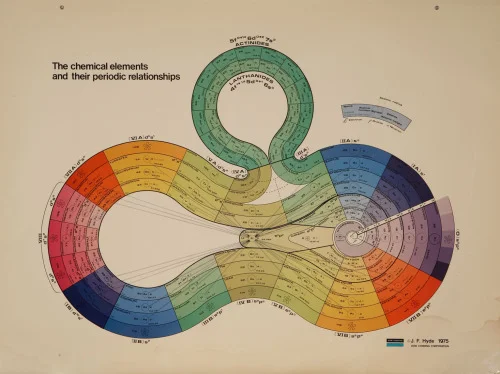
The Periodic Table in the Round

I like these different versions of the periodic table flagged by othmeralia, who wrote: 

In 1869 Dmitrii Mendeleev sketched his first draft of the periodic table.  While Mendeleev’s version remains the most common, alternative arrangements include circular, cylindrical, pyramidal, spiral, and triangular layouts.  Indeed, Edward Mazurs chronicled over 140 types in his seminal work, Graphic Representations of the Periodic System over 100 Years! Which one gets your vote?

The trouble is that the more well-known you are, the more difficult it is to hide away and actually work. When no one is interested in you and inviting you to things, it’s easier.

– British designer Zandra Rhodes, in an interview for the April, 2014 issue of Harvard Business Review by Alison Beard. My title for this quotation isThe Boon of Being Unknown.

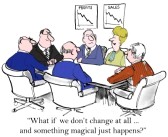
So What If We Don't Change at All…and Something Magical Just Happens?

A tweet with this cartoon reminded me of my post “The Unavoidability of Faith.” I believe that one of the first decisions one must make before putting forth effort is whether efforts are likely to make one’s life better. Since thinking hard is itself effort, there is no way the decision of whether beginning to make an effort at life-improvement has a high enough marginal product to be worthwhile can be made in a fully rational way. It takes faith. If you believe that making an effort at life-improvement is worthwhile (and perhaps by the actions that result, get some confirmation), expressing that faith to others who are just starting out might make a big difference in their lives.

Of course, there are many other things one might have faith in, instead: for example, the idea that even without any effort, everything might work out well because of something magical. What a pleasant belief! But will it work?

Max Huppertz—The Decline in Labor Force Participation: Speed Bump, Hysteresis, or "I, Robot"?

Max Huppertz is a student in my “Monetary and Financial Theory” class and has his own Tumblr blog, Liberal Animation. Of all my current students, Max is the one whose writing reminds me most of Noah Smith’s style on Noahpinion. To get a full picture of Max’s sense of humor, you will have to go to his blog Liberal Animation, but the guest post below shows the depth of Max’s analysis. Max:


Evan Soltas had an interesting post about labor market tightness a couple of weeks ago. His main point is that, looking at the quits rate, you might think that labor markets are pretty tight right now. That might be a sign that, overall, there’s not a lot of unused economic capacity, or at least, not a lot of unused capacity that matters (more on that below). If you think that’s the case, you’d reach very different policy conclusions when it comes to monetary tightening than someone who thinks there’s still plenty of slack in the economy.

Quite a few people have given their 2 cents already. John Aziz makes a point about the potential benefits of overshooting: it might create jobs for some of the long-term unemployed.

Evan may have a good reason for disregarding the long-term unemployed. John’s proposal might be all we need. But if neither of the two is completely right, we may be in trouble.

Why does Evan think that the long-term unemployed don’t matter? He says that if they don’t compete with more active members of the labor force, they can’t hold back wage growth or interfere with employer/employee matching (because they won’t keep people from quitting a job they don’t like for one they enjoy). Which is a valid point.

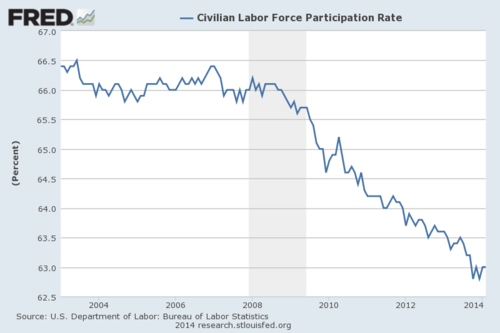
But in the medium to long run, a drop in lower labor force participation seems like somewhat of an issue. And participation is down:

It seems to me that there are three possible reasons for this, and three scenarios how this could play out:

  1. The decrease in labor force participation is transitory. In that case Evan’s assessment is correct, although you could still argue that the possibility to overshoot is a risk worth taking, given its potential benefits.
  2. The decrease is more or less permanent, due to labor market hysteresis. In that case, overshooting alone might do the trick.
  3. The decrease is more or less permanent, and it’s a (labor!) demand trend. In that case, we might have a real issue on our hands.

1) Will it all be over soon?

Evan seems pretty convinced that the long-term unemployed “really can’t matter much in a macroeconomic sense”. I think that statement makes sense only if you assume that, in the long run, labor force participation will return to its pre-crisis level. Else, I would like to see an argument as to why we should ignore the fact that 3% of the total US labor force decided to take some time off. Changes of that magnitude are the ones that tend to matter little now, but a lot if they turn out to be persistent over several years’ time.

2) The UI forever (well, kinda…)

Just so we’re clear: economists have a somewhat peculiar interpretation of the word permanent. When I say that the drop in labor force participation might be permanent, I don’t really mean forever. I mean, “for around ten years or so”. Which is substantially longer than recovering from the recent crisis will take (hopefully, anyway), and thus covers a much longer time span than scenario one. So why might participation be depressed for a whole decade?

There are a few stories you could tell that might lead to scenario two. Maybe people lost a lot of human capital while they were unemployed, and have genuine trouble finding a job. Or maybe, employers regard long-term unemployment as a signal. Long-term unemployment might indicate that you’re not the kind of person people would want to employ. Granted, it might also mean you were just unlucky and got laid off at a time when it was really hard to find a new job. But so long as employers have plenty of ‘good’ applicants to choose from – people who aren’t sending out the long-term unemployment signal – they might be okay with rejecting you anyway.

I’m not sure how likely this scenario is, but if this is the one we’re in, definitely overshoot! Temporarily overheating the economy may raise inflation a little, but it would also mean more job openings and fewer people applying. Making job applicants scarce would provide an incentive for employers to take a closer look at the long-term unemployed, and to figure out whether what happened to them was just bad luck – or whether they’re actually bad apples.

3) Rise of the Robot Lords

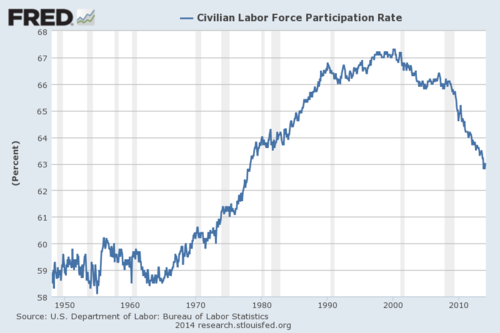
What if the long run equilibrium level of employment is actually decreasing over time? Take a look at the bigger picture:

For a while now, there has been stagnation and quite a substantial drop in labor force participation, even before the dot-com bubble. If employers desperately needed these people, wouldn’t you expect them to raise wages and try to lure some of them back into the game?

I know this sounds a little like a sci-fi cliché, but if falling demand for labor due to increased mechanization were responsible for discouraging workers from even trying to find a job, overshooting will at best give a temporary boost to labor force participation. After that, we’re back to the downward trend.

The remedies for this kind of situation are very different from what we need to do in the other two cases. Increasing the general level of education would be a good idea (it generally is, but especially in this case).

Rethinking the social safety net would be another (this is probably worthy of a post of its own, but let me give you my intuition). Many of the labor-intensive industries of today might rethink their business model once robots become more cost-effective. What happens if mechanization puts us into a position where the vast majority of workers in classic manufacturing jobs (cars, steel) – and possibly also a fair few in the service sector (eventually, burger-flipping robots will be the norm) – are no longer needed? And when, at the same time, the new ‘employees’ – machines – won’t ever ask for pensions, or unemployment benefits? Well, it seems to me that indefinite unemployment insurance, or a guaranteed basic income, might not be so Utopian in this scenario.

Faced with this kind of affluence, society might well decide that the dangers of ‘paying people to be unemployed‘ are far outweighed by the benefits of getting much closer to what John Rawls would call a well-ordered society. And, especially in a highly educated society, I think we have reason to believe that people actually want to work, instead of being on the dole. As Jeffrey Smith nicely said (referring to Arno Duebel, a German who had been living off unemployment benefits for 36 years straight):

The actual mystery, though, is not the existence of someone like Arno, but rather, given the relative generosity of many European welfare states, their relative scarcity.

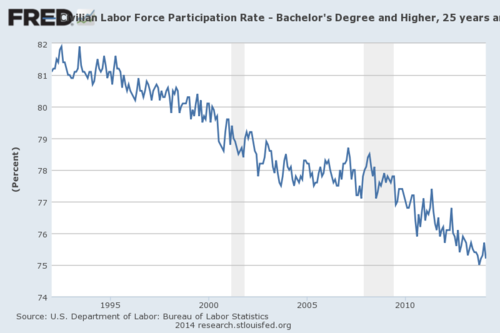
By the way, labor force participation isn’t just down for low-skill workers; this may be an issue that affects us all, even those with a college education (albeit to a lesser degree):

blog.supplysideliberal.com tumblr_inline_n48vd0Ne7I1r57lmx.png

Like I said, this deserves a post of its own.

Humans good, robots bad?

I think that the third scenario is the one we want to be in. Any kind of job that a robot (or machine in general) can do better then a human – why not let it do it?

But it’s also the most difficult one to come to terms with, politically and ideologically. The left would need to give up part of its struggle for the ‘working class’, at least in the classical meaning of the word – factory workers, hard manual labor, that kind of thing. The right, on the other hand, might need to concede that in this kind of environment, maybe having a basic income won’t annihilate the US economy.

Issues like these would have to be dealt with during the next few years and decades. Or, who knows, maybe we are in scenario one, and Evan is right, or two, and John is right. But if not – and there are good reasons to believe this – we might want to start thinking about the implications.