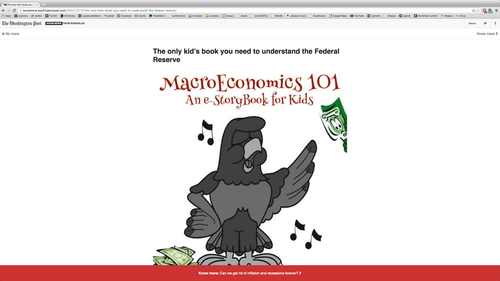
Dylan Matthews: The Only Kid's Book You Need to Understand the Federal Reserve

blog.supplysideliberal.com tumblr_inline_my9mmwPnf01r57lmx.png

I was delighted to see Dylan Matthews featuring in Wonkblog the children’s monetary policy storybook Donna D'Souza and I put together. Dylan accompanied the storybook with these very kind words:

Miles Kimball is one of the most consistently creative economists working these days, and so it’s our luck that he’s taken to writing for a popular audience. His latest work is a foray into kid’s lit, summarizing the basics of how central banks respond to economic downturns in a children’s coloring book (see above).

I have made an effort to promote our storybook in a new medium: with my daughter Diana’s technical assistance, I made and posted three YouTube videos of the storybook:

John Stuart Mill and C. S. Lewis on Originality

Originality is the opposite of orthodoxy. As such, originality is much more controversial in practice than the ritual praise our culture heaps on originality would suggest. So when face to face with an actual instance of originality, it is worth remembering what John Stuart Mill wrote about originality in On Liberty chapter III, “Of Individuality, as One of the Elements of Well-Being,” paragraph 11:

… originality is a valuable element in human affairs. There is always need of persons not only to discover new truths, and point out when what were once truths are true no longer, but also to commence new practices, and set the example of more enlightened conduct, and better taste and sense in human life. This cannot well be gainsaid by anybody who does not believe that the world has already attained perfection in all its ways and practices. It is true that this benefit is not capable of being rendered by everybody alike: there are but few persons, in comparison with the whole of mankind, whose experiments, if adopted by others, would be likely to be any improvement on established practice. But these few are the salt of the earth; without them, human life would become a stagnant pool. Not only is it they who introduce good things which did not before exist; it is they who keep the life in those which already existed. If there were nothing new to be done, would human intellect cease to be necessary? Would it be a reason why those who do the old things should forget why they are done, and do them like cattle, not like human beings? There is only too great a tendency in the best beliefs and practices to degenerate into the mechanical; and unless there were a succession of persons whose ever-recurring originality prevents the grounds of those beliefs and practices from becoming merely traditional, such dead matter would not resist the smallest shock from anything really alive …

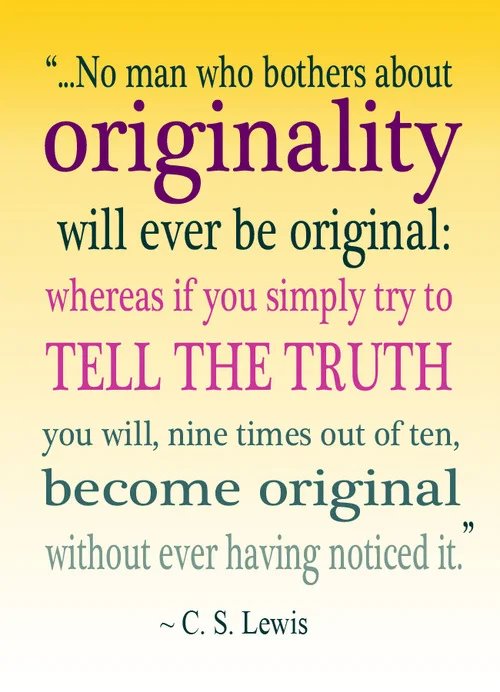
For those who value originality of the world-improving kind John Stuart Mill writes of, C. S. Lewis gives good advice in Emily Sutherland’s poster at the top of this post. (I like the way Emily polishes this gem from the original passage.) What C. S. Lewis says reminds me of something I often say to myself in touchy situations: “If I think hard enough, there has to be some way to get away with telling the truth.”

Geometric Coin Sculptures

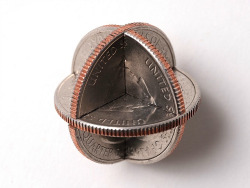
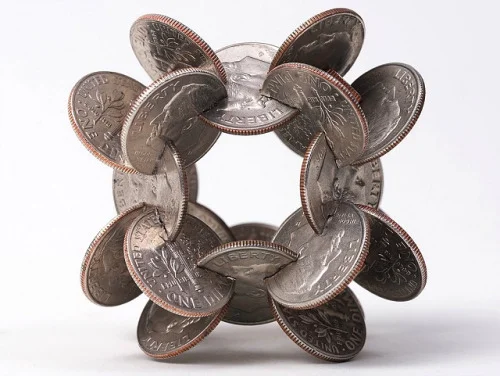
From junkculture: "Complex Geometric Forms Made from Coins Notched and Joined Together.“ Geometry never gets old.

h/t dianakimball

Quartz #37—>Larry Summers Just Confirmed that He is Still a Heavyweight on Economic Policy

blog.supplysideliberal.com tumblr_inline_mxg4q2fgBa1r57lmx.png

Link to the Column on Quartz

Here is the full text of my 37th Quartz column, “Larry Summers just confirmed that he is still a heavyweight on economic policy,” now brought home to supplysideliberal.com. It was first published on November 15, 2013. Links to all my other columns can be found here.

If you want to mirror the content of this post on another site, that is possible for a limited time if you read the legal notice at this link and include both a link to the original Quartz column and the following copyright notice:

© November 15, 2013: Miles Kimball, as first published on Quartz. Used by permission according to a temporary nonexclusive license expiring June 30, 2015. All rights reserved.


Janet Yellen was in the hot seat yesterday before the Senate Banking Committee. Due to a remarkably public vetting process, the presidential nomination for US Federal Reserve Chair that put her there also constituted a comedown for Yellen’s principal rival for the job: Larry Summers. At an International Monetary Fund Conference in honor of former Bank of Israel Governor—and earlier IMF chief economist—Stan Fischer on Nov. 8, Summers made a strong bid for continued relevance to economic policy-making as a private citizen with a trenchant speech. (David Wessel gives an overall report on the conference in this Wall Street Journal article.) Here is the speech:

Summers begins by crediting Fischer for inspiring him to be a macroeconomist, saying this of Fischer’s graduate course on Monetary Economics at MIT:  “It was a remarkable intellectual experience. And it was remarkable also because Stan never lost sight of the fact that this was not just an intellectual game: getting these questions right made a profound difference in the lives of nations and their peoples.” Summers transmitted that attitude to me as one of my professors at Harvard, and I have tried to hand it on to my own students.

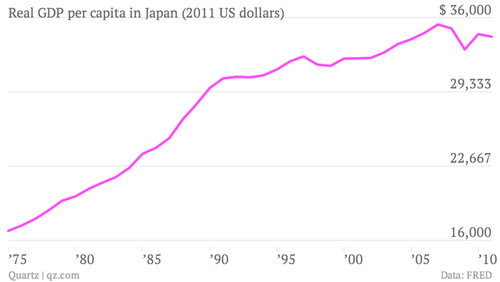
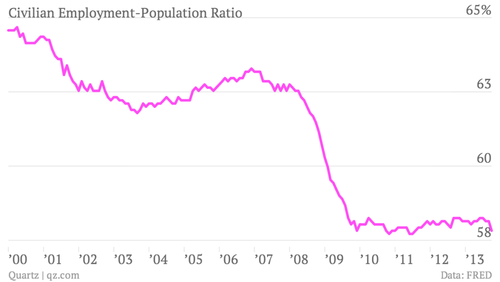
After his praise of Fischer, Summers gives a conventional account of the financial crisis in the fall of 2008 and the largely successful efforts to contain that crisis. But the rest of his speech goes in surprising directions. Summers emphasizes the possibility of “secular stagnation” like that the Japanese economy has suffered in the last two decades. The extent of Japan’s stagnation is breathtaking: In 2013, the Japanese economy is only half the size economists in the 1990’s predicted it would be by now. Even here in the US, GDP is falling further and further behind what we would have predicted just a few years back, and the fraction of the population that has a job has hardly recovered at all in the past four years, despite the fact that the financial crisis was well-contained by November 2009.

What lies behind the stagnation the Japanese economy has suffered in the last two decades and that Summers fears for the United States? He suggests this:

Suppose that the short-term real interest rate that was consistent with full employment had fallen to negative 2% or negative 3% sometime in the middle of the last decade.

With a 2% rate of inflation, an interest rate 3% below inflation would be a negative 1% interest rate in ordinary terms (what macroeconomists would call a -1% nominal interest rate.) But conventional monetary policy can’t reach an interest rate as low as -1%, because anyone can lend as much as they want to the government at 0% by piling up paper currency. This is the zero lower bound on nominal interest rates that macroeconomists justly obsess over. The zero lower bound creates situations where interest rates seem low, but are not low enough to put the economy in high gear.

In the years before the financial crisis, financial excess propped the economy up without ever getting to the kind of excess demand that would push unemployment down to unsustainably low levels and cause higher inflation. In Summers’ words:

Even a great bubble wasn’t enough to produce any excess of aggregate demand…Even with artificial stimulus to demand, coming from all this financial imprudence, you wouldn’t see any excess.

After the financial crisis, the end of financial excess left too little demand and stagnant employment.

What can be done? It isn’t easy to fix things:

  • People grudgingly tolerate zero interest rates for years on end. But that is not enough.
  • It is hard to keep running huge budget deficits year after year after year—and Japan’s experience with trying to escape stagnation by government spending casts doubt about whether that would do the job.
  • There are serious concerns about doing quantitative easing for years with no end in sight.
  • Finally, Summers points out that the very financial regulations that could prevent another financial crisis tend to drive the interest rates people earn when they save further below the interest rates they pay when they borrow, effectively tightening the zero lower bound.

Here is Larry Summers’s conclusion, which stops just short of what the US and the world economy needs—a solution:

It is not over until it is over…We may well need, in the years ahead, to think about how we manage an economy in which the zero nominal interest rate is a chronic and systemic inhibitor of economic activity, holding our economies back, below their potential.

So let me return to versions of two of the questions I posed at the end of July, in “Three big questions for Larry Summers, Janet Yellen, and anyone else who wants to head the Fed.”

  1. Why not eliminate the zero lower bound entirely by changing the way we handle paper currency?
  2. Couldn’t we afford to have much stricter financial regulations—in particular high equity (“capital”) requirements—to avoid a future financial crisis if the zero lower bound were no longer a problem?

Though crucial, diagnosing a problem is not enough. Every diagnosis suggests places to look for a cure. If the zero lower bound is the problem, then getting rid of it is an obvious solution. The economists I talk to, including the many economists I have talked to in central banks around the world, recognize that the real difficulties in eliminating the zero lower bound are political difficulties rather than technical difficulties. So the major economies of the world and the many smaller ones that face the zero lower bound have a choice: politics as usual, with a real chance of secular stagnation, or paving the way for negative interest rates. Politics will stay the same until a critical mass of people do what it takes to make them different. Summers proved at the IMF conference that he is still an economic policy heavyweight—someone who could contribute a lot toward reaching that critical mass in the war against the zero lower bound, if he is willing to join the fight.

Gather 'round, Children, Here's How to Heal a Wounded Economy

blog.supplysideliberal.com tumblr_inline_mxyhvcFHmK1r57lmx.png

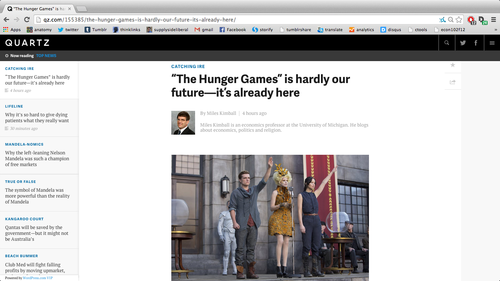
Here is a link to my 41st column on Quartz: “Gather round, children, here’s how to heal a wounded economy." It could also be called "Electronic Money: The Coloring Book.”

Thanks are due to Donna D'Souza for her help in the cause of healing the economy, starting with education about electronic money.  

In case there are any problems with the SoundCloud links in the Quartz column, here is the audio of me reading the story aloud and the audio of me singing the operatic ballad that has the words of the story as the lyrics.

Since I began writing about electronic money, many people have told me that the biggest issues with serious negative (nominal) interest rates and the subordination of paper currency to electronic money needed to make them possible are political issues. I agree. I have thought that the way to change the politics of negative interest rates is to keep explaining them, from many different angles. This is the children’s storybook angle.

I think our storybook/coloring book works as a children’s story. There is an attempt to solve a problem that fails, then there is a twist that solves the problem from an unexpected direction–using a seeming curse that is actually a blessing. See what you think.

Reactions

Greg Mankiw writes on his blog:

If my favorite textbook hasn’t simplified things enough for you…

My friend and former student Miles Kimball takes a stab at explaining some basic macroeconomics through the vehicle of a child’s storybook.

Gerald Seib and David Wessel, in the Wall Street Journal, write:

University of Michigan economist Miles Kimball posts a downloadable coloring book and colored-in storybook to explain his simplified version of how the macro-economy and monetary policy work. [Quartz]

Noah Smith: You Are Already in the Afterlife

This is Noah Smith’s 2d guest religion post on supplysideliberal.com. I love this one almost as much as his 1st:

“God and SuperGod.”

 The Roman emperor and philosopher

Marcus Aurelius said something similar

to what you see below, but I like Noah’s version better:


If you ever want to freak yourself out, just sit there and think hard about what it’s like to be dead. Not “playing a harp in Heaven” dead, or even “roasting in a lake of fire in Hell” dead, but really dead. Just no more thoughts, forever and ever and ever and ever. 

Doesn’t that send a shiver down your spine? That’s called self-preservation instinct. No wonder people like to believe in an afterlife, right? Everyone wants to live forever

Now let’s think about something much less scary. Try to remember what it was like to be a 5-year-old (or if that challenge is too hard, try to remember–really remember–what it was like to be you 10-years ago). Of course you can remember snippets - the feel of a set of toy blocks, or the sound of your mom’s voice, or the shape of your kindergarten classroom. But I bet you can’t remember what it was really like to experience life, moment-to-moment, as a 5-year-old. How would the 5-year-old you react to this blog post? Would (s)he be comfortable in the chair you’re sitting in right now? What would (s)he be looking forward to right now? 

You may be able to guess at the answers to these questions, but the truth is, you don’t know. The experience and feeling and “qualia” of being a 5-year-old you is gone forever. You will never again perceive the Universe the way the 5-year-old you did. In other words, the 5-year-old you is dead. Really, truly gone from the Universe. The 5-year-old you will never think another thought. 

Even if you go to Heaven. 

So don’t be so afraid of Real Death. It’s something you’ve already experienced - not just once, but an indeterminate number of times. You, right now, are a living person, but because you’re living and growing and changing, you’re dying at the same time. Death is an old friend. 

Now think about what this means for the afterlife. Heaven is a comforting thought because it quiets our self-preservation instinct. But what would happen if we really went to Heaven? Either we’d have experiences similar to those we had when alive (flying around, playing a harp, eating infinite Doritos without getting fat, whatever), or we won’t. But if we experience things, those experiences will change us. Then eventually we won’t be the same person anymore. The soul may be eternal, but the part of you that’s really you just can’t stick around. 

So it doesn’t really matter if there’s an afterlife or not, does it? Life is change, and change is death. The process of living is the process of dying. 

So what does this mean for our lives? It means we shouldn’t spend much time worrying about death. And it also means we shouldn’t put our hopes in a better life in the next world. This is the world. This is life. You’re awake and alive and thinking things right now. Isn’t that amazing?


Interview by Joseph Sotinel for the French Website BFMBusiness about Electronic Money (with a Translation of My Bit)

blog.supplysideliberal.com tumblr_inline_mxnqjoS9O01r57lmx.png

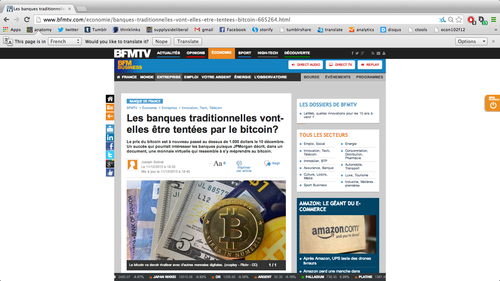
I was interviewed on Wednesday (December 11, 2013) by Joseph Sotinel of BFMBusiness for an article on electronic money: “Les banques traditionnelles vont-elles être tentées par le bitcoin?” (“Are traditional banks going to be tempted by bitcoin?”) The article, like the title, is in French. Here is what I am quoted as saying:

Une monnaie électronique permettrait des taux d'intérêts négatifs

Mais un acteur manque pour élaborer une monnaie électronique: les banques centrales. “On ne peut pas avoir de monnaie gérée par un algorithme ou un robot aujourd'hui sans avoir d'inflation”, explique Miles Kimball, avant d'ajouter: “Le bitcoin, en soi, n'est pas très utile, mais montre ce qui peut être fait.”

Selon lui, si les banques centrales se convertissaient aux monnaies électroniques, elles gagneraient de nouveaux outils monétaires, comme la possibilité de fixer des taux directeurs négatifs.

“Il faudrait alors des régulations financières très strictes”, reconnaît l'universitaire. En attendant, son idée gagne du terrain. En septembre, la Banque de France l'a accueilli pour un séminaire au sujet de la monnaie électronique.

But I didn’t say that, because my French isn’t that good! Here is my translation, done with the help of Google translate, having listened and talked back to the three levels of Pimsleur’s French CD’s–and knowing what I said in the first place. 

Electronic Money Permits Negative Interest Rates

But there is one category of actor that has failed to develop electronic money: central banks. Today, we cannot have money managed by an algorithm or a robot without inflation [or deflation], explains Miles Kimball, before adding: “Bitcoin would not work very well in that regard, but it shows what can be done.”

According to him, if central banks converted to electronic money, they gain new monetary tools, such as the possibility of setting negative rates.

“It would then be appropriate to have very strict financial regulation,” recognizes the university professor. Meanwhile, his idea is gaining ground. In September, the Bank of France hosted him for a seminar on electronic money

The Volcker Rule

Former Fed Chairman Paul Volcker suggested what has come to be called the Volcker Rule.

I am with Anat Admati and Martin Hellwig in strongly preferring tougher equity requirements on the liability side of the balance sheet that make sure banks and other financial firms are investing their own shareholder’s money to tight restrictions on the asset side like the Volcker rule. But given where the discussion is, I think the Volcker rule is a net plus. The Volcker rule can always be loosened later in exchange for higher equity requirements. The stronger the liability-side rules (high equity or “capital” requirements) the more financial firms can innovate on the asset side without putting the economy in danger, or putting taxpayers on the hook. The value of that innovation is one reason I think equity requirements are so much superior. Of course, there have to be *some* asset-side rules, but they only have to rule out quite extreme positions if the equity requirement is at 50%, as I recommended here:

Anat Admati, Martin Hellwig and John Cochrane on Bank Capital Requirements.

The reason common equity is such a good funding mechanism for financial stability is that stock prices go up and down all the time and no one is likely to be deceived by a claim that stocks are totally safe. By contrast, almost all forms of debt have built into them some relatively sudden transition from looking fairly safe to looking very scary when things go south. Stocks don’t have that sudden transition because they always look at least a little scary.

Miles Kimball and Scott Sumner: Monetary Policy, the Zero Lower Bound and Madison, Wisconsin

I had an interesting email exchange with Scott Sumner that he agreed I could share with you. In addition to talking about monetary policy and the zero lower bound, Scott and I figured out that we grew up less than a mile away from each other in Madison, Wisconsin. I am leaving out the actual addresses because security questions sometimes ask them, but I looked them up on Google Maps: the two houses Scott grew up in were 7/10 and 8/10 of a miles from mine. And Scott was in an elementary school class with my older brother Chris! (Chris has one guest blog post on supplysideliberal.com:

“Big Brother Speaks: Christian Kimball on Mitt Romney.”


Miles: 

I think you might be interested in my latest post:

“Monetary vs. Fiscal Policy: Expansionary Monetary Policy Does Not Raise the Budget Deficit.”

Scott: 

Thanks Miles, I’ll do a post in reply in the next few days.

Miles:

Wonderful! Thanks, Scott.

Scott: 

Sorry to get back to you so late, but I did this post in reply about a month ago:

“Miles Kimball on the Good, the Bad, and the Ugly”

I saw you grew up in Madison.  The West side by any chance?  And did you have any older siblings?  The name is familiar.

Miles:

I am so far behind on my email I am only reading this now. Thanks for your post. My main reaction is that the mechanisms you mention might be enough at 2% inflation, but not at zero. To safely have 0 inflation, I think we need to eliminate the ZLB.

Yes. I went to Nakoma (later renamed Thoreau) for elementary school. My older brother was Christian Kimball. Paula and Mary are other siblings. I also had cousins David, Kent and Tim Kimball.

Scott:

It’s a small world, I recall that Chris was a classmate of mine in elementary school.  That’s 50 years ago!

I think we should keep the NGDP target path high enough to keep nominal rates above zero; not because I think zero rates prevent us from hitting our target, but rather because low rates might force the Fed to buy a lot of stuff, and I don’t think an enormous balance sheet is desirable.  So I agree about zero inflation being undesirable, but for different reasons.

Another reason to say away from the zero bound is to stop Williamson from writing more crazy posts.  :)

PS.  My first blog post after the intro (in early 2009) suggested that the Fed might want to look at negative IOR–but it fell short of your proposal.

Miles:

That is really cool to realize that you knew Chris! I’ll see him next week.  

Actually, I was going the other way, saying that absent the ZLB, zero inflation has definite benefits as compared to 2% inflation. So if eliminating the ZLB by the kind of thing I am proposing allows us to have 0 inflation instead of 2%, that alone would make it worth doing. You probably saw this, but I lay out the detailed argument here:

“The Costs and Benefits of Repealing the Zero Lower Bound … and Then Lowering the Long-Run Inflation Target.”

Scott: 

My memory is poor, but I vaguely recall he was a more serious and mature student than the other boys.  And I think he had glasses (as did I.)  That’s all I recall.  I suppose I should ask which street you lived on—we lived in Huron Hill then Seneca Place.  My brother was 3 years younger–closer to your age.

I do get your point about negative rates on money making it easier to have zero inflation.  In my view 90% of the cost of raising inflation from 0% to 2% or 3% comes from the taxation of capital, and I think right now it would be easier to switch to a progressive consumption tax than to deal with paper currency in your system.  But we are going to all electronic money in a few decades anyway so you’ll be right in the long run.  And then you’ll just have to convince the Krugman’s of the world that zero inflation is not bad for the labor market (money illusion and all.)

Miles:

I would like to make a blog post out of our exchange (leaving out our exact addresses of course!) I think the discussion about monetary policy in particular will be of interest to people, as well as the fact that we grew up only about a mile from each other.  Would that be OK?

Scott:

That’s fine.

BTW, I don’t really care, but people will get the impression that I grew up in an upper middle class family, when were were actually middle class.  My dad told me in the 1970s that he’d never made more than $10,000 in his life, which might be $50,000 or $60,000 today.  But he was clever with real estate and got us into a nice neighborhood, until they divorced when I was 11.  Don’t know if you are planning to discuss the affluence of Nakoma, if so you are free to use this info about me, or not, as you prefer.

Miles: 

Thanks, Scott.
Cathy O'Neil on Slow-Cooked Math

Math is sometimes better when it is marinated and cooked slowly; timeless truths take time. Cathy O'Neil, who blogs as Mathbabe, makes that point in her Q&A post  “How do I know if I’m good enough to go into math?” She kindly gave me permission to reblog it here. I talk about my own experiences after the text of her post. 

Q:

Hi Cathy,

I met you this past summer, you may not remember me. I have a question.

I know a lot of people who know much more math than I do and who figure out solutions to problems more quickly than me. Whenever I come up with a solution to a problem that I’m really proud of and that I worked really hard on, they talk about how they’ve seen that problem before and all the stuff they know about it. How do I know if I’m good enough to go into math?

Thanks, High School Kid

A: 

Dear High School Kid,

Great question, and I’m glad I can answer it, because I had almost the same experience when I was in high school and I didn’t have anyone to ask. And if you don’t mind, I’m going to answer it to anyone who reads my blog, just in case there are other young people wondering this, and especially girls, but of course not only girls.

Here’s the thing. There’s always someone faster than you. And it feels bad, especially when you feel slow, and especially when that person cares about being fast, because all of a sudden, in your confusion about all sort of things, speed seems important. But it’s not a race. Mathematics is patient and doesn’t mind. Think of it, your slowness, or lack of quickness, as a style thing but not as a shortcoming.

Why style? Over the years I’ve found that slow mathematicians have a different thing to offer than fast mathematicians, although there are exceptions (Bjorn Poonen comes to mind, who is fast but thinks things through like a slow mathematician. Love that guy). I totally didn’t define this but I think it’s true, and other mathematicians, weigh in please.

One thing that’s incredibly annoying about this concept of “fastness” when it comes to solving math problems is that, as a high school kid, you’re surrounded by math competitions, which all kind of suck. They make it seem like, to be “good” at math, you have to be fast. That’s really just not true once you grow up and start doing grownup math.

In reality, mostly of being good at math is really about how much you want to spend your time doing math. And I guess it’s true that if you’re slower you have to want to spend more time doing math, but if you love doing math then that’s totally fine. Plus, thinking about things overnight always helps me. So sleeping about math counts as time spent doing math. 

[As an aside, I have figured things out so often in my sleep that it’s become my preferred way of working on problems. I often wonder if there’s a “math part” of my brain which I don’t have normal access to but which furiously works on questions during the night. That is, if I’ve spent the requisite time during the day trying to figure it out. In any case, when it works, I wake up the next morning just simply knowing the proof and it actually seems obvious. It’s just like magic.]

So here’s my advice to you, high school kid. Ignore your surroundings, ignore the math competitions, and especially ignore the annoying kids who care about doing fast math. They will slowly recede as you go to college and as high school algebra gives way to college algebra and then Galois Theory. As the math gets awesomer, the speed gets slower.

And in terms of your identity, let yourself fancy yourself a mathematician, or an astronaut, or an engineer, or whatever, because you don’t have to know exactly what it’ll be yet. But promise me you’ll take some math major courses, some real ones like Galois Theory (take Galois Theory!) and for goodness sakes don’t close off any options because of some false definition of “good at math” or because some dude (or possibly dudette) needs to care about knowing everything quickly. Believe me, as you know more you will realize more and more how little you know.

One last thing. Math is not a competitive sport. It’s one of the only existing truly crowd-sourced projects of society, and that makes it highly collaborative and community-oriented, even if the awards and prizes and media narratives  about “precocious geniuses” would have you believing the opposite. And once again, it’s been around a long time and is patient to be added to by you when you have the love and time and will to do so.

Love,  Cathy

I especially like what Cathy says about fast and slow. I think of myself as a slow mathematician. It often takes me half an hour to wrap my head around a math problem or much more if it is a big one. I have gotten used to the confusion I regularly experience for that first chunk of time. If I keep wrestling with the problem, and come at it from different angles, usually the mental fog eventually clears.

Individuality: Noble and Beautiful; Crushing Individuality: Despotism.

John Stuart Mill's On Liberty chapter III, “Of Individuality, as One of the Elements of Well-Being,” paragraph 9 reads:

It is not by wearing down into uniformity all that is individual in themselves, but by cultivating it and calling it forth, within the limits imposed by the rights and interests of others, that human beings become a noble and beautiful object of contemplation; and as the works partake the character of those who do them, by the same process human life also becomes rich, diversified, and animating, furnishing more abundant aliment to high thoughts and elevating feelings, and strengthening the tie which binds every individual to the race, by making the race infinitely better worth belonging to. In proportion to the development of his individuality, each person becomes more valuable to himself, and is therefore capable of being more valuable to others. There is a greater fulness of life about his own existence, and when there is more life in the units there is more in the mass which is composed of them. As much compression as is necessary to prevent the stronger specimens of human nature from encroaching on the rights of others, cannot be dispensed with; but for this there is ample compensation even in the point of view of human development. The means of development which the individual loses by being prevented from gratifying his inclinations to the injury of others, are chiefly obtained at the expense of the development of other people. And even to himself there is a full equivalent in the better development of the social part of his nature, rendered possible by the restraint put upon the selfish part. To be held to rigid rules of justice for the sake of others, develops the feelings and capacities which have the good of others for their object. But to be restrained in things not affecting their good, by their mere displeasure, develops nothing valuable, except such force of character as may unfold itself in resisting the restraint. If acquiesced in, it dulls and blunts the whole nature. To give any fair play to the nature of each, it is essential that different persons should be allowed to lead different lives. In proportion as this latitude has been exercised in any age, has that age been noteworthy to posterity. Even despotism does not produce its worst effects, so long as individuality exists under it; and whatever crushes individuality is despotism, by whatever name it may be called, and whether it professes to be enforcing the will of God or the injunctions of men.

(Above, I modernized the spelling of “developes” to “develops.”)

What Bitcoin Tells Us about Electronic Money

blog.supplysideliberal.com tumblr_inline_mxe8apjkgT1r57lmx.png

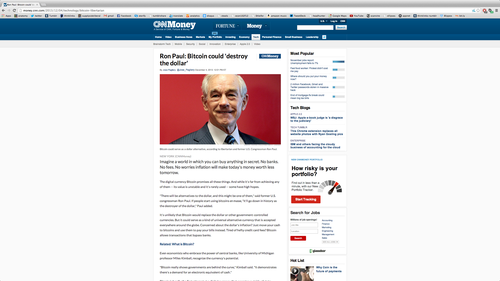
Link to Jose Pagliery’s CNNMoney article “Ron Paul: ‘Bitcoin could destroy the dollar’”

Jose Pagliery interviewed me for a CNNMoney article on Bitcoin. Here are the 2 passages with quotes from me:

Even economists who embrace the power of central banks, like University of Michigan professor Miles Kimball, recognize the currency’s potential.

“Bitcoin really shows governments are behind the curve,” Kimball said. “It demonstrates there’s a demand for an electronic equivalent of cash.”

“Governments absolutely demand a monopoly on money and credit. They’re not going to give it up easily,” Paul warned. “They will come down hard.”

Kimball hopes politicians will take a less combative approach, choosing instead to compete.

“I suppose they could just try to crush Bitcoin, but that’s the wrong way to do it,” Kimball said. “Governments should be creating their own version of Bitcoin. They should be ashamed they haven’t.”

Our interview is also reflected in the mention of how Bitcoin dominance would take away central banks' “ability to help slow and speed up economic activity,” and in the discussion M-PESA. Jose did not fully reflect my claim that Bitcoin is an attempt at digital gold; even once things settled down, a dominant Bitcoin would give us monetary policy as bad as the gold standard did, which was pretty bad.