Quartz #27—>Three Big Questions for Larry Summers, Janet Yellen, and Anyone Else Who Wants to Head the Fed
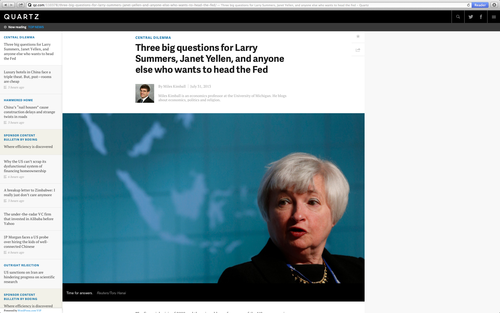
Here is the full text of my 27th Quartz column, "Three big questions for Larry Summers, Janet Yellen, and anyone else who wants to head the Fed,“ now brought home to supplysideliberal.com. It was first published on July 31, 2013. Links to all my other columns can be found here.
If you want to mirror the content of this post on another site, that is possible for a limited time if you read the legal notice at this link and include both a link to the original Quartz column and the following copyright notice:
© July 31, 2013: Miles Kimball, as first published on Quartz. Used by permission according to a temporary nonexclusive license expiring June 30, 2014. All rights reserved.
The financial crisis of 2008 and the miserable performance of the US economy since then made the Federal Reserve look bad. And almost everything the Federal Reserve has done since then to try to get the economy back on track—from the role it took in the Wall Street bailouts (detailed in David Wessel’s book In Fed We Trust), to dramatically increasing the money supply, to quantitative easing—has also made the Fed look bad.
Despite how bad the Fed’s performance looks, things could have been worse—much worse—and I have argued that Ben Bernanke, who led the Fed through this difficult time, should be given a third term as head of the Fed. But as President Obama has made very clear, that is not going to happen.
Now there are rival campaigns for who will follow Bernanke as Fed chief, with former Treasury Secretary Larry Summers and Fed Vice Chairman Janet Yellen as the leading candidates. Ezra Klein has repeatedly written on Wonkblog that Obama’s inner circle favors Summers, and Senate Democrats were galvanized by the prospect to write a letter favoring Yellen, followed a few days later by a New York Times editorial board weighing in strongly for Yellen. Much of the discussion has focused on personality differences that I can verify: Larry Summers was one of my professors in economics graduate school and I had a memorable dinner talking about the economics of happiness with Janet Yellen and her Nobel-laureate-to-be husband George Akerlof when I gave a talk at Berkeley in 2006.
I distilled my own observations into tweets saying on the one hand that “Larry Summers can dominate a room full of very smart economists” while “Janet Yellen, like her husband George Akerlof, is one of the nicest economists I have ever met.” Despite that personal knowledge, and the same publicly available information as everyone else, I had to confess on a HuffPost Live segment on July 25, 2013, that my own views on the relative merits of Summers and Yellen go back and forth on an hourly basis. The source of my trouble is this: there are many questions Larry Summers has studiously avoided addressing about monetary policy (Neil Irwin in Wonkblog thinks this is a deliberate, but flawed strategy) and even Yellen, who has an extensive and laudable record on past and current monetary policy and financial stability policy, hasn’t answered all the questions I have about the future of monetary policy and policy to enhance financial stability. On financial stability, Summers has made mistakes in the past (helpfully listed by Erika Eichelberger at motherjones.com), so I especially want to know where he would go in the future in this important function of the Fed.
The questions I would like to ask Larry Summers and Janet Yellen are many, but let’s focus on three big ones:
- Eliminating the “Zero Lower Bound” on Interest Rates. Given all of the problems that a floor of zero on short-term interest rates causes for monetary policy, what do you think of going to negative short-term interest rates, as I have argued for here and here and here? If we repealed the “zero lower bound” that prevents interest rates from going below zero, there would be no need to rely on the large scale purchases of long-term government debt that are a mainstay of “quantitative easing,” the quasi-promises of zero interest rates for years and years that go by the name of “forward guidance,” or inflation to make those zero rates more potent. Repealing the “zero lower bound” would require dramatic changes in monetary policy (and in particular, a dramatic change in the way we handle paper currency), but wouldn’t that be worth it?
- Nominal GDP Targeting. What do you think of clarifying monetary policy by guiding short-term interest rates by the velocity-adjusted-money-supply (nominal GDP) targets recommended by the Market Monetarists, combined with regular, explicit forecasts for how high GDP can go without raising inflation? (See “This Economic Theory was Born in the Blogosphere and Could Save the Markets from Collapse.”) In hindsight, it is clear that the Fed should have acted more quickly, and done more, to get the US economy out of the slump the financial crisis put it in. During that time, the behavior of the velocity-adjusted money supply clearly indicated that more monetary stimulus was needed. Wouldn’t it make sense to pay more attention to an indicator that does well both in ordinary times and when the economy faces a crisis the likes of which we haven’t seen since the Great Depression—and move away from the faulty reliance some of those who vote in the Fed’s monetary policy committee put on non-velocity-adjusted money supply numbers?
- High Equity Requirements for Banks and Other Financial Firms.What do you think of what Anat Admati and Martin Hellwig have to say about financial regulation in their book The Bankers’ New Clothes: What’s Wrong with Banking and What to Do About It? Their argument comes down to this: despite all of the efforts of bankers and the rest of the financial industry to obscure the issues, it all comes down to making sure banks are taking risks with their own money—that is, funds provided by stockholders—rather than with taxpayers’ or depositors’ money. For that purpose, there is no good substitute to requiring that a large share of the funds banks and other financial firms work with come from stockholders. (For follow-up questions on financial regulation, Admati and Hellwig have an invaluable cheatsheet.)
Any serious candidate for the Fed who gives positive answers to these three questions will have my enthusiastic support, and I hope, the enthusiastic support of all those who have a deep understanding of monetary policy and financial stability. But any candidate for the Fed who gives negative answers to these three questions will be indicating a monetary policy and financial stability philosophy that would leave the economy in continued danger of slow growth (with little room for error) and high unemployment in the short run, and the virtual certainty of another serious financial crisis a decade or two down the road.
Update: I am delighted that Gerald Seib and David Wessel flagged this column in their August 2, 2013 Wall Street Journal “What We’re Reading”feature. They write
University of Michigan economist Miles Kimball says the best candidate to take over as leader of the Fed will back negative short-term interest rates, nominal GDP targeting, and high equity requirements for banks and financial firms. If a candidate is chosen who opposes any of these three, Mr. Kimball predicts another serious financial crisis in the next two decades. [Emphasis added.]
In their last sentence, they go beyond what I intend when I write
But any candidate for the Fed who gives negative answers to these three questions will be indicating a monetary policy and financial stability philosophy that would leave the economy in continued danger of slow growth (with little room for error) and high unemployment in the short run, and the virtual certainty of another serious financial crisis a decade or two down the road.
Let me clarify. First, it is not these beliefs by the Fed Chief alone that would lead to a financial crisis, but the philosophy that would answer my three questions in the negative, held more generally—by the Fed Chief and other important players around the world. But of course, the Fed Chief is a hugely important player on the world stage. Second, I write “who gives negative answers to these three questions” meaning negative answers to all three. To separate out the causality more carefully, what I have in mind with the parallel structure of my final sentence in the column (quoted just above) is
- Rejection of both negative interest rates and nominal GDP targeting—and perhaps rejection of negative interest rates alone—“would leave the economy in continued danger of slow growth (with little room for error) and high unemployment in the short run.”
- Rejection of high equity requirements for banks and other financial firms would lead to “the virtual certainty of another serious financial crisis a decade or two down the road.”
Outtakes: Here are two passages that I had to cut to tighten things up, but that you may find of some interest:
In brief, the Fed put itself in the position of getting bad results using unpopular methods. By July 2009, the Fed’s job approval rating in a Gallup poll was down to 30%, below the job approval rating for the IRS . By the time of the 2012 presidential election campaign, Republican crowds enthusiastically chanted the title of Republican candidate Ron Paul’s book End the Fed.
…in a 32-second exchange with Charlie Rose that is well worth watching for the nuances, President Obama said “He’s already stayed a lot longer than he wanted, or he was supposed to.” The praise for Bernanke in the Charlie Rose interview is so tepid and ungenerous that my interpretation is the same as US News and World Report editor-in-chief Mortimer Zuckerman’s in his July 25, 2013 Wall Street Journal op-ed “Mistreating Ben Bernanke, the Man Who Saved the Economy”: “This comment made it clear that Mr. Bernanke’s days were numbered.”
General Freedom as a Way to Get Others to Gather Experimental Evidence for Me about Different Ways of Living

In Chapter 3 of On Liberty, John Stuart Mill pivots from arguing for freedom of speech to arguing for arguing for freedom of action. He begins the chapter by arguing that finding truth requires experimentation as well as discussion. So people who do unusual things with their lives are doing me a favor, by their experimentation:
SUCH being the reasons which make it imperative that human beings should be free to form opinions, and to express their opinions without reserve; and such the baneful consequences to the intellectual, and through that to the moral nature of man, unless this liberty is either conceded, or asserted in spite of prohibition; let us next examine whether the same reasons do not require that men should be free to act upon their opinions—to carry these out in their lives, without hindrance, either physical or moral, from their fellow-men, so long as it is at their own risk and peril…. if he refrains from molesting others in what concerns them, and merely acts according to his own inclination and judgment in things which concern himself, the same reasons which show that opinion should be free, prove also that he should be allowed, without molestation, to carry his opinions into practice at his own cost. That mankind are not infallible; that their truths, for the most part, are only half-truths; that unity of opinion, unless resulting from the fullest and freest comparison of opposite opinions, is not desirable, and diversity not an evil, but a good, until mankind are much more capable than at present of recognizing all sides of the truth, are principles applicable to men’s modes of action, not less than to their opinions. As it is useful that while mankind are imperfect there should be different opinions, so is it that there should be different experiments of living; that free scope should be given to varieties of character, short of injury to others; and that the worth of different modes of life should be proved practically, when any one thinks fit to try them. It is desirable, in short, that in things which do not primarily concern others, individuality should assert itself. Where, not the person’s own character, but the traditions of customs of other people are the rule of conduct, there is wanting one of the principal ingredients of human happiness, and quite the chief ingredient of individual and social progress.
Top 200 Influential Economics Blogs: Aug 2013 | Onalytica Indexes →
Confession of a Supply-Side Liberal is ranked 61st in this list of influential economics blogs. That seem pretty good to me, since the readership of my columns on Quartz itself would not be counted. On that score, note that at the end of June 2012, just a month after I started blogging, Confessions of a Supply-Side Liberal was ranked 31st.
On the decline in ranking since the last list, Andreea Moldovan makes this note:
We have recently added some very well-known and influential blogs such as Economix, FT Alphaville and Vox, causing most blogs to go down in ranking.
Bruce Bartlett on Careers in Economics and Related Fields
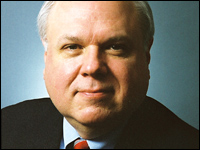
Bruce Bartlett (image from Ezra Klein’s 2009 interview with Bruce)
Having read Bruce Bartlett’s op-eds for many years, I was pleased to have him send me directly a comment on the column Noah Smith and I wrote: “The complete guide to getting into an economics PhD program.” He kindly gave me permission to reprint what he wrote here. His main point is that there are many good careers in economics that do not require a PhD. I agree. Indeed, one of the reasons I feel good about Noah’s and my advice about working toward an economics PhD is that along that highway, there are many wonderful exits along the way, should you choose not to go all the way to an economics PhD. And if you do get a PhD, there are many careers outside of economics, as well as in, that you will be well prepared for.
Here is what Bruce wrote to me:
I realize your column was specifically about getting a Ph.D. in economics, but you might have also discussed the options for working in economics with no degrees in economics at all. I don’t have any and I did pretty well and landed some high level government economics positions. My career path is probably not very transferable, but I would mention journalism as one place one can write about economics without a degree in the subject. Catherine Rampell, a NYT business reporter, for example, has only a BA in English and she’s very good. Another option is law. Many areas of law intersect with economics—tax law, antitrust, many areas of economic regulation etc. The law reviews are filled with articles about economics that would never be accepted by any actual economics journal, but that will get you tenure at a law school, where all you need is a law degree. Political scientists and sociologists also do a lot of quasi-economics work. So if you are just interested in being an economist without wanting to jump through the hoops to get a Ph.D. in the subject and teach it at the university level, I would suggest there are other options.
I would also mention that there are a lot of jobs for those who only have a master’s degree in the subject. That is often good enough for government work or a job in a think tank or as a business economist or at an international financial institution such as the World Bank.
Anat Admati's Words of Encouragement for People Trying to Save the World from Another Devastating Financial Crisis
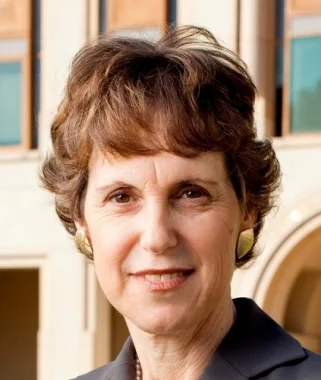
I was privileged to be copied on an email exchange between Anat Admati and someone who had worked hard to make the financial system more stable, but had gotten discouraged by the politics one runs into in such an effort. I loved Anat’s words of encouragement, which I think are apt for anyone who is trying to make a difference for greater financial stability in the real world. Anat kindly gave me permission to reprint a passage from that message here, after some very light editing:
…“policy makers’ indifference to reality” resonates. I had no idea just how bad it can be. First I was shocked at confusions and misunderstanding. Naively I thought that is mostly what it is, never mind why, if folks don’t understand, maybe they can’t be blamed. Then you come across the political issues and the capture and the picture becomes much uglier. I read a book recently and met the author called “Willful Blindness” – http://www.amazon.com/Willful-Blindness-Ignore-Obvious-Peril/dp/0802777961 – part of the evidence is from experiments. It becomes about what people WANT to know, and then of course they have to be ABLE to do something about it, and they also have, again, to WANT to do something. By the time you get to actually doing something, well, the numbers are very few and far between.
So I may have stirred the pot, but serious progress, maybe a little bit, reluctantly, hard to tell… it depends on expectations..
Anyway, I can understand the bruised feelings. In my case, especially since I am up against a lot of money, I also get bruised a lot and it’s hard to take. It’s easy to give up, but I get annoyed about the wrong side winning so I dust myself off and think of something else to do. Fortunately, I/we do have paying jobs and I feel by now that under the circumstances, it is virtually our duty to lobby on behalf of the public. The political economy of money and influence ends up messing up democracies, see Olsen etc…
Scott Sumner vs. Peter Schiff on the Kudlow Report
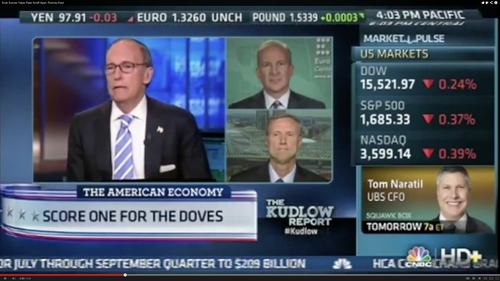
Link to the Youtube video “Scott Sumner Takes Peter Schiff Apart, Point by Point.”
Having confronted Peter Schiff myself along with Mike Konczal on HuffPost Live, I was glad to see Scott Sumner’s detailed rebuttals to Peter Schiff on Larry Kudlow’s show. I do not use the word lightly when I write that Peter Schiff is spouting gobbledygook. But in the words of one of my John Stuart Mill posts, “Let the Wrong Come to Me, for They Will Make Me More Right.” Scott Sumner is made very right in this segment.
Noah Smith, Miles Kimball and Claudia Sahm on Math in Economics →
Short and sweet & sour.
Jeff Smith: More on Getting into an Economics PhD Program

My University of Michigan colleague Jeff Smith had these wise words to add to what Noah and I said on how to get into an economics PhD program. Jeff kindly gave me permission to reprint his advice here as a guest post:
I am generally in agreement with what Miles and Noah have to say, but would add or alter a few bits:
1. By all means do not just focus on the top five or 10 or 15 programs. The poster child here is probably Amitabh Chandra (now at the Kennedy School), whose doctorate is from Kentucky. On my very first visit to Kentucky back in my assistant professor days, I was assigned to meet with Amitabh and told to talk him out of staying at Kentucky for his doctorate. I failed, but his career seems to have turned out fine anyway. The reason it turned out fine is that the faculty at Kentucky, who already knew Amitabh as a stellar undergraduate, treated him like a colleague throughout his doctoral studies. He got a lot more attention and opportunity than he would have at a top program. Example number two is my colleague Martha Bailey, whose doctorate is from Vanderbilt. What Amitabh and Martha have in common is a lot of internal drive, which you need to make this strategy work because there is less external pressure from peers and faculty outside the top departments.
2. You should take more than just one statistics course. If your college offers an upper econometrics track for undergraduates (many do, and Michigan will soon) take the whole thing. If an upper track is not available, be sure you do what you can and think about taking some courses in the statistics department as well.
3. Learn to program if you do not already know. Pretty much any reasonable programming language will do. Once you have learned one, others (including statistical packages like Stata or Matlab) are much easier to learn.
4. I think there can be more value in doing an MA first than Miles and Noah. This is particularly true if your undergraduate record is a bit weak and/or if you are unsure you really want to do a doctorate. The trick is then picking the correct MA program. Many are aimed at mid-career people adding a credential and not at people thinking about a doctorate. I recommend in particular the programs at UBC and Toronto. They have the added bonus of plugging you into a somewhat different network and letting you experience life in another country (assuming you are not Canadian).
5. It is harder to get someone to hire you as a research assistant, even at a zero money wage, than Miles and Noah suggest. The time cost to the professor is really large of having a research assistant. Paying that time cost for someone who turns out not to produce - it happens! - is something faculty really try hard to avoid. So if you want to do this, it is probably best to first make a good impression in a class, or in someone else’s class who is willing to write an email of introduction for you to the person you want to work for.
6. Think about taking, or at least auditing, first-year graduate courses at your undergraduate institution. I did this at Washington, taking Gene Silberberg’s excellent first quarter of graduate micro.
7. Getting a doctorate at a biz school with an economics group is at least as good as a straight-up economics program. It is easier to get in and you will likely have more financial aid and a nicer place to work. The same holds for some policy school doctoral programs.
Self-Control as Inaction

Wu-wei: action through inaction
The image of self-control, both in popular culture and in economics, is of a kind of action. But psychologists Justin Hepler and Dolores Albarracín report that priming people with extraneous inaction words helped them resist temptation, while extraneous action words made it harder for them to resist temptation. (See the news article by Rick Nauert, “Is Unconscious Self-Control Possible?”) This sounds like Taoist wisdom to me: the key Taoist concept of wu-wei is “action through inaction.”
John Maynard Keynes as Art Snob
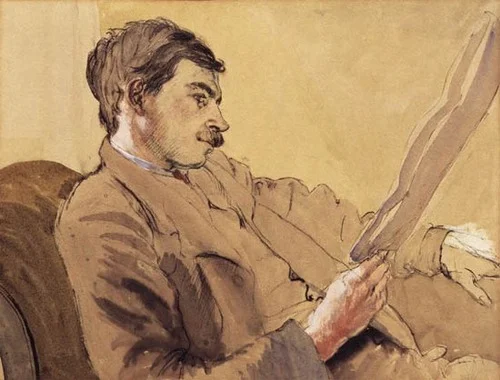
In his book How Music Works, David Byrne argues for the traditional economic principle “De gustibus, non est disputandum”–tastes are not to be disputed. But eminent economist John Maynard Keynes departed from that principle in the arts. Here is what David Byrne says about Keynes, on pages 279 and 280:
Outside of his work as an economist, Lord Keynes was involved in an organization called the Council for the Encouragement of Music and the Arts (CEMA), a government arts-funding agency that later morphed into the Arts Council of Great Britain. It was established during World War II to help preserve British culture. Keynes, however, didn’t much like popular culture–so some things were deemed outside the provenance of the agency’s mission. Keynes “was not the man for wandering minstrels and amateur theatricals,” observed Kenneth Clark, the director of London’s National Gallery, and later the host of the popular television series Civilisation. Mary Glasgow, Keynes’s longtime assistant, concurred: “It was standards that mattered, and the preservation of serious professional enterprise, not obscure concerts in village halls.”
If we subscribe to the nineteenth-century view that professionally made classical music is good for you and good for the ordinary man, then it follows that supporting it financially is more like funding a public-health measure than underwriting entertainment. The funding of “quality” work is then inevitable, because it’s for the good of all–even though we won’t all get to see it. The votes came in, and the amateurs lost by a landslide. (The Arts Council did, however, modify their brief after Keynes’s death.) There seemed to be no way, meanwhile, to teach folks how to develop their own talent–one was either born with it or not. Hazlitt, Keynes, and their ilk seem to discount any knock-on effects of benefits that amateur music-making might have. In their way of thinking, we should be happy consumers, content to simply stand back and admire the glorious efforts of the appointed geniuses. How Keynes’s friends like Virginia Woolf, or his wife, the ballerina Lydia Lopokova, learned their own skills is not explained.
How to Avoid Another NASDAQ Meltdown: Slow Down Trading (to Only 20 Times Per Second)

Let me mention one thing to watch out for if (to bolster the argument that high-frequency trading adds to liqiuidity) someone brings to the table empirical evidence on the effect of high-frequency trading bid/ask spreads: front running by the market makers can raise trading costs too. The extra trading costs from the front running of high-frequency trading should be added to the usual bid/ask spread; just because a trading cost is less visible than bid/ask spreads doesn’t mean it doesn’t count.
Michael Huemer's Libertarianism

The Lone Ranger and Tonto (original story, movie, movie review)
I am not drawn to Libertarianism as it is usually argued (see my post “Libertarianism, a US Sovereign Wealth Fund, and I”), but I am drawn to Michael Huemer’s version of Libertarianism. I am not sure that he has the right practical solution for achieving the ethical ideals he champions, but the ethical ideals themselves must be taken very seriously. I want you to see some of the force of his argument. I actually find his arguments most powerful as applied in particular areas of concern, as you can see in my post “Michael Huemer’s Immigration Parable.” I plan to post more of Michael’s “applications” in the future.
My own very brief summary of Michael’s argument is that it is only OK for the government to do what the Lone Ranger (along with Tonto and any number of other colleagues) could ethically do. But let me give you Michael’s own summary of his argument, with two passages from his book The Problem of Political Authority: An Examination of the Right to Coerce and the Duty to Obey:
Libertarianism is a minimal government (or, in extreme cases, no government) philosophy, according to which the government should do no more than protect the rights of individuals. Essentially, libertarians advocate the political conclusions defended in this chapter. But this position is very controversial in political philosophy. Many readers will wonder if we are really forced to it. Surely, to arrive at these radical conclusions, I must have made some extreme and highly controversial assumptions along the way, assumptions that most readers should feel free to reject.
Libertarian authors have indeed frequently relied upon controversial assumption. Ayn Rand, for example, thought that capitalism could only be defended by appeal to ethical egoism, the theory that the right action for anyone in any circumstance is always the most selfish action. Robert Nozick is widely read as basing his libertarianism on an absolutist conception of individual rights, according to which an individual’s property rights and rights to be free from coercion can never be outweighed by any social consequences. Jan Narveson relies on a metaethical theory according to which the correct moral principles are determined by a hypothetical social contract. Because of the controversial nature of these ethical or metaethical theories, most readers find the libertarian arguments based on them easy to reject.
I have appealed to nothing so controversial in my own reasoning. I reject the foundations for libertarianism mentioned in the preceding paragraph. I reject egoism, since I believe that individuals have substantial obligations to take into account the interests of others. I reject ethical absolutism, since I believe an individual’s rights may be overridden by sufficiently important needs of others. And I reject all forms of social contract theory, for reasons discussed in Chapters 2 and 3.
The foundation of my libertarianism is much more modest: common sense morality. At first glance, it may seem paradoxical that such radical political conclusions could stem from anything labeled ‘common sense.’ I do not, of course, lay claim to common sense political views. I claim that revisionary political views emerge out of common sense moral views. As I see it, libertarian political philosophy rests on three broad ideas:
- A nonagression principle in interpersonal ethics. Roughly, this is the idea that individuals should not attack, kill, steal from, or defraud one another and, in general, that individuals should not coerce one another, apart from a few special circumstances.
- A recognition of the coercive nature of government. When the state promulgates a law, the law is generally backed up by a threat of punishment, which is supported by credible threats of physical punishment, which is supported by credible threats of physical force directed against those who would disobey the law.
- A skepticism of political authority. The upshot of this skepticism is, roughly, that the state may not do what it would be wrong for any nongovernmental person or organization to do. [pp. 176-177]
I have therefore focused on defending skepticism about authority by addressing the most interesting and important theories of authority. In defending this skepticism, I have, again, relied upon no particularly controversial ethical assumptions. I have considered the factors that are said to confer authority on the state and found that in each case, either those factors are not actually present (as in the case of consent-based accounts of authority) or those factors simply do not suffice to confer the sort of authority claimed by the state. The latter point is established by the fact that a nongovernmental agent to whom those factors applied would generally not be ascribed anything like political authority. I have suggested that the best explanation for the inclination to ascribe authority to the state lies in a collection of nonrational biases that would operate whether or not there were any legitimate authority. Most people never pause to question the notion of political authority, but once it is examined, the idea of a group of people with a special right to command everyone else fairly dissolves. [p. 178]
Cetier the First: Convertible Capital Hurdles

For financial stability, along with Anat Admati, Martin Hellwig and others, I strongly advocate the simple idea of requiring banks and other financial firms to be financed by at least 50% equity on the liability side of their balance sheets.
… despite all of the efforts of bankers and the rest of the financial industry to obscure the issues, it all comes down to making sure banks are taking risks with their own money—that is, funds provided by stockholders—rather than with taxpayers’ or depositors’ money. For that purpose, there is no good substitute to requiring that a large share of the funds banks and other financial firms work with come from stockholders.
In particular, the basic problem with convertible capital, bail-ins, and so on is that they all require a decision–either drawn out an painful, or sudden and painful–to force those who have theoretically accepted a risk to actually take a loss. By contrast, equity holders take losses and make gains continually, without everything hingeing on a decision to make some group take the loss. The automatic nature of taking equity losses and getting equity gains is both an advantage in itself and tends to make these capital gains and losses more continuous and less sudden than for convertible capital and “debt” in bail-ins. The discretion that typically exists for convertible capital and bail-ins is much worse than monetary policy discretion, because the decision makers in those cases can’t help being highly conscious of which specific groups are losing money from their decision. By contrast, for monetary policy the decision makers have many other plausible ways they might be looking at things besides the distributional perspective.
For getting the flavor of the problems with convertible capital, in particular, I liked this article on “Coco Hurdles” by Cetier the First on the Capital Issues website so much that I asked and received Cetier’s permission to reprint it here. (Note: The pen-name Cetier the First is from the Basel abbreviation for Common Equity Tier 1, or CETier 1–this is basically shares, not convertible capital.)
There is a vibrant debate going on regarding convertible capital or coco’s, see for example this recent paper from the U.S. treasury.
On first sight a coco looks great. In going concern there is a tax advantage for the issuer. And when the issuer’s viability starts deteriorating, cocos may help lower the probability of default. Once a bank is in real trouble, a coco can be used to minimize the loss in default. Conversion should also dilute the owners, a punishment that should deter moral hazard behavior.
However, in practice, cocos are a mess. I will explain.
All discussions on cocos start out praising them for their virtuous properties: they are good for financial stability; they limit the probability of default and the loss given default. The general idea is that the coco converts when the bank hits some predetermined trigger, e.g. a BIS ratio of 9%. When conversion takes place, the reckless owners are punished by way of dilution, and the bank does not have to access the market for new capital. The bank stays in business and can carry on as if nothing ever happened.
In practice there are hurdles that make cocos punitively unattractive. But before digging into these hurdles, let me first define a coco as any security that may be written off (partially or in full), in some cases combined with a form of compensation. This compensation can be in the form of shares or in the form of a claim on future reserves of the bank.
Coco hurdles:
- There is no such thing as an automatic trigger, even though a Tier 2 coco issued by Barclays end of 2012 says its trigger is automatic. Ignore that. Bank supervisors will always want discretion, for example for financial stability purposes. Offering discretion on pulling the trigger is opening Pandora ’s Box. If the supervisor can decide about the trigger, maybe another party can decide too, etc, etc.
- Conversion ends in tears, damaging the issuer’s reputation and increasing the cost of next coco issuances. Examples are Santander’s conversion of valores bonds, or the write down of SNS bonds. These cases show that conversion is the beginning of trouble, not the end.
- Rank deterioration: conversion of a coco entails writing down its value: if shares are not wiped out first, then the coco loses its seniority. It becomes junior to shares. Basel III requires a full write-off of securities that count as regulatory capital. Such a full write-off deprives the holder from any future upside potential, rendering the coco deeply junior to equity. The jump from senior to equity to junior to equity makes pricing the coco very difficult.
- Even if pricing were doable, the cost of a coco will be high: investors seek compensation for the threat of a write-down combined with the limited upside potential. Consequently, the high servicing costs of cocos are a major drain on a bank’s cash flows. And, unlike dividends, the payments on cocos cannot be skipped easily.
- Some regulators, e.g. the European Banking Authority, allow a write-up after a write-down. That may look kind to the holder, but in practice the write-up is complicated: when, how fast, how much? Will prospective equity investors like it if coco-holders have their security written up before dividends be paid?
- Further, the quicker the write up, the less the coco absorbs losses, the less it contributes to financial stability. On the other hand, the slower the write-up, the less attractive the coco will be for investors. There is no optimal speed here.
- Orphans and widows. Cocos issued out of bank subsidiaries are tricky, as conversion turns coco holders into new co-owners, jointly with the parent bank. The parent bank may even lose its majority ownership of its subsidiary, in which case the latter becomes an orphan, and the former becomes a widow. Will the subsidiary be able to stand on its own feet?
- Mothers and daughters. A conversion may coincide with a take-over. Suppose the acquirer is a foreign bank, e.g. Fortis taking over ABN AMRO, and BNP Paribas taking over Fortis. Suppose ABN AMRO once issued cocos with terms specifying that it converts into shares of the parent. Would a domestic coco holder ever think of becoming co-owner of a foreign unknown bank? Would BNP Paribas like to deal with legacy bond-holders of a subsidiary becoming new owners?
- Conversion of cocos may dilute shareholders. However, there is nothing to prevent a bank from handing cocos to its executives, to complement holdings in shares. Conversion will turn existing owners into new owners, rendering the dilution effect partially void.
Despite the theoretical virtues of coco’s, in practice these virtues may be virtual.
Note: Anat Admati tweets
Re difficult pricing issues, see also http://papers.ssrn.com/sol3/papers.cfm?abstract_id=2018478 … discontinuous tax treatment complicates too
and also agrees with my claim that bail-in-able debt has similar issues.
Update: John Aziz writes this addendum to his post “Obama Talks Bubble Avoidance”:
Miles Kimball on Twitter points me toward Anat Admati’s suggestion of implementing bank capital requirements to make bubbles less damaging. This is a very fair suggestion, because it is a stabiliser that does not lean on the idea of eliminating bubbles, but the idea of limiting their impact. Obviously, rules can be gamed, but if implemented properly it could systematically limit the size of bubbles, by cutting off the fuel of leverage.
My First Appearance in the Atlantic
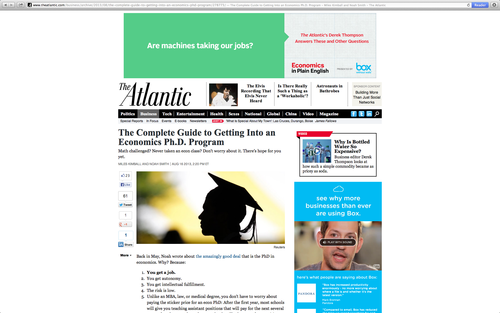
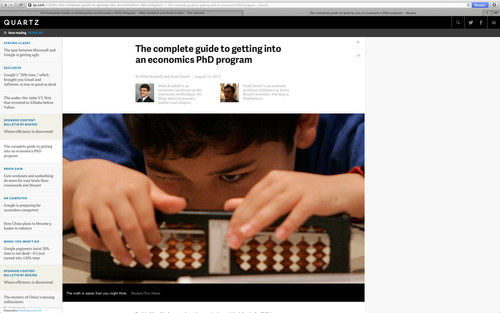
This is another milestone for me, to have the column I wrote with Noah Smith, “The Complete Guide to Getting Into an Economics Ph.D. Program” appear in the Atlantic as well as on Quartz. (They are both owned by the Atlantic Co., but are different websites.) As you can see, the Atlantic layout and picture is different. For comparison, here is the layout and picture on Quartz:
John Stuart Mill's Brief for Freedom of Speech
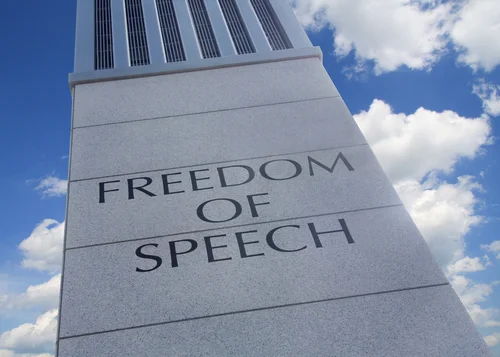
John Stuart Mill couldn’t do hypertext, but I can do it for him. John gave the second chapter of On Liberty the title "Of the Liberty of Thought and Discussion.“ Here is how he sums up his argument at the end of the chapter, with links to the posts where I give his more detailed arguments:
We have now recognised the necessity to the mental well-being of mankind (on which all their other well-being depends) of freedom of opinion, and freedom of the expression of opinion, on four distinct grounds; which we will now briefly recapitulate.First, if any opinion is compelled to silence, that opinion may, for aught we can certainly know, be true. To deny this is to assume our own infallibility. (See ”John Stuart Mill on the Adversary System,“ ”John Stuart Mill on the Protection of ‘Noble Lies’ from Criticism“ and ”Should Troubling Arguments Be Kept Away from Those Who Might Be Unduly Swayed by Them?“)Secondly, though the silenced opinion be an error, it may, and very commonly does, contain a portion of truth; and since the general or prevailing opinion on any subject is rarely or never the whole truth, it is only by the collision of adverse opinions that the remainder of the truth has any chance of being supplied. (See ”A Remedy for the One-Sidedness of the Human Mind“ and ”Why Progressives and Conservatives Need Each Other.“)Thirdly, even if the received opinion be not only true, but the whole truth; unless it is suffered to be, and actually is, vigorously and earnestly contested, it will, by most of those who receive it, be held in the manner of a prejudice, with little comprehension or feeling of its rational grounds. (See ”Let the Wrong Come to Me, For They Will Make Me More Right“ and "In Praise of Trolls.”)And not only this, but, fourthly, the meaning of the doctrine itself will be in danger of being lost, or enfeebled, and deprived of its vital effect on the character and conduct: the dogma becoming a mere formal profession, inefficacious for good, but cumbering the ground, and preventing the growth of any real and heartfelt conviction, from reason or personal experience. (See “How Freedom of Speech for Falsehood Keeps the Truth Alive.”)
Note: "John Stuart Mill’s Defense of Freedom" links to posts on the rest of "On Liberty."
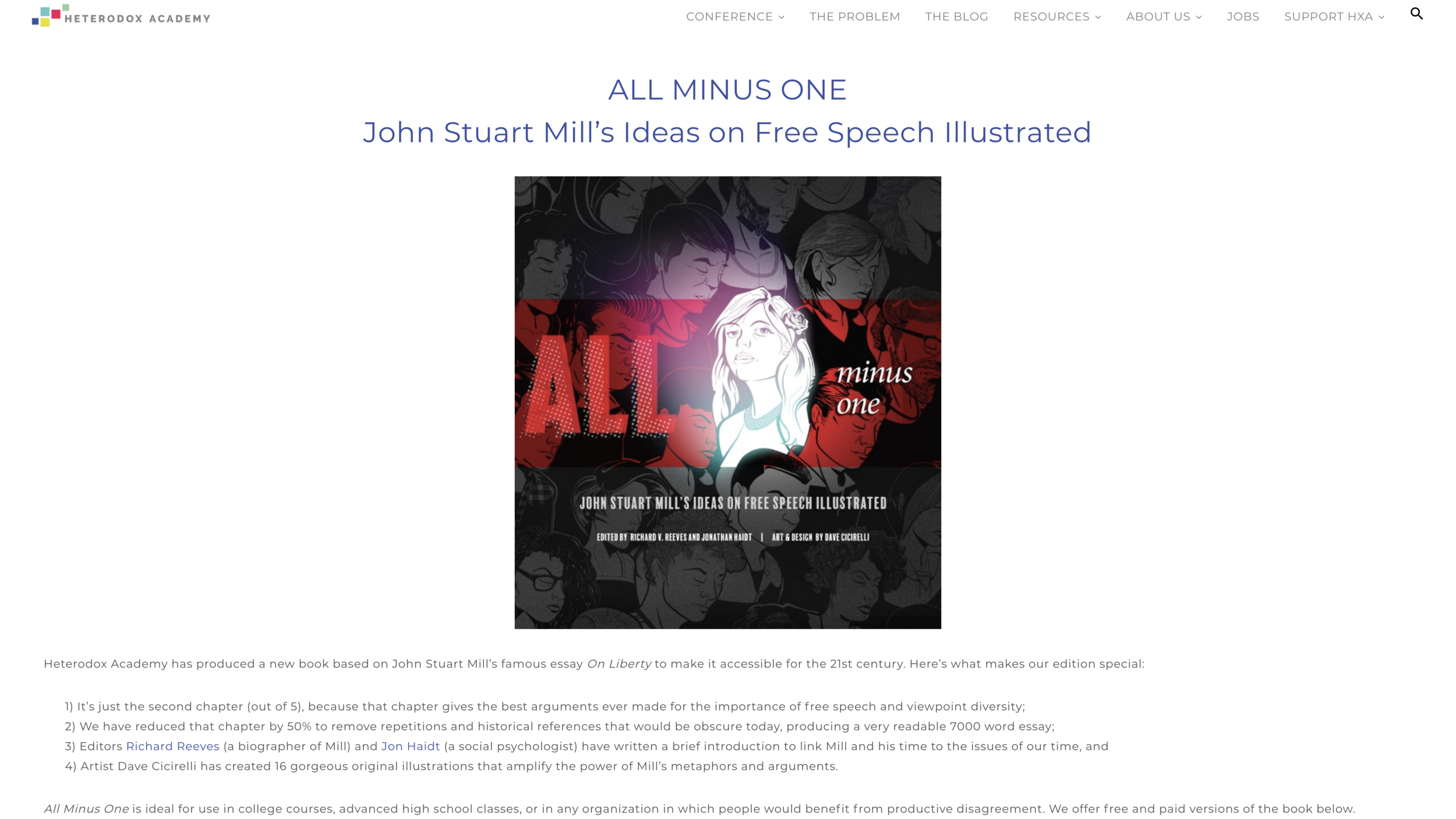
Update, October 19, 2019: Richard Reeves and Jonathan Haidt have created an abridged version of this second chapter of On Liberty to make it’s still timely message more accessible to college students:
Update, October 31, 2019: You might be interested in John Danaher’s layout of John Stuart Mill’s argument for freedom of speech.
Masao Ogaki on Osamu Tezuka: Illusion of Motion on a Stationary Manga Page

On my trip to Tokyo in June, 2013 to teach about the Economics of Risk and Time at Keio University and to gives seminars about electronic money at the Bank of Japan, Keio University and the Ministry of Finance, Masao Ogaki gave me an intriguing account of how famous Manga author Osamu Tezuka achieved some of the subjective effect of a motion picture with a stationary manga page. He kindly agreed to write up a paragraph for supplysideliberal.com. Here is what Masao has to say:
My son, who grew up in the United States, loves to read Manga in Japanese but does not read Manga translated into English. I asked why, and he explained to me that eye-movements are important for Manga. I got interested in this and searched for internet articles. An article, http://shuhosato.mangareborn.jp/blog/?p=59, explains that this technique is called “visual guidance,” which has been used to create a rhythm and sometimes an illusion of motion. I am not an expert, but think that the first Manga artist who started to use this technique was Osamu Tezuka in 1940s. He started to use complicated layouts that calculate and guide the reader’s eye-movements of reading sentences and watching pictures.
Because the way the illusion of motion is created depends on habits of how one’s eyes scan a page, the technique would have to be adapted to work for comics or manga in English. I am hoping will try to achieve this affect in a way that works for native English readers, or even better, that someone has already.
Miles and Noah: The Complete Guide to Getting Into an Economics PhD Program
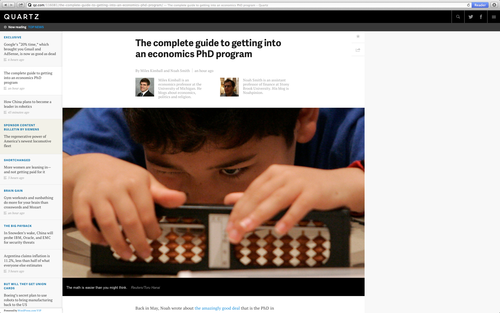
Personally, I would rather read Noah’s blog than any other blog in cyberspace. That brilliant style shows through here; I think I managed not to spoil things too much in this column.
In case you are curious, let me say a little about the financial costs and benefits of an economics PhD. At Michigan and other top places, PhD students are fully funded. Here, that means that the first year’s tuition and costs are covered (including a stipend for your living expenses). In years 2 through 5 (which is enough time to finish your PhD if you work hard to stay on track), as long as you are in good standing in the program, the costs of a PhD are just the work you do as a teaching assistant. So there are no out-of-pocket costs as long as you finish within five years, which is tough but doable if you work hard to stay on track. Tuition is relatively low in year 6 (and 7) if you can’t finish in 5 years. Plus, graduate students in economics who have had that much teaching experience often find they can make about as much money by tutoring struggling undergraduates as they could have by being a teaching assistant.
When a school can’t manage full funding, the first place it adds a charge is in charging the bottom-half of the applicant pool for the first year, when a student can’t realistically teach because the courses the grad students are taking are too heavy. That might add up to a one-time expense of $40,000 or so in tuition, plus living expenses.
On pay, the market price for a brand-new assistant professor at a top department seems to be at least $115,000 for 9 months, with the opportunity to earn more during the summer months. If you don’t quite make it to that level, University of Michigan PhD’s I have asked seem to get at least $80,000 starting salary, and Louis Johnston tweets that below-top liberal arts colleges pay a starting salary in the $55,000 to $60,000 range. But remember that all of these numbers are for 9-month salaries that allow for the possibility (though not the regularity) of earning more in the summer. Government jobs tend to pay 12-month salaries that are about 12/9 of 9-month academic salaries at a comparable level.
There is definitely the possibility of being paid very well in academic economics, though not as well as the upside potential if you go to Wall Street. For example, with summer pay included, quite a few of the full economics professors at the University of Michigan make more than $250,000 a year. (Because we are at a state university, our salaries are public.)
The bottom line is that the financial returns are good enough that you should have no hesitation begging or borrowing to finance your Economics PhD. (Please don’t steal to finance it.)
What about the costs of the extra year it might take to study math the way we recommend? If you have been developing self-discipline like a champion, but are short on money and summers aren’t enough, you could spend a gap year right after high school just studying math, living in your parents’ house at very low cost; most colleges will let you defer admission for a year after they have let you in.
Update
I liked this comment that Kevin C. Smith (an MD) sent to Quartz:
Great advice!
I almost flunked Grade 8 because my math was so bad [back in the day they would flunk you for that, at least in Alberta.]
I wound up heading for medicine. A friend who was a few years ahead of me warned: “You’ll never make it if you are not good at math!”
I hired a math tutor in August [before University started], and did every question at the end of every chapter in every one of my text books. I couldcall my tutor when I got stuck [God bless her, wherever she is in the world today!] Math got to be fun after a while [like being really good at solving puzzles.]
You might add to you list of suggestions: hire a tutor do all the questions in all your textbooks
Long story short, I won the Gold Medal for Science, and have found that a really good grasp of math has helped my enjoyment of the world and of my work a lot.
Miles and Mike Konczal vs. Peter Schiff on HuffPost Live: What is Inflation? How Does Monetary Policy Work? What Causes Financial Crises?
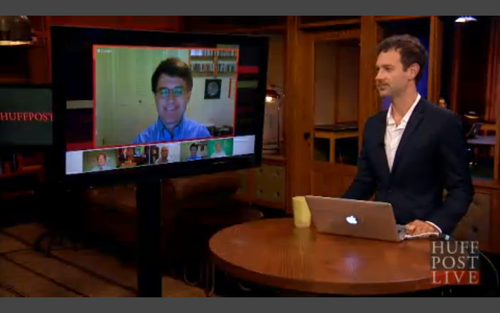
Note: The segment doesn’t really start until a little after the 2 minute mark.