Directions for Well-Being Research

I am sharing here the answers I gave for a survey for the “Expert Consultation on the Future of Wellbeing Research.” (Christopher Barrington-Leigh-—currently at McGill University—is the Director of the World Wellbeing Panel.) Most of the questions involved ranking a list of options, followed by a textbox for explaining that ranking.
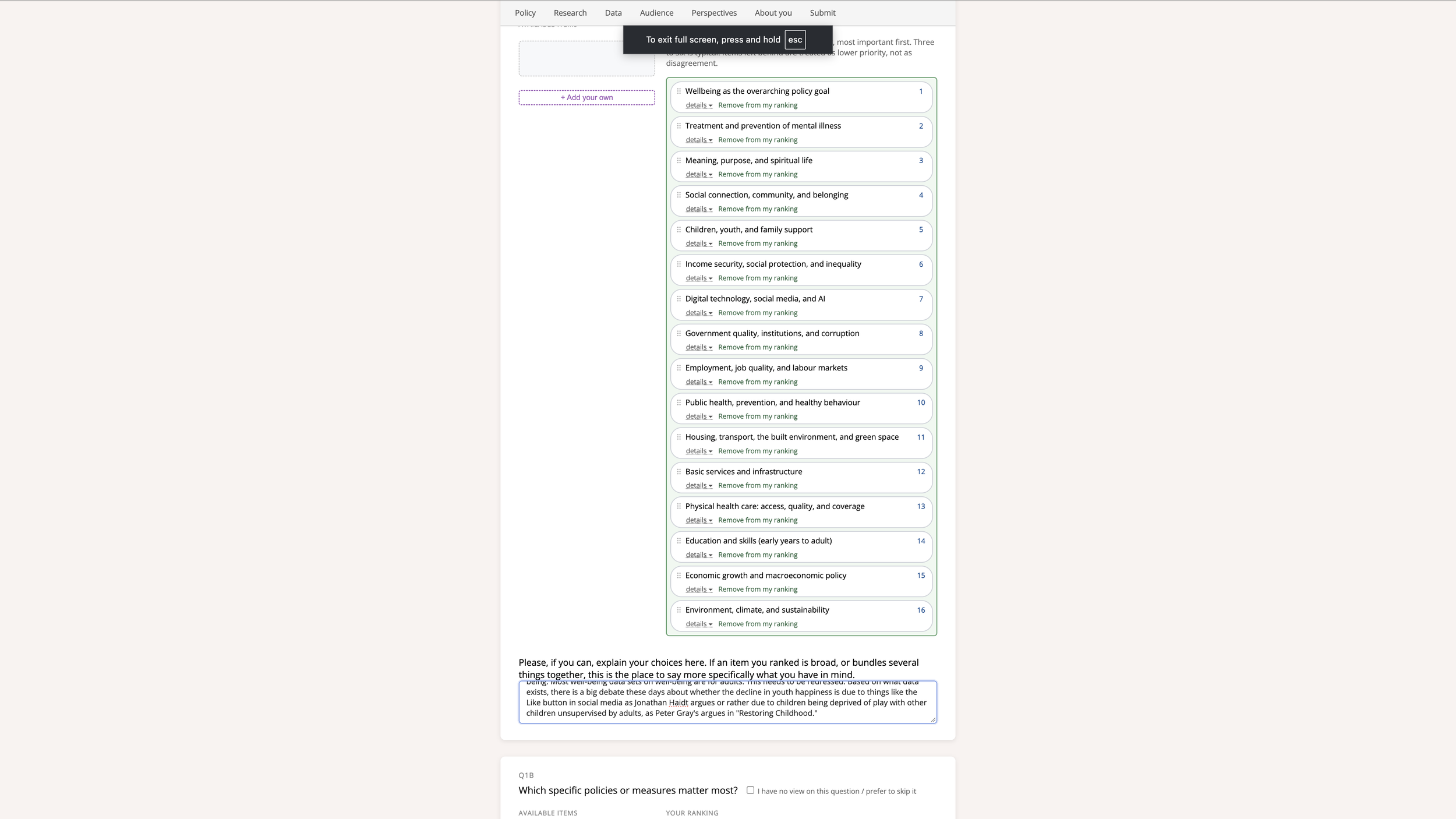
Which broad areas of policy matter most for wellbeing? Let me explain my top 6. (1) This is meant to say that we should be somewhat agnostic about what is important. Research can help identify things we didn't realize were so important. (2) Mental illness causes an enormous amount of suffering. In our paper "What Do People Want?" (Benjamin, Cooper, Heffetz, Kimball and Kundu), we find that social desirability leads people to understate how much they care about their mental health. After correcting for that, it ranks very high among things people care about. Ranking mental health so highly in this survey is also based on the sense that policy is neglecting mental health more than it is neglecting other things people care about deeply. Well-being research has the potential to help redress that imbalance in policy. (3) If AI and robots become better than humans at most things, there is a crisis of meaning coming down the road. We need to understand how people can have meaningful lives when how much humans are needed for production is less. As Keynes noted, the aristocrats of old do not present a good example of people having meaningful rich lives when they had a large amount of leisure. It should be possible to have meaningful, full lives with less anchoring in work, but it will be tricky. We need to figure it out. We don't know that AI and robots will be that good at doing most of the things humans do in the work world now, but we need to be prepared for that possibility. (4) Social science research gives a lot of evidence that social connection, community and belonging matter a lot. But policy tends to focus on "hard" indicators of how things are going. Well-being research that measures marginal rates of substitution among different aspects of well-being and corrects for scale-use heterogeneity has the potential to "harden up" indicators of things like social connection, community and belonging in the eyes of policymakers. (5) Policy in the US and in many other countries favors the interests of senior citizens over those of children. Well-being research might help highlight that imbalance—but only if we begin collecting more well-being data on children. Also, I think we'll learn a lot that collectively we don't realize is crucial for children's well-being. Most well-being data sets on well-being are for adults. This needs to be redressed. Based on what data exists, there is a big debate these days about whether the decline in youth happiness is due to things like the Like button in social media as Jonathan Haidt argues or rather due to children being deprived of play with other children unsupervised by adults, as Peter Gray's argues in "Restoring Childhood." (6) The two big problems with GDP, pressed into service as if it were a measure of national well-being are (a) that it does not take into account non-market goods like many I mentioned in (1-5), and (b) that it make no adjustment at all for inequality. A national well-being index opens up the opportunity to formally bring in considerations of inequality in a way grounded in modern welfare theory. (This is the current top research project for Dan Benjamin, Ori Heffect, Jiannan Zhou and me.) And because of the Weber-Fechner law, and evidenced by how income wants to come in logarithmically, even simple well-being measures seem to have curvature a logarithmic function, which implicitly looks like an inequality adjustment with inequality aversion of 1 for income, which is certainly closer to the truth than 0, by all evidence about the typical person's judgments about inequality. That is, no inequality aversion on a well-being response scale is like inequality aversion of 1 for a money-metric. Evidence of inequality aversion on the well-being response scale then says the inequality aversion for a money-metric is greater than 1. Much more research needs to be done on different ways of eliciting inequality aversion.
Which specific policies or measures matter most? (1) Almost everyone realizes now that even in the next 5-10 years, dealing with things like AI-enabled terrorism and AI-enabled hacking, and making sure AI's care about human well-being are crucial for keeping things from going to hell in a handbasket. It is also crucial that AI not only care about human well-being, but also that it has a deep and subtle understanding of human well-being anchored in high-quality well-being indexes that are continually improved. (Otherwise, as in Jack Williamson's novella "With Folded Hands" where AI concerns about human safety trumped other aspects of human well-being, AI might sacrifice broad human well-being for the sake of some aspects of well-being.) (2) Well-being indexes can identify low-hanging-fruit: low-cost policies that can do a lot to raise well-being. They can also help set right policy priorities among higher-cost policies. (3-4) One of the lowest-cost interventions that might greatly improve well-being is psychological training like the "Positive Intelligence" training (that my wife and I offer free for economists). See https://blog.supplysideliberal.com/post/2020/9/10/how-economists-can-enhance-their-scientific-creativity-impact-and-engagement and https://blog.supplysideliberal.com/post/2020/10/19/testimonials-for-positive-intelligence-1 . Then mental health beyond the reach of such training is important to fund more fully for the reasons I gave earlier. (5) Strong, noncorrupt institution and the rule of law are the foundation on which policy is based. (6) Poverty interferes greatly with well-being. Here, there is a crucial debate, which well-being research should inform: if AI helps government budgets enough that more help for the poor is in the cards, and assuming there are elements of both, should it be primarily in the form of universal basic income or primarily in the form of wage matching (for example, for every dollar someone earns, the government matches it with a dollar—the earned income tax credit on steroids). (7) Sugar consumption at the current level causes a huge amount of avoidable chronic health problems. Doing what it takes to shift the standard American diet and its counterpart in other rich countries decisively away from sugar would have huge benefits. People do care about health a lot! And there is the interesting well-being issue of helping people find food pleasure in other ways, both for the sake of the food pleasure itself (an aspect of well-being) and so that they are better able to avoid sugar.
What is the most important change needed to better integrate wellbeing evidence into policy-making? I have listed things more in the order they need to be done than in importance. They are all important for integrating well-being into policy making. (1) Right now, figuring out issues such as scale-use correction, aggregation across aspects of well-being and constructing social welfare measures from well-being measure (including interpersonal aggregation with attention to inequality) are crucial to persuade governments that the scientific community has prepared the way for individual and national well-being measures. (2) Then, we need panels of well-being data designed with the science in (1) and provide data helpful for high-quality causal applied micro estimates. To be specific, the well-being panel that tracks national well-being should have substantial resources for social scientists to propose additional questions to facilitate causal estimation, or to permit convincing arguments for causality that might fall somewhat short of what we ordinarily call "causal estimation." (3) Of course, in addition to data to aid in causal estimates in the well-being panel data infrastructure we also need to make the collection of well-being data standard for randomized controlled trials and other situations where there will be a "natural experiment." Once the scientific framework and data infrastructure are in place, the next step is to train all of the social scientists employed by governments in using that framework and data infrastructure, and in designing their own survey to fill gaps relative to practical policy issues they face. Finally, public understanding and demand will be crucially for getting well-being data and science to be pervasively used by governments.
What are the three most important unresolved research questions in wellbeing research? I am focusing my answer here on things I think are sorely underdone in the well-being literature. (1) We need researchers to collect a lot more calibration question data so scale-use correction is possible. This can matter a lot. For example, the income coefficient, which is used extensively for interpretation of results, becomes much smaller after scale-use correction. See https://www.nber.org/papers/w31728 . Without calibration question data, we can't know where it matters a lot—as in that case—and where it matters less. (2) By far the bulk of well-being research to date is correlational. There are many shining exceptions, but they are a small percentage of all the well-being research. (3) So far, much of the research on people not maximizing well-being has assumed that life satisfaction is the appropriate goal. But comprehensive well-being is much more than that. I believe that people often do not maximize their well-being, but that should be judged against their own values, and well-being data showing how well they are at maximizing what they themselves value—not by life satisfaction alone.
What are the most important sets of wellbeing data we need but do not yet have? (1) The desperate need is for panel data on wellbeing that includes panel data on calibration questions, so that changes over time can be corrected for changes in scale use. Very basic questions depend on it, such as what the Easterlin paradox looks like after correcting for changes in scale use. (2) We need data on well-being for at least older children that is comparable to well-being data for adults. If well-being data is used for policy, children will be neglected too much in policy if we are not collecting well-being data for them. (3) Well-being determinants could be very different in low and middle-income countries. Understanding well-being in low and middle income countries is crucial for development economics. (4) Well being data (including calibration questions) for RCT's immediately gets us strong causal evidence. (5) There is little doubt that time-use matters a lot of well-being. We need to understand time-use at work as well is in the rest of people's time. (6) Cross-checking results based on self-reports with administrative records can be very valuable. And of course, huge sample sizes can also be very valuable. (7) It is awkward, if not confounding, to try to understanding the short-run dynamics of felt happiness (or other well-being measures) by asking how happy someone feels every minute or so. Passive biometric measures of happiness would help us understand those dynamics. This matters if the claim Kimball and Willis's "Utility and Happiness" is approximately true: that felt happiness is the sum of baseline mood—the part of happiness based on determinants that can matter in the long run, though they also might vary in the short run—and elation—the part of happiness that is an impulse response to news about lifetime utility. Minute to minute dynamics of happiness could then tell us a lot about expected (=perceived) innnovations in information about lifetime utility.