The Federalist Papers #9 B: A Large Confederation May Be More Politically Stable Than a Small Nation—Alexander Hamilton Cites Montesquieu
Alexander Hamilton considered Montesquieu to be in such high regard among his readers that in the Federalist Paper #9, he takes pains
to parry Montesquieu’s praise of small nations
to trumpet Montesquieu’s praise of confederations
to argue that it is OK to have the federal government interject itself into state governments to a considerable extent
to argue that it is OK to have more populous states have more votes in the federal government.
The subject to which Alexander Hamilton applies this treatment of Montesquieu is the “enlargement of the orbit” of the type of republican systems that existed within each of the states:
To this catalogue of circumstances that tend to the amelioration of popular systems of civil government, I shall venture, however novel it may appear to some, to add one more, on a principle which has been made the foundation of an objection to the new Constitution; I mean the ENLARGEMENT of the ORBIT within which such systems are to revolve, either in respect to the dimensions of a single State or to the consolidation of several smaller States into one great Confederacy. The latter is that which immediately concerns the object under consideration. It will, however, be of use to examine the principle in its application to a single State, which shall be attended to in another place.
Alexander Hamilton parries Montesquieu’s praise of small nations by pointing out that following this opinion of Montesquieu would require breaking up some of the larger of the thirteen states, then depending on his readers to think that would be a ridiculous thing to do:
The utility of a Confederacy, as well to suppress faction and to guard the internal tranquillity of States, as to increase their external force and security, is in reality not a new idea. It has been practiced upon in different countries and ages, and has received the sanction of the most approved writers on the subject of politics. The opponents of the plan proposed have, with great assiduity, cited and circulated the observations of Montesquieu on the necessity of a contracted territory for a republican government. But they seem not to have been apprised of the sentiments of that great man expressed in another part of his work, nor to have adverted to the consequences of the principle to which they subscribe with such ready acquiescence.
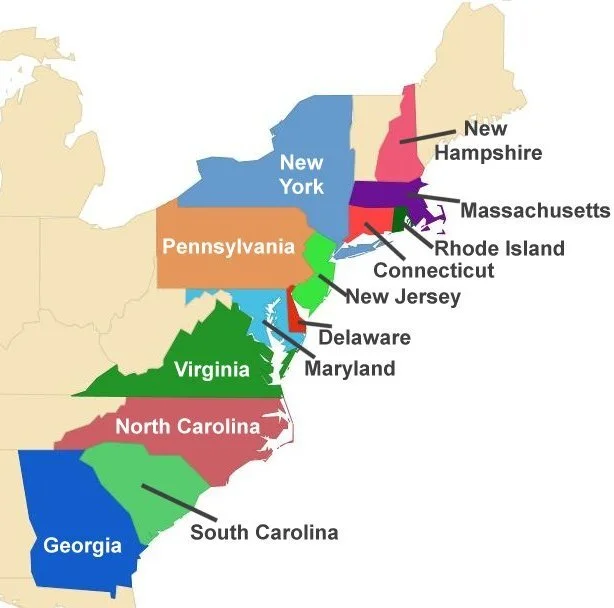
When Montesquieu recommends a small extent for republics, the standards he had in view were of dimensions far short of the limits of almost every one of these States. Neither Virginia, Massachusetts, Pennsylvania, New York, North Carolina, nor Georgia can by any means be compared with the models from which he reasoned and to which the terms of his description apply. If we therefore take his ideas on this point as the criterion of truth, we shall be driven to the alternative either of taking refuge at once in the arms of monarchy, or of splitting ourselves into an infinity of little, jealous, clashing, tumultuous commonwealths, the wretched nurseries of unceasing discord, and the miserable objects of universal pity or contempt. Some of the writers who have come forward on the other side of the question seem to have been aware of the dilemma; and have even been bold enough to hint at the division of the larger States as a desirable thing. Such an infatuated policy, such a desperate expedient, might, by the multiplication of petty offices, answer the views of men who possess not qualifications to extend their influence beyond the narrow circles of personal intrigue, but it could never promote the greatness or happiness of the people of America.
Then Alexander Hamilton cites Montequieu as seeing great virtues in a confederation. (I am trying to use forms of the word that do not conjure up the Civil War Confederacy.) Montesquieu’s main arguments in favor of what he calls a “confederate republic” are:
A large enough confederation has enough military power to provide security against external threats.
It is harder for a tyrant to gain power in a large confederation than in a small nation.
It is harder for a popular insurrection to succeed in a large confederation than in a small nation.
Here is how Alexander Hamilton cites Montesquieu in these regards (I tried to make one footnote easier to understand):
Referring the examination of the principle itself to another place, as has been already mentioned, it will be sufficient to remark here that, in the sense of the author who has been most emphatically quoted upon the occasion, it would only dictate a reduction of the SIZE of the more considerable MEMBERS of the Union, but would not militate against their being all comprehended in one confederate government. And this is the true question, in the discussion of which we are at present interested.
So far are the suggestions of Montesquieu from standing in opposition to a general Union of the States, that he explicitly treats of a CONFEDERATE REPUBLIC as the expedient for extending the sphere of popular government, and reconciling the advantages of monarchy with those of republicanism.
"It is very probable,'' (says he [“The Spirit of the Laws,'' vol. i., book ix., chap. i.] ) "that mankind would have been obliged at length to live constantly under the government of a single person, had they not contrived a kind of constitution that has all the internal advantages of a republican, together with the external force of a monarchical government. I mean a CONFEDERATE REPUBLIC.
"This form of government is a convention by which several smaller STATES agree to become members of a larger ONE, which they intend to form. It is a kind of assemblage of societies that constitute a new one, capable of increasing, by means of new associations, till they arrive to such a degree of power as to be able to provide for the security of the united body.
"A republic of this kind, able to withstand an external force, may support itself without any internal corruptions. The form of this society prevents all manner of inconveniences.
"If a single member should attempt to usurp the supreme authority, he could not be supposed to have an equal authority and credit in all the confederate states. Were he to have too great influence over one, this would alarm the rest. Were he to subdue a part, that which would still remain free might oppose him with forces independent of those which he had usurped and overpower him before he could be settled in his usurpation.
"Should a popular insurrection happen in one of the confederate states the others are able to quell it. Should abuses creep into one part, they are reformed by those that remain sound. The state may be destroyed on one side, and not on the other; the confederacy may be dissolved, and the confederates preserve their sovereignty.
"As this government is composed of small republics, it enjoys the internal happiness of each; and with respect to its external situation, it is possessed, by means of the association, of all the advantages of large monarchies.''
I have thought it proper to quote at length these interesting passages, because they contain a luminous abridgment of the principal arguments in favor of the Union, and must effectually remove the false impressions which a misapplication of other parts of the work was calculated to make. They have, at the same time, an intimate connection with the more immediate design of this paper; which is, to illustrate the tendency of the Union to repress domestic faction and insurrection.
Alexander Hamilton was a proponent of a strong federal government. He was also a proponent of more populous states having more votes within the federal government. He is alert to set out arguments in favor of both of these. He begins by simply saying the case for a weak federal government or equal voting power by each state is not clear and asserts without providing evidence that equal voting power in a confederation regardless of population “has been the cause of incurable disorder and imbecility in the government:
A distinction, more subtle than accurate, has been raised between a CONFEDERACY and a CONSOLIDATION of the States. The essential characteristic of the first is said to be, the restriction of its authority to the members in their collective capacities, without reaching to the individuals of whom they are composed. It is contended that the national council ought to have no concern with any object of internal administration. An exact equality of suffrage between the members has also been insisted upon as a leading feature of a confederate government. These positions are, in the main, arbitrary; they are supported neither by principle nor precedent. It has indeed happened, that governments of this kind have generally operated in the manner which the distinction taken notice of, supposes to be inherent in their nature; but there have been in most of them extensive exceptions to the practice, which serve to prove, as far as example will go, that there is no absolute rule on the subject. And it will be clearly shown in the course of this investigation that as far as the principle contended for has prevailed, it has been the cause of incurable disorder and imbecility in the government.
Alexander Hamilton then argues that the proposed Constitution doesn’t take away too much power from the states:
The definition of a CONFEDERATE REPUBLIC seems simply to be "an assemblage of societies,'' or an association of two or more states into one state. The extent, modifications, and objects of the federal authority are mere matters of discretion. So long as the separate organization of the members be not abolished; so long as it exists, by a constitutional necessity, for local purposes; though it should be in perfect subordination to the general authority of the union, it would still be, in fact and in theory, an association of states, or a confederacy. The proposed Constitution, so far from implying an abolition of the State governments, makes them constituent parts of the national sovereignty, by allowing them a direct representation in the Senate, and leaves in their possession certain exclusive and very important portions of sovereign power. This fully corresponds, in every rational import of the terms, with the idea of a federal government.
Finally, Alexander Hamilton cites Montesquieu to argue it is OK for a federal government to interject itself into state government affairs in an important way and that voting rights in the federal government that depend on population are OK:
In the Lycian confederacy, which consisted of twenty-three CITIES or republics, the largest were entitled to THREE votes in the COMMON COUNCIL, those of the middle class to TWO, and the smallest to ONE. The COMMON COUNCIL had the appointment of all the judges and magistrates of the respective CITIES. This was certainly the most, delicate species of interference in their internal administration; for if there be any thing that seems exclusively appropriated to the local jurisdictions, it is the appointment of their own officers. Yet Montesquieu, speaking of this association, says: "Were I to give a model of an excellent Confederate Republic, it would be that of Lycia.'' Thus we perceive that the distinctions insisted upon were not within the contemplation of this enlightened civilian; and we shall be led to conclude, that they are the novel refinements of an erroneous theory.
PUBLIUS.
Here are links to my other posts on The Federalist Papers so far:
The Federalist Papers #1: Alexander Hamilton's Plea for Reasoned Debate
The Federalist Papers #3: United, the 13 States are Less Likely to Stumble into War
The Federalist Papers #4 B: National Defense Will Be Stronger if the States are United
The Federalist Papers #5: Unless United, the States Will Be at Each Others' Throats
The Federalist Papers #6 A: Alexander Hamilton on the Many Human Motives for War
Narayana Kocherlakota Advocates Negative Interest Rates Now
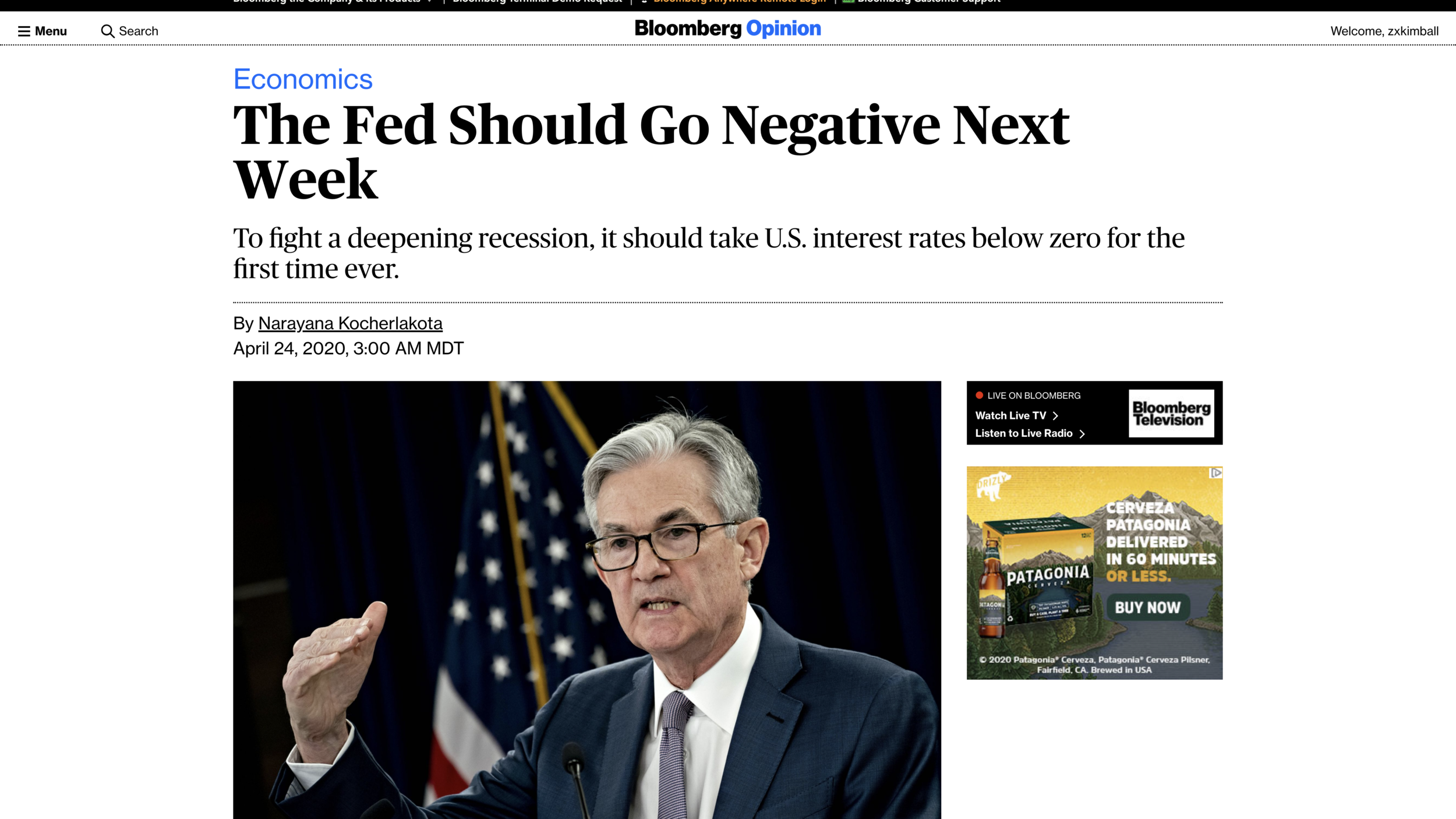
I think Narayana Kocherlakota is jumping the gun a bit: let’s wait and see what aggregate demand we need once the lockdowns are mostly over. But I am glad to see Narayana Kocherlakota advocating negative interest rates since we might well need them once the lockdowns are over. (See “Why We are Likely to Need Strong Aggregate Demand Stimulus after Tight Social Distancing Restrictions are Over.”) Narayana’s advocacy is noteworthy because he is a former President of the Minneapolis Federal Reserve Bank.
Narayana makes the key arguments for considering negative interest rates as a normal part of the monetary policy toolkit. Quoting him, but adding a bullet for each passage:
Why the fear of negative rates? A decade ago, the answer would have been that it was impossible to go below zero: Banks would simply avoid the charges by withdrawing their reserve deposits and holding the funds in paper currency, which pays zero interest. But economists now recognize that doesn’t happen, because it’s costly to store billions (or trillions) of dollars of paper currency safely. Several European central banks, as well as the Bank of Japan, have successfully taken interest rates below zero. 1 This stimulates consumer demand in the usual ways: by incentivizing banks to make loans at lower interest rates, to bid up the prices of financial assets, and to charge higher fees for deposits.
Another of the Fed’s concerns about negative rates has to do with financial stability — a relatively new (and completely made up) responsibility of central banks. … But officials worry that they will also weigh on banks’ profitability, pushing down share prices and making the financial system more vulnerable to distress. …
The Fed is inventing a trade-off where none exists. If the central bank really cares about financial stability, it has many tools to ensure it. Right now, for example, it could block large banks from paying dividends, a practice that erodes the capital they need to absorb losses. None of this precludes a monetary policy focused on the Fed’s congressional mandate of maximizing employment and keeping inflation near target.
Of course, my favorite part of Narayana’s column is his citation of my IMF Working Paper with Ruchir Agarwal, “Enabling Deep Negative Rates to Fight Recessions: A Guide.” Narayana writes:
Central banks have so far been unable or unwilling to lower interest rates more than a percentage point below zero. But the economists Ruchir Agarwal and Miles Kimball have offered a guide on how they can go further.
“Enabling Deep Negative Rates to Fight Recessions: A Guide” pulls together for an academic and policy audience what I have been writing about on this blog for a while, as you can see from “How and Why to Eliminate the Zero Lower Bound: A Reader’s Guide.” Copy-pasting from that bibliographic post:
If you want academic policy papers, please turn to these three:
My IMF Working Paper with Ruchir Agarwal: “Enabling Deep Negative Rates to Fight Recessions: A Guide” (pdf) (or on IMF website)
Can Fasting Help Fight the Coronavirus?
Update: This is a fairly technical blog post. Here are some less technical posts related to this topic:
Since I wrote “Fasting Helps Avoid Collateral Damage in Fighting Bacterial Infections; Glucose Helps Avoid Collateral Damage in Fighting Viral Infections” about the potential dangers of being in a fasted state at the acute stage of COVID-19 when the immune system is hyperactive and immune system processes could do damage to own cells, I have been interested in possible other effects of fasting at other stages of infection. On this, note that the acute phase when one’s immune system is hyperactive is likely to be under a doctor’s care, so decisions then can probably be outsourced to that doctor; effects at other stages are more likely to be effects one needs to consider oneself.
In this post, I am going to talk about benefits of ketosis and benefits of fasting interchangeably. Fasting is the easiest and fastest way to get into ketosis. An extreme keto diet can also sometimes get to ketosis.
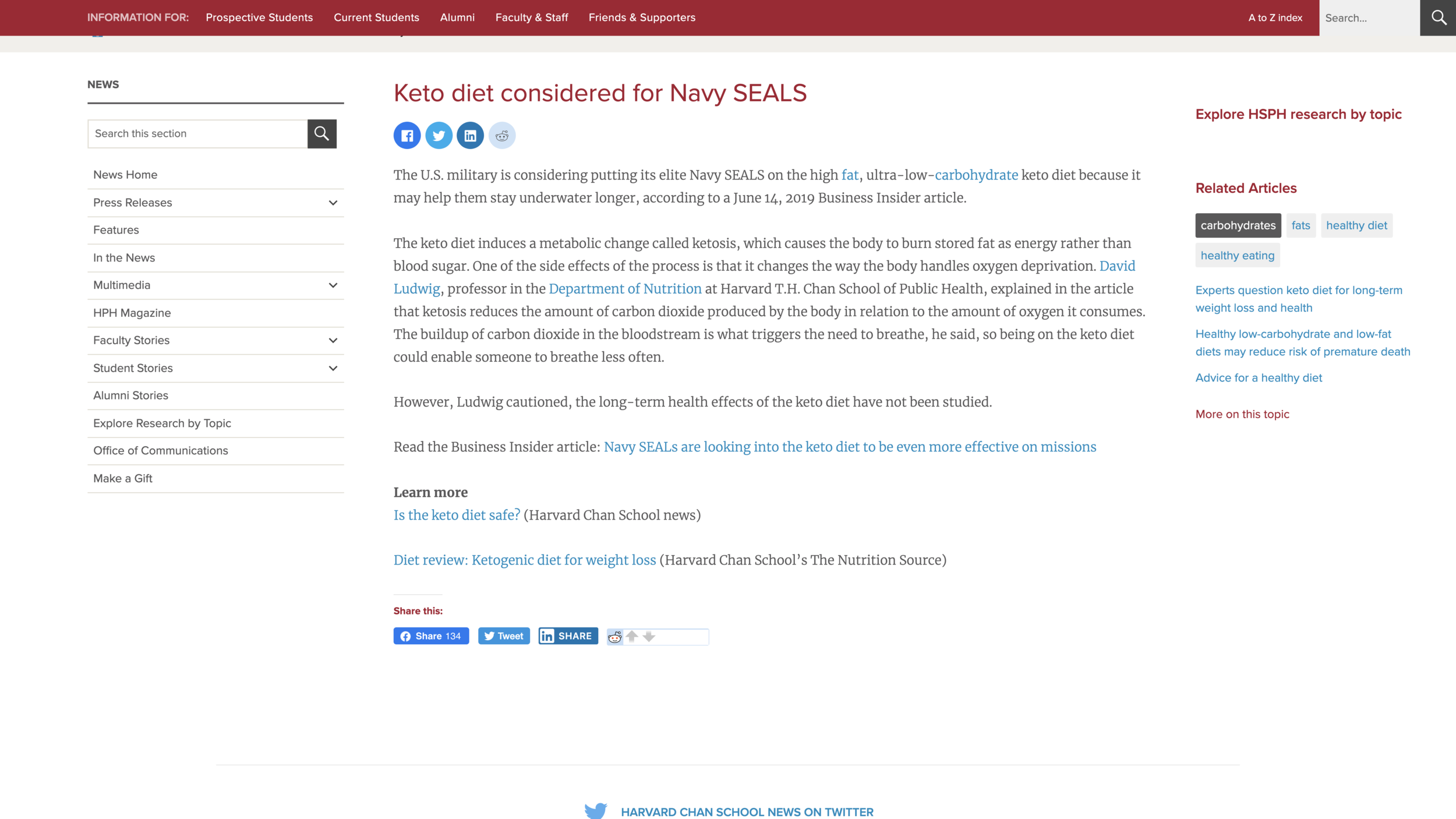
One important potential effect that I remember reading, but have lost the reference to, was a claim that ketosis could help reduce damage from being on a mechanical ventilator. I’d be glad for help finding that reference. But one thing that makes this a possible effect is that ketosis reduces production of carbon dioxide, which may reduce the amount of struggling to breathe. As long as medical technicians keep the actual level of oxygen adequate, less struggling to breathe may lead to less damage from the ventilator. (See the abstract shown below. Also see “Adaptation to chronic hypoxia during diet-induced ketosis” which sounds like another way in which ketosis could mute the effects of oxygen deprivation.)
Beyond that speculative effect on breathing struggles on a ventilator, measures such as fasting and going off sugar can reverse some chronic diseases such as diabetes, which appear to increase danger of dying if one gets infected by the novel coronavirus. (See “Interactions between COVID-19 and Chronic Diseases.”)
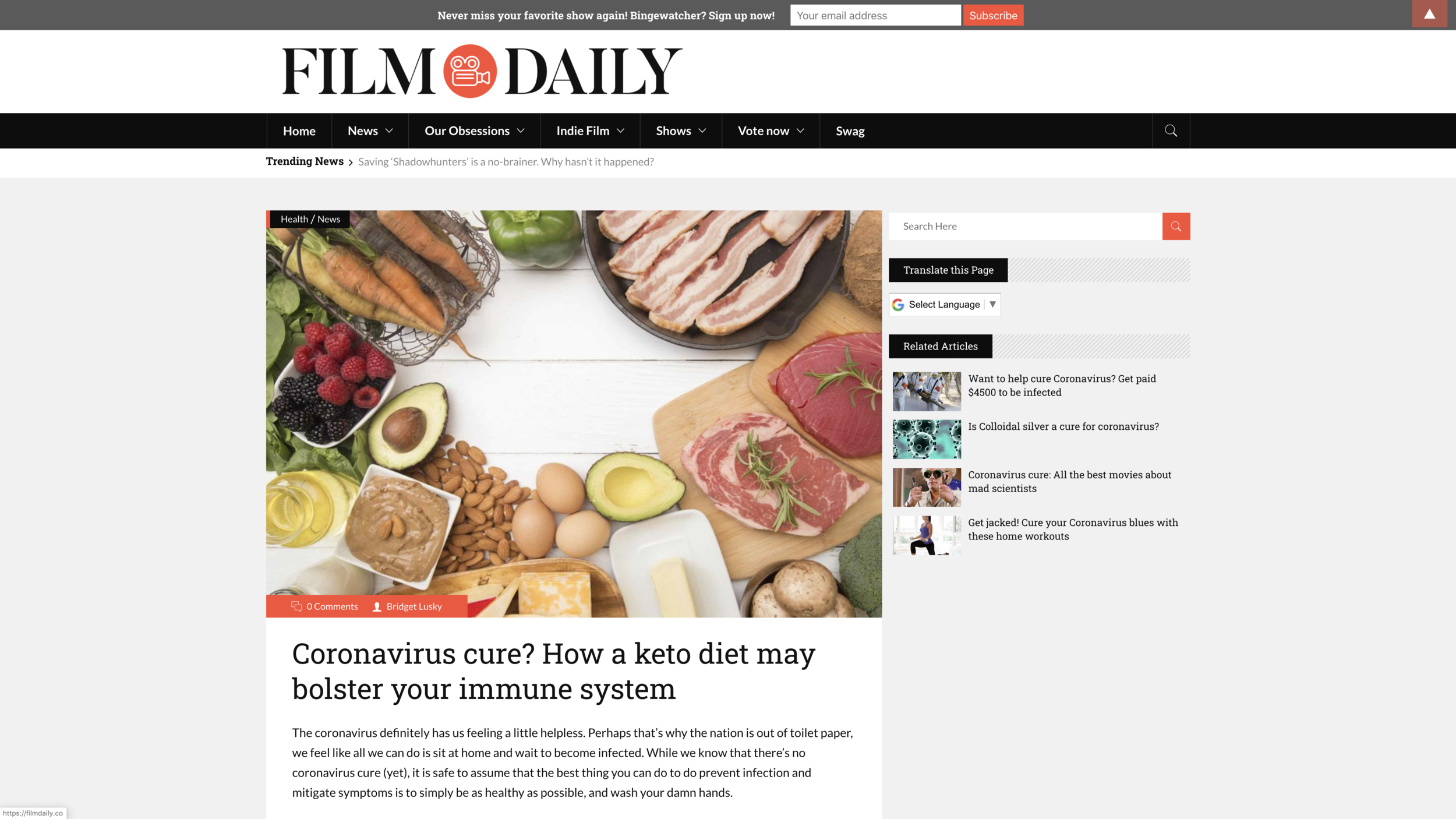
Two other potential benefits of fasting or a ketogenic diet are mentioned in the article shown at the top of this post that has an overstated title. Here is the first:
Flu-related inflammation can severely damage the lungs. It’s worth mentioning that shortness of breath is a marker symptom of the coronavirus, as well as influenza A. Coronavirus patients in critical care are also struggling with lung damage and the inability to breathe without a respirator.
To test the keto diet’s effects on flu-related inflammation, the Yale team fed mice infected with influenza A – the most serious type flu– either a keto or standard diet for a week before infection. After four days, all seven of the mice fed a standard diet succumbed to the infection, compared to only five out of the 10 mice on the keto diet. Additionally, these keto diet mice also didn’t lose as much weight, which is usually a sign of flu infection in animals.
It may be that this inflammation mechanism is not really distinct from the chronic disease interactions; it could be a major mechanism for those chronic-disease interactions. Anyway, beware of double-counting benefits.
Second, there is a possibility that fasting or a ketogenic diet channels the immune system toward a more helpful response: T-cells and mucus. From the same article at the top of this post:
The team at Yale was able to narrow down the exact effects keto had on the mice’s bodies. The keto diet boosted the numbers of a specific T cell that’s found in the lungs. T cells are part of the body’s immune response, and the amped number of those cells reduced the vulnerability of the cells lining the lunges, making them more resistant to infection and increasing mucus production.
Akiko Iwasaki says that the extra mucus is protecting the mice, and trapping the flu virus to stop it from spreading. While the bodies of mice to differ from humans, scientists do have a starting point from which to boost immunity and help cure coronavirus, influenza and more.
Conclusion: I have to emphasize how speculative all of this is. However, also remember that chronic diseases kill more people each year than COVID-19 is likely to kill even in its peak year. So doing things that help with chronic diseases and might help in dealing with COVID-19 seems like a good idea.
For annotated links to other posts on diet and health, see:
Bex's Rules for Life

Bex Bassin is one of my “tribe” members from the Co-Active Training Institute Leadership Program that I am in. (See “Vicky Biggs Pradhan: How Crises Make Us Rethink Our Lives.) She had a wonderful analogy between her approach to making mosaics and an approach to life, so I asked her to do this guest post. Here are Bex’s words:
Rules to live by. (As lifted from mosaic principles)
To begin, start with a sketch. Actually, the very beginning starts with inspiration. I’ll see a tree in the moonlight and imagine how it could look made from shards of glass. I'll feel a sense of curiosity and power as I imagine my own enchanted interpretation of this tree. Light filtering through colored glass creates a hypnotic sensory delight. I don’t know how long I stare at the tree. Maybe it’s only a minute or maybe it turns into an awkward and uncomfortable few minutes for whoever is standing with me. As I stare, I’m translating my view into the specs and prep for a new project. How will I reflect the light from the moon? How dark should I make the tree? What is the color scheme? I’m imprinting this moment of the silhouetted tree. The anticipation spurs my desire to play and create.
Commitment is key; glue from the beginning. It’s a waste of time to lay out each piece without glue. I think this is where passion becomes relevant. Like in life, when I hold myself back from fulling committing to hedge my bets, in case it doesn’t work out or something better comes along, the world responds in kind. I still feel the loss if it doesn’t work out, so I didn’t save myself any heartache by not going all in. If I really don’t like an aspect of the mosaic, I can always take up the pieces that aren’t working when it’s clear there’s a mistake. But my commitment must be sincere here as well because it take effort to undo what I created.
It’s really about breaking things. The most fun I have with glass mosaics is when it comes to the breaking of the glass. The tactile nature of making my own puzzle pieces and I only know where the belong. There is so much satisfaction in mistreating fragility. I imagine my feminist predecessors felt the same way as they broke through ceilings. I find solace in the unconventionality of breaking a piece of glass and mixing it with other pieces according to my own version of beauty. And it’s a necessary step in the creation of a mosaic. Without breaking glass into shards of various sizes and shapes, there is no material to work with. And leveraging the tools to amplify my strength reminds me that sometimes I need help along the way.
Don’t force the fit, the right piece always lands into the right space. I suspect most humans have some level of anxiety underlying their actions. Since it’s part of our physiology, it must have provided value throughout select points in history. Although, in my own experience of partaking in the hamster wheel of achievement for two decades of my career, it’s hard to see the value of anxiety. The grind, ‘the she who suffers the most’ award, are no longer concepts I aspire to. After I managed to jump off the wheel, I recognized the value of ease and the magic of flow. It’s not random, flow can be cultivated by giving your mind some time off and dropping into your heart. It’s disconcerting at first, but my mind makes poor decisions, if it ever reaches one, when it comes to mosaic play. This relates to plans as well. If a piece doesn’t end up in the mosaic, then I didn’t need it.
Do what you love. I didn’t realize how much I pay attention to color until I started playing with mosaics. Color pops at me from every direction with the vibrancy of a mountain sunrise etches into my mind. I moved to California from the east coast nearly ten years ago. Shortly after moving, I commented to my mother that the sunrises and sunsets are just spectacular on the west coast and I couldn’t even recall seeing anything barely as beautiful on the east coast. She chuckled, and replied, “that’s because you weren’t looking”.
I enjoy every minute of creating. This continues to take me by surprise. I truly love this play and for a long time, I refused to call myself an artist. As one would expect, I had the usual doubt that I was any good and didn’t feel like I deserved to use the same label as someone who actually creates beautiful art. And then at some point, It didn’t matter to me. My pieces were for me to create. Each one felt like a part of me and I was content to keep them all forever. I would adorn every space on every wall, which when I imagine it, would be pure bliss. Each time I look at one of my pieces I’m taken in by it. The color, the shapes the absolute joy that they emit. Or maybe the joy is coming from me and its just echoing off the glass back at me.
The fine print: I recently received a new piece of counsel that I intend to add to my repertoire. *If I’m not having fun; change the rules.
Like me, Bex is a Co-Active Coach. (See “Co-Active Coaching as a Tool for Maximizing Utility—Getting Where You Want in Life.”) She supports individuals looking to discover and realize their answer to the question: what would you like? Here is her coaching contact information:
email address: bex@coachbex.com
phone number: (805) 410-3838

Bex Bassin

Bex’s most recent mosaic
Two Dimensions of Pandemic-Control Externalities

In order to better understand externalities in efforts to slow the march of COVID-19 such as social distancing and wearing facemasks, I wrote down the following control theory model. It simplifies in many ways from reality. For example, the model
treats the course of the disease and the transmission to others during the course of the disease as if it all happened in an instant.
treats everything as happening so quickly that discounting is unimportant
acts as if the number of people who will become immune before the introduction of a vaccine remains a very small fraction of the population (that can be ignored)
pretends that a vaccine will be deployed instantly at a known moment in the future.
takes the perspective of the social planner, except in some of my commentary. The social planner is assumed to be able to require certain behaviors. This is not entirely unreasonable since behaviors such as social distancing and mask-wearing—or failures to do so—are fairly visible.
Still, I think this model gets the logic of the externalities right.
Among logically equivalent representations of the control theory model, I tried to choose the most convenient representation. I think in particular that making the state variable the natural logarithm of the number of people infected at any moment makes the math simpler. Here are the key definitions:

The optimization problem itself is this:

The Hamiltonian, first order condition, Euler equation and transversality condition are:

The Euler equation can be integrated with the transversality condition as terminal condition to get this integral for lambda, the marginal burden of the log level of infections:

What are the two dimensions of externalities?
Efforts to either not get the disease in the first place or to not transmit it to others have an externality in keeping the disease from spreading. This externality is shown in the first-order condition by lambda[f’(x)+g’(x)]. This is an externality on the assumption that you yourself become immune once you have the disease, see any efforts you make as a drop in the bucket, and are egocentric, so the future spread of the disease is not a concern to you once you have the disease.
Even if the vaccine were coming tomorrow, efforts to keep from transmitting the disease to others benefit those others. This externality is shown by the term e^k g’(x).
In the first-order condition, only e^k f’(x) is a direct benefit to oneself.
When is it most important to make great efforts at social distancing, facemask wearing, etc? The first-order condition gives an answer. First, it is most important to make efforts when the prevalence of the disease is high—that is, when e^k is big. Second, holding e^k fixed, efforts to reduce the spread of the disease are more important the further away the vaccine is; lambda is bigger the earlier it is in the course of the disease. Third, this is not a concave problem, so there may be multiple local minima. In particular, there may be two policies that both satisfy the necessary conditions, one of which lets the disease explode and another that keeps it under control. One of these is likely to be better than the other. Steering a course toward the lower minimum is important.
Don’t miss these other posts on the coronavirus pandemic:
Getting More Vitamin D May Help You Fight Off the New Coronavirus

The Importance of Vitamin D: Much is not known about COVID-19 and the coronavirus that causes it. One big question is whether the big disparity in mortality between African Americans and other Americans is due simply to poorer preexisting health and worse access to health care, or if there is also something else going on. In the category of “something else going on,” a greater prevalence of Vitamin D deficiency among African Americans has to be considered as a possibility. We know that Vitamin D deficiency was historically a powerful enough evolutionary force that those who have many generations of ancestors who lived nearer the poles than the equator ended up with light skin. So Vitamin D deficiency should not be despised as a demon.
In any case given the shred of evidence we have, taking Vitamin D supplements probably has a good benefit cost ratio right now. In his April 16, 2020 Wall Street Journal article “Vitamin D and Coronavirus Disparities,” Vatsal Thakkar writes this about the importance of Vitamin D for the immune system:
Vitamin D supplementation in African-Americans reduced cancer risk 23%. How? Cancer cells develop regularly in most animals, including humans, as the result of toxic injuries or glitches in DNA replication, but a healthy immune system destroys them. There is evidence that low vitamin D levels make the immune system go blind.
…
A 2009 study examined sun exposure and fatality rates during the 1918-19 Spanish flu pandemic, which killed an estimated 50 million world-wide. Disparities in access to health care were minimal then, since treatment consisted mostly in supportive measures and convalescence. Antivirals, vaccines, intensive-care units and ventilators didn’t exist.
The U.S. erected emergency hospitals—one of which, the Camp Brooks Open Air Hospital in Massachusetts, had the unique distinction of being an outdoor recovery unit. The mortality rate for patients there fell from 40% to 13% when they were moved outside. Sunlight might have proved to be literally the best disinfectant.
How Much Vitamin D to Get: On how much Vitamin D to get, it is important to know that the minimum daily requirement was messed up by a statistical error. See:
Making Sure Your Body Can Make the Active Form of Vitamin D: The Vitamin D we produce with the help of the sun or in food or supplements still needs to be turned into an active form. Contrary to what we have been taught about milk being good for Vitamin D, whatever does in terms of getting the Vitamin D raw materials, it can inhibit the production within the body of the active form of Vitamin D. See:
That doesn’t mean you can ever have milk or dairy. You just need to have a big enough chunk of the day when you don’t have milk or dairy to give your body a chance to make the active form of Vitamin D. That is, if you do consume dairy, don’t consume it all the time.
Caveat: I want to emphasize how little is known. It may turn out that Vitamin D does essentially nothing to reduce risk of a bad case of COVID-19. But if you take an amount of Vitamin D in line with the recommendations in line with “Carola Binder—Why You Should Get More Vitamin D: The Recommended Daily Allowance for Vitamin D Was Underestimated Due to Statistical Illiteracy,” I think the benefit/cost ratio is good. And time-restricted eating in general is a good idea, especially when so many of us are holed up at home near the refrigerator. See “Eating During the Coronavirus Lockdown.”
For annotated links to other posts on diet and health, see:
Zeynep Tufekci: New Evidence that Universal Wearing of Masks Could Help a Lot →
The mask wearing needs to be universal because the main benefit is an externality.
The Federalist Papers #9 A: There Has Been Technological Progress in Practical Principles of Republican Government—Alexander Hamilton
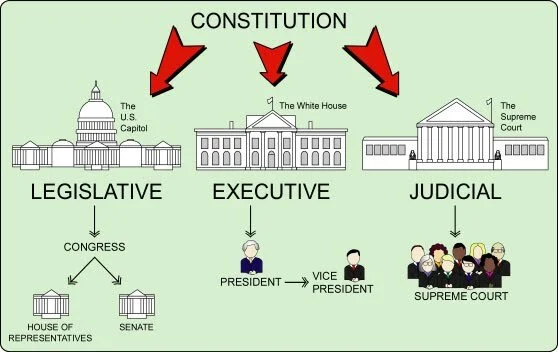
In his introduction to the 9th number of the Federalist Papers, Alexander Hamilton boldly claims that there has been technological progress in the principles of Republican government. He first reminds readers of how bad things used to be even for cities and nations that had periods of considerable freedom and democracy. Then he very explicitly claims that there has been progress:
The science of politics, however, like most other sciences, has received great improvement. The efficacy of various principles is now well understood, which were either not known at all, or imperfectly known to the ancients.
Finally he lists key principles of republican government that had been discovered. Leaving for a future post his next theme of how larger republic may be more stable, here is his list, with my added bullets:
The regular distribution of power into distinct departments;
the introduction of legislative balances and checks;
the institution of courts composed of judges holding their offices during good behavior;
the representation of the people in the legislature by deputies of their own election:
He then again, in this specific context, asserts that there has been progress in understanding of the principles of stable republican government:
… these are wholly new discoveries, or have made their principal progress towards perfection in modern times. They are means, and powerful means, by which the excellences of republican government may be retained and its imperfections lessened or avoided.
Below is all of this in context:
|| Federalist No. 9 ||
The Union as a Safeguard Against Domestic Faction and Insurrection
For the Independent Journal.
Author: Alexander Hamilton
To the People of the State of New York:
A FIRM Union will be of the utmost moment to the peace and liberty of the States, as a barrier against domestic faction and insurrection. It is impossible to read the history of the petty republics of Greece and Italy without feeling sensations of horror and disgust at the distractions with which they were continually agitated, and at the rapid succession of revolutions by which they were kept in a state of perpetual vibration between the extremes of tyranny and anarchy. If they exhibit occasional calms, these only serve as short-lived contrast to the furious storms that are to succeed. If now and then intervals of felicity open to view, we behold them with a mixture of regret, arising from the reflection that the pleasing scenes before us are soon to be overwhelmed by the tempestuous waves of sedition and party rage. If momentary rays of glory break forth from the gloom, while they dazzle us with a transient and fleeting brilliancy, they at the same time admonish us to lament that the vices of government should pervert the direction and tarnish the lustre of those bright talents and exalted endowments for which the favored soils that produced them have been so justly celebrated.
From the disorders that disfigure the annals of those republics the advocates of despotism have drawn arguments, not only against the forms of republican government, but against the very principles of civil liberty. They have decried all free government as inconsistent with the order of society, and have indulged themselves in malicious exultation over its friends and partisans. Happily for mankind, stupendous fabrics reared on the basis of liberty, which have flourished for ages, have, in a few glorious instances, refuted their gloomy sophisms. And, I trust, America will be the broad and solid foundation of other edifices, not less magnificent, which will be equally permanent monuments of their errors.
But it is not to be denied that the portraits they have sketched of republican government were too just copies of the originals from which they were taken. If it had been found impracticable to have devised models of a more perfect structure, the enlightened friends to liberty would have been obliged to abandon the cause of that species of government as indefensible. The science of politics, however, like most other sciences, has received great improvement. The efficacy of various principles is now well understood, which were either not known at all, or imperfectly known to the ancients. The regular distribution of power into distinct departments; the introduction of legislative balances and checks; the institution of courts composed of judges holding their offices during good behavior; the representation of the people in the legislature by deputies of their own election: these are wholly new discoveries, or have made their principal progress towards perfection in modern times. They are means, and powerful means, by which the excellences of republican government may be retained and its imperfections lessened or avoided.
Here are links to my other posts on The Federalist Papers so far:
The Federalist Papers #1: Alexander Hamilton's Plea for Reasoned Debate
The Federalist Papers #3: United, the 13 States are Less Likely to Stumble into War
The Federalist Papers #4 B: National Defense Will Be Stronger if the States are United
The Federalist Papers #5: Unless United, the States Will Be at Each Others' Throats
The Federalist Papers #6 A: Alexander Hamilton on the Many Human Motives for War
Seconding Paul Romer's Proposal of Universal, Frequent Testing as a Way Out
Link to Paul Romer’s Twitter thread on his proposal for universal, frequent testing
Paul Romer has proposed testing everyone for COVID-19 every two weeks and frontline workers as much as every day. Simulations like the one illustrated in his brief video above indicate that testing everyone frequently and totally isolating those who test positive could be effective at keeping the novel coronavirus in check. I think this is a very promising way to get out of the pandemic earlier than the deployment of a vaccine without having to keep a big chunk of the economy shut down. Let me share some specific thoughts I have about Paul Romer’s proposal:
This should be obvious, but this is not something we can do right now. We need to massively scale up the materials for doing tests for having the novel coronavirus and the number of people trained to perform the test. This will take some time. But given a few months to scale things up, it seems to me we ought to be able to do any number of the tests at a roughly constant marginal cost.
Relative to the large fraction of a trillion dollars per month that it costs the economy to be on COVID-19 lockdown, universal testing is quite affordable. Approximate the US population as 1/3 of a billion people. (We have to test children too, because they could be quite important transmitters of the disease.) To make the calculations easy, but quite conservative, suppose the test costs $90. Then it costs $30 billion every time we test everyone once. Again, conservatively, suppose we need to test people on average 4 times per month. That then comes to $120 billion per month. I would be shocked if that isn’t a lot less than the economic cost of lockdowns. And with different assumptions, the cost of the testing regime could be an order of magnitude less than this $120 billion per month.
The Federal government doesn’t have to be totally on board for this for it to show its worth in states willing to try it. Block grants to states to try various things are well within the range of political possibility. (Much less likely, some states might be able to pass constitutional amendments loosening their budget balance rules for this emergency. Some states may already have loopholes in their balanced budget rules.) Here is how a state could do the job:
Get some of the funds by mandating that health insurance cover these tests. However, many people will need to have the tests paid for directly or indirectly by the state or federal government.
Require that to get a paycheck from an employer in the state, someone must have been tested recently (whatever the result).
Require that children can only attend school and only receive paid childcare if they have been tested recently.
Have a fine for those who don’t get tested.
Require that anyone buying anything in person in the state have a certificate that they tested negative recently. This is key for avoiding transmission from other states.
Paul Romer’s basic idea is not an either-or choice. There is a continuum of possibilities. Most people are now comfortable with the idea of “test-and-trace.” But in any test-and-trace regime, it matters a lot what one does with borderline cases. Doing test-and-trace with a policy of “When in doubt, test; when the test leaves doubt, isolate” is a good part of the way toward Paul Romer’s proposal. The more tests we as a nation produce, the more conservative we can be with our test-and-trace policy, with universal testing as simply a very conservative test-and-trace policy. So you don’t have to sell a universal testing program to begin with. You just gradually make test-and-trace more and more conservative as the number of tests available increases. People have time to get used to widespread testing.
Don’t miss these other posts on the coronavirus pandemic: