80,000 Hours Blog: Most Interventions Don't Work →
Related Post: See "Let's Set Half a Percent as the Standard for Statistical Significance."
A Partisan Nonpartisan Blog: Cutting Through Confusion Since 2012
Because people are so obviously unequal in so many ways, it is tricky saying what one means by saying everyone is "equal before the law." Putting a high value on freedom makes that easier, because then "equality before the law" means that everyone gets to do whatever they want in as long as they respect other people's right to do whatever they want. I discuss some of the complexities in this in "The Complexity of Liberty: How Equality Enters into a Good Definition of Liberty," but the basic idea has become intuitive in our society, which has a fairly well-defined notion of the boundaries of each person's private sphere.
The issues I discussed in "The Complexity of Liberty: How Equality Enters into a Good Definition of Liberty" were about setting the boundaries between the private spheres of different adults. After laying out how freedom provides a way of thinking about equality under the law in section 54 of his 2d Treatise on Government: “Of Civil Government” (Chapter VI. Of Paternal Power), in sections 55 and 56, John Locke deals with a different complication: limitations on the size of the private sphere of freedom for children. What John Locke emphasizes is that the limitations on children should be temporary ones.
Though I have said above, Chap. II. That all men by nature are equal, I cannot be supposed to understand all sorts of equality: age or virtue may give men a just precedency: excellency of parts and merit may place others above the common level: birth may subject some, and alliance or benefits others, to pay an observance to those to whom nature, gratitude, or other respects, may have made it due: and yet all this consists with the equality, which all men are in, in respect of jurisdiction or dominion one over another; which was the equality I there spoke of, as proper to the business in hand, being that equal right, that every man hath, to his natural freedom, without being subjected to the will or authority of any other man.
Children, I confess, are not born in this full state of equality, though they are born to it. Their parents have a sort of rule and jurisdiction over them, when they come into the world, and for some time after; but it is but a temporary one. The bonds of this subjection are like the swaddling clothes they art wrapt up in, and supported by, in the weakness of their infancy: age and reason, as they grow up, loosen them, till at length they drop quite off, and leave a man at his own free disposal.
Adam was created a perfect man, his body and mind in full possession of their strength and reason, and so was capable, from the first instant of his being, to provide for his own support and preservation, and govern his actions according to the dictates of the law of reason which God had implanted in him. From him the world is peopled with his descendants, who are all born infants, weak and helpless, without knowledge or understanding: but to supply the defects of this imperfect state, till the improvement of growth and age hath removed them, Adam and Eve, and after them all parents were, by the law of nature, under an obligation to preserve, nourish, and educate the children they had begotten; not as their own workmanship, but the workmanship of their own maker, the Almighty, to whom they were to be accountable for them.
In American society, we take it for granted than children are no longer subject to their parents after a certain age (typically 18), absent a serious mental disability. But not all societies have allowed children to be automatically emancipated from their parents at a certain age. I suspect that English society already allowed children to be emancipated after a certain age even in John Locke's time, so that John Locke could use that English custom to give a counterargument to the idea that the authority of monarchy could derive from the power of parents over their children.
For links to other John Locke posts, see these John Locke aggregator posts:
This is an interesting panel discussion. In addition to useful background explanation, the discussion had three specific bits I found revealing. Let me transcribe those parts. Then I will expand on what Michele Mazzocco says.
Lindsey Jones: ... there is a beautiful study by Aaron Maloney and Sian Beilock showing that when parents have math anxiety and they do homework with their children, then their children end up being even more math anxious and performing even worse in school.
Lindsey Jones: But there are things we can do as well. So there is research showing that suggests that for example if you engage students in what is called "expressive writing" exercises, before they take, for example, a high-stakes math exam—they simply write down how they feel about the upcoming test, how they feel about the upcoming exam—and if you do that, you lessen the effects of the anxiety on the subsequent test performance.
Michele Mazzocco: In our longitudinal study, we looked back at kindergarten, first, second graders' descriptions of math and reading. And, again, looking at the different groups of children, those who had consistently shown difficulties with math throughout the study, we looked back at how they had defined math and reading in first and second grade. They were significantly more likely to use negative language in describing math compared to reading, more likely to describe it as difficult compared to their typically-achieving peers.
And this gets back to the chicken-or-egg problem that Daniel was talking about: Is it that they disliked math and therefore they avoided it and therefore didn't get better at math? Or is it that they disliked math because it was difficult and math would have continued to be problematic for them, regardless of their disposition towards math?
And I think that this speaks to the broader issue of math disposition. Math anxiety is a very real phenomenon; it's something that we should not ignore. But there's also the part of the math disposition that reflects how children feel about the importance of math—it's usefulness—and the sentiment that "Hey, you know this might be one of those things that's hard. It might be something where I need a recipe guide or I need some help. I need some scaffolds. But that's OK, because we all need some scaffolding for different kinds of tasks, and putting forth effort actually leads to some success." So if we have this healthy disposition towards math and recognize that effort is required, that effort doesn't mean necessarily that I'm bad at it—it just means that I need to work harder.
After Noah Smith's and my column "There's One Key Difference Between Kids Who Excel at Math and Those Who Don't" went viral (and was translated into Spanish here), many people shared their own personal stories of ultimate success at learning math even when they went through a period of thinking they were bad at math. Many other people shared wonderful ideas for how to help people learn math. I tried to distil those ideas and some of my own into the advice in "How to Turn Every Child into a 'Math Person'" One of the key ideas is that it is OK to learn math slowly:
A second related idea is that for children, math needs to be made as fun, relevant and unthreatening as possible:
In "How to Turn Every Child into a 'Math Person'," I pointed to leading a math club for children as a wonderful choice for those willing to volunteer to help kids.
I have also been interested in how to teach math effectively in more formal settings:
More recently, I have run across discussions of stereotypes for particular demographic groups that can get in the way of learning math:
For those who need a little extra confidence boost to counteract a tendency to underestimate themselves, I also discuss "Travis Bradberry: Ten Guaranteed Ways To Appear Smarter Than You Are."
At a high level, the confidence that one can learn math, as well as the idea of "slow math" is important in the advice Noah and I give in "The Complete Guide to Getting into an Economics PhD Program."
By the way, I dug out these links simply by typing "math" into my blog search box. There are more, especially guest posts people telling personal stories of overcoming the belief that they were bad at math.
The most important principle is the key not only to learning math but to succeeding at almost anything: knowing that you can get smarter by working hard at getting smarter. Here is that message, generalized:

Boulder Creek (image source here)
In addition to the Economics Department here at the University of Colorado Boulder, where I am a professor, I have been hanging out at the Institute for Behavioral Genetics, which is on the other end of campus, a beautiful hike past the football stadium and then along the Boulder Creek Path.
One of the impressive people I have met at the Institute for Behavior Genetics is David Brazel, currently a Predoctoral Trainee of the Institute for Behavioral Genetics and of Molecular Cellular and Developmental Biology.
Though he now focuses on drug addiction, in order to get into his joint program, David had to do a research proposal comparable in detail to a grant proposal, which was directed at research on obesity. So David read a lot of the previous research in this area. I had a chance to talk to David last Wednesday and David graciously gave his permission for me to share with you what I learned from that conversation and the hypotheses about obesity that I ran by David. I should say that what I learned, or thought I learned, may not exactly match what David said or what he thinks. What I have below represents what I ended up thinking after talking to him.
Leptin and Ghrelin. Following Jason Fung in the way I lay out in "Obesity Is Always and Everywhere an Insulin Phenomenon, I have emphasized the role of insulin and its opponent hormone glucagon. David said that research has also pointed to leptin and ghrelin as extremely important. For example, the genes for leptin and ghrelin seem important in predicting obesity. This is something I need to look into more.
Beige Fat. One of the intriguing things David mentioned was that some of the most important genes for obesity have to do with whether fat cells are trying to generate heat or not. Mice have such a high surface-area to volume ratio, they would get cold if they didn't have something called "brown fat," which generates a lot of heat. Humans don't have brown fat in the same sense as rodents, but they do often have fat cells with an enhanced number of mitochondria and enhanced heat generation that are called "beige fat."
One way to make your fat cells more beige so that they burn more energy is to live in a cold climate. It may be that taking cold showers could make a difference, too. A lot of research remains to be done on this.
Obesity research is still at an early stage in many areas. One general theme from my conversaition with David was this: while the views I have taken about obesity on this blog might be wrong, they are consistent with the existing research on obesity. This is saying much less than you might think: the results of existing research admit of many, many interpretations, and much is simply unknown.
Is It Healthy for Humans to Eat What Is Healthy for Rats and Mice? One simple example is my suspicion of using rodent data to give advice about what humans should eat. (Thinking about rodent brown fat might steer you in the right direction, but thinking about which foods are fattening to rodents may steer you in the wrong one.) Several people I have talked to who are involved in genetics research have been sympathetic to this argument that I made in "The Case Against Sugar: Stephan Guyenet vs. Gary Taubes":
I am inclined to agree with Stephan that rodent data do not support the idea that sugar is more harmful than fat (though it does seem to support the idea that fat plus sugar is worse than fat alone). But I am struck by the possibility that rodents might be much better adapted to highcarb diets than humans are. This may even allow them to eat sugar with less harm than humans. Am I wrong in thinking that for many, many generations rodents outside laboratories have tended to eat highcarb diets? The "many, many generations" is important. Even if rodents had only been eating highcarb diets for the same number of years as humans, the larger number of generations per century would have allowed rodents that hang around humans to be naturally selected to tolerate highcarb diets more than long-generationed humans.
Every discipline tends to develop conventions that the best research that is feasible for the typical researcher should be treated with respect. But if the best experimental research that is feasible is studies on rodents that might be much better adapted to highcarb diets than humans and small-sample-size human studies, it shouldn't make it any more persuasive to those of us who are not acculturated diet scientists for them to say "This is the state of the art."
Both Stephan Guyenet, as I discuss in "The Case Against Sugar: Stephan Guyenet vs. Gary Taubes" and Seth Yoder, as I discuss in "The Case Against the Case Against Sugar: Seth Yoder vs. Gary Taubes," are insufficiently cautious in applying rodent data to recommendations about what humans should eat. This leads me to believe that it might be common for nutritionists to rely too heavily and too uncritically on results from rodent data.
Almost everyone would agree that the adequacy of mice and rats as a model for human nutrition is a crucial scientific question. The specific research I would love to have someone point me to, and would love to see someone pursue if it hasn't been done already is to look closely at the coevolution of mice and rats with humans, and the evolutionary response of mice and rats to the human agricultural transition. I know there has been a lot of interesting work on the coevolution of humans and dogs, so this is a type of research that can be done. There may even be mouse remains partially preserved in ancient middens that would provide some ancient mouse DNA before, during and after the human agricultural transition.
Belly Fat. It is known that belly fat is correlated with insulin resistance. But research has not fully established why. I threw out a possibility that extends the logic of this passage from "Obesity Is Always and Everywhere an Insulin Phenomenon":
People often talk as if obesity itself caused many chronic diseases. But other than joint problems, and the social stigma of obesity, almost all of the diseases associated with obesity could be due to the common cause of elevated insulin levels. That is,
chronically elevated insulin levels usually cause obesity, and
chronically elevated insulin levels have many dangerous side effects.
There is an interesting theoretical case in which chronically high insulin levels would be de-linked from obesity. Suppose the fat cells of someone caught in a carb rebound cycle became resistant to insulin, but his or her muscle cells retained their normal sensitivity to insulin. Because the fat cells would not respond much to the insulin signal telling them to take in glucose from the bloodstream and convert it into triglycerides and then fat, he or she would not gain much weight. But to keep blood glucose levels in line, insulin levels would have to go up even further to get the job done just from the muscle cell response to insulin. If high insulin levels cause most of the chronic diseases we associate with obesity, then while still normal in weight, he or she would be at risk for all of these chronic diseases. This is someone others might envy for being able to eat anything without gaining weight—right up until he or she died of a heart attack. ...
If, on the other hand, muscle cells become more resistant to insulin than fat cells, then the higher insulin levels that result from insulin resistance will lead to weight gain. Moreover, the fact that even a little food can still elevate insulin levels quite a bit will make weight loss very difficult. In saying this, I have in mind this model relating insulin levels to fat accumulation and decumulation
high insulin level —> accumulation of body fat
medium insulin levels over a substantial range —> body fat steady
low insulin level —> fat burning
If you have insulin resistance for muscle cells but not fat cells, even small amounts of food will prevent reaching an insulin level low enough to lead to fat burning. The only way to get insulin levels low enough to lead to fat burning may be to have a substantial period of time with no food at all—fasting.
One logical possibility for why belly fat is an especially good indicator of insulin resistance is that belly fat cells are one of the last type of fat cells to become insulin resistance. So they still respond strongly to the "take in blood sugar and turn it into fat" message of elevated insulin even when high levels of insulin shouting that message go less and less heeded by other fat cells. This is speculative, but what is known is that there are several distinct types of fat cells in the body. So it is not impossible that belly fat cells get insulin resistant at a slower rate on average than other types of fat cells.
The Net Body Fat Accumulation Response to Insulin Curve. Talking to David, I waved my hands in the air trying to describe something like the graph below giving the picture I have in my mind of how the permanent weight gain or weight loss of fat accumulation or fat burning is related to insulin levels. Here, as in response to the other ideas I put forward, he said the basic idea was possible; the research hasn't been done to confirm or refute this idea. He also emphasized that the set of mechanisms would no doubt be more complex than this.
I think there is a bit of optical illusion in the graph below: the horizontal axis really is flat, but a trick of the eye makes it look downward-sloping. The insulin level—really a stand-in for a linear combination of several hormones—is on the horizontal axis. Also on the horizontal axis is the equation giving where the insulin level comes from in this simplified model: the product of calories, average insulin index of the food one eats and one's level of insulin resistance. Insulin resistance increases the insulin response for any type of food. So the more insulin resistant you are, the more you need to shift to lower insulin-index foods and the more you need to fast if you want to achieve a low enough insulin level to lose weight. (See "Forget Calorie Counting; It's the Insulin Index, Stupid" on the foods to avoid and the foods to move toward to lower the average insulin index of the food you eat.)
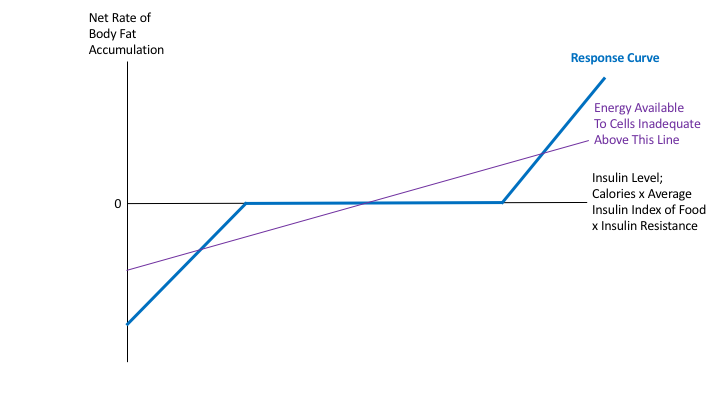
A key feature of the net body fat accumulation response to insulin curve that I have drawn is that it has a flat part. There is a range of insulin levels that lead to no weight gain and no weight loss. But a high enough insulin level, while it lasts, leads to weight gain; conversely, a low enough insulin level, while it lasts, leads to weight loss. A simple way to get a response curve of this shape is to have one signaling mechanism for weight gain that has a high insulin level threshold and another signaling mechanism for weight loss that has a low insulin level threshold. The main reason to think the shape might be something like this is that people are as close to steady in their weight as they are. Without a flat part to the response curve, that would be harder to get.
It might seem that lowering calorie intake would be a good way to lower your insulin index. But calorie intake also matters for making sure your cells have enough nourishment and energy. The balance between pain and weight loss is dramatically different depending on what part of the response curve you are in:
Technically, in this simple model, the amount of nourishment available to cells is shown by which line you are on parallel to the purple line. The purple line itself can be seen as a dividing line between adequate and inadequate nourishment. What give this model its interesting results is that nourishment is linear in calories and net body fat accumulation, but net body fat accumulation is nonlinear in insulin levels.
The bottom line is that you will feel hungry even shortly after eating a lot if you are eating a lot of high insulin index foods, but as long as you have plenty of fat to burn, you won't feel all that hungry if you are not eating anything at all. That is the revolutionary idea that I learned from reading Jason Fung's books The Obesity Code and The Complete Guide to Fasting—and an idea that matches my own experience and the experience a few other people who have shared their experiences as self-appointed guinea pigs with me.
Don't miss these other posts on fighting obesity:
Also see the last section of "Five Books That Have Changed My Life."

Image source. Rob Porter is holding the document
Note: This is not about the well-known economist named Rob Porter but the former White House staffer
The sharp edge of the Rob Porter story came home to me when I realized my personal connection. Other than the victims and those close to the victims, some of those whose hearts are hurt most deeply by someone's misbehavior are the parents of the bad actor. I know Rob Porter's father Roger Porter well.
My connection comes through the small world of Mormons at the highest levels of academia. Roger Porter was my bishop when I was in the student congregation in Cambridge, Massachusetts in 1977-1979 before I served a Mormon mission in Japan. Moreover, in a Mormon congregation, even the bishop and his family has a "home teacher" (see "Inside Mormonism: The Home Teachers Come Over"), and although I was less than 19 years old during this period, I was assigned as the home teacher for Roger Porter and his family. (Since Rob was born in 1977, that means I was the home teacher for Rob Porter during his first two years of life.)
Roger Porter is a truly delightful person. His his wife Ann was also truly delightful. Ann died last year and so was spared the latest reminder of Rob's bad behavior. I don't see any angle whereby Rob could make any progress at blaming his parents for his bad actions.
Tangentially, as a young White House Fellow, Roger Porter took on a role in the Ford Administration similar to role that Rob took in the Trump administration: being an effective manager of the paper flow.
Good parents want their children to be good and to do good as well as to be happy. By all accounts, Rob was doing some good within the Trump Administration; but he did bad things in his marriages.
I am moved by the progress that the #MeToo era represents. It is a huge step forward for humanity to the extent that it is now harder for men to get away with treating women badly.
The question I have, though, is what the path for repentance is for men who have treated women badly. One thing I think is a minimum standard for us as a public to treat men in the public sphere as having repented is this: men who have done serious harm to women should come forward and admit their crimes and near-crimes without waiting to be accused by others. If someone proactively says they have acted badly and shows real evidence of having turned over a new leaf, there should be some length of time after which we as a public should treat them more or less the same as those who were never bad in the first place. (In the private sphere, more caution is likely to be appropriate for women.)
The Mormon Church, in particular, should encourage men who have treated women badly to talk about what they did wrong and their efforts to do better. This sends an important to other men about intolerable behavior. The Mormon Church is an institution that could dramatically improve the record of its men in their treatment of its women by having men who are truly remorseful talk about how they mistreated women and how terrible a thing that is. (Other institutions need this just as much, but have less of the institutional capability to make it happen.)
I am pleased to be included again as a FocusEconomics top blog. The link on the title of this post goes to the FocusEconomics webpage for 2018 top blogs in economics and finance.
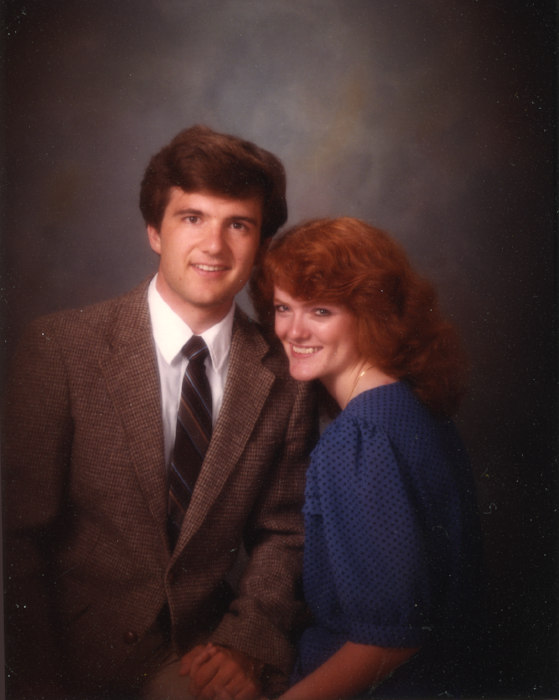
Miles and Gail in 1984 (engagement photo)
I am proud to share with you the first guest post on supplysideliberal.com by my wife Gail. It is also the 2d post on her blog resilienceconspiracy.com.
This is a Valentine's Day themed post. In case you are interested, I have two Valentine's Day themed posts of my own: "Marriage 101" and "Marriage 102."
Update: Gail also has a later guest post:
When I was 22 years old, I met Miles Kimball. Two months later we were married. We were young, attracted to one another, and had an uninformed confidence born of youth and optimism that we could make a successful marriage.
When I looked into Miles’s eyes, I thought about all the wonderful things in our future: kids, jobs, and building a life together that would be fulfilling and joyful. I imagined the love I felt for him would naturally grow, with no thought of the real work a successful marriage requires.
I’ve sometimes wondered if I could have seen the challenges ahead, would I have entered into this partnership? If I could have seen the grief, heartache, and work it would take to find common ground . . . would I have gazed into this man’s eyes and agreed to spend my life with him?
Miles and I have been married 33½ years. We’ve had the tragic misfortune of burying three children—each separate loss taking a tremendous toll on our family. We’ve regrouped many times, struggling to find the language to explain our separate experiences in order to move on together.
Romantic love is fun and mostly easy. This Valentine’s Day I’d like to pay tribute to the troopers, the couples who manage to sort through all the challenges, upheavals, job losses, grief, health challenges and more . . . and still manage to connect, eye-to-eye with the person they long-ago promised to spend their life with.
Love is complicated . . . and sometimes very simple. I remember the first time I saw Miles walking toward me to pick me up for our first date. I felt a surge of hope and wonder. Now when Miles walks toward me I feel the validation of someone who sees me, has comforted me, and has shouldered our shared burdens with grace and humor. After all we’ve been through, he continues to approach life with a happiness and optimism I’ve come to rely on.
Today, Miles and I still want to be in the same room with one another and face whatever is coming together. Who could ask for more?
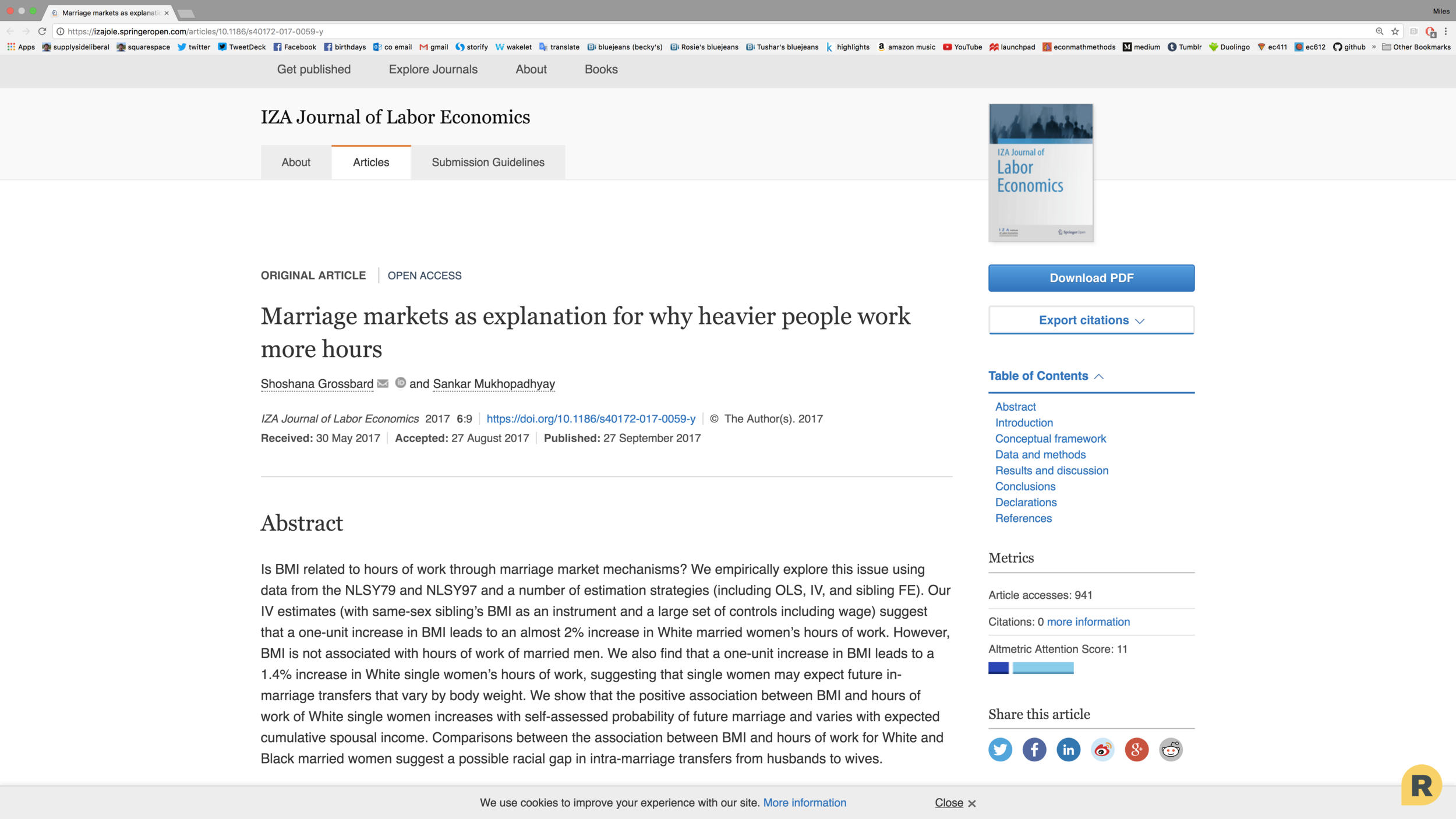
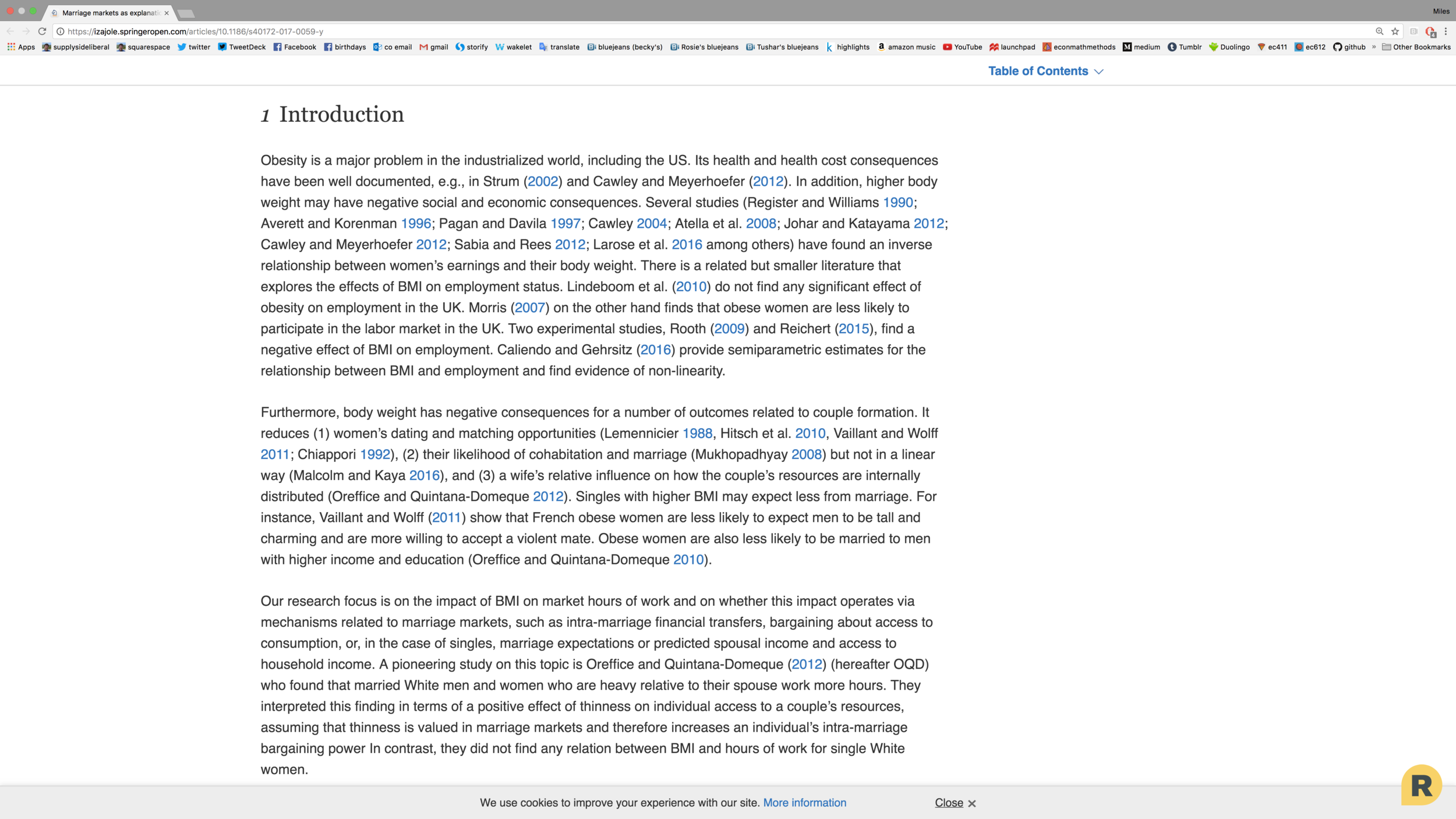
Obesity has many other negative consequences in our culture beyond its negative health consequences. The introduction to Shoshana Grossbard and Sankar Mukhopadhyay's article flagged above lists many:
Obesity is a major problem in the industrialized world, including the US. Its health and health cost consequences have been well documented, e.g., in Strum (2002) and Cawley and Meyerhoefer (2012). In addition, higher body weight may have negative social and economic consequences. Several studies (Register and Williams 1990; Averett and Korenman 1996; Pagan and Davila 1997; Cawley 2004; Atella et al. 2008; Johar and Katayama 2012; Cawley and Meyerhoefer 2012; Sabia and Rees 2012; Larose et al. 2016 among others) have found an inverse relationship between women’s earnings and their body weight. There is a related but smaller literature that explores the effects of BMI on employment status. Lindeboom et al. (2010) do not find any significant effect of obesity on employment in the UK. Morris (2007) on the other hand finds that obese women are less likely to participate in the labor market in the UK. Two experimental studies, Rooth (2009) and Reichert (2015), find a negative effect of BMI on employment. Caliendo and Gehrsitz (2016) provide semiparametric estimates for the relationship between BMI and employment and find evidence of non-linearity.
Furthermore, body weight has negative consequences for a number of outcomes related to couple formation. It reduces (1) women’s dating and matching opportunities (Lemennicier 1988, Hitsch et al. 2010, Vaillant and Wolff 2011; Chiappori 1992), (2) their likelihood of cohabitation and marriage (Mukhopadhyay 2008) but not in a linear way (Malcolm and Kaya 2016), and (3) a wife’s relative influence on how the couple’s resources are internally distributed (Oreffice and Quintana-Domeque 2012). Singles with higher BMI may expect less from marriage. For instance, Vaillant and Wolff (2011) show that French obese women are less likely to expect men to be tall and charming and are more willing to accept a violent mate. Obese women are also less likely to be married to men with higher income and education (Oreffice and Quintana-Domeque 2010).
The research behind their article identifies another, as described in the abstract:
Is BMI related to hours of work through marriage market mechanisms? We empirically explore this issue using data from the NLSY79 and NLSY97 and a number of estimation strategies (including OLS, IV, and sibling FE). Our IV estimates (with same-sex sibling’s BMI as an instrument and a large set of controls including wage) suggest that a one-unit increase in BMI leads to an almost 2% increase in White married women’s hours of work. However, BMI is not associated with hours of work of married men. We also find that a one-unit increase in BMI leads to a 1.4% increase in White single women’s hours of work, suggesting that single women may expect future in-marriage transfers that vary by body weight. We show that the positive association between BMI and hours of work of White single women increases with self-assessed probability of future marriage and varies with expected cumulative spousal income. Comparisons between the association between BMI and hours of work for White and Black married women suggest a possible racial gap in intra-marriage transfers from husbands to wives.
Moreover, beyond all the negative consequences listed above, I am struck by what a great share of the consciousness of many people is filled by thoughts about their own unsuccessful weight-loss efforts. That is, these negative consequences of obesity and being overweight are on top of the costs people incur to try to weigh less. I emphasize the expenditure of consciousness itself, but of course there is a great deal of time and money spent in weight-loss efforts as well. It is a bit like crime: we suffer from crime and we are hurt by all of the costs we incur to try to reduce crime.
Having emphasized all the costs on top of the health cost, how big is the health cost itself? Here is a way to get an idea of the right order of magnitude. A little googling turns up the 2013 PLOS One article "Life Years Lost Associated with Obesity-Related Diseases for U.S. Non-Smoking Adults" by Su-Hsin Chang , Lisa M. Pollack, Graham A. Colditz which cites these CDC figures in the introduction:
The Centers for Disease Control and Prevention (CDC) estimates that approximately 112,000 deaths are associated with obesity each year in the United States [6], [7].
When combined with a $9 million valuation of a statistical life, which is not an unreasonable number (see the Wikipedia article "Value of Life"), that comes to slightly over $1 trillion worth of obesity-related deaths each year.
The total cost of obesity, including all of the above, motivates me to keep writing about how to fight it. Here are the main posts I have written so far on fighting obesity:
Also see the last section of "Five Books That Have Changed My Life."
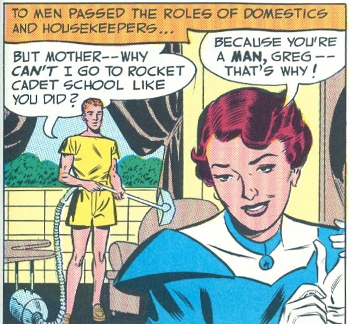
Large-scale matriarchies appear often in fiction, but are hard to point to in real life. Some of these fictions project matriarchy into prehistory. But I suspect the status of women relative to men is better now than at any other time since the emergence of Homo Sapiens. For better than now, we need to look to the future, not the past.
The word "patriarchy" points to a very real correlation between autocratic hierarchy and sexism. There are, and there have been female dictators and semi-dictators. But it is hard to come up with an example of an autocratic government that has as high a percentage of women in the top echelons of power (say in a list of the top 100 most politically powerful people in a nation) as many democracies do. (Communist governments officially proclaimed the equality of men and women. But they did not and do not have a large percentage of women in the top echelons of power.)
In sections 52 and 53 of John Locke's 2d Treatise on Government: “Of Civil Government” (Chapter VI. Of Paternal Power), John Locke points to an interesting reason that gender equality is a bad fit for autocracy: it put two people at the head of each family, instead of one, and thereby undercuts the notion that one person needs to be at the top of society:
It may perhaps be censured as an impertinent criticism, in a discourse of this nature, to find fault with words and names, that have obtained in the world: and yet possibly it may not be amiss to offer new ones, when the old are apt to lead men into mistakes, as this of paternal power probably has done, which seems so to place the power of parents over their children wholly in the father, as if the mother had no share in it; whereas, if we consult reason or revelation, we shall find, she hath an equal title. This may give one reason to ask, whether this might not be more properly called parental power? for whatever obligation nature and the right of generation lays on children, it must certainly bind them equal to both the concurrent causes of it. And accordingly we see the positive law of God every where joins them together, without distinction, when it commands the obedience of children, “Honour thy father and thy mother,” Exod. xx. 12. “Whosoever curseth his father or his mother,” Lev. xx. 9. “Ye shall fear every man his mother and his father,” Lev. xix. 3. “Children, obey your parents,” &c. Eph. vi. 1. is the style of the Old and New Testament. 1
Had but this one thing been well considered, without looking any deeper into the matter, it might perhaps have kept men from running into those gross mistakes, they have made, about this power of parents; which, however it might, without any great harshness, bear the name of absolute dominion, and regal authority, when under the title of paternal power it seemed appropriated to the father, would yet have sounded but oddly, and in the very name shewn the absurdity, if this supposed absolute power over children had been called parental; and thereby have discovered, that it belonged to the mother too: for it will but very ill serve the turn of those men, who contend so much for the absolute power and authority of the fatherhood, as they call it, that the mother should have any share in it; and it would have but ill supported the monarchy they contend for, when by the very name it appeared, that that fundamental authority, from whence they would derive their government of a single person only, was not placed in one, but two persons jointly. But to let this of names pass.
The image of mothers and fathers being equal leaders of a family is not even a good fit as an image for oligarchic rule: most mother-father pairs leading families jointly have dispositions that differ more than the three individuals in a triumvirate, for example. So the image of mothers and fathers leading families jointly tends to suggest the idea that it is possible for people who are different to be involved in ruling. That is at least partway toward the idea of democracy.
I have become enamored of the idea that involving people with different dispositions and different views in making a decision is likely to result in a better decision. Believing this forces me into the awkward position of being open to the possibility that I might be wrong even in situations where I am convinced that I am right. It also leads me to hope that my words persuade when I am right and don't persuade when (unbeknownst to me) I am wrong.
I have enough confidence in my own views that if somehow, I were magically in the position of being a benevolent dictator in a society that would tolerate a departure from democracy, it would be hard to lay down that power entirely. But one of the first things I would do would be to gather around me a set of councillors I respected and trusted who would not hesitate to tell me when they thought I was wrong. Then I would irrevocably cede constitutional authority to the council that I had appointed—and mandate a transition to democracy by the time most of those councillors would become unable to serve due to death or advanced age.
For links to other John Locke posts, see these John Locke aggregator posts:
In this video, Christina Hoff Sommers recounts the standard result that after accounting for differences occupational choices, there isn't much of a gender gap left. She note that there are also plenty of omitted variables in the typical study to potentially account for most of the rest.
Christina also emphasizes the market logic that could lead to such a result: if women are cheaper, a private equity firm could make a lot of money by taking over firms that are slowly losing money and make them profitable just by hiring cheaper women. They could cut wages and still get plenty of employees simply by being willing to hire mostly women. Somewhat harder, entrepreneurs willing to hire mostly women should often be successful against established businesses that are reluctant to hire women. I had a storify discussion about this: "The Argument that the Free Market Will Rectify Discrimination as a Guide to Business Opportunities."
Let me say something about these two points in reverse order.
The logic that predicts the profit motive is enough to close the gender wage gap does not operate in areas where the profit motive is weak. This means that a good place to look for genuine gender wage gaps is in the nonprofit sector—for example, in nonprofit universities. Even there, cost-minimization in the hiring of lower staff is likely to suppress genuine gender wage gaps for lower-level staff. The genuine gender wage gaps are more likely to be concentrated among the professoriate. This does present a genuine opportunity for universities that hire more female professors. But it is not easy for private equity firms to take over a university and make it follow a policy of hiring more female professors. Nor is it easy to establish successful new universities that can compete at the top rank. So universities themselves need to decide to seize the opportunity if it is going to happen; it is not likely to be forced on them. (On this opportunity for Economics Departments specifically, see my post "When Women Don’t Get Any Credit for Coauthoring with Men.")
Turning to Christina's research summary suggesting their is very little in the way of a genuine gender wage gap, I am struck first by how many of the differences in occupational choices made by men and women to back to inequality within households headed by a male-female pair. In this list, let me use the terminology "husband" and "wife," with the understanding that similar issues applied to unmarried heterosexual couples:
Second, I am struck by the role of sometimes subtly, sometimes not-so-subtly hostile workplaces in discouraging women from pursuing many lucrative professions. For example, think of Christina's list of high-paying careers in which women are underrepresented:
I am willing to bet that women face ill-treatment in all of these fields. What I know best is that Silicon Valley has produced many stories of ill-treatment for women in the tech industry. In math, the discouragement of women begins early in telling them they are not good at math and sciences. On this, see "Calculus is Hard. Women Are More Likely to Think That Means They’re Not Smart Enough for Science, Technology, Engineering and Math" and "There's One Key Difference Between Kids Who Excel at Math and Those Who Don't."
In addition to outright ill-treatment, a common type of discrimination against women comes from workplace cultures that amp up the need for highly "competitive" self-serving behaviors that our culture has more actively socialized women against doing than it has socialized men against doing. Men also take advantage of prosocial things that women have been socialized towards doing.
The details differ by particular occupation. To see how this places out in a narrow neck of the woods, see "How Big is the Sexism Problem in Economics?
When men create hostile or unfair workplaces for women, there can be a tipping point where private equity firms and entrepreneurs swoop in and switch to workplaces with such a preponderance of women that the few men are unable to enforce a hostile workplace environment. But this can require a very discontinuous change. A few more women and a few less men won't do it. There are market opportunities here, but only for the bold.
Third, I do think that our culture bestows more approval on women who sacrifice salary for nonpecuniary benefits than on men who sacrifice salary for nonpecuniary benefits. Men who choose a low-paid meaningful job are more likely to face criticism than women are for not sucking it up and taking the alternative soul-deadening job in order to better support the family. Leaving anything related to child-rearing in another category (see above), here are some of the other nonpecuniary benefits women are given more social approval than men for choosing even at the cost of low pay:
Looking at another, more complex dimension, both men and women are given more social approval for choosing jobs that seem gender appropriate. This cuts in all kinds of ways on the relative pay of men and women. For example, men may be too slow to leave the declining manufacturing sector for mid-level and low-level healthcare positions because a factory job seems more masculine. Here women are helped by the fact that nursing, which is a relative good career compared to factory work (given the way things are going), has been deemed gender-appropriate for women. On the other hand, women may be especially ready to go into elementary school teaching despite its low pay because even in 2018, this seems like an especially gender-appropriate career.
Conclusion: The bottom line is this:
Hat tip to Joseph Kimball for pointing me to this video.
I really like this blog post.
Here is how I stumbled across it. When I suggested that correlations being caused by a third factor needed a snappier, catchier name in "Cousin Causality," Chris Chabris tweeted that it was called "third-variable causation" in psychology. Though neither this nor the other term in use, "shared causation", meet my standards for being snappy and catchy, knowing the phrase "third-variable causation" led me to a search on Twitter that turned up Julia Rohrer's post.