Don Lincoln: What Good Is Particle Physics?
This is a heartwarming 7 minute video about the value of science. Hat tip to Joseph Kimball.
A Partisan Nonpartisan Blog: Cutting Through Confusion Since 2012
This is a heartwarming 7 minute video about the value of science. Hat tip to Joseph Kimball.

Link to the Wikipedia page for this painting: "The Angelus," by Jean-François Millet
John Locke, in section 32 of 2d Treatise on Government: “Of Civil Government” (in Chapter V "Of Property") writes:
But the chief matter of property being now not the fruits of the earth, and the beasts that subsist on it, but the earth itself; as that which takes in and carries with it all the rest; I think it is plain, that property in that too is acquired as the former. As much land as a man tills, plants, improves, cultivates, and can use the product of, so much is his property. He by his labour does, as it were, inclose it for the common. Nor will it invalidate his right, to say every body else has an equal title to it; and therefore he cannot appropriate, he cannot inclose, without the consent of all his fellow-commoners, all mankind. God, when he gave the world in common to all mankind, commanded man also to labour, and the penury of his condition required it of him. God and his reason commanded him to subdue the earth, i. e. improve it for the benefit of life, and therein lay out something upon it that was his own, his labour. He that in obedience to this command of God, subdued, tilled and sowed any part of it, thereby annexed to it something that was his property, which another had no title to, nor could without injury take from him.
I want to highlight two aspects of this chapter. First, I find John Quiggin's post "John Locke Against Freedom" persuasive. John Quiggin argues as follows:
Given his reputation as a defender of property rights and personal freedom, Locke has been accused of hypocrisy for his role in promoting and benefiting from slavery and the expropriation of indigenous populations, actions that would seem to contradict his philosophical position. This is too charitable.
The real contradictions are to be found within Locke’s philosophical writings. These are designed to fit his political positions both in England, where he supported resistance to the absolutist pretensions of the Catholic James II, and in America, where he was part of the slave-owning ruling class (albeit from afar). ...
Considered in the American context ... Locke is not offering a theory of original acquisition. Rather, his theory is one of expropriation, designed specifically to justify the “fraud and injustice” to which Hume refers.
Locke’s central idea is that agriculturalists, by mixing their labor with the soil, thereby acquire a title to it. He immediately faces the objection that before the arrival of agriculture, hunters and gatherers worked on the land and gained sustenance from it. So, it would seem, the would-be farmer has arrived too late. The obvious example, to which he refers several times, is that of European colonists arriving in America. Locke’s answer is twofold.
First, he invokes his usual claim that there is plenty of land for everybody, so appropriating some land for agriculture can’t be of any harm to the hunter-gatherers. This is obviously silly. It might conceivably be true for the first agriculturalist ... or the second or the fiftieth, but at some point the land must cease to be sufficient to support the preexisting hunter-gatherer population. ...
Locke’s real defense is that regardless of whether there is a lot or a little, uncultivated land is essentially valueless. All, or nearly all, the value, he says, comes from the efforts of the farmers who improve the land. Since God gave us the land to improve, it rightfully belongs to those who improve it.
In my post "John Locke on Diminishing Marginal Utility as a Limit to Legitimately Claiming Works of Nature as Property" I argue against the expropriation of native lands as follows:
To justify, theoretically, taking that land from the Native Americans, one would have to add the principle that when technology changes so that people need less land to support themselves, then previous land claims need to be reevaluated. In general, such a principle is a recipe for a big mess. Better to, at a minimum, require rich outsiders to purchase land as European Americans did from Native Americans in a few cases, and as the European New Zealanders did to a much greater degree from the Maori. If technology has really improved dramatically, they should be able to do so.
One of the ways that John Locke justifies both the expropriation of native lands and slaveholding is by quoting the Bible. I discuss his Biblical justification of slavery in "John Locke Treats the Bible as an Authority on Slavery." The Bible verses alluded to in section 32 that he uses to justify expropriation are Genesis 2:15, before the Fall,
The Lord God took the man and put him in the Garden of Eden to work it and take care of it.
and Genesis 3:17-19, after the Fall:
“Cursed is the ground because of you;
through painful toil you will eat food from it
all the days of your life.
It will produce thorns and thistles for you,
and you will eat the plants of the field.
By the sweat of your brow
you will eat your food
until you return to the ground,
since from it you were taken;
for dust you are
and to dust you will return.”
From the point of view of these verses, hunter-gatherer populations were violating a command of God by not being farmers. John Locke is unfair here in counting the labor of farmers. Hunting and gathering is also labor.
Cultivation is not the only way to improve land. Land can also be "improved" by combining it with the knowledge of where to find plants to gather and animals to hunt on that land. But John Locke won't count that.
The second aspect I want to point to is that after correcting John Locke to include all kinds of labor in improving land, not just cultivation, I do feel sympathetic to the idea that labor is not only honorable, but honorable enough to sometimes by rewarded by a claim to something that was unmade by humans, or to some of the income of things that were unmade by humans.
One of the arguments these days for a universal basic income is that it frees people from the necessity to work, as if needing to work were an undignified imposition on people. It may be that we have somehow subtracted dignity from many forms of work, but work itself is not inherently undignified!
Some day the robots may be able to do all the work for us. But I see that day as at least 100 years off. In the meantime, much needs to be done, and we need everyone to pitch in! Instead of giving everyone a basic income without needing to work, let's give everyone a basic income as long as they do work, and make sure there is a way to work.
Personally, I like Morgan Warstler's plan for this using wage subsidies for those at the low end of the wage distribution. One way I might emend his plan is to augment the income floor for those who do government help in the form of wage subsidies by adding in some credits that can be used only to buy services from others who are also receiving this kind of government help. By that means, the poor can be encouraged to help one another by providing inexpensive services to one another, in addition to, as now, the poor providing services to the rich and the rich providing often overpriced services to the poor.
Another way it is necessary to add to Morgan Warstler's plan is that services done under the rubric of the wage subsidy system needs to be free of the most onerous limitations of occupational licensing. Streamlined, minimalist occupational licensing requirements for those working under that rubric can be the beginning of streamlined, minimalist occupation licensing requirement for everyone.
Update: Morgan Warstler replies on Twitter.
Don't miss other John Locke posts. Links at "John Locke's State of Nature and State of War."
In my post "Obesity Is Always and Everywhere an Insulin Phenomenon" I explain why insulin is so central to obesity. In brief, among its many other effects insulin is an instruction to fat cells to take in blood sugar and turn it into stored fat. As a result, knowing the details of what ramps up your body's insulin production is much more helpful for weight loss than counting calories.
The Problem with Calories In/Calories Out. But isn't it obvious that weight-loss is all about calories in/calories out, given the familiar energy balance identity below?
Weight Gain in Calories = Calories Consumed - Calories Expended
The basic problem with that view is in the title of my storify story "How the Calories In/Calories Out Theory Obscures the Endogeneity of Calories In and Out to Subjective Hunger and Energy." To understand weight-loss or weight gain from the energy balance identity, you have to understand calories consumed and calories expended. And insulin is the key to understanding calories consumed and calories expended.
As mentioned above, high insulin levels cause sugar to be taken out of the bloodstream and turned into fat in the fat cells. The low blood sugar levels then have two effects: making you hungry, so you want to eat more, and making you feel less energetic, so you burn fewer calories.
(If your body produces too much insulin for too long, it can create enough insulin resistance to cause Type II diabetes. Once you have Type II diabetes, administered insulin or an insulin-promoting drug may play a role in treatment. But dietary modifications may help. Jason Fung is an expert on that, and has a Center for Intensive Dietary Modification that he talks about in his book The Complete Guide to Fasting.)
People often say the way to lose weight is to "Eat less, move more." By itself that is not so stupid, but what is off track is to think that you "Eat less, move more" by trying to "Eat less, move more." Instead, just keep your insulin levels down, and your body will automatically make you want to eat less and move more without you trying at all—other than whatever effort it took to keep your insulin levels down. (Here I am taking a bit of poetic license in counting a rise in basal metabolism as "moving more.")
Some aspects of a low-insulin strategy for weight loss will look very similar to what you might try to do anyway under the naive take on calories in/calories out that surrounds us in our culture: for example, eat lots of greens, avoid anything with added sugar; avoid eating late at night. But many other aspects of a low-insulin strategy are quite different than the conventional wisdom.
What I think is the correct advice—and hope will become conventional wisdom in a better future—is to avoid all foods and beverages that cause the body to produce a lot of insulin and to lean towards foods and beverages that cause the body to produce relatively little insulin. This post looks at the evidence on which foods and beverages cause the body to produce a lot of insulin and which don't in order to give advice about what are healthy and unhealthy foods to eat in relation to weight gain and weight loss and the suite of "Western diseases" such as diabetes, heart disease and strokes that are highly correlated with weight gain and weight loss.
Multipliers. "Table 2" linked above (from the paper linked above that) reports the results of experiments in which experimental subjects ate a particular food, and then their insulin was measured over a period of time after that. The table focuses on differences between different foods and beverages. But there are also difference across people and across time in insulin production.
Compared to other people, you will produce more insulin in response to any given food or beverage if you are "insulin resistant." Basically, if you have had chronically high insulin levels, some cells in your body are likely to respond less to insulin, and so your body produces more insulin. It is a little like people who have hurt their hearing through many years of loud music; because they can't hear as well, they often turn up the volume of the music even more to make up for the lost hearing. The bottom line is that the more you have acted to raise you insulin levels in the past and the less you have done to lower your insulin levels in the past, the more insulin any given food is likely to cause your body to produce now.
Compared to other times of day, you will produce more insulin in response to things you eat late in the day. On this there is less evidence than one would like, but here is what Jason Fung says in Chapter 12 of The Complete Guide to Fasting
... is there a difference between eating during the day and eating at night? Well, the studies are few, but perhaps revealing. In a 2013 study, two groups of overweight women were randomly assigned to eat a large breakfast or a large dinner. Both ate 1400 calories per day; only the timing of the largest meal was changed. The breakfast group lost far more weight than the dinner group. Why? Despite following similar diets and eating about the same amount, the dinner group had a much larger overall rise in insulin. An earlier 1992 study showed similar results. In response to the same meal given either early or late in the day, the insulin response was 25 to 50 percent greater in the evening.
Insulin production being high late in the day has a very obvious implication for weight loss: if you can, make your big meal of the day lunch, not dinner. For most people this is possible at least on the weekends. Actually, as far as timing goes, a big breakfast is likely as good, maybe even better, but as I will discuss below, many common breakfast foods are particularly high in their insulin production, so it might need to be a big breakfast that doesn't look like breakfast food to you. So suggesting that lunch be the big meal might lead to less misunderstanding.
The fact that doing badly in relation to insulin in the past will cause you trouble now has several important implications:
Prevention is much, much easier than cure. For most people, if they simply avoid added sugar and avoid eating late at night starting from a young age, they won't get fat. But if you are already overweight, chances are you have some degree of insulin resistance, and you will have to be stricter in your actions to reduce insulin production in order to have the results be reasonable insulin levels despite the high multiplier you have because past actions have led to insulin resistance. (Let me be clear that any past actions that have led to insulin resistance may not be your fault at all. They may well have been out of ignorance caused by the bad dietary advice the government has given us.)
Just because someone else can get away with eating something doesn't mean you can. Indeed, you can learn something about your own insulin responses without any elaborate testing equipment: just notice which foods have a rebound effect where they lead to your getting hungry again an hour or two later. (For me personally, the big heap of white rice routinely served in Asian restaurants with almost any meal was an obvious example of this.)
Reversing insulin resistance and thereby reducing one's personal multiplier for insulin production can be very valuable. Even apart from the direct health benefits, reversing insulin resistance expands the range of foods one can eat without causing trouble. (For example, reversing insulin resistance can add to the number of different kinds of whole fruit one can eat without trouble. That is valuable because many fruits have benefits that need to be balanced against the relatively high levels of insulin production most of them cause.) The only thing I know powerful enough to do much toward reversing insulin resistance is serious fasting of the sort Jason Fung talks about in The Complete Guide to Fasting
The rest of this post gives a few general rules about good and bad foods and beverages and then divides foods and beverages into groups according to their food insulin index or "insulin index" for short. I title each section according to my own rules of thumb about how to think of each insulin index range. This may give you some sense of what the numbers mean:
70 or above insulin index: "never" foods
Insulin index from 50 to 69: wicked treats: very bad, but not quite as bad as some other things
Insulin index from 30 to 49: except on special occasions (such as a meal at a good restaurant) portion sizes should be kept small
Insulin index from 20 to 29: go-to staples for a low-insulin approach
Insulin index from 10 to 19: especially good foods
Insulin index below 10: suitable for eating and drinking even on an extended "modified fast."
Also, for comparison, straight sugar (glucose) has an insulin index of 100.
For simplicity, I will report only the point estimate of the insulin index for a food or beverage. Table 2 at the link reports standard errors. You should double those to get an idea of a reasonable range of what could be true. In particular, if you think one of the insulin index ratings doesn't make any sense, it is fair to look up the standard errors in the table, then add double the standard error and subtract double the standard error to get a reasonable range of what the true insulin index might be for that food. It is especially valuable to be suspicious of the point estimate of an insulin index and pay close attention the confidence interval obtained by looking at plus or minus 2 standard errors when the insulin indexes for similar foods seem very different than the insulin index for the food you are looking at. I do a bit of that below.
Now the general principles:
General Principle #1: Avoid "Lowfat" Foods
The first general principle is to avoid all lowfat foods. The highfat versions both taste better and have a lower insulin index. So as economists would say, all lowfat foods are dominated: worse on taste and worse in terms of making you fat. Always choose the high fat version of everything. Let me give here some of the comparisons from the table between lowfat and highfat versions of things:
vanilla ice cream: 65
lowfat vanilla ice cream: 69
milk: 24
1% milk: 34
skim milk: 60
reduced-fat cottage cheese: 40
lowfat cottage cheese: 52
tuna canned in oil: 16
tuna canned in water: 26
Chips Ahoy chocolate chip cookie: 33
Chips Ahoy reduced-fat chocolate chip cookie: 49
potato chips: 45
40% reduced-fat potato chips: 51
From here on, I will list only the highest-fat versions of things in the table since eating lowfat versions of things makes no sense unless you want to fool yourself that you are eating more healthily than you are.
General Principle #2: Avoid Cold Cereal
Many, many different kinds of cold cereal have been tested. They all have fairly high insulin indexes. I won't list them all. Below are the worst and the best, but aside from all-bran original, even the best is pretty bad:
grapenuts: 110
rice krispies: 94
original shredded wheat: 91
special K (US version—Australian version much better): 86
Kellogg's cornflakes (US version—Australian version much better): 82
wheaties: 78
frosted flakes: 72
...
7 whole grain puffs: 59
great grains: 57
Kellogg's cornflakes (Australian version—US version much worse): 55
sustain: 52
honeysmacks: 49
cracklin' oat bran: 48
special K (Australian version—US version much worse): 48
Quaker 100% natural granola oats, honey and raisins: 41
Kellogg's all-bran original: 23
General Principle #3: Avoid Sweet Beverages, Including Fruit Juice
The trouble with sweet beverages is that the sugar in them is too easily and quickly digested, and so causes and insulin spike. That includes fruit juices. The fiber in fruit is needed to slow down digestion and moderate the insulin spike. Making fruit into juice stops the fiber from doing its work.
Even beverages with artificial sweeteners can cause an insulin spike simply from a mental anticipation effect: it is easy for your body to start looking forward to some real food if you taste something sweet. Some artificial sweeteners have other effects on insulin, but for those that operate through a mental anticipation ("cephalic") channel, my view is that they are more OK when sprinkled on real food than when drunk as part of a "zero calorie beverage" which makes the body expect nourishment that won't actually be there.
If you want to know about the effects of a particular non-sugar sweetener on insulin, try googling "insulin [name of non-sugar sweetener]" and you might find articles like this on the effects of stevia and aspartame on insulin.
General Principle #4: Avoid Things with Added Sugar
This one is pretty obvious. One more lenient rule of thumb is to avoid anything with any form of sugar listed among the top three ingredients.
General Principle #5: Avoid Starchy Foods
The body can turn starch into sugar so fast that starches cause insulin spikes similar to sugar itself. But in case it is not so obvious what is a starchy food, I list them all in the category for the appropriate insulin index range.
General Principle #6: If You Drink Alcohol, Lean Towards White Wine Instead of Red Wine or Beer
For other health reasons, I am not going to recommend drinking alcohol. (The idea that alcohol is good for health doesn't replicate well, empirically.) But it is worth knowing that while beer has an OK insulin index of 20, white wine has an insulin index of only 3. (Gin has an even lower insulin index of 1, but such high levels of alcohol have other negative side effects for health that have nothing to do with insulin.) Because grapes have a relatively high insulin index, I suspect that red wine, which leaves more of the grape in has quite a bit higher insulin index than white wine. Indeed, I wouldn't be surprised if the insulin index for red wine is in the same ballpark as for beer. Given this principle, of alcoholic beverages I will only list white wine below.
On to the groupings. Note that many foods and beverages haven't been tested, so one has to guess based on the things that have been tested. One good example is what I said about cold cereal above. I'll bet cold cereals that haven't been tested have quite a high insulin index, too! (Below I will leave cold cereals out, since I dealt with them all I need to above.) Remember to choose the highest-fat version of everything available. Lowfat versions of things will have a higher insulin index than what I list below!
Insulin Index above 70: Foods and Beverages to Avoid Completely—Or If You Must, Only the Tiniest Bite
jellybeans: 117
pancake and waffle mix: 110
honeydew melon: 93 (95% confidence interval from 63 to 123)
Mars bar: 89
potatoes: 88
baked beans (with added sugar): 88
strawberry lowfat yogurt: 84
fruit punch: 76
97% fat-free pretzels: 74
sherbet: 76
white bread: 73
whole-wheat bread: 70
Insulin Index from 50 to 69: Wicked Treats—Very Bad, But Not Quite as Bad as the Things Listed Above
fat-free blueberry muffin: 69
blueberry struesel muffin: 69
sweetened iced tea: 69
peaches canned in syrup: 65
vanilla ice cream: 65
peach-mango frozen yogurt: 64
water crackers: 64

Image from the Wikipedia article for "Water biscuit," a.k.a. water cracker
chocolate cake brownie with chocolate frosting: 60
black grapes: 60
bananas: 59
Panjacks: 58

Website for buying Panjacks—but don't buy any!
white rice: 58
croissants: 58
chocolate chip cookies: 57
McDonald's french fries: 57
orange juice: 55
Australian french fries: 54
peaches canned in juice: 54
fat-free oatmeal raisin cookie: 54
doughnuts with cinnamon sugar: 54
battered fish fillets: 54
supermoist yellow cake with chocolate frosting: 53
Insulin Index from 30 to 49: Portion Sizes Should Be Kept Small Except on Special Occasions
In addition to keeping portion sizes small, make sure to combine things in this category with other things that have a lower insulin index. Try not to eat them all by themselves.
apple juice: 47
apple pie: 47
pizza: 47
brown rice: 45
Australian Jatz crackers: 45
potato chips: 45
corn chips: 45
coca cola: 44
oranges: 44
apples (red delicious): 43
white fish: 43
cinnamon swirl pastry: 42
lentils: 42
carrot juice: 41
Australian grain bread: 41
frozen corn: 39
popcorn: 39
honey-raisin bran muffin: 37
snickers bar: 37
beef steak: 37
white corn tortillas: 36
chocolate milk: 34
muesli bar: 34
beef lasagna: 34
Chips Ahoy full-fat chocolate chip cookie: 33 (95% confidence interval from 27 to 39)
raisins: 31 (95% confidence interval from 21 to 41)
Insulin Index from 20 to 29: Go-To Staples for a Low-Insulin Approach
porridge (I assume this means unsweetened, non-instant oatmeal—the Wikipedia entry for "porridge" says, "Porridge made from rolled oats or ground oatmeal is common in the UK, Ireland, Australia ... It is known as simply 'porridge'"): 29
Australian brown pasta (I assume with no sugar added): 29
Australian white pasta (I assume with no sugar added): 29
tuna canned in water: 26
milk: 24
taco: 24
eggs: 23
navy beans: 23
prawns: 21
tofu: 21
7% fat cheddar cheese: 20
Insulin index from 10 to 19: Especially Good Foods
chicken fried in olive oil with skin: 19 (95% confidence interval from 11 to 27)
cream cheese: 18
roast chicken without skin: 17 (95% confidence interval from 9 to 25)
tuna canned in oil: 16
Australian hot dog (I assume with no sugar added): 16
peanuts: 15
Australian bologna (I assume with no sugar added): 11
Australian peanut butter (I assume with no sugar added): 11
Insulin index below 10: Suitable for Eating and Drinking Even on an Extended "Modified Fast."
Jason Fung argues for the benefits of extended fasts (periods of time without eating) in The Complete Guide to Fasting. And many people find not eating for even a week surprisingly easy. Anyone interested in this should read the book before trying it and heed Jason's warning:
If you are on any medication, you need to talk to your doctor before trying an extended fast, because appropriate dosages are often affected by how much you are eating. If you are diabetic and don't have your doctor adjust your diabetes medicine for the fact that you are eating less for a period of time, you could die.
Here, what I want to suggest is that for those who don't tolerate extended fasts (lasting more than a day) very well, it might work well to have a week, say, in which you only eat very-low-insulin-index foods. To my mind, that is too little variety to be a satisfying diet all the time, but if you think of it as a modified fast, a week of very restricted food choices wouldn't be that bad if you then go back to eating a wide variety of things. Here, I will list the things there is data on, then I will give my best guess about a wider range of things I suspect would have an insulin index below 10.
Let me note this: I assume the bacon in the list just below is bacon with no sugar added. Unfortunately, in the US, most bacon does have sugar added. You have to work hard to find bacon without sugar added and then pay extra. Bacon with sugar added likely has an insulin index quite a bit higher than 9. You may not always feel it is worth the extra money for bacon with no sugar added, but I would make a point of getting bacon with no sugar added for your modified fast, if you are going to eat bacon during your modified fast.
full-fat bacon (with no added sugar): 9
walnuts: 5
avocado: 4
olive oil: 3
white wine: 3
butter: 2
Based on this data and my guesses about the insulin index of things that weren't tested in time for this table, I would allow any of the following foods during a "modified fast":
full-fat bacon
any type of nuts (except maybe peanuts)
any type of nut butter that doesn't have any added sugar
avocados
oil of any kind
vinegar
salad dressing that has less 1 gram or less of carbs
hummus (see my discussion in the Conclusion)
butter
cream
coffee (but don't use a sweetener)
any kind of tea (but don't use a sweetener)
white wine (if you drink alcohol)
kale
This list means that you can have a very nice kale salad with bacon, avocado, olive oil, low-carb dressing and pine nuts, with a side of other nuts. And you can have "bulletproof coffee" which is butter melted into coffee, or stick with just cream in your coffee or tea. That doesn't sound so bad if it is only for a week.
It should go without saying that if you like these foods, it is great to eat them all the time—don't limit them to modified fasts. Part of my own practice is to make sure to eat a gigantic salad every day. That daily salad has a few other things in it, for example a tomato, mushrooms and half a cucumber, two eggs instead of bacon, and usually lettuce and spinach instead of kale, but it includes many things in this "insulin index so low it is suitable for a modified fast" category, including a whole avocado every day, pine nuts and all three of hummus, oil (olive oil or MCT oil) and full-fat 1-gram-carb ranch dressing. Preparing food causes an anticipatory rise in insulin, which makes me hungry, so I eat handfuls of roasted cashews and almonds and raw brazil nuts and salted raw macadamia nuts while I am preparing my salad.
Even with a modified fast, be alert to any warning signs that you should increase the range of food you are eating. If you need to, you can always raise the upper limit on the insulin index for your modified fast above 9, or discontinue your modified fast entirely. Nausea or an irregular or unusually fast or slow heart rate are warning signs you should heed. Also, worry about a level of dizziness or weakness that seems scary to you. But I am hopeful that eating to satiation from the list of very-low-insulin-index foods will keep such symptoms at bay. Since, in a modified fast, you are eating until you feel full at least once a day from the list of very-low-insulin-index foods, it is also unlikely that you would feel the extreme hunger that is also a warning sign. This sensation is called "true hunger" in this "All About Fasting" blog post that I googled:
True hunger is a sensation in the mouth and throat, similar to thirst, and not a gnawing pain in the stomach. The way it will get your attention is that [it] comes after many days of experiencing no hunger. Seemingly out of the blue, you'll have an intense desire for food. ...
Having once experienced this "true hunger", you will no longer confuse it with the emotional desire or physical discomfort we usually associate with hunger. Such physical "hunger pains" felt either in the stomach, or as "hunger headaches", are said to actually be withdrawal and detox symptoms from rich foods, chemicals, and stimulants.
In any case, be careful. Different people have different experiences, and because a lot of nutritional research has been barking up the wrong tree, research on fasting in general and on individual differences in responses to fasting or modified fasting is sorely lacking. It makes sense to do some experimentation to learn about your own reactions to dietary changes and fasting, but be cautious in the risks you take.
The Conundrum of Fruit
As I alluded to above, one issue with a low-insulin diet is that many fruits have a high insulin index. And many fruits weren't tested in time for this list. Although there are many important differences, the glycemic index does have a positive correlation with the insulin index. Given the lack of direct data on the insulin index for many fruits, let me report some glycemic indexes for various fruits (mostly from this website). Unlike above, in my list below I put fruits with the lowest glycemic indexes first. Where there is insulin index data, I put that alongside for comparison.
Glycemic Index
cherries: 20
grapefruit: 25
dried apricots: 32
pears: 38
apples: 39 (insulin index 43)
oranges: 40 (insulin index 44)
plums: 40
blueberries: 40
strawberries: 41
fresh peaches: 42 (insulin index 54 for peaches canned in juice)
bananas: 51 (insulin index 59)
grapes: 53 (insulin index 60)
Based on this data, for fruits with no direct insulin index data, I would guess the insulin index by multiplying the glycemic index by 1.1. Based on what I know, I have made cream and frozen cherries (or sometimes cherries and half and half) one of my healthy treats. I also love grapefruit. Apricots look like a good way to go as well. I view Pears and apples as fruits that should be eaten only in moderation.
Given the other benefits of fruits, weighed down by the high sugar content, and therefore high glycemic index of most fruits, the other choice I have made for myself is use this fruit powder:
I don't have any commercial relationship with this product. Indeed, no one pays me anything for my blog. (I do get paid by Quartz for columns I write there.) But also, all I know about this product is what the advertisements for it say. I figure that taking many kinds of fruit and turning them into a powder that I mix with milk destroys some of the value of the antioxidants, phytochemicals, and other micronutrients, but for me the fact that the sugar has been subtracted in making the powder more than makes up for that. Overall, I feel I am getting an improved ratio of the good aspects of fruit relative to the bad aspects. I do eat some whole fruit (cherries and cream :), but I feel the variety of different fruits that are used to make this powder is valuable because it might give me a wider range of different antioxidants, phytochemicals and other micronutrients.
In any case, I wanted to get across the message that, contrary to what you have been taught "fruits and vegetables" are not automatically healthy. Some vegetables—such as carrots, peas, and corn—are relatively starchy, and most fruits have a lot of sugar that weighs down the benefit from their other good aspects. Be just as careful with fruits and vegetables in your efforts to avoid too much fattening insulin production as with other things you eat.
Conclusion
If everyone kept handy a table of insulin indexes and treated foods and beverages with high insulin indexes as fattening, and treated foods and beverages with low insulin indexes as good for keeping weight low, it could make a huge difference to health in the US and other countries around the world. This is an area where accurate information alone can do a lot to raise welfare. So spread the word!
I hope that soon, many more foods and beverages will be tested for their effects on insulin production by the body, so that an insulin index table will soon be as complete as the calorie tables that I am warning you away from relying on.
Let me illustrate how I cope with the current state of the data on the insulin index. I wanted to guess the insulin index for basic hummus (with no added sugar). I first think about the insulin index for related foods like beans and lentils, but that still leaves me confused. Also I wondered whether being mashed up would affect the insulin index (anything that makes digesting something easier, including chopping something or mashing it can raise the insulin index), so I googled "hummus glycemic index" and found that it was 6. Multiplying by 1.1 or a bit more makes me hope insulin index for hummus is about 7, which would mean it was a very good food, suitable even for modified fasts. That is how I would then treat hummus until I found genuine insulin index data for hummus or for the chickpeas hummus is made from. An easier case is cucumbers. Without direct data on the insulin index for any of these, I start out expecting cucumbers to have a bit higher insulin index than lettuce or spinach. To confirm, I googled the glycemic index for cucumbers as 15 (giving me a guess of 17 for the insulin index for cucumbers), but find on the same webpage that spinach and lettuce have the same glycemic index of 15, somewhat higher than I expected. Googling kale glycemic index gets me an estimate of 4 or below for the glycemic index, which further makes me guess an insulin index of 5, which is behind my inclusion of kale in the "suitable for modified fasts" category above. Finally, curious about another ingredient in my daily salad, I googled a glycemic index of 15 for mushrooms.
I learned a lot from studying this table of the insulin index for various foods and beverages. I hope you have learned something from my take on that table.
Finally, let me emphasize again: please read "Obesity Is Always and Everywhere an Insulin Phenomenon" if you haven't already. That is where I explain why insulin is so important for anyone who cares about their weight or the many deadly diseases that are highly correlated with weight.
Update: I think you will find the discussion about this post on my Facebook page interesting. And here is an organized version of the discussion on Twitter. Also, let me copy out here a highly relevant Q&A with the same commenter in the comments for my post "On Fighting Obesity" and "'Forget Calorie Counting. It's the Insulin Index, Stupid' in a Few Tweets":
Matt: So i don't totally get the fascination with focusing on insulin vs calories in / calories out.
If you were to eat a ton of fatty meat, nuts, guacamole etc and low sugar you would still gain weight. I don't think many nutrionists / healthcare professionals would disagree. Would you?
What usually happens, however, is that carbs / sugar are insanely cheap and tasteful and ubiquitous now such that way more calories in vs calories out means weight has gone. As well as insulin issues and overconsumption of sugar. I just don't see why you disagree so much with saying yeah it is an calories in vs calories out thing, but primarily caused due to the massive increase in sugar / fast digesting carbs.
I think you partially agree to this by saying the problem with calories in / calories out is wrong due to the fact that calories in isn't totally exogenous.
In short, I think you are on to something with the importance of sugar, and fast digesting carbs, and the resulting insulin effects, I just think that you miss a good bit by not integrating that with the relatively accepted and common sense calories in / calories out framework.
Miles: I totally disagree. If you eat only high-fat food, you just can't get much down. You will be too full.
By contrast, people can eat a huge amount of sugary things. Sugar gives you a keen appetite.
How many calories you want to eat is governed in a big way by how much insulin is produced. Sugar produces a lot of insulin and makes you read to eat more an hour or two later. Fat by itself makes you not want to eat more.
Calories in/calories out talks as if calories in and calories out are exogenous. They aren't. They are governed in a big way by insulin.
Matt: The bloomin onion has 1,950 calories, of which 72 are due to sugar, and over 1300 are due to fat... you are telling me that is not fattening and that the fat in tht will be satieting? Or that a wedge salad that has 500 calories, and then the clam chowder that has 400 calories which is mainly fat is filling and won't make you fat? That's crazy....None have substantial refined carbs or "starchy", they all have huge, huge amounts of fat and added fat / frying / oil.
Sugar is bad, which seems obvious, and I totally agree. the insulin side you and taube talk about is just way exaggerated.
(btw, love your blog, and love your unique economic insights. It probably almost seems like I am trolling you since this is about my fourth comment on this topic, but I have lost and kept off 90 lbs over 4 years ( statistics shows <10 percent of people do this) with primarily a calorie counting philosiphy, and this was emphasized when i did nutrition research before recently going to outback (not a big govt rule guy at all, but them mandating calorie information for larger chains certainly has changed my habits, despite many studies I think showing smaller broad scale change). Just thought I would make what anecdotally and logically seems obvious about added fat (oil / butter / fried etc).
Miles: Just avoiding sugar and flour (which is highly correlated with avoiding processed foods) will do an enormous amount of good. So if you are getting that right, I am not surprised you are having a lot of success.
Yes, I do think that it is better to focus on the effects of food and drink on insulin than on calories, which implies that avoiding avoiding dietary fat is not helpful (unless you are substituting food with an even lower insulin index or are fasting—no food).
Think of it this way: many American adults gain about 1 pound a year. One pound of body fat corresponds to about 3500 calories. That means 1 pound a year is slightly less than 10 calories a day. So someone gaining 1 pound a year is keeping the calories in/calories out balance on average within 10 calories per day out of, say, 2000 calories a day overall. That is a remarkably close match! It is clear that people are not doing this consciously. So there must be unconscious regulatory mechanisms that are keeping calories in and calories out in very close balance. If those regulatory mechanisms get off by even 10 calories a day, it leads to being overweight in a now typical way. If those regulatory mechanisms get off by 30 calories a day, it can lead to serious obesity. So it is the regulatory mechanism you should pay attention to, and keeping it on track. The regulatory mechanism will handle the calories in/calories out for you. And insulin is central to the regulatory mechanism.
Let me also say that many things people think are fattening really are fattening, but are fattening for a different reason than people think:
Bread and butter: It is the bread you need to worry about, not the butter.
Pizza: It is the dough and the sugar in the toppings you need to worry about, not the cheese.
Hamburger: It is the bun you need to worry about, not the meat.
Ice Cream: It is the sugar (or nonsugar sweeteners) and corn syrup you need to worry about, not the cream.
Note: If you find the title of this post puzzling, take a look at the Wikipedia article for "It's the economy, stupid."
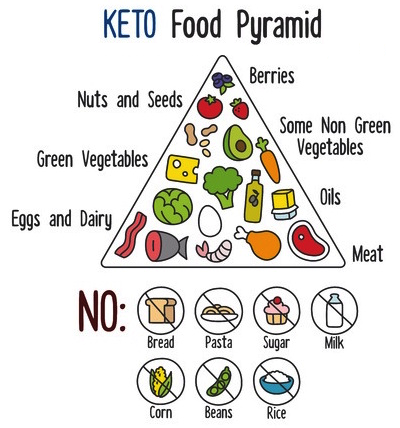
Update: Bonnie Kavoussi pointed me to the graphic below, which does a good job at showing how to avoid the types of food that are the very highest on the insulin index. But here are my notes on this graphic, from my post "The Keto Food Pyramid":
The Keto Food Pyramid doesn't do a good job at distinguishing between types of food that are medium on the insulin index and those that are low on the insulin index. Avoiding high is most important, but leaning toward low in the choice between low and medium also matters. In particular, any fruit (including berries), as well as most types of meat, poultry and fish need to be eaten in moderation,
While skim milk is high on the insulin index, whole milk is not.
While some types of beans are high on the insulin index, other types of beans are reasonably low on the insulin index.
While I suspect typical American spaghetti is indeed quite bad, existing evidence on the insulin index suggests (surprisingly) that there may be some types of pasta that are not so bad. More research is needed on this.
It is only raw carrots that are OK. Cooked carrots have a higher glycemic index, suggesting a high insulin index.
Potatoes should be on the banned list.
For annotated links to other posts on diet and health, see:
For example, here is what the first section looks like:
I. The Basics

Link to the podcast shown above
The interview with me on the Fed begins at the 26 minute mark. I posted "A New Era for the Fed" the same day I did this interview.
There is also a segment about "What I Got Wrong" at the 53 minute mark, related to my posts "Jason Fung: Dietary Fat is Innocent of the Charges Leveled Against It" and "Obesity Is Always and Everywhere an Insulin Phenomenon."
In addition to the extensive Twitter discussion linked above, for more contrarian discussion of nutrition, obesity and chronic diseases, don't miss:
Michael Weisbach holds the Ralph W. Kurtz Chair in Finance at Ohio State University. When he saw the two posts here on the Economics Job Market Rumors website
Michael thought immediately of how bad Finance Job Rumors was as well. Finance Job Rumors is technically part of Economics Job Market Rumors, but in practice involves a different set of people, but with similar online behavior. I encouraged Michael to write a guest post about Finance Job Rumors. You see his words below.
I, like many others, was appalled (but not surprised) when I read about Alice Wu’s study about sexism in EJMR. We in finance have our own message board inside EJMR (called Finance Job Rumors). Unfortunately, we are not immune to the issues Ms. Wu describes in her paper. Our board regularly contains sexist and racist comments about many members of the profession. After communicating with Miles about his entry on the subject, which I thought was terrific, he invited me to post some thoughts about the finance board on his blog.
The finance board appears to be dominated by graduate students and assistant professors who are having difficulty finding success, either in completing their degree, getting a job they are happy with, or publishing their research. The overall theme of the board is unfairness. Posters love to complain about how the profession plays favorites and values connections more than it should. They are not in the “mafia” that runs the profession, didn’t go to “HRM” schools as students (the EJMR name for the top 5 or 10 schools), are not of a protected minority, do not have connections (either personal or professional) with the powerful people in the profession, and, most of all, in their own minds, are themselves true scholars unlike the people who are successful at getting papers published (whom they call “regression monkeys”).
What has happened on the finance site is that the comments have become, in a large number of cases, very mean and personal. The targets of posters’ vitriol are anyone who is successful. Favorite targets tend to be top assistant professors and the current stars of the job market. As Ms. Wu pointed out, women are much more likely to be criticized, especially if posters think they are attractive. But there are others as well: if one is related to a senior member of the profession, or if posters have decided that one does not deserve his status in the profession for some reason, the board can be particularly mean.
I of course have been criticized on the site. For example, I was interested to learn from an anonymous poster that I free rode on the seven papers and one book that I wrote with Ben Hermalin. In fact, he did all of the work on them while I did nothing meaningful. Fortunately, this criticism is fairly minor and obviously incorrect, and most importantly for me, nothing about my personal life or appearance has made it onto the board (that I know about). I’m sure if I were an attractive female instead of a balding middle aged guy, a lot more would have been written about my appearance. And I’m sure it would have been especially hurtful. It actually hurt quite a lot to read the relatively mild things that were posted about me, I can only imagine what it is like to one of the frequent targets of the posters there. It must be truly awful to be a new member of the profession and to read these things about oneself online.
Ours is a tough profession. It is hard to do research, to get a good tenure track job, and to publish one’s research. Some of the issues the board focuses on are real. There is way too much discrimination against Asians, and it is true that high profile people get a far easier time from journals than people who have not yet developed reputations. It is natural that there is resentment. Many very smart, hard-working people cannot get jobs they are happy with and cannot publish their research in top journals.
But the board creates real problems. Young scholars should not have to have anonymous posters assaulting their character or personal appearance, or making cheap shots about their work in a forum where a large fraction of the profession will see it. It isn’t clear what to do about the situation. There is freedom of speech and it is impossible to monitor or regulate what is posted online. As a first step, I would implore all posters to remember that when you discuss someone online, they will undoubtedly read it, as will their friends and sometime their families too.

Congratulations are due to Jerome Powell on being nominated to be Chair of the Board of Governors of the Federal Reserve. At this point I know Jerome Powell only from news reports, though I was pleased to realize a few days ago that the locked-down Twitter account @jeromehpowell created in 2011 is following me, as well as several of my friends in the blogosphere. If he is reading this, let me say that I would be glad to craft a blog post on any topic he would like to hear my opinion on, and would be happy to do so while keeping his query confidential.
As top dog, Jerome Powell may reveal a strategic perspective that was hidden from view while he was just a member of the Board of Governors being a team player. That sort of thing does happen: my grandfather was a Mormon Church leader who faded into the background—until by longevity he became President of the Mormon Church and turned out to be one of the pivotal leaders of the Mormon Church in the 20th century, with a broad strategic vision no one expected.
But there is also an excellent chance that Jerome Powell, as someone who believes in consensus, and has come to respect the Fed's excellent permanent staff through his service so far, will continue to be guided in important measure by the Fed staff.
Given that possibility, it is more important than ever for the Fed's staff economists to step up their efforts to prepare for the next recession or other crisis, even though several more years are likely to intervene before that next recession or other crisis hits. The decline of the natural interest rate and inflation call for the development of new tools of monetary policy, beyond what were used during the Great Recession and its aftermath. (Anyone on the Fed staff who feels complacent about the future after the experience we have been through and the dangers that remain should wake up and smell the coffee!) And even if we had in place the key tools for dealing with future shocks—deep negative interest rates and vert high capital requirements—there are many other improvements that can be made to monetary policy.
I have laid out my views on the urgent research agenda for monetary policy in my paper "Next Generation Monetary Policy." In brief, the pluses and minuses of each of these possible dimensions of monetary policy need to be studied carefully, so that by the time of the next recession or other crisis, we know the virtues and vices of each:
Many of these will be very good for the nation and the world, but have political ramifications as well. For the Fed staff, let me say there is a good chance Jerome Powell will not only listen to you, but will be good at running political interference for the Fed to make it feasible for the Fed to get away with doing the right thing.
This is an excellent treatment. Kudos to Neil Irwin. Here is a quotation from Dick Thaler in Neil's article:
A good rule of thumb is we shouldn’t impose a set of rules that will create moral outrage, even if that moral outrage seems stupid to economists
--Richard Thaler
At least on the surface, a great deal of the inequality in the United States today seems to be about the ownership of land. But on closer examination much of what we think of as the value of land is often the value of a grant from a local government (that doles such things out in a miserly fashion) of the right to build on a piece of land. Or often, it is the value of having something already built on a piece of land that has escaped by a grandfather clause from what would otherwise be a prohibition against building on a piece of land. The monopoly local governments have over all rights to build within a substantial area, and what they do with that monopoly, ends up keeping many people from being able afford to live near jobs that would sustain them financially or live near amenities that would brighten their lives.
But even if there weren't such, one could worry that land ownership could be the source of much inequality--and a source of inequality that at some point in the past wasn't justified by an individual's effort or saving. John Locke tries to deal with this in two different way in his 2d Treatise on Government: “Of Civil Government”: by saying land can be claimed from an unowned state when labor mixed with it (see "On John Locke's Labor Theory of Property" and "John Locke: Property in the State of Nature"), and by saying that diminishing marginal utility limits how much land an individual can claim. In section 31 (in Chapter V "Of Property") he writes:
It will perhaps be objected to this, that if gathering the acorns, or other fruits of the earth, &c. makes a right to them, then any one may ingross as much as he will. To which I answer, Not so. The same law of nature, that does by this means give us property, does also bound that property too. “God has given us all things richly,” 1 Tim. vi. 12. is the voice of reason confirmed by inspiration. But how far has he given it us? To enjoy. As much as any one can make use of to any advantage of life before it spoils, so much he may by his labour fix a property in: whatever is beyond this, is more than his share, and belongs to others. Nothing was made by God for man to spoil or destroy. And thus, considering the plenty of natural provisions there was a long time in the world, and the few spenders; and to how small a part of that provision the industry of one man could extend itself, and ingross it to the prejudice of others; especially keeping within the bounds, set by reason, of what might serve for his use; there could be then little room for quarrels or contentions about property so established.
This means that the first few humans to go to a big new region should not have the right to claim the whole big region in order to profit from selling those rights to those who came later. Instead, they should only be able to claim the amount they can use with a reasonably high amount of additional utility from each acre.
A principle that diminishing marginal utility limits the amount of previously unowned land one can claim can make land reform at the point a country modernizes reasonable: it is likely that those who have large amounts of land either inherited it from someone who claimed too much in the distant mists of the past, or inherited it from someone who stole the land from someone who had a more legitimate claim at that time. (There is a logical possibility that someone worked really hard and bought land from others fair and square, but I don't think that describes the modal large landowner in the types of countries that have done a land reform.)
One current issue in the US where the principle that land claiming is limited by diminishing marginal utility is in rules governing coastal land. The Common Law makes land up to the high water mark a commons. This makes sense given the high marginal utility people get from swimming, enjoying the beach in other ways and walking along rivers. There is a constant temptation for those who own a house near a stretch of beach or river to obstruct others' access to that body of water. But the great enjoyment people get from having that access should make us suspicious of even very rich people who feel very much entitled to do so trying to get away with excluding people from that natural water access.
One of the troublesome aspects of John Locke's principles for claiming land is that an amount of land that would be unreasonably large for someone to claim if the relevant technology is agricultural would be quite reasonable to claim if the only available technology was hunting and gathering. Thus, even though John Locke is coming from a place not very sympathetic to them, the Native Americans had a legitimate claim to their land even according to John Locke's principles according to the mostly hunting and gathering technology that prevailed when they, in fact claimed the land. To justify, theoretically, taking that land from the Native Americans, one would have to add the principle that when technology changes so that people need less land to support themselves, then previous land claims need to be reevaluated. In general, such a principle is a recipe for a big mess. Better to, at a minimum, require rich outsiders to purchase land as European Americans did from Native Americans in a few cases, and as the European New Zealanders did to a much greater degree from the Maori. If technology has really improved dramatically, they should be able to do so. So this is a safer principles for dealing with improvements in technology for getting more out of a given amount of land. To some, given large enough technological differences, the purchase prices in that kind of situation may look almost the same as forcible dispossession, but morally, purchase even at a low price is vastly different from forcible dispossession.
(There is, of course, an issue of whether collectively-owned land was sold by appropriate collective decision-making processes. Did everyone who had partial ownership get compensated in some way? Did the individual who purported to sell violate group norms in doing so? This is akin to the idea that an important component of so-called colonial exploitation is often providing tools at a price to one set of indigenous people who want to oppress another set. One key subspecies of this is to give weapons to one set of indigenous people to steal ownership of something from another set of indigenous people and then sell portion of that to the outsiders.)
I like it that (by my interpretation) John Locke has the equality-favoring principle of diminishing marginal utility built in as a component of his rule for claiming as property things created by nature. (Here I have written about land, but ideas logically available would be another set of things created by nature worthy of consideration in another post.) Diminishing marginal utility was one of the themes in my inaugural post "What is a Supply-Side Liberal?" and something I have followed up on in other posts as well:
Because John Locke's ideas are so often used as a justification for the inequality we see around us being morally legitimate, it is good to be alert to every place where what he says doesn't necessarily go in that direction. Some inequality is justified, some isn't—by John Locke's theory as well as most other theories. (Trying to make the distinction between legitimate wealth and illegitimate wealth is a key theme of my column "Odious Wealth: The Outrage is Not So Much Over Inequality but All the Dubious Ways the Rich Got Richer.")
Update: Related to this post, John Quiggin writes "John Locke Against Freedom." Highly recommended.
Don't miss other John Locke posts. Links at "John Locke's State of Nature and State of War."
Don't miss my closely related post: "Jason Fung: Dietary Fat is Innocent of the Charges Leveled Against It." Also, take a look at
Hat tip to Jakob Nays's comment on my post "Obesity Is Always and Everywhere an Insulin Phenomenon"
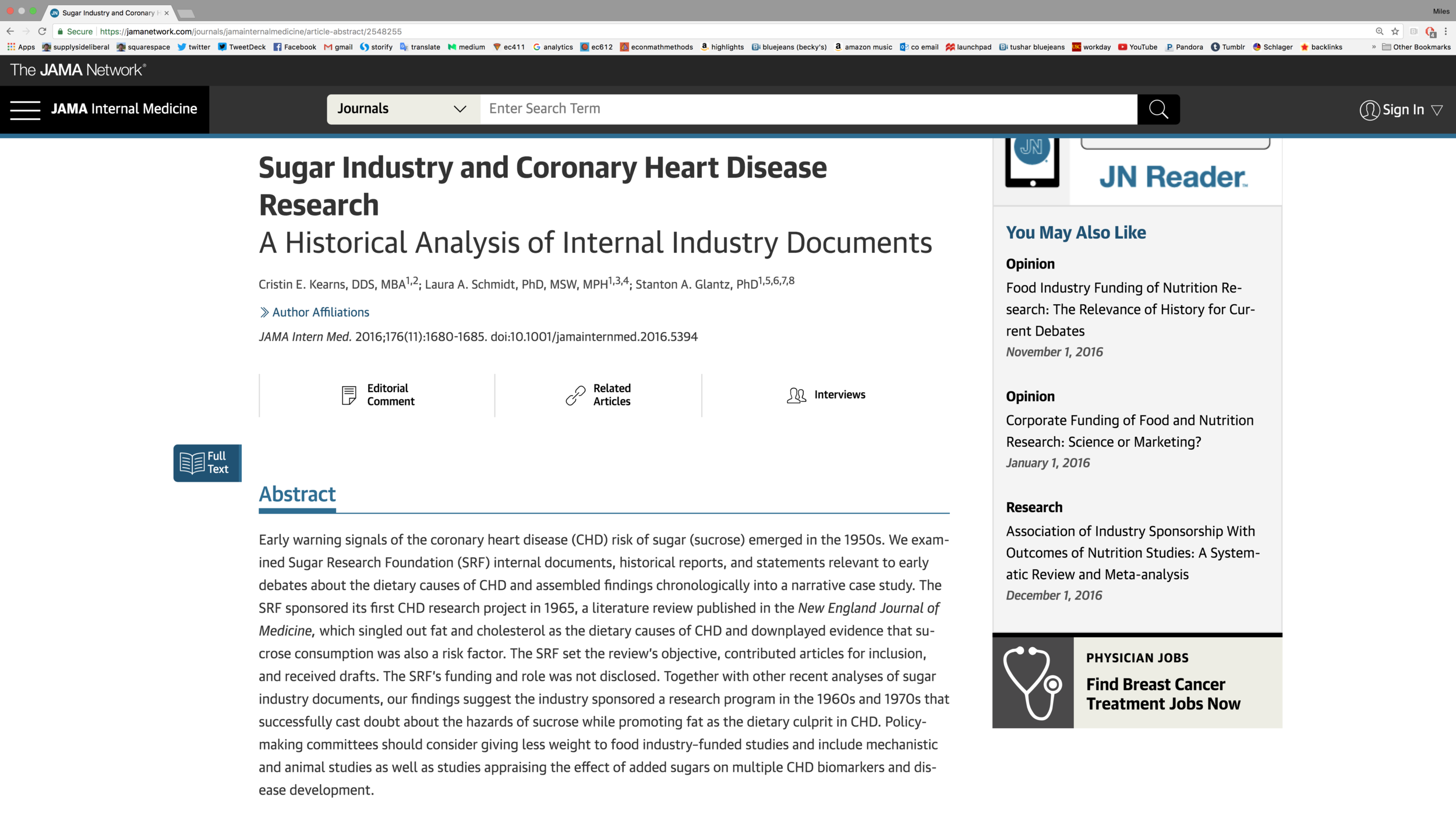
In case it is too small to read above, here is the abstract, which says it much better than I could:
Early warning signals of the coronary heart disease (CHD) risk of sugar (sucrose) emerged in the 1950s. We examined Sugar ResearchFoundation (SRF) internal documents, historical reports, and statements relevant to early debates about the dietary causes of CHD and assembled findings chronologically into a narrative case study. The SRF sponsored its first CHD research project in 1965, a literature review published in the New England Journal of Medicine, which singled out fat and cholesterol as the dietary causes of CHD and downplayed evidence that sucrose consumption was also a risk factor. The SRF set the review's objective, contributed articles for inclusion, and received drafts. The SRF's funding and role was not disclosed. Together with other recent analyses of sugar industry documents, our findings suggest the industry sponsored a research program in the 1960s and 1970s that successfully cast doubt about the hazards of sucrose while promoting fat as the dietary culprit in CHD. Policymaking committees should consider giving less weight to food industry-funded studies and include mechanistic and animal studies as well as studies appraising the effect of added sugars on multiple CHD biomarkers and disease development.
For more contrarian discussion of nutrition, obesity and chronic diseases, don't miss: