Erin Lee Carr—My Dad, My Mentor: How Do You Say Goodbye to Your Father? →
I can’t remember who sent me this after I wrote about my own Dad and his death a few weeks ago, but I love it.
A Partisan Nonpartisan Blog: Cutting Through Confusion Since 2012
I can’t remember who sent me this after I wrote about my own Dad and his death a few weeks ago, but I love it.
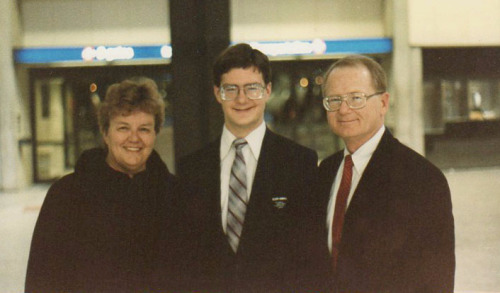
Bee Kimball, Joseph Kimball and Edward Kimball, in 1988
Below is my brother, Joseph’s tribute to my Dad, who died November 21, 2016. (My own tribute to my Dad appeared November 27, 2016. My brother Chris’s tribute appeared December 11, 2016.) Joseph is a big contributor to this blog behind the scenes with his discerning eye for interesting articles to flag here.
Here are Joseph’s words:
My father grew up in a home that had a well used dictionary by the table, and continued that practice in his own home. We used that dictionary often to look up definitions and pronunciations. He used language in his professional life making lessons for law students and writing books about law. He used language in his church service. He had a file full of talks he had written through the years on many different topics, and could pull one out and adapt it to whatever needed to be said in a meeting. He also spent time writing biographies and other works on church topics.
I remember him working on the Teachings of Spencer W. Kimball book. He had typed up all the quotes he was going to use, and cut each one out so he could shuffle them around on the pages as he worked out which went where. This was in the days before word processing was normal, so there were an awful lot of little slips of paper. He was willing to talk to me about many of the quotes.
After he completed his large biography about his father, he wrote a biography of his grandfather, Andrew Kimball, which his father asked him to do when the presidency meant he no longer had time to do it. I was very pleased that my father let me take a draft of the biography and make comments and editing suggestions. He listened to what I had to say, and I believe he used a number of my ideas in the book.
When he was in charge of punishing me, his method was to use reason and come to a mutually agreed arrangement to minimize the probability of future transgressions with self administered consequences if that failed. He controlled his temper exceptionally well--I only saw him lose his cool a very few times.
His use of language wasn’t all serious though. His sense of humor came through in his word choices. He was very fond of word play, and particularly puns. My own children have learned to endure puns from me since I learned them at my father’s knee. He also liked to do crossword puzzles, and regularly completed them until his eyesight got bad enough he was unable to read.
I will miss his reasoned and kind words that helped me many times in my life.


Link to Feedspot’s list of Top 20 Macro Blogs
I was pleased to be included in Feedspot’s list of Top 20 Macro Blogs, in the 9th spot. I added their badge to my sidebar.
As one of their inputs, Feedspot used the Alexa rank of my blog site. It took me a while to realize this was a rank, not a rating, so lower numbers are better and higher numbers are worse! Being the 1,168,514th ranked website according to Alexa is something, but it doesn’t sound that impressive! :)

Link to Lauren Razavi’s backchannel.com post “India Just Flew Past Us in the Race to E-Cash”. Hat tip to slashdot.com and Joseph Kimball
What India’s government did in demonetizing the 1000-rupee and 500-rupee notes was a mess. But it did have the helpful effect of spurring mobile payments, both by the current inconvenience for paper currency and, as people look toward the future, reducing trust in paper currency.
Two quotations from Lauren Razavi’s backchannel.com article linked above flesh out that story:
1. All of this has created a newfound system that practically incentives mobile payment. With so many people queuing up at banks every day — and a lot of Indian bureaucracy to wade through in order to open a traditional bank account or line of credit —the appeal of more convenient digital alternatives is easy to understand. According to a report in the Hindu Business Line, as many as 233 million unbanked people in India are skipping plastic and moving straight to digital transactions.“Cash has lost its credibility and payments are no longer perceived in the same way,” says Upasana Taku, the cofounder of Indian mobile wallet company MobiKwik, which reported a 40 percent increase in downloads and a 7,000 percent increase in bank transfers since demonetization. “There’s chaos at the moment but also relief that India will now be an improved economy,” she says.
2. Before last month, Paytm, a mobile app that allows users to pay for everything from pizza to utility bills, saw steady business—it was processing between 2.5 and 3 million transactions a day. Now, usage of the app has close to doubled. 6 million transactions a day is common; 5 million is considered a bad day.
This is an excellent long-read.
Most laws and rules are backed up by some form of punishment if not followed, even if the punishment is not fully regularized. When is punishment legitimate? And what kind of punishment is legitimate? John Locke gives an answer to that question in section 8 of his 2d Treatise on Government: “On Civil Government”:
And thus, in the state of nature, one man comes by a power over another; but yet no absolute or arbitrary power, to use a criminal, when he has got him in his hands, according to the passionate heats, or boundless extravagancy of his own will; but only to retribute to him, so far as calm reason and conscience dictate, what is proportionate to his transgression, which is so much as may serve for reparation and restraint: for these two are the only reasons, why one man may lawfully do harm to another, which is that we call punishment. In transgressing the law of nature, the offender declares himself to live by another rule than that of reason and common equity, which is that measure God has set to the actions of men, for their mutual security; and so he becomes dangerous to mankind, the tye, which is to secure them from injury and violence, being slighted and broken by him. Which being a trespass against the whole species, and the peace and safety of it, provided for by the law of nature, every man upon this score, by the right he hath to preserve mankind in general, may restrain, or where it is necessary, destroy things noxious to them, and so may bring such evil on any one, who hath transgressed that law, as may make him repent the doing of it, and thereby deter him, and by his example others, from doing the like mischief. And in this case, and upon this ground, every man hath a right to punish the offender, and be executioner of the law of nature.
John puts down serious limitations on punishment: First, punishment is only legitimate when someone has violated the preexisting “law of nature,” not when someone has violated an arbitrary rule that has been established against their opposition or otherwise without their consent, and without any promise they have freely made coming into play. The law of nature is given a new description in this section as “the tye, which is to secure them from injury and violence.”
Second, punishment should not be in proportion to the extreme anger it is easy to feel when someone crosses one of us in some regard. Third, punishment should be governed by the three legitimate purposes of punishment:
Reparation
Restraint
Deterrence
Although John uses the word “retribute” he seems to be excluding simply “getting back at someone” as a legitimate ground of punishment–a ground or motive that is sometimes called “retribution.”
By contrast, reparation, which improves the condition of the person originally harmed from its low ebb after that injury is an excellent purpose of punishment. It is important to search for ways to punish that accomplish at least some reparation at the same time that they work toward restraint or deterrence.
John’s concern about legitimate vs. illegitimate punishment is clear in his care to make the case for punishment at all instead of no punishment: those who violate “reason and common equity” are “dangerous to mankind,” and “every man upon this score, by the right he hath to preserve mankind in general, may restrain, or where it is necessary, destroy things noxious to them.” The concern to justify punishment that John exhibits here is a model for all of us. A minimum (though often far from sufficient) requirement for justifying punishment is this: Whenever one argues for punishment of an individual, or executes punishment on one’s own account, one should be prepared to point to some significant bad consequence that would occur if there were not a policy of punishment in a situation like that. That bad consequence needs to be “bad” in a reasonably objective sense, and greater than the badness of the punishment itself. If nothing bad would happen in the absence of punishment in a given type of situation, punishment should not be undertaken. (Note that this is a different standard than “absence of punishment in this one particular instance would do no harm, taking people’s expectation of the probability of punishment in similar future instances as fixed.”)
For links to other John Locke posts, see these John Locke aggregator posts:
John Locke's State of Nature and State of War (Chapters I–III)
On the Achilles Heel of John Locke's Second Treatise: Slavery and Land Ownership (Chapters IV–V)
John Locke Against Natural Hierarchy (Chapters VI–VII)
John Locke's Argument for Limited Government (Chapters VIII–XI)
John Locke Against Tyranny (Chapters XII–XIX)
This is a very interesting analysis.
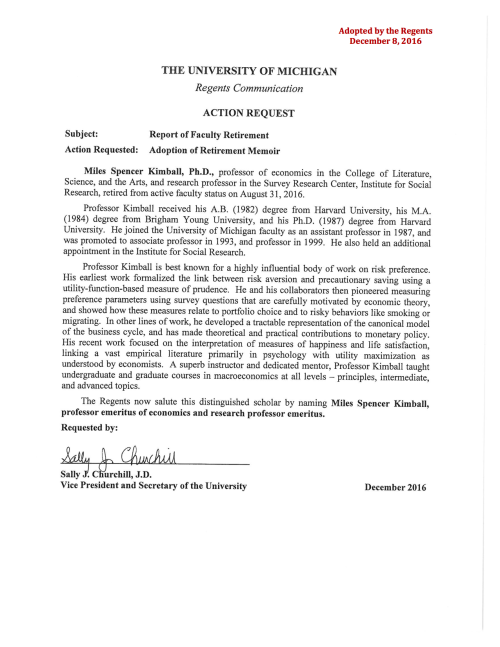
When I moved to the University of Colorado Boulder a few months ago, I had taught for 29 years at the University of Michigan. As a result, even though I was only 56 years old, I was able to retire instead of resign from the University of Michigan. I am now officially an Emeritus Professor of Economics and Emeritus Research Professor (in Survey Research) of the University of Michigan.
I post the official notice here partly because it gives an excellent–though perhaps a bit overly shiny–picture of my academic career to date. Someone who likes me must have written it. :)
I am proud of my long association with both the Economics Department and the Survey Research Center at the University of Michigan, and am glad to still have this official tie to the University of Michigan and my colleagues there.
Although deep negative interest rates are straightforward to handle even when a currency region uses paper currency intensively, the needed changes in paper currency policy are likely to be seen as less upsetting to people when cash usage is low. Thus, even when the time has not yet come for more dramatic changes in paper currency policy, it is useful for public policy to encourage the replacement of cash by other means of transactions.
Some countries are much further along in reducing cash usage than others. The article above points in particular to Scandinavian countries and South Korea. Two quotations:
In Sweden, cash usage is low and declining–so much so that I could point out that it made no sense in Sweden to let the “tail wag the dog” by letting paper currency get in the way of otherwise optimal interest rate policy.
There are three key factors in the decline in cash usage in Sweden. First, some time back, Sweden stopped subsidizing cash usage. There is only one place in Sweden for banks to get cash from the central bank: at a cash window near Arlanda airport near Stockholm. Carting cash to or from anywhere else in the country must be paid for by someone other than an arm of the government.
Second, Swedish kronor are not that useful for international crime. Finland provides an interesting natural experiment. Until it joined the euro zone, cash usage was declining in Finland, paralleling what was happening in Sweden. But since Finland joined the euro zone, cash withdrawals have increased greatly. Why? The Finnish markka was not very useful in international crime. The euro is.
Third, electronic forms of payment are advancing quickly in Sweden. For example, the mobile app Swish now makes it very easy for people in Sweden to transfer funds to anyone else with the app on their phone.
It is not necessary to eliminate paper currency entirely to make deep negative interest rates possible. But it makes things easier both politically and practically if cash usage is already seen of as something of only marginal importance.
Update: JP Koning points out another big factor in the decline in cash usage in Sweden, which he lays out in his post “Thoughts on Rogoff’s ‘Curse of Cash'”:
As discussed in this excellent post by Martin Enlund, the Swedes implemented a tax deduction in 2007 for the purchase of household-related services such as the hiring of gardeners, nannies, cooks, and cleaners. This initial deduction, called RUT-avdrag, was extended in 2008 to include labour costs for repairing and expanding homes and apartments, this second deduction called ROT-avdrag.
Enlund’s chart shows how the decline in krona outstanding closely coincides with the timing of the introduction of RUT and ROT:
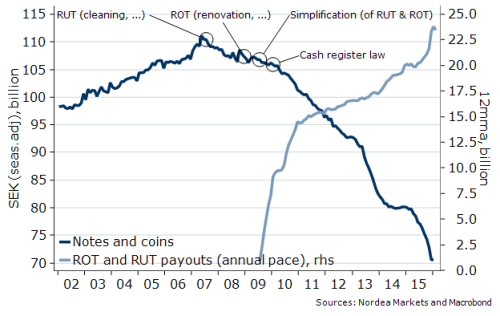
Prior to the enactment of the RUT and ROT deductions, a large share of Swedish home-related purchases would have been conducted in cash in order to avoid taxes, but with households anxious to claim their tax credits, many of these transactions would have been pulled into the open. Note the rise in RUT and ROT payments on Enlund’s chart, for instance. Calleman reports that the number of customers using registered domestic service companies rose from 92,000 in 2008 to 537,600 in 2013. Since the implementation of RUT and ROT, Swedish opinions on paying for undeclared work have changed dramatically. In 2006, 17% said it was completely wrong to to hire undeclared labour. In 2012, 47% felt it was completely wrong.
In passing, let me say that giving some kind of tax break or at least tax exemption for services provided at a low wage rate is also good for helping those near the bottom of the income distribution. It accords with many people’s intuitive notions of fairness. And it is helpful for efficiency as well–helping to make sure that ad hoc opportunities for gains from trade are not missed. And given the option of evading taxes by using cash, trying to tax such low-wage services may not in fact provide enough tax revenue to make current policies of trying to tax such services worth the bad side effects.
Sunstone is a magazine that discusses issues related to Mormonism. It is independent of the Mormon Church.

Thanks to Ralph Johnson for permission to use this picture here, which Ralph took in honor of Edward Lawrence Kimball. Picture copyright Ralph Johnson
Below is my brother, Chris’s tribute to my Dad, who died November 21. (My own tribute to my Dad appeared two weeks ago. Chris has appeared several times before on this blog: 1,2,3.) Here are Chris’s words:
My son Chase says:
My grandfather Ed Kimball was my soft spoken hero. He was the man I want to be, in virtually every way: a dedicated teacher; a thoughtful disciple; a loyal son, father, and husband; a clear writer and honest historian. I love him, and I know he loves me.
The list of Dad’s attributes is long: kind, smart, dedicated, thoughtful, honest, funny, considerate. I would like to illustrate a few, including some for which stories tell and single words fail.
A. Dad saw three-dimensional people. He did it in writing history and biography. He did it in serving on the parole board. He did it in serving as a bishop. He did it in parenting seven quite different children. He did not categorize or label people. He saw individuals and dealt with us as individuals.
B. Behind the Clark Kentish mild-mannered demeanor, Dad thoughtfully and knowingly challenged the status quo. He did it by asking good questions. I have called him “subversive” in the kindest most affirming sense. He would have rejected the label but smiled with recognition. Dad was not didactic. He seldom preached or argued. Dad was subversive in the sense that Socratic dialogue is subversive of things as they are. He was subversive in the sense that good history is sometimes subversive of revealed religion. Dad took pleasure in asking good questions.
C. Dad would volunteer to act as scribe or secretary for faculty meetings. He explained to me that nobody wanted the job and it was a way to serve, and allowed him be more of a quiet listener than active participant. He was a modest, self-effacing man, always serving others. But the next sentence is important. He went on to say that when anyone wants to know what was discussed and decided, the minutes tell the story. By delivering the minutes in his voice, he had the last word.
D. When I was 14, Dad and I went to the Boundary Waters in northern Minnesota for a 50-mile canoe trip. We paddled across lakes, then portaged the canoe and our packs from one lake to the next. Dad was commanding in the canoe but struggled to carry a small pack over the portages. I carried a pack on my back, a second in front, and the canoe on my shoulders. With powerful arms and shoulders, but something like 1-½ legs, Dad did the almost impossible feat of paddling and walking 50 miles. That’s big. Dad took his son on a once-in-a-lifetime trip. That’s really big. But the most important part of the story is that Dad humbled himself to make the trip even knowing that his 14 year old son would have to carry the load.
No son should see his father that way. It ruins the hero myth. But every son should carry his father, at least once in his life.
E. In the context of a discussion about the nature of God and how we think about the God-Man relationship, I mentioned to my Jewish philosophy professor that one of my models was my father in that I knew about him that he loved me, without reserve, without regard to what I did or did not do. It was absolute bedrock certainty. The professor suggested that was valuable knowledge–unusual and to be treasured.
If I had one wish it would be that my children and grandchildren would enjoy that absolute assurance, that I love you, as my father loved me, as our Father and Mother love us.
F. Dad is rightly lauded for the two biographies of Spencer W. Kimball. The first one in particular (written with his nephew Andrew) broke the pattern of hagiography that characterized stories of Mormon leaders. The usual narrative is that he was a truth teller, essentially unable to do otherwise than tell it ‘warts and all.’ That is correct. But the deeper story is that he knew what he was doing–consciously, intentionally, using all the advantages at his disposal. He told me once that he felt a filial duty to write about his father, but he also recognized an opportunity to make a difference in the world of Mormon history and biography. He had unparalleled access to the life of a living Mormon Prophet. He was confident that he could persuade his father to give permission. And he knew that it would work out to everyone’s benefit because his father was a genuinely good man–not perfect, but good.
Dad would not say it about himself, but would have warmed to my saying it of him, as he did of his father: Edward Kimball, my father, was a good man.
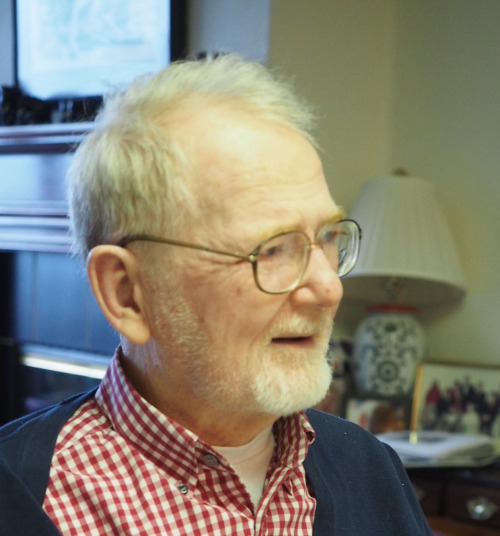
Edward Lawrence Kimball, September 23, 1930–November 21, 2016
I find the variety of ways people end up rich interesting.
There is some very interesting reporting here. The ability to suppress free speech–even horrific speech–through social disapproval has greatly eroded. People now have to actually be convinced; the ability to shame people away from promoting bad ideas is gone.
Link to Wikipedia article “Indian 500 and 1000 rupee note demonetisation”
India’s sudden declaration that its existing 500- and 1000-rupee notes were invalid and needed to be replaced by new notes, with severe restrictions on that conversion is so far afield from my proposals for taming paper currency that I have been slow to write about it. Nevertheless, there are some interesting lessons to be learned. In this post, I will assume you know the basics. For that, the Wikipedia article flagged above is actually much better than the news accounts. Here are some of the lessons to draw and theoretical insights sparked by thinking about this episode:
First, the details of any modification in paper currency policy matter a lot. Getting the details wrong can make a big mess.
Second, central banks and governments do big unexpected things. With a bit of care, there is no reason they can’t do big things that are well-designed and have much smaller side-effects instead of big things that are badly designed and cause a great deal of trouble.
Third, a policy that doesn’t depend on surprising people is likely to be better implemented, since policies can be planned and executed better if the depth of secrecy required is less and therefore more people can be brought in on the planning.
Fourth, keeping large cash hoards is inherently risky, since almost all of the reasons one might want to keep a large cash hoard are reasons the government is likely to frown upon. In practice, governments are unlikely to tolerate the equivalent of what in the US would be the trillions and trillions of dollars of hoarded cash needed to enforce a lower bound on interest rates. (See “How Negative Interest Rates Prevail in Market Equilibrium.”)
Fifth, reducing the expected rate of return on paper currency relative to the rate of return on bank money causes a flight away from paper currency, not a flight toward paper currency. People in India are not saying “If we can’t freely turn in paper currency without restrictions and without documentation at the bank, let’s just quit dealing with the banks and instead use the cash the government is trying to invalidate for transactions instead.”
Sixth, it is important to think through all of the ways that people might try to get around something. Approaches that leave no way around (such as a gradually changing effective exchange rate for paper currency that makes the return on paper currency equal to the return on safe, short-term electronic rates) have a real advantage.