Jingoism in Cahoots with Protectionism

Protection, moreover, has always found an effective ally in those national prejudices and hatreds which are in part the cause and in part the result of the wars that have made the annals of mankind a record of bloodshed and devastation—prejudices and hatreds which have everywhere been the means by which the masses have been induced to use their own power for their own enslavement.
— Henry George, Protection or Free Trade

The Bank of Japan Renews Its Commitment to Do Whatever It Takes

Link to Wikipedia article on Haruhiko Kuroda

I am not impressed by a target of zero for 10-year Japanese government bonds as stimulative measure, when they have been trading at negative rates. Fortunately, I think this is simply a sign that the Bank of Japan is continuing to search for new tools. And, as you can see from “How and Why to Eliminate the Zero Lower Bound: A Reader’s Guide,” there are tools available that are much more powerful than anything the Bank of Japan has used so far. 

In particular, one of the most powerful tools the Bank of Japan has not yet tried is a negative paper currency interest rate through a gradually increasing discount on paper currency obtained from the cash window of the Bank of Japan (and a corresponding gradually increasing discount in what is credited to a bank’s reserve account when paper currency is deposited). A negative paper currency interest rate in turn makes it possible to cut other short-term interest rates much further.

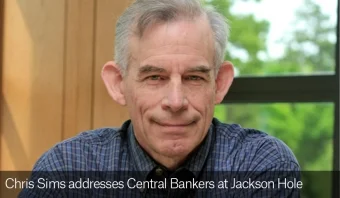
Watching the Bank of Japan’s actions over the last few years and talking to its chief, Governor Haruhiko Kuroda, at Jackson Hole, left me confident about the Bank of Japan’s willingness to try new tools. What I wondered is whether the Bank of Japan would declare that it was already close to the natural rate of unemployment, and so didn’t need to do much more. My view is that after 20 years of slump, the Bank of Japan needed to risk overshooting its inflation target in order to find out both what its natural level of output really is, and to find out what it takes to permanently raise inflation to 2%, as it has decided it wants to do. In its September 21, 2016 statement, the Bank of Japan declares that it has come around to that point of view–better to risk overshooting than to undershoot:

The Bank will continue expanding the monetary base until the year-on-year rate of increase in the observed CPI (all items less fresh food) exceeds the price stability target of 2 percent and stays above the target in a stable manner. Meanwhile, the pace of increase in the monetary base may fluctuate in the short run under market operations which aim at controlling the yield curve. With the Bank maintaining this stance, the ratio of the monetary base to nominal GDP in Japan is expected to exceed 100 percent (about 500 trillion yen) in slightly over one year (at present, about 80 percent in Japan compared with about 20 percent in the United States and the euro area). 

The Bank will make policy adjustments as appropriate, taking account of developments in economic activity and prices as well as financial conditions, with a view to maintaining the momentum toward achieving the price stability target of 2 percent.

I think it is this stated willingness to overshoot, not the introduction of an explicit yield-curve targeting, is what caused the yen to depreciate on the Bank of Japan’s September 21 announcement. 

The other key section of the the September 21, 2016 statement is the section labelled “Possible options for additional easing”: 

With regard to possible options for additional easing, the Bank can cut the short-term policy interest rate and the target level of a long-term interest rate, which are two key benchmark rates for yield curve control. It is also possible for the Bank to expand asset 5 purchases as has been the case since the introduction of QQE. Moreover, if the situation warrants it, an acceleration of expansion of the monetary base may also be an option.  

Note the specific mention of lower short-term rates as an option. 

Beyond the policy of a gradually increasing discount on paper currency obtained from the cash window of the Bank of Japan to make it possible to lower short-term rates without inducing massive paper currency storage, the most important complementary policy is one to make negative rates more acceptable politically: a shift in the details of the interest on reserves formula to explicitly link the amount of funds on which banks can earn an above-market interest rate to their provision of zero rates to small household accounts. The government retail bank represented by Postal Savings should also be part of this program, just as if it were a private bank (although its subsidy could come from another arm of the government rather than from the interest-on-reserves formula). Here is how it works, as I detailed in my post “Ben Bernanke: Negative Interest Rates are Better than a Higher Inflation Target”: 

I have advocated arranging part of the multi-tier interest on reserves formula to kill two birds with one stone: not only support bank profits but also subsidize zero interest rates in small household accounts at the same time–the provision of which is an important part of the drag on bank profits as it is now. I think being able to tell the public that no one with a modest household account would face negative rates in their checking or saving account would help nip in the bud some of the political cost to central banks.

To avoid misunderstanding, it is worth spelling out a little more this idea of using a tiered interest on reserves formula to subsidize provision of zero interest in small household checking and savings accounts. To make it manageable, I would make the reporting by banks entirely voluntary. The banks need to get their customers to sign a form (maybe online) designating that bank as their primary bank and giving an ID number (like a social security number) to avoid double-dipping. In addition to shielding most people from negative rates in their checking and savings accounts, this policy also has the advantage of setting down a marker so that it is easier for banks to explain, say, that amounts above $1500 average monthly balance in an individual checking+saving accounts or a $3000 average monthly balance in joint couple checking+saving accounts would be subject to negative interest rates. That is, the policy is designed to avoid pass-through of negative rates to small household accounts but encourage pass-through to large household accounts, in a way that reduces the strain on bank profits.

Finally, in Japan, I would tie the ability of banks to get an above-market rate on a portion of their reserves to their passing along the discount on paper currency to their customers when their customers withdraw paper currency, so that regular people would get the benefit of that discount, too.

With the combination of a negative paper currency interest rate induced by a gradually increasing discount on paper currency obtained from the cash window of the central bank, and effective subsidies to support zero rates on small household accounts to make negative rates in general more acceptable, the Bank of Japan would have as much firepower it needs to achieve its goals. 

Given how little we understand about economies that have been in a 20-year slump, I applaud the objective the Bank of Japan has now announced of continuing to stimulate the Japanese economy until the signs of the Japanese economy being above the natural level of output become absolutely unmistakable by inflation going above 2%. In the case of Japan, the economic risk from doing too little is much greater than the risk from doing too much. 

Note: I will be going to the Bank of Japan to deliver this message personally in a few days. I have seminars scheduled at the Bank of Japan on September 27 and October 7. You can see the regularly updated itinerary for all of my travels to promote the inclusion of full-bore negative interest rate policies in the monetary policy toolkit in my post Electronic Money: The Powerpoint File

Ben Bernanke: Maybe the Fed Should Keep Its Balance Sheet Large

This is a good summary of some of the most important papers at Jackson Hole this year. The description at the top of Ben’s blog post is accurate: “Ben Bernanke sees merit in the case for keeping the Fed’s balance sheet large instead of shrinking it, as is the current plan.” Having listened to the same talks, I see the same merit. 

You can see Ylan Q. Mui’s reaction to this blog post of Ben’s in her Wonkblog post “The Federal Reserve confronts a possibility it never expected: No exit.”

Negative Rates and the Fiscal Theory of the Price Level

I was very pleased to be invited to the Jackson Hole monetary policy conference this past August. One of the highlights of the conference was Chris Sims’s lunchtime talk on the first main day of the conference, “Fiscal Policy, Monetary Policy and Central Bank Independence.” The fiscal theory of the price level is something I have been confused about for a long time. Chris Sims interpreted it from a remarkable simple point of view–a point of view very close in its logic to the way I analyze the transmission mechanism for interest rates cuts–including going to a negative interest rate or a deeper negative rate–in my posts  

I confirmed my interpretation of what Chris was saying in a question I posed in the Q&A right after his talk. I still may have it wrong, but here is what I understood. 

Why Lower Rates Increase Aggregate Demand and Higher Rates Reduce Aggregate Demand

Suppose real interest rates go down. Adding up spending from both sides of almost every borrower-lender relationship in which rates go down, aggregate demand should increase because:

  1. The negative shock to effective wealth of the lender is matched by an equal and opposite shock to the effective wealth of the borrower. This is the “Principle of Countervailing Wealth Effects” I discuss in the posts listed above. Long-term fixed rates can mute the shock to the effective wealth of both sides, but absent a big change in the inflation rate will still typically lead the borrower to feel better off with the change in rates and the lender to feel worse off in terms of annuity equivalents (whatever the asset values on paper). 
  2. In almost all cases, the marginal propensity to consume is higher for the borrower than for the lender, so that adding up the effects on borrower and lender, the wealth effects add up to an increase in spending. The particular marginal propensity to consume (MPC) that matters is the marginal propensity to consume of the borrower out of reductions in interest expenses and the marginal propensity to consume of the lender out of interest earnings.
  3. In addition to the wealth effects on the non-interest spending of the borrower and lender, there is a substitution effect on both borrower and lender toward spending more now simply because spending now is relatively cheaper compared to spending later when the interest rate is lower. (For the lender alone, the wealth effect may easily overwhelm the substitution effect, so that the lender may spend less when interest rates go down, but for the borrower and lender combined the wealth effect and substitution effect both go in the same direction given 1 and 2: toward more non-interest spending when the rate goes down.)

What if interest rates go up? Then, adding up spending from both sides of almost every borrower-lender relationship in which rates go up, aggregate demand should decrease because:

  1. The positive shock to the effective wealth of the lender is matched by an equal and opposite shock to the effective wealth of the borrowerthe “Principle of Countervailing Wealth Effects.” Long-term fixed rates can mute the shock to the effective wealth of both sides, but absent a big change in the inflation rate will still typically lead the lender to feel better off with the change in rates and the borrower to feel worse off in terms of annuity equivalents (whatever the asset values on paper). 
  2. In almost all cases, the marginal propensity to consume is higher for the borrower than for the lender, so that adding up the effects on borrower and lender, the wealth effects add up to a reduction in spending. The particular MPC that matters is the marginal propensity to consume of the borrower out of reductions in interest expenses and the MPC of the lender out of interest earnings.
  3. In addition to the wealth effects on the non-interest spending of the borrower and lender, there is a substitution effect on both borrower and lender toward spending less now simply because spending now is relatively more expensive compared to spending later when the interest rate is higher. (For the lender alone, the wealth effect may easily overwhelm the substitution effect, so that the lender may spend more when interest rates go up, but for the borrower and lender combined the wealth effect and substitution effect both go in the same direction given 1 and 2: toward less non-interest spending when the rate goes up.)

The Fiscal Theory of the Price Level Points to the Exception

The Fiscal Theory of the Price Level comes into play when there is an exception to the rule that the borrower has a higher marginal propensity to consume than the lender. This has happened historically along the path to hyperinflations. The key borrower-lender relationship for understanding hyperinflations is the one in which the government is the borrower and bond-holders are the lenders. If inflation and interest rates are changing rapidly the wealth effects on both sides of the borrower-lender relationship in which the government is the borrower can have extra complexities, but the Principle of Countervailing Wealth Effects still applies: any effective gain in wealth to the government is an effective loss in wealth to the bond-holders and any effective loss in wealth to the government is an effective gain in wealth to the bond-holders.  

One possible issue is if there is an unexpected increase in inflation that reduces even the annuity equivalent of long-term government bonds, so that the higher inflation increases aggregate demand through a higher government propensity to consume out of that inflation windfall than the reduction in spending to those who have had the annuity equivalent of their bonds eroded by inflation.  

Another possible issue is related to the one envisioned in Thomas Sargent and Neil Wallace’s “Some Unpleasant Monetarist Arithmetic.” Suppose government borrowing is short-term and that the markets demand inflation compensation according to the Fisher equation, and that the central bank pushes up the real interest rate as inflation goes up. If the government reduces non-interest spending more than the bond-holders raise their spending as its real interest costs go up, then the situation is stable. But if the government keeps its non-interest spending roughly the same (financing the rising deficit out of additional borrowing), then any increase in bond-holder spending will result in an increase in aggregate demand. Unless aggregate demand goes down as a result of the effect of rising real rates on other borrower-lender relationships, the situation will be unstable. That instability can easily lead to hyperinflation.    

Failure of Stabilization with a Lower Bound on Rates

Now consider the opposite situation from a hyperinflation. Suppose the economy starts with aggregate demand below what would keep the economy at the natural level of output. Interest rate cuts should raise aggregate demand according to the logic his post begins with. But if interest rate cuts are stopped short by a lower bound on rates, there may still be a deficiency in aggregate demand. And the markets, knowing that balance may not be reachable given the lower bound on rates, will not have future expectations that are as stabilizing as one would hope. 

How Eliminating the Zero Lower Bound Leads to Stability

As long as rates can go as far down as needed, the logic of countervailing wealth effects–with borrowers having a higher MPC than lenders–ensures that aggregate demand will eventually rise to equal the natural level of output. Expectations of this will exert a stabilizing influence. The only potential problem is if important borrowers have lower marginal propensities to consume than the lenders on the other side of that borrower-lender relationship. The most plausible case of such a failure would be the government as borrower. But even a government in the grip of austerity because of a concern about budget deficits and national debt, is likely to have a relatively high marginal propensity to consume out of interest savings because those interest savings are manifested as a lower budget deficit–as conventionally measured–than the government would otherwise face. That is, is it really plausible that even a government in the grip of an austerity policy would spend less on non-interest items than it otherwise would because its interest expenses went down? That doesn’t seem plausible to me. Whatever reduction in non-interest spending the austerity approach lead to in itself, a low enough interest rate should reduce interest expenses enough that the government should begin spending more on non-interest items. I would be surprised if it isn’t close to 1 for 1 (MPC = 100%) in an environment where many people will be pushing the government to spend more, and for austerity proponents, pointing to a high budget deficit is one of the few effective ways of pushing back on that pressure to spend more. 

How, in the Event, the Stabilization Mechanisms Need Not Be So Fiscal After All

The confidence that a low enough interest rate would bring forth enough additional aggregate demand to equal the natural level of output, plus the confidence that the central bank can and will lower the interest rate as much as necessary (having eliminated the zero lower bound) will make the economy stable. And part of that confidence may be knowing that in extremis the interest rate mechanisms described above would lead to more government spending on non-interest items as the central bank cut rates. But that does not mean that (given the initial recessionary situation) equilibrium would, in fact, be restored by a large increase in government spending on non-interest items. Knowing that the economy would return to the natural level of output, investment would be more robust. And even if there is still a big deficiency of aggregate demand, interest rate cuts raise aggregate demand through all the other borrower-lender relationships as well–many of them relationships in which the government is not involved. So it is quite possible for aggregate demand to be restored to equilibrium with the natural level of output with a relatively modest response of government spending on non-interest items as interest rates drop. Indeed, it is quite possible for the direct effect of an austerity policy to exceed the effect of interest rate cuts on government spending on non-interest items, so that government spending on non-interest items remains below normal during the recovery. Aggregate demand doesn’t have to come from the government. Interest rate cuts will guarantee that it comes from somewhere–unless the whole thing is destabilized by implausible expectations of an implausibly low government marginal propensity to consume out of interest rate savings. 

Why There Is an Asymmetry Between Hyperinflation and Stabilization in the Absence of a Lower Bound on Interest Rates

Because cutting non-interest spending can be very difficult, it can and does happen that a government sometimes does have a low marginal propensity to cut non-interest spending as interest expense increases. But in a serious recession when there will be clamoring for more spending from all sides, there is nothing likely to stand in the way of even a quite austere government increasing government spending on non-interest items somewhat relative to what spending on non-interest items would have been had interest expenses been higher. On the other side of the transaction, the typical MPC of government bond-holders is quite low. And there are many, many other borrower-lender relationships in which borrowers unquestionably have a higher MPC than the lenders on the other side of the transaction. Finally, all of that leaves out the substitution effect, which can be quite powerful in raising aggregate demand in response to interest rate cuts, once one is comparing it to the sum of wealth effects for the borrowers and lenders on both sides of a transaction rather than to the wealth effect for only the lenders. 

Conclusion

Anyone who forgets to think about borrowers will never understand the transmission mechanism through which interest rates affect the economy. Thinking about borrowers as well as lenders shows just how powerful cutting rates can be in stabilizing the economy once the lower bound on interest rates has been eliminated

Gwynn Guilford: The Epic Battle Between Clinton and Trump is a Modern Day Morality Play

Link to Gwynn Guilford’s Quartz column “The epic battle between Clinton and Trump is a modern day morality play”

I am an admirer of Jonathan Haidt’s theory of moral intutions, laid out in his book The Righteous Mind. I applied it a while back to the measurement of national well-being in “Judging the Nations: Wealth and Happiness Are Not Enough.” Gwynn Guilford applied it in a trenchant July 31, 2016 Quartz column “The epic battle between Clinton and Trump is a modern day morality play” that is worth revisiting now that Labor Day is past and the general election campaign has begun in earnest. 

Here are some key passages in Gwynn’s column:

1. Hunkered down in their ideological corners, Clinton and Trump could have been talking about two wholly different countries.

And in a way, they were. Their convention themes described visions of the American moral order that light up the brains of different types of voters, appealing to discrete layers of the US electorate. Both candidates went for intensity over breadth. However, of the two, Trump exhibited a much deeper and more strategic understanding of human nature, as he had throughout the primaries.

2. In his book, Righteous Mind, Haidt shows how our responses to political debate are almost pure intuition; quick-firing moral reflexes that our brains overlay with rationales after the fact.

The other vital insight involves what Haidt describes as six types of intuitions—or, as he calls them, moral foundations: care/harm, fairness/cheating, liberty/tyranny, loyalty/betrayal, authority/subversion, and sanctity/degradation. These combine to form the unconscious attitudes that animate each of us, to form our sense of morality.

This doesn’t tend to happen in a vacuum; different swaths of American society construct morality with radically different proportions of these. Urban liberal communities that thrive on commerce tend to respond strongly to only the first two of these, care/harm and fairness/cheating (and, to some extent, liberty/tyranny). Democratic voters, therefore, generally prioritize openness and tolerance and tend to be suspicious of authority. Conservative morality, which stems more from agrarian roots, typically engages all of the moral foundations, but with a heavy emphasis on the latter three of loyalty/betrayal, authority/subversion, and sanctity/degradation.

3. [Clinton] championed equality—protecting people’s “rights” got 12 specific mentions—pushing down hard on the “fairness” moral foundation.

4. Clinton also played to the other biggie of liberal morality, caring for the suffering, oppressed, and downtrodden.

5. [Clinton] showed a deference to authority in praising the military, the president and vice president, and police officers. (Convention speakers like Khizr Khan, the father of a slain Muslim US solider, bolstered this theme even more.)

6. Though pundits largely expected Trump to use the convention to broaden his appeal to voters, the event was instead a sweeping tableau of America’s descent into immorality. Each night was themed around Trump’s campaign slogan, “Make America great again” (subbing in “safe,” “work,” “first,” and “one” for “great”). Throughout the convention, Trump proxies railed against Clinton’s supposed betrayal of America in her handling of the Benghazi embassy attack, while the tragic deaths of people killed by unauthorized immigrants was cited to illustrate the mortal threats citizens now face. Another pet theme was how the undermining of police by subversive groups (the implication, usually, being Black Lives Matter activists) is letting crime and chaos flourish. Meanwhile, political correctness forbids reasonable people from criticizing the ethnic and religious groups who are killing Americans. Tolerance has made America unsafe, unpatriotic, and (obviously) un-great.

7. As many have observed, the facts backing up Trump’s narratives are pretty thin on the ground. However, to people whose sense of morality is grounded heavily in respect for authority and loyalty to a certain in-group, Trump’s diagnosis makes intuitive sense. Anyone baffled that Trump’s supporters ignore the spuriousness of his arguments are very likely people whose moral configurations don’t incline them to favor authority and loyalty much in the first place.

Gwynn goes on to speculate about strategies that might help Hillary Clinton by tapping into a wider range of moral intuitions.

As a Utilitarian, my own moral intuitions center around the care/harm axis. But whatever one’s own primary intuitions, anyone who wants to use persuasion to help make the world a better place needs to understand and appeal to the full range of moral intuitions. As I wrote in “Nationalists vs. Cosmopolitans: Social Scientists Need to Learn from Their Brexit Blunder,” it is clear that many people do not have this understanding. Reading The Righteous Mindis a good start. Then follow that up by reading George Lakoff’s Moral Politics, where George Lakoff argues that the leftwing has a “nurturant parent” morality while conservatives have a “strict father” morality. (If the phrase “strict father” sounds bad to you, you probably don’t lean toward a strict father morality.)

On the care/harm axis that is primary for me, with loyalty to all of humanity rather than only a subset of humanity, the welfare of immigrants seems to me a central concern. As I tweeted yesterday, 

Preventing people from escaping poverty by preventing them from immigrating to the US is one of the cruelest things we do.

But in the interests of more open immigration, I have on various occasions also appealed to 

In any worthy cause–and if ever there were a worthy cause, this is one–it is important to make arguments that speak to all parts of the brain. We sell short the things we believe in if we do not try to make that kind of well-rounded argument for them.

Henry George on How the Civil War Led to High, Persistent Tariffs

Nor could protection have reached its present height in the United States but for the civil war. While attention was concentrated on the struggle and mothers were sending their sons to the battle-field, the interests that sought protection took advantage of the patriotism that was ready for any sacrifice to secure protective taxes such as had never before been dreamed of—taxes which they have ever since managed to keep in force, and even in many cases to increase.
— Henry George, Protection or Free Trade

Ben Bernanke: Negative Interest Rates are Better than a Higher Inflation Target

Link to “Modifying the Fed’s policy framework: Does a higher inflation target beat negative interest rates?” on Ben Bernanke’s blog

It is clear from Ben Bernanke’s September 13, 2016 blog post, that his answer to his title, “Does a higher inflation target beat negative interest rates?” is “No.” This is not a ringing endorsement of negative rates by Ben, but it is a recognition of the importance of negative rates as part of the monetary policy toolkit. And Ben is quite forthright in naming names of other central bankers he thinks have too negative a view of negative rates. 

Ben links to my paper with Ruchir Agarwal, “Breaking Through the Zero Lower Bound” in this passage:

… it is not clear that an inflation target as high as 4 percent would be politically tenable and hence credible in the U.S. or other advanced economies, whereas arguably feasible institutional changes, some as simple as eliminating or restricting the issuance of large-denomination currency, could expand the scope for negative rates.

Ben also says this in a footnote:

[3] The Fed could also encourage banks (or provide incentives for them) to pass on the negative rates to market-sensitive investors rather than retail depositors, as described here by Miles Kimball, a negative-rates proponent. For more on Miles’ overall argument, see here.

Let me expand on that footnote. I have advocated arranging part of the multi-tier interest on reserves formula to kill two birds with one stone: not only support bank profits but also subsidize zero interest rates in small household accounts at the same time–the provision of which is an important part of the drag on bank profits as it is now. I think being able to tell the public that no one with a modest household account would face negative rates in their checking or saving account would help nip in the bud some of the political cost to central banks.

To avoid misunderstanding, it is worth spelling out a little more this idea of using a tiered interest on reserves formula to subsidize provision of zero interest in small household checking and savings accounts. To make it manageable, I would make the reporting by banks entirely voluntary. The banks need to get their customers to sign a form (maybe online) designating that bank as their primary bank and giving an ID number (like a social security number) to avoid double-dipping. In addition to shielding most people from negative rates in their checking and savings accounts, this policy also has the advantage of setting down a marker so that it is easier for banks to explain, say, that amounts above $1500 average monthly balance in an individual checking+saving accounts or a $3000 average monthly balance in joint couple checking+saving accounts would be subject to negative interest rates. That is, the policy is designed to avoid pass-through of negative rates to small household accounts but encourage pass-through to large household accounts, in a way that reduces the strain on bank profits.

Comparison to Ben’s March 2016 Post and a December 2015 Interview of Ben by Ezra Klein

Ben also had an earlier March 18, 2016 post about negative interest rates: “What tools does the Fed have left? Part 1: Negative interest rates.”  Reading the two posts back to back, it is clear that Ben has warmed up to negative interest rates in the six months from March 2016 to September 2016. Nevertheless, even back in March, Ben leavened his skepticism about negative rates with these two passages:

1. The idea of negative interest rates strikes many people as odd. Economists are less put off by it, perhaps because they are used to dealing with “real” (or inflation-adjusted) interest rates, which are often negative. Since the real interest rate is the sticker-price (nominal) interest rate minus inflation, it’s negative whenever inflation exceeds the nominal rate. Figure 1 shows the real fed funds rate from 1954 to the present, with gray bars marking recessions.[3] As you can see, the real fed funds rate has been negative fairly often, including most of the period since 2009. (It reached a low of -3.8 percent in September 2011.) Many of these negative spells occurred during periods of recession; this is no accident, since during recessions the Fed typically lowers interest rates, both real and nominal, in an effort to spur recovery.

2. The anxiety about negative interest rates seen recently in the media and in markets seems to me to be overdone. Logically, when short-term rates have been cut to zero, modestly negative rates seem a natural continuation; there is no clear discontinuity in the economic and financial effects of, say, a 0.1 percent interest rate and a -0.1 percent rate. Moreover, a negative interest rate on bank reserves does not imply that the most economically relevant rates, like mortgage rates or corporate borrowing rates, would be negative; in the US, they almost certainly would not be.

It is also clear that Ben Bernanke has warmed up to my proposals specifically, if you compare what he wrote in his most recent September 13, 2016 blog post to what he said in part of a December 15, 2015 interview I transcribed in my post “Ezra Klein Interviews Ben Bernanke about Miles Kimball’s Proposal to Eliminate the Zero Lower Bound.”

Though Ben Bernanke is quite cautious about negative rates, I count him now as an ally in the effort to bring them fully into the monetary policy toolkit, with the actual use of negative interest rate tools remaining a very weighty decision. 

David Beckworth—The Balance Sheet Recession That Never Happened: Australia

I am grateful for permission from David Beckworth to mirror his post as a guest post here. Here is what David wrote:


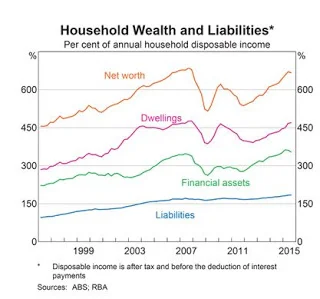
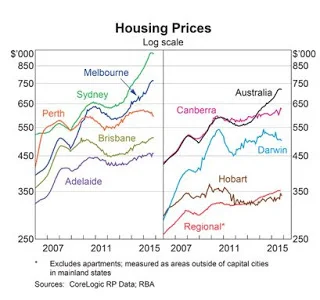
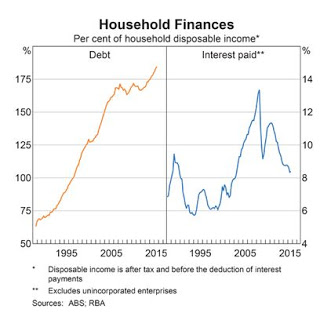
Probably the most common explanation for the Great Recession is the “balance-sheet” recession view. It says households took on took on too much debt during the boom years and were forced to deleverage once home prices began to tank. The resulting drop in aggregate spending from this deleveraging ushered in the Great Recession. The sharp contraction was therefore inevitable. But is this right? Readers of this blog know that I am skeptical of this view. I think it is incomplete and misses a deeper, more important story. Before getting into it, let’s visit a place that according to the balance sheet view of recessions should have had a recession in 2008 but did not.

That place is Australia. It too had a housing boom and debt “bubble”. It too had a housing correction in 2008 that affected household balance sheets. This can be seen in the figures at the top of this post. 

Despite the balance sheet pains of 2008, Australia never had a Great Recession. In fact, it sailed through this period as one the few countries to experience solid growth. And, as Scott Sumner notes, it was also buffeted by a collapse in commodity exports during this time. If any country should have experienced a sharp recession in 2008 it should have been Australia.

So why did Australia’s balance sheet recession never happen? The answer is that the Reserve  Bank of Australia (RBA), unlike the Fed, got out in front of the 2008 crisis. It cut rates early and signaled an expansionary future path for monetary policy. It also helped that the policy rate in Australia was at 7.25 percent when it began to cut interest rates. This meant the central bank could do a lot of interest rate cutting before hitting the zero lower bound (ZLB). So between being more aggressive than the Fed and having more room to work,  the RBA staved off the Great Recession.

This experience in Australia speaks to why the balance sheet recession view miss the deeper, more important problem behind depressions: the ZLB. Unlike the RBA, the Fed was slow to act in 2008 and that allowed the market-clearing or “natural” interest rate to fall below the ZLB. Had the Fed acted sooner or had it been able to keep up with the decline in the natural interest rate once it passed the ZLB, the Great Recession may not have been so great (See Peter Ireland’s paper for more on this point).

Here is how I made this point in my review of Atif Mian and Amir Sufi’s book, House of Debt, in the National Review:

Why should the decline in debtors’ spending necessarily cause a recession?
Recall that for every debtor there is a creditor. That is, for every debtor who is cutting back on spending to pay down his debt, there is a creditor receiving more funds. The creditors could in principle provide an increase in spending to offset the decrease in debtors’ spending. But in the recent crisis, they did not. Instead, households and non-financial firms that were creditors increased their holdings of safe, liquid assets. This increased the demand for money. This problem was exacerbated by the actions of banks and other financial firms. When a debtor paid down a loan owed to a bank, both loans and deposits fell. Since there were fewer new loans being made during this time, there was a net decline in deposits [and thus] in the money supply. This decline can be seen in broad money measures such as the Divisia M4 measure. These developments—increase in money demand and a decrease in money supply—imply that an excess money-demand problem was at work during the crisis.
The problem, then, is as much about the excess demand for money by creditors as it is about the deleveraging of debtors. Why did creditors increase their money holdings rather than provide more spending to offset the debtors? …Mian and Sufi do briefly bring up a potential answer: the zero percent lower bound (ZLB) on nominal interest rates.
The ZLB is a floor beneath which interest rates cannot go. This is because creditors would rather hold money at zero percent than lend it out at a negative interest rate. This creates a big problem, because market clearing depends on interest rates’ adjusting to reflect changes in the economy. In a depressed economy, firms sitting on cash would start investing their funds in tools, machines, and factories if interest rates fell low enough to make the expected return on such investments exceed the expected return to holding money. Even if the weak economy means the expected return to holding capital is low, falling interest rates at some point would still make it more profitable to invest in capital than to hold money. Similarly, households holding large amounts of money assets would start spending more if the return on holding money fell low enough to make household spending worthwhile. This is a natural market-healing process that occurs all the time. It breaks down when there is an increase in precautionary saving and a decrease in credit demand large enough to push interest rates to zero percent. If interest rates need to adjust below zero percent to spur creditors into providing the offsetting spending, this process will be thwarted by the ZLB.
It is the ZLB problem, then, rather than the debt deleveraging, that is the deeper reason for the Great Recession.

Australia never hit the ZLB. That is why it avoided the Great Recession. If we want to avoid future Great Recessions we need to find better ways to avoid or work around the ZLB.

John Stuart Mill’s Defense of Freedom

I have finished blogging my way through John Stuart Mill’s On Liberty. I circled around to blog my way through the “Introductory” chapter last:

Chapter I: John Stuart Mill’s Introduction to a Defense of Freedom

These posts collect links for blog posts based on paragraphs in the other chapters:

Chapter II: John Stuart Mill’s Brief for Freedom of Speech

Chapter III: John Stuart Mill’s Brief for Individuality

Chapter IV: John Stuart Mill’s Brief for the Limits of the Authority of Society over the Individual

Chapter V: John Stuart Mill Applies the Principles of Liberty

I also have a few miscellaneous posts from when I first started writing posts inspired by On Liberty:

The Presumption in Favor of Any Belief Generally Entertained is Especially Weak in the Case of a Theory which Enlists the Support of Powerful Special Interests

It should be remembered, however, that the presumption in favour of any belief generally entertained has existed in favour of many beliefs now known to be entirely erroneous, and is especially weak in the case of a theory which, like that of protection, enlists the support of powerful special interests. The history of mankind everywhere shows the power that special interests, capable of organization and action, may exert in securing the acceptance of the most monstrous doctrines. We have, indeed, only to look around us to see how easily a small special interest may exert greater influence in forming opinion and making laws than a large general interest. As what is everybody’s business is nobody’s business, so what is everybody’s interest is nobody’s interest. Two or three citizens of a seaside town see that the building of a custom-house or the dredging of a creek will put money in their pockets; a few silver miners conclude that it will be a good thing for them to have the government stow away some millions of silver every month; a navy contractor wants the profit of repairing useless iron-clads or building needless cruisers, and again and again such petty interests have their way against the larger interests of the whole people.
— Henry George, Protection or Free Trade

How the Free Market Works Its Magic

Link to the Wikipedia article on “Harry Potter (character)”

Some people misunderstand free market principles. The free market depends on the establishment of property rights. That is the free market, not a departure from it. In particular, the free market yields good results only because after the obvious ways of getting ahead–lying, stealing and threatening violence–are outlawed, people have to exchange things that are valuable to other people in order to get ahead. 

Monetary policy is another interesting area to talk about. The logic saying that the free market yields good results comes from a model in which monetary policy doesn’t matter for anything important–have a central bank or not, it is all the same in that model. As soon as monetary policy matters, there is a genuine asterisk on the idea that the free market alone can do the job. As Milton Friedman recognized, some sensible monetary policy has to be appended to the establishment of property rights. 

Note: The timing of this post was inspired by yesterday’s post “Narayana Kocherlakota: Want a Free Market? Abolish Cash.”

Narayana Kocherlakota: Want a Free Market? Abolish Cash

Link to Narayana Kocherlakota’s column “Want a Free Market? Abolish Cash” on Bloomberg View

Narayana Kocherlakota has now joined me in advocating the complete elimination of the zero lower bound, and done it with a nice free-market argument. You can see the whole article at the link above. Let me quote my favorite passage and the bit about me:

… governments – by issuing cash and managing inflation – put a floor on how low interest rates can go and how high asset prices can rise. That’s hardly a free market.

Like any government interference, this causes inefficiencies. By preventing the future prices of goods and services from rising too far above the current prices, it constrains demand for current goods and services. The weak demand, in turn, leads companies to hire less and invest less in the development of new technologies, leaving the work force underutilized and productivity low. Sound familiar? …

The right answer is to abolish currency and move completely to electronic cash, an idea suggested at various times by Marvin Goodfriend of Carnegie-Mellon University, Miles Kimball of the University of Colorado and Andrew Haldane of the Bank of England. Because electronic cash can have any yield, interest rates would be able go as far into negative territory as the market required.

To clarify my own position, I have no objection to a cashless economy, but I think some nations may need to eliminate the zero lower bound in the near future, and a nonpar exchange rate between paper currency and electronic money (with electronic money as the unit of account) can be implemented on much shorter notice than arranging things so that the economy can easily do without paper currency entirely. So my own emphasis–as you can see from my bibliographic post “How and Why to Eliminate the Zero Lower Bound: A Reader’s Guide”–has been on what might be seen as the transitional system of a taking paper off par to eliminate the zero lower bound rather than the total elimination of paper currency itself.