Henry George: Who Shall Drive Men into Freedom? Till They Use the Reason with Which They have been Gifted, Nothing Can Avail

In all lands, men whose toil creates abounding wealth are pinched with poverty, and, while advancing civilization opens wider vistas and awakens new desires, are held down to brutish levels by animal needs. Bitterly conscious of injustice, feeling in their inmost souls that they were made for more than so narrow a life, they, too, spasmodically struggle and cry out. But until they trace effect to cause, until they see how they are fettered and how they may be freed, their struggles and outcries are as vain as those of the bull. Nay, they are vainer. I shall go out and drive the bull in the way that will untwist his rope. But who shall drive men into freedom? Till they use the reason with which they have been gifted, nothing can avail. For them there is no special providence.
— Henry George, Protection or Free Trade

Peter Conti-Brown on Marriner Eccles and the Refounding of the Fed

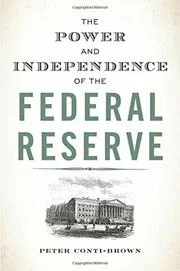
Link to The Power and Independence of the Federal Reserve on Amazon

Marriner Eccles may be the Mormon who had the most positive impact on the course of history for a reason unconnected to any church office held or explicitly religious role. Yet I suspect that most Mormons could not say what he did and why it was so important. 

Marriner Eccles transformed the Federal Reserve from the creaky structure that helped that US lurch into the Great Depression into an organization much closer to the Fed we know today, and because of the Fed’s prestige, ultimately influenced central banking in many other nations as well. Here is the story of Marriner Eccles and the refounding of the Fed as told by Peter Conti-Brown in his wonderful book The Power and Independence of the Federal Reserve:  

Nibbling around the edges of the Wilsonian federalist central bank might have remained the order of the day had it not been for Marriner S. Eccles, perhaps the most intriguing figure in Federal Reserve history. Eccles’s father was a Scottish immigrant, a Mormon convert, a bigamist (Marriner’s mother was his father’s second wife), and, in time, one of the wealthiest men in the state of Utah. Eccles thrived in his father’s business and expanded it into mining, timber, and especially banking. He was a millionaire in his own right by the age of twenty-two.

Eccles rose to national prominence in part because of his success as a banker during the height of the banking crises of the Great Depression. With bank failure rates reaching unprecedented heights, Eccles’s banks survived, largely owing to his own savvy ability to maintain credibility and confidence. While there were other successful bankers, what made Eccles noteworthy was that he was also something of a radical. For example, at the 1932 Utah State Bankers Convention, he laid out his theory of the Depression and its cure in plain language. “Our depression was not brought about as a result of extravagance,” he said. “It was not brought about as a result of high taxation.” It came, instead, because “[w]e did not consume as a nation more than we produced. We consumed far less than we produced. The difficulty is that we were not sufficiently extravagant as a nation.” There was a simple reason for this: The theory of hard work and thrift as a means of pulling us out of the depression is unsound economically. True hard work means more production, but thrift and economy mean less consumption. Now reconcile those two forces, will you? Eccles had a solution, too: “There is only one agency in my opinion that can turn the cycle upward and that is the government.”

In modern parlance, we’d call arguments like these Keynesian. But 1932 was four years before John Maynard Keynes had published his General Theory of Employment, Interest, and Money, the book that expounded the notion that government should be responsible for compensating for slack in consumer demand. Though they had never met, the millionaire Mormon from Utah had anticipated the dapper Cambridge don’s worldview. In an amusing historical aside, the two did eventually meet during the Bretton Woods negotiations about the future of the world’s postwar economic order. Despite their common diagnosis of depression and consumption, they didn’t take well to each other. Eccles thought the British needed to make better assurances of repayment to the United States for prewar loans, a source of great consternation to the British. “No wonder that man is a Mormon,” Keynes retorted to a colleague outside of Eccles’s hearing. “No single woman could stand him.”

Eccles didn’t make much more headway with the bankers and businessmen who heard him articulate these heretical views in Utah in 1932 than he did with Keynes in 1944. “Poor Eccles,” a president of a western railroad is said to have remarked. “He must have had so terrible a time with his banks that he is losing his mind.” No matter. Their opinions mattered much less than that of Rex Tugwell, already part of FDR’s original “Brains Trust.” In Eccles, Tugwell had discovered an indispensable resource: a western banker whose ideas were even more radical than the incoming administration’s. Eccles came to work with the new Roosevelt administration as a special assistant to the secretary of the treasury.

Eventually, Eccles was considered for the position of “Governor” of the Federal Reserve Board. To give a sense of how the board governor position was then perceived, the post became vacant when Eugene Black resigned—to take the position of governor of the Federal Reserve Bank of Atlanta.

Eccles refused the president’s offer. In response to inquiries of his availability, he responded that he “would not touch the position of governor [of the Federal Reserve Board] with a ten-foot pole unless fundamental changes were made in the Federal Reserve System.” Roosevelt invited him to propose his view of what those changes should be, and he and an assistant prepared a three-page blueprint of what amounted to a refounding of the Federal Reserve. That refounding would eliminate the federalist compromise. He narrowed his sights on the Reserve Banks: “Although the Board is nominally the supreme monetary authority in this country,” he wrote in a memo to Roosevelt, “it is generally conceded that in the past it has not played an effective role, and that the system has been generally dominated by the Governors of the Federal Reserve Banks.” As an “unfortunate result,” he continued, “banker interest, as represented by the individual Reserve Bank Governors, has prevailed over the public interest, as represented by the Board.” Eccles’s position was notable: Eccles was himself a banker whose views were represented by the Federal Reserve Bank of San Francisco, and yet he sought the banks’ exclusion from national policy. The problem wasn’t only one of inappropriate banker influence on the system; it was also one of governance. “With such an organization” as the Federal Reserve System, wrote Eccles’s assistant and partner in Fed reform, Lauchlin Currie, “it is almost impossible to place definite responsibility anywhere. The layman is completely bewildered by all the officers, banks and boards. Even the outside experts know only the legal forms.” Eccles proposed a radical legislative overhaul to resolve both the problems of governance and banker influence.

THE SECOND FOUNDING OF THE FEDERAL RESERVE: THE BANKING ACT OF 1935

Eccles sold Roosevelt on the proposal. He committed the presidency to the passage of Eccles’s bill, and Eccles accepted the governorship so that he could more effectively lead the legislation through Congress from inside the Fed. The New York Evening Post summarized the point perfectly: “Marriner S. Eccles is a unique figure in American Finance—a banker whose views on monetary policy are even more liberal than those already embraced by the New Deal.”

In transforming the Fed into something that was ultimately much more effective at keeping the economy on track than what the Fed was before, Marriner Eccles exhibited the “save the world” ethic I see as one of the best elements of Mormonism. 

Confessions of a Supply-Side Liberal in Thai

Link to supplysideliberalth.tumblr.com

I am delighted that my former student Suparit Suwanik has volunteered to translate some key posts from supplysideliberal.com into Thai. Suparit holds a Masters of Applied Economics degree from the University of Michigan, and has returned to work at the Bank of Thailand (Thailand’s central bank). He was a student in my “Monetary and Financial Theory” class, and is the author of two guest posts (in English) on supplysideliberal.com: “Putting Paper Currency In Its Proper Place” and “Hope for a Phase-out of the 500 Euro Note.”

Suparit has already translated the first column I wrote about negative interest rate policy: “How Subordinating Paper Currency to Electronic Money Can End Recessions and End Inflation.”

Democracy is Not Freedom

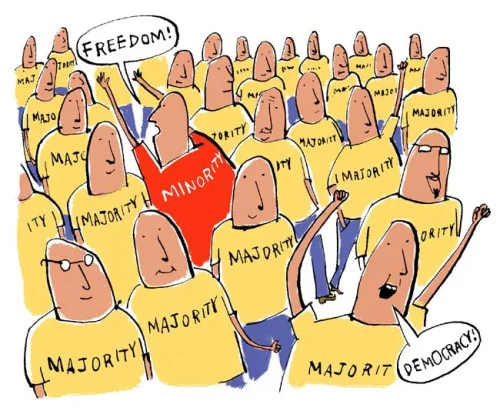
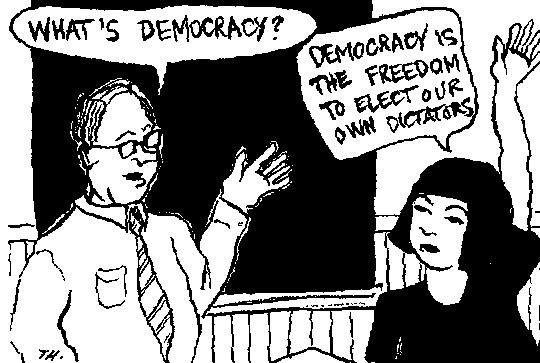
Often, people talk as if democratic elections bestowed a beneficent, mystical moral glow on decisions. Such an illusion may be useful, since the acquiescence of those who are outvoted is much preferable to a civil war. But what can actually be said for democracy is much more modest. The Book of Mormon gives a much more qualified recommendation for democracy: 

Now it is not common that the voice of the people desireth anything contrary to that which is right; but it is common for the lesser part of the people to desire that which is not right; therefore this shall ye observe and make it your law—to do your business by the voice of the people. And if the time comes that the voice of the people doth choose iniquity, then is the time that the judgments of God will come upon you; yea, then is the time he will visit you with great destruction even as he has hitherto visited this land. Mosiah 29:26,27

In other words, most of the time, what the majority of the people would choose is reasonable, some of the time it isn’t. When what the majority of the people would choose is bad, you are in trouble. 

John Stuart Mill rightly emphasizes the importance of personal freedom, even over political participation. In the 13th paragraph of the “Introductory” chapter, he writes:

No society in which these liberties are not, on the whole, respected, is free, whatever may be its form of government; and none is completely free in which they do not exist absolute and unqualified. The only freedom which deserves the name, is that of pursuing our own good in our own way, so long as we do not attempt to deprive others of theirs, or impede their efforts to obtain it. Each is the proper guardian of his own health, whether bodily, or mental and spiritual. Mankind are greater gainers by suffering each other to live as seems good to themselves, than by compelling each to live as seems good to the rest.

When thinking of the virtues of democratic decision-making, it makes a big difference what kinds of decisions one is talking about. When it is possible to divvy up personal spheres and let individuals make many decisions, the need for collective decision-making can be reduced. Some kinds of collective decisions can be made by voluntary associations rather than by the whole polity. 

When it comes to decisions that are made by the whole polity, spelling out the details of how what used to be called “natural law” will actually be enforced is certainly legitimate. As John Locke put it, people have a right to punish others for violence, theft, fraud and the like that it is better that they delegate to the state in order to avoid unending vendettas. But the right to do that enforcement preceded the state. 

The hard philosophical issue in relation to democratic decision-making arises when going beyond the enforcement of the principles formerly known as “natural law” to talking about schemes for making things better overall that help some people at the expense of others. It seems too bad to disallow such schemes entirely–especially when many people can be benefitted greatly while only a few are hurt a little. But the warrant for state compulsion for the sake of such schemes is a bit shaky. 

Where things become very clear is that state compulsion is never warranted for schemes that make some people better off and some worse off, but overall make things worse by a utilitarian test. I am arguing that such measures are not merely unwise, but immoral. Compelling someone to do something at the implicit threat of being thrown in jail or worse is a grave thing and is immoral and unethical to do for the sake of something that can’t even meet a utilitarian cost-benefit test that takes due account of the different meaning something has to a poor person as opposed to a rich person.  

As things stand, the courts adjudicating the US constitutional system show too much deference to democratic decisions that use state compulsion to reduce overall utilitarian welfare. It may be objected that there is often a disagreement about the effect of a decision on overall utilitarian welfare. But when a good case can be made that a democratic decision, enforced implicitly at the point of a gun, makes people much worse off–even if they don’t realize that is so–then I think the courts should not be shy of saying so and disallowing that democratic decision. To do otherwise would be to attribute a magic to democratic decisions that they simply don’t have. 

No way of making decisions is perfect. And of course judges, too, make mistakes. But since democracy has no magic that makes democratic decisions always correct, we should not be afraid of a constitutional system that sometimes has judges overrule democratic decisions if we find that it works well in practice. 

To dig deeper into the principles of liberty, see links to other John Stuart Mill posts collected here.

The Federal Reserve System's Dysfunctional Governance in 1934

Currie described the situation in a 1934 memo to Eccles: “Decentralized control is almost a contradiction in terms. The more decentralization the less possibility there is of control.” The problem was that “[e]ven though the Federal Reserve Act provided for a very limited degree of centralized control, the system itself by virtue of necessity was forced to develop a more centralized control of open market operations.” The ad hoc institutional development consisted of “fourteen bodies composed of 128 men who either initiate policy or share in varying degrees in the responsibility for policy.” (The fourteen were the twelve Federal Reserve Banks, the Federal Reserve Board, and the once powerful Federal Advisory Council, a group of bankers that advised the Federal Reserve Board.) These various bodies, and their governors and boards, made governance and public accountability a virtual impossibility. Currie glumly concluded that “[s]uch a system of checks and balances is calculated to encourage irresponsibility, conflict, friction, and political maneuvering” such that “anybody who secures a predominating influence must concentrate on handling men rather than thinking about policies.“
— Peter Conti-Brown, The Power and Independence of the Federal Reserve

Scott Sumner on Negative Interest Rate Policy

Link to Scott Sumner’s post “Miles Kimball on Negative Interest Rates” on his blog “The Money Illusion”

I am grateful to Scott Sumner for permission to mirror his post “Miles Kimball on Negative Interest Rates” as a guest post here. This will gives you an idea of what Scott thinks of one of my main emphases. Here is Scott:


David Beckworth did a very interesting podcast with Miles Kimball. You probably know that Miles is an economics professor at Michigan and blogs under the name “Supply Side Liberal” (a label not far from my own views.)

Here are some good points that Miles emphasized:

1. If the Fed had been able to do negative interest back in 2008, the average interest rate over the past 8 years would probably have been higher than what actually occurred. Lower in 2008-09, but then higher ever since, as the economy would have recovered more quickly. He did not mention the eurozone, but it’s a good example of a central bank that raised rates at the wrong time (in 2011) and as a result will end up with much lower rates than the US, on average, for the decade of the “teens”. Frustrated eurozone savers should blame German hawks.

2. He suggested that if the Fed had been able to do negative interest rates back in 2008-09, the financial crisis would have been milder, because part of the financial crisis was caused by the severe recession, which would itself have been much less severe if rates had been cut to negative 4% in 2008.

3. Central banks should not engage in interest rate smoothing. He did not mention this, but one of the worst examples occurred in 2008, when it took 8 months to cut rates from 2% (April 2008) to 0.25% (December 2008.) The Fed needs to be much more aggressive in moving rates when the business cycle is impacted by a dramatic a shock.

Although I suggested negative IOR early in 2009, I was behind the curve on Miles’s broader proposal (coauthor Ruchir Agarwal), which calls for negative interest on all of the monetary base, not just bank deposits at the Fed. To do this, Miles recommends a flexible exchange rate between currency and electronic reserves, with the reserves serving as the medium of account. Currency would gradually depreciate when rates are negative. Initially I was very skeptical because of the confusion caused by currency no longer being the medium of account. I still slightly prefer my own approach, but I now am more positively inclined to Miles’s proposal and view it as better than current Fed policy.

Miles argued that the depreciation of cash against reserves would probably be mild, just a few percentage points. Then when the recession ended and interest rates rose back above zero, cash could gradually appreciate until brought into par with bank reserves. He suggested that the gap would be small enough that many retailers would accept cash at par value. As an analogy, retailers often accept credit cards at par, even though they lose a few percent on the credit card fees.

If cash was still accepted at par, would that mean that it did not earn negative interest, and hence you would not have evaded the zero bound? No, because Miles proposes that the official exchange rate apply to cash transactions at banks. This would prevent anyone from hoarding large quantities of cash as an end run around the negative interest rates on bank deposits. So that’s a pretty ingenious idea, which I had not considered. Still, I think my 2009 reply to Mankiw on negative IOR holds up pretty well, even if I did not go far enough (in retrospect.)

Why is negative interest still not my preferred solution? Because I don’t think the zero bound is quite the problem that Miles assumes it is, which may reflect differing perspectives on macro. Listening to the podcast my sense was that he looked at macro from a more conventional perspective than I do. At the risk of slightly misstating his argument, he sees the key problem during recessions as the failure of interest rates to get low enough to generate the sort of investment needed to equilibrate the jobs market. That’s a bit too Keynesian for me (although he regards his views as somewhat monetarist.)

In my view interest rates are an epiphenomenon. The key problem is not a shortfall of investment, it’s a shortfall of NGDP growth relative to nominal hourly wage growth. I call that my “musical chairs model” although the term ‘model’ may create confusion, as it’s not really a “model” in the sense used by most economists. In my view, the key macro problem is the lack of one market, specifically the lack of a NGDP futures market that is so heavily subsidized that it provides minute by minute forecasts of future expected NGDP. If the Fed would create this sort of futures/prediction market (which it could easily do), then the price of NGDP futures would replace interest rates as the key macro indicator and instrument of monetary policy. Recessions occur when the Fed lets NGDP futures prices fall (or shadow NGDP futures if we lack this market). Since there is no zero bound on NGDP futures prices, we don’t need negative interest rates. However, in place of negative rates the central bank may need to buy an awful lot of assets. You could say there is a zero lower bound on eligible assets not yet bought by the central bank. Which is why we need to set an NGDPLT path high enough so that the central bank doesn’t end up owning the entire economy.

To conclude, although Miles’s negative interest proposal is not my first preference, put me down as someone who regards it as better than current policy.

PS. I was struck by how many areas we have similar views. For instance he thought blogging was really important because what mattered in the long run was not so much the number of publications you have, but whether you’ve been able to influence the younger generation economists (grad students and junior faculty).

PSS. I will gradually catch-up on the podcasts, and then do another post on the 2nd half of the Brookings conference on negative IOR.


Us and Them

This is my latest sermon, to be given today at the Community Unitarian Universalists in Brighton.  Here is the abstract:

Abstract: Group identity is the source of many of the best and the worst things that people do. In the form of patriotism, school spirit, esprit de corps, or brotherhood or sisterhood, it can encourage crucial sacrifices and help provide meaning to people’s lives. But the dark side of group identity is the felt division of the world into “us” and “them”–with “them” viewed as not fully human. A key challenge for liberal religion is to help create a strong group identity that can embrace all of humanity.  


I have been a strong supporter of more open immigration. So I have been concerned by the strength of anti-immigration sentiment revealed by Donald Trump’s success as a political candidate on an anti-immigration platform, and the Brexit vote in the United Kingdom to leave the European Union, also driven in important measure by anti-immigration sentiment.   

Economists argue over whether immigration is good for the people in the receiving country or not, for the most part coming down on the side of immigration raising the wages of the large majority of people in the receiving country, with the important exceptions of slightly earlier immigrants and those without a high school diploma. (Immigrants also are likely to raise rents and property values, which is good for those who own property and not so good for those who don’t.) But the most important benefit of immigration often goes unmentioned–the benefit to the immigrants themselves–many of whom come from nations that–relative to the United States–are in bad shape either economically or politically. To me, it is a breach of economic ethics to do a cost-benefit analysis that puts a zero weight on any category of human beings affected by a policy as anything more than a mathematical exercise; and to discuss immigration without mentioning the benefit of immigration to the immigrants themselves is to make the same error in a less formal way. 

Although I am skeptical of it, an argument can be made that for some policy-making purposes, it would be appropriate to give a higher weight to the effects of a policy to current citizens than to the effects of that policy on an equal number of potential future citizens, but as can be seen in an exercise I have had my students do, when coming from a desperately poor nation, the benefits of immigration to an immigrant are so much greater than the costs to those in the receiving country that even if the well-being of immigrants is counted as worth only one-hundredth as much as the well-being of citizens, immigration often looks like a good deal.

So the key issue in immigration policy is whose well-being counts: who is in the charmed circle of people whose lives we are concerned about and who is not. On this question of whose well-being counts, Aristotle encouraged Alexander the Great to view all Greeks as friends and all non-Greeks with only as much concern as if they were beasts (1,2). In the same vein, I don’t think it is just an anthropologists’ legend that the word many hunter-gatherers have for their own tribe can be reasonably translated as “the People,” with the implication of a less-than-fully-human status for those in other tribes. 

In many ways, we demonstrate that we do care about people in other nations. We provide both private and public foreign aid, with a fair bit of it altruistically designated for the world’s poorest of the poor. I think concern for the world’s poorest of the poor would be even greater than it is if there were a program for schoolchildren in the United States and other rich nations to chat over Skype–perhaps in broken English–with sister classrooms of schoolchildren in very poor areas of the world. I would be willing to bet a great deal that such a program would not go on for very long before someone got the bright idea that one of the best ways to help their friends abroad would be to help them immigrate to the the United States or other rich nation. And of course, if doable, that idea would be a sound one. The poorest of the poor, if brought to our shores, would soon be at a much higher standard of living than in the land they came from. The basic reason is simple. Leaving aside ruling cliques able to take over natural resource wealth, countries and regions become rich by being relatively well run. The same human being, in a relatively well-run country, does much better than in a poorly-run country.   

According to the Gospels, Jesus had an answer for whose well-being counts both in the way he recognized women, lepers, children, Samaritans and tax-collectors day after day as full human beings, but also in his great charge:

Therefore go and make disciples of all nations, baptizing them in the name of the Father and of the Son and of the Holy Spirit, (Matthew 28:19)

In my blog post “‘Keep the Riffraff Out!’” which tries to ferret out that sentiment in many nooks and crannies of our public policy, I pursued an analogy between nations and religions, writing this:

Mormonism is a proselyting religion. Close to 35 years ago, I was one of many Mormon missionaries trying to persuade people in Tokyo to become Mormons. And most of you will one time or another see Mormon missionaries at your door, wherever you are in the world. 

One of the positive features of a proselyting religion that is not always fully appreciated is that newcomers are fully welcome, as long as they make even a minimal attempt to fit in. And if they so choose, it is not hard for them to become full members of the community.

Sometimes, members of the Mormon Church question the virtue of bringing someone into the community who has enough needs that they are likely to require more help from the community than the amount they are able to help others. But the young women and men serving for a year and a half or two as full-time missionaries and higher Mormon Church authorities quickly overrule such sentiments.

I don’t believe in the supernatural anymore, so I don’t believe in Mormonism. But I do believe in America. 

I wish America were a proselyting nation, eager to bring newcomers into the fold. I believe it would be a better world if more of the world’s 7 billion people were Americans. There are many people who would be willing converts to being Americans, but we keep them out.  

Today I want to pursue the analogy between nations and religions in a little more detail. I think there are three basic models, that I will call the Unitarian-Universalist model, the Mormon model and the Zoroastrian/Orthodox Jewish model. 

When my wife Gail and I, as well as some of our friends, fled from Mormonism sixteen years ago, we were not only welcomed by what is now the First Unitarian Universalist Congregation of Ann Arbor with open arms, but welcomed just as we were. I am sure former Mormons must have seemed weird to some of the members of the congregation, but they took all of that in stride, partly because they were conscious of their own idiosyncrasies.  

When converts join the Mormon Church, they are expected to follow a substantial set of rules of conduct and behavior. Right away, they are expected to contribute not only financially but in assigned roles in the congregation. And even patterns of insider jargon and oddities such as a positive attitude towards Jell-O are soon inculcated. So it isn’t long before newcomers have patterns of action and speech that feel comfortable to the long-timers in a congregation.  

Zoroastrianism has relatively few converts, and Orthodox Judaism makes it hard for people to convert if they weren’t Jewish at some level to begin with. One reason they are not proselyting religions is that historically, they were minority religions in lands where trying to convert others would have been seen as an affront to the dominant religion. But even now–though attitudes toward converts may be shifting–there are many Zoroastrian priests and Orthodox Rabbis who are very reluctant to accept someone as a convert who shows up on their doorstep wanting to convert. 

The analogy is to three types of immigration policies:

  1. Welcoming people as they are, with all of the multicultural complexity that entails, 
  2. Welcoming people on the condition that they quickly take on the patterns of the dominant culture, 
  3. Discouraging people from coming in. 

There are sincere believers in each type of policy. Personally, I find it hard to decide between the Unitarian-Universalist model of accepting people as they are and the Mormon model of trying to change people to better fit the cultural norms of the nation they are joining–if only to help guarantee people’s willingness to accept newcomers, and to help generate extra esprit de corps that may help people be more altruistic toward one another. 

So far I have been talking about citizens and foreigners or members and non-members of a religion. But these are both special cases of a powerful psychological lens: “us” versus “them.” For many of the few people who would ever pay any attention to anything I said, the main us-them distinction is between those who are relatively well-educated–say those who have at least some college education or maybe a bachelor’s degree (or who act as if they do) and those who don’t have so much education (or act as if they don’t). Or for others, the main us-them distinction may be quite directly between the “us” of those who accept foreigners and other marginalized groups and the “them” who don’t. 

It is hard not to want to exclude those who want to exclude and hard not to be intolerant of those who are intolerant, but Edwin Markham’s poem “Outwitted” shows the way to be intolerant of intolerance and to exclude exclusion without being intolerant of people who are intolerant or trying to exclude people who are exclusionist. Edwin wrote:

“He drew a circle that shut me out-

Heretic, rebel, a thing to flout.

But love and I had the wit to win:

We drew a circle and took him In!

For those of us who can empathize with foreigners who want to join us in our fair land, one of the great tasks of empathy that we face is to understand the feelings of those who want to “keep the riffraff out” without thinking of them as riffraff. Full human beings–who should be treated as full human beings–can and do often want to treat other human beings as less than full human beings. This is not a rare quirk of human nature, but a common one. So we had better learn to deal with it.

My point of entry into attempted empathy with anti-immigrant sentiment is to think of the difference between a big city and a small town. Big cities are complex and attract people who like complexity. Adding, say, 5% to the population of that big city by the entry of additional immigrants adds a bit to the complexity, but doesn’t change the fundamental character of the big city. By contrast, in a small town of, say, 1000 people, where everyone knows almost everyone else, adding three families of immigrants could seem as if it totally changed the character of the town. Things just aren’t the way they used to be once those immigrants arrive, and there was a certain comfortable charm to the way things used to be. So the effect of immigrants on their surroundings isn’t just a matter of population percentages, but also a matter of how demographically complex the community was to begin with. Of course, in addition to the first few immigrants seeming like a big deal, the point at which “outsiders” become numerous enough to gain serious political influence–when it didn’t seem as if they had it before–is also a potential moment for distress. 

In a Twitter debate I had about immigration policy after the Brexit vote, Morgan Warstler and Nick Rowe both argue that some of the opposition to immigration comes from people’s desire to, in effect, belong to a club that they like. A hint of evidence for this view can be found in the claim I have seen that those who are “socially-connected” by attending church or belonging to a literal club have been less likely to vote for Donald Trump. One theory for this would be that if one’s main social group is something smaller than the entire geographical community one lives in, immigrants moving into one’s geographical community are less disruptive of one’s social relationships than if one’s main social group is one’s entire geographical community. If this is true, a church one actually attends, by providing a social group somewhat buffered from demographic shocks, may tend to make make one more accepting of immigrants coming into one’s geographic community. By contrast, a church one doesn’t attend may act as a quasi-ethnic identity that makes one less tolerant of outsiders.  

As I read the current news, it is painful for me to see refugees from war-torn lands shunned as if they were nuclear waste that can’t find a home even in Yucca mountain. And I hate to see people so eager to exclude immigrants that they will accept other serious costs to do so. To me, one of the most important principles is that human beings are human beings, and that everyone’s well-being counts. 

I would love to find the secret to instilling in people a kind of patriotism not only for their own nation, but also for humanity. It may be only my parochial pride talking, but I think we are a remarkable and wonderful species. Without treating other animals or plants or sophonts badly, we should feel good about belonging to the ranks of homo sapiens.

On the other hand, when we see people behaving badly, it is worth remembering that they, like us, are still apes–so, perfect behavior is not to be expected. Let us give each other a break and forgive often, even as we strive to encourage the best in ourselves and others, while standing firmly against the worst impulses of human nature in others and ourselves.
Selfishness and the Fall of Rome

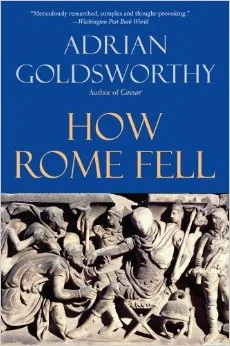
Link to Adrian Goldsworthy’s How Rome Fell: The Death of a Superpower

pp. 418, 419: 

It is only human nature to lose sight of the wider issues and focus on immediate concerns and personal aims. In the Late Roman Empire this was so often all about personal survival and advancement–the latter bringing wealth and influence, which helped to increase security in some ways, but also rendered the individual more prominent and thus a greater target to others. Some officials enjoyed highly successful careers through engineering the destruction of colleagues. Performing a job well was only ever a secondary concern. Even emperors were more likely to reward loyalty over talent. Officials and commanders needed only to avoid making a spectacular mess of their job–and even then enough influence could conceal the facts or pass the blame onto someone else. None of this was entirely new, but it became endemic. When ‘everyone’ acted in the same way there was no real encouragement to honesty or even competence. The game was about personal success and this often had little connection to the wider needs of the empire. 

It was not a phenomenon unique to the Late Roman Empire, nor are its implications only of significance to the United States or indeed any other country. All human institutions, from countries to businesses, risk creating a similarly short-sighted and selfish culture. It is easier to avoid in the early stages of expansion and growth. Then the sense of purpose is likely to be clearer, and the difficulties or competition involved have a more direct and obvious impact. Success produces growth and, in time, creates institutions so large that they are cushioned from mistakes and inefficiency. The united Roman Empire never faced a competitor capable of destroying it. These days, countries and government departments do not easily collapse–and Western states do not face enemies likely to overthrow them by military force. In the business world the very largest corporations almost never face competitors that are truly their equal. Competition within the commercial market at any level is obviously rarely carried out on entirely equal terms. 

In most cases it takes a long time for serious problems or errors to be exposed. It is usually even harder to judge accurately the real competence of individuals and, in particular, their contribution to the overall purpose. Those in charge of overseeing a country’s economy generally reap the praise or criticism for decisions made by their predecessors in office.