Q&A: Evidence that Financial Flows Determine the Overall Balance of Trade, Not Tariffs?
I am grateful to Greg Mankiw and Doug Irwin for permission to share this email exchange with you on the impotence of tariffs to affect the balance of trade.
Miles to Greg Mankiw:
Dear Greg,
I have always really liked your model of international finance in your Principles and your Intermediate books. You may not know this, but I wrote a blog post to try to explain it,I have always really liked the the model of international finance in your Principles and Intermediate books. I wrote a blog post, “International Finance: A Primer,” to try to explain it. I use those principles all the time in blog posts as well as in class.
My undergraduate student, August Klatt (copied above) asked this excellent question: “Is there any empirical evidence to back up the prediction that a change in tariffs has no effect on net exports under flexible exchange rates (other things being equal)?”
Greg to Miles:
Thanks, Miles, for your note and kind words.
I do not know of a relevant study to cite off the top of my head. But when I return from spring break, I will look around and let you know if I find anything.
Greg
Greg to Doug Irwin:
Hi Doug,
I was wondering if you could help me find a relevant paper or two. You seem like you might be the right person to ask (in light of your great book, Free Trade Under Fire).
A lot of standard models predict that, under flexible exchange rates, trade restrictions do not affect the trade balance (because NX=S-I and the restrictions do not directly affect S or I). Instead, the exchange rate moves so that a trade restriction reduces both imports and exports.
Do you know of any empirical studies that confirm or refute this? Obviously, this topic is relevant for Mr Trump’s proposed policies regarding China.
Doug Irwin:
Hi Greg,
I don’t know of any particular studies or papers to point you to, but theory and experience confirm it. The theory is the Lerner Symmetry Theorem, that a tax on imports is a tax on exports, so that imposing a tax on imports (to reduce imports) means that necessarily that exports will be taxed as well (resulting in a reduction in exports). The question is the mechanism by which this happens, which is obviously different under fixed and floating exchange rates.
In terms of experience, the US trade balance did not change appreciably after the imposition of the Smoot-Hawley tariff. In more recent decades, countries that have rapidly dismantled import restrictions (Chile, New Zealand) did not start running large trade deficits (although they often had fixed exchange rates and devalued or floated when they introduced their trade reforms). I don’t think China ran a large trade deficit when it unilaterally opened up its economy in the 1980s and 1990s, although as your know their current account began to balloon when you were at CEA (no causality suggested!). Another experience: I think Japan had a rough current account balance until they deregulated private capital outflows in 1980 at which point their CA surplus began to grow.
Regarding China - we do know that they retaliate immediately. Whenever Commerce and the ITC rule affirmatively on an antidumping case involving China, it is almost miraculous how China immediately finds that the United States has been dumping in their market as well.
I hope this helps a little. Let me know if you would like some elaboration.
How the Romans Made a Large Territory 'Rome'
“Edgy in a different way was the idea of the asylum, and the welcome, that Romulus gave to all comers–foreigners, criminals, and runaways–in finding citizens for his new town. There were positive aspects to this. In particular, it reflected Roman political culture’s extraordinary openness and willingness to incorporate outsiders, which set it apart from every other ancient Western society that we know. No ancient Greek city was remotely as incorporating as this; Athens in particular rigidly restricted access to citizenship. This is not a tribute to any ‘liberal’ temperament of the Romans in the modern sense of the word. They conquered broad swathes of territory in Europe and beyond, sometimes with terrible brutality; and they were often xenophobic and dismissive of people they called ‘barbarians.’ Yet, in a process unique in any pre-industrial empire, the inhabitants of those conquered territories, ‘provinces’ as Romans called them, were gradually given full Roman citizenship, and the legal rights and protections that went with it. … As one King of Macedon observed in the third century BCE, it was in this way [through inclusiveness] that ‘the Romans have enlarged their country.’”
Emily Badger: There is No Such Thing as a City that Has Run Out of Room—Especially in America →
Note: Don’t miss my related post “Density is Destiny.”
Ryan Silverman—$15 Federal Minimum Wage: Positive Intentions, Negative Results

Link to Ryan Silverman’s Linked In homepage
I am pleased to host another student guest post, this time by Ryan Silverman. This is the 10th student guest post this semester. You can see all the student guest posts from my “Monetary and Financial Theory” class at this link.
A significantly higher minimum wage in America will damage small businesses, reduce the incentive to invest in human capital, and make it harder to improve living standards.
The current federal minimum wage is $7.25 per hour. However, 29 states and the District of Columbia have set minimum wages above the federal minimum wage. Kicking off 2016, 14 states began the new year by raising their minimum wage. The nation is trending towards higher minimum wages under the rationale that all workers deserve livable wages. Many activists are fighting to raise minimum wage to $15 an hour, more than twice the current federal minimum wage.
Minimum wage jobs typically require little to no education, such as dishwashers and cashiers. The supply of minimum wage workers tends to be highly elastic, making each worker easily replaceable. It turns out that over half of minimum wage workers are between ages 16-24, many of whom are not yet financially independent.
It is clear that minimum wage jobs are not intended for those who are in dire need of funds. Minimum wage jobs are intended to provide supplemental income in return for simple labor. Higher wages should serve as an incentive for laborers to invest in various forms of human capital to make themselves more productive in the workforce. If every American could live a comfortable life providing menial labor, and skip the rigors and cost of higher education, our productivity growth as a country would slow down, if not reverse itself.
Many small businesses have already factored the current federal minimum wage into their expenses and would be unable to operate if their labor costs doubled. Any increase in the failure of small businesses would further widen the gap between upper and middle classes. Big businesses will take over the market share of struggling small businesses, creating less competition and more monopolistic behavior. Too many people act as if the set of jobs available is fixed. In the short run the set of jobs available may indeed be close to fixed, and the minimum wage may not seem to affect jobs much at all, but in the long run, the set of jobs available far from fixed. A higher wage will drive many jobs out of existence over the course of ten to twenty years.
Even for the poor that a minimum wage is intended to help, a substantial fraction of the benefits of a higher wage for those who manage to keep their jobs will be eaten up by the higher prices of goods produced in part by other minimum wage workers. For example, many people on limited incomes shop at Walmart. If Walmart has to pay higher wages, the customers at Walmart, who are themselves struggling, will have to pay higher prices.
In addition to destroying jobs over the course of ten to twenty years, a higher minimum wage might tempt many people to queue up for jobs with a high minimum wage instead of getting more training. Forgoing training is not only a limitation on the life of the individual, it also deprives society of skilled work that it needs. For example, Emergency Medical Transport professionals do important work. Their services are pivotal to saving lives and require much more education and training than a typical minimum wage worker. If the minimum wage increased while the wage of Emergency Medical Transport professionals stayed the same, there would be less incentive to gain those skills. On the other hand, if Emergency Medical Transport professional wages go up, then these crucial services become more expensive.
One must also consider the effect on the natural unemployment rate if the minimum wage increases to $15. Fewer workers will have a marginal product high enough to be employed, and more will waste time looking for jobs in scarce supply. The Congressional Budget Office predicts that if the federal minimum wage is raised to $10.10, as many as a million workers could lose their jobs.
In the long run, I predict a further wealth disparity caused by the ability of large companies and conglomerates to better weather the minimum wage hike than smaller businesses. Small businesses have substantially less operating capital to support their largest expenses of employee wages and benefits. Small businesses will encounter the most difficulties staying afloat with higher minimum wages, particularly in difficult economic times.
Raising the minimum wage might seem to many like, at worst, a relatively harmless political gesture. But for those whose marginal product is below the minimum wage, it can be a nightmare, making it hard for them to find a job. Wouldn’t it be better to let each person choose his or her own minimum wage? But of course that is exactly what happens when there is no minimum wage at all. Next best would be to choose a minimum wage carefully for each demographic group, to make sure it wasn’t too high relative to that group’s marginal product. But a uniform minimum wage is certain to shut some groups out of the labor force–those who struggle the most at finding jobs to begin with. It may be that some of those groups are made up of people who don’t desperately need a job. But if they don’t desperately need a job, they also don’t need an increase in the minimum wage either. And if they do desperately need a job, a higher minimum wage will make it harder to find one.
Tom Keen and Francine Lacqua Interview Miles Kimball on Bloomberg Radio about Negative Interest Rates and Nominal GDP Targeting →
University of Michigan’s Miles Kimball discusses negative interest rates and how it’s just an extension of positive interest rates as well as real GDP versus GDP plus inflation. He speaks with Tom Keene and Francine Lacqua on Bloomberg Surveillance.
Jacob Barnard: The Great Inversion

Link to Jacob Barnard’s Linked In homepage
I am pleased to host another student guest post, this time by Jacob Barnard. This is the 9th student guest post this semester. You can see all the student guest posts from my “Monetary and Financial Theory” class at this link.
Deciding to invert a corporation is a logical choice resulting from high corporate taxes, not from being a “bad corporate citizen.”
Recently, U.S.-based firm IHS Inc. and U.K.-based Markit Ltd. announced a merger to create a $13 billion data firm. The issue this brings up isn’t an anti-trust matter though, but rather, where its new headquarters is going to be. The current plan is for the new firm to be based out of London, which means it would only have to pay the 20% corporate tax rate used by the U.K. instead of the 35% corporate tax rate in the U.S. This process, known as inversion, has come under fire from many politicians. President Obama has even called corporations that undergo this process unpatriotic and likens it to not being a good corporate citizen. The process is completely reasonable, however, and is popular because of a high corporate tax rate, not a lack of patriotism.
The process of corporate inversion has been made more difficult by a law put in place in 2004, which was meant to eliminate the favorable tax treatment of “surrogate foreign corporations.” These occur if the stockholders of a former U.S. corporation own 60% of the stock in a merged foreign corporation as a result of their previous holdings in the U.S. corporation. The new parent country’s corporation must also account for less than 25% of the merged corporation’s employees, wages, assets, and income for it to be considered a surrogate. That amount is open to interpretation, however, and can be re-interpreted to make inversions harder, which is what the IRS did in 2015.
Clearly, the US government wants to fight inversion. Despite these efforts, however, corporations are still trying to leave. The reason is obvious: the corporate tax rate. The United States has the highest of all OECD countries and third-highest among all reporting countries. The federal corporate income tax rate combined with the average rate paid in each state is 39.1%. The world-wide average is 22.9% and has been dropping for over a decade. The U.S. rate, on the other hand, has stayed the same. As a result, corporations in the U.S. lose more and more money each year by not inverting and already pay an extra 16%. A corporation’s shareholders have the right to hire and fire directors, so they are, and should be, the directors’ main concern, not a country.
The argument some people like to make is that inverted corporations don’t pay their “fair share” because they are receiving the benefits of the U.S. government, military, markets, and infrastructure without paying taxes to the U.S. to pay for these things. The problem with that reasoning is quite simple: they are actually required, by law, to pay their fair share. Foreign corporations pay the U.S. tax on profits earned by their U.S. subsidiaries in the U.S. What is their fair share if not the amount that actually results from business generated in the U.S.? If anything, corporations that stay in the U.S. pay more than their fair shares because, unlike most other OECD countries, the U.S. requires corporations to pay the corporate tax on foreign-earned income in order to repatriate it, minus however much they already paid in foreign corporate taxes. This means the U.S. is taxing corporations on profits earned because of the benefits provided by foreign governments, military , markets, and infrastructures. If foreign corporations aren’t using accurate, “arms-length” transfer prices in order to artificially move income out of the U.S., then that’s a problem, but it’s a problem for almost all multinational corporations with subsidiaries in the U.S., not just inverted ones.
The problem comes right back to our significantly higher tax rate then. If our tax rate is high enough to cause firms to change their behavior this much, perhaps we should start considering whether it might be too high, possibly even decreasing our tax revenue. Even if it isn’t, lowering it would probably be a good idea at this point. Stricter inversion requirements might be enough to keep current corporations in the U.S., but how are we going to convince future corporations to incorporate in the U.S. if the only way to convince current ones to stay is by forcing them to?
John Stuart Mill on the Sources of Prejudice About What Other People Should Do

Many of us have occasion to argue against particular types of prejudice. But John Stuart Mill unmasks all prejudices in the 6th paragraph of the “Introductory” to On Liberty:
But though this proposition is not likely to be contested in general terms, the practical question, where to place the limit—how to make the fitting adjustment between individual independence and social control—is a subject on which nearly everything remains to be done. All that makes existence valuable to any one, depends on the enforcement of restraints upon the actions of other people. Some rules of conduct, therefore, must be imposed, by law in the first place, and by opinion on many things which are not fit subjects for the operation of law. What these rules should be, is the principal question in human affairs; but if we except a few of the most obvious cases, it is one of those which least progress has been made in resolving. No two ages, and scarcely any two countries, have decided it alike; and the decision of one age or country is a wonder to another. Yet the people of any given age and country no more suspect any difficulty in it, than if it were a subject on which mankind had always been agreed. The rules which obtain among themselves appear to them self-evident and self-justifying. This all but universal illusion is one of the examples of the magical influence of custom, which is not only, as the proverb says, a second nature, but is continually mistaken for the first. The effect of custom, in preventing any misgiving respecting the rules of conduct which mankind impose on one another, is all the more complete because the subject is one on which it is not generally considered necessary that reasons should be given, either by one person to others, or by each to himself. People are accustomed to believe, and have been encouraged in the belief by some who aspire to the character of philosophers, that their feelings, on subjects of this nature, are better than reasons, and render reasons unnecessary. The practical principle which guides them to their opinions on the regulation of human conduct, is the feeling in each person’s mind that everybody should be required to act as he, and those with whom he sympathizes, would like them to act. No one, indeed, acknowledges to himself that his standard of judgment is his own liking; but an opinion on a point of conduct, not supported by reasons, can only count as one person’s preference; and if the reasons, when given, are a mere appeal to a similar preference felt by other people, it is still only many people’s liking instead of one. To an ordinary man, however, his own preference, thus supported, is not only a perfectly satisfactory reason, but the only one he generally has for any of his notions of morality, taste, or propriety, which are not expressly written in his religious creed; and his chief guide in the interpretation even of that. Men’s opinions, accordingly, on what is laudable or blameable, are affected by all the multifarious causes which influence their wishes in regard to the conduct of others, and which are as numerous as those which determine their wishes on any other subject. Sometimes their reason—at other times their prejudices or superstitions: often their social affections, not seldom their antisocial ones, their envy or jealousy, their arrogance or contemptuousness: but most commonly, their desires or fears for themselves—their legitimate or illegitimate self-interest. Wherever there is an ascendant class, a large portion of the morality of the country emanates from its class interests, and its feelings of class superiority. The morality between Spartans and Helots, between planters and negroes, between princes and subjects, between nobles and roturiers, between men and women, has been for the most part the creation of these class interests and feelings: and the sentiments thus generated, react in turn upon the moral feelings of the members of the ascendant class, in their relations among themselves. Where, on the other hand, a class, formerly ascendant, has lost its ascendancy, or where its ascendancy is unpopular, the prevailing moral sentiments frequently bear the impress of an impatient dislike of superiority. Another grand determining principle of the rules of conduct, both in act and forbearance, which have been enforced by law or opinion, has been the servility of mankind towards the supposed preferences or aversions of their temporal masters, or of their gods. This servility, though essentially selfish, is not hypocrisy; it gives rise to perfectly genuine sentiments of abhorrence; it made men burn magicians and heretics. Among so many baser influences, the general and obvious interests of society have of course had a share, and a large one, in the direction of the moral sentiments: less, however, as a matter of reason, and on their own account, than as a consequence of the sympathies and antipathies which grew out of them: and sympathies and antipathies which had little or nothing to do with the interests of society, have made themselves felt in the establishment of moralities with quite as great force.
People often have feelings about the conduct of others. If person A is able to insist that another person B should do X because not doing X makes A feel bad, this could imply a tyrannical domination by A of others like B unless the scope of A’s legitimate sphere for concern and insisting about B’s and others’ actions is limited somehow. It won’t work to give each person a sphere of decisive influence over all the things that shehe cares about because those spheres of decisive influence would be overlapping–meaning they wouldn’t be spheres of decisive influence at all. Somehow, the legitimate sphere of decisive influence for each person must be delimited in a way that doesn’t lead to too much overlapping.
Of course, it is possible to have decisions made jointly by several different people. But in cases of stubborn disagreement, there must be some mechanism for deciding–even if that mechanism is flipping a coin. Dividing up as much as possible into separate spheres of decisive influence in which one person is dominant has been a very useful strategy to minimize the need to use other social choice mechanisms like voting that tend to constantly raise the possibility of conflict. John Stuart Mill’s advocacy of both civil and social liberty can be seen as advocating an equitable division of spheres of decisive influence more or less in line with the physical body of each person and (for the most part) the fruits of each person’s labors.
Economists have done some work on subtle social choice mechanisms that are not in such common use as the division of spheres of decisive influence and voting. In the case of each such social choice mechanism, a key question is how it could be made a staple of everyday social choice as voting, flipping a coin or the division of spheres of decisive influence are. Or to put it another way, a social choice mechanism has only fully come into its own as a general purpose method if children on the playground often use it to resolve their disputes.
Chris Matthews on Negative Interest Rates
Link to the October 21, 2015 fortune.com article “Ben Bernanke sees the upside of negative rates.”
I was pleased to see, belatedly, the fortune.com article “Ben Bernanke sees the upside of negative rates” by Chris Matthews. Chris quotes from and links to my Quartz column “America’s huge mistake on monetary policy: How negative interest rates could have stopped the Great Recession in its tracks.”
Chris’s other link is also interesting: he links to Joshua Franklin’s October 16, 2015 reuters.com article “Swiss bank ABS plans negative interest rates for some depositors.” The key passages there are:
“On transactional accounts … there will be negative interest rates of -0.125 percent from the first franc,” the ABS spokeswoman said, adding that this would come into effect from the start of next year. …
Major banks like UBS and Credit Suisse have introduced deposit charges for some large clients but Swiss broadcaster SRF said ABS would be the first Swiss bank to introduce negative rates for smaller clients.
The Most Exciting Thing About Bitcoin Isn't Bitcoin →
If you click through, this is a nice graphic about blockchain technology.
August Klatt: The Luck of the Draw
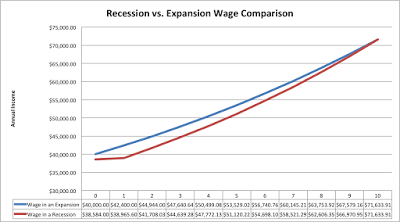
A college degree obtained during an expansion and a college degree obtained during a recession are two very different things.
I am pleased to host another student guest post, this time by August Klatt. This is the 8th student guest post this semester. You can see all the student guest posts from my “Monetary and Financial Theory” class at this link. This is the 2d guest post by August. Don’t miss his previous guest post: “Is the NFL Trying to Hide Something by Injecting Bias into Head Injury Science?”
Quick, graduate as fast as you can before another recession hits. The United States has made a full recovery from the Great Recession and there hasn’t been a better time to be a college grad. Josh Zumbrun of the Wall Street Journal reports that income for college graduates is at its highest levels since 2003. The median income for recent college graduates is now $43,000, (ages 22-27) which is $3000 more than the previous year’s median. In addition, the unemployment rate for recent college grads (4.9%) is almost down to pre-recession levels. These numbers seem refreshing as I am currently a junior in college, but as we learned from the Great Recession, things can change quickly. If you have the opportunity to graduate soon, take advantage of it!
How much does it really matter whether you graduate in good times or bad times? The short answer: a lot. The National Bureau of Economic Research conducted a study to determine the effects of graduating in a recession. They concluded that recent graduates lost 9% in their wages initially, which went down to 4.5% by fives years, and showing no loss in wages by the tenth year.
For the graph at the top, I created a projection of wages of an individual that graduates in a recession versus an expansion using the data that the National Bureau of Economic Research provided. The projection uses the most accurate data I could find, but I am not claiming that my assumptions used are perfect. I assumed a starting salary of $40,000 for the individual in the expansion, and an initial salary of $38,584 for the individual hired in the recession (9% less than the expansion individual). I also assumed the losses in wages from 9% to 0% in 10 years decreased at a linear rate. Both individuals obtained a 6% increase in wages annually, which is very reasonable considering most people see 70% of their wage increase in the first 10 years of working. One of the reasons behind these large wage increases has to do with the fact that younger professionals change jobs more frequently. According to Cameron Keng workers who stay in their jobs are getting raises of 3% on average, while workers who change companies are getting a 10% to 15% salary increase. I thought that 6% was a good middle ground to build the model off of.
The area between the two lines is the loss in wages for the individual who unluckily graduated in a recession. From this projection, the loss turns out to be a little more than a $20,000 over the 10 years. Keep in mind that I am assuming these two individuals are identical in every way, except for the timing of their graduation. That’s a lot of money to lose for being purely unlucky.
Many of these losses come from the lack of jobs available, which can lead to students taking jobs at smaller companies or ones that aren’t the best fit for them. These drops in wages also only account for the students who actually get jobs. It doesn’t account for the rise in the unemployment rate. In the Great Recession, the unemployment rate reached 7% for recent grads. That extra 2% rise in the unemployment rate represents recent grads that are making zero income that would have been making a wage in an expansion.
In the first 10 years of a career, it is likely to see 70% of the wage increases. As a college student with more than likely lots of debt, you want to take full advantage of this wage growth right out of school. There’s nothing you can do to affect the economic conditions when you graduate, but these differences in wages are real and unfortunate.
Zhi Ying Lin: Why Are People So Upset About Uber’s Surge Pricing—And Should They Be?

Link to Zhi Ying Lin’s Linked In homepage
I am pleased to host another student guest post, this time by Zhi Ying Lin. This is the 7th student guest post this semester. You can see all the student guest posts from my “Monetary and Financial Theory” class at this link.
People should not be upset about Uber’s surge pricing as it creates market efficiency. Uber though, should improve its model by representing some of the variation in pricing as a discount and creating a loyalty program to reduce passengers’ dissatisfaction.
There has been an outrage against Uber for charging its passengers more than the normal rate on busy days. On this past New Year’s Eve, many passengers posted their receipts from Uber on social media websites to complain about the “ridiculously” inflated fare. There were some riders who paid more than $200 for a 20-minute ride, but Matthew Lindsay from Canada, probably paid the highest price of all - $800 for a 60-minute ride.
This happened because Uber adopts surge pricing as its core business strategy. This model uses an algorithm that calculates the fare multiplier based on the supply and demand for rides. When the demand exceeds the supply in a particular area, the base fare gets multiplied to attract more driver-partners.

People feel upset about surge pricing because they treat the base fare as a reference point. So, when there is a price surge, they feel that they get ripped off because to them, the base fare is the price that they “should” be paying. After all, most traditional taxis and buses have fixed pricing schemes with predetermined prices regardless of time. Why should Uber surge its prices during peak hours?
First, it ensures adequate supply of driver-partners on busy days. As we all know, it is always hard to hail a cab on rainy days or during peak hours because drivers, who are limited to a 20% wage hike, face very little incentive to drive. Like Princeton economist Henry Farber put it, some drivers stop driving simply because it is less pleasant to drive in the rain, and there is no additional benefit in continuing to drive.
To increase driver’s incentives, Uber allows surge pricing, which essentially removes the price cap. Though this strategy is still not perfect, Uber’s economists managed to prove that there is a high correlation between surge pricing and a rise in driver-partners supply.
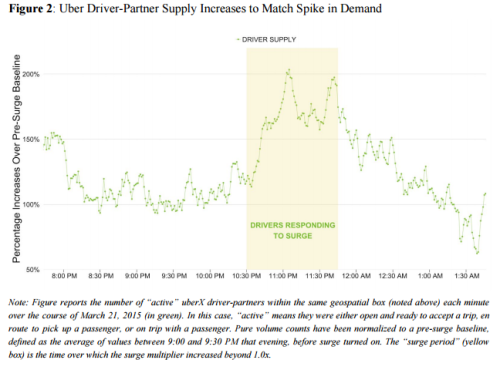
In addition, due to a technical glitch, they managed to demonstrate the negative effects of not having surge pricing on busy days. Findings show that as fares dropped to normal, completion rates fell dramatically and waiting times increased.
Besides increasing the supply of driver-partners, surge pricing also helps to control the demand for rides. It makes sure that those who value the service more are able to secure rides. Though some people might argue that surge pricing is a form of price gouging, it creates much-needed incentives for people to think harder about what they really need. This means that those who really, really need a ride–and are willing to pay the surge prices–will always be able to get a ride.
Given the benefits of surge pricing, it would be great if Uber could find a way to reduce customer discontent about surge pricing, rather than abandon surge pricing. One way to do this would be represent some of the variation in prices as a discount, rather than a premium. As mentioned earlier, riders treat the base fare as a reference point, so prices that are higher than the reference point are considered as losses, while prices below that seem like gains. As suggested by this paper, Uber could charge its passengers inflated prices during peak hours and give large discounts during off-peak hours, with the reference price somewhere in between. When the higher regular price becomes the reference point, passengers will not feel the losses that they experience under the current system. They will feel like they gain something from the discounted prices on regular days. The right level for the reference price between the minimum and maximum prices can be chosen by the kind of experimentation that an online platform like Uber is well set up to do. Of course, Uber should do this in the context of educating customers about the benefits of having a price that adjusts to equate supply and demand in real time.
Another, complementary approach that can be combined with an intermediate reference price is for Uber to give loyalty points to frequent app users that can be used to pay for surge pricing. Customers who have enough loyalty points might then even experience the surge prices as a gain, since they can feel satisfaction that they accumulated enough loyalty points to pay for the surge pricing. Customers who don’t have enough loyalty points to pay for the above-reference part of the price will at least then have hope that they can have enough loyalty points to pay for surge prices in the future. This can help to shift a part of the responsibility in a customer’s mind from the company to the customer her- or himself. It also has the usual benefits of loyalty points–the encouragement to use the app more frequently. Isn’t it great to kill two birds with one stone?
The economic argument for surge pricing is strong: bring out more drivers when they are needed and help make sure those who need a ride most can still get one, even during peak times. The problem is customer dissatisfaction with surge pricing, due to the principle of loss-aversion and notions of fairness that fail to take these benefits of surge pricing into account. So Uber should keep its surge pricing, but raise the reference price so that sometimes the price variation looks like a discount, and let customers pay for the part of surge prices above the reference price with loyalty points. Making surge pricing work better psychologically can preserve the benefits of real-time price variation to match supply and demand.
Ki Bum Kim: The Economic Craziness of Korean Marriages

Link to Ki Bum Kim’s Linked In homepage
I am pleased to host another student guest post, this time by Ki Bum Kim. This is the 6th student guest post this semester. You can see all the student guest posts from my “Monetary and Financial Theory” class at this link.
Getting married in Korea is not easy. So much money has to be spent and the unique Korean marriage culture of gift giving is the place to point the finger. In Korea, the groom’s side and the bride’s side both present gifts to each other’s families. “Gift trading” goes all the way back until the ancient Joseon Dynasty of 1392. Traditionally, good silk for new clothes and simple jewelry were exchanged. Today in 2016, mink fur coats, luxury watches, jewelry, and expensive designer shoes are exchanged.
This continued tradition of gift exchanges has become a huge burden for young couples. To the point where marriages are called off. Many couples call them off because of the expected amount of money often differs between the two families. Ms. Park, a 30 year old Korean woman who recently cancelled her marriage a week before the wedding, confided to the Korean Herald that she could not handle the stress from her fiancé’s mother. She said the problem initially arose when the mother-in-law asked for a $70,000 Mercedes-Benz car for her son in return for the house her fiance’s family bought.
Park’s family eventually made a loan and bought the car because they were happy in getting a lawyer son-in-law. However , Park’s mother-in-law criticized her for not buying luxury watches for the in-laws, saying, “This is because you were not well educated in your family.” Ms. Park decided then she could no longer continue with the wedding.
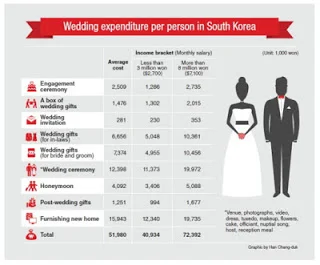
Along with the power duels, the “show-off” mentality that some Korean parents have adds onto the pile of stress for couples. Parents want to boast their wealth and power by holding lavish weddings. Data shows that “the average cost for a wedding in 2011 rose about 270 percent from 1999.” The average cost of weddings is $90,000. The hefty fee poses no problem for rich people who can manage to do that. However, the problem lies within the normal people whose average income is roughly $42,400 according to government data.
Ewha Woman’s University Professor Harris Kim in his explanation of why Koreans financially strain themselves over weddings blame the Korea’s social stigma surrounding weddings. “Korean society is very tightly knit, and people here are very concerned about how others view them. The wedding works as a status symbol, like a marker of where you stand in the society.”
The mentality is quite hard to understand. Ignoring the cost of a lavish wedding does not seem “forward-looking.” The youth unemployment rate is increasing each year, reaching a high time of 10% in 2015. Housing prices are also skyrocketing. The rent in Seoul, the capital of South Korea is growing and growing. Yet, some people contemplate about buying Rolex watches and Benz cars.
Kisun Lee, a 29-year-old consultant at Impact Consulting, sums the situation up perfectly. “None of that expensive jewelry is actually useful or beautiful, and you know you’ll just regret using the money for that after you’re actually married and need money for your married life.”
Fortunately, there is a budding trend among young couples who overpower their parents and spend frugally on weddings, who decide no gifts shall be exchanged. The government has also begun to help by turning its public buildings, town halls and service centers into inexpensive wedding venues during the weekends.
Mark Manson: To Answer “What Do I Want?” Answer "What Am I Willing to Suffer For?" →
Jesus wanted to save the world.
Tibor Scitovsky: Mankind is Desperately Anxious to Have an Index of Welfare
“National account statisticians have long been aware, of course, of some of these problems and have warned against the use of national product or income estimates as an index of welfare. But since mankind is desperately anxious to have an index of welfare, such warnings have always fallen on deaf ears.”
– Tibor Scitovsky, “The Place of Economics Welfare in Human Welfare,” May 17, 1973 David Kinley lecture at the University of Illinois at Urbana-Champaign. (Available as chapter 2 in Human Desires and Economic Satisfaction.)
Kfir Eliaz and Ran Spiegler: Incentive Compatible Advertising on a Social Network
My colleague here at the University of Michigan Kfir Eliaz and his coauthor Ran Spiegler have made the first ever theatrical trailer for a technical economics paper. He gave me permission to share this email with you:
Hi Miles,
I have a new paper with a colleague in tel-aviv (Ran Spiegler) called “incentive compatible advertising on a social network”. Though the paper is on a topic which is not related to your interests, we made a cinematic trailer for it (to the best of our knowledge, the FIRST EVER cinematic trailer for an academic paper), which you may still enjoy (full screen view and high volume is recommended). The trailer is posted here.
The actual paper is posted here.
Best, Kfir
William Wagner III: Scientific Cheating

Link to William Wagner III’s Linked In homepage
I am pleased to host another student guest post, this time by William Wagner III. This is the 5th student guest post this semester. You can see all the student guest posts from my “Monetary and Financial Theory” class at this link.
The importance that academics has placed on getting material published has led to bad science and even worse statistics.
The world of professional academics is a world unlike any other. With a laid back environment as well as a varying work schedule, the academic culture is very different than that of the typical corporate culture. Recently, there has been an aspect of the culture that has troubled many people. In 2014 on Inside Higher ED, Colleen Flaherty wrote a piece entitled Evaluating Evaluations where she discussed a study that displays the changing importance of different roles played by academics. She reports, “The study, out in the ‘American Association of University Professors’ journal Academe, also suggests that collegiality as a criterion for tenure and promotion is on the decline, and that value increasingly is being placed on research and publication – even for professors at teaching-oriented liberal arts institutions.” This usually comes as no surprise to most academics. They know that publishing is the most important part of their job. The term 'Publish or Perish" has become a colloquial term on campus due to this emphasis. This added pressure has put academics in a tough position, and has had troubling consequences.
When an academic is faced with either publishing or perishing they are left with few options. The first, and hopefully least utilized, is fraud. Make up a study, create fake data, and publish fake results. Most people agree that this type of academic fraud is not very common due to the strict penalties that have been put in place for people if found guilty. So what are the other options? NPR’s Planet Money explores what many academics are doing on Episode 677: The Experiment Experiment. They claim that–across a broad range of scientific fields–the push for publication has led many academics to cut corners and publish bad scientific findings. In particular, teasing data into being significant enough to publish. A simple, yet very helpful example they give on the podcast is studying flipping a coin. This coin is totally ordinary, with a 50-50 chance to land on either side, but–for argument’s sake–pretend we are ignorant of that fact. We start out by flipping the coin 10 times and 7 times it comes up heads. These results seem to indicate that there is a bias towards heads, but there isn’t enough proof to make a statistically significant finding. At this point the academic has a choice to either abandon the experiment and have nothing to show, or maybe continue on and see what else can happen. Maybe after flipping four more times–all of which happen to come up heads, boom, there is a “significant” result! Now the not-so-scientific scientific investigator has enough evidence to make a conclusion about coin flipping–a conclusion that in reality is false.
These kinds of practices have corrupted science, and lead to many false findings. These finding then go on to have real world implications, with potentially dangerous impacts on society. Brain Nosak, for example, pioneered the “Replication Project,” where replication of past successful psychology experiments was done to test their validity by testing their ability to be replicated. Following the original procedures in each case, they replicated 100 experiments. Out of those 100 they were only able to replicate the original findings 36 times. Similar problems exist in economics as well.
What can be done? There are at least three schools of thought. The first is to force researchers to register each study in advance, reporting on their intended methods of data collection and analysis. This forces them to stick to their original procedure, and not keep altering it until a “significant” result is found. the data. The second idea is to have institutions place less emphasis on publication and place a higher importance on other things such as student evaluations (which have their own problems). The third is to increase the professional rewards for trying to replicate other scientist’s results so the genuine results are more often sorted out from the spurious results. What is clear is that something needs to be done.
Update: In a comment on Miles’s Facebook post for this, Arthur Lewbel writes “A much simpler way to address much of the problem: use 4 sigma instead of 2 sigma as the standard of significance.” I (Miles) think that suggestion has a lot of merit to it. In any case, people should have to be much more apologetic about having a p-value (probability of a finding being the result of chance if there wasn’t any tinkering) as high as 5%, and only feel good about a result if the computed p-value is more like .1%, so that even if there was some tinkering there is a half-decent chance the result is genuine.