Mackenzie Wolfgram: The Key to the First Wave of Welfare Benefits from Animal Cloning is the Cloning of Studs

I am pleased to host another student guest post, this time by Mackenzie Wolfgram. This is the 26th student guest post this semester. You can see all the student guest posts from my “Monetary and Financial Theory” class at this link. This is Mackenzie’s 3d guest post. His first two were “Why the $15 Minimum Wage is Bad for the Poor” and “Capital Lease Accounting is Honest Accounting. Operating Lease Accounting is Not.”
Recently, Tianjin China announced plans to build the first large scale animal cloning facility, which is set to be up and running sometime in 2016. There has been sufficient controversy surrounding the subject, with some touting this as the 21st century advancement that will allow us to help feed the masses, while others claim that this is an example of people playing god, is unethical, and will have unintended consequences. One such consequence is that the reduced variety in the gene pool of farm animals could allow for less resilience to disease and lead to plague like illness ravaging our food, this could potentially more than offset any advantage of the cloning program. Regardless of opposition, the plans are going to proceed. While I don’t think that this operation will actually be able to “feed the masses” immediately, animal cloning has been a long time coming and will have benefits akin to those we see from genetically modified plants, which will included cheaper, higher quality meat.
In the short term, there is no feasible way that this cloning facility will be vastly superior at rapid beef production than any other factory farm. People hear cloning and they get visions of fully grown cows being 3d printed and slaughtered in a matter of minutes, orc style. Yet, these cows will still have to go through a normal cow life cycle, from infants to adulthood. The main difference between using a cloning facility and not is cost effectiveness. Currently, you have bulls with good genes selling on the market for upwards of one million dollars, just for the breeding prospects. Since they rear larger cows with better meat, less fat, etc. farmers are willing to pay large sums of money for them. Even though there is no guarantee that the offspring of these bulls will be genetically superior, farmers are still clamoring to pay around $3,500 per ejaculation of the semen of choice bulls. While this may seem to be a ridiculous price, it is a means of producing better cows and more meat, which in the end is a net gain for farmers.
This cloning facility does not mean that we will have unlimited cows immediately, thus the ability to feed the masses has been overstated; however we will see the cost of producing a “perfect cow” sharply fall, and the ability to do so rapidly increase. For instance, right now there are few bulls with choice characteristics as aforementioned. These few bulls have extraordinary qualities that merit the high prices paid for their sperm. At the new Chinese factory, after a few generations of gene alterations, perfect cows could be produced without the need for expensive bull semen. We will see genetic modifications allowing for faster cow growth, more milk production, better fat/meat ratios and other desirable qualities happen within only a few generations. Scientists could pick and choose these qualities and quickly mass produce them instead of waiting for genetic chance to suddenly make the lucky farmer who owns a “perfect bull” an overnight millionaire.
Critics who fear that we will become more susceptible to illness on a large scale have a very valid point, and we will have to find a way to circumvent this problem. As of now, there is no end all solution for the issue of decreased lack of diversity, however I imagine that the reward is worth the risk in this scenario. I think that overall, animal cloning and genetic modification will provide a net benefit to societies that partake in it. While we may not feed the masses overnight, “perfect cows” on a large scale could indeed drive up the quality and availability of beef while simultaneously cutting the price. Eventually, if we were able to produce cows that grew to be twice as big in half the time, we could see massive gains in our ability to provide meat to a growing populous. So while this operation is not without critics, or risk, it is a worthwhile advancement that is soon going to be necessary to support our populations increasing size and our growing appetite for meat.
QE May or May Not Work for Japan; Deep Negative Interest Rates Are the Surefire Way for Japan to Escape Secular Stagnation

In my view “secular stagnation” is simply a name for being stuck at the zero lower bound. Yimian Wu interviewed me in an article for MarketWatch about whether Japan was on the road to getting the higher inflation it wants in order to make the zero lower bound less binding. In the article she writes:
University of Michigan economics professor Miles Kimball, said Japan should keep stimulating its economy until it is overheated to a point that the inflation rate is higher than desired.
This deserves clarification. What I said is this: I think there is still a lot of slack in the Japanese economy, and I will only believe that the slack in the Japanese economy is exhausted when Japan gets more inflation than it wants. To find out exactly how much slack it has, it is worth it for Japan to risk higher-than-desired inflation.
When I walk around Tokyo, I see many workers doing low-productivity activities that no one would ever be paid to do in the US. So I think there is a lot of potential to increase output per work hour by having workers work more intensely or do higher productivity activities as demand picks up.
Hanging on to workers even if there isn’t much of any great importance to do is sometimes called “labor-hoarding.” The amount of labor-hoarding in Japan is reflected by its historically high percentage of extra output from each percentage point reduction in unemployment in Japan’s version of Okun’s law. And historically, Japan has been able to have quite low unemployment rates without accelerating inflation.
Yimian goes on to write about her phone interview with me:
However, he said Japan’s large-scale QE might have some side effects that can’t be predicted. “We knows a fair bit about what it (quantitative easing) does with a certain dosage, and then you triple that dosage and nobody knows.”
Instead of quantitative easing, Kimball advocated negative interest rates. In a phone interview, he explained that cutting interest rates, even below zero, would have a more direct effect in stimulating the economy than increasing long-term bond purchases.
In addition to the phone interview, Yimian emailed a set of questions, which I answered as follows:
Yimian: How would you comment on Japan’s Quantitative Easing from 2001-2006? It clearly did not help improve inflation but without the QE, would Japan’s economy then be worse? Did it increase economic activities?
Miles: The size of QE during that period was quite small. I wouldn’t have expected it to do much, and it didn’t do much.
Yimian: How would you comment the QE starting in 2013? When do you expect Japan would exit QE this time? When do you project Japan can hit the 2 percent inflation target?
Miles: Here is what I have written on recent QE in Japan:
- Is the Bank of Japan Succeeding in Its Goal of Raising Inflation?
- Japan Should Be Trying Out a Next Generation Monetary Policy
With a negative interest rate policy, as I would recommend, it is not necessary to hit a 2% inflation target. What matters is getting to full employment, which is quite achievable. Once Japan is at full employment so people can easily find jobs, the Japanese government should take measures to make layoffs easier so that people can be steered away from less productive toward more productive work.
Yimian: Do you think a large scale of QE is sustainable for Japan, considering its speed and scale of asset purchase? How would you compare the two QE programs, in terms of goal, scale and impact? Did the two QE spur company borrowing and consumer spending? Real wages and household savings seem to continue declining, how will QE work if consumers have less to spend and consumption tax is increased?
Miles: QE is a very risky way to go because it might not work. Also, no one knows the side effects of very large doses of QE. There is no real experience from other countries in the use of QE starting from such a low level of inflation. The surefire way to get the economy to full employment is to use negative interest rates.
… I have links to other things I have written and a video of an interview you should look at here:
Also, you should be aware that many of the shorter pieces I have written on negative interest rate policy have been translated into Japanese:
Ningxing Zhang: The Policy Mistakes that Led to Terrible Air Pollution in Beijing

Link to Ningxing Zhang’s Twitter homepage
I am pleased to host another student guest post, this time by Ningxing Zhang. This is the 25th student guest post this semester. You can see all the student guest posts from my “Monetary and Financial Theory” class at this link.
Recently, serious air pollution in Beijing forced people has to pay more attention on it. Hazardous smog engulfs Beijing in past several weeks and people had to wear protective face masks if they want to go outside; drivers had to reduce car speed because of poor visibility. It is no exaggerations to say that one cannot see any buildings which are locate more than 50 meters away. “Beijing air quality late Tuesday was 516, or “beyondindex,” according to a U.S. Embassy reading, with harmful particles known asPM2.5 reaching 20 times the amount the World Health Organization considershealthy.” Compare to that, PM2.5 in Ann Arbor was less than 30 today.
If you still can’t image how serious the air pollution was in Beijing, let’s see this interesting fact: an artist known as Brother Nut has vacuumed the dust in Beijing during past 87 days, and then has used the collection of dust to make a tangible brick! “Nearly everyone in Beijing would have a brick in their stomachs. Older people, maybe five,” “If all of the dust in Beijing was collected together, it would be enough to build the world’s biggest environmental protection bureau.” People in Beijing are forced to inhale a large amount of dust in their lung. The air pollution in Beijing had grown infuriatingly worse in recent years.
The government needs to take responsibility for the serious air pollution in Beijing. In around 2010, the government noticed that air pollution in Beijing was already beginning to deteriorate. But the policies meant to reduce air pollution made it worse. One of the most important actions is moving those factories or industries which can create air pollution out of Beijing area. However, almost all of those factories have been moved to Hebei Province which is the nearest province to Beijing. Shougang (capital steel industry) is one of the biggest steel plants in china. It was in Beijing area, has also been moved to Tangshan in Hebei in2009. It has stopped production altogether in Beijing by end of 2010 and fully moved to Heibei. Government wants to decrease emissions of air pollution by moving polluted factories and industries out of Beijing. However, the result is that pollution actually was not been controlled even a little bit. Air quality in Beijing has continuously deteriorated in last five years without any improvement.
The biggest reason is that Hebei is not far away from Beijing. Moving those polluted factories to Hebei didn’t really solve the problem. After 2010, air pollution problem became very serious in Hebei. If we check the list of most polluted cities in china, five cities of top 10 are from Heibei province. Also, Beijing’s air quality was not improved. Air pollution is not like other kinds of pollution, for example, water pollution, is relative steady and usually just within a certain area; it can quickly diffuse by blow of wind. Thus, air pollution in Hebei can easily move to Beijing and suddenly become hazardous smog. If we also consider about the very high population density in Beijing, which makes urban building’s density in Beijing are also very high, then things are even worse. Once air pollution reached Beijing area, those buildings will “lock” it which is hardly to blow away even with very heavy wind. That is why Beijing’s air pollution is not always that terrible, but on some days it becomes extreme.
The other contributing factor is the weakness of administration system. Like Shougang, a very large proportion of firms as well as factories which have been moved to Hebei are state-owned enterprises. Those firms are supervised directly by Chinese central government. Before moving, those firms in Beijing are strictly supervised by central government; under the pressure of the National Environment department, they have to carefully control their emissions. However, since they have moved to Hebei, the local government and local environment department are not authorized to supervise those state-owned enterprises, because they have same administration level. The result is that without strict restriction, those firms will increase production without consideration of air pollution. Although after that, central government has noticed the problem and has authorized local government to supervise those state-owned enterprises, the situation was not improved at all. Increasing production of state-owned enterprises will also lead to huge local economic development; of course local government were glad to see that and not really took actions to control air pollution. Compare to economic development, environment protection was usually not that important, especially for local government in china.
Both geographic problem and political weakness made government policies of control of Beijing’s air pollution have failed. Thus, government should carefully make new policies to stop air pollution by fully consideration about its feasibility. Wrong policies will lead to a sequence of serious problem in future.
Mayumi Matsushita: Social Networks and Terrorism

Link to Mayumi Matsushita’s Linked In profile
I am pleased to host another student guest post, this time by Mayumi Matsushita. This is the 24th student guest post this semester. You can see all the student guest posts from my “Monetary and Financial Theory” class at this link.
The recent Paris attacks made us shocked everyone on one time at 13 November 2015. Not only Parisians but also people who live in different countries could share their alarm on social networks. People might have noticed unusual notifications appeared on Facebook: friends name live in Paris was marked safe, which Facebook introduced last year inspired by an employee project built in the wake of the devastating tsunami that struck Japan in 2011. Other Social Networks like Twitter and Google showed their powers. On Twitter, Parisians used the hashtag #PorteOuverte—or open door in French—to offer shelter to stranded visitors. Google was making international calls to France from its Hangouts mobile communication app free through the weekend, so people could check on the status of friends and relatives. Actually, for me, using Twitter was the best way to gauge the real-time information about the attack. Changing the number of dead people made me connected directly with Parisians. So totally I found the power of Social Networks in the Paris attack. Moreover, after the attack, Social networks intended to protect us from terrorism by using their powers more aggressively. Facebook started to remove a profile page used by one of two people suspected of killing 14 people the previous day in San Bernardino, Calif. Facebook said it has hundreds of people on its community operations team, which vets content reported by users from four offices worldwide, according to the Wall Street Journal.
However, there is a limit to completely and fairly protect from terrorism and, for this reason, there is a fact that social network systems have supported indirectly to create the terrorism. The volume of information on Social Networks is huge and we might not judge all of the contents and remove the dangerous ones completely. If we strengthen the regulation for the contents directly, the possibility of making another kind of discrimination would increase and the merits of Social Networks like easily sharing information and connecting with people would disappear. This dilemma has indirectly supported the terrorism, unfortunately. Because of cost-free registration and free speech, there are a lot of supporters of ISIS on Twitter (see the graph below). This data shows how the terror group extends its presence across social media, which is both alarming and a sign of our digital era. ISIS uses Social networks as one strategy to recruit supporters globally. This is one of the reasons why they would upload sensational announcements and videos on the net. They would get big attention from potential supporters, using the social networks as the recruit or commercial advertisements.
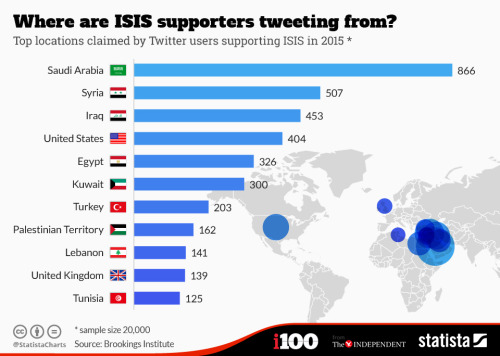
So we should understand the good and downside of social networks. It can protect us from terrorism but also promote it by connecting individuals and creating an information bias easily. It has a huge power to connect and gather people and information in a single direction from both good and bad aspects. To make well-balanced decisions, we should continue to try to control this power for the right direction as possible and keep in mind that we always face the risks to be agitated by information bias.
John Stuart Mill on Why a Free People, to Stay a Free People, Should Do Many Things Outside of Government

Jeff Guo, discussing in the Washington Post the announcement that Mark Zuckerberg and his wife Priscilla Chan were setting aside $45 billion to do good in the world through the Chan Zuckerberg Initiative, quoted this excerpt from a 2010 Der Spiegel interview with the German billionaire Peter Krämer:
Krämer: I find the US initiative highly problematic. You can write donations off in your taxes to a large degree in the USA. So the rich make a choice: Would I rather donate or pay taxes? The donors are taking the place of the state. That’s unacceptable.
SPIEGEL: But doesn’t the money that is donated serve the common good?
Krämer: It is all just a bad transfer of power from the state to billionaires. So it’s not the state that determines what is good for the people, but rather the rich want to decide. That’s a development that I find really bad. What legitimacy do these people have to decide where massive sums of money will flow?
SPIEGEL: It is their money at the end of the day.
Krämer: In this case, 40 superwealthy people want to decide what their money will be used for. That runs counter to the democratically legitimate state. In the end the billionaires are indulging in hobbies that might be in the common good, but are very personal.
I recoil at the statism in Peter Krämer’s views. The state has no monopoly on wisdom, and it seems unwise to give it a monopoly in providing public goods. It is also a danger to freedom in other matters to give the state a monopoly in providing public goods, as John Stuart Mill cogently explains in paragraph 21 of On Liberty “Chapter V: Applications”:
A very different spectacle is exhibited among a people accustomed to transact their own business. In France, a large part of the people having been engaged in military service, many of whom have held at least the rank of non-commissioned officers, there are in every popular insurrection several persons competent to take the lead, and improvise some tolerable plan of action. What the French are in military affairs, the Americans are in every kind of civil business; let them be left without a government, every body of Americans is able to improvise one, and to carry on that or any other public business with a sufficient amount of intelligence, order, and decision. This is what every free people ought to be: and a people capable of this is certain to be free; it will never let itself be enslaved by any man or body of men because these are able to seize and pull the reins of the central administration. No bureaucracy can hope to make such a people as this do or undergo anything that they do not like. But where everything is done through the bureaucracy, nothing to which the bureaucracy is really adverse can be done at all. The constitution of such countries is an organization of the experience and practical ability of the nation, into a disciplined body for the purpose of governing the rest; and the more perfect that organization is in itself, the more successful in drawing to itself and educating for itself the persons of greatest capacity from all ranks of the community, the more complete is the bondage of all, the members of the bureaucracy included. For the governors are as much the slaves of their organization and discipline, as the governed are of the governors. A Chinese mandarin is as much the tool and creature of a despotism as the humblest cultivator. An individual Jesuit is to the utmost degree of abasement the slave of his order, though the order itself exists for the collective power and importance of its members.
As you can see in my post four weeks ago, “How and Why to Expand the Nonprofit Sector as a Partial Alternative to Government: A Reader’s Guide,” I advocate going in exactly the opposite direction that Peter Krämer recommends. (And see this reply to the kinds of objections to philanthropy that Peter Krämer makes: William MacAskill: 5 Criticisms of Billionaire Mega-Philanthropy, Debunked.) It is good to have the government fill in the gaps among important things that–for one reason or another–are not popular objects of charity. But many important things can be done not only well, but better by nonprofits than by the government–and would be popular objects of donation for people required by the government to give to some worthy cause.
"18 Misconceptions about Eliminating the Zero Lower Bound" in Japanese: ゼロ金利下限を取り除くことについての18の誤解 →
The Powerpoint file I use for presentations at central banks has now been translated into Japanese! Above is the link to the translated blogpost introducing the file, and here is a direct link to the translated Powerpoint file:
Julian Smith: Why Tech Companies Don’t Want to Go Public

Link to Julian Smith’s LinkedIn profile
I am pleased to host another student guest post, this time by Julian Smith. This is the 23d student guest post this semester. You can see all the student guest posts from my “Monetary and Financial Theory” class at this link.
Following the text of what Julian wrote initially is a lightly edited version of my Q&A with him. Julian and I think you will find that discussion interesting.
The tech companies’ startup blueprint for years was to build their business through valuation rounds with venture capital firms before going public and generating profits for shareholders. At the start of the tech boom there were very few “unicorns,” privately held firms with valuations over a billion dollars. Now, the ground appears to be shifting. Tech firms are no longer chasing profits for a potential initial public offering. The firms seem to fear of entering the stock market by many tech firms that are not longer looking for IPO.
The fear of the stock market and lure of private buyers caused a huge spike in the number of unicorns in the tech industry. These companies have not had a lot of success going public according to the Economist article “The rise and fall of the unicorns.” The article lists Square and Etsy as examples of such failures, stating, “It has become clearer that the high valuations firms achieve in private are not always maintained when they go public.” The lack of broad market reception for these firms compared to their venture capital valuations has scared firms away from the stock market. The Economist authors argue, “Many investors in unicorns had bet that a new generation of technology firms would unsettle the old guard, but that has not happened as quickly as they had predicted. Tech giants like Amazon, Google and Facebook have continued to grow impressively, especially considering their already large size; and they have been adept at entering new markets that startups might otherwise have claimed.” Instead of disrupting the norm, the new tech startups have merely settled into the old tech landscape. While this certainly does not make them failures, it does change the investor outlook.
The slipping valuations and dominance of tech giants altered many tech firms’ goal from IPOs to now being bought by another firm. The success that Amazon, Google, and Facebook have enjoyed entering new markets means that successful and innovative tech firms have an abundance of buyers for mergers and acquisitions. In an article for the Wall Street Journal, Telis Demos and Corrie Driebusch describe the transition of tech firms’ objectives, “At least 18 companies have stopped pursuing filed U.S. IPOs this year because they were being acquired, according to a Wall Street Journal analysis of Dealogic figures. That amounts to about 10% of companies that filed for IPOs and either went public or sold themselves this year.” The authors of the article argue that the volatility in the stock market is causing tech companies to shy away from the public market and seek to be bought by these large companies to maintain their valuations.
The inability of new tech firms to displace the established giants has altered the goals of emerging firms. The tech giants have been successful at expanding and adapting to new technologies, eliminating market share for new firms. This means firms can capture more value by joining the larger firms that competing on their own, leading firms to want to be bought rather than going public.
Q&A
Miles: This is fascinating, but I still don’t understand why a tech firm would be more valuable to a private value than in an IPO. Are the private buyers overpaying, is the public irrationally pessimistic, or is the firm really worth more to a private buyer? What paragraph would you have written in answer to that question?
Julian: The private buyers see the tech firms as assets they are adding to their business strategy while investors are expecting firms to disrupt markets and succeed on their own instead. New tech companies have repeatedly failed to disrupt the former giants, so public investors do not see their value. The firms do not create high enough profits to return to shareholders. For the larger buyers, they see much more value in expanding their reach and creating more core competencies. Private buyers derive more value from the expansionary possibilities than public investors can derive from independent investment.
Miles: How does this create more profits than in a separate firm:
… they see much more value in expanding their reach and creating more core competencies …
Another possibility: are they buying these firms to rein them in so the new firms don’t disrupt?
Julian: I think that’s a valid reason for some companies, but I also think there is a valuation premium from being bought by a private company because they add more value to a firm that already has the infrastructure and knowledge than they do as an independent company. There are a lot of opportunities for synergy and increased efficiency across the evolving tech space for these large firms that simply cannot by captured by a startup with an IPO.
Miles: I see three factors mentioned in the two articles you linked besides the ones you mentioned. In "The rise and fall of the unicorns“ it suggests that some private valuations are sometimes made to look higher than they really are–for example because the investor is given not just a share of equity, but also a put. The Wall Street Journal article you link to, "Forget Going Public, U.S. Companies Want to Get Bought,” suggests that IPO prices have gotten riskier because of overall market volatility associated with uncertainty about what the Fed will do, and have gone down some because of an overall shift in financial investment toward passive funds.
The Wall Street Journal Gets It Right On Negative Interest Rate Policy, Thanks to Tommy Stubbington
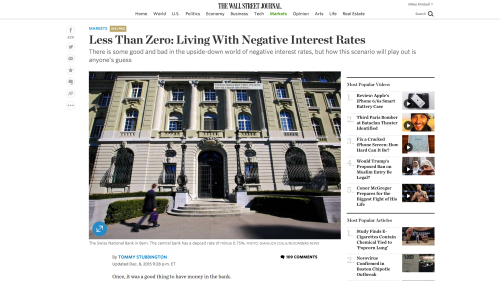
The Wall Street Journal has been slow to understand the potential of negative interest rate policy that I have laid out in various ways. But now, thanks to Tommy Stubbington–who interviewed me at length last Thursday–the Wall Street Journal has done an excellent front page treatment of negative interest rate policy. The whole article is great for giving the current context of negative interest rates in Europe, but below are the passages that most closely reflect Tommy’s interview of me. The first bit below has the same message as the title of my recently published paper “Negative Interest Rate Policy as Conventional Monetary Policy.” The rest should also be familiar to those who follow supplysideliberal.com:
Europe’s economic stagnation has proved so long and intractable that the region’s central banks are cutting interest rates to spur their economies. If it helps to move rates from 1% to 0.5% and 0.5% to 0%, why not try minus 0.5%? …
There is no hard limit on how low they can go. If commercial banks start widely imposing negative rates on retail customers, physical cash might look attractive. After all, it has a rate of 0%, although it isn’t without cost. One needs vaults and guards to store it, and it is no good for buying merchandise online.
Still, some economists said negative rates can be a powerful stimulative tool, if central banks can fully harness them.
Miles Kimball, an economist at the University of Michigan, has been preaching the gospel of deeply negative rates to central banks. When demand for money is low, as it is during a deep recession, Mr. Kimball argues, central banks should make borrowing as easy as necessary, even if that means paying banks to do it.
Mr. Kimball has a novel way around the physical-cash problem: make bank notes less valuable. He proposes that the Federal Reserve set an exchange rate between bills and electronic money. If it wanted, say, a minus 1% rate, it could decree that a $100 bill deposited in a year’s time would yield a $99 credit to a bank account. …
The interest in such schemes isn’t purely academic. With rates still at zero in much of the developed world years into the postcrisis recovery, central bankers may find themselves facing the next recession without much room to cut.
“It’s wrong to say central banks have run out of ammunition,” said Mr. Kimball. “Negative rates can be on tap before the next recession. There’s no limit to how deep we can go.”
Anand Jetha: Cutting the Cable Is Not All That

I am pleased to host another student guest post, this time by Anand Jetha. This is the 22d student guest post this semester. You can see all the student guest posts from my “Monetary and Financial Theory” class at this link. This is Anand’s 3d guest post. His first two were “Slow Progress in Battery Technology Will Hold Back Electric Cars” and “Diamonds are Not Your Best Friend.”
The number of streaming services and subscriptions like Netflix and Sling TV are on the rise. These services and the purchase of a Smart TV have been giving the false illusion that it is cheaper to cut cable services in favor of all streaming.
At one point in the last two years, it’s very likely you have talked to someone who “cut the cable.” They no longer get a contract TV subscription from AT&T, Comcast, or satellite providers like Dish. They say they don’t watch all the channels they get and consequently they don’t understand why they are paying so much for things they don’t use. There are a number of website out there telling you how to do it such as http://www.cutcabletoday.com. It may sound tempting when the “cable cutter” says they only pay $20/month plus taxes for Sling TV and let’s say a Netflix subscription for $9.99/month plus taxes. Sounds great! My question to the cable cutter is, however, how do you watch those services? Do they magically stream on your devices from some magical cloud? Well the obvious answer is no, and they rely on a steady internet connection. Internet still has to be paid monthly through one of those providers that people are trying to avoid.
The problem people face in urban areas is that the cable company that services their area (depending on if it’s a monopoly) generally provides the TV service and internet service in a bundle on 12 or 24-month contracts. These contracts can also be re-signed at the end of the term or a different provider can be selected on their 12 or 24-month contract. Comcast in Ann Arboroffers a 12-month contract with 75 Mbps and 150+ channels for $89.99/month plus taxes. So for someone to cut cable that means they are opting out of the bundle but still will need to keep the internet portion if they plan to stream TV or anything in their home. And if you plan to use multiple devices and a TV at the same time, higher speeds will be a necessary than with the bundle that has cable TV. I don’t see it being feasible for Mom to be checking e-mail, Dad to be watching Monday night football using Sling TV, and two kids watching movies on Netflix or streaming music/videos unless they have a strong internet connection over 50 Mbps. Those plans alone start at $59.99/month for the slowest internet speeds, and then add $20/month for Sling TV and $9.99/month for Netflix bringing the total to about $89.98/month. That’s exactly $0.01 cheaper than the original bundle. And if you’re anything like me, those two services alone will not be able to satisfy your need for also HBO and college sports. These will cost you extra from other streaming services. This does not include the cost of buying the equipment (Google Chromecast, Apple TV, Sling adaptor); I’ll just leave that out of the discussion for now as a fixed cost. Cutting the cable is not a horrible idea as long as cost of internet is reasonable. The more a household wants to say they can cutback because they can just “find it online,” they also need to be able to get “online.”
Vamika Bajaj—Chuck Grassley and Dick Durbin are Wrong: The US Needs More H1B Visas

Link to Vamika Bajaj’s Linked In homepage
I am pleased to host another student guest post, this time by Vamika Bajaj. This is the 21st student guest post this semester. You can see all the student guest posts from my “Monetary and Financial Theory” class at this link.
Tightening H1B visa regulations is economically inefficient. H1B visas do not pose a threat to American jobs, but rather, contributes to the growth of the American economy
There is a lot of discussion about tightening immigration regulations in order to make it harder for non-Americans to obtain H1B visas. The H1B visa is one of the most common visas under which foreigners continue to maintain a legal status while working in the United States. These visas are also known as skilled worker permits; most firms help sponsor their foreign employees to obtain an H1B visa.
Currently, H1B visas are granted by a computer-run lottery, where the probability of winning is only about 30%. Despite this, there has been recent discussion about tightening these regulations even further. For instance, two Senators, (Chuck Grassley and Dick Durbin) are campaigning heavily for making it harder to get H1B visas. Their main argument is that H1B visas are given to workers who are stealing jobs from Americans. They are proposing to make it mandatory for all firms offering H1B visas to first attempt to find Americans to fill those job openings before petitioning for H1B visas for their foreign staff. They also want to ban firms from hiring more people under the H1B visa if half of the company’s staff is already non-American.
But the assumption that H1B visas take jobs from Americans is not warranted. That foreigners are working in America does not necessarily imply that they are stealing jobs from Americans. Of course, I am not claiming that not a single American has ever been displaced by H1B workers. However, I argue that the majority of H1B workers are not displacing Americans, but rather that they are adding direct value to their firm and in turn, the American economy as a whole. In fact, according to the economists Giovanni Peri, Kevin Shih and Chad Sparber, “H-1B visa holders contributed between 10 and 25 percent of the aggregate productivity growth that took place in the United States from 1990 to 2010.” Obviously, economic growth in the economy is beneficial to immigrants and Americans alike.
Furthermore, to argue that Americans are being displaced from jobs by H1B workers would be to assume that a certain proportion of the currently unemployed Americans and the current holders of H1B visas represent close substitutes. But if that were the case, private firms would probably only be hiring Americans anyway. There would be no reason for them to deal with the paper work associated with providing employees with visas, if they could get equally good workers without doing so. It is obvious then, private firms have to see something valuable in a worker to sponsor an H1B visa.
For example, a very large proportion of IT services in the US are provided by Indians. This is because an important part of the Indian economy, education system and infrastructure cater toward developing a labor supply with strong IT skills. This is not to say that Americans would not be able to provide IT skills and services that are at par with those provided by India. However, this does mean that there is a much larger supply of labor that is highly skilled in the IT sector if Indians are added to the mix. Given this, it should come as no surprise that majority of H1B visas are held by Indians. In fact in 2014, 70% of H1B visas were allotted to Indians, the majority of whom worked in IT firms, including Google, Microsoft and IBM. It would y be economically inefficient to make it difficult for these workers to obtain visas, as they add value to the American economy and pay taxes to the American government.
Another common criticism is that companies hire workers with H1B visas not for their skill, but for the lower wages they are likely to accept. In that sense, they would simply be hiring foreigners because it is cheaper. However, there is certainly no merit to the simple version of this argument. Research conducted by the Brookings Institution revealed that 90% of H1B visa holders have a technical background in STEM related fields. (STEM: Science, Technology, Engineering, Mathematics.) The reason that those with STEM related knowledge hold most of these positions is that such specialized positions are harder to fill. This makes it even more likely that H1B workers are being hired for their skill and are not simply displacing Americans by accepting lower wages. Additionally, there is evidence to support that due to this technical knowledge, the average H1B worker with a STEM related bachelors degree actually makes more than an American counterpart who holds a bachelors degree in any field. So it is more a matter of much extra skill for some extra money than it is less money for the same skill. In any case, H1B visa holders are not reducing wages for those who are at the bottom of the heap, but competing with others who are quite well paid.
Economic efficiency and social welfare are maximized when demand is met with supply without artificial restrictions. A free labor market would correspond to minimal restrictions in the availability of H1B visas. It is in the interest of private firms to hire those employees whose skills they believe will best match the company’s needs. For this reason, it would be economically more efficient not to tighten rules associated with H1B visas.
Update: There is a lively set of comments on this post on Miles’s Facebook page, here.
Woo Chul Ro: Is a US University Education Worth It for Foreign Students?

Website of the Korean Student Association at the University of Michigan. Despite the troubles Woo Chul Ro is pointing out, the Korean students at the University of Michigan are smiling :)
I am pleased to host another student guest post, this time by Woo Chul Ro. This is the 20th student guest post this semester. You can see all the student guest posts from my “Monetary and Financial Theory” class at this link. This is Woo’s guest post. His first is “Woo Chul Ro: Affirmative Action by US Colleges is Troubling, But Still a Net Plus for Social Justice.”
International student enrollment of US colleges benefits the universities and the US economy, but it is causing an issue for the international students.
US colleges, including our own University of Michigan, pride themselves in enrolling international students and harboring an internationally diverse group of students on the campus. However, the number of international students is controversial because it may crowd out domestic students. But there is another problem with international students in US colleges–a problem for them. In terms of job prospects, they may not be getting their money’s worth. US students are complaining that they are being edged out by international students. But are even the international students being served well?
According to the Wall Street Journal article Foreign Enrollment at US Colleges Hits a Record, the international student enrollment in US colleges as a whole are constantly rising. As of today, 1 in 20 American college students are international students and around half of these international students are from China, India, and Korea. Since I am from South Korea myself, I would like to set the Korean students as an example. The Korean international students are ranked as the third among the number of international student enrollment by origin in the US colleges, according to the article. The combination of cultural significance of education and the belief by the general public that the US colleges teach world-leading education sends more than 60,000 students per year from South Korea to the US.
However, from what I have seen from this school, most international students end up eventually going back to their country after their education. Strict laws enforced by the US government make it much more expensive and complicated to hire international students over domestic students. This is causing an issue on international college students. In South Korea, many of these international students go back to their homeland and have trouble adjusting to the domestic job market. As a matter of fact, Samsung, the largest and the most dominant conglomerate in South Korea, explicitly announced that they will be hiring fewer students who graduated universities abroad due to their lack in efficiency. US education is biased towards how things work in the US, which means the US education may be of less value for international students compared to domestic students. This is not good at all for the foreign students. The domestic students being edged out may not get into the college of their choice, but most of them can get a job almost as well as if they had gone to a higher ranked school. But the international students often find it difficult to survive at the jobs in their home countries due to the unfitting education they received at a foreign university
I once heard a Korean mom interviewing on a Korean television “I would even sell my house to send my child to Harvard.” I think this is exactly what the US colleges are capitalizing on. The interdependent Asian cultures, like China and Korea (combined makes up almost 40% of US international students), think of US schools as a much higher level of education than the domestic education, which is why some Korean families are willing to spend more than 4 times the tuition of top domestic universities to send their kids abroad. However, their education in the US could be valued less than their domestic education. While the US colleges are taking high tuition from international students, this phenomenon could actually be hurting the international students.
Noah Smith: Sunni Islam is Failing

This is Noah’s 14th guest religion post on supplysideliberal.com. Don’t miss Noah’s other guest religion posts!
- God and SuperGod
- You Are Already in the Afterlife
- Go Ahead and Believe in God
- Mom in Hell
- Buddha Was Wrong About Desire
- Noah Smith: Judaism Needs to Get Off the Shtetl
- Why Do Americans Like Jews and Dislike Mormons?
- Render Unto Ceasar
- Original Sin
- Islam Needs To Separate Church and State
- Noah Smith—Jews: The Parting of the Ways
- Noah Smith: You With the Fro
- The Fight of the Ages: Pain and Death
Here is Noah:
In the wake of the terrorist attacks, a lot of predictable Muslim-bashing is coming out of the American right wing. This needs to stop. Muslims are just normal human beings, subject to the same incentives and pressures as the rest of us. The refugees pouring out of Syria are fleeing an unfortunate situation - the violent collapse of their society and the atrocities of the Islamic State. They deserve our help, not our scorn.
But the rise of ISIS, and the wars in Syria, Iraq, Libya, Yemen and Pakistan are the symptom of something big, bad, and important that is happening to the Islamic world. Basically, Sunni Islam is failing at its core mission.
That’s a dramatic, big claim to make. It’s based on a book I read. “Destiny Disrupted: A History of the World Through Islamic Eyes,” by Tamim Ansary makes the case that Sunni Islam is not quite like other religions.
In fact, the word “religion” is a catch-all term that we apply to a bunch of different social institutions, but Buddhism is not like Christianity, which is not like Judaism, etc. Ansary makes the case that Sunni Islam was conceived primarily not as a spiritual institution, but as a temporal one. Instead of establishing connections between humans and God, Sunni Islam was expressly about creating a just, peaceful society here on Earth.
The Arabian peninsula in the 600s was a place of perpetual tribal and city-state violence. Islam, according to Ansary, was conceived as a way to end the violence and unite the world under a peaceful umbrella. A religious judiciary would derive laws from Islam’s founding texts (the Quran and Hadith), which would then have divine authority. Using this divinely authorized jurisprudence, Islamic courts would then create a stable, orderly, peaceful and moral society. Meanwhile, temporal rulers would use military power to expand the zone of Islamic peace. In fact, early Islamic judges declared that the world was divided into the “House of Islam”, under which peace and justice would (ideally) reign, and the “House of War,” which was the rest of the world.
So Sunni Islam was more of a political force than a spiritual one - a replacement for traditional empires like Persia and Rome. For a while, the dream worked - the early caliphates were stable and prosperous, with conflict only at the borders, where conquest was ongoing. But as Islamic conquest bogged down and was halted in Europe, India, and Africa, war turned inward. The Umayyad dynasty was overthrown and the Abbasid dynasty replaced it, then soon fractured into competing emirates and alternative caliphates.
In later centuries, the dream of Islamic peace was again realized in a number of places. The Ottoman Empire, an unusually long-lived and stable regime, united vast swathes of the Middle East and North Africa. Even after its breakup, societies that embraced traditional Islam - most importantly, Saudi Arabia - had low rates of crime and violence while maintaining traditional values. As long as its armies prevailed in the field, Islam was still doing its “job”.
But something has changed. Throughout much of the Islamic world (with the notable exceptions of Bangladesh and Indonesia), violent conflict now prevails. Here, via Wikipedia, is a list of the world’s ongoing major conflicts:

All four of the world’s major wars are mostly Muslims fighting other Muslims. A large percentage of the smaller wars on Wikipedia’s list - about half, by my count - are also primarily Muslims fighting Muslims.
NOT Muslims fighting non-Muslims. Samuel Huntington, author of “The Clash of Civilizations,” declared that Islam has “bloody borders.” That was true in the 600s and 700s, but now it is not Islam’s borders that are bloody. A few conflicts - Kashmir, unrest in Malaysia, the Israel-Palestine conflict, or Islamist terrorism in the West - do feature non-Muslims fighting Muslims, but these are dwarfed in number and size by the wars in which Muslims are fighting and killing each other.
The same is true of Islamist terrorism. Despite operating globally, al Qaeda killed many times as many Muslims as non-Muslims. The same is currently true of Islamist terrorism in general.
In other words, the House of Islam is now the House of War, and it is the rest of the world where peace prevails. If Tamim Ansary is right about Sunni Islam’s core mission, then Sunni Islam is failing dramatically at that mission.
Why is this happening? Obviously, most Muslims - like most humans - are peaceful people who have absolutely no desire for violent conflict. And yet here is the reality that millions in the core Islamic countries of the Greater Middle East, through no fault of their own, are now being forced to live with what you see at the top of this post.
Nor is the culprit the precepts of Islam itself. The current wars in the Islamic world are NOT at all similar to the conquests of Islam’s early empire, which were directed outward.
One reason might be the Resource Curse. The vast oil wealth of the Arabian peninsula, channeled by Saudi moneymen to fundamentalist madrassas around the world, has stoked the growth of a radical Islam. But although countries like Russia and Iran also suffer from the Resource Curse, and have also engaged in some violence, they have not done with Orthodox Christianity and Shia Islam what Saudi Arabia has done with Sunni Islam.
A deeper reason may be modernity. Disruptive technologies overturn established power hierarchies. The information revolution and international migration tend to break down the barriers of closed societies. These changes have proven very stressful for most modern nation-states, and adjustment has often been difficult. But Sunni Islam, which is a much older political system than the modern nation-state, may simply be less flexible with respect to the disruptions of modernity.
Sex culture, transmitted through the internet and migration, places huge strains on traditional morality. The service industry and the global women’s liberation movement make traditional gender roles incredibly hard to maintain. Science challenges religious authorities, while modern capitalism requires a secular legal system that cannot easily derive its principles from the Quran or Hadith.
In other words, Sunni Islam as a system of law and governance may simply be badly adapted for dealing with the pressures of modern technology and economics. The breakdown of the social stability created by traditional Islamic jurisprudence may be behind the rise of increasingly extreme and radical violent extremist elements like al Qaeda and ISIS.
It’s very interesting to note that Shia Islam has not suffered nearly such severe and violent extremism. The Iranian Revolution produced a violent, revisionist regime, but despite abundant oil, Iran is now a stable nation-state whose proxy militias - Hezbollah, the Shia militias in Iraq, and the Houthis in Yemen - are not nearly as religiously extreme, and which have not (recently) attacked the West like al Qaeda and now ISIS have done. This may be luck, or it may be because Shia Islam relies less on the kind of distributed network of religious judges that forms the basis of the Sunni social system. In other words, because theological authority in Shia Islam is more centralized, the Ayatollahs at the center may be able to adapt Shia Islam better to changing circumstances than Sunni Islam has managed. Shia Islam also may have turned itself into something less like a substitute for the state, and more like a standard “religion” analogous to Christianity or Buddhism.
Anyway, whatever the reason, the upshot is that the victims of the Paris terror attacks were not victims of a “clash of civilizations” or an Islamic jihad against the West. They were collateral damage from the collapse of someone else’s civilization - the Sunni Islamic civilization of the Arabian peninsula, North Africa, and Pakistan.
So how should Sunni Islam respond? How should it adjust in order to make itself no longer the House of War? Personally, I think it should think about separating church and state, limiting the scope of religious jurisprudence, and ceding more authority to temporal rulers. In other words, it should become more of a spiritual and moral religion, and less of a social system.
Scott Aldworth: Credit Scores for Micro-Loans from Phone Use Patterns

Link to Scott Aldworth’s LinkedIn homepage
I am pleased to host another student guest post, this time by Scott Aldworth. This is the 19th student guest post this semester. You can see all the student guest posts from my “Monetary and Financial Theory” class at this link.
Silicon Valley startups are making the approval process and distribution of micro-loans easier to individuals in developing countries, and will help these emerging economies grow
Some Silicon Valley-back startups are revolutionizing how creditworthiness is determined in the developing world, looking at new metrics that are different from the traditional measures of credit. Traditional methods of measuring credit are an individuals three credit ratings determined by the three main credit rating bureaus: TransUnion, FICO, and Equifax. The new method, however, uses different data from phone usage.
A simple app that can take all sorts of data - everything from texts, emails, GPS coordinates, social-media posts, to retail receipts - hold correlations with creditworthiness. This new strategy reduces the cost of pulling up a credit score for an individual in a developed country. Even more obscure data, like how often an individual charges their phone or how many incoming texts they receive have patterns that can give signals about their creditworthiness.
The loans are small and are not given by traditional banks. The average loan is only about $30, but these small loans, also known as micro-loans, can give a taxi driver enough money for gas or a fruit stand owner enough money for fresh produce.
Kiva, an organization that lends out micro-loans in emerging economies, gives out loans similar to these at as little at $25. Their deposits also come from generous contributions from the organization’s chapters and individual donors which are then paid back once the loanee can pay back the loan. These micro-loans allow poor individuals in emerging economies to get the money they need to pay for expensive upfront costs of running their business without a credit score that is needed to get a loan from a bank.
Jong Beom Park: Brexit Is a Bad Idea for Both Economic and Security Reasons
I am pleased to host another student guest post, this time by Jong Beom Park. This is the 18th student guest post this semester. You can see all the student guest posts from my “Monetary and Financial Theory” class at this link. This is Jong Beom’s 2d guest post. His first is “The $28 Trillion Per Year Woman: Benefits of Full Participation of Women in the World Economy.”
Britain will make arguably one of the most substantial decisions in its long history before the end of 2017. As the Tories were re-elected in May 2015, the British Prime Minister David Cameron has declared to hold a referendum whether to remain in or leave the European Union (EU) by 2017, and that day is approaching fast. Cameron’s intention may be to renegotiate its terms with the EU and thereby convince the British public to favor the current state, he is facing a tough opposition domestically from Eurosceptics, led by a money-loaded lobbyist group. Their main argument is that Britain would be able to form new trade relationships outside the EU, while still being able to trade with EU nations, and form its own social and employment laws all without the membership of the EU. But, I would like to argue that the United Kingdom can benefit, both economically and politically, more by remaining in the EU.
From the start, Britain’s road to the EU was rocky. Instead of joining the European Coal and Steel Community (ECSC) when it was first founded in 1951, Britain formed its own trade union, the European Free-Trade Association, with six other smaller countries. Because they were more fortunate economically than other countries in Europe after WWII, Britain had no reason be in a customs union with other European powerhouses, such as Germany and France. Well, in my opinion, now they do. Although its initial intention may have been purely economic, Britain today also attains security benefits from the EU in midst of the migration crisis and recent terrorist attacks in Paris.
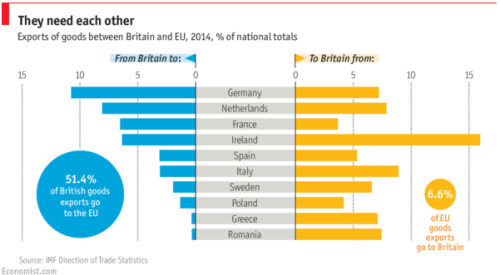
First, to fully understand Britain’s reliance on the EU for its overall exports, look at the figure at the top of this post. As shown in that the figure at the top, Britain exports more than half of its total exports to the EU. Although it would still be able to trade with EU countries without the EU membership, like Switzerland and Norway, Britain would trade 55% more as a member of the EU, according to John Springford of the Centre for European Reform. The EU would inevitably place more restrictions on Britain in trading with its EU members if Britain exits. Eurosceptics argue that Britain could better exploit additional trade opportunities with non-EU countries and use the required budget for its EU membership in the development of new industries. Nonetheless, in my opinion, the possibly of these new benefits without the membership of the EU does not outweigh benefits that Britain is already claiming.
Moreover, in addition to economic benefits, Britain is also enjoying security benefits, especially in the current state of Europe. Today, Europe is more or less in a security turmoil after a series of deadly terrorist attacks in Paris, France. As a nonmember, Britain would have had no role in discussing and collaborating on security measure. Domestic Eurosceptics claim that the EU has a limited influence on Britain’s security because “principle guarantor [of European security] for 70 years has been the North Atlantic Treaty Organization.” Even so, Europe as a whole is facing tougher challenges today than ever before. Following the terrorist attacks in Paris last week, EU, separately from NATO, promised a collective action by the member states, possibly strengthening the EU borders and retaliate against responsible terrorist organizations. In addition, more control over employment and social laws can be achieved without leaving the EU. For member states of the EU, most of their national regulations have been collapsed into one supranational regulation. However, as David Cameron demanded in his letter to the President of the European Council, Donald Tusk, Britain would still be able to fight for more of its own control without leaving the EU. If Britain could retain some control over EU regulations as the EU takes up on Cameron’s demand, it would be an ideal situation for Cameron and pro-EU campaigners at home.
Matthew Hoffman—Corporations Are Not Bluffing: They Are Moving Out

Link to Matthew Hoffman’s Linked In homepage
I am pleased to host another student guest post, this time by Matthew Hoffman. This is the 17th student guest post this semester. You can see all the student guest posts from my “Monetary and Financial Theory” class at this link.
I have written many posts this year regarding taxes, and how for many decades this topic has been hotly debated. Many of my posts have argued for decreasing taxes, as they generally hurt business, cause corporations to increase prices, reduce employment, etc. I understand that we do need taxes to pay for public goods, military products, social benefits, and many more government costs, but the magnitude of these goods and the tax dollars spent for them is a separate debate from which taxes are the least distortionary. Recently, the tax debate has turned towards corporations.
According to the articles Elizabeth Warren’s Tax Warning and Warren wants to hike taxes on big business to raise revenue Democratic Senator Elizabeth Warren has been a staunch opponent to other Democrats who desire to decrease the corporate tax rate. A decrease in the tax would make “the U.S. economy more competitive,” however Senator Warren is not convinced by the corporations’ strategy, in which they “tell a story about high U.S. taxes, demand tax cuts from the U.S. Congress, and threaten to leave the U.S. for good if they don’t get what they want.” In Warren’s opinion, this argument is just a bluff, in which the corporations are simply looking for a decrease in taxes. Instead, Warren argues for an increase in corporate taxes, in order to gain more revenue for the US government. However, as the authors argue, this is no bluff, as corporations have been leaving the US
Recently, in the Wall Street Journal, the article Pfizer and Allergan to Merge in $155 Billion Inversion Deal discusses the merger between two large pharmaceutical corporations: Pfizer and Allergan. This is an example of how I corporations are in fact moving their headquarters to other countries since taxes are too high in the United States. A useful comparison is to how companies so often move their headquarters to Delaware within the United State. Corporations move their headquarters to Delaware becuase corporate taxes are known to be low there. Similarly, corporations will continue by moving headquarters out of the country where corporate taxes are even lower.
The article discusses how the Allergan/Pfizer deal “brings together a diverse stable of drugs, from Pfizer’s cancer medicines and vaccines, to Allergan’s skin-care treatments and eye drugs.” Additionally, given the magnitude of the new company, it is unsure whether the company can be properly managed. It has been hypothesized that the new company will again be split, where the strengths of each new company will be delegated appropriately.
However, this deal supports my argument concerning corporate taxes and ultimately dismantles Senator Warren’s theory. As part of the deal, Pfizer will shift its tax base to Allergan’s home base in Ireland. Even though Pfizer is the larger of the two companies, Pfizer structured the deal so that Allergan would absorb Pfizer in order to pay fewer taxes. In the US, Pfizer was paying a rate of roughly 25%, but in Ireland they will pay about 17-18%. As a result of this move to a foreign country, American jobs will be lost since the headquarters of the company are no longer located in the US.
I don’t understand how Senator Warren can say corporations are bluffing in order to achieve lower taxes, when we see so many corporate inversions. Increasing corporate taxes is not the solution. There is good reason to think decreasing corporate taxes will result in more jobs, more corporations staying in the US, and more foreign investment in the US.
Cyrus Anderson: Making a Market Where None Exists, Google-Style

I am pleased to host another student guest post, this time by Cyrus Anderson. This is the 16th student guest post this semester. You can see all the student guest posts from my “Monetary and Financial Theory” class at this link. This is Cyrus’s 2d guest post. His first is “Hot Property in China.”
Google’s open sourcing move is laying the groundwork for products based on the company’s renowned infrastructure.
Google recently open sourced its TensorFlow library for artificial intelligence. But why? There are a fair number of open source projects already available for the various AI stuff one might want to do, as well as companies offering services and products in the area. One explanation is altruism and a bit of indirect benefit from the advancement of research. This is possible, but an explanation more fitting for a profit motivated company would be that the open sourcing move was made to build a market for future product releases.
The hardest ingredient to acquire in order to make a market is that of the participants. Google hopes to bring them together by setting standards with its open source platform. Open source will attract more people than offering TensorFlow as a product, in large part because it is free. Since Google is widely recognized, and for its software, it should have little trouble reaching critical mass. From there, the sheer amount of usage will propel it forwards. As with any open source project with sufficiently rigorous standards for contributions, more users means more possible contributors, as well as a larger community that can be leveraged for support on technical issues and whatnot. It also means more pairs of eyes that can uncover problems in the software and provide fixes. These together make a well-built piece of software that will form a standard.
Setting the standards is great, but what does this mean? Just as Google set the standards for search engines and as a result captures mountains of advertising revenues, it may be trying to do the same for AI. The prediction being made here is that widespread adoption of Google’s new open source software will, in the future, provide the company with a market that will more readily buy its AI-related products. This can come in the form of greater recognition leading to greater acceptance of those paid-for things, but even better than that would be greater uptake of new Google products that interfaced with the TensorFlow library due to its already widespread use.
This is not too hard to imagine- Google released its software, but it has retained many of the bits that make the code fast on hardware. As a Wired article attests, “To be sure, Google isn’t giving away all its secrets. […] it’s not sharing access to the remarkably advanced hardware infrastructure that drives this engine (that would certainly come with a price tag).” Access to the hardware could be offered as a service, such as specially built hardware for TensorFlow operations. This would help Google compete with Amazon’s AWS, as this special purpose could make it cheaper and more powerful for its use cases than the generic computing provided by the current services. As the large companies such as Amazon, Microsoft, and Google build ever more attractive packages for their cloud computing services, their offered computing power will become cheaper, under increasingly flexible terms (e.g. pay for actual computing done, rather than buying hours allotted on the machines). The next step may well be special purpose infrastructure that can cater better to more specific customer needs, in which case Google is poised to make a killing.