John Stuart Mill’s Vigorous Advocacy of Education Vouchers

John Stuart Mill was a strong proponent of mandatory education. But he was a vigorous opponent of trying to push students into public schools. The key to his opposition is the key to many people’s support of pushing students into public schools: having students attend public schools is a way to get greater conformity.   

What did John suggest? Vouchers, at least for the poor. Many people think of Milton Friedman as the originator of the idea of education vouchers. But the idea is clear in paragraph 13 of On Liberty “Chapter V: Applications.”

Were the duty of enforcing universal education once admitted, there would be an end to the difficulties about what the State should teach, and how it should teach, which now convert the subject into a mere battle-field for sects and parties, causing the time and labour which should have been spent in educating, to be wasted in quarrelling about education. If the government would make up its mind to require for every child a good education, it might save itself the trouble of providing one. It might leave to parents to obtain the education where and how they pleased, and content itself with helping to pay the school fees of the poorer classes of children, and defraying the entire school expenses of those who have no one else to pay for them. The objections which are urged with reason against State education, do not apply to the enforcement of education by the State, but to the State’s taking upon itself to direct that education: which is a totally different thing. That the whole or any large part of the education of the people should be in State hands, I go as far as any one in deprecating. All that has been said of the importance of individuality of character, and diversity in opinions and modes of conduct, involves, as of the same unspeakable importance, diversity of education. A general State education is a mere contrivance for moulding people to be exactly like one another: and as the mould in which it casts them is that which pleases the predominant power in the government, whether this be a monarch, a priesthood, an aristocracy, or the majority of the existing generation, in proportion as it is efficient and successful, it establishes a despotism over the mind, leading by natural tendency to one over the body. An education established and controlled by the State should only exist, if it exist at all, as one among many competing experiments, carried on for the purpose of example and stimulus, to keep the others up to a certain standard of excellence. Unless, indeed, when society in general is in so backward a state that it could not or would not provide for itself any proper institutions of education, unless the government undertook the task: then, indeed, the government may, as the less of two great evils, take upon itself the business of schools and universities, as it may that of joint stock companies, when private enterprise, in a shape fitted for undertaking great works of industry, does not exist in the country. But in general, if the country contains a sufficient number of persons qualified to provide education under government auspices, the same persons would be able and willing to give an equally good education on the voluntary principle, under the assurance of remuneration afforded by a law rendering education compulsory, combined with State aid to those unable to defray the expense.

It is a mistake to see this issue primarily in the US context. Education in the US will probably muddle through, and may improve dramatically either because of technological progress (see my column “The Coming Transformation of Education: Degrees Won’t Matter Anymore, Skills Will”) or in a smaller way, because a Supreme Court ruling weakens the deadening hand of teachers’ unions. What is much more important is for the developing world to shift toward voucher-supported private education rather than trying to fix a public education system in which teachers very frequently fail to show up for work. Effective and inexpensive private education alternatives are springing up in many developing countries that should be encouraged by loosened regulation first and foremost, and by a share of public expenditure on education if possible. 

The August 1, 2015 edition of the Economist has a fascinating article on this:

The $1-a-week school: Private schools are booming in poor countries. Governments should either help them or get out of their way

Here are some key passages:

Although Mathare has virtually no services like paved streets or sanitation, it has a sizeable and growing number of classrooms. Not because of the state—the slum’s half-million people have just four public schools—but because the private sector has moved in. Mathare boasts 120 private schools.

This pattern is repeated across Africa, the Middle East and South Asia. The failure of the state to provide children with a decent education is leading to a burgeoning of private places, which can cost as little as $1 a week (see article).

The parents who send their children to these schools in their millions welcome this. But governments, teachers’ unions and NGOs tend to take the view that private education should be discouraged or heavily regulated. That must change.

… when public schools exist, they often fail. In a survey of rural Indian schools, a quarter of teachers were absent. In Africa the World Bank found teacher-absenteeism rates of 15-25%. Pakistan recently discovered that it had over 8,000 non-existent state schools, 17% of the total. Sierra Leone spotted 6,000 “ghost” teachers, nearly a fifth the number on the state payroll.

… private schools are innovative. Since technology has great (though as yet mostly unrealised) potential in education, this could be important. Bridge gives teachers tablets linked to a central system that provides teaching materials and monitors their work. Such robo-teaching may not be ideal, but it is better than lessons without either materials or monitoring.

The Economist Endorses Nominal GDP Targeting and Notes that the Zero Lower Bound is a Policy Choice, Not a Law of Nature

Link to the Economist article

In a remarkable editorial, the Economist endorsed nominal GDP targeting. What is more, it is finally reporting on the zero lower bound accurately. Here are the key passages:

Endorsing NGDP Targeting as a Solution to Shifting Inflation Determination Relationships:

That is because the usual relationship between inflation and unemployment appears to have broken down. In the short run, economists think these two variables ought to move in opposite directions. High joblessness should weigh on prices; low unemployment ought to push inflation up, by raising wages.

Unfortunately, in many rich countries this standard inflation thermostat is on the blink. In 2008 economic growth collapsed and unemployment soared, but inflation only gradually sank below target. Now, by contrast, unemployment has fallen to remarkably low levels, but inflation remains anaemic. This has wrong-footed central banks.

… it makes sense to look beyond inflation—and to consider targeting nominal GDP (NGDP) instead.

… an NGDP target would free central banks from the confusion caused by the broken inflation gauge. To set policy today central banks must work out how they think inflation will respond to falling unemployment, and markets must guess at their thinking. An NGDP target would not require the distinction between forecasts for growth (and hence employment) and forecasts for inflation.

Mentioning the Zero Lower Bound in a Way that Indicates It Is a Policy Choice, Not a Law of Nature:

Interest rates cannot be cut far below zero without radical changes in the nature of money (the Bank of England’s chief economist recently suggested eliminating cash).

Harris Schlesinger

Link to Harris Schlesinger’s University of Alabama homepage

I am sad at the passing of Harris Schlesinger, a leading light in the economics of risk that I have done some work in. Here are passages from two emails I received about his life, work and untimely death:

With great sadness the board of EGRIE [European Group of Risk and Insurance Economists] learned of the death of Harris Schlesinger on September 29 after a long illness.  His intellectual contributions to the field of risk and insurance economics were substantial.  A friend of many; his dedication, enthusiasm, humor and kindness will be greatly missed.  His loss will be deeply felt, particularly at our annual meeting that he enjoyed so much.

– Mark Browne, Christophe Courbage, Alexander Mürmann, Andreas Richter, Hato Schmeiser, and Nicolas Treich

We have just heard that Harris Schlesinger passed away this week. He was only 63, and had visited CESifo as a guest scholar as recently as last November. To say that the news was a shock is a huge understatement.

Harris was a Professor of Economics and Finance at the University of Alabama, as well as the holder of the Frank Park Samford Chair of Insurance. He was also an Adjunct Professor of Finance at the University of Konstanz, a Research Fellow at the Center of Finance and Econometrics, and a CESifo Research Network Fellow. He had affiliations as a Research Associate with the Munich Risk & Insurance Center and with the Institute for Insurance Economics at the University of St. Gallen.

With a BA and MA from SUNY College at Potsdam, New York, and an MS and PhD from the University of Illinois, he was past president of both the American Risk and Insurance Association and the European Group of Risk and Insurance Economists. He was the founding editor of the Geneva Papers in Risk and Insurance Theory and an associate editor for five academic journals. He published articles in more than two dozen journals, including the American Economic Review,Journal of Finance, Econometrica, Quarterly Journal of Economics and Journal of Political Economy.

But that was only the professional side. As a person he was endowed with a terrific sense of humour, generosity and a warm personality that will be sorely missed.

– Hans-Werner Sinn

Mackenzie Wolfgram: Why the $15 Minimum Wage is Bad for the Poor


New York Governor Andrew Cuomo has already issued official recommendation for all fast food chains in New York City to raise the minimum wage for employees to $15 per hour, and he doesn’t intend to stop there. On Thursday the Democrat unveiled plans to hike the statewide minimum wage for all workers to a hefty $15 per hour. On the surface, these wage hikes seem like a benevolent plan. One that is only fair to the people who work low paying jobs only to live in relative poverty; after all, paying poor people more money should lead them out of poverty. Again, that is on the surface. In reality, this wage hike is one of the worst things that legislators can do to these lower class workers. Raising the minimum wage this drastically will have huge negative effects on employment, the profitability of thousands of businesses, and the condition of the lower class.

The arguments against this movement are laid out fantastically in Tim Worstall’s, “Yes, New York’s $15 Fast Food Minimum Wage Will Be A Failure–Why Do You Ask?” In this article, Worstall effectively dismisses any good that the $15 minimum wage is rumored to do.  Cuomo claims that his plan will benefit the people of New York in the following ways:

  1. Ending government welfare as a means of subsidies to employees of large corporations
  2. Saving taxpayer money at the sole expense of multimillion dollar corporations
  3. Having minimal effects on employment

Effectually, these benefits are meant to raise low wage workers out of poverty. Unfortunately, not one of them is fundamentally sound.

Governor Cuomo attacked fast food corporations, namely Burger King and McDonald’s, for paying such low wages that their employees were required to live with the aid of state funded subsidies, costing the state millions of dollars annually. However, as Worstall points out, welfare is by no means a subsidy program. This can be clearly proven.

A subsidy to the workers of a fast food franchise would lead to the employer paying lower wages. Since part of the reserve wage would be met by the government subsidy, the employer would only have to make up the difference between the subsidy and reserve wage. So, a true subsidy would cause businesses to pay lower wages, since the government would step in and pay a portion of their workers salaries.

With exception made for the Earned Income Tax Credit (EITC), which is pretty clearly effectively a subsidy (and which I will ignore due to its making up only a small percentage of welfare) most forms of government welfare offered today do not allow companies to pay lower wages, and therefore cannot be considered subsidies. In fact, welfare is cause for a higher reserve wage. When a person is unemployed with no welfare, they are willing to work for a lower wage. So without welfare, companies can attract people to jobs that offer lower wages. When a person is unemployed, but has welfare, it will take a higher wage to get them to accept a position. This is because welfare will theoretically give them a bargaining point, and a means of holding out for higher paying positions to come along, as they no longer need the money as desperately as they did when there was no welfare. Since welfare does not lower wages, it cannot be considered a subsidy.

Although Cuomo’s point about subsidies was not exactly correct, I find it immoral to take the stand that we should force people to take the lowest paying jobs for fear of homelessness and starvation. In addition to immorality, the subsidy argument is mainly a semantic one. Yes, Cuomo is wrong to claim that he is subsidizing fast food workers, but the fact remains that these workers are not making a living wage, and require welfare to live. Semantics aside, there is still a problem. However, I maintain that this wage hike is only going to hurt both the employees and employers.

Cuomo’s next point was that this higher wage will save millions of dollars of taxpayer money at the sole expense of big businesses. For the sake of argument, we will give Cuomo an advantage, put on rose colored glasses, and say that companies will not lay off a single employee as a result of this wage hike. (Unlikely, and these newly laid off employees will require even more welfare than they already require.) However, even with these unrealistic expectations, Cuomo is still wrong to claim that he is only hurting McDonald’s and Burger King type businesses. Just because a store says McDonald’s on the outside does not mean that the McDonald’s corporation owns it. In fact, the vast majority of these businesses are owned by franchisees. This wage hike would double the cost of labor for these franchisees and cause many to go out of business, since they cannot afford to staff their restaurants. This plan only attacks these small franchisees. In a way Cuomo is right, he will be hurting these big brands, but indirectly, and only by shutting down their franchised locations, ending the livelihood of hundreds of franchisees, and causing mass layoffs of low wage employees. Again, this is not good for the people his plan “helps.”

Cuomo’s last point is that, empirically, wage increases have not caused widespread changes in employment levels, so this one shouldn’t either. He is wrong. This wage hike is magnitudes bigger than any that we’ve ever seen. The new price floor on labor will be binding for many work positions, unlike prior wage bumps where only a small percentage of workers were forced below the new minimum wage. In this case, a huge percentage of workers would have to be given substantial raises, many nearly doubling their salaries. Businesses cannot afford this hit. We will see vast layoffs, as well as robotics and new computer tech taking over low skilled, formerly manned jobs. Currently, these low skill low pay laborers have jobs, once they become low skill high pay laborers, they will no longer be employable. Again, this plan hurts everybody.

Tony Yates’s Worries about Breaking Through the Zero Lower Bound Are Unfounded for a System Built around Electronic Money that Keeps Paper Currency in a Subsidiary Role

Tony Yates’s Twitter homepage

I wanted to reply to Tony Yates’s post “Haldane on coping with the zero lower bound.” Tony was reacting to this passage from Bank of England Chief Economist Andrew Haldane’s recent speech, discussing the basic options for eliminating the zero lower bound that Willem Buiter detailed in the first decade of this millenium:

Over a century ago, Silvio Gesell proposed levying a stamp tax on currency to generate a negative interest rate (Gesell (1916)).  Keynes discussed this scheme, approvingly, in the General Theory.  More recently, a number of modern-day variants of the stamp tax on currency have been proposed – for example, by randomly invalidating banknotes by serial number (Mankiw (2009), Goodfriend (2000)).

A more radical proposal still would be to remove the ZLB constraint entirely by abolishing paper currency.  This, too, has recently had its supporters (for example, Rogoff (2014)).  As well as solving the ZLB problem, it has the added advantage of taxing illicit activities undertaken using paper currency, such as drug-dealing, at source.

A third option is to set an explicit exchange rate between paper currency and electronic (or bank) money.  Having paper currency steadily depreciate relative to digital money effectively generates a negative interest rate on currency, provided electronic money is accepted by the public as the unit of account rather than currency.  This again is an old idea (Eisler (1932)), recently revitalised and updated (for example, Kimball (2015)).

Tony responds:

Andy points out that inflation is costly, and so an extra 2 percentage points of it is proportionately more costly.  Yet it seems to me that allowing negative interest rates on digital cash increases the cost of 2 per cent inflation somewhat.  Formerly, consumers get zero interest on their notes and coins holdings, while they depreciate at an average of 2 per cent a year.  With occasionally negative rates, these ‘shoe-leather costs’ of inflation increase a bit, proportional to the time spent below zero, and just how negative they go.  A reminder:  during the dark days of the previous crisis it was commonly thought that rates would ideally have gone down to about negative 7% or 8%.

Second, I query the judgement that eliminating cash and using negative rates would be less damaging to the credibility of monetary institutions than bumping up the inflation target.  Ultimately, in the absence of good models of how reputations are won and lost, this argument is really about trading hunches.  But mine is that there is a risk of a serious WTF moment when the no-cash system is explained, or people find out that they actually have to pay large sums of money simply for the privilege of having it.  Anecdotally, we know from many models of money that equilibria where money is valued are quite fragile – specifically, it’s quite easy to write down models in which it is not.

I am not going to defend Silvio Gesell’s direct taxation of paper currency or the total abolition of paper currency. But I will defend my own recommendation, which builds on Robert Eisler’s idea of having an exchange rate between paper currency and bank money (which in modern times can be called “electronic money” since it is encoded in the memory banks of computers). 

Tony has two worries. The first is a worry about “shoe-leather costs”–people being overly discouraged from using paper currency. But shoe-leather costs are all about the spread between the paper currency interest rate and other safe interest rates. My recommendation to central banks is to keep the paper currency interest within 50 basis points of the target rate at all times, except when that would push a paper dollar toward being worth more than an electronic dollar. Consider in particular the baseline case of a paper currency equal to the target rate whenever that doesn’t take paper currency above par. Then there are no shoe-leather costs when paper currency is away from par. 

If a central bank follows this recommendation, paper currency is at par only during periods of time when the target rate is positive, and things are very much as under the current system when the target rate is positive. One might lament the shoe-leather costs during those periods, but it is a lament one could equally have in the current system. And over time, as central banks gain confidence that the zero lower bound is no more, they are likely to lower the target inflation rate, bringing shoe-leather costs during those periods at par down as well. 

Tony’s second worry is that confidence will be shaken by the dramatic change in the system. He is certainly right that the formal models give little guidance on this point because under any fiat money system, the formal models allow the value of money to suddenly drop to zero at any time for no real reason. So any answer must be based solidly on intuitions about the real world rather than on a formal calculation. 

Part of my reply to Tony’s second worry is to note that a straightforward arbitrage argument ensures that how the central bank treats paper currency at the cash window determines the value of paper currency relative to electronic money. (See An Underappreciated Power of a Central Bank: Determining the Relative Prices between the Various Forms of Money Under Its Jurisdiction.) So the danger at issue has to be something about all the forms of money controlled by the central bank put together. 

But the main point I want to make is that the approach I recommend changes everything very gradually. At the moment of introducing the new system, paper currency starts at par, just as it is under the current system. Even at a quite low nominal interest rate of -4% per year, the value of paper currency relative to electronic money would only be changing by about 1.1 basis points per day. For example the exchange rate would go from 1000 electronic dollars per 1000 paper dollars on day zero to 999.89 electronic dollars per 1000 paper dollars the next day–an 11 cent paper currency deposit fee on $1000. The paper currency deposit fee on $1000 would escalate by roughly 11 cents each day, to 22 cents, then 33 cents, etc., until compounding kicked in a little more to make the absolute amount of the addition to the fee each day a little less. (Note that to fully establish the exchange rate, the paper currency deposit fee is levied on net deposits, meaning that on the day a deposit by a private bank at the Fed’s cash window of p$1000 would become e$999.89 in the bank’s reserve account, a withdrawal of p$1000 would only result in a deduction of e$999.89 from the bank’s reserve account. Or if the bank wanted to withdraw e$1000, it would receive something close to p$1000.11.)

Of course, 1.1 basis points per day adds up over time, so this is a big deal. My point is not to minimize the importance of what is being done with the exchange rate between paper currency and electronic money, but to say that the exchange rate is moving very gradually each day. There is plenty of time for people to get used to the new system. And the continuity from one day to the next means that for private agents, behaving more or less as they did yesterday is a viable option until they figure things out. By the time they figure things out, the system already has a track record of day after day looking stable. 

All of the above is to argue that getting paper currency out of the way of negative interest rates will not cause any drastic change in behavior. The electronic negative interest rates themselves can and should cause a significant change in behavior–after all, the point is to stimulate the economy, as was needed in 2009 in the US, and as is needed now in the eurozone and in Japan. But I suspect that central banks will be fairly gradual in going to deeper negative rates as well. If the Swiss National Bank goes to deeper negative rates, for example, I will be surprised if the next step down from -.75% per year is to any lower than -1.25%. (And it is even more unlikely that the next step down would be to lower than -1.5%.) 

Gradualism in going to deeper negative rates, (associated with gradualism in lower the paper currency interest rate to get paper currency out of the way) has costs in the slowness of the extra stimulus, but it tends to allay the kinds of worries that Tony is expressing. If the first step down in the paper currency interest rate is to -.5%, at that rate, after a full quarter, the paper currency deposit fee would only by 1/8 %, meaning that the exchange rate was .99875 electronic dollars per paper dollar after three months. That is nowhere near as disruptive as many other things central banks have done in the past, such as the sudden change in the exchange rate for the Swiss Franc back in January, 2015 (which I wrote of in my column “Swiss Pioneers! The Swiss as the Vanguard for Negative Interest Rates.”)

Patrick Goodney: The Fed Should Raise Its Target Rate Before the End of 2015

Patrick Goodne

Patrick Goodne

I am delighted to be able to start another season of student guest posts with this guest post by Patrick Goodney. The students in my “Monetary and Financial Theory” class are required to do 3 blog posts each weak during the semester. From among the best of these I choose some to be guest posts here. (You can see the class assignment and resource blog here, and links to student guest posts from previous semesters here.)  Patrick’s post below is the first student guest post this semester. 

I have a different take on the current monetary policy situation than Patrick, as you can see from my post “Larry Summers: The Fed Looks Set to Make a Dangerous Mistake by Raising Rates this Year,” but I thought Patrick made the case for raising the Fed’s target fed funds rate sooner rather than later as well as anyone else I have seen. This guest post is a good starting point for the debate. Here is Patrick:


Increasing the federal funds rate before the end of the year would increase the Fed’s credibility and would remove some of the harmful speculation on their plans for the future. It would also be a good start to believing we’re finally out of the shadows of the Great Recession.

In June, the Fed projected to “raise the short-term federal-funds rate from near zero now to 1.625% by the end of 2016 and to 2.875% by the end of 2017,” according to The Wall Street Journal. Many were expecting the Fed to take the first step in hiking rates during their mid-September meeting. However, the near-zero rate persisted. The seemingly apprehensive Fed has many wondering: if the Fed is planning on gradually increasing interest rates, when exactly are they going to actually start?

The common thread through recent media reports on the Fed is a lack of confidence in their ability and willingness to effect change. There is some extreme pessimism about the odds of an increase in the federal funds rate this year. Futures market traders put the probability of a federal funds rate increase before the end of the year at just 35%, according to Jon Hilsenrath and Ben Leubsdorf of The Wall Street Journal. There is some extreme pessimism that an increase now would be good for the economy. Many say that the economy still needs the support of a near-zero interest rate. And there is even pessimism that the Fed isn’t actually able to change the federal funds rate at all.

Matt Phillips argues in Quartz that the Fed’s ability to impact the federal funds rate is uncertain, saying that “in the near decade since [the last time the Fed increased interest rates], pretty much every rule, technique, and guideline the Fed once relied on has been drastically rewritten, revamped, or removed.” Phillips says that the Fed would be working with an entirely new toolbox when it comes to increasing interest rates, and that any outcome resulting from using this toolbox is part of “the greatest monetary experiment in history.”

So there exists significant doubt about the Fed’s power in general, to say the least. The low federal funds rate has persisted so long many are taking it for granted. And the economy is continuing to perform very well—The Wall Street Journal reported yesterday that “The nation’s gross domestic product, the broadest measure of economic output, revved up to a 3.9% seasonally adjusted annual growth rate in the second quarter.” The continued success of the economy is some of the reason why the Fed is planning on increasing rates. The Fed’s policies come with a lag—“If it waits too long, [Federal Reserve Chairwoman] Yellen said, the Fed might end up having to raise rates abruptly to stop the economy from overheating,” write Hilsenrath and Leubsdorf. So surely some change in the interest rate will be inevitable.

One reason why this increase in the federal funds rate should happen sooner rather than later is because, frankly, the Fed needs to show some signs of life in order to gain some credibility and to also prevent speculative forces that lead to “inappropriate risk-taking that might undermine financial stability,” using some more words from Chairwoman Yellen.

The announcement of an increase before the end of the year would be a signal to consumers that we are finally okay again and is a first step to getting the Fed on the path they’re heading towards anyways. The Fed has been taking lashes that they’re unable to change anything, and by announcing that they’re at least going to try, before many are expecting them to, they’ll clear out a lot of the associated negative conceptions about the market. It would be a boon to consumer confidence if there are reports of the Fed believing we do not need the support of a low federal funds rate anymore (perhaps partially mitigating the contractionary effects of the rate hike). The Fed would get more respect as an entity—or maybe less disrespect—by surprising the market with a relatively dynamic decision on their end. And hopefully we would get bogged down by less thinkpieces about how the Fed can’t do anything at all anymore (although that would be unlikely).

So, Fed, silence the critics and let the media write about how America’s finally bounced back, because even if the Fed doesn’t fully believe that to be true, saying it will make it closer to a reality than living in between.

Leon Berkelmans: Time to Consider Negative Interest Rates to Boost Growth

I am grateful to Leon Berkelmans for securing permission from the Australian to mirror his article here, which appeared in the Australian on September 12, 2015.

Below, Leon mentions New Zealand as a monetary policy innovator that might adopt negative interest rates. On that, see also “Michael Reddell: The Zero Lower Bound and Miles Kimball’s Visit to New Zealand.”


The world waits, feverishly, for next week’s Federal Reserve meeting. The FOMC could increase interest rates for the first time in almost a decade. Martin Sandbu, of the Financial Times, called this decision “the single most important imminent economic policy decision in the world”. But there’s an even more important issue in plain sight. And we are not talking about it.

It’s the zero lower bound on interest rates. The Fed will be increasing interest rates from that bound, where rates have been stuck since the end of 2008. Other major economies are stuck at the zero lower bound too. Japan has been there for a couple of decades. The ECB hit the zero lower bound a few years after the Fed, but it’s there now, and unlikely to exit any time soon.

Some European central banks have been able to implement rates slightly below zero, showing that small negative returns will be tolerated, but there is a limit.

In any case, the zero lower bound has been costly. One analysis by Federal Reserve economists suggested that unemployment would have been 3 percentage points lower in 2012 had they been able to cut interest rates to negative 4 per cent.

One might adopt the position that the global financial crisis was a freak event. We haven’t seen such extremes in central bank interest rate policy before. Once economies exit the current situation, we are unlikely to see them again in the future. I think such a position is wrong.

In 2012, in their World Economic Outlook, the IMF documented the gradual but sustained and relentless decline in real long-term interest rates over the last three decades.

This decline in real long-term rates will translate to lower short-term nominal rates, on average, over the cycle. That means the zero lower bound is more likely to be hit. This is true, no matter where you are. Every economy is likely to face this new future.

There are several possible responses to these developments, among them: rely on unconventional monetary policy, raise the inflation target, pursue fiscal activist policy, implement institutional changes so that negative interest rates are possible, or change the monetary framework away from inflation targeting.

Unconventional monetary policy, namely quantitative easing and forward guidance, has probably had its successes. A different study by Federal Reserve economists has suggested that unconventional policies subtracted one and a quarter percentage points from the unemployment rate.

However, there is uncertainty about how unconventional policies work. For example, in 2012 Michael Woodford, the doyen of academic monetary economists, suggested that quantitative easing, in particular, did not have the effects typically ascribed to it.

Moreover, he claimed that unconventional policies often caused financial markets to become more pessimistic, an unsavoury side effect for a policy that’s supposed to be stimulatory. The debate and academic inquiry rages on, and more work will be needed before economists can claim to have mastered unconventional policy.

Raising the inflation target would help. Olivier Blanchard, outgoing chief economist at the IMF, and Janet Yellen, chair of the Federal Reserve, have openly mused about the possibility. But questions remain here too. How do you raise the target, and make the new target credible, given that the old target had been changed?

Activist fiscal policy could provide stimulus when interest rates are stuck at zero. Peter Tulip, of the Reserve Bank, last year pointed out how this would ameliorate the costs of the zero lower bound.

It’s again a possibility, but I think there are open questions about the alacrity of the political process. Could it always be relied upon to do enough?

Changes could be implemented to make significant negative interest rates feasible. Ken Rogoff, a former IMF chief economist, has discussed the possibility of abolishing physical currency, which would do the trick. Moving away from an inflation target, towards something like nominal GDP targeting, could also work. Michael Woodford offered this as an alternative in the same 2012 paper I mentioned earlier. However, there are some shortcomings, especially in a small open economy like Australia, where a volatile terms of trade can play havoc with nominal GDP growth.

I’m not sure any solution is perfect. However, central banks should plan ahead. It’s unlikely that the future will look like the pre-GFC past. Planning on that basis will lead to tears and leave a guilty central bank looking jealously at an innovator that took the issue head on — perhaps an innovator like, gasp, New Zealand.

Leon Berkelmans is director, international economy, at the Lowy Institute for International Policy.

Jeff Jordan, Anu Hariharan, Frank Chen and Preethi Kasireddy: 16 Startup Metrics

Marc Andreessen is the only billionaire I know to be following me on Twitter. This guest post on his blog “Software is Eating the World” (linked above) is useful for economists who want to get a little more sense of the real world of business. It is also helpful for people who want to enhance their “Shark Tank” viewing experience. (On “Shark Tank” also see my post “Shark Tank Markups.”) 

Bank of England Chief Economist Andrew Haldane Explains How to Break Through the Zero Lower Bound

Some of the reporting of Andrew Haldane’s September 18 speech “How low can you go?” skipped over key things he said. Here is the part of his speech where he explains how to break through the zero lower bound:

Negative interest rates on currency

That brings me to the third, and perhaps most radical and durable, option.  It is one which brings together issues of currency and monetary policy.  It involves finding a technological means either of levying a negative interest rate on currency, or of breaking the constraint physical currency imposes on setting such a rate (Buiter (2009)).

These options are not new.  Over a century ago, Silvio Gesell proposed levying a stamp tax on currency to generate a negative interest rate (Gesell (1916)).  Keynes discussed this scheme, approvingly, in the General Theory.  More recently, a number of modern-day variants of the stamp tax on currency have been proposed – for example, by randomly invalidating banknotes by serial number (Mankiw (2009), Goodfriend (2000)).

A more radical proposal still would be to remove the ZLB constraint entirely by abolishing paper currency.  This, too, has recently had its supporters (for example, Rogoff (2014)).  As well as solving the ZLB problem, it has the added advantage of taxing illicit activities undertaken using paper currency, such as drug-dealing, at source.

A third option is to set an explicit exchange rate between paper currency and electronic (or bank) money.  Having paper currency steadily depreciate relative to digital money effectively generates a negative interest rate on currency, provided electronic money is accepted by the public as the unit of account rather than currency.  This again is an old idea (Eisler (1932)), recently revitalised and updated (for example, Kimball (2015)).

All of these options could, in principle, solve the ZLB problem.  In practice, each of them faces a significant behavioural constraint.  Government-backed currency is a social convention, certainly as the unit of account and to lesser extent as a medium of exchange.  These social conventions are not easily shifted, whether by taxing, switching or abolishing them.  That is why, despite its seeming unattractiveness, currency demand has continued to rise faster than money GDP in a number of countries (Fish and Whymark (2015)).

One interesting solution, then, would be to maintain the principle of a government-backed currency, but have it issued in an electronic rather than paper form.  This would preserve the social convention of a state-issued unit of account and medium of exchange, albeit with currency now held in digital rather than physical wallets.  But it would allow negative interest rates to be levied on currency easily and speedily, so relaxing the ZLB constraint.

Would such a monetary technology be feasible?  In one sense, there is nothing new about digital, state-issued money.  Bank deposits at the central bank are precisely that.

Alex Rosenberg Interviews Miles Kimball for CNBC: Could Negative Interest Rates Be Next on the Fed’s Policy Menu?

Here is a link to Alex Rosenberg’s distillation of his interview with me about negative interest rate policy (if you ignore the video at the top and focus on the words beneath that). He did a great job of representing our wide-ranging conversation in a compact way. (In the interview, I did give other economists, especially Willem Buiter, more credit for working out the key ideas for eliminating the zero lower bound than Alex indicated; it is a standard journalistic trope to simplify the story of collective efforts to make it sound like the work of one individual.)

I found one error, or at least misleading bit, in the article. It says:

At the same time, the government would have to remove the requirement that businesses accept cash as legal tender.

This is a common misconception about legal tender. For the most part, “legal tender” laws only affect the treatment of debt. Except perhaps in a few states, shopkeepers are legally allowed to refuse payment in cash. (On many plane flights I have been on recently, they have announced that they would only accept payment by credit or debit card, for example.)

Here is the explanation from the US Treasury website about legal tender (found with the help of my brother Chris Kimball):

The pertinent portion of law that applies to your question is the Coinage Act of 1965, specifically Section 31 U.S.C. 5103, entitled “Legal tender,” which states: “United States coins and currency (including Federal reserve notes and circulating notes of Federal reserve banks and national banks) are legal tender for all debts, public charges, taxes, and dues.”

This statute means that all United States money as identified above are a valid and legal offer of payment for debts when tendered to a creditor. There is, however, no Federal statute mandating that a private business, a person or an organization must accept currency or coins as for payment for goods and/or services. Private businesses are free to develop their own policies on whether or not to accept cash unless there is a State law which says otherwise. For example, a bus line may prohibit payment of fares in pennies or dollar bills. In addition, movie theaters, convenience stores and gas stations may refuse to accept large denomination currency (usually notes above $20) as a matter of policy.

This means that adjusting “legal tender” itself, while desirable, is less crucial for the type of policy I am recommending. The legal tender issue for debts can be handled by putting appropriate clauses in debt contracts, if lawyers wake up. For payments to the government, legal tender is also an issue, but I think once people started showing up at the IRS with suitcases full of cash, the government would quickly fix that loophole.

Update: In response to my questioning of this passage, Alex corrected it to “At the same time, the government could not require that businesses accept cash as legal tender.”

Here I would say that it is important that businesses not be required to accept cash as legal tender for large-ticket durables and investment goods; it causes less trouble if the government requires businesses to accept cash for goods that people typically use cash for now (indeed, I have argued that businesses might in any case voluntarily continue to accept cash at par for a long time even in the absence of any government constraint), and below-par cash as legal tender for debts, while an undesirable side effect, does not create a zero lower bound, since one cannot get an unlimited supply of new debt contracts on the same terms as old debt contracts. 

John Stuart Mill: In the Parent-Child Relationship, It is the Children Who Have Rights, Not the Parents

Because the government so often makes mistakes, good parents aplenty have been afraid of “Child Protective Services” taking their children away for no good reason. But John Stuart Mill argues for the appropriateness of at least some government intervention in parent-child relationships in paragraph 12 of On Liberty “Chapter V: Applications”

I have already observed that, owing to the absence of any recognised general principles, liberty is often granted where it should be withheld, as well as withheld where it should be granted; and one of the cases in which, in the modern European world, the sentiment of liberty is the strongest, is a case where, in my view, it is altogether misplaced. A person should be free to do as he likes in his own concerns; but he ought not to be free to do as he likes in acting for another, under the pretext that the affairs of the other are his own affairs. The State, while it respects the liberty of each in what specially regards himself, is bound to maintain a vigilant control over his exercise of any power which it allows him to possess over others. This obligation is almost entirely disregarded in the case of the family relations, a case, in its direct influence on human happiness, more important than all others taken together. The almost despotic power of husbands over wives needs not be enlarged upon here, because nothing more is needed for the complete removal of the evil, than that wives should have the same rights, and should receive the protection of law in the same manner, as all other persons; and because, on this subject, the defenders of established injustice do not avail themselves of the plea of liberty, but stand forth openly as the champions of power. It is in the case of children, that misapplied notions of liberty are a real obstacle to the fulfilment by the State of its duties. One would almost think that a man’s children were supposed to be literally, and not metaphorically, a part of himself, so jealous is opinion of the smallest interference of law with his absolute and exclusive control over them; more jealous than of almost any interference with his own freedom of action: so much less do the generality of mankind value liberty than power. Consider, for example, the case of education. Is it not almost a self-evident axiom, that the State should require and compel the education, up to a certain standard, of every human being who is born its citizen? Yet who is there that is not afraid to recognise and assert this truth? Hardly any one indeed will deny that it is one of the most sacred duties of the parents (or, as law and usage now stand, the father), after summoning a human being into the world, to give to that being an education fitting him to perform his part well in life towards others and towards himself. But while this is unanimously declared to be the father’s duty, scarcely anybody, in this country, will bear to hear of obliging him to perform it. Instead of his being required to make any exertion or sacrifice for securing education to the child, it is left to his choice to accept it or not when it is provided gratis! It still remains unrecognised, that to bring a child into existence without a fair prospect of being able, not only to provide food for its body, but instruction and training for its mind, is a moral crime, both against the unfortunate offspring and against society; and that if the parent does not fulfil this obligation, the State ought to see it fulfilled, at the charge, as far as possible, of the parent.

I think the government policy questions here are quite hard. But on the much more basic question of whether it is appropriate for us to take an interest in the way other people treat their children, I would give a resounding “Yes!”

Even there, one should beware of the mistakes one could make because one has not walked in another parent’s shoes. Many a parent, after being blessed with an easy child for their first, and falling prey to a certain arrogance as a result, have been brought up short by how hard a time they had with a later child.

Nevertheless, at the end of the day, it is the children’s interests that must come first, not the parents’ interests. It is because it generally makes sense to trust parents to have a child’s interests more deeply at heart than the government that it makes sense to give parents the latitude society does give them. (A good illustration of an area where the government frequently does not have children’s interests very deeply at heart is where educational quality in the public schools comes into conflict with the interests of teachers.)

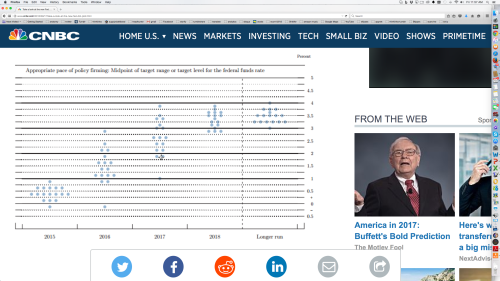
For the First Time, Someone on the US Monetary Policy Committee Is Recommending a Negative Target Rate

Look at the two dots below zero showing the idea that negative rates should start now and continue into 2016. Thanks to Leon Berkelmans for pointing this out. 

Bleg: Do I need to change my title? Has this happened before?

For those who want to get some evidence of causality between awareness of how easy it is to break through the zero lower bound and leaning toward negative rates, see the schedule of my travels so far to talk about eliminating the zero lower bound here.

Eric Schlosser on the Underground Economy

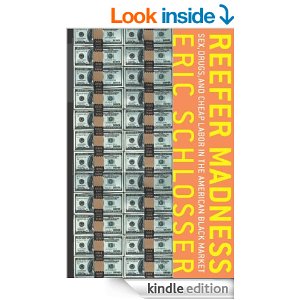
Eric Schlosser is most famous as the author of Fast Food Nation. I recently finished another of his books: Reefer Madness: Sex, Drugs and Cheap Labor in the American Black Market, which is about three sectors of the underground economy: drugs, undocumented workers, and pornography, all viewed from a business and public policy perspective. Here is Wikipedia’s current summary of its three chapters:

Chapter 1: Reefer Madness, Schlosser argues, based on usage, historical context, and consequences, for the decriminalization of marijuana.

Chapter 2: In the Strawberry Fields, he explores the exploitation of illegal immigrants as cheap labor, arguing that there should be better living arrangements and humane treatment of the illegal immigrants America is exploiting in the fields of California.

Chapter 3: An Empire of the Obscene details the history of pornography in American culture, starting with the eventual business magnate Reuben Sturman.

Here are three passages that I found especially interesting, including the historical origin of marijuana laws in xenophobia and how boring pornography can be:

  • The political upheaval in Mexico that culminated in the Revolution of 1910 prompted a wave of Mexican immigration to the American Southwest. The prejudices and fears that greeted these peasant immigrants also extended to their traditional means of intoxication: smoking marijuana. Police officers in Texas claimed that marijuana incited violent crimes, aroused a “lust for blood,” and gave its users “superhuman strength.” Rumors spread that Mexicans were distributing this “killer weed” to unsuspecting American schoolchildren. Sailors and West Indian immigrants introduced marijuana to port cities along the Gulf of Mexico. In New Orleans newspaper articles associated the drug with African Americans, jazz musicians, prostitutes, and underworld whites. “The dominant race and most enlightened countries are alcoholic,” on prominent critic of marijuana argued, expressing a widely help belief, “whilst races and nations addicted to hemp … have deteriorated both mentally and physically.” Marijuana was depicted as an alien intrusion into American life, capable of transforming healthy teenagers into sex-crazed maniacs. In 1914, El Paso Texas enacted probably the first local ordinance banning the sale or possession of marijuana; by 1931, twenty-nine states had outlawed marijuana, usually with little fanfare or debate. [pp. 19-20]
  • The Clinton administration largely abandoned efforts to enforce the obscenity laws, discontinuing the policies of the Reagan and Bush administrations. [p. 202]
  • Larry Flynt’s theory–that legalizing porn will eventually reduce the demand for porn–is not as outlandish as it may seem. That is exactly what happened in Denmark a generation a go. In 1969 Denmark became the first nation in the world to rescind its obscenity laws, an act taken after much deliberation and study. According to Vagn Greve, a former director of the Institute of Criminal Law and Criminology at the University of Copenhagen, when Denmark’s obscenity laws were overturned, there was a steep rise in the consumption of porn, followed by a long, steady decline. “Ever since then,” Greve told me, “the market for pornography has been shrinking.” Porn sales remain high in Copenhagen mainly because of purchases by foreigners. Greve’s colleague at the institute, the late Berl Kutchinsky, studied the effects of a legalized pornography in Denmark for more than twenty-five years. In a survey of Copenhagen residents a few years after the “porno wave” had peaked, Kutchinsky found that most Danes regarded porn as “uninteresting” and “repulsive.” Subsequent research confirmed these findings. “The most common immediate reaction to a one-hour pornography stimulation,” Kutchinsky concluded, “was boredom.” [pp. 203, 204]