[The story of Socrates] has defined for twenty-four centuries the essential components of the life of the mind: to wit, the ability to give a reasoned basis for belief and the quest to find the truth that lies behind appearances. His practice of asking embarrassing questions, even at the risk of personal loss, and even without hope of an immediate answer, is fundamental to what we are.

– Harold Attridge, as Dean of the College of Arts and Letters University of Notre Dame. As quoted in Cultivating Humanity: A Classical Defense of a Liberal Education, by Martha C. Nussbaum, p. 266.

Eric X. Li: Is Democracy Necessary?

In the comment section of “Why Thinking about China is the Key to a Free World,” Kierto Duong claims that I underrate the Chinese government. The video above was a key part of his defense.

The video is somewhat off target for what I was saying in “Why Thinking about China is the Key to a Free World.” I never said that democracy was crucial to prosperity but that freedom is crucial to prosperity. The following passage in “Why Thinking about China is the Key to a Free World.” gives the working definition of freedom I am using:

When Dan Benjamin, Ori Heffetz, Nichole Szembrot and I surveyed more than four and a half thousand Americans about what they viewed as the most important objectives for public policy, the top two (of 131 choices) were “freedom from injustice, corruption, and abuse of power in your nation,” and “people having many options and possibilities in their lives and the freedom to choose among them.”

This pairing of responses shows an awareness of the danger to freedom from those who would organize the institutions of a nation to serve the interests of an in-group at the expense of an out-group. At the beginning of the struggle toward freedom, the in-group is very small and the out-group large. At later stages of the struggle toward universal freedom, the in-group will be large and the out-group small. But adding up across the world, it is not at all clear that a majority of the people in the world today can be called truly free.

This kind of freedom is not synonymous with democracy. In particular, I think the kind of counter-majoritarian rules in the Bill of Rights (including the 9th amendment to the US Constitution that suggests there are many, many other rights not explicitly listed) take freedom a long way beyond where it would be from democracy alone. And indeed, the US is now much less free than it might be because over time, majoritarian forces described in Barry Friedman’s excellent overview of Supreme Court history The Will of the People: How Public Opinion Has Influenced the Supreme Court and Shaped the Meaning of the Constitution have eroded some of the freedom-enhancing principles in the constitution. 

Also, the United States would now be significantly more prosperous than it is if Franklin D. Roosevelt had not pushed the Supreme Court to abandon key principles of economic freedom. (The gold standard and other bad monetary policy ideas thus not only contributed greatly to Hitler’s rise to power but also to the erosion of key US constitutional principles.)

At the end of “Why Thinking about China is the Key to a Free World,” I give two examples of how freedom might be supported that are not about ordinary democracy: 

So, as I advocated here in “Yes, There is an Alternative to Austerity vs. Spending: Reinvigorate America’s Nonprofits,” it is enough to use the arm of the government to require more substantial charitable contributions, while giving people wide latitude to decide which particular causes they want to support. This can both assist in things the government is now doing, such as taking care of senior citizens and supporting medical research, and begin to take care of things that should be done, but aren’t. With millions of people each required to do something, but allowed to think and decide for themselves what most needs to be done, the odds that the benefits of freedom and prosperity extend into all the nooks and crannies of society improve dramatically.

Finally, though efforts to measure national well-being in ways that respect the full range of things human beings care about are still in their infancy, there is hope that developing such measures as counterpoints to GDP can guide public policy toward ways of improving the quality of life in nations that use them in unexpected ways. Such measures of national well-being might also be used by autocrats to keep those they rule over just happy enough to forestall rebellion, but those rulers would be faced with this truth: people love freedom, and will never be content for long without it.

There is a lot to think about in trying to define freedom, but it is not synonymous with democracy.

I stand by my prediction that greater freedom in China would ultimately lead to more prosperity. But many of the key dimensions of freedom that would help China the most are not about democracy per se.

Larry Summers: The Fed Looks Set to Make a Dangerous Mistake by Raising Rates this Year

I find Larry Summers’ argument in his latest Financial Times column linked above quite persuasive: that the Fed should wait until at least the beginning of 2016 to raise rates. In addition to assessing the economic situation, he points to a possible reason for bias in the Fed’s decision making that rings true to me. Larry writes:

I doubt that, if rates were now 4 per cent, there would be much pressure to raise them.

Although positive versus negative would be more salient than it rationally should be in any case, I think the zero lower bound makes a rate of zero seem more special than it really is. Knowing that the zero lower bound is a policy choice rather than a law of nature makes monetary policy choices at an interest rate more obviously like choices at a 4% interest rate. In either case, the decision should be made based on the behavior of inflation, output, and labor market measures, not on whether the interest rate seems high or low in an absolute sense. I don’t agree with Larry Summers’ take on what interest rates are likely to be once the economy has fully recovered, but his take point to the truth that there is great uncertainty about exactly what the medium-run natural interest rate and the long-run natural interest rate are. 

And since there is still in all likelihood an output gap, the short-run natural interest rate could be quite a bit lower. See my posts 

Another Argument for Waiting to Raise Rates: Interest Rate Smoothing Should Be a Thing of the Past

In addition to Larry Summers’ arguments for holding off on raising rates, I have a conceptually quite distinct argument: the Fed can afford to wait to raise rates, because it can always raise rates very fast if it needs to later on.

Contrary to what optimal control models suggest, monetary policy committees around the world tend to believe the fallacy that (although events can sometimes overrule this) it is a good thing to raise and lower rates slowly. This belief shows up as policy rate movements being predictably in one direction for a long time, with small steps along the way. Optimal control models suggest that instead a policy rate should look a lot more like a random walk modified by some drift and mean reversion. That means that optimal monetary policy should have lots of reversals and dramatic movements in the interest rate when there has been relatively big news since the last meeting. 

Let me address one myth: that Mike Woodford has shown that interest-rate smoothing makes sense. I would be glad to be corrected, but I think this myth arises because Mike talked about the Fed carrying about affecting the bond markets (and more generally macroeconomic) expectations of future rates. Just as backward-looking state variables have forward-looking costate variables, bond market expectations are like a forward-looking state variable for the Fed; those bond market expectations have a corresponding backward-looking costate variable. 

As an analogy, in working toward my dissertation, I did an unpublished efficiency-wage model (which you can see and freely download here) in which, to motivate workers with an expectation of future pay making a job valuable, there is a backward-looking costate variable that can be interpreted as “seniority.”

Such backward-looking costate variables giving guidance about doing the right thing in relation to bond-market expectations contribute additional drift terms to the optimal policy rate, but it still seems to me that over a six-week span of time between FOMC meetings, the variance of news is sufficient that the effect of news should typically be substantially larger than the sum of all drift terms on the policy rate. Hence the metaphor of a muddy random walk.

John Stuart Mill on Freedom of Contract

Allowing freedom for an individual to do as she or he chooses within a certain sphere suggests also allowing freedom for groups of individuals to interact with one another as they all choose within a certain sphere of actions. (I wrote about this before in The Free Market and Collective Liberty.) Several issues arise:

  1. protecting people from being sold out by their past selves

  2. social enhancement of people’s ability to make commitments

  3. protecting people from mistakes of their past or current selves

  4. the temptation to obstruct freedom for the sake of pecuniary externalities

John Stuart Mill’s touches on many of these issues in paragraph 11 of On Liberty “Chapter V: Applications”:

It was pointed out in an early part of this Essay, that the liberty of the individual, in things wherein the individual is alone concerned, implies a corresponding liberty in any number of individuals to regulate by mutual agreement such things as regard them jointly, and regard no persons but themselves. This question presents no difficulty, so long as the will of all the persons implicated remains unaltered; but since that will may change, it is often necessary, even in things in which they alone are concerned, that they should enter into engagements with one another; and when they do, it is fit, as a general rule, that those engagements should be kept. Yet, in the laws, probably, of every country, this general rule has some exceptions. Not only persons are not held to engagements which violate the rights of third parties, but it is sometimes considered a sufficient reason for releasing them from an engagement, that it is injurious to themselves. In this and most other civilized countries, for example, an engagement by which a person should sell himself, or allow himself to be sold, as a slave, would be null and void; neither enforced by law nor by opinion. The ground for thus limiting his power of voluntarily disposing of his own lot in life, is apparent, and is very clearly seen in this extreme case. The reason for not interfering, unless for the sake of others, with a person’s voluntary acts, is consideration for his liberty. His voluntary choice is evidence that what he so chooses is desirable, or at the least endurable, to him, and his good is on the whole best provided for by allowing him to take his own means of pursuing it. But by selling himself for a slave, he abdicates his liberty; he foregoes any future use of it beyond that single act. He therefore defeats, in his own case, the very purpose which is the justification of allowing him to dispose of himself. He is no longer free; but is thenceforth in a position which has no longer the presumption in its favour, that would be afforded by his voluntarily remaining in it. The principle of freedom cannot require that he should be free not to be free. It is not freedom, to be allowed to alienate his freedom. These reasons, the force of which is so conspicuous in this peculiar case, are evidently of far wider application; yet a limit is everywhere set to them by the necessities of life, which continually require, not indeed that we should resign our freedom, but that we should consent to this and the other limitation of it. The principle, however, which demands uncontrolled freedom of action in all that concerns only the agents themselves, requires that those who have become bound to one another, in things which concern no third party, should be able to release one another from the engagement: and even without such voluntary release, there are perhaps no contracts or engagements, except those that relate to money or money’s worth, of which one can venture to say that there ought to be no liberty whatever of retractation.

A good reason to let people change their minds on most things is to avoid letting their past self either sell them out or deliver them into a predicament through a mistake. One way of viewing this is as I did in my post “Drug Legalization and Time Slices of People as Ethical Units”: if we consider the ethical unit to be a time-slice of an individual, then there is not full consent to an engagement if the current time-slice does not consent. 

From that point of view, one should only allow previous time-slice of a person commit the current time-slice if, to the individual, the ability to commit is quite valuable to that individual. In particular, in cases where person B will only incur a significant cost if able to rely on a commitment from person A and person A following through on that commitment has a corresponding cost that is of the same order of magnitude as the cost incurred by person B, it may seem reasonable to allow people to commit their future selves. 

Nevertheless, if, say an early time-slice of person A borrows to spend on wild carousing that leaves no memories at all because of drunkenness, leaving the later time-slice of person A with nothing, why should the earlier time-slice of person A be able to sell out the later time-slice in that way? The basic answer would be that normally person B doesn’t know whether person A will use the borrowed money well or badly, and it is in A’s interest to encourage B to be willing to lend if most likely the money will be used well. But when it becomes apparent that the early time-slice of person A most likely is selling out the later time-slice of person A, in a way that is easily observable to person B, then the case for society enforcing the sell-out of the later time-slice of person A to person B by the earlier one becomes much weaker. 

Notice that this principle that an early time-slice of a person shouldn’t ordinarily be able to sell out a later time-slice gives a much different argument for people not being able to sell themselves into slavery than the one John Stuart Mill gives–and an argument that applies to much less extreme circumstances. 

Paternalism is an attempt to save people from the mistakes of their current and future selves. Behavioral Economics has enlarged our awareness of all the ways that people might not guard their own interests very well, either through ignorance, through cognitive processing limitations, or through internal conflict that can happen even within a particular period of time.

But the simple principle of letting people back out of most things because it takes some time to figure out what is going takes care of a lot of situations. One place where this is particularly important is in sexual situations that college students get themselves into. One can see from, for example, the results of this survey of University of Michigan students that there are many cases of nonconsensual sexual activity. From the experiences of a professor at another university who is on the committee worrying about such things, I have heard that a large part of the problem is that, say, a man thinks a woman doesn’t have the right to change her mind once she has gone along with things long enough to get him really going. But of course a woman always has the right to change her mind and decide to stop all sexual activities cold at any point, regardless of how encouraging she was before that. Every moment of an interaction brings her more information, and every minute allows an all-too-often alcohol or drug-addled brain to process that information. Even if one sometimes allows earlier time-slices of an individual to commit later time-slices, in this case, one can trust the later time-slice of that individual who decides to switch to non-consent much more than the earlier time-slice that had much a much more limited perspective on the erstwhile partner now forcing himself on her. 

The moral of the story is that one thing all incoming college students need to taught is that a sexual partner has not only a reasonable likelihood, but an inalienable right to change her or his mind and switch to nonconsent at any time. 

An inalienable right is one that an earlier time-slice of an individual cannot sell off. The concept of an inalienable right helps with many of the issues addressed here. 

The opposite of inalienable rights–“alienable rights”–should be those rights where allowing an individual sell off a right by committing a future self to something (such repaying a college loan) that is quite valuable to a typical person’s welfare by convincing others to do something (such as to extend the loan). 

I have focused most on freedom of contract that has an important intertemporal dimension, since many contracts do, and this raises some of the thorniest issues. When a contract involves what happens over a relatively short span of time, then the case for treating the earlier and the later time-slice of an individual almost as if they were separate people is much less. So ordinarily people should be allowed to commit themselves for short spans of time, if we have reason to believe that the slightly early time-slice of that individual is well-informed. 

An interest relatively pure case, where there is very little intertemporal aspect is when a day-laborer wants to work for less than the minimum wage. Why should the law say that if the day laborer can’t find a good job, he or she is not allowed to take a bad job? Just because someone is poor and deserves a handout doesn’t mean they are stupid about a basic job decision like that. 

Even unions often don’t want minimum wages to apply to their own members. Here from a recent Wall Street Journal article:

In at least a half-dozen of those communities, the pay-floor ordinances include a provision allowing unions to waive the wage mandates as part of a collective-bargaining agreement. Labor groups often seek the exemptions because they say they provide the flexibility to negotiate better benefits for all union members or raises for more senior workers making more than the minimum. …

The carve-outs are increasingly drawing the ire of business groups representing the hotel and tourism industries, among others. They say such exemptions are a way for unions to organize or gain negotiating power by using the ability to opt out of the wage law as leverage to achieve other goals.

For instance, business groups say, unions could advise companies that if they agree to labor representation, they can avoid paying the minimum wage, spending less on wages overall. The strategy could let unions bolster their ranks at a time when union membership is falling, business groups say.

Although minimum wages are often harmful to the individual they apply to, they may sometimes help certain other people who would otherwise have to compete with the individual who is kept out of the labor force by the minimum wage. Of course, there is always the case of someone whose firm has paid enough of a sunk cost in the employment relationship that he or she will not be fired but will instead take a bigger share of the surplus from the employment relationship by getting a higher wage. Even this person would only want the minimum wage for him or herself to apply to the current job, not to the next job. 

Thus, facing a minimum wage oneself in future jobs is a harmful restriction on one’s freedom to benefit certain other people. It is a restriction on freedom to generate a pecuniary externality. But as I wrote in John Stuart Mill on Legitimate Ways to Hurt Other People, a pecuniary externality is a legitimate ways to hurt another person. Why? In part because in every pecuniary externality, whenever someone on one side of a transaction out there is hurt by a change in the price, the other party to the transaction benefits by that change in the price. This may sound boring, but it means that the good results one get from the free market depend crucially on not trying to stop pecuniary externalities. Ordinarily, when two individuals both want to do a trade and other people care mainly because prices are affected, society is ahead overall by going ahead with the trade and letting the chips fall where they may for everyone who cares about the price, since those chips will fall in a positive and negative way that should add up to zero in dollar terms. 

And it is a myth that raising the minimum wage reduces inequality–the inequality that matters far more than any other kind of inequality is the desperation of the people at the very bottom, which is worsened by the minimum wage. The minimum wage is a way to help people one rung up on the ladder–who are more likely to vote–at the expense of people at the very bottom. (On some of the scientific issues about the minimum wage, see my recent post “The Economist–Destination Unknown: Large Increases in the Minimum Wage Could Have Severe Long-Term Effects.”) 

The Supreme Court justices who upheld freedom of contract (before the “New Deal Settlement” transformed the official interpretation of the constitution without going through the amendment process) were actually fairly sophisticated about making some of the distinctions above. They upheld many regulations that could be viewed as helping the individuals the regulations were imposed upon. In the most famous “freedom of contract” case of all, Lochner vs. New York, the US Supreme Court was taking the side of poor bakers of bread who were recent immigrants being given a hard time by richer, longer-established bakers of bread. The poor bakers knew they weren’t being “protected” by the regulations at issue, they were being pushed out of business. The book I show at the top of this post is an excellent treatment of the history.


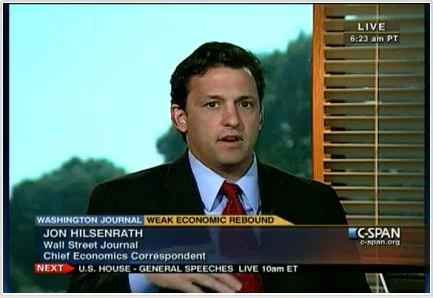
Wall Street Journal Off Track: Jon Hilsenrath and Nick Timiraos Report As If the “Effective Lower Bound” Were a Law of Nature

To their credit, in their August 17, 2015 Wall Street Journal article “U.S. Lacks Ammo for Next Economic Crisis” Jon Hilsenrath and Nick Timiraos talk about negative interest rates as a potential policy tool, writing at different points: 

  • The Fed, for example, could experiment with negative interest rates.
  • Mr. Bernanke said he was struck by how central banks in Europe recently pushed short-term interest rates into negative territory, essentially charging banks for depositing cash rather than lending it to businesses and households. The Swiss National Bank, for example, charges commercial banks 0.75% interest for money they park, an incentive to lend it elsewhere. Economic theory suggests negative rates prompt businesses and households to hoard cash—essentially, stuff it in a mattress. “It does look like rates can go more negative than conventional wisdom has held,” Mr. Bernanke said.

Yet although they reflect the evolution of the zero lower bound (still a handy name) into what many central banks are now calling the “effective lower bound,” which is somewhat below zero, Jon and Nick do nothing to inform their readers that cash hoarding can be avoided by the simple expedient of a time-varying paper currency deposit fee at the cash window of a central bank that creates an exchange rate between paper currency and electronic money, which can then lower the yield on paper currency by allowing it to very slowly depreciate against electronic money. (As a terminological note, I should say that most of the time I will continue to use the phrase “zero lower bound” rather than “effective lower bound,” since I think the big shift is to break through the zero lower bound on the nominal interest rate for paper currency–which then removes any effective lower bound on other interest rates as long as the full set of interest rates the central bank then controls are moved in tandem.)

The article also gives a misleading impression with its subtitle, “Policy makers worry fiscal and monetary tools to battle a recession are in short supply” and an unnuanced picture caption saying

U.S. Defenses Down: The Federal Reserve will have fewer monetary weapons in the next recession. It has less room to cut rates, and its swollen portfolio will make it harder to launch new rounds of bond buying.

If the Fed has fewer monetary weapons in the next recession, it will be only because either legal barriers or timidity leave it fewer monetary weapons. The Fed knows how to break through the “effective lower bound” ever since my seminar there on November 1, 2013. (I also gave a seminar at the New York on October 15, 2014 and I am slated to give a seminar at the Chicago Fed at the beginning of September 2015.)

Of course, Jon and Nick are not the only ones off target. I am sure that they are correct in reporting

Others, including Sen. Bob Corker (R.,Tenn.), see only the Fed’s limits. “They have, like, zero juice left,” he said.

Many economists believe relief from the next downturn will have to come from fiscal policy makers not the Fed, a daunting prospect given the philosophical divide between the two parties.

But I am confident that many more economists (as well as senators) would realize how much more the Fed and other central banks can do if the Wall Street Journal would report on the work being done on ways to break through the “effective lower bound.” To that end, I sent an email to Jon (whom I have corresponded with on occasion in the past) that I am copying out here as an open letter, after very light editing: 

Dear Jon,

I wanted to write because I think the title of today’s column is simply false–and the real story is much more interesting. I said much the same thing about a recent Economist column in Quartz:

Radical Banking: The World Needs New Tools to Fight the Next Recession

You have probably been following my work on negative interest rates to some extent. I have the things I have written on that collected here, 

How and Why to Eliminate the Zero Lower Bound: A Reader’s Guide

and my academic paper with Ruchir Agarwal on it is coming soon.

Central banks are well aware of the fact that it is not that hard to break through the zero lower bound, if only because of my extensive travels to tell them about it, listed in my post

Electronic Money: The Powerpoint File.

Thinking about this sort of thing is what is happening under the surface at many central banks.

A Wind-Powered Birthday Rhinoceros

image source

image source

My daughter Diana gave me this Jr. Scientist Series Mini Rhinoceros (serious assembly required). The box says it is for ages 8+. At 55 years old, I qualify.

The Mini Rhinoceros owes its design to Theo Jansen, an artist who makes giant versions of such wind-powered mechanical animals. You can see an interview with Theo Jansen here. (That link also leads to many other related videos.)

I like the fact that whichever way the wind blows, the rhinoceros always moves forward.

Are Sports Arena Subsidies the Membership Fee in a Two-Part Tariff?

My brother Joseph points me to this piece on the perennial issue of whether sports arenas are bad deal for cities that chip in for them: “Is a sports arena an investment or a subsidy?” by Gigi Douban on Marketplace. This article is sparked by presidential candidate Scott Walker’s signing off on $250 million in public money for a new Milwaukee Bucks arena.

The thing I am wondering about is whether calculations of the benefits of subsidizing sports arenas takes into account the full measure of sheer consumer surplus of people who attend and would be willing to pay much more than the ticket price.

Plausibly, the taxes might come from primarily from the relatively rich to benefit the relatively rich, so think of this as distributionally neutral, to a first approximation. Because the average dollar benefit goes up with income, the labor supply distortion may also not be a major issue. See Louis Kaplow’s “On the (Ir)Relevance of Distribution and Labor Supply Distortion to Government Policy.” To look at it another way, the fact that people might want to make enough money to be able to afford to live in an area with the amenity of having a sports team helps avoid labor supply distortion.

The total consumer surplus from having a sports team in an area could be quite high because the benefit could be extremely high for the ultra-rich. Indeed, I would expect the benefit to go up more than proportionately with income, since sports attendance should be a luxury good. Functional forms not reflecting the extent to which sports attendance is a luxury good would underestimate the consumer surplus.

In other words, sports arenas don’t necessarily need to bring jobs and economic development for subsidies to be worthwhile–they can be worthwhile simply because people like having sports teams in their local area so they can attend in person–beyond what they pay in the ticket price.

To put it another way, arena subsidies are part of a two-part tariff pricing: because having the sports arena in the local area is a public good, the “membership fee” of being in the class of cities with a sports team in a given league is paid for by the government. Then the per-use fee is paid by those who actually attend.

Am I missing something?

Rodney Stark’s Contrarian Assessment of the Crusades

I find Rodney Stark’s positive take on Christianity’s historical effects refreshing. (Type in “Rodney Stark” into the search box on my sidebar to see other posts inspired by Rodney Stark’s books.) This has extended to rebuttals of claims of negative historical effects, as in his book God’s Battalions: The Case for the Crusades. Here is a passage rom pages 8 and 9 summarizing the argument of the book:

To sum up the prevailing wisdom: during the Crusades, an expansionist, imperialistic Christendom brutalized, looted, and colonized a tolerant and peaceful Islam.

Not so. As will be seen, the Crusades were precipitated by Islamic provocations: by centuries of bloody attempts to colonize the West and by sudden new attacks on Christian pilgrims and holy places. Although the Crusades were initiated by a plea from the pope, this had nothing to do with hopes of converting Islam. Nor were the Crusades organized and led by surplus sons, but by the heads of great families who were fully aware that the costs of crusading would far exceed the very modest material rewardcs that could be expected; most went at immense personal cost, some of them knowingly bankrupting themselves to go. Moreover, the crusader kingdoms that they established in the Holy Land, and that stood for nearly two centuries, were not colonies sustained by local exactions; rather thay required immense subsidies from Europe.   

In addition, it is utterly unreasonable to impose modern notions of proper military conduct on medieval warfare; both Christians and Muslims observed quite different rules of war. Unfortunately, even many of the most sympathetic and otherwise sensible historians of the Crusades are unable to accept that fact and are given to agonizing over the very idea that war can ever by “just,” revealing the pacifism that has become so widespread among academics. Finally, claims that Muslims have been harboring bitter resentments about the Crusades for a millenium are nonsense: Muslim antagonism about the Crusades did not appear until about 1900, in reaction against the decline of the Ottoman Empire and the onset of actual European colonialism in the Middle East. And anti-crusader feelings did not become intense until after the founding of the state of Israel. These are principal themes of the chapters that follow. 

Two other notes are in order. To begin with, the Byzantine emperors really were quite treacherous. The First Crusade began on the presumption that once Jerusalem was taken by the crusaders that the Byzantine Empire would take care of keeping it. The crusader Kingdom of Jerusalem arose from the fact that the Byzantine emperors didn’t care much about keeping Jerusalem. And the later “sack” of Constantinople in a later crusade had a large element of putting valuables in sack to collect on a debt incurred by a Byzantine emperor who had promise to pay the crusaders for help in a civil war.

Also, the deaths when Jerusalem was taken by the crusaders in the First Crusade need to be kept in perspective. Rodney writes on pages 157-158:

First of all, it is not only absurd but often quite disingenuous to use this event to “prove” that the crusaders were bloodthirsty barbarians in contrast to the more civilized and tolerant Muslims.Dozens of Muslim massacres of whole cities have been reported in previous chapters, and the crusaders knew of such occurrences. Second, the commonly applied “rule of war” concerning siege warfare was that if a city did not surrender before forcing the attackers to take the city by storm (which inevitably caused a very high rate of casualties in the besieging force), the inhabitants could expect to be massacred as an example to others in the future. That is, had the Muslims surrender Jerusalem on June 13 when the towers were ready to be rolled against the walls, they would no doubt have been given terms that would have prevented a massacre.

Our own secular, liberal culture owes a lot historically to Christianity, so it is good not to overdo the criticism of our cultural forebears. It isn’t easy to struggle up toward the level of enlightenment we have now. They helped us get there. We should try to bring compassion and empathy to our understanding of history–even to the brutal elements of history. Where we should be intolerant is of evil in the present day, regardless of its source.

Owen Nie: Monetary Policy in Colonial New York, New Jersey and Delaware

Following up on his guest posts “Playing Card Currency in French Canada,” and “Pre-Revolutionary Paper Money in Pennsylvania,” Owen Nie offers here another guest post on monetary history. This one is drawn from Richard Lester’s “Prosperity issues in New York, New Jersey and Delaware” Monetary Experiments: Early American and Recent Scandinavian. New York: Augustus M. Kelley, 1970. 112-141.


In New York, two paper money issues in 1714 and 1717 were authorized to finance military expenditures against French Canada. In following years evidences suggested that these monetary expansions were responsible for opulent trade and business conditions until the gradual retirement of these currencies from taxes occasioned for that purpose in 1720s and 1730s. Hence in 1737 another bill to issue paper money was passed, this time not only to defray expenses but with a deliberate goal of providing a circulating medium and stimulating the economy. This issuance, like the earlier two, aided greatly in New York’s recovery from depression. New Jersey did not issue paper money as early as New York first did and later decided on monetary expansion in 1723 after observing its neighbor’s better trade and industrial conditions. New Jersey’s reduced reliance on New York and Pennsylvania’s money was among many other benefits of such an expansion. In 1733 an additional bill to issue more paper currency was passed in New Jersey as it became a great necessity, but all subsequent proposals of such nature were rejected by British government except for defraying His Majesty’s military expenditures. These paper currencies were issued on loan; interest was paid to the state and served to reduce the need for levying taxes. Delaware had similar experiences with currency expansions (in 1723, 1729 and 1746) as these of New York and New Jersey and of Pennsylvania.  In all of these four North American colonies in over a half century, currency issues appeared to have achieved their purpose of greasing the wheels of the economy without bringing about detrimental effects of extreme inflation later on, as price stability was at least as good as it would have been on gold and silver standards.

The Economist—Destination Unknown: Large Increases in the Minimum Wage Could Have Severe Long-Term Effects

More than 31 months after “Isaac Sorkin: Don’t Be Too Reassured by Small Short-Run Effects of the Minimum Wage” appeared on this blog, the July 25, 2015 issue of The Economist has caught on to the importance of Isaac Sorkin’s research on the minimum wage. They are similarly late in noticing Jonathan Meer and Jeremy West’s research that appeared in the post “Jonathan Meer and Jeremy West: Effects of the Minimum Wage on Employment Dynamics” and still do not address the critique of that research in “Arindrajit Dube: Jonathan Meer and Jeremy West’s Negative Correlation for Minimum Wages and Employment Growth is a Statistical Artifact.”

The Economist article has a nice pair of graphs showing how much much lower US minimum wages are compared to income or median pay than in Europe (However, the US minimum wage is at a very high level relative to median pay and income in Puerto Rico, with disastrous effects.) The Economist also gives a nice report on Isaac’s latest research with Daniel Aaronson and Eric French: 

In a second paper, written with Daniel Aaronson of the Federal Reserve Bank of Chicago and Eric French of University College London, Mr Sorkin goes further, offering empirical evidence that higher minimum wages nudge firms away from people and towards machines. The authors look at the type of restaurants that close down and start up after a minimum-wage rise. An increase in the minimum wage seems to push some restaurants out of business. The eateries that replace them are more likely to be chains, which are more reliant on machines (and therefore offer fewer jobs) than the independent outlets they replace. This effect has not been picked up before because the restaurants which continue to operate do not change their employment levels, so the jobs total does not shift much in the short run.

It always seemed too good to be true when David Card and Alan Krueger claimed that an increase in the minimum wage left employment unchanged or even increased it a little in New Jersey restaurants. There is more and more reason to be skeptical of the reassurance that gave to minimum wage advocates. 

Update August 19: Isaac Sorkin points out that Jonathan Meer and Jeremy West have answered Arindrajit Dube and coauthors’ objections in a cogent supplemental appendix that can be found here.  

Discounting Government Projects

Image source: February 4, 2014 speech on “The outlook for the New Zealand economy,” by Graeme Wheeler, Governor of the Reserve Bank of New Zealan

Image source: February 4, 2014 speech on “The outlook for the New Zealand economy,” by Graeme Wheeler, Governor of the Reserve Bank of New Zealan

During my three weeks in New Zealand as a Visiting Research Fellow of the New Zealand Treasury helping New Zealand get closer to developing national well-being indices (see 1,2,3), I learned of the New Zealand Treasury’s current custom of using an 8% per year real discount rate for evaluating government projects (including “social projects”). That custom makes no sense to me; I wrote a series of emails to New Zealand Treasury officials explaining why. They took me up on my offer to give a presentation on this issue. You can see the Powerpoint file I used here, though I didn’t have time to cover the abridged version of the presentation I had given a year ago at the US Congressional Budget Office on capital budgeting that I appended after the discussion about discounting. 

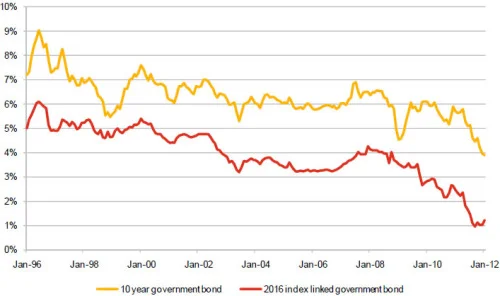
Below, I have copied out the text of the emails I wrote, after subtracting some identifying information at the beginning of the first email. As usual when I talk to officials of government agencies, I am telling you what I told them and what I recommended, but–to maintain a certain degree of confidentiality–remarking only in the most general terms about their reactions. The distinct emails are marked by Roman numerals. To understand these emails, you need to know that New Zealand has a sovereign wealth fund called the Superfund. Also, it is good to have a sense of the yield on New Zealand government bond: I have a graph showing the nominal yield above, and a graph comparing the nominal to the real yield below. 


I. There is an extremely strong argument against using an 8% real discount rate in evaluating government projects. I think the argument below can be sharpened to become institutionally relevant.

Basically, an 8% real discount rate makes no sense to use unless the New Zealand government is actually getting an 8% real return on funds that it saves. It is not enough for someone to claim that the New Zealand government theoretically could get an 8% real return on funds it saves when that is not true or is only theoretical because the New Zealand government would never actually do that with funds saved by not doing a project.

The argument here also dovetails nicely with a presentation I gave at the Congressional Budget Office a little over a year ago on capital budgeting, that I would be happy to give here next week some time in addition to my other talk if there is interest. (I attached the Powerpoint file.)

Here is the argument against the 8% real discount rate used for assessing government projects in more detail:

(1) On the face of it, such a high discount rate is hard to square with the much lower government borrowing rate, which in simple cases clearly implies a benefit from borrowing to fund the project if the project has a net present value that is positive given that government borrowing rate. What is going on?

(2) Historically (perhaps back in the 1970s) the 8% per year real discount rate was motivated by the expected return on the stock market, and the idea that government projects are risky investments. But it is important to look beyond this superficially plausible set of words to the underlying logic, which doesn’t hold up.

(3) The underlying logic of the 8% per year real discount has to be that the opportunity cost of a project is that the money could be put into the stock market (say a diversified international fund) if it weren’t used for the project. This logic requires (a) that if funds weren’t used for the project that it is in fact realistic the funds would be added to the Superfund and (b) that the extra funds in the superfund would be earning an 8% per year real return.

(4) To the extent that there is a great reluctance on the part of the government to invest extra funds in the Superfund, that tends to indicate some combination of either (a) for various political or institutional reasons it is not realistic that the extra funds will be added to the Superfund or (b) the risk-adjusted return that is expected if the extra funds were added to the Superfund is much less than 8% per year in real terms. In either case, an 8% per year real return is not a relevant rate at which to discount government projects. This is easy to show in two models: (a) where the flows of funds into the Superfund (the government’s sovereign wealth fund) are fixed in a way that is exogenous to projects undertaken among the projects now being discounted at 8%; (b) where the government is rationally indifferent on the margin between investing more in the Superfund and paying off some of the debt, which then makes the interest rate on the debt the relevant one because it is in this model equivalent to a risk-adjusted return on money in the Superfund.

(5) Some might argue that the riskiness of government projects hasn’t been adequately included in the discussion above. That is true, but the risk in government projects is quite different from regular stock market risk, so the risk adjustment must be done in another way. A good method of risk adjustment for projects is to think seriously of the real dollar value they will have dependent on the level of real consumption in the economy. One virtue of thinking about the adjustment this way is also that it provides a reminder that the dollar value of the flow of benefits from many projects will tend to increase in the future simply because trend increases in per capita income will raise the willingness to pay for those benefits.

II. Just to be clear, my view is that (a) all projects that are better than putting the money in the Superfund should be done, and (b) if someone claims that a project is worse than putting money in the Superfund, then money should be put in the Superfund instead, and © if a project looks better than paying off some of the debt by buying bonds–or, almost equivalently, good enough that borrowing at the bond rate to do it looks like a positive present value–it should also be undertaken UNLESS the government is willing to issue additional bonds to put more money in the Superfund invested in risky assets.

Like Roger Farmer, I have argued that many, many governments should in fact be expanding their sovereign wealth funds (like the Superfund) by borrowing at the quite low interest rates that are possible for financially sound governments these days. Borrowing at favorable rates to better fund the Superfund (which I am assuming would invest the extra funds in a diversified international portfolio of risky assets) is indeed quite a good “project” in its own right and so should set a substantial hurdle for other projects to meet but

(1) certainly not as high as an 8% real return, assessed almost as if that were a safe return and

(2) if borrowing or using other available funds to better fund the Superfund is ruled out of court for any reason, that “project” of better funding the Superfund (and thereby implicitly investing in a diversified international portfolio of risky assets) cannot rationally be used as a comparison to set a high hurdle rate for other projects.

To argue that borrowing to better fund the Superfund should in fact be taken seriously, let me point out several other advantages to it, beyond the fact that it is a relatively high return “project”:

(i) If the accounting separates the Superfund from the rest of the government debt, then better funding the superfund makes it possible to point to the amount of bonds the government has issued to remind people of the liability the government has taken on to pay pensions in the future out of the Superfund (and whatever else the Superfund is committed to in the future). This reminder of the liability the government has taken on can be quite helpful.

(ii) Because it makes sense for a small open economy such as New Zealand’s to be investing in an internationally diversified portfolio of risky assets, better funding the Superfund will generate capital outflows that are likely to cause some depreciation in the New Zealand dollar. Some opinions suggest the New Zealand dollar is to strong to begin with, so that might be a good thing.

(iii) The issuance of additional government bonds could raise safe interest rates. As long as this is taken into account in calculating the returns to the “project” of borrowing to invest in an internationally diversified portfolio of risky asset, that “project” is still a good idea in terms of the overall government budget. For the private economy, it will lead to a safe interest rate that better reflects the the costs and benefits of various actions that New Zealand actually faces vis a vis the rest of the world. One interesting side effect of a higher safe interest rate is that land prices are likely to fall somewhat.

(iv) The choice between investing only in broadly based ETF’s and doing more actively managed diversified international investments is a hard one. However, on one end, even simply by its choice of ETF’s New Zealand could have a good effect on corporate governance around the world. On the other end, if the dangers of rent-seeking and corruption can be avoided, there may be a way to, say, use more actively managed international diversified investments as a way for New Zealanders to learn more about technologies in the companies they invest in, for example.

Note in all of this that other projects that are actually better than investing internationally are being undertaken, after a full assessment of all the costs and benefits of those projects, including how those costs and benefits are correlated with high levels of per capita consumption or low levels of per capita consumption.  

III. Note that all these arguments boil down to saying that one can argue quite sincerely that if someone claims that despite meeting the present value test according to the government borrowing rate that a project is less good than investing internationally in risky assets, it implies that one should be investing internationally in risky assets, NOT necessarily that the project should not be undertaken (though one would have to reassess after investing internationally in risky assets as appropriate). If investing internationally in risky assets is ruled out, then the simpler present value test relative to the borrowing rate is the right one.  

IV. Thoughts on how to frame a rule for the evaluation of projects in relation to their intertemporal dimension–and in relation to their interpossibility dimension given that outcomes are uncertain:

A. It is appropriate to use the government borrowing rate to evaluate the intertemporal dimension of projects …

B. PROVIDED that the ever-present option of adding more funds to the Superfund is enrolled in the list of possible projects to be evaluated. Actually, this option of adding more funds to the Superfund is a number of different projects, since adding the first $1 billion dollars is a different proposition from adding the 101st additional $1 billion; if adding the first $1 billion is actually undertaken, then adding the 2d $1 billion must be added to the list of projects to be evaluated and compared with other projects.

C. The simplest application of the (real) government borrowing rate as a discount rate is when the (real) dollar value of of benefits and costs is certain. But this is uncommon. How should one deal with uncertainty? Here is my suggestion:

1. The strong assumptions needed to use a market risky rate to adjust for risk definitely do not hold. This is for many reasons, but the simplest is to say that the kinds and details of risks entailed by government projects tend to be different from the kinds and details of risks entailed by private projects. Hence, market risky rates should not be referred to at this stage. Provision B expresses well the primary and big way in which market risky rates are relevant.

2. Any adjustment for the risk in the cost and benefits of a government project in real dollars needs to be serious about asking “How will the costs and benefits change depending on how high the level of per capita consumption is?” Sometimes the answer to this question may depend on why per capita consumption is high or low in a future situation, but often a reasonable answer can be given simply by considering the likely benefits and costs in more or less prosperous possible futures.

A simple example of variation in the real dollar value of a project is that the willingness to pay for most non-market goods goes up when people have more money from which to pay.

3. It is also essential for good project evaluation that the overall upward trend in per capita GDP be realistically taken into account. For example, since on average the future is likely to be more prosperous than the present, we can anticipate that on average, the willingness to pay in real dollars for then current non-market goods is likely to be higher in the future than in the present.

4. Projects that provide benefits that are just as high in real dollar terms in bad financial situations where dollars are more precious as in good situations where dollars are less precious (which can be discounted quite simply at the government borrowing rate) are more valuable than otherwise similar projects that provide benefits that are high in real dollar terms primarily when dollars are also less precious and provide benefits that are lower when dollars are very precious. This should be assessed.

5. In assessing the extent to which the typical project which evinces benefits with higher willingnesses to pay in good financial situations than bad should be marked down in attractiveness relative to a simple discounting of its expected real dollar benefits by the government borrowing rate, there is a serious discussion to be had about what level of risk aversion should be applied. As someone who has devoted a significant part of my career to studying and thinking about risk aversion, I want to insist that much is unknown here and that a simplistic application of the level of risk aversion that seems to be implicit in some particular financial market (without regard to all of the conflicting evidence about risk aversion in other markets and other decisions) is inappropriate. I think it is best for the government to make its own, separate determination of an appropriate level of risk aversion to apply based on a vigorous internal debate about this very issue, which should involve philosophical considerations and a wide range of survey data on people’s preferences as a counterpoint to market data. I would be delighted to be involved in such a debate. (I have a presentation or two in my back pocket on this, but consider presenting them less urgent than the one on capital budgeting that is a strong complement to the series government discount-rate memos I have been sending by email.) Based on what I know, I would apply a risk aversion curvature in per capita consumption of not more than 2.