Wall Street Journal Off Track: Jon Hilsenrath and Nick Timiraos Report As If the “Effective Lower Bound” Were a Law of Nature

To their credit, in their August 17, 2015 Wall Street Journal article “U.S. Lacks Ammo for Next Economic Crisis” Jon Hilsenrath and Nick Timiraos talk about negative interest rates as a potential policy tool, writing at different points: 

  • The Fed, for example, could experiment with negative interest rates.
  • Mr. Bernanke said he was struck by how central banks in Europe recently pushed short-term interest rates into negative territory, essentially charging banks for depositing cash rather than lending it to businesses and households. The Swiss National Bank, for example, charges commercial banks 0.75% interest for money they park, an incentive to lend it elsewhere. Economic theory suggests negative rates prompt businesses and households to hoard cash—essentially, stuff it in a mattress. “It does look like rates can go more negative than conventional wisdom has held,” Mr. Bernanke said.

Yet although they reflect the evolution of the zero lower bound (still a handy name) into what many central banks are now calling the “effective lower bound,” which is somewhat below zero, Jon and Nick do nothing to inform their readers that cash hoarding can be avoided by the simple expedient of a time-varying paper currency deposit fee at the cash window of a central bank that creates an exchange rate between paper currency and electronic money, which can then lower the yield on paper currency by allowing it to very slowly depreciate against electronic money. (As a terminological note, I should say that most of the time I will continue to use the phrase “zero lower bound” rather than “effective lower bound,” since I think the big shift is to break through the zero lower bound on the nominal interest rate for paper currency–which then removes any effective lower bound on other interest rates as long as the full set of interest rates the central bank then controls are moved in tandem.)

The article also gives a misleading impression with its subtitle, “Policy makers worry fiscal and monetary tools to battle a recession are in short supply” and an unnuanced picture caption saying

U.S. Defenses Down: The Federal Reserve will have fewer monetary weapons in the next recession. It has less room to cut rates, and its swollen portfolio will make it harder to launch new rounds of bond buying.

If the Fed has fewer monetary weapons in the next recession, it will be only because either legal barriers or timidity leave it fewer monetary weapons. The Fed knows how to break through the “effective lower bound” ever since my seminar there on November 1, 2013. (I also gave a seminar at the New York on October 15, 2014 and I am slated to give a seminar at the Chicago Fed at the beginning of September 2015.)

Of course, Jon and Nick are not the only ones off target. I am sure that they are correct in reporting

Others, including Sen. Bob Corker (R.,Tenn.), see only the Fed’s limits. “They have, like, zero juice left,” he said.

Many economists believe relief from the next downturn will have to come from fiscal policy makers not the Fed, a daunting prospect given the philosophical divide between the two parties.

But I am confident that many more economists (as well as senators) would realize how much more the Fed and other central banks can do if the Wall Street Journal would report on the work being done on ways to break through the “effective lower bound.” To that end, I sent an email to Jon (whom I have corresponded with on occasion in the past) that I am copying out here as an open letter, after very light editing: 

Dear Jon,

I wanted to write because I think the title of today’s column is simply false–and the real story is much more interesting. I said much the same thing about a recent Economist column in Quartz:

Radical Banking: The World Needs New Tools to Fight the Next Recession

You have probably been following my work on negative interest rates to some extent. I have the things I have written on that collected here, 

How and Why to Eliminate the Zero Lower Bound: A Reader’s Guide

and my academic paper with Ruchir Agarwal on it is coming soon.

Central banks are well aware of the fact that it is not that hard to break through the zero lower bound, if only because of my extensive travels to tell them about it, listed in my post

Electronic Money: The Powerpoint File.

Thinking about this sort of thing is what is happening under the surface at many central banks.

A Wind-Powered Birthday Rhinoceros

image source

image source

My daughter Diana gave me this Jr. Scientist Series Mini Rhinoceros (serious assembly required). The box says it is for ages 8+. At 55 years old, I qualify.

The Mini Rhinoceros owes its design to Theo Jansen, an artist who makes giant versions of such wind-powered mechanical animals. You can see an interview with Theo Jansen here. (That link also leads to many other related videos.)

I like the fact that whichever way the wind blows, the rhinoceros always moves forward.

Are Sports Arena Subsidies the Membership Fee in a Two-Part Tariff?

My brother Joseph points me to this piece on the perennial issue of whether sports arenas are bad deal for cities that chip in for them: “Is a sports arena an investment or a subsidy?” by Gigi Douban on Marketplace. This article is sparked by presidential candidate Scott Walker’s signing off on $250 million in public money for a new Milwaukee Bucks arena.

The thing I am wondering about is whether calculations of the benefits of subsidizing sports arenas takes into account the full measure of sheer consumer surplus of people who attend and would be willing to pay much more than the ticket price.

Plausibly, the taxes might come from primarily from the relatively rich to benefit the relatively rich, so think of this as distributionally neutral, to a first approximation. Because the average dollar benefit goes up with income, the labor supply distortion may also not be a major issue. See Louis Kaplow’s “On the (Ir)Relevance of Distribution and Labor Supply Distortion to Government Policy.” To look at it another way, the fact that people might want to make enough money to be able to afford to live in an area with the amenity of having a sports team helps avoid labor supply distortion.

The total consumer surplus from having a sports team in an area could be quite high because the benefit could be extremely high for the ultra-rich. Indeed, I would expect the benefit to go up more than proportionately with income, since sports attendance should be a luxury good. Functional forms not reflecting the extent to which sports attendance is a luxury good would underestimate the consumer surplus.

In other words, sports arenas don’t necessarily need to bring jobs and economic development for subsidies to be worthwhile–they can be worthwhile simply because people like having sports teams in their local area so they can attend in person–beyond what they pay in the ticket price.

To put it another way, arena subsidies are part of a two-part tariff pricing: because having the sports arena in the local area is a public good, the “membership fee” of being in the class of cities with a sports team in a given league is paid for by the government. Then the per-use fee is paid by those who actually attend.

Am I missing something?

Rodney Stark’s Contrarian Assessment of the Crusades

I find Rodney Stark’s positive take on Christianity’s historical effects refreshing. (Type in “Rodney Stark” into the search box on my sidebar to see other posts inspired by Rodney Stark’s books.) This has extended to rebuttals of claims of negative historical effects, as in his book God’s Battalions: The Case for the Crusades. Here is a passage rom pages 8 and 9 summarizing the argument of the book:

To sum up the prevailing wisdom: during the Crusades, an expansionist, imperialistic Christendom brutalized, looted, and colonized a tolerant and peaceful Islam.

Not so. As will be seen, the Crusades were precipitated by Islamic provocations: by centuries of bloody attempts to colonize the West and by sudden new attacks on Christian pilgrims and holy places. Although the Crusades were initiated by a plea from the pope, this had nothing to do with hopes of converting Islam. Nor were the Crusades organized and led by surplus sons, but by the heads of great families who were fully aware that the costs of crusading would far exceed the very modest material rewardcs that could be expected; most went at immense personal cost, some of them knowingly bankrupting themselves to go. Moreover, the crusader kingdoms that they established in the Holy Land, and that stood for nearly two centuries, were not colonies sustained by local exactions; rather thay required immense subsidies from Europe.   

In addition, it is utterly unreasonable to impose modern notions of proper military conduct on medieval warfare; both Christians and Muslims observed quite different rules of war. Unfortunately, even many of the most sympathetic and otherwise sensible historians of the Crusades are unable to accept that fact and are given to agonizing over the very idea that war can ever by “just,” revealing the pacifism that has become so widespread among academics. Finally, claims that Muslims have been harboring bitter resentments about the Crusades for a millenium are nonsense: Muslim antagonism about the Crusades did not appear until about 1900, in reaction against the decline of the Ottoman Empire and the onset of actual European colonialism in the Middle East. And anti-crusader feelings did not become intense until after the founding of the state of Israel. These are principal themes of the chapters that follow. 

Two other notes are in order. To begin with, the Byzantine emperors really were quite treacherous. The First Crusade began on the presumption that once Jerusalem was taken by the crusaders that the Byzantine Empire would take care of keeping it. The crusader Kingdom of Jerusalem arose from the fact that the Byzantine emperors didn’t care much about keeping Jerusalem. And the later “sack” of Constantinople in a later crusade had a large element of putting valuables in sack to collect on a debt incurred by a Byzantine emperor who had promise to pay the crusaders for help in a civil war.

Also, the deaths when Jerusalem was taken by the crusaders in the First Crusade need to be kept in perspective. Rodney writes on pages 157-158:

First of all, it is not only absurd but often quite disingenuous to use this event to “prove” that the crusaders were bloodthirsty barbarians in contrast to the more civilized and tolerant Muslims.Dozens of Muslim massacres of whole cities have been reported in previous chapters, and the crusaders knew of such occurrences. Second, the commonly applied “rule of war” concerning siege warfare was that if a city did not surrender before forcing the attackers to take the city by storm (which inevitably caused a very high rate of casualties in the besieging force), the inhabitants could expect to be massacred as an example to others in the future. That is, had the Muslims surrender Jerusalem on June 13 when the towers were ready to be rolled against the walls, they would no doubt have been given terms that would have prevented a massacre.

Our own secular, liberal culture owes a lot historically to Christianity, so it is good not to overdo the criticism of our cultural forebears. It isn’t easy to struggle up toward the level of enlightenment we have now. They helped us get there. We should try to bring compassion and empathy to our understanding of history–even to the brutal elements of history. Where we should be intolerant is of evil in the present day, regardless of its source.

Owen Nie: Monetary Policy in Colonial New York, New Jersey and Delaware

Following up on his guest posts “Playing Card Currency in French Canada,” and “Pre-Revolutionary Paper Money in Pennsylvania,” Owen Nie offers here another guest post on monetary history. This one is drawn from Richard Lester’s “Prosperity issues in New York, New Jersey and Delaware” Monetary Experiments: Early American and Recent Scandinavian. New York: Augustus M. Kelley, 1970. 112-141.


In New York, two paper money issues in 1714 and 1717 were authorized to finance military expenditures against French Canada. In following years evidences suggested that these monetary expansions were responsible for opulent trade and business conditions until the gradual retirement of these currencies from taxes occasioned for that purpose in 1720s and 1730s. Hence in 1737 another bill to issue paper money was passed, this time not only to defray expenses but with a deliberate goal of providing a circulating medium and stimulating the economy. This issuance, like the earlier two, aided greatly in New York’s recovery from depression. New Jersey did not issue paper money as early as New York first did and later decided on monetary expansion in 1723 after observing its neighbor’s better trade and industrial conditions. New Jersey’s reduced reliance on New York and Pennsylvania’s money was among many other benefits of such an expansion. In 1733 an additional bill to issue more paper currency was passed in New Jersey as it became a great necessity, but all subsequent proposals of such nature were rejected by British government except for defraying His Majesty’s military expenditures. These paper currencies were issued on loan; interest was paid to the state and served to reduce the need for levying taxes. Delaware had similar experiences with currency expansions (in 1723, 1729 and 1746) as these of New York and New Jersey and of Pennsylvania.  In all of these four North American colonies in over a half century, currency issues appeared to have achieved their purpose of greasing the wheels of the economy without bringing about detrimental effects of extreme inflation later on, as price stability was at least as good as it would have been on gold and silver standards.

The Economist—Destination Unknown: Large Increases in the Minimum Wage Could Have Severe Long-Term Effects

More than 31 months after “Isaac Sorkin: Don’t Be Too Reassured by Small Short-Run Effects of the Minimum Wage” appeared on this blog, the July 25, 2015 issue of The Economist has caught on to the importance of Isaac Sorkin’s research on the minimum wage. They are similarly late in noticing Jonathan Meer and Jeremy West’s research that appeared in the post “Jonathan Meer and Jeremy West: Effects of the Minimum Wage on Employment Dynamics” and still do not address the critique of that research in “Arindrajit Dube: Jonathan Meer and Jeremy West’s Negative Correlation for Minimum Wages and Employment Growth is a Statistical Artifact.”

The Economist article has a nice pair of graphs showing how much much lower US minimum wages are compared to income or median pay than in Europe (However, the US minimum wage is at a very high level relative to median pay and income in Puerto Rico, with disastrous effects.) The Economist also gives a nice report on Isaac’s latest research with Daniel Aaronson and Eric French: 

In a second paper, written with Daniel Aaronson of the Federal Reserve Bank of Chicago and Eric French of University College London, Mr Sorkin goes further, offering empirical evidence that higher minimum wages nudge firms away from people and towards machines. The authors look at the type of restaurants that close down and start up after a minimum-wage rise. An increase in the minimum wage seems to push some restaurants out of business. The eateries that replace them are more likely to be chains, which are more reliant on machines (and therefore offer fewer jobs) than the independent outlets they replace. This effect has not been picked up before because the restaurants which continue to operate do not change their employment levels, so the jobs total does not shift much in the short run.

It always seemed too good to be true when David Card and Alan Krueger claimed that an increase in the minimum wage left employment unchanged or even increased it a little in New Jersey restaurants. There is more and more reason to be skeptical of the reassurance that gave to minimum wage advocates. 

Update August 19: Isaac Sorkin points out that Jonathan Meer and Jeremy West have answered Arindrajit Dube and coauthors’ objections in a cogent supplemental appendix that can be found here.  

Discounting Government Projects

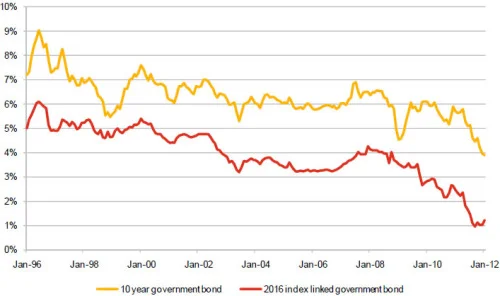
Image source: February 4, 2014 speech on “The outlook for the New Zealand economy,” by Graeme Wheeler, Governor of the Reserve Bank of New Zealan

Image source: February 4, 2014 speech on “The outlook for the New Zealand economy,” by Graeme Wheeler, Governor of the Reserve Bank of New Zealan

During my three weeks in New Zealand as a Visiting Research Fellow of the New Zealand Treasury helping New Zealand get closer to developing national well-being indices (see 1,2,3), I learned of the New Zealand Treasury’s current custom of using an 8% per year real discount rate for evaluating government projects (including “social projects”). That custom makes no sense to me; I wrote a series of emails to New Zealand Treasury officials explaining why. They took me up on my offer to give a presentation on this issue. You can see the Powerpoint file I used here, though I didn’t have time to cover the abridged version of the presentation I had given a year ago at the US Congressional Budget Office on capital budgeting that I appended after the discussion about discounting. 

Below, I have copied out the text of the emails I wrote, after subtracting some identifying information at the beginning of the first email. As usual when I talk to officials of government agencies, I am telling you what I told them and what I recommended, but–to maintain a certain degree of confidentiality–remarking only in the most general terms about their reactions. The distinct emails are marked by Roman numerals. To understand these emails, you need to know that New Zealand has a sovereign wealth fund called the Superfund. Also, it is good to have a sense of the yield on New Zealand government bond: I have a graph showing the nominal yield above, and a graph comparing the nominal to the real yield below. 


I. There is an extremely strong argument against using an 8% real discount rate in evaluating government projects. I think the argument below can be sharpened to become institutionally relevant.

Basically, an 8% real discount rate makes no sense to use unless the New Zealand government is actually getting an 8% real return on funds that it saves. It is not enough for someone to claim that the New Zealand government theoretically could get an 8% real return on funds it saves when that is not true or is only theoretical because the New Zealand government would never actually do that with funds saved by not doing a project.

The argument here also dovetails nicely with a presentation I gave at the Congressional Budget Office a little over a year ago on capital budgeting, that I would be happy to give here next week some time in addition to my other talk if there is interest. (I attached the Powerpoint file.)

Here is the argument against the 8% real discount rate used for assessing government projects in more detail:

(1) On the face of it, such a high discount rate is hard to square with the much lower government borrowing rate, which in simple cases clearly implies a benefit from borrowing to fund the project if the project has a net present value that is positive given that government borrowing rate. What is going on?

(2) Historically (perhaps back in the 1970s) the 8% per year real discount rate was motivated by the expected return on the stock market, and the idea that government projects are risky investments. But it is important to look beyond this superficially plausible set of words to the underlying logic, which doesn’t hold up.

(3) The underlying logic of the 8% per year real discount has to be that the opportunity cost of a project is that the money could be put into the stock market (say a diversified international fund) if it weren’t used for the project. This logic requires (a) that if funds weren’t used for the project that it is in fact realistic the funds would be added to the Superfund and (b) that the extra funds in the superfund would be earning an 8% per year real return.

(4) To the extent that there is a great reluctance on the part of the government to invest extra funds in the Superfund, that tends to indicate some combination of either (a) for various political or institutional reasons it is not realistic that the extra funds will be added to the Superfund or (b) the risk-adjusted return that is expected if the extra funds were added to the Superfund is much less than 8% per year in real terms. In either case, an 8% per year real return is not a relevant rate at which to discount government projects. This is easy to show in two models: (a) where the flows of funds into the Superfund (the government’s sovereign wealth fund) are fixed in a way that is exogenous to projects undertaken among the projects now being discounted at 8%; (b) where the government is rationally indifferent on the margin between investing more in the Superfund and paying off some of the debt, which then makes the interest rate on the debt the relevant one because it is in this model equivalent to a risk-adjusted return on money in the Superfund.

(5) Some might argue that the riskiness of government projects hasn’t been adequately included in the discussion above. That is true, but the risk in government projects is quite different from regular stock market risk, so the risk adjustment must be done in another way. A good method of risk adjustment for projects is to think seriously of the real dollar value they will have dependent on the level of real consumption in the economy. One virtue of thinking about the adjustment this way is also that it provides a reminder that the dollar value of the flow of benefits from many projects will tend to increase in the future simply because trend increases in per capita income will raise the willingness to pay for those benefits.

II. Just to be clear, my view is that (a) all projects that are better than putting the money in the Superfund should be done, and (b) if someone claims that a project is worse than putting money in the Superfund, then money should be put in the Superfund instead, and © if a project looks better than paying off some of the debt by buying bonds–or, almost equivalently, good enough that borrowing at the bond rate to do it looks like a positive present value–it should also be undertaken UNLESS the government is willing to issue additional bonds to put more money in the Superfund invested in risky assets.

Like Roger Farmer, I have argued that many, many governments should in fact be expanding their sovereign wealth funds (like the Superfund) by borrowing at the quite low interest rates that are possible for financially sound governments these days. Borrowing at favorable rates to better fund the Superfund (which I am assuming would invest the extra funds in a diversified international portfolio of risky assets) is indeed quite a good “project” in its own right and so should set a substantial hurdle for other projects to meet but

(1) certainly not as high as an 8% real return, assessed almost as if that were a safe return and

(2) if borrowing or using other available funds to better fund the Superfund is ruled out of court for any reason, that “project” of better funding the Superfund (and thereby implicitly investing in a diversified international portfolio of risky assets) cannot rationally be used as a comparison to set a high hurdle rate for other projects.

To argue that borrowing to better fund the Superfund should in fact be taken seriously, let me point out several other advantages to it, beyond the fact that it is a relatively high return “project”:

(i) If the accounting separates the Superfund from the rest of the government debt, then better funding the superfund makes it possible to point to the amount of bonds the government has issued to remind people of the liability the government has taken on to pay pensions in the future out of the Superfund (and whatever else the Superfund is committed to in the future). This reminder of the liability the government has taken on can be quite helpful.

(ii) Because it makes sense for a small open economy such as New Zealand’s to be investing in an internationally diversified portfolio of risky assets, better funding the Superfund will generate capital outflows that are likely to cause some depreciation in the New Zealand dollar. Some opinions suggest the New Zealand dollar is to strong to begin with, so that might be a good thing.

(iii) The issuance of additional government bonds could raise safe interest rates. As long as this is taken into account in calculating the returns to the “project” of borrowing to invest in an internationally diversified portfolio of risky asset, that “project” is still a good idea in terms of the overall government budget. For the private economy, it will lead to a safe interest rate that better reflects the the costs and benefits of various actions that New Zealand actually faces vis a vis the rest of the world. One interesting side effect of a higher safe interest rate is that land prices are likely to fall somewhat.

(iv) The choice between investing only in broadly based ETF’s and doing more actively managed diversified international investments is a hard one. However, on one end, even simply by its choice of ETF’s New Zealand could have a good effect on corporate governance around the world. On the other end, if the dangers of rent-seeking and corruption can be avoided, there may be a way to, say, use more actively managed international diversified investments as a way for New Zealanders to learn more about technologies in the companies they invest in, for example.

Note in all of this that other projects that are actually better than investing internationally are being undertaken, after a full assessment of all the costs and benefits of those projects, including how those costs and benefits are correlated with high levels of per capita consumption or low levels of per capita consumption.  

III. Note that all these arguments boil down to saying that one can argue quite sincerely that if someone claims that despite meeting the present value test according to the government borrowing rate that a project is less good than investing internationally in risky assets, it implies that one should be investing internationally in risky assets, NOT necessarily that the project should not be undertaken (though one would have to reassess after investing internationally in risky assets as appropriate). If investing internationally in risky assets is ruled out, then the simpler present value test relative to the borrowing rate is the right one.  

IV. Thoughts on how to frame a rule for the evaluation of projects in relation to their intertemporal dimension–and in relation to their interpossibility dimension given that outcomes are uncertain:

A. It is appropriate to use the government borrowing rate to evaluate the intertemporal dimension of projects …

B. PROVIDED that the ever-present option of adding more funds to the Superfund is enrolled in the list of possible projects to be evaluated. Actually, this option of adding more funds to the Superfund is a number of different projects, since adding the first $1 billion dollars is a different proposition from adding the 101st additional $1 billion; if adding the first $1 billion is actually undertaken, then adding the 2d $1 billion must be added to the list of projects to be evaluated and compared with other projects.

C. The simplest application of the (real) government borrowing rate as a discount rate is when the (real) dollar value of of benefits and costs is certain. But this is uncommon. How should one deal with uncertainty? Here is my suggestion:

1. The strong assumptions needed to use a market risky rate to adjust for risk definitely do not hold. This is for many reasons, but the simplest is to say that the kinds and details of risks entailed by government projects tend to be different from the kinds and details of risks entailed by private projects. Hence, market risky rates should not be referred to at this stage. Provision B expresses well the primary and big way in which market risky rates are relevant.

2. Any adjustment for the risk in the cost and benefits of a government project in real dollars needs to be serious about asking “How will the costs and benefits change depending on how high the level of per capita consumption is?” Sometimes the answer to this question may depend on why per capita consumption is high or low in a future situation, but often a reasonable answer can be given simply by considering the likely benefits and costs in more or less prosperous possible futures.

A simple example of variation in the real dollar value of a project is that the willingness to pay for most non-market goods goes up when people have more money from which to pay.

3. It is also essential for good project evaluation that the overall upward trend in per capita GDP be realistically taken into account. For example, since on average the future is likely to be more prosperous than the present, we can anticipate that on average, the willingness to pay in real dollars for then current non-market goods is likely to be higher in the future than in the present.

4. Projects that provide benefits that are just as high in real dollar terms in bad financial situations where dollars are more precious as in good situations where dollars are less precious (which can be discounted quite simply at the government borrowing rate) are more valuable than otherwise similar projects that provide benefits that are high in real dollar terms primarily when dollars are also less precious and provide benefits that are lower when dollars are very precious. This should be assessed.

5. In assessing the extent to which the typical project which evinces benefits with higher willingnesses to pay in good financial situations than bad should be marked down in attractiveness relative to a simple discounting of its expected real dollar benefits by the government borrowing rate, there is a serious discussion to be had about what level of risk aversion should be applied. As someone who has devoted a significant part of my career to studying and thinking about risk aversion, I want to insist that much is unknown here and that a simplistic application of the level of risk aversion that seems to be implicit in some particular financial market (without regard to all of the conflicting evidence about risk aversion in other markets and other decisions) is inappropriate. I think it is best for the government to make its own, separate determination of an appropriate level of risk aversion to apply based on a vigorous internal debate about this very issue, which should involve philosophical considerations and a wide range of survey data on people’s preferences as a counterpoint to market data. I would be delighted to be involved in such a debate. (I have a presentation or two in my back pocket on this, but consider presenting them less urgent than the one on capital budgeting that is a strong complement to the series government discount-rate memos I have been sending by email.) Based on what I know, I would apply a risk aversion curvature in per capita consumption of not more than 2.

John Stuart Mill on the Regulation of Bars

John Stuart Mill’s discussion of the regulation of bars and the like in paragraph 10 of On Liberty “Chapter V: Applications” touches on many key issues that arise for contested laws:

  1. Something OK in itself may have a high transition probability into bad behavior. This may warrant some regulation if that regulation is genuinely focused on the bad behavior that there are genuinely high transition probabilities into.
  2. The need for some regulation can often be used as an excuse for either (a) creating monopoly rents for favored individuals or (b) trying to suppress something under the guise of regulation.
  3. There is a real issue of when we should assume that people are competent to make good decisions for themselves and when they or at least their future selves would be glad for guidance and help in making decisions, even when there some government intervention in that guidance and help. This is a matter of degree rather than necessarily an absolute either-or issue. This issue has been raised in recent years by Behavioral Economics and was raised by John Stuart Mill in a counterpoint between his condescending attitude toward the working class and his dislike of governmental bossiness. John Stuart Mill makes the point that the government must have a well-thought-out graduated licensing scheme (as many states now have for drivers’ licenses) in order for the claim that one is temporarily restricting something to help someone learn as someone learns how to handle internal conflicts holds up. He seems to assume that people can ultimately many to resolve their internal conflicts.

He writes:

The question of making the sale of these commodities a more or less exclusive privilege, must be answered differently, according to the purposes to which the restriction is intended to be subservient. All places of public resort require the restraint of a police, and places of this kind peculiarly, because offences against society are especially apt to originate there. It is, therefore, fit to confine the power of selling these commodities (at least for consumption on the spot) to persons of known or vouched-for respectability of conduct; to make such regulations respecting hours of opening and closing as may be requisite for public surveillance, and to withdraw the license if breaches of the peace repeatedly take place through the connivance or incapacity of the keeper of the house, or if it becomes a rendezvous for concocting and preparing offences against the law. Any further restriction I do not conceive to be, in principle, justifiable. The limitation in number, for instance, of beer and spirit houses, for the express purpose of rendering them more difficult of access, and diminishing the occasions of temptation, not only exposes all to an inconvenience because there are some by whom the facility would be abused, but is suited only to a state of society in which the labouring classes are avowedly treated as children or savages, and placed under an education of restraint, to fit them for future admission to the privileges of freedom. This is not the principle on which the labouring classes are professedly governed in any free country; and no person who sets due value on freedom will give his adhesion to their being so governed, unless after all efforts have been exhausted to educate them for freedom and govern them as freemen, and it has been definitively proved that they can only be governed as children. The bare statement of the alternative shows the absurdity of supposing that such efforts have been made in any case which needs be considered here. It is only because the institutions of this country are a mass of inconsistencies, that things find admittance into our practice which belong to the system of despotic, or what is called paternal, government, while the general freedom of our institutions precludes the exercise of the amount of control necessary to render the restraint of any real efficacy as a moral education.

Owen Nie: Pre-Revolutionary Paper Money in Pennsylvania

Following up on “Owen Nie: Playing Card Currency in French Canada,” Owen Nie offers here another guest post on monetary history. This one is drawn from Richard Lester’s “Currency Issues to Overcome Depressions in Pennsylvania, 1723 and 1729.” Monetary Experiments: Early American and Recent Scandinavian. New York: Augustus M. Kelley, 1970. 56-111. 


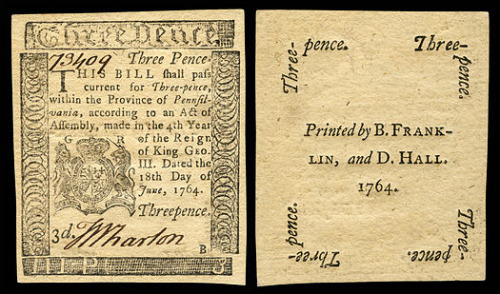
This chapter provides a detailed account of the two attempts, in 1723 and in 1729, to combat depression by monetary expansion in Pennsylvania prior to the Revolutionary War. Before this monetary experiment, the scarcity of metallic money, a result of the lack of mints in North America and the prohibition by the British government of exporting gold and silver to the colonies, was widely considered a cause for business depression in Pennsylvania as well as in other North American colonies in various historical accounts. In answer to the scarcity of a medium of exchange, the Pennsylvania Assembly passed an act in 1723 to issue 15,000 pounds of paper money as a remedy. This soon brought about a remarkable recovery in business conditions and trade activities (mostly British imports into Pennsylvania) without engendering inflation and runaway speculation. By 1729 the necessity for additional monetary expansion was becoming apparent and hence a bill to issue an additional 30,000 pounds was passed and a new round of revival of business soon ensued. The two monetary expansions enabled Pennsylvania to enjoy more favorable price levels and exchange rates in the following years. Pennsylvania’s success and prosperity was such that the colonists protested vehemently when the British Board of Trade prohibited the American colony from issuing paper money in 1764. There seem to be general agreement that these currency expansions, with combating depression as their sole objective, had been a remarkable success.

Quartz #65—>Why Thinking about China is the Key to a Free World

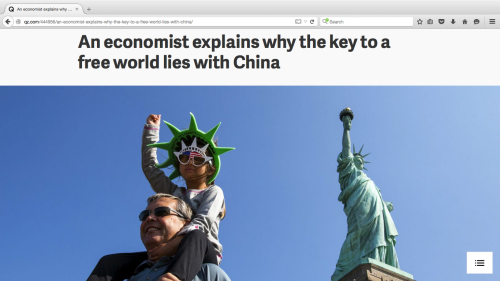
Here is the full text of my 65th Quartz column, “An economist explains why a key to the free world lies with China,” now brought home to supplysideliberal.com. It was first published on July 3, 2015. Links to all my other columns can be found here.

Ori Heffetz pointed out the error of my counting 239 years (“almost a quarter of a millenium”) of freedom in the United States since 1776, since the key date for freedom in the United States can’t be counted any earlier than the adoption of the 13th Amendment to the Constitution on December 18, 1865 abolishing legal slavery in the US. We are coming up on the 150th anniversary of that event later on this year. This actually reinforces my statement in the first sentence of the column that freedom is a rarity in human history. I am leaving this error in the column itself, because it is an instructive error, once pointed out. 

In addition to comments here, don’t miss the comments and debate in reaction to my first link to the Quartz column.    

If you want to mirror the content of this post on another site, that is possible for a limited time if you read the legal notice at this link and include both a link to the original Quartz column and the following copyright notice:

© July 3, 2015: Miles Kimball, as first published on Quartz. Used by permission according to a temporary nonexclusive license expiring June 30, 2020. All rights reserved.


Freedom is a rarity in human history, and still too much of a rarity in the world today. This should be no surprise. Would-be tyrants abound, and it is not easy to establish a system that keeps them all in check. The wonder is that we can celebrate the better part of a quarter of a millennium of freedom in the United States, and comparable freedom in some other lucky countries.

When Dan Benjamin, Ori Heffetz, Nichole Szembrot and I surveyed more than four and a half thousand Americans about what they viewed as the most important objectives for public policy, the top two (of 131 choices) were “freedom from injustice, corruption, and abuse of power in your nation,” and “people having many options and possibilities in their lives and the freedom to choose among them.”

This pairing of responses shows an awareness of the danger to freedom from those who would organize the institutions of a nation to serve the interests of an in-group at the expense of an out-group. At the beginning of the struggle toward freedom, the in-group is very small and the out-group large. At later stages of the struggle toward universal freedom, the in-group will be large and the out-group small. But adding up across the world, it is not at all clear that a majority of the people in the world today can be called truly free.

In international struggles for freedom, the advantage free nations have had in per capita income has helped to keep them from being overwhelmed by a coalition of dictatorships and oligarchies. As Daron Acemoglu and James Robinson argue in Why Nations Fail, the level of economic freedom necessary to enjoy the full benefits of innovation presents a constant danger of undermining the power of those currently in charge. As long as a country is getting up to speed on existing technologies and settled best practices, such dangers can be kept within bounds. But, a small in-group with a toehold on power is loathe to allow a creative adventure into the unknown that could transform the political arena as well as the economy.

The key to the future of freedom in our world is China. Its one-and-a-quarter billion people and high rate of economic growth are the reasons its course is so important to the future:

  • In the best case, China may evolve toward full freedom, and the full measure of prosperity possible when no one group manages to obstruct progress in order to cling to power.
  • China may descend into a civil war, with advanced weapons on more than one side of that war.
  • China may become like Russia under Putin, only more powerful: nominally democratic, but authoritarian and aggressively nationalistic.
  • China may continue under the rule of a nominally Communist oligarchy as now, but with economic growth gradually slowing (because of the limits to economic liberalization without political liberalization) so that it stalls out at a GDP per person perhaps 30-40% of that in the US—which would still make the total size of its economy significantly larger than that of the US, simply because China has so many more people.

Thus, over a horizon of two or three decades, China is dangerously unpredictable. The last three possibilities—Chinese civil war, a Chinese Putin, or continued dominance by an oligarchy that attacks freedom as a faulty Western conceit—all represent serious dangers to the progress of freedom in the world, as well as to peace. The imperative of raising the likelihood of full freedom in China means that trying to stand in the way of Chinese economic growth is not the answer. And one should remember Berkeley economist Brad DeLong’s question: “Does it really improve the national security of the United States for schoolchildren in China to be taught that the United States sought to keep them as poor as possible for as long as possible?”

If one rejects the fool’s errand of trying to stunt the economic growth of a dangerously unpredictable China, the best course to protect freedom and relative peace in the world is to make the free world stronger: numerically, economically, militarily, and in the quality of life freedom can be shown to provide. On all of these fronts, I worry about what I see as a lack of seriousness by the leaders and citizens of the free world about meeting the challenge of China.

Strengthening the free world numerically

Bringing more people into the free world is easier than it sounds. The key is to focus on people, not patches of ground. Although it is hard to bring a patch of ground currently subject to an oppressive regime under free institutions, the economic importance of land—apart from what is on top of the land—continues to decline relative to the importance of people, education and training, ideas and capital. Once one focuses on people, the answer is clear: bring people to where freedom already rules. That is so easy it is hard to do the opposite. Many people in benighted countries seek freedom and the prosperity that full freedom enables. Standing in the way of those hopes, many otherwise free countries make strenuous efforts to keep those people seeking prosperity and freedom out.

The rhetoric is all about those hoping to join the free world taking away the jobs of those already there. Forgotten is the fact that those hoping to join the free world will also serve in the armed forces and pay taxes to support those armed forces, as well as raise children who will invent the technologies that can help us meet the challenge of China economically as well as militarily. (For the record, the only persuasive evidence for immigrants materially hurting the job prospects of those already here is for them hurting the job prospects of other recent immigrants.)

Despite the relative difficulty of bringing nations closer to full freedom, there is important work to be done in that arena—particularly in solidifying and deepening freedom in nations that are well along the road toward freedom, but need to go further. The people in Turkey recently voted decisively against creeping dictatorship. I agree with The Economist in calling for the European Union to move forward with admitting Turkey in order to solidify those gains. And because of the number of people involved, helping India reach its full potential is of crucial importance for the free world.

Strengthening the free world economically

It is much better to have the democratic tug of war between different groups each looking to get their share of the pie than it is to have one favored group that alone gets its way. But when it comes to strength in a dangerous world, it is the size of the pie that matters most. Economists actually have excellent tools for understanding what it takes to foster economic growth. Monetary policy tools for stabilizing the economy are advancing faster than most people realize.

And although issues of taxation and certain labor market rules continue to be contentious, there is broad agreement among economists about many key measures to foster long-run economic growth: improving education, pouring resources into research and development, and preserving economic freedom: the ability to do new things in new ways without your competitor being able to get the government to stop you. In the area of economic policy, one of the biggest problems is simply the amount of political airtime taken up by a small set of issues that leaves little time to discuss everything else.

Strengthening the free world militarily

Militarily, one of the free world’s successes is now also a weakness. After World War II, great efforts were made to encourage pacifism in Japan and Germany. Those efforts bore remarkable fruit. Anyone who spends any time in Japan or Germany soon learns how deep pacifism runs in those countries now. Japan’s pacifism only affects its own military efforts, but Germany’s pacifism has contributed to pacifism in the rest of Europe. For the rest of the free world, I would riff on St. Augustine by saying “Make me pacifist, but not yet.” Peace is important, but so is freedom. Let freedom triumph; then we can hope to be able to afford pacifism. In the meanwhile, the pacifism of Japan and Germany means that the rest of the free world needs to shoulder a bigger military burden.

Given numerical and economic strength–fostered by more immigration, education, research and economic freedom–there is no lack of ideas for how to turn technological sophistication and military spending into military strength (with all the frightfulness inherent in military strength). A fascinating article in The Economist details some of these ideas:

  • putting a new generation of autonomous drones in the air and under the sea
  • lasers and electromagnetic rail guns to protect aircraft carriers against incoming missiles without the huge expense of current anti-missile missiles
  • making our own communications and computing networks robust to enemy attack, while going after theirs.

For the free world, the objective of military strength is not war, but deterrence. What all scenarios for China’s future hold in common is that China is likely to behave better if it faces a relatively strong American military than if it faces weakness.

Strengthening the case for freedom

When the free world does well, it is much harder for the unfree world to keep out the winds of freedom. But autocracies use every failure of the free world to argue that autocracy isn’t so bad in comparison. In making the case for freedom, good economic policy in the free world goes a long way. But making sure that the benefits of freedom extend to everyone is also crucial.

Some argue that the way to make sure that the benefits of freedom extend to everyone is to expand government social programs. But the use of government power when it is not necessary is itself an affront to freedom, since people are in effect being told to “get with the program” or be thrown in jail. I don’t think we currently know how to get done what needs to be done with a doctrinaire libertarian approach, but we can edge in that direction. People want to help others who are less fortunate. The only thing that stops them from doing what needs to be done voluntarily is concern about the time and resources that might take away from their own families.

So, as I advocated here in “Yes, There is an Alternative to Austerity vs. Spending: Reinvigorate America’s Nonprofits,” it is enough to use the arm of the government to require more substantial charitable contributions, while giving people wide latitude to decide which particular causes they want to support. This can both assist in things the government is now doing, such as taking care of senior citizens and supporting medical research, and begin to take care of things that should be done, but aren’t. With millions of people each required to do something, but allowed to think and decide for themselves what most needs to be done, the odds that the benefits of freedom and prosperity extend into all the nooks and crannies of society improve dramatically.

Finally, though efforts to measure national well-being in ways that respect the full range of things human beings care about are still in their infancy, there is hope that developing such measures as counterpoints to GDP can guide public policy toward ways of improving the quality of life in nations that use them in unexpected ways. Such measures of national well-being might also be used by autocrats to keep those they rule over just happy enough to forestall rebellion, but those rulers would be faced with this truth: people love freedom, and will never be content for long without it.
These different defenses of literature are connected with different conceptions of democracy. The world-citizen view insists on the need for all citizens to understand differences with which they need to live; it sees citizens as striving to deliberate and to understand across these division. It is connected with a conception of democratic debate as deliberation about the common good. The identity-politics view, by contrast, depicts the citizen body as a marketplace of identity-based interest groups jockeying for power, and views difference as something to be affirmed rather than understood. Indeed, it seems a bit hard to blame literature professionals for the current prevalance of identity politics in the academy, when these scholars simply reflect a cultural view that has other, more powerful sources. Dominant economic views of rationality with the political culture have long powerfully promoted the idea that democracy is merely a marketplace of competing interest groups, without any common goals and ends that can be rationally deliberated. Economics has a far more pervasive and formative influence on our life than does French literary theory, and it is striking that conservative critics who attack the Modern Language Association are slow to criticize the far more powerful sources of such anticosmopolitan ideas when they are presented by market economists. It was no postmodernist, but Milton Friedman, who said that about matters of value, ‘men can ultimately only fight.’ This statement is false and pernicious. World citizens should vigorously criticize these ideas wherever they occur, insisting that they lead to an impoverished view of democracy.

Stephen Strobbe’s 12 Life Lessons

At the University of Michigan we have a student-selected “Golden Apple” award for excellent teachers. The winners traditional give an “Ideal Last Lecture.” I liked the 12 life lessons Golden Apple Winner Stephen Strobbe gave. (You can see the full article in the University of Michigan’s University Record here.) Here they are:

  1. Ultimately, you are responsible for your own happiness.
  2. You can’t accomplish much of anything by yourself.
  3. Everything doesn’t happen for a reason.
  4. Sometimes it’s wonderful to be wrong.
  5. You can learn something from almost anyone.
  6. You don’t need to learn all of life’s lessons the hard way, just the important ones.
  7. Say yes to more than you think you can do.
  8. Ask for what you need.
  9. Surround yourself with people who want you to succeed.
  10. Let yourself be adopted by a dog.
  11. Seek good counsel, and then use it.
  12. When the time comes, you will be enough.