John Stuart Mill Worries about Money Corrupting Advocacy and Facilitation
John Stuart Mill is not always as libertarian as people think. After defending free speech vigorously in an earlier chapter, in paragraph 8 of On Liberty “Chapter V: Applications,” he defends the idea of driving vice underground if the people advocating and facilitating it are likely to be advocating and facilitating it primarily for the money. However, he makes an interesting distinction: if paid facilitation is necessary to enable people to pursue vice, it must be allowed. But if home-production is adequate to make the vice possible, then it is legitimate to make the market provision of facilitation illegal in order to drive it underground, where it will be less of a bad influence. Here is what he writes:

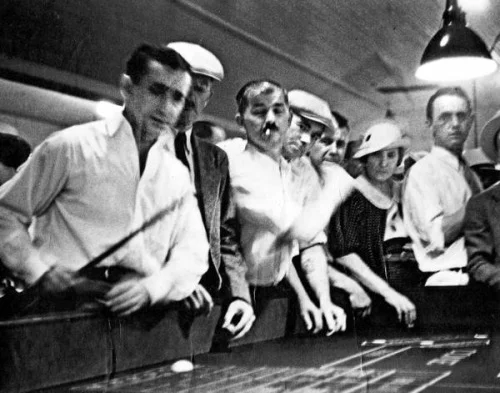
There is another question to which an answer must be found, consistent with the principles which have been laid down. In cases of personal conduct supposed to be blameable, but which respect for liberty precludes society from preventing or punishing, because the evil directly resulting falls wholly on the agent; what the agent is free to do, ought other persons to be equally free to counsel or instigate? This question is not free from difficulty. The case of a person who solicits another to do an act, is not strictly a case of self-regarding conduct. To give advice or offer inducements to any one, is a social act, and may, therefore, like actions in general which affect others, be supposed amenable to social control. But a little reflection corrects the first impression, by showing that if the case is not strictly within the definition of individual liberty, yet the reasons on which the principle of individual liberty is grounded, are applicable to it. If people must be allowed, in whatever concerns only themselves, to act as seems best to themselves at their own peril, they must equally be free to consult with one another about what is fit to be so done; to exchange opinions, and give and receive suggestions. Whatever it is permitted to do, it must be permitted to advise to do. The question is doubtful, only when the instigator derives a personal benefit from his advice; when he makes it his occupation, for subsistence or pecuniary gain, to promote what society and the State consider to be an evil. Then, indeed, a new element of complication is introduced; namely, the existence of classes of persons with an interest opposed to what is considered as the public weal, and whose mode of living is grounded on the counteraction of it. Ought this to be interfered with, or not? Fornication, for example, must be tolerated, and so must gambling; but should a person be free to be a pimp, or to keep a gambling-house? The case is one of those which lie on the exact boundary line between two principles, and it is not at once apparent to which of the two it properly belongs. There are arguments on both sides. On the side of toleration it may be said, that the fact of following anything as an occupation, and living or profiting by the practice of it, cannot make that criminal which would otherwise be admissible; that the act should either be consistently permitted or consistently prohibited; that if the principles which we have hitherto defended are true, society has no business, as society, to decide anything to be wrong which concerns only the individual; that it cannot go beyond dissuasion, and that one person should be as free to persuade, as another to dissuade. In opposition to this it may be contended, that although the public, or the State, are not warranted in authoritatively deciding, for purposes of repression or punishment, that such or such conduct affecting only the interests of the individual is good or bad, they are fully justified in assuming, if they regard it as bad, that its being so or not is at least a disputable question: That, this being supposed, they cannot be acting wrongly in endeavouring to exclude the influence of solicitations which are not disinterested, of instigators who cannot possibly be impartial—who have a direct personal interest on one side, and that side the one which the State believes to be wrong, and who confessedly promote it for personal objects only. There can surely, it may be urged, be nothing lost, no sacrifice of good, by so ordering matters that persons shall make their election, either wisely or foolishly, on their own prompting, as free as possible from the arts of persons who stimulate their inclinations for interested purposes of their own. Thus (it may be said) though the statutes respecting unlawful games are utterly indefensible—though all persons should be free to gamble in their own or each other’s houses, or in any place of meeting established by their own subscriptions, and open only to the members and their visitors—yet public gambling-houses should not be permitted. It is true that the prohibition is never effectual, and that, whatever amount of tyrannical power may be given to the police, gambling-houses can always be maintained under other pretences; but they may be compelled to conduct their operations with a certain degree of secrecy and mystery, so that nobody knows anything about them but those who seek them; and more than this, society ought not to aim at. There is considerable force in these arguments. I will not venture to decide whether they are sufficient to justify the moral anomaly of punishing the accessary, when the principal is (and must be) allowed to go free; of fining or imprisoning the procurer, but not the fornicator, the gambling-house keeper, but not the gambler. Still less ought the common operations of buying and selling to be interfered with on analogous grounds. Almost every article which is bought and sold may be used in excess, and the sellers have a pecuniary interest in encouraging that excess; but no argument can be founded on this, in favour, for instance, of the Maine Law; because the class of dealers in strong drinks, though interested in their abuse, are indispensably required for the sake of their legitimate use. The interest, however, of these dealers in promoting intemperance is a real evil, and justifies the State in imposing restrictions and requiring guarantees which, but for that justification, would be infringements of legitimate liberty.

John Stuart Mill’s emphasis in this passage on the corrupting influence of money makes me think about the debate over restrictions on campaign contributions. There, I do think that the distinction the Supreme Court has made between direct contributions to a candidate and “independent” expenditures makes some sense. But I might draw the line a little differently: as long as money will only help a candidate win an election, this seems important enough for free speech that it should probably be allowed. But if money is given into such direct control of the candidate that the candidate can turn it to personal use–including even moderate luxury on the campaign trail–the potential for corruption seems more severe and the argument for limiting things becomes greater. This is actually an argument for prohibiting campaign funds from being used for the candidate’s comfort rather than an argument for limiting contributions to a campaign fund. If such a restriction had the side-effect of discouraging people who like high levels of material comfort–that they can’t pay for out of their own pockets–from running for office, that might not be a bad thing.

As regards literature, postmodernism recognizes no large, collective enterprise with a clear direction that all legitimate participants must respect. Though the history of interpretation is not cyclical, there is no reason why what has been done already in interpretation may not be done again if we find it rewarding. … The more innovation comes to seem mere variation, the more easily the old and neglected can become new again. There exists no historical imperative to be obeyed or disobeyed. Nothing must be done. Anything might be done. When the results are interesting, they are not interesting because they constitute ‘progress.’ Evidence coerces. Art merely seduces.

– Jack Miles, in Christ: A Crisis in the Life of God, pp. 330-331

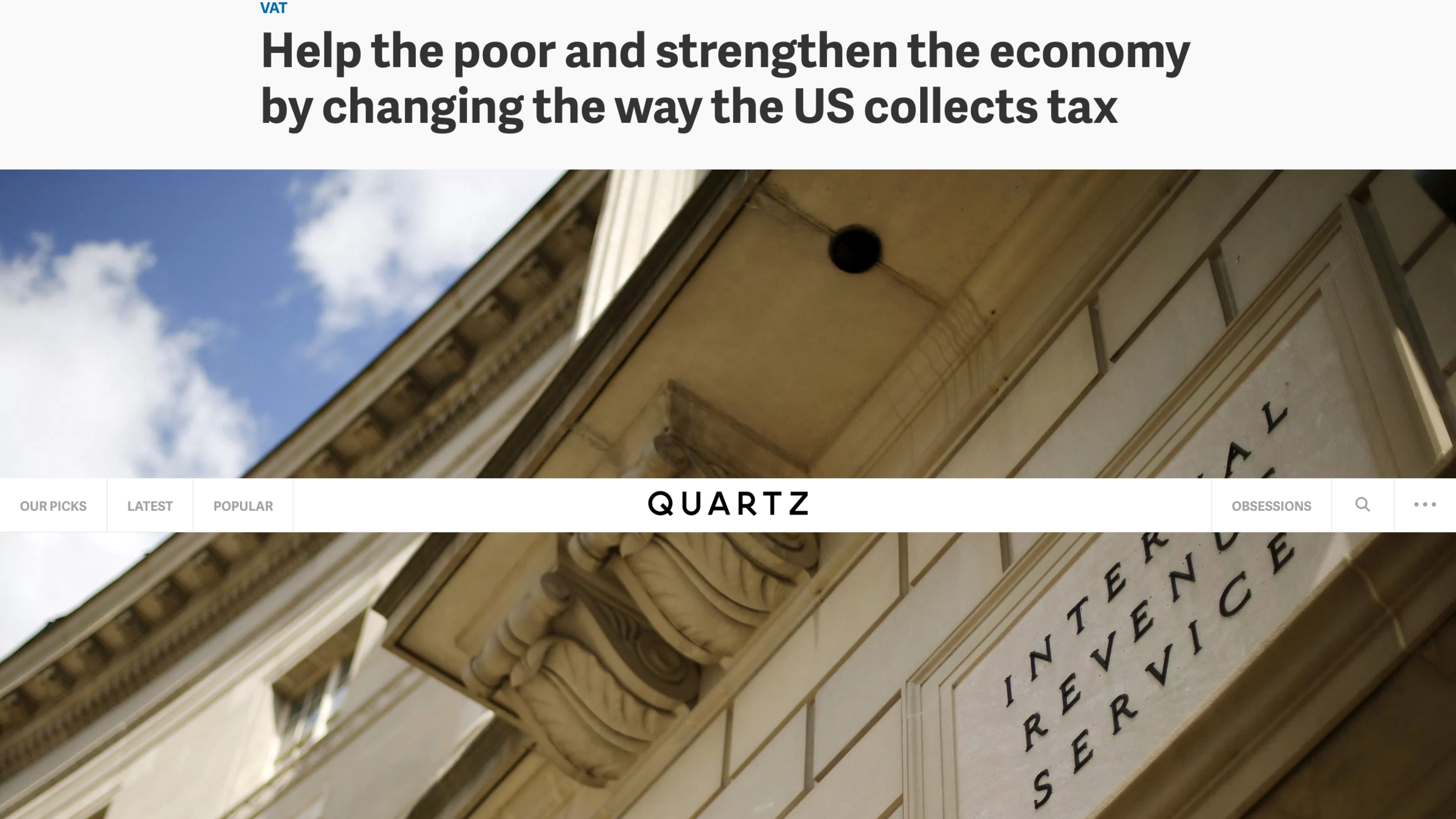
Quartz #63—>VAT: Help the Poor and Strengthen the Economy by Changing the Way the US Collects Tax

Here is the full text of my 63d Quartz column, “VAT: Help the poor and strengthen the economy by changing the way the US collects tax,” now brought home to supplysideliberal.com. It was first published on June 8, 2015. Links to all my other columns can be found here.

If you want to mirror the content of this post on another site, that is possible for a limited time if you read the legal notice at this link and include both a link to the original Quartz column and the following copyright notice:

© June 8, 2015: Miles Kimball, as first published on Quartz. Used by permission according to a temporary nonexclusive license expiring June 30, 2020. All rights reserved.


Despite a hard first quarter, someday soon the US economy may be in a position where it needs people to save more instead of spend more. Economists will start talking about the importance of having people save to provide funds for investment instead of the importance of having people spend to generate enough demand that investment is worthwhile. A few weeks ago, I pointed out in “How Increasing Retirement Saving Could Give America More Balanced Trade” how increasing the saving rate can also raise net exports, in a way that has a long-lasting positive effect on jobs. And I pointed out how a regulation making saving something automatic people have to opt out of, instead of something they have to opt into, could dramatically raise the saving rate.

A change in our tax system could also raise the national saving rate: shifting from taxing income to taxing only the part of income that is consumed, while exempting the part of income that is saved. The clean, well-tested way to tax consumption rather than income is to use a value added tax or VAT.

A VAT tax is like a sales tax on final sales to households that is collected gradually all along the way as goods and services are produced. It is structured so that the buyers in business-to-business transactions are motivated to check that the sellers are paying the tax—which makes it much harder to cheat on than other taxes.

Most rich, well-run countries other than the US use a value added tax. And though it is much harder to compare saving rates accurately across countries than one might think, most of those other countries seem to have higher saving rates than the US. In saying all of this about a VAT tax, I am only repeating the conventional wisdom, which I think in this regard is by and large on target.

But there is another aspect of the conventional wisdom about a VAT tax that I think is totally off target: the idea that a VAT tax hits the poor especially hard. Part of this misconception comes from the simple fact that measuring how progressive or regressive a tax is by the fraction of income paid in taxes at different levels of income is already sneaking in the idea that income is the right basis for taxation—exactly the question that is at issue. Measuring how progressive or regressive a tax is by the fraction of consumption paid in taxes at different levels of consumption would give a different picture.

The other part of this misconception is that typical measures of progressivity or regressivity ignore the other side of the ledger: the government assistance that people are given at different levels of income or consumption. Ignoring that side of the ledger slips in an assumption about how government assistance would be affected by a VAT tax that seems wrong to me. (Here I am counting Social Security and Medicare as government assistance since people don’t have individual Social Security or Medicare accounts and the government can change the level of benefits at any time.)

To think about how taxing consumption taxes rich and poor consider this question: “Who can afford to spend more than they earn from their job?” People who absolutely can’t afford a given level of spending will ultimately fall so deeply in debt that outside forces will stop them from spending so much. So they may pay more taxes on their consumption now, but will pay fewer taxes later. So it is the consumption people can afford that matters for consumption taxes over the long haul.

There are two basic ways you and your immediate family might be able to afford to spend more than you earn from jobs: have a pile of your own wealth to draw on for consumption or have someone else give you money to spend. Other things equal, having a pile of your own wealth to draw on for consumption makes you richer; so that side of things makes a consumption tax–such as a VAT–progressive. If someone else is giving you money to spend when you don’t really need it, that counts as being rich in a spongeing sort of way. Or to put it better, although ignoble, the ability to convince other people to let you sponge off of them is its own form of wealth.

On the other hand, if someone is giving you money to spend because you really do need it, they should realize that the amount of money you need has to be grossed up enough to get the same amount of goods and services even after paying the VAT. In particular, if the someone giving you money to spend is the taxpayer, through the government, whatever dire need motivated the taxpayer to help you out is a need for a given amount of goods and services, and the dollar value of the government assistance should of course be grossed up enough to buy the same amount of goods and services even after paying for the VAT. Since consumer price indices are usually calculated including VAT taxes, this could happen through the standard process of cost-of-living adjustments.

Notice that the government receives the VAT taxes paid on goods purchased with money from government assistance. So grossing up the government assistance to pay the VAT tax is just shuffling money from one government account to another and isn’t an unsustainable drain on the government budget.

Of course, the shift to a VAT tax could be used as an excuse to cut the amount of goods and services provided as government assistance. That would be regressive. But analytically that should be considered a shift to a VAT tax in the more neutral assistance-preserving way described above plus a cut in government assistance. The VAT tax itself should not be blamed for this effective cut in government assistance. But in the flawed accounting all too often used, the VAT tax is blamed for this unmotivated and far from inevitable cut in the effective level of government assistance.

What I have laid out is not the end of the story; there are many other issues in the transition to a value-added tax—for example, while lowering income taxes on 401(k) distributions would keep those who saved that way under the old tax system whole, something needs to be done to honor at least in spirit the promise to those who saved in a Roth plan that after paying taxes on that saving up front, they wouldn’t be taxed later on. But the basic story is that a value-added tax is progressive when the accounting is done right and the shift to a VAT tax is not used as an unwarranted excuse to cut the effective level of government assistance. This shouldn’t really come as any surprise, since governments in many countries that intend to do a lot more redistribution than the US use a value-added tax.

Rick Perry’s New Look

In my book, Ben Bernanke is a hero for making US monetary policy as good as it was in the aftermath of the Financial Crisis of late 2008 and during the Great Recession that followed. So I will not easily forgive Rick Perry for calling Ben’s actions “almost treacherous – or treasonous in my opinion” in a speech back in August, 2011

Yet, I was intrigued by Rick Perry’s emphases said in what the Wall Street Journal called “Perry’s Race Talk,” that happened on July 2, 2015. In addition to education reform and criminal justice reform to reduce the number of Americans in prison, Rick talked about the importance of allowing enough construction so that more people can live in our most attractive cities without subsidies:

There is a lot of talk in Washington about inequality. Income inequality. But there is a lot less talk about the inequality that arises from the high cost of everyday life,” Mr. Perry says. “In blue state coastal cities, you have these strict zoning laws, environmental regulations that have prevented builders from expanding the housing supply. And that may be great for the venture capitalist who wants to keep a nice view of San Francisco Bay, but it’s not so great for the single mother working two jobs in order to pay rent and still put food on the table for her kids.

I began to more fully realize the importance of this issue when I wrote “The Wrong Side of Cobb-Douglas: Matt Rognlie’s Smackdown of Thomas Piketty Gains Traction.” Here is a key paragraph from that post (which is well worth reading in its entirety):

Above, I wrote that developers should have to pay some of the costs of reductions in the quality of life nearby when higher density is unpleasant to live nearby–say by blocking out the sun. In an earlier version of this post, I actually made the serious mistake of saying they should pay for the reduction in “land values” from development nearby. But that is wrong by a cost-benefit test. Suppose a particular housing development is neutral for the quality of life nearby. Then it would still reduce the values of land nearby by providing more housing competition. This is not a social loss but rather a shift in wealth from landowners renters and future buyers of land, which reduces inequality. So a key conceptual issue for appropriate land policy is to not think of everything that reduces neighboring land values as a bad thing, but to distinguish when (and how much) it brings down land prices by reducing the quality of life nearby from when (and how much) it brings down land prices by providing additional housing competition.

To put a point on it, a simple political economy analysis indicates that, whatever the right amount of housing in an area from a cost-benefit point of few, the local homeowners and building owners will tend to want too little of it, since any extra housing provides competition for one of their assets. If they were to get their hands on some type of government machinery allowing them to hinder the construction of additional housing …

This is a problem in most advanced countries. For example, the Sveriges Riksbank, the central bank of Sweden, is quite concerned about financial stability. But a few inquiries indicated that this was primarily a concern about the skyrocketing prices of houses in Stockholm. Those prices have at least as much to do with barriers to the construction of new housing as they do with any monetary policy action.

In general, I think the issue of allowing enough construction so that people who are not rich have a chance to live in attractive cities is important enough that it should come to mind whenever one thinks about supply-side reforms. It is also an affront to human dignity to lean toward excluding people, as I discussed in “’Keep the Riffraff Out!’” and “The Message of Jesus for Non-Supernaturalists.”

Why Thinking about China is the Key to a Free World

blog.supplysideliberal.com tumblr_inline_nqxhtu5g5m1r57lmx_500.png

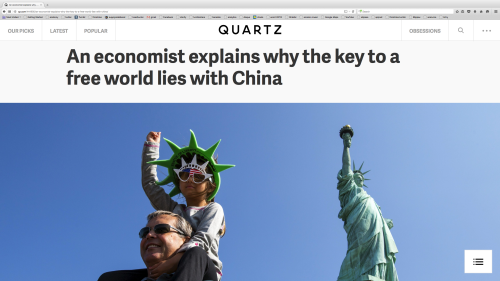
Here is a link to my 65th column on Quartz: “An economist explains why the key to a free world lies with China.” This is my July 4th column, arriving a little early. 

Update: Don’t miss the robust discussion in the comments below. I make some important clarifications there. Also, there is an interesting set of comments here on Facebook with a reply from me. 

Update July 9, 2015: On the military technology dimensions, John L. Davidson tweeted a link to this interesting article on the important work on unmanned submarines.

Next Year’s Momentous Supreme Court Decision: Reining in Public Sector Unions?

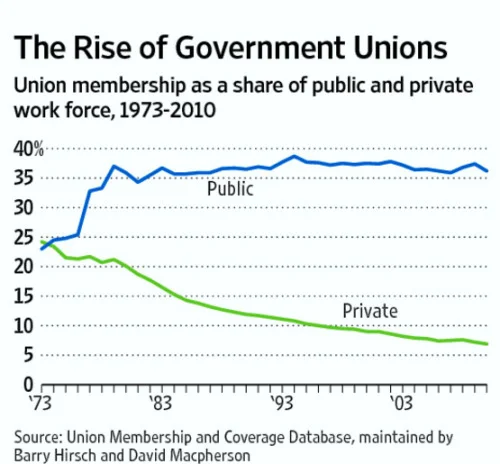
immediate image source (ultimate source is the Wall Street Journal)

immediate image source (ultimate source is the Wall Street Journal)

After its momentous decisions this year legalizing gay marriage throughout the US, saving Obamacare one more time, and preserving the option of nonpartisan redistricting, the Supreme Court of the United States said it will decide next year on whether public sector unions can legally force those who work for the government to pay union dues even if they disagree with what the union is doing. If the Supreme Court addresses this question squarely, this will be a momentous decision because public sector unions are where the action is in unionization. In the last three decades, unionization fell dramatically in the private sector, but rose dramatically in the public sector (see above). The most likely reason is that public sector unions can offer political foot-soldiers to garner votes for those of their bosses who behave themselves as well as labor peace, while private sector unions can only provide labor peace. Without the combination of a political weapon and a strike weapon, I don’t see how public sector unions could have been so much more successful than private unions. Thus, I think the challengers’ contention the public sector unions are inherently political is quite reasonable.

I am cheering for the challengers because I think a reduction in the power of public sector unions would be a big boon to the US economy. It is often very valuable to for the government to provide additional public goods. But it is not so great to pay a higher price for the same level of government-provided goods and services, simply because public sector unions have effectively brandished their two weapons: the political weapon and the strike weapon. Our concern for income distribution should always be focused on the lot of the very poorest.

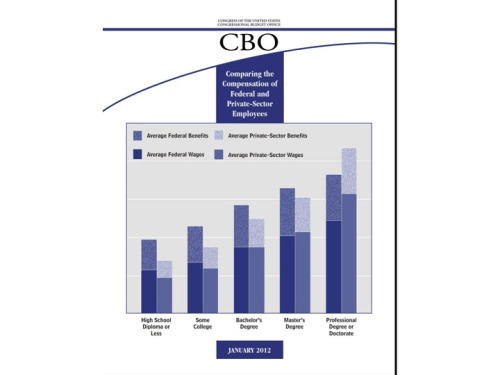
So whenever workers who are already typically paid more than comparable workers in the private sector have their wages go up further, it pushes the income distribution in the wrong way. And raising the cost of government employees who help the poor can easily lead to lower levels of service provided to the poor. This can often happen not only from price effects, but also from overall government budget pressures, as when overly generous delayed pension payments from a corrupt bargain between public sector unions and politicians that were never subjected to voter approval come due. And of course, government unions can often obstruct innovations (particularly in education) as well as draining limited government funds with wage demands that go beyond comparable private sector wages.

(Of course, I myself am officially a government employee, since the University of Michigan is a state university, but my salary owes nothing to a union. And part of my salary comes ultimately from the federal government, in the form of research support; I earnestly try to produce enough valuable research to make that a good bargain.)

Nonpartisan Redistricting

blog.supplysideliberal.com tumblr_inline_nqsbdi93iT1r57lmx_500.png

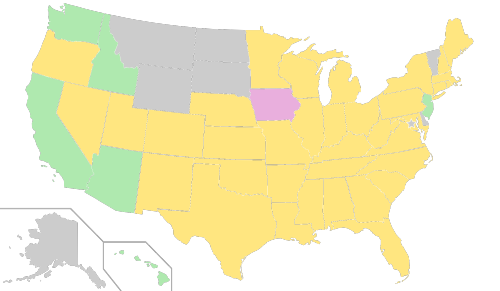
From the Wikipedia article “Redistricting Commision”: 

Legislatures control redistricting in states marked yellow, while commissions control redistricting in states marked green. In states marked purple, non-partisan staff proposes the maps, but the state legislature votes on the proposal. States marked grey have only one representative.

Since at least August 19, 2012, in my post “Persuasion,” I have been an enthusiastic proponent of nonpartisan. There I wrote:

Many people may not realize the extent to which political polarization in the House of Representatives arises from partisan and pro-incumbent redistricting. When electoral districts are designed to be either safe Republican or safe Democratic districts, then the main fear for a politician seeking reelection is losing in the primary. That typically pulls members of the House of Representatives toward the extremes. Nonpartisan redistricting is a way to have more districts be competitive in the general election and so make those running for Congress worry more about the general election relative to how much they worry about the primary. I believe this would pull politicians toward to center and toward a greater willingness to work with those in the other party. Getting change to happen in this area will be hard, but there are groups already working on this. I believe the long-run value to our Republic of nonpartisan redistricting would be substantial.

In other words since most (all but about 40 of 435) Congressional districts are designed to be safe for one party or the other, those in Congress often take actions to please their bases rather than the center. That in turn tends to push Congress toward being more of an arena of posturing rather and less of an arena for deliberating about helpful legislation.  

So I am pleased that the Supreme Court upheld the constitutionality of redistricting commissions. (I am not sure the text of the Constitution fully supports this decision, so ideally it would be good to have a constitutional amendment declaring them legal–and going beyond that, requiring them for all states.)

I hope with the issue of constitutionality settled that more and more states adopt redistricting commissions. Though this may involve short-run sacrifices of reelection probabilities, I think this is actually even in the long-run interest of a party in control of a given state, since parties that get used to appealing to the center to a greater degree are likely to grow in influence.

Bob Willis Honored with the 2015 Jacob Mincer Award for Lifetime Contributions to the Field of Labor Economics

My University of Michigan colleague and coauthor was given the Society of Labor Economist’s lifetime achievement award at the joint meeting of the Society for Labor Economics and the European Association of Labour Economists in Montreal (Fourth SOLE|EALE World Meetings, June 26-28, 2015). Let me copy from the note I received about this: 

“SOLE’s Lifetime Achievement Award was first awarded in 2004 to Gary Becker and Jacob Mincer and was henceforth named the Jacob Mincer Award.  Subsequent winners are: Orley Ashenfelter, Richard Freeman, Dale Mortensen, Reuben Gronau, Claudia Goldin, Ronald Ehrenberg and Daniel Hammermesh.  I am honored to be included in such distinguished company that includes three Nobel Prize winners (Becker, Heckman and Mortensen), three Presidents of the American Economic Association (Becker, Ashenfelter and Goldin) and a Chair of the President’s Council of Economic Advisors (Lazear).

Here is the full citation:

Robert J. Willis is Professor of Economics at the University of Michigan and Research Professor at the Institute for Social Research and the Population Studies Center, University of Michigan.  He is a Fellow and past President of the Society of Labor Economics, and is this year’s recipient of the Jacob Mincer Prize, the Society’s Career Achievement Award for lifetime contributions to the field of labor economics.

In the 1970s, Willis was one of the young labor economists who ushered in the modern era of the field with work that combined rigorous modeling and econometric sophistication and that emphasized the tight links between theory and empirical analysis that characterize labor economics.  Following his path-breaking work on the economic modelling of fertility, Willis published a number of innovative papers, including collaborations with Jim Heckman, Lee Lillard, and Sherwin Rosen, on the econometrics of longitudinal labor supply models and the treatment of self-selection in estimating the returns to education.  His many contributions to family economics, several coauthored with Yoram Weiss, include work on surprises as determinants of divorce, the inefficiency of child support payments, and an economic model of non-marital childbearing.  Working with multidisciplinary teams of researchers, Willis has examined intergenerational ties in Asian countries, including the effect of credit constraints on child investments and exchange motives for intergenerational transfers.  His work is well-known among demographers, and in 2002 he received the prestigious Mindel C. Sheps Award for outstanding contributions to mathematical demography and demographic methodology from the Population Association of America.

Willis’ contributions to labor economics include his long service (1995-2007) as Director of the Health and Retirement Study (HRS), a pivotal piece of social science infrastructure that has provided data on aging Americans and their employment, assets, health and family ties for three decades.  Under his leadership, the HRS has introduced many new survey instruments, including measures of cognitive functioning and dementia.  His latest work studies the extent of cognitive declines with aging and their implications for issues such as retirement planning, earnings, and the caregiving needs of the elderly.  This research continues the commitment to innovation, rigorous measurement, and conceptual clarity that characterizes Robert Willis’ long career in labor economics.”

John Stuart Mill on Public and Private Actions

I am always intrigued when I see John Stuart Mill arguing for less freedom than I expect. While expansive in the degree of freedom he argues for behind closed doors, In paragraph 7 of On Liberty “Chapter V: Applications,” paragraph 7, he argues for much tighter limitations on what can be done in public:

Again, there are many acts which, being directly injurious only to the agents themselves, ought not to be legally interdicted, but which, if done publicly, are a violation of good manners, and coming thus within the category of offences against others, may rightfully be prohibited. Of this kind are offences against decency; on which it is unnecessary to dwell, the rather as they are only connected indirectly with our subject, the objection to publicity being equally strong in the case of many actions not in themselves condemnable, nor supposed to be so.

I find this troubling when one considers that many actions for which it is contested whether they are injurious or not. And doing something in public as performance art can be a form a free speech. 

On the other hand, I don’t see how to make society work without some significant limitations on what one can do in public that go beyond any limitations on what one can do in private. 

I am actually quite puzzled about how to draw the line in a principled way between things that should be allowed both in public and private and those that should be allowed only in private. And it occurs to me that any serious classroom discussion of On Liberty should wrestle with this question.

The nature of injustice is that we may not always see it in our own times.

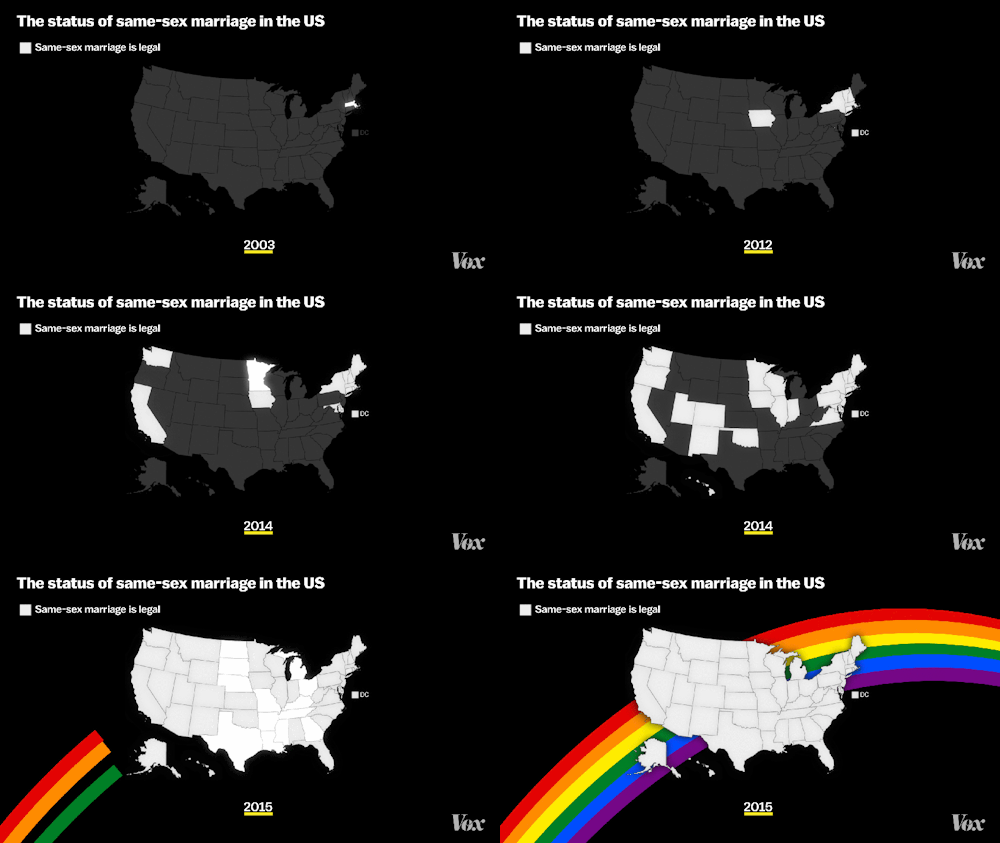
Anthony Kennedy, joined by Ruth Bader Ginsburg, Stephen Breyer, Sonia Sotomayor and Elena Kagan, in Obergefell et al. v. Hodges, the June 26, 2015 Supreme Court decision making gay marriage legal throughout the United States (p. 11).

Related reading:

The Case for Gay Marriage is Made in the Freedom of Religion

“The Hunger Games” Is Hardly Our Future—It’s Already Here