Q&A: Is Electronic Money the Mark of the Beast?

Simon: My name is Simon Hauser. I write for a german media outlet (Godmode-Trader.de) and occasionally I address your fascinating thoughts about monetary policy and in particularly e-money.

I appreciate that your “confessions” not only gravitate around the quantifiable sphere, but also around deeper and (by economists) often neglected issues like religion and the like.

To my knowledge the bible is the only sacred book that talks about E-Money - or to be more accurate - the abolishment of cash:

And he causes all, the small and the great, and the rich and the poor, and the free men and the slaves, to be given a mark on their right hand or on their forehead, and he provides that no one will be able to buy or to sell, except the one who has the mark, either the name ofthe beast or the number of his name. (Revelation 13:16)

What is you opinion about the potential dangers emanating from a unholy alliance between E-Money and a „beast“ for the concept of liberty? Wouldn’t E-Money – besides all positive effects it offers – be the ultimate tool of subjugation in the hands of a future system, which might lurk in the fat tail of probability distribution?

Best regards from an avid reader.

Miles: At first I was excited to read in your email that e-money was in the Bible. But as you point out, only as the work of the devil!

As far as liberty goes, it is important that my system is one that keeps paper currency around. It does not try to disadvantage paper currency, only to keep the interest rates on paper currency in line with the interest rates available electronically.  

Also, as a critique of the idea of just abolishing paper money, I always argue that it is hard to stop people from using paper currency completely because for some transactions there is a high demand for secrecy. If a government tried to abolish paper currency completely, people would start using foreign paper currency. A government could effectively tax paper currency to a substantial degree before people switched to a foreign paper currency, but there is a limit. (For the graphs in my Powerpoint file, I took a -20% interest rate on paper currency as my very rough guess for about how low the interest rate on domestic paper currency could be before people switched to using a foreign paper currency–in a context where the government was doing the usual things to discourage people from using foreign paper currency.) I don’t think it is that easy to take away people’s ability to do transactions in secret.

Miles’s Addendum: A famous economist (whose identity I will protect) made to me the following very interesting point: for those who worry about oppression by a future government worse than the government we have now, it is a mistake to put any faith in paper money. It is very easy for a government that sees paper money as subversive to make paper money worthless by issuing huge amounts of it. A technically cutting-edge country willing to annoy foreign countries, can even make foreign paper money worthless by issuing large amounts of high-quality counterfeit bills. Rather than putting faith in paper currency, a much better check on the power of a future government would be for the current government to issue convenient gold and silver coins of specified weight that could be used as money in dire future circumstances. As long as these gold and silver coins were not given a dollar value in non-apocalyptic times, but rather were labeled by weight, and were not used as a unit of account, they would not interfere with monetary policy in pre-apocalyptic dimes. (Their dollar values would fluctuate in value relative to electronic dollars according to supply and demand for gold and silver.) Of course in an apocalyptic situation, these coins would become a unit of account among those fighting the oppressive government–and that is as it should be. 

Notice that having had a gold standard means nothing in an apolacyptic situation because the government can simply go off that gold standard; what is needed in an apocalyptic situation is actual gold coins of known weight, or something else that can easily be used as a commodity currency. Those gold coins or other things that can serve as a standby commodity currency don’t cause any trouble in the non-apocalyptic situation as long as they have a fluctuating price relative to the unit of account in the non-apocalyptic times.    

Brad DeLong: Try Everything

I very much like Brad DeLong’s message here. 

Brad is happy to include my proposals within the scope of “Try everything.” Here is my Twitter interaction with him on that. 

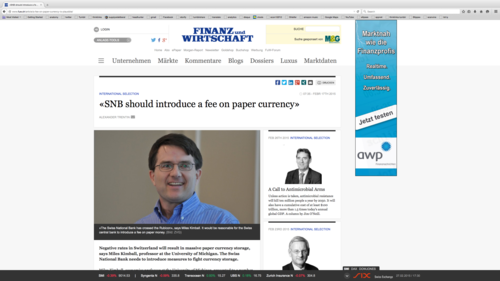
Negative Interest Rates and Financial Stability: Alexander Trentin Interviews Miles Kimball

Link to the original English version “SNB should introduce a fee on paper currency” and link to the German version “SNB sollte Gebühr auf Bargeld einführen.”

After Alexander Trentin wrote about my electronic money proposal in “Japan, It’s Time to Finally Overthrow Cash!” in a post on the Zurich web magazine Finanz und Wirtschaft (which translates as “Finance and Economics”), he arranged an interview with me. This is his distillation of that interview. I appreciate his permission to mirror it here, after a reasonable delay. What I like most about this interview is the chance it gave me to talk about how follow up an electronic money policy that makes deep negative interest rates possible with measures to enhance financial stability. 

The caption for the picture at the top is 

«The Swiss National Bank has crossed the Rubicon», says Miles Kimball. It would be reasonable for the Swiss central bank to introduce a fee on paper money.

and the summary at the top is 

Negative rates in Switzerland will result in massive paper currency storage, says Miles Kimball, professor at the University of Michigan. The Swiss National Bank needs to introduce measures to fight currency storage.

Miles Kimball, economics professor at the University of Michigan, presented to a number of central banks his idea of a fee on paper currency. In his opinion it is crucial to inhibit the storage of cash to ensure the effectiveness of negative rates. Kimball writes about his idea at «Confessions of a Supply-side Liberal».

Mr Kimball, the president of the Swiss National Bank (SNB), Thomas Jordan, said that the current deposit rate in Switzerland of –0.75 percent could be even more negative. But how low can negative rates go?

If people know that the value of paper currency could go below par, the only limit to how low interest rates can go is full-scale economic recovery. Such an expansion – including in Switzerland’s case a competitive exchange rate – would make further low interest rates unnecessary.

But how low can interest rates go when people can earn a zero interest rate by storing cash?

People disagree about that. But even with a negative rate of –0.75 percent – given some time, let’s say five years – there would be massive paper currency storage. It might take a while until business models are set up to store paper currency. But if people knew the current situation would continue, this would happen at current negative rates. But if I were going to set up a paper currency storage business, I would be afraid that the SNB would disrupt my business – as it should. If people become confident that the SNB won’t do anything to get in the way of their profit by paper currency storage then the ability to set negative rates will be severely compromised. The SNB has already crossed the Rubicon into the territory where they need to do additional things to inhibit massive paper currency storage.

Last year you had a presentation to SNB staff. What did you advise them to do?

I proposed a deposit fee on paper currency. The path that the SNB followed makes it quite plausible. I know that they are open to new approaches. The fact that they went down to –0.75 percent tells you that they are open to try new policies. In the current context it is fairly straightforward and would sound reasonable to say: we start to see signs of a buildup of paper Swiss francs, so we want to inhibit that. We will cut off the arbitrage between paper currency storage and negative rate deposits by introducing a gradually increasing paper currency deposit fee. If banks want to deposit the paper currency with the SNB, they have to pay this fee. I don’t see any reason why the SNB could not defend this. Giving up the currency peg to the Euro was much more controversial.

So, if I would like to deposit bank notes on my account, the bank would charge me, because they have to pay a fee with the SNB. Is this correct?

Yes, if the deposit fee started at zero, but was going to increase every year by 1.25 percent, then even at interest rates of –1.25 percent there would be no temptation to pile up paper currency because there would be no way to profit from such cash storage any more. Notice that at that rate it would take years before the fee would be more than a few percent. With such a small deposit fee, most retailers would still accept cash at par. So the deposit fee should not create problems for regular households who just get paper currency to pay for goods. And hopefully the economy can recover before the deposit fee has to increase further.

You argue for large swings in interest rates to stabilize the economy. To fight a recession, you propose rates could go quickly to negative rates. What kind of level of interest rates would you have advised for the great recession in 2008/2009?

I wrote in “America’s Big Monetary Policy Mistake: How Negative Interest Rates Could Have Stopped the Great Recession in Its Tracks” that if we had a rate of –4 percent in the US in 2009, we would have a robust economic recovery by the end of 2009. In fact, I think a rate of –3 percent would probably have done the trick. To people who doubt that even –4 percent would have been low enough, I answer that you can go as low as you need to. At some point the economy takes off at very fast speed. That brings interest rates up. If measures are taken to avoid massive paper currency storage, then the only limitation on how low you can go on interest rates is that at some point you get an economic recovery.

You advocate negative rates instead of Quantitative Easing, QE. How do these instruments work differently?

QE operates with risk and term premia. With negative interest rates you lower all four interest rates: the central bank target rate, the lending rate, the rate on bank reserves, and the paper currency interest rate. Negative rates bring the whole term and risk structure down. If the risk premium is too high than QE works great. But it becomes harder: If you squeeze term and risk premia more and more, you need larger and larger amounts of QE to have an effect. And if you try to squeeze the risk premium below what it should be, there are probably some bad side effects. In contrast, if you use negative rates to pull the whole term and risk structure down, the economy can still function in a normal way. Banks operate on spreads: if they can lend at a higher interest rate than they borrow, they are fine. I don’t want to be too negative about QE, because during the financial crisis risk premia were elevated, so it was good to bring them down then. And there is a good argument to be made that risk premia have typically been too high even in normal times, so it is good to bring them down some. But there is a limit to how much QE can do.

Not all parts of the economy are evenly stimulated by low interest rates. What would you say about worries that, due to low rates, real estate prices and other asset prices could end up in a bubble?

According to standard economic theory, asset prices in general should be high when interest rates are low. If real estate prices in particular are an issue, you could have property taxes. But the big issue is not that property prices get really high, but the high degree of leverage in real estate. The right policy is to require banks to have 50% equity financing, in addition the individual mortgages should having 50% equity requirements. Only some of the equity financing of mortgages needs to come from the homeowner. Banks could effectively put up the rest by taking a portion of the capital gain or loss on a house when it is sold. The idea of high equity financing is to let the people who are putting up the equity sign up in advance that if prices fall, they will take the hit.

Are there other effects of low interest rates on asset prices?

The equilibrium real interest rates might tend to be low in the future. The transformation from manufacturing to services in many countries like Germany and in the future China could be one reason for that. The future interest rates could be positive, but maybe fairly low. Such a low interest rate in the long run would mean that predictions and expectations about what will happen in the more distant future are much more important for asset prices. The debates about such expectations could make asset prices fluctuate more.

Why is the distant future more influential when rates are low?

If interest rates are high, then companies only care about projects that pay out very fast,  because otherwise they can’t pay back that interest. On the other hand, if interest rates are very low, companies and people also make investments that may take quite some time to pay off, because the interest burden is modest. If you can wait a long time for the pay-off, people’s ideas of what will happen ten or twenty years from now will become crucial for buying companies or valuing projects. If you have low interest rates, asset prices will not only be high, they will fluctuate more. So we need to have structures in place to deal with that. A higher equity requirement for banks and mortgages will make explicit who is taking the risks. If the risk-bearing is not made explicit through equity requirements, it will be the government and taxpayer who will have to pay for losses to stop a financial crisis.

But would higher equity requirements not outweigh the positive effect of negative rates?

As there is an implicit government subsidy for debt, higher equity requirements are taking away some government subsidy for debt-financed investment. To compensate for that you may need to lower rates further. In a speech Larry Summers said that as aggregate demand is too low, we might need bubbles to increase demand when at the Zero Lower Bound. But having negative rates allow us restrain bubbles with higher equity requirements without worrying about having enough aggregate demand. Negative rates are powerful enough you don’t have to depend on asset bubbles any more to stimulate aggregate demand.

In one article, you argued that Switzerland offers insurance to the world through the safe assets it provides. But how can the country benefit from offering this insurance?

Switzerland should consider establishing a Sovereign Wealth Fund, separated from the central bank. This is now standard when a government has more financial wealth than debt. With negative interest rates large sums could be borrowed, maybe four or five trillion Francs, and they could be invested in exchange traded funds, to avoid get involved in individual companies. The business would be that of a bank: borrow cheaply, invest with a higher return. One reason for the criticism of the large foreign exchange reserves of the SNB was the low returns. I think higher returns would lead to greater acceptance of a large fund.


Bio of Miles from the German version:

Miles Kimball has taught at the University of Michigan in Ann Arbor since 1987.  He is Professor of Economics. Before completing his doctorate in economics at Harvard, he studied linguistics with a thesis on the philosophy of language. Kimball has presented his proposals on negative interest rates and the introduction of an electronic currency to many experts, including the Fed, the ECB and the Swiss National Bank. He also presents his ideas on his blog "Confessions of a Supply-Side Liberal.“
I remember my own first grade teacher and how stirring she found the words of John F. Kennedy, as he took the reins of the country and challenged his fellow citizens to—and here I paraphrase only slightly—‘Ask not what I can do for you; ask what you can do for me’ Ever since, I’ve been alert to pro-government prejudice among teachers and other opinions leaders.

John Stuart Mill on Having a Day of Rest and Recreation

It is not surprising that John Stuart Mill argues against the imposition of one’s religious strictures on other people–including one’s beliefs about a day of rest from regular work. What I find surprising is that he has so much sympathy for some sort of social rules to encourage people to take a day of rest. He does recommend that people not all synchronize their day of rest, since recreation often requires the help of someone doing herhis job. In On Liberty, Chapter IV, “Of the Limits to the Authority of Society over the Individual” paragraphs 20, he writes:

Another important example of illegitimate interference with the rightful liberty of the individual, not simply threatened, but long since carried into triumphant effect, is Sabbatarian legislation. Without doubt, abstinence on one day in the week, so far as the exigencies of life permit, from the usual daily occupation, though in no respect religiously binding on any except Jews, is a highly beneficial custom. And inasmuch as this custom cannot be observed without a general consent to that effect among the industrious classes, therefore, in so far as some persons by working may impose the same necessity on others, it may be allowable and right that the law should guarantee to each the observance by others of the custom, by suspending the greater operations of industry on a particular day. But this justification, grounded on the direct interest which others have in each individual’s observance of the practice, does not apply to the self-chosen occupations in which a person may think fit to employ his leisure; nor does it hold good, in the smallest degree, for legal restrictions on amusements. It is true that the amusement of some is the day’s work of others; but the pleasure, not to say the useful recreation, of many, is worth the labour of a few, provided the occupation is freely chosen, and can be freely resigned. The operatives are perfectly right in thinking that if all worked on Sunday, seven days’ work would have to be given for six days’ wages: but so long as the great mass of employments are suspended, the small number who for the enjoyment of others must still work, obtain a proportional increase of earnings; and they are not obliged to follow those occupations, if they prefer leisure to emolument. If a further remedy is sought, it might be found in the establishment by custom of a holiday on some other day of the week for those particular classes of persons. The only ground, therefore, on which restrictions on Sunday amusements can be defended, must be that they are religiously wrong; a motive of legislation which never can be too earnestly protested against. “Deorum injuriæ Diis curæ.” It remains to be proved that society or any of its officers holds a commission from on high to avenge any supposed offence to Omnipotence, which is not also a wrong to our fellow creatures. The notion that it is one man’s duty that another should be religious, was the foundation of all the religious persecutions ever perpetrated, and if admitted, would fully justify them. Though the feeling which breaks out in the repeated attempts to stop railway travelling on Sunday, in the resistance to the opening of Museums, and the like, has not the cruelty of the old persecutors, the state of mind indicated by it is fundamentally the same. It is a determination not to tolerate others in doing what is permitted by their religion, because it is not permitted by the persecutor’s religion. It is a belief that God not only abominates the act of the misbeliever, but will not hold us guiltless if we leave him unmolested.

I heartily agree with John Stuart Mill that “abstinence on one day in the week, so far as the exigencies of life permit, from the usual daily occupation, … is a highly beneficial custom.” It can be a hard custom to maintain for those of us who feel ourselves to be in some kind of contest (or what economists often call a “tournament”) against others whom we imagine as not taking any time off. For some of us in competitions we feel to be tight, even sleep seems like a luxury that is hard to afford. (I was glad to host the guest post “Dan Miller: Sleep as a Strategic Resource,” but look at the gainsaying comment to see how negative the attitude toward sleep can be among competitive types.)

Perhaps the best way we could shift the culture toward giving highly competitive folks like many of us a bit of a break would be to make our ability to keep up with everything despite taking time off something to brag about. I am thinking about something like the story I told in “How the Idea that Intelligence is Genetic Distorted My Life—Even Though I Worked Hard Trying to Get Smarter Anyway:

Once I actually got to college, with many other smart competitors, I knew I would have to work hard in ways more directly related to classes. But the desire to impress my classmates with the appearance of little input for high performance was still there. I still get a frisson of joy remembering the time one of my classmates expressed awe that I managed to survive in college despite not studying on Sunday.

In that vein, one of the things I have always been impressed with about William F. Buckley is that he managed to do everything he did to change the world while still pursuing his favorite recreations (such as sailing) vigorously. 

The following story is told about Joseph Smith, the founder of Mormonism:

That Joseph Smith liked to pull sticks, wrestle, play baseball, swim, and hunt is generally well known. William Allred, who played ball with Joseph many times, recalled an instance when someone criticized the Prophet for indulging in play. To answer the criticism Joseph told a parable about a prophet and a hunter—clearly explaining his own philosophy about the relationship of play to work. As the story goes, a certain prophet sat under a tree “amusing himself in some way.” Along came a hunter and reproved him. The prophet asked the hunter if he always kept his hunting bow strung up.
 “Oh no,” said he.
“Why not?”
“Because it would lose its elasticity.”
“It is just so with my mind,” stated the prophet; “I do not want it strung up all the time.”5

Except in genuine emergencies (which are frequent enough), let us try not to act like workaholics, especially since it tilts things toward everyone else feeling they need to act like a workaholic. There is plenty of trouble in the world, and a lot to do to save it. But maybe a little fun (and sleep) along the way will improve our productivity enough that it won’t put us too far behind in that endeavor.

And in fact, thinking only about "productivity” dramatically understates the benefit of taking some time off now and then. There is always a big danger of finding that one has worked very hard to take the world in the wrong direction. A balanced life gives one a fighting chance to gain the extra perspective needed to lessen that danger.

Virginia Postrel: The Glamour of Terrorism

Jihadi terrorism combines two ancient forms of glamour, the martial and the religious, with the modern allure of media celebrity. It promises to fulfill a host of desires: for purity and meaning, union with God, historical significance, attention and fame, a sense of belonging, even (posthumous) riches and beautiful women. The jihadi’s ultimate goal of a restored caliphate exemplifies the glamorous utopia, while the terrorist plot recalls the synchronization of heist movies, with a secret and intricate plan in which every team member is important and the goal is to outwit authorities and commit a crime. It’s not hard to imagine how appealing all this might be to a bored, alienated, and impressionable person.

– Virgina Postrel, The Power of Glamour, pp. 220-221

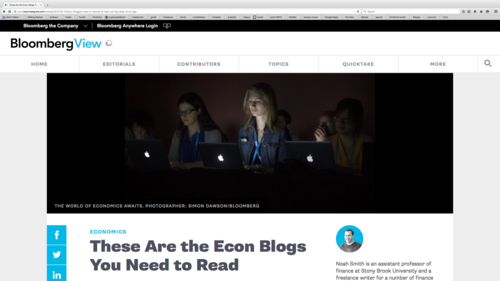
Noah Smith: These are the Econ Blogs You Need to Read

blog.supplysideliberal.com tumblr_inline_njzxa37r491r57lmx.png

Link to Noah’s article on Bloomberg View

In his article “These are the Econ Blogs You Need to Read,” Noah Smith has some kind words to say about me and this blog:

The Dreamers
Confessions of a Supply-Side Liberal, by Miles Kimball: My doctoral adviser has recently become one of the most interesting and original occupants of the blogosphere. His favorite topics include monetary policy – where he champions unconventional ideas such as electronic money, federal lines of credit, and a U.S. sovereign-wealth fund – and education, where he urges a rethink of our basic values and approaches. As the grandson of a prophet of the Mormon church, he also has a deep interest in religion.

Leaving this aside, Noah gives a very useful tour of the economics blogosphere. This is an article I will send my students to help them find their way in the econ blogosphere.

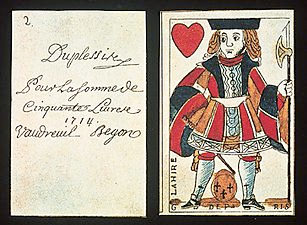
Owen Nie: Playing Card Currency in French Canada

The proposal I have made for a shift to an electronic money standard. Leaving the paper standard is comparable in magnitude to the earlier departure from the gold standard. But over the centuries there have been many monetary systems. I think it is useful to realize that monetary systems come and go. So I was glad when Owen Nie, a PhD student at the University of Michigan, volunteered to conduct a summer research project looking into alternative historical monetary systems. Owen will report what he learned in a series of guest posts. This is the first. This is a distillation from a chapter “Playing Card Currency of French Canada” from Richard Lester’s book Monetary Experiments: Early American and Recent Scandinavian. (Also see the Wikipedia article on “Card money in New France.”) Here is Owen’s summary:


The North American colonies were a great laboratory for monetary economics. In 1685 the French Canadian authorities were forced by an emergency (the yearly allotment didn’t arrive in a timely way and left the troops and officials unpaid) to issue paper money made of ordinary playing card, made a legal tender and redeemable in cash or bills of exchange (later in silver coin in France, which is effectively a silver exchange standards) as the King’s vessel’s next arrival with the colonies’ yearly appropriation. The practice was repeated a number of times and considered a success in the early 18th century except for the period of Queen Anne’s War. The King, previously opposed to the monetary experiment, started issuing playing card money in 1730. However, the afterwards excessive supply of this currency, issued to defray mounting military expenditures, together with a relative scarcity of goods as manpower were directed towards wartime efforts and a deterioration of French finances caused inflation and delayed redemption at a large discount of face value by the time Canada was ceded to England in 1763. In its sixty-five years of existence, the system collapsed only twice, both because warfare money in excess of government funds destined for the colony.

On Having a Thesis

My main strategy for helping the students in my Monetary and Financial Theory class is to have them write a lot. They write 3 blog posts a week on an internal class blog. I have showcased some of the best of these blog posts on this blog, “Confessions of a Supply-Side Liberal.” You can see links to all these student guest posts here. The magic of having students write many, many short pieces is something that can be implemented easily by any instructor anywhere who has the good fortune to have a teaching assistant to make brief comments on them all, as I have.* And there is a bit of magic to the blog post format, which tends to disinhibit students. (I know with some degree of confidence, because there was a point at which I switched from having students do short essays that were printed out in one semester of a Principles of Macro class to doing blog posts the next semester. The blog posts were better.) 

In this post, I wanted to give a few other tips for writing blog posts in addition to pointing to the magic of writing a lot. The first is that the wind-up in the introduction shouldn’t be too long. Indeed, the most common request from my editors at Quartz when I send them a first draft of a column is that I should shorten the introduction. I often need the lengthy introduction as I write in order to get into the topic, but once the rest of the piece is written, the introduction can be slashed to something much shorter.  

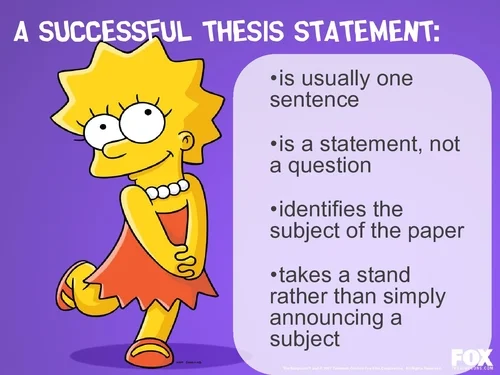
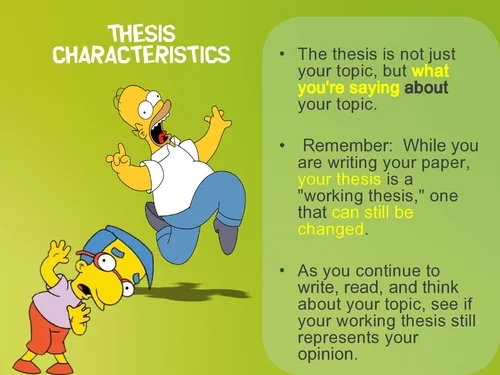
The second tip is that it is important to have a thesis: something that you want to say and are willing to try to back up. If you want some examples of thesis statements, about half the time the titles my editors choose for my Quartz columns are their take on what a thesis statement would be. (You can see a list of titles of my Quartz columns here.) Lisa Simpson above gives some excellent guidance on what a thesis statement should be like; I am afraid the other half of my titles don’t obey these rules for thesis statements.

How can you come up with a thesis statement, and arguments to back it up? There may be other harder ways to come up with a thesis statement, but the easiest way is to think of something you want to say that you actually believe. For most people this is definitely the way to go if you are allowed to choose from a broad range of topics. 

To come up with the thesis statement itself, read the newspaper, read other people’s blogs, read books, talk to people, and constantly keep a look-out for any reaction you have that makes you want to say something to the world or at least to some other people. Figure out how to say the gist quickly, so that it can fit in one sentence. It might have to be only an approximation to what you really want to say to fit into one sentence, but that is OK. If that kind of brevity is hard for you, get a Twitter account and practice saying things in 140 characters or less on Twitter. (You can see my tweets here. I think they provide many examples of thesis statements, though not always the supporting arguments!) 

The thesis statement does not always have to actually appear in your post or essay, but it needs to exist and you need to know what it is. And I recommend that beginning writers actually put the thesis statement into the post or essay. 

In addition to the question “What am I trying to say here?” the question “What am I trying to accomplish in this piece?” is also helpful in identifying a thesis statement. But once you answer “What am I trying to accomplish in this piece?” you need to go back to the question “What am I trying to say here?” in order to come up with the thesis statement itself.   

Trying to support your thesis statement can seem daunting. But anything that would make someone a little more likely to agree with your thesis statement counts as supporting it. Even “preaching to the choir”—that is, making someone who already agreed with you more energized to spread the word or to do something about it—counts.

To come up with arguments to back up your thesis statement, ask yourself why you believe it. (Remember, I am only telling you the easy way to come up with thesis statements and back them up. Learning how to argue for something you don’t believe is an advanced writing skill for folks like lawyers.) If you ask yourself why you believe it and can’t come up with anything, maybe you should choose another topic. If you can answer that question, write down the answer, and you are on your way. 

There are different levels of arguments you can have for a thesis statement. The upper level is when you have arguments that might convince someone else even if they start out a bit skeptical. In other words, if you can take on the burden of proof and meet that with your arguments, that is impressive. 

The lower level of supporting a thesis statement is to explain why you believe it and to lay out what someone else would have to do to convince you otherwise. That is, if you can defend your thesis statement against an attack when the attacker has the burden of proof, that definitely counts for something.  

The point is to have a clear thesis statement, and support it as well as you can. Admitting where you might be wrong and where there are weaknesses in your line of argument can be nice, too, although it doesn’t work as the substance of the whole post! If you actually think you might be wrong, that itself can make a good thesis statement: “I used to think X, but now I realize that I just might be wrong, because ….”  

That leads into my last tip. An essay is more memorable if there is a bit of conflict or drama in it. For example, “So and so says X, but they are wrong”; or “The conventional wisdom is X, but …”; or “Here is an issue that is extremely important that needs to be addressed; here is what needs to be done”; or “Here is something that will change the world in a big way.” To get that drama you need to have an opposition between two things: for example, two different ways of looking at things; how things are and how they should be; the way things are now and the way things used to be; how things are now and how they will be in the future. 

Everything that I am suggesting gets a lot easier with practice. If you keep writing many, many short pieces and keep these tips in mind, you will find your writing getting better and better. Have confidence and just keep going. Being a good writer will give you a huge advantage in your career. And there is a decent chance that, say, around the 25th short piece you write, writing will start to become fun for you.   

* To keep the grading burden down, we have a simple check, check+, check- grading system in which there is a strong default toward students getting a check; of the 1/8 of all posts that are revised and sent on to me, I only give a check+ to posts that are at a level worthy of being guest posts on my blog, and we only give check-’s to blog posts that exhibit either obvious low effort or a disregard of instructions.    

In addition to making the grading effort reasonable for a teaching assistant (in a 40 student class) despite the large number of blog post writing assignments, giving most posts a check helps to avoid premature perfectionism, which is one of the biggest dangers in learning to write. The blog post format also helps to reduce the danger of premature perfectionism, since the traditions for the blogosphere allow for a certain rate of typos, grammatical errors and awkward phrasing. This makes gaining fluency in writing blog posts in English quite doable even for students for whom English is a second language. 

It is easy to continue to polish blog posts after their initial posting. But even if initial posting is delayed until after polishing, it is possible to keep the polishing from creating writers block if the polishing is separated from writing the first draft of a post. 

It is hard enough getting ideas down in any form. Don’t burden your writing by requiring too much polish on a first draft. With experience, your first drafts will start looking more polished, but if you want to be a fluent writer, difficult polishing must always be delayed until after getting the first draft down.

Update: Since I wrote this, I have instituted in my class a requirement that students put an explicit thesis statement at the top of their posts. (I do not require that the thesis statement be made part of body of the post itself, in accordance with what I said above: “The thesis statement does not always have to actually appear in your post or essay, but it needs to exist and you need to know what it is.”) I think this is helping a lot in making the posts more focused.

Electronic Money: The Quiz

As part of the midterm exam in my “Monetary and Financial Theory” class, I wrote a set of multiple-choice questions based on my Powerpoint file “Breaking Through the Zero Lower Bound.” It occurred to me that those of you who have been following the electronic money theme on my blog might want to try your hand at the quiz generated by extracting those questions from the exam. I think your understanding will be deepened by doing this quiz and then looking at the answers. (Do try it in that order!) 

A. Suppose that a time-varying paper currency deposit fee is used to keep the paper currency interest rate below the target rate in Japan. Which of the following things could create a zero lower bound even with paper currency out of the way? 

  1. Gold
  2. Bitcoin
  3. Foreign Currency
  4. An interest rate of zero on the balances of money in (government-run) postal savings accounts.
  5. Being able to pay off debts with paper currency at its face value.

B. Filling in a bit what he meant, when Ben Bernanke came to the University of Michigan, what did he say about the unconventional monetary policies of quantitative easing and forward guidance? 

  1. Forward guidance has failed; that is why the Fed has abandoned forward guidance and turned to quantitative easing as its primary tool of monetary policy.
  2. Forward guidance is an absolute commitment. The Fed uses quantitative easing primarily to convince the markets of that.
  3. Because the Fed is worried about the side effects of unconventional policies such as quantitative easing, the Fed has stimulated the economy less than it would have if it could have just lowered interest rates.
  4. Quantitative easing and forward guidance can work when the inflation rate is 1% or above, but when inflation is below zero as in Japan, they won’t work. So the Fed is deeply worried about Japan.
  5. None of the above.

C. Which of the following does Miles point to as an advantage of monetary policy over fiscal policy for economic stabilization (that is, for keeping the economy at the natural level of output)?

I. Monetary policy does not raise the budget deficit

II. Monetary policy can push the costs of economic stabilization onto other countries

III. There is a strong tradition of technocratic monetary policy, but no institutional framework for technocratic fiscal policy (other than automatic stabilizers, which aren’t enough). 

  1. I
  2. II
  3. III
  4. I and II
  5. I and III

D. From earlier to later, which of the following is a correct order of events for the US?

  1. The Great Moderation, the Great Recession, the Great Inflation (ended by the Volcker disinflation)
  2. The Great Recession, the Great Moderation, the Great Inflation (ended by the Volcker disinflation)
  3. The Great Moderation, the Great Inflation (ended by the Volcker disinflation), the Great Recession
  4. The Great Inflation (ended by the Volcker disinflation), the Great Depression, The Great Recession
  5. The Great Inflation (ended by the Volcker disinflation), the Great Moderation, the Great Recession

E. Suppose the electronic dollar is used by everyone (including all units of the government) as the unit of account (and unit of price setting) and the inflation rate relative to that unit of account is zero. If an exchange rate between paper currency and electronic money makes the “inflation rate” relative to the paper dollar positive, which of the following would be costs of that “inflation rate” relative to the paper dollar?  

  1. Messing up price signals
  2. Menu costs
  3. Messing up the tax code in unintended ways
  4. Unpredictability of inflation messing up contracts
  5. None of the above.

F. Eliminating the zero lower bound with a paper currency interest rate that can go negative is likely to lead governments (in particular central banks) to lower inflation in both rich, basically well-run countries, and poor, not-so-well-run countries, for two different reasons:  

  1. There would no longer be any need to push down price cost markups with inflation in order to make the economy more efficient, and there would no longer be any need for inflation to make it easier to lower real wages for some workers.
  2. There would no longer be any need to push down price cost markups with inflation in order to make the economy more efficient, and it would be possible to earn substantial seignorage without any inflation relative to the unit of account.
  3. There would no longer be any need to steer away from the zero lower bound with inflation, and there would no longer be any need for inflation to make it easier to lower real wages for some workers.
  4. There would no longer be any need to steer away from the zero lower bound with inflation, and there would no longer be any need to push down price cost markups with inflation in order to make the economy more efficient.
  5. There would no longer be any need to steer away from the zero lower bound with inflation, and it would be possible to earn substantial seignorage without any inflation relative to the unit of account.

G. “On the Need for Large Movements in Interest Rates to Stabilize the Economy with Monetary Policy." Which of the following could increase aggregate demand as a result of the Fed lowering interest rates to deep negative rates?

I. Purchases of durable goods for storage

II. Purchases of foreign assets

III. Higher asset prices

  1. I
  2. I and II
  3. I and III
  4. II and III
  5. I, II and III

H. Treating the electronic dollar as the unit of account, what is the paper currency interest rate for 2019 if at the beginning of the year a paper dollar is worth $0.96 electronic dollars, while at the end of the year, a paper dollar is worth $0.98 electronic dollars? Closest to:  

  1. -4%
  2. 2%
  3. 0
  4. +2%
  5. +4%

J. Treating the electronic dollar as the unit of account, what is the paper currency interest rate for 2019 if at the beginning of the year a paper dollar is worth $0.90 electronic dollars, while at the end of the year, a paper dollar is worth $0.90 electronic dollars? Closest to: 

  1. -10%
  2. -9%
  3. 0
  4. +9%
  5. +10%

K. Which of the following is false

  1. It is possible to get a 1.5% rebate on all purchases with a Capital One Quicksilver Visa card and a 2% rebate on all purchases with a Fidelity Investment Rewards American Express card  
  2. The fees retailers pay when people use American Express cards are generally higher than the fees retailers pay when people use Visa cards.  
  3. If the paper currency deposit fee that banks paid at the cash window of the Fed was 1%, retailers would still be better off getting paid in cash than being paid by credit card even though paper currency would be below par.
  4. With rare exceptions, retailers always refuse to accept credit cards when they would net less money (after fees) from a credit card purchase than from a cash purchase.
  5. All of the above are true  

L. Think of a situation like that in late 2008. Inflation is fairly sticky. (Note that inflation being sticky is a stronger statement than prices being sticky.) Imagine that there are only 3 monetary zones in the world: A, B and C. To begin with, A has inflation of -1%, B has inflation of 0%, and C has inflation of +2%. After a serious financial crisis that makes all three countries want to do a major monetary expansion, Countries B and C keep their paper currency at par, but Country A uses a time-varying paper currency deposit fee to keep the paper currency interest rate below its target rate. What would be a good prediction for what would happen to net exports (NX) in these countries? 

  1. NX is likely to decrease for A, but increase for C.
  2. NX is likely to increase for B, but decrease for C.
  3. NX is likely to increase for A, but decrease for B.
  4. NX is likely to decrease for A, but increase for B.
  5. NX is likely to increase for all three because all three have a monetary expansion to deal with the effects of the financial crisis.

Answers

The single source that covers the most ground, though a bit cryptically, is my "Breaking Through the Zero Lower Bound” Powerpoint file. Someday, I hope to get a video made of one of these talks. 

A. 4

Guaranteeing an interest rate of zero over all horizons and in unlimited quantities in government-run banks is very similar to guaranteeing an interest rate of zero over all horizons and in unlimited quantities on government issued pieces of paper. It would also make people unwilling to lend at a rate significantly below zero.  

Gold, Bitcoin and foreign currencies all have prices that fluctuate relative to the electronic dollar unit of account. Other things equal, they are all likely to go up quite a bit in price relative to the e-yen unit of account when interest rates are cut and then to have expected capital losses as those prices gradually come back to earth. That expected capital loss brings their expected rate of return of these assets down. In any case, there is no riskless arbitrage to be had. 

Also, purchasing foreign currencies tends to put yen (electronic or paper) in the hands of people who don’t want the yen, so that the exchange rate adjusts until those dollars are absorbed by an increase in net exports from Japan. (See International Finance: A Primer.) 

If people increase gold production, that actually looks like an increase in consumption or investment and raises aggregate demand. It is not the kind of increase in aggregate demand I would wish, but it is an increase in aggregate demand. (If the gold is bought from abroad, that tends to cause a depreciation which stimulates production of other things domestically to export or to replace imports that won’t be imported because gold is being imported.)  

As far as debt contracts go, the value of the old debt contracts may be changed by the option to pay them off in below-par paper currency, but since the old debt contracts are in fixed supply, they just adjust in price. Paper dollars that can be used to pay off old debts don’t go up in value as a result–their value is pegged by the central bank. Instead, the old debt goes down in value, making the debtor less in debt

B. 3. 

See my post “Ben Bernanke: The Fed Does Less Monetary Stimulus Than It Thinks Is Warranted Because It Is Afraid of the Side Effects of Unconventional Tools.”

C. 5.

See “Monetary vs. Fiscal Policy: Expansionary Monetary Policy Does Not Raise the Budget Deficit” and “On the Need for Large Movements in Interest Rates to Stabilize the Economy with Monetary Policy.”

D. 5. The Great Recession was in the 1930’s. The Great Inflation was in the 1970s and the Volcker disinflation that ended it was in the early 80’s. The Great Moderation was from the mid 1980’s until the Financial Crisis in late 2008. The Great Recession began in earnest with that Financial Crisis. Its aftereffects have dragged on until now.   

E. 5.  See “The Costs and Benefits of Repealing the Zero Lower Bound … and Then Lowering the Long-Run Inflation Target." 

F. 5. For rich, basically well-run countries, the primary reason for inflation is the desire of central banks to steer away from the zero lower bound. For countries with weak tax systems, earning seignorage has sometimes been an important motivation for inflation. Both the zero lower bound and seignorage have to do with "inflation” relative to paper currency rather than inflation relative to the unit of account when the unit of account is electronic. So once a country goes off the paper standard, there is much less reason or temptation for inflation. (There is still the temptation to overstimulate the economy to go above the natural level of output, which can cause inflation.)

G. 5. All three. Durables purchases count as investment or consumption. Higher asset prices should have a wealth effect on consumption and a Q-theory-type effect on investment, as I discuss in “Monetary Policy and Financial Stability." Foreign asset purchases lead to higher net exports according to the logic I explain in ”International Finance: A Primer“ and my international finance Powerpoint file that I use in teaching. 

H. 4. Since the electronic dollar would be the unit of account (and is the numeraire for the analysis), the paper currency interest rate is equal to the capital gain rate on paper currency. Since the value of a paper dollar is increasing at (very close to) 2% in a year, the paper currency interest rate is equal to that capital gain of 2%. (An additional year at that rate would bring paper currency back to par.)

J. 3. Even though paper currency is away from par, if the effective exchange rate with unit-of-account electronic money is constant, there is no capital gain or loss, and the paper currency interest rate is 0. 

K. 4. This question is relevant to my argument that retailers are likely to accept paper currency at par up to about a 4% paper currency deposit fee. In ”A Minimalist Implementation of Electronic Money“ I make this argument as follows:

At the grocery store or other shops, it might be a while before merchants discouraged customers from using paper currency. As it is now, merchants accept credit cards despite the fact that must pay to accept credit-card payment. For example, in the UK, Barclay Card currently advertises that it charges businesses 1.5% on credit card transactions. 
So currently, getting paid by credit card is something like 1.5% less attractive than getting paid in paper currency. If, in order to avoid alienating customers, businesses were willing to continue accepting paper currency at par even if it was 1.5% less attractive to them than credit card payments, that might allow a 3% swing before things changed for retail customers: retail customers might be able to pay with paper currency at par even if banks had to pay a 3% penalty to the central bank for paper currency deposits.

Since then, I have read things that suggest that typical charges for credit cards are higher than this. In particular, it seems unlikely that credit card companies would give me an across-the-board rebate bigger than the fees they receive. You can see at these links that the Fidelity Investment Rewards American Express card gives a 2% rebate for everything and the Quicksilver Visa gives a 1.5% rebate for everything. I have both of these in my wallet (the Visa card for places that don’t accept American Express). 

Besides providing evidence about how much less retailers are now willing to accept from credit card payments than cash payments, the other reason these rebates are interesting is that they will encourage the use of electronic money, as more and more people get bigger and bigger discounts by paying with their credit cards. I now think that at least in the near term, increases in competition will make the effective fees that credit card companies charge narrow more by bigger and bigger rebates than by a reduction in the direct fee paid by retailers.

The fact that retailers now put up with getting so much less from credit card payments is an important fact that deserves more economic modeling. 

L. 3. The real interest rate is the nominal interest rate minus inflation. Since Country A can push its nominal interest rate as low as needed, it can also push its real interest rate very low. Country B can only get its real interest rate down to 0. Country C can only get its real interest rate down to -2% (a zero nominal rate minus inflation of 2%). I take the statement that they all want a vigorous monetary expansion to mean that Country A pushes its real interest rate significantly below -2%. So there will be substantial extra capital outflow from Country A, fleeing the low real interest rates. Extra capital outflow puts domestic currency in the hands of people outside the currency zone for whom it is a hot potato. Exchange rate adjustments recycle that currency to its home area through encouraging more net exports. The opposite happens for country B: because of its high real interest rate of 0 (compared to -2% for country C and below that for country A), foreign funds flow into country B. To do that, investors in Country B must buy up Country B currency that is available abroad, which prevents other people outside Country B from using that currency to buy exports from Country B. So Country B’s exports fall. Alternatively, Country B’s imports could rise to put more of Country B’s currency in the hands of foreigners. Country B’s residents are unlikely to put much currency in the hands of foreigners by buying foreign assets because they can get a zero real interest rate domestically, but face negative real interest rates abroad.


The Teleotheistic Achievement of the New Testament

Jack Miles won a Pulitzer Prize for his book God: A Biography. By the “biography” of God, he means in this case the character development of God one sees if one reads the Hebrew Bible as a piece of literature. Since there is a significant chronological element to the arrangement of books within the Tanakh, this character development within the Hebrew Bible read as literature follows to an important degree the evolution of thought about the character of God among the Israelites. This evolution of thought about the character of God is of great importance because over time, the concept of God has come closer to being a picture of an ideal character to strive after. In Rabbinic Judaism and Christianity, this evolution of thought about the character of God continued after the books of the Tanakh had all been written. The details were different within Rabbinic Judaism and Christianity, but in both cases God became more and more representative of an ideal.   

In “Teleotheism and the Purpose of Life,” I write:

The key difference between evolution as our creator and the god of the Bible is that with evolution the best comes at the end, not at the beginning.  There was no Garden of Eden—only primordial soup in a warm pond.   But heaven is still possible; we and our descendants just need to build it.
The first task is to decide what we want.  The medieval theologian Anselm defined God as “that than which no great can be thought” and proceeded to argue that God must exist since something that exists is greater than something that doesn’t exist.  Therefore, the greatest of all things must exist.   It is my understanding that modern philosophers reject Anselm’s argument on the basis that “existence” is not an ordinary attribute like being massive or being photosynthetic.  Existence has a special status in logic.  So let me do a riff on Anselm by defining God as “the greatest of all things that can come true.”  God is the heaven—or in Mormon terms, the Zion, the ideal society—that we and our descendants can build, and god is a reasonable description of the kind of people who make up that society.   But what does a heavenly society look like?
Let’s start with the easier question of what an ideal human being looks like.   Here I look to Jesus.  Not the historical Jesus, but the imagined Jesus who is the projection of every good human trait, as valued by our culture.  It makes all the sense in the world to ask “what would Jesus do” even if one believes that the historical Jesus was only a man, since “what would Jesus do” is a good shorthand for what our culture thinks a good person would do.  This is an example of the way in which many of the highest ideas of goodness in Western Culture are embedded in religious language.

Since it is very hard to build God without having a reasonably clear of what one is trying to build, the evolution of the idea of God toward something better is a key step on the path that may someday bring what can reasonably be called God or Gods and Heaven into full existence. So from the standpoint of Teleotheism, the character development of God seen as a literary character is a sketch of the road to pursue in reality.

Aside from its pairing with the New Testament, the Old Testament is a slightly modified and rearranged version of the Tanakh. The books of the Old Testament and Tanakh promise over and over again that God will eventually come in power to rescue Israel from foreign subjugation. By the time of Jesus, the fulfillment of this promise already seemed long delayed, and persuasive excuses for the delay were running out. Amazingly, Rabbinic Judaism and Christianity found two different ways to explain why God allowed the destruction of Jerusalem in 70 AD, and the crushing of the Bar Kokhba revolt in 135 AD. (These events can be appropriately compared in their psychological impact to Hitler’s murder of millions of Jews many centuries later. The number who died in the siege of Jerusalem in 70 AD was high because the Romans chose a time when Jews had gathered in Jerusalem from all around the Roman world and beyond.) Here I will only talk about the explanation given by Christian writers in the New Testament. (I hope to do a post some day about the explanation given by Rabbinic Judaism.)

I will follow closely Jack Miles’s literary interpretation of the New Testament in Christ: A Crisis in the Life of God. (Hat tip to John L. Davidson for recommending this book, in reaction to my post “The Mormon View of Jesus.”) Here is a hint of what Jack means by a literary interpretation, beginning on page 276 of the book: 

Meanwhile, general literary criticism, weary of its own demystification of the author, has begun to place a new emphasis on the work as a work and on the value of cultivating an aesthetic response to it. It has begun to move, in a word, to a new emphasis on beauty. 

Jack uses the metaphor of a rose window to contrast a literary interpretation with historical criticism: literary criticism is looking at the rose window; historical criticism is trying to look through the rose window.   

The historical criticism of the Bible–a process that I have compared to the examination of a rose window, pane by pane, for signs of the absence of stain–may yet prove a paradoxically good preparation for this old/new kind of criticism, for, obviously, if you have checked every pane hoping to find one without stain, you end up knowing something about every pane as well as a great deal about stain. Traditional Bible scholars, though their research has almost always been at least nominally in the service of history, have, de facto, studied the development of images and motifs, noted allusions, explicit and implicit, and performed a thousand other services crucial to the literary appreciation of the Bible–so much so, indeed, that some of what is offered as literary criticism by those who lack their training and have not combed through the text as meticulously as they have may quite understandably strike them as too simple-minded for serious comment. But rather than dismiss literary criticism as sciolist dilettantism, historically trained critics could become literary critics themselves and try to improve the neighborhood. 

Jack Miles argues that the New Testament was written in the first instance for the Greek-speaking Jews of the Diaspora, who were deeply steeped in the words of the Septuagint–the Greek Old Testament. For someone steeped in the Septuagint, what the New Testament portrays is God thinking better of his former warlike ways, and unwilling to come in power until the very end of the world. Knowing the future–that the Jews would continue to be under subjugation to the Romans until even worse befell them–God became a man to suffer along with his people, and to suffer crucifixion in advance of the great suffering the Jews would suffer in the First and Second Jewish-Roman Wars. Only by suffering himself could God justify his decision to allow the Jews to suffer under the Romans and to be slaughtered by the Romans in the Jewish-Roman wars without intervening.

The literary achievement of the New Testament is in part that the willingness of God become man to suffer and die helped to reconcile the readers of the New Testament to God’s unwillingness to free the Jews from subjugation to the Romans (as God had been unwilling to free the Jews from many previous masters). And of course, the claim that by that suffering and death, God had conquered and reversed death itself also helped greatly. 

But now let me step back from the direct literary interpretation of the New Testament, which treats its account as if it were true. I want to talk about what was accomplished historically by this powerhouse of religious literature. It made the image of God better (as Rabbinic Judaism did in another way). Here are some of the virtues exhibited by that Jesus, the God of the New Testament:     

  1. Accountability: The greatest of all is willing to suffer along with his people. This helped greatly in the idea that even kings were not above being questioned and subject to laws.  
  2. Peacableness: Jesus exhibited nonviolence again and again. 
  3. Intellectuality: Jesus spent time expounding scripture, indicating the importance of the written word. 
  4. Love: Instead of victory over enemies, the sign of God’s people was to be the fact that they loved one another, and even loved their enemies.   

This is an image of God that I can endorse. Even in a world that, as I believe, has no supernatural power to turn to, we can all strive to exhibit such virtues, and to build a world in which it will be easier for other people to gain and exercise them.  

I do not think the New Testament image of God is the final word even in goodness. Indeed, I think that the Jesus people refer to nowadays when they ask the question “What would Jesus do?” is better than the Jesus portrayed in the New Testament. But the image of God in the New Testament was a huge advance over what came before, as also the God of Rabbinic Judaism was a huge advance over the image of God before that time. It is important for us to continue to refine our image of what an ideal human being and an ideal human society are as a key step toward making those ideals a reality.

Scott McCloud: Just Because You’ve Decided to Sell Out Doesn’t Mean Anyone’s Going to Buy

Write for yourself. If you just write the kinds of stories you think others will want to read, you’ll be competing with cartoonists who are far more enthusiastic for that kind of comic than you are, and they’ll kick your ass every time. Or to put it another way: “Just because you’ve decided to sell out, that doesn’t mean that anyone’s going to buy.”

Dan Miller: Sleep as a Strategic Resource

tumblr_inline_nk1urgtpmS1r57lmx.jpg

Link to Dan Miller’s LinkedIn homepage

I am pleased to host this guest post by Dan Miller on the importance of sleep–even as compared to other business concerns. It is the third guest post this semester from students in my Monetary and Financial Theory class. You can see links to all of the other student guest posts here. Here is Dan:


The corporate culture in America and around the globe has come to value employees that can work harder than ever before, even if that means working around the clock.  While it is a common understanding that people need at least eight hours of sleep to function properly, there is a small portion of the population (1-3%), are among the “sleepless elite,” people who report only needing a fraction of the sleep that the vast majority of the population needs. There are numerous CEOs, billionaires, and successful politicians including Marissa Mayer, Martha Stewart, and even Barack Obama  who report being members of this unique group.  Donald Trump, another idolized entrepreneur in the “sleepless elite,” has been quoted saying “How can somebody who is sleeping 12 hours a night compete with someone who is only sleeping three or four.”

By discussing their ability to get by with little sleep, these executives are serving as role models for a norm that a full night’s sleep is optional, even a luxury, if you want to get ahead in business.  I believe that the corporate world can and should shed this toxic notion that “sleep is for the weak” for the benefit of individuals, organizations and the economy as a whole. A better, healthier approach to sleep will ensure that organizations are getting the best performance out of its human capital.  However elementary, proper sleep is the best measure to prevent a fatigued or stressed out work force.

Sleep deprivation is viewed by some, not without merit, as a national health crisis similar to obesity.  Organizations should go a step further and help combat this by not only encouraging and a sleep-supportive culture, but also create set of sleep-supportive practices. Organizations should not fear that they are meddling with employees private lives by encouraging sleep. Form a strictly financial perspective some organizations do encourage sleep as a method of reducing healthcare costs. Sleep is a performance enhancing, preventative behavior and it should be a central concern for organizations.

The workplace demands influence sleep, people’s jobs are inextricably linked with their ability to establish healthy sleep habits. Here are some active steps for promoting and preserving employees “sleep life”.

1. Culture

CEOs and managers should go on the record stating how much they benefit from a full nights sleep. This will set a good example because leaders set the tone for organizational habits.  In addition, sleep education programs could be a useful resource for larger organizations where the executives may be distant from large portions of the work force.

2. Allow employees to separate from work when the day is finished.

Checking work related emails late into the night has been cited as a cause for sleep deprivation by some.  Set limits on how late emails can be sent or at least set limits on how late people should be expected to respond to emails.

3. Nap Rooms.

The key idea behind naps is to mange your circadian rhythms and to wake up feeling refreshed, not groggy.  Employees who are struggling with sleep deprivation can at least temporarily alleviate the problem with short bouts of sleep in a napping room. Even small loss in productivity from a few minutes of napping is worth while if it prevents a costly mistake and is a wise investment.

4. Manage or Reduce work hours scheduled and permitted.

Sleep experts suggest that sleep policies should limit scheduled work to no more than 12 hours a day, and preferably less than that.

A critical takeaway from this post is that corporations should start to treat sleep as a strategic resource. Even small deficits of sleep can have negative consequences. Although workers often convince themselves that missing a few hours here and there is no big deal, the literature suggests that doing so creates problems. In fact,missing less than one hour of sleep on one night has been linked to memory declines and increases in workplace injuries and “cyberloafing.”

Quartz #59—>Swiss Pioneers! The Swiss as the Vanguard for Negative Interest Rates

Link to the Column on Quartz

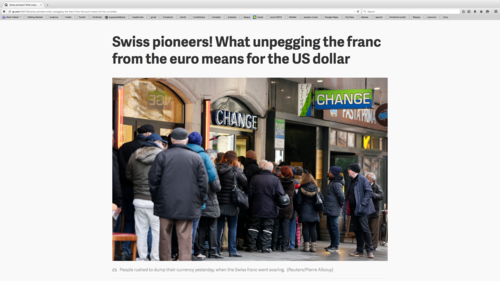
Here is the full text of my 59th Quartz column, “Swiss pioneers! What unpegging the franc from the euro means for the US dollar,” brought home to supplysideliberal.com. It was first published on January 16, 2015. Links to all my other columns can be found here.

This column is a follow-up to “The Swiss National Bank Means Business with Its Negative Rates." Thanks to Mark Fontana for letting me know in real time about the Swiss National Bank’s actions. Note that since I wrote this column, Denmark’s central bank has lowered its certificate of deposit rate to -.75%. I doubt they would have done that at this point without the example of the Swiss National Bank in going down to -.75% for the interest on reserves.   

If you want to mirror the content of this post on another site, that is possible for a limited time if you read the legal notice at this link and include both a link to the original Quartz column and the following copyright notice:

© January 16, 2015: Miles Kimball, as first published on Quartz. Used by permission according to a temporary nonexclusive license expiring June 30, 2017. All rights reserved.


The Swiss National Bank’s dismantling of its ceiling on the value of the Swiss franc yesterday stunned the financial world. Jim Armitage and Russell Lynch of the Independent called the ensuing jump up in the value of the Swiss franc an earthquake; Social media called it “Francogeddon;” while the CEO of Swatch, Nick Hayek, called it “a tsunami for the export industry and for tourism, and finally for the entire country.” Thomas Jordan, the head of the Swiss National Bank, explained, “If you decide to exit such a policy, you have to take the markets by surprise.”

At points during the day yesterday, the Swiss franc was as much as 39% more expensive relative to the euro and the US dollar than it had been the day before. Exchange rate movements have yet to settle down, but seem to be headed for something closer to a 15%-25% increase in the value of the Swiss franc.

In my Dec. 19, 2014 column “The Swiss are now at a negative interest rate due to the Russian ruble collapse” I made three predictions. On one, I was spectacularly wrong. On the second, I was exactly on target. As for the third, its time has not yet come, but will.

When I wrote “no one should underestimate the Swiss National Bank when it says that it will do whatever it takes to keep its exchange rate at 0.833 euros per Swiss franc” I badly underestimated the speed of events. On top of the continuing crisis of the Russian ruble, the financial markets’ belief that the ECB will soon begin serious quantitative easing to lower yields in the eurozone is now also steering investors toward Swiss assets. And buying Swiss assets requires buying Swiss francs. So there is a scramble to get hold of Swiss francs, even at a premium.

The Swiss National Bank decided it was a fool’s game to fight this: keeping the ceiling on the Swiss franc’s price longer would have meant the Swiss National Bank taking bigger losses. As it is, the Swiss National Bank lost on the order of 60 billion Swiss francs (equivalent to about $68 billion in US dollars) when yesterday’s exchange rate movements made its foreign asset holdings worth that much less in terms of Swiss francs.

But events have borne out my second prediction: that the Swiss National Bank would move toward deeper negative interest rates. The SNB’s new interest rate for banks keeping money in an account at the SNB is now down to -0.75 % per year. That is three-quarters of a percent below zero. By comparison, the European Central Bank is still at -0.2% per year, or only a fifth of a percent below zero.

My third prediction was that the Swiss National Bank is prepared, if needed, to push interest rates lower still—beyond the -0.75% they are at now. In a bit of hyperbole, Hans Guenther-Redeker said in a Bloomberg interview that if the Swiss National Bank pushed interest rates down to -2%, “You have to make a bank depositor to pay for the services of the bank—or for the luxury of having a deposit with the bank. That is going to turn capitalism upside down.” Swiss National Bank interest rates at -2% now look much more likely to happen. If the Swiss National Bank does lower interest rates to -2%, capitalism will adjust, and the Swiss economy will get stimulus it badly needs.

Besides lowering interest rates, the other main option the Swiss National Bank has to keep the Swiss economy from sputtering is to push the Swiss franc down relative to the US dollar, now that the SNB has given up pushing the Swiss franc down so hard relative to the euro. But it will have to buy huge amounts of dollar assets to have much of an effect on the Swiss franc/dollar exchange rate if it doesn’t use interest rate cuts to help make the Swiss franc cheaper relative to the US dollar.

I am betting that, going forward, interest rate policy will be the linchpin for the Swiss National Bank rather than exchange rate interventions. What the Swiss National Bank knows that many financial market observers have not yet figured out is this: other than an economy that starts to boom and risk overheating from lower interest rates, there is no limit to how far a central bank can cut interest rates, as long as it cuts the interest rate on paper currency along with other interest rates.

As I explained to an attentive audience at the Swiss National Bank on July 15, 2014, in a negative interest rate environment, all that is needed to bring the rate of return on paper currency down in line with the other interest rates a central bank controls is to introduce, and for a time gradually increase, the size of a paper currency deposit fee when private banks come to deposit paper currency at the cash window of the central bank. Then, once a robust economy leads to positive interest rates again, the paper currency deposit fee at the central bank’s cash window can be gradually reduced back to zero, until the next time that negative interest rates are needed to keep the economy on track. (You can find all the details here.)

Although lowering the paper currency interest rate in tandem with other interest rates avoids the massive paper currency storage that would otherwise be a serious side effect of deep negative rates, there is no question that negative interest rates will require many detailed adjustments in how banks and other financial firms conduct their business. Like it or not, Swiss banks and the rest of the Swiss financial industry may be forced to lead the way in figuring out these adjustments, just as the Swiss National Bank is leading the way in figuring out how to conduct negative interest rate policy. The Swiss are eminently qualified for that pioneering role. The rest of the world would be well-advised to watch closely.

If putting a dollar value on human lives strikes you as cold-hearted, grow up. You implicitly put a dollar value on human lives every time you buy a candy bar with funds that could instead have been donated to the local fire department. No matter who you are, there is a limit to what you’re willing to spend to save lives; the only question is whether you’re willing to think honestly about what that limit is. [Kip] Viscusi thought hard not about his own limit but about how to measure other people’s limits, through observations of their behavior. That’s where the $6.6 million comes from–an estimate of what real people in real situations are willing to pay to make themselves safe.

Hojoon Kim: Will Mobile Payment Apps Replace Cash in the Near Future?

Hojoon Kim

Hojoon Kim

I am pleased to host this guest post by Hojoon Kim on the progress of electronic money–something that could some day make monetary policy easier. It is the second guest post this semester from students in my Monetary and Financial Theory class. You can see links to all of the other student guest posts here. Here is Hojoon:


What do the following apps have in common?

  • Venmo
  • Square Cash
  • PayPal
  • Google Wallet

These mobile apps not only allow users to make transactions without credit cards or cash but they allow people to easily transfer their money from bank account to their friends’ bank accounts. Even if you forget your wallets at home, it is no longer a big problem because you always can pay with Google Wallet or you can borrow money from your friend and pay them immediately through Venmo. It is early in the day to think so that the world is moving in the direction of a cashless society. However, some people already believe that the society without credit card or cash will become a reality. Adrew Kortina, co-founder of Venmo, claims that people won’t be swiping credit cards in 2017. He said, “We are betting people will be using their phones for most payments in the future, instead of plastic cards or desktop computers“. Due to its ease of use or usability, numerous numbers of people are currently using these mobile apps in their daily life and Venmo processes $10 each month, which makes people to think that cash and credit card will likely to disappear. The graph below shows that the mobile transaction volume of Venmo will exceed its Starbucks in the near future.

Therefore, it is reasonable for technology experts to predict that the use of mobile payment apps will prevail over the use of cash or credit cards. According to The Pew Research Center Internet & American Life Project, 65 percent of technology experts believe that making transaction or payments via smartphone will be the dominant by 2020. Hal Varian, chief economist at Google said, “The 2020 date might be a bit optimistic, but I’m sure that this will happen. What is in your wallet now? Identification, payment, and personal items. All this will easily fit in your mobile device and will inevitably do so.”

Although many technology experts expect that cash will disappear by 2020, I personally do not think that cash will ever disappear at least in my life. I admit that mobile payment apps are innovative technologies in a sense that it does not require for people to bring cash or credit cards. Thus, it is more convenient and more secure than the traditional methods of payment such as cash and credit cards. However, here are the reasons why I think that people will keep using cash.

1. Cash is always good for small merchants

When you see merchants selling small stuff on the street, it is easy to notice that most of merchants only accept cash. The reason is very simple if we think of a fee that occurs from transactions of credit card payment or mobile payment apps. Most merchants on the street or at small stores do not sell expensive goods or products, suggesting that it would be costly for them to accept payment cards or mobile payments. Therefore, people will have to use cash when buying goods from small merchants.

2. As long as black market exists, it is unlikely that cash will disappear.

I think this is the most fundamental reason why people will keep using cash. Most crime organizations or crime syndicates heavily rely on untraceability and anonymity of money, especially when they are engaged in drug dealing, terrorism and selling illegal weapons. Once their transactions are traced, it is really easier for police or governments to track them, which is something that criminals do not want. I cannot definitely say that cash will stay forever in our society due to an advancement of technology and increasing demand for mobile payments. However, it would be hard to see the world without cash as long as crime exists in our society.

3.  There are always corrupted government officials who always want to take a secret payments. 

Not only the United States, but also other countries have been spending considerable amount of money and efforts to end bribery and corruption. However, it is not been so successful when we consider the countries with the lowest reported bribery rate all have a bribery rate of at least 1 %. Now, let’s assume that you want to bribe government officials and you have three options to give them money; cash, credit card and mobile payments. What would you choose? Of course, you would want to pay with cash unless you want to go to prison. This is another reasons why cash will never disappear unless government corruption no longer exist.

Drug Legalization and Time Slices of People as Ethical Units

Writing in 1869, John Stuart Mill hadn’t seen just how far Prohibition of alcohol would go in the United States in the 20th century, or how far prohibition of other drugs with recreational potential would go in the 21st century. Even back in the 19th century, people were making the argument that drug use harms other people and so is a legitimate subject for regulation. In On Liberty, Chapter IV, “Of the Limits to the Authority of Society over the Individual” paragraphs 18 and 19, John Stuart Mill is quick to counter the argument by pointing out how this puts no limits on the ability of society to meddle in an individual’s life: 

But, without dwelling upon supposititious cases, there are, in our own day, gross usurpations upon the liberty of private life actually practised, and still greater ones threatened with some expectation of success, and opinions propounded which assert an unlimited right in the public not only to prohibit by law everything which it thinks wrong, but in order to get at what it thinks wrong, to prohibit any number of things which it admits to be innocent.
Under the name of preventing intemperance, the people of one English colony, and of nearly half the United States, have been interdicted by law from making any use whatever of fermented drinks, except for medical purposes: for prohibition of their sale is in fact, as it is intended to be, prohibition of their use. And though the impracticability of executing the law has caused its repeal in several of the States which had adopted it, including the one from which it derives its name, an attempt has notwithstanding been commenced, and is prosecuted with considerable zeal by many of the professed philanthropists, to agitate for a similar law in this country. The association, or “Alliance” as it terms itself, which has been formed for this purpose, has acquired some notoriety through the publicity given to a correspondence between its Secretary and one of the very few English public men who hold that a politician’s opinions ought to be founded on principles. Lord Stanley’s share in this correspondence is calculated to strengthen the hopes already built on him, by those who know how rare such qualities as are manifested in some of his public appearances, unhappily are among those who figure in political life. The organ of the Alliance, who would “deeply deplore the recognition of any principle which could be wrested to justify bigotry and persecution,” undertakes to point out the “broad and impassable barrier” which divides such principles from those of the association. “All matters relating to thought, opinion, conscience, appear to me,” he says, “to be without the sphere of legislation; all pertaining to social act, habit, relation, subject only to a discretionary power vested in the State itself, and not in the individual, to be within it.” No mention is made of a third class, different from either of these, viz. acts and habits which are not social, but individual; although it is to this class, surely, that the act of drinking fermented liquors belongs. Selling fermented liquors, however, is trading, and trading is a social act. But the infringement complained of is not on the liberty of the seller, but on that of the buyer and consumer; since the State might just as well forbid him to drink wine, as purposely make it impossible for him to obtain it. The Secretary, however, says, “I claim, as a citizen, a right to legislate whenever my social rights are invaded by the social act of another.” And now for the definition of these “social rights.” “If anything invades my social rights, certainly the traffic in strong drink does. It destroys my primary right of security, by constantly creating and stimulating social disorder. It invades my right of equality, by deriving a profit from the creation of a misery I am taxed to support. It impedes my right to free moral and intellectual development, by surrounding my path with dangers, and by weakening and demoralizing society, from which I have a right to claim mutual aid and intercourse.” A theory of “social rights,” the like of which probably never before found its way into distinct language: being nothing short of this—that it is the absolute social right of every individual, that every other individual shall act in every respect exactly as he ought; that whosoever fails thereof in the smallest particular, violates my social right, and entitles me to demand from the legislature the removal of the grievance. So monstrous a principle is far more dangerous than any single interference with liberty; there is no violation of liberty which it would not justify; it acknowledges no right to any freedom whatever, except perhaps to that of holding opinions in secret, without ever disclosing them: for, the moment an opinion which I consider noxious passes any one’s lips, it invades all the “social rights” attributed to me by the Alliance. The doctrine ascribes to all mankind a vested interest in each other’s moral, intellectual, and even physical perfection, to be defined by each claimant according to his own standard.

On drug legalization, I am not willing to go as far as John Stuart Mill. In my post Allison Schrager: The Economic Case for the US to Legalize All Drugs, I wrote this:

I agree with Allison that we need to legalize the production and sale of drugs in order to take revenue, and therefore power, away from criminal gangs. But I think it is important that we do whatever we can to drive down the usage of dangerous drugs consistent with taking the drug trade out of the hands of criminals:
  • Taxes on dangerous drugs as high as possible without encouraging large-scale smuggling;
  • Age limits on drug purchases as strict as consistent with keeping the drug trade out of the hands of illegal gangs;
  • Free drug treatment, financed by those taxes;
  • Evidence-based public education campaigns against drug use, financed by those taxes;
  • Demonization in the media and in polite company of those who (now legally) sell dangerous drugs;
  • Mandatory, gruesome warnings like those we have for cigarettes;
  • Widespread mandatory drug testing and penalties for use of dangerous drugs—but not for drug possession;
  • Strict penalties for driving under the influence of drugs.
Notice that in order to keep the drug trade from going underground, prosecutors must not be allowed to use evidence that an individual purchased or possessed drugs as evidence that he or she used drugs. Evidence of use would have to come from some form of drug testing or from behavior.

(Note: Of course, there needs to be strict rules limiting when testing can legitimately be insisted on, since indiscriminate testing is itself an infringement on liberty.)

How can I justify keeping the use of dangerous drugs illegal? First, by “dangerous drugs” I mean, for example, a drug that has a high probability of causing brain damage if used recreationally in an ongoing way that is easy for someone to fall into. My argument is that, ethically, I am every bit as justified in using time-slices of an individual as the unit for ethical concern as opposed to individuals. If we take that tack, then people’s future selves are like (time-slices of) their children: ethical units that those people now typically have a strong enough altruistic attachment to that we can mostly trust them to try to do the right thing. But just as we are justified in taking children out of the homes of parents who show strong enough evidence of doing something harmful enough to those children that either their competence or the strength of their altruistic link toward those children is in serious doubt, it might under some circumstance be reasonable to take someone’s future self out of that person’s present self’s custody.  

Now, when speaking of taking a person’s future self out of that person’s current self’s custody, it is crucial to distinguish between that person doing something unusual in a way that is consistent between future self and present self and something in which the present self shows a serious lack of “parental” concern for the future self. Here is an example of a test–at least as a thought experiment. Suppose that it were possible to have someone experience the harmful effects of a drug first and then experience the more pleasant, recreational aspects of the drug. Regardless of how you or I view the balance between the positive aspects of the drug and the negative aspects, as long as the individual was willing to experience (in the thought experiment) the harmful effects first and only then experience the more pleasant, recreational aspects, I see no reason or justification for stopping that person.  

Notice that the issue I am raising goes far beyond the question of which drugs to legalize. The principle of deference or non-paternalism to another person’s decisions that has (in my view) such a strong basis at a given point in time becomes weaker when there are harmful effects on an individual in the future, and one recognizes that one is concerned–in what I think is an ethically appropriate way–about that person’s future self in a way that is distinct from caring about the individual seen as a single thing. The idea that time-slices of individuals might be appropriate ethical units means that one cannot necessarily simply accept someone else’s degree of impatience (=the utility discount rate). Given the high costs of any interference with another person–including especially the costs to liberty itself, which is something people care deeply about for themselves–there should be a great deal of deference for another person’s own handling of their own future self. But like the deference we give to parents in the handling of their children, our deference to others in the handling of their own future selves does not deserve the same level of deference as the almost absolute deference we should have to people’s handling of their own current selves, within the private sphere.

Virginia Postrel on Charisma

In its precise sense, charisma (originally a religious term) is a quality of leadership that inspires followers to join the charismatic leader in the disciplined pursuit of a greater cause. … Glamour doesn’t persuade the audience to share a leader’s vision. Instead it inspires the audience to project their own longings onto the leader … making glamour most effective at a distance. Charisma, by contrast, works through personal contact. … Charisma draws the audience to share the charismatic figure’s own commitments, seeking that person’s affection or approval. Charisma enhances leadership, glamour enhances sales.

– Virginia Postrel, The Power of Glamour, pp. 116-117