Drew Hinshaw: Nigeria Produces Half the Electricity of North Dakota-for 249 Times More People

I have heard distressing, yet fascinating, stories from a colleague who has spent time in Africa about how folks in Africa often act like the “Homo Economicus” of our theories, but without the benefit of adequate property rights to keep things on track. One example I found vivid is the routine theft of wire from power lines in order to sell the copper. So I was interested to read Drew Hinshaw's Wall Street Journal article linked above about electricity in Nigeria. I particularly noticed these passages which help make vivid the kinds of problems that can face a poor country trying to get richer:

The quest to turn the lights back on in Nigeria is pitting some of the country’s richest men against rusted power lines, pilfered electricity and grenade-lobbing saboteurs. …

Half of Nigeria’s electricity is stolen or lost on quarter-century-old power lines. Companies have taken on the job of installing electric meters and bringing bills to the hundreds of thousands of Nigerian households that run wires to nearby electrical poles, without paying. …

Nigeria will need to lay fresh pipelines to tap its gas reserves—the world’s eighth largest—to fuel those turbines. One problem: Saboteurs lurking in the swamps keep throwing grenades under what few gas pipelines exist in an attempt to extort protection money from Nigeria’s government. …

When Mr. Elumelu’s staff first walked into the plant last November—they weren’t given access until it was purchased—they discovered technicians weren’t wearing safety goggles or even shoes. Some crawled into the innards of deadly gas turbines wearing flip flops.

Those workers had also lost track of turbine parts, rendering the massive machines unusable. All told, the station produces just 160 megawatts—half the wattage the company assumed when it bought the place.

Michigan, University and State, Occasion a Landmark Supreme Court Decision on Affirmative Action

The link above is to a well-written and careful discussion by Jess Bravin in the Wall Street Journal of the Supreme Court’s 6-2 decision to uphold the right of a state—in this case Michigan—to prohibit the use of explicitly race-based affirmative action at its universities.

Within Michigan, the voter initiative against using race-based affirmative action was prompted in the main by the University of Michigan’s actions.

As a professor at the University of Michigan, what I regret most is this: by going too far in the direction of formulaic affirmative action, the University of Michigan caused a backlash that may imperil the ability of the faculty and administrators at the University of Michigan to do affirmative action based on case-by-case judgments. That seems especially unfortunate to me because I think affirmative action based on case-by-case judgments is likely to strike a better balance among all the different kinds of affirmative action that might be warranted.

Here is a link to an earlier Wall Street Journal article giving some of the history of the legal battle about affirmative action in Michigan:

The Periodic Table in the Round

I like these different versions of the periodic table flagged by othmeralia, who wrote: 

In 1869 Dmitrii Mendeleev sketched his first draft of the periodic table.  While Mendeleev’s version remains the most common, alternative arrangements include circular, cylindrical, pyramidal, spiral, and triangular layouts.  Indeed, Edward Mazurs chronicled over 140 types in his seminal work, Graphic Representations of the Periodic System over 100 Years! Which one gets your vote?

The trouble is that the more well-known you are, the more difficult it is to hide away and actually work. When no one is interested in you and inviting you to things, it’s easier.

– British designer Zandra Rhodes, in an interview for the April, 2014 issue of Harvard Business Review by Alison Beard. My title for this quotation isThe Boon of Being Unknown.

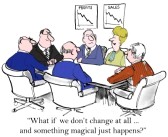
So What If We Don't Change at All…and Something Magical Just Happens?

A tweet with this cartoon reminded me of my post “The Unavoidability of Faith.” I believe that one of the first decisions one must make before putting forth effort is whether efforts are likely to make one’s life better. Since thinking hard is itself effort, there is no way the decision of whether beginning to make an effort at life-improvement has a high enough marginal product to be worthwhile can be made in a fully rational way. It takes faith. If you believe that making an effort at life-improvement is worthwhile (and perhaps by the actions that result, get some confirmation), expressing that faith to others who are just starting out might make a big difference in their lives.

Of course, there are many other things one might have faith in, instead: for example, the idea that even without any effort, everything might work out well because of something magical. What a pleasant belief! But will it work?

Max Huppertz—The Decline in Labor Force Participation: Speed Bump, Hysteresis, or "I, Robot"?

Max Huppertz is a student in my “Monetary and Financial Theory” class and has his own Tumblr blog, Liberal Animation. Of all my current students, Max is the one whose writing reminds me most of Noah Smith’s style on Noahpinion. To get a full picture of Max’s sense of humor, you will have to go to his blog Liberal Animation, but the guest post below shows the depth of Max’s analysis. Max:


Evan Soltas had an interesting post about labor market tightness a couple of weeks ago. His main point is that, looking at the quits rate, you might think that labor markets are pretty tight right now. That might be a sign that, overall, there’s not a lot of unused economic capacity, or at least, not a lot of unused capacity that matters (more on that below). If you think that’s the case, you’d reach very different policy conclusions when it comes to monetary tightening than someone who thinks there’s still plenty of slack in the economy.

Quite a few people have given their 2 cents already. John Aziz makes a point about the potential benefits of overshooting: it might create jobs for some of the long-term unemployed.

Evan may have a good reason for disregarding the long-term unemployed. John’s proposal might be all we need. But if neither of the two is completely right, we may be in trouble.

Why does Evan think that the long-term unemployed don’t matter? He says that if they don’t compete with more active members of the labor force, they can’t hold back wage growth or interfere with employer/employee matching (because they won’t keep people from quitting a job they don’t like for one they enjoy). Which is a valid point.

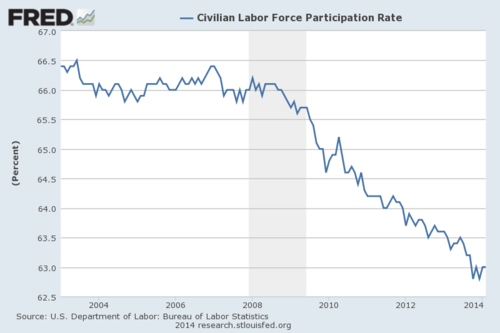
But in the medium to long run, a drop in lower labor force participation seems like somewhat of an issue. And participation is down:

It seems to me that there are three possible reasons for this, and three scenarios how this could play out:

  1. The decrease in labor force participation is transitory. In that case Evan’s assessment is correct, although you could still argue that the possibility to overshoot is a risk worth taking, given its potential benefits.
  2. The decrease is more or less permanent, due to labor market hysteresis. In that case, overshooting alone might do the trick.
  3. The decrease is more or less permanent, and it’s a (labor!) demand trend. In that case, we might have a real issue on our hands.

1) Will it all be over soon?

Evan seems pretty convinced that the long-term unemployed “really can’t matter much in a macroeconomic sense”. I think that statement makes sense only if you assume that, in the long run, labor force participation will return to its pre-crisis level. Else, I would like to see an argument as to why we should ignore the fact that 3% of the total US labor force decided to take some time off. Changes of that magnitude are the ones that tend to matter little now, but a lot if they turn out to be persistent over several years’ time.

2) The UI forever (well, kinda…)

Just so we’re clear: economists have a somewhat peculiar interpretation of the word permanent. When I say that the drop in labor force participation might be permanent, I don’t really mean forever. I mean, “for around ten years or so”. Which is substantially longer than recovering from the recent crisis will take (hopefully, anyway), and thus covers a much longer time span than scenario one. So why might participation be depressed for a whole decade?

There are a few stories you could tell that might lead to scenario two. Maybe people lost a lot of human capital while they were unemployed, and have genuine trouble finding a job. Or maybe, employers regard long-term unemployment as a signal. Long-term unemployment might indicate that you’re not the kind of person people would want to employ. Granted, it might also mean you were just unlucky and got laid off at a time when it was really hard to find a new job. But so long as employers have plenty of ‘good’ applicants to choose from – people who aren’t sending out the long-term unemployment signal – they might be okay with rejecting you anyway.

I’m not sure how likely this scenario is, but if this is the one we’re in, definitely overshoot! Temporarily overheating the economy may raise inflation a little, but it would also mean more job openings and fewer people applying. Making job applicants scarce would provide an incentive for employers to take a closer look at the long-term unemployed, and to figure out whether what happened to them was just bad luck – or whether they’re actually bad apples.

3) Rise of the Robot Lords

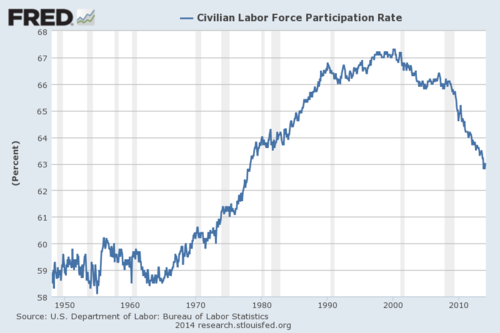
What if the long run equilibrium level of employment is actually decreasing over time? Take a look at the bigger picture:

For a while now, there has been stagnation and quite a substantial drop in labor force participation, even before the dot-com bubble. If employers desperately needed these people, wouldn’t you expect them to raise wages and try to lure some of them back into the game?

I know this sounds a little like a sci-fi cliché, but if falling demand for labor due to increased mechanization were responsible for discouraging workers from even trying to find a job, overshooting will at best give a temporary boost to labor force participation. After that, we’re back to the downward trend.

The remedies for this kind of situation are very different from what we need to do in the other two cases. Increasing the general level of education would be a good idea (it generally is, but especially in this case).

Rethinking the social safety net would be another (this is probably worthy of a post of its own, but let me give you my intuition). Many of the labor-intensive industries of today might rethink their business model once robots become more cost-effective. What happens if mechanization puts us into a position where the vast majority of workers in classic manufacturing jobs (cars, steel) – and possibly also a fair few in the service sector (eventually, burger-flipping robots will be the norm) – are no longer needed? And when, at the same time, the new ‘employees’ – machines – won’t ever ask for pensions, or unemployment benefits? Well, it seems to me that indefinite unemployment insurance, or a guaranteed basic income, might not be so Utopian in this scenario.

Faced with this kind of affluence, society might well decide that the dangers of ‘paying people to be unemployed‘ are far outweighed by the benefits of getting much closer to what John Rawls would call a well-ordered society. And, especially in a highly educated society, I think we have reason to believe that people actually want to work, instead of being on the dole. As Jeffrey Smith nicely said (referring to Arno Duebel, a German who had been living off unemployment benefits for 36 years straight):

The actual mystery, though, is not the existence of someone like Arno, but rather, given the relative generosity of many European welfare states, their relative scarcity.

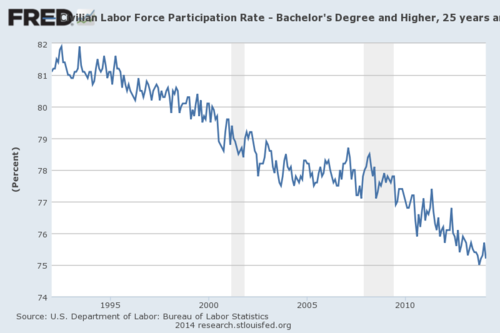
By the way, labor force participation isn’t just down for low-skill workers; this may be an issue that affects us all, even those with a college education (albeit to a lesser degree):

blog.supplysideliberal.com tumblr_inline_n48vd0Ne7I1r57lmx.png

Like I said, this deserves a post of its own.

Humans good, robots bad?

I think that the third scenario is the one we want to be in. Any kind of job that a robot (or machine in general) can do better then a human – why not let it do it?

But it’s also the most difficult one to come to terms with, politically and ideologically. The left would need to give up part of its struggle for the ‘working class’, at least in the classical meaning of the word – factory workers, hard manual labor, that kind of thing. The right, on the other hand, might need to concede that in this kind of environment, maybe having a basic income won’t annihilate the US economy.

Issues like these would have to be dealt with during the next few years and decades. Or, who knows, maybe we are in scenario one, and Evan is right, or two, and John is right. But if not – and there are good reasons to believe this – we might want to start thinking about the implications.

Robert Flood and Miles Kimball on the Status of the Efficient Markets Theory

Robert Flood is an economist famous for his study of asset bubbles. Links to many of his papers can be found here. 

My post “Robert Shiller: Against the Efficient Markets Theory” started a lively discussion on my Facebook wall (which is totally public). I added my discussion with Dennis Wolfe and a summing up by Richard Manning to “Robert Shiller: Against the Efficient Markets Theory” itself, but I thought the discussion with Robert Flood deserved its own post. See what you think:

Robert: This stuff is fun to talk about without a model, but finding one that works so you can use it for testing is harder. The stuff without a model says nothing about data so is nice for talk shows.

Miles: Any model we would write down at this point would be drastically wrong, so it would not be of much immediate practical value. What we need first is a suite of survey and experimental tools for measuring all the narrative forces that Bob Shiller is talking about.

Robert: As I have said, this is fun stuff. I just wish you’d get past the Efficient Markets thing. It’s undefined w/o a model and you do not want to talk about models - neither do I. The “stories organizing” notion is as good as anything else. I look forward to seeing where it goes. John Cochrane aside, the SDF approach looks like a dead end to me. It’s killing Macro and does not seem to do much for Finance.

Miles: There is no lack of efficient markets theory models that describe the way the world isn’t. Take your pick. In class today, I talked about the no-trade theorems, for example. In the real world, 95% of all trading volume cannot be explained if you insist that everyone has the same expectations.

Robert: Now you are talking. The issue you mention is a problem with Rep Agent - RA - not with EM. Indeed, having problems with RA gives an immediate research strategy - no RA - information dispersion, taste dispersion, life span dispersion, information discovery, transactions costs, rules of thumb….. In my view EM is not a hypothesis, it is an assumption about how people behave and not just in financial markets.

Miles: None of information dispersion, taste dispersion, life span dispersion, information discovery, transactions costs can possibly explain the volume we see. Only different people processing the available information differently can possibly yield the volume we see. Of your list, only “rules of thumb” is in this category, but in reality there are many people very actively processing the same information in different ways to come to different opinions. That is a failure of rational expectations. Without rational expectations, there is no efficient markets theory left, since the EMT logic runs from (approximately?) perfect competition in asset markets and (approximately?) rational expectations.

Robert: Agreed, volume is a real issue. I think it has something to do with the way we have structured compensation. Why is different processing of information a RE failure? People have very different experiences, different abilities and therefore different costs and therefore process things differently. The only failure is the failure by definition of RA. Forget econ for a moment. Look at politics. The dispersion of beliefs is, I think, much wider than the dispersion of information.

Miles: The assumption of rational expectations is the assumption of perfect information processing, given the information you have in front of you. There was a time half a century ago when economists thought that imperfect information and imperfect information processing were similar issues, but technical advances have made it clear that imperfect information can be dealt with by nice extensions of standard theory. Not so for imperfect information processing. Methodologically, that is a radical departure from standard theory, though a necessary one for many applications, since people in the real world are not infinitely intelligent and many real-world economic decisions are quite difficult computationally and conceptually–difficult enough to tax the abilities even of PhD economists, let alone people who don’t love solving optimization problems. I raised some of these issues in my post “The Unavoidability of Faith.”

Robert: Sure. The Muth model, Lucas, Sargent, Sharp etc had free relevant information - including full information about the model generating outcomes and costless processing. So what? Expand the framework to include all sorts of costs and you have a bigger model, but that does not make people behave stupidly. The guys in the model will use their history (goodby Markov) to process things until they think (Bayes comes in here) it’s not worth processing more. (Oddly, this is Peter Garber’s completely incomprehensible thesis written under Lucas)

Miles: I agree that people do not generally behave stupidly. My point is that to this day, our standard technical tools depend crucially on them being infinitely intelligent. There is a reason Peter Garber’s thesis was not easy to understand. Dealing with imperfect information *processing* is a *much* bigger technical leap than dealing with imperfect information. This is one of the themes of my paper “Cognitive Economics” that I am giving as the keynote speech at the Japanese Economic Review Conference in Tokyo in August.

Robert:Ok. I am happy to agree on the NSS way of thinking ( NSS = Not So Stupid). In my view, that’s all EM or RE says. Remember where we came from - no expectations, static expectations, adaptive expectations.

Update:Willem Buiter writes on the Facebook version of this post:

Willem H. Buiter:Efficient Markets Theory is an obvious empirical failure. Unfortunately, the alternative is a swamp of mutually contradictory but non-refutable (i.e non-scientific - long live Popper) anecdotes.


Pranav Krishnan: Fighting European Deflation with Negative Interest Rates

Pranav Krishnan is a student in my my “Monetary and Financial Theory” class. Pranav also has a blog that focuses on the finances of European football. Here is what Pranav has to say about eurozone monetary policy:


There were some positive signs around Europe, where it appeared that Spain’s unemployment rate had bottomed out in late 2013.

Perhaps talk of Europe’s recovery has come a little too early. While there were signs of positive growth in countries like Spain and Italy over the past few months, inflation was very low, and even more so inflation expectations.  David Roman of the Wall Street Journal wrote about a significant deflationary risk in Europe and how officials are expecting the European Central Bank to take the appropriate measures necessary to stem the tide. Josef Makuch, Slovenian Central Bank governor-rightly-feels that deflation could cause even more problems in the long term.

“Several [ECB] policy makers are ready to adopt nonstandard measures to prevent slipping into a deflationary environment,”

It appears that there might be more to this issue, than simply highlighting the risk of deflation.  The article was largely skimming the surface of what could become a wider problem later on.  Demosthenes Tambakis, a professor at the University of Cambridge, wrote for The Economist, outlining his opinion on why the Eurozone is at risk for deflation in further detail,  He points to very low inflation expectations across Europe and that alone increases a risk in deflation.  While he admitted that this risk shouldn’t rise so dramatically based on expectations alone, he does point out a few other institutional design elements that could contribute; Most notably, the European Central bank’s mandate, and the Zero Lower Bound.

The European Central Bank mandate is a bit pedantic in terms of legislature but it can play a role in the eyes of most economists.  The ECB, cites Tambakis, is committed to just below 2%, in contrast to say the Fed who wants to maintain a 2% average over time.  Tambakis believes that this causes an asymmetry which assures everyone that while they do not have to fear runaway inflation, they should worry when prices are too low because the ECB by design would be more reluctant to embark on expansionary monetary policy (increasing the money supply) than they are to contract.  While this point could make some sense in that the ECB might be unintentionally ‘guiding’ people to expecting less inflation in the medium-run and long-run, I would be surprised if this had a serious impact on inflation expectations.  Given the low levels of inflation in Europe, most economists and investors would likely expect lower levels to continue especially with the reduction in German growth rates.

The more likely argument seems to be the one about the Zero Lower Bound.  These risks are determined by the Shiller Index which predicts the long-run frequency of international stock market crashes.  Europe has faced two issues, in that they’ve suffered from the original financial crisis of 2008 and then the individual debt issues that each country faces. So, the natural reaction would be to cut interest rates to stimulate demand, but the Zero Lower Bound in Europe threatens to create a liquidity trap for the Eurozone.   In tandem with the dual mandate language set by the ECB, everyone already has very low expectations of inflation and the inability for countries to set monetary policy and stimulate demand individually threatens to worsen the situation for the Eurozone as a whole.

While there could be some legislation to create a more unified Europe fiscally and financially, the best thing the ECB can hope to do now is if they are going to be rigid about keeping inflation below 2% they should be more flexible about the Zero Lower Bound and allow the interest rate to hover in a broader range of negative interest rates.  The process will be rather painful because inflation expectations could plummet but in the long term, Europe could be better for it and escape the dangers of a long-term liquidity trap.