On Idealism Versus Cynicism

I know from Twitter interactions that Peggy Noonan is not everyone’s favorite essayist. But I like what she has to say in her February 18, 2014 blog post “Our Decadent Elites.” She starts by talking about the TV series “House of Cards”:

“House of Cards” very famously does nothing to enhance Washington’s reputation. It reinforces the idea that the capital has no room for clean people. The earnest, the diligent, the idealistic, they have no place there.

Peggy points out how, rather than dispute the picture of Washington given by “House of Cards,” many Washington politicians “embrace the show and become part of its promotion by spouting its famous lines”. And she brings in the folks on Wall Street by flagging Kevin Roose’s fly-on-the-wall account of financial bigwigs at play in the New York Magazine: “One-Percent Jokes and Plutocrats in Drag: What I Saw When I Crashed a Wall Street Secret Society.”

What I like most is Peggy’s picture of how things should be. She writes:

We’re at a funny point in our political culture. To have judgment is to be an elitist. To have dignity is to be yesterday. To have standards is to be a hypocrite—you won’t always meet standards even when they’re your own, so why have them?

Judgement, dignity and standards are the watchwords. And here is her picture of the white hats (which is my attempt at a gender-neutral equivalent of “the good guys”):

No one wants to be the earnest outsider now, no one wants to play the sober steward, no one wants to be the grind, the guy carrying around a cross of dignity. No one wants to be accused of being staid. No one wants to say, “This isn’t good for the country, and it isn’t good for our profession.”

Highlighting the key words, that is: 

  • earnest outsider,
  • sober steward,
  • grind,
  • carrying a cross of dignity,
  • staid,
  • willing to say “This isn’t good for the country, and it isn’t good for our profession."

I think that often, doing good can be more fun than Peggy suggests. But in the tough cases, this is a good picture of the kind of idealism we should all strive for–and never be ashamed of.

The need for such idealism cuts across all professions. For example, as I wrote in "When Honest House Appraisers Tried to Save the World,”

Being a bond-rater may not seem like the kind of job that could save the world, but it was. In particular, the financial crisis that has cost us so dearly since 2008 could have been avoided if the bond-raters had refused to stamp undeserving mortgage-backed securities as AAA.

On the whole, I am impressed with the degree to which the economists I know put truth first, and how seriously they take the responsibility to push public policy in constructive directions. And for unabashed idealism, the blogosphere is like a shining light in comparison to the darkness that Peggy sees in the halls of power.

But is idealism a chump’s game that can only lead to personal disillusionment? I don’t think so. As I wrote in my 2013 Christmas column “That Baby Born in Bethlehem Should Inspire Society to Keep Redeeming Itself”:

… the fact that the young will soon replace us gives rise to an important strategic principle: however hard it may seem to change misguided institutions and policies, all it takes to succeed in such an effort is to durably convince the young that there is a better way.

For those who have something worthwhile to say, there has never been a time in the earth’s history when it was easier to reach more young people to make one’s case. And somewhat parochially, I can’t help thinking that young economists are an especially important audience. (Here I include among economists all those who love economics, regardless of their level of formal training.) The world listens to economists–and will continue to listen to at least that subset of economists who put truth first, ahead of personal gain and partisan commitments.

The wheel of time turns, and today’s darkness is swept into the grave (sadly, along with much that is very, very good). Let us create light for the future; then in the future there will be light.

Update: In a tweet, Claudia Sahm speculates about the operative definition of “young.” My answer in that convo was this:

My image of “young” is someone who does not yet feel powerful, but is likely to have more influence in the future than now.

I have the sense that not yet feeling powerful often makes people more open to persuasion, starting with the time and willingness to hear out a new idea. “More influence in the future than now” has different timelines for different kinds of influence. Those under 18 are on a track to having more influence as voters in the future than now. Peak influence within economic in hiring and tenure decisions, and as journal referees and editors comes later. Peak influence within an organization like the Federal Reserve Board probably comes later still in the life cycle.

Leonard B. Katzman on the Religious Argument for Legalizing Gay Marriage

Thanks to Leonard B. Katzman for offering this guest post:

I read your recent Quartz column “The Case for Gay Marriage is Made in the Freedom of Religion." I thought you might be interested in the attached, which is the testimony I delivered before the Rhode Island Senate Judiciary Committee last March arguing in favor of marriage equality. As a lawyer, for many years I testified as to the legal/civil rights arguments in favor. Last year I was persuaded to be part of a coalition of religious leaders and testify from a faith perspective on the topic. Among other reasons for the coalition, this was to be a counterpoint to the lobbying of the Catholic Church which holds great influence here in Rhode Island.

In essence, I explain that denying gay Jewish people legal civil marriage rights is a denial of the right of Jewish people to the free exercise of our religion. All testimony was limited to 3 minutes and so this is just about as much information as I could cram into my allotted time although I certainly could have gone on at length on this topic.

Matt Rognlie on Misdiagnosis of Difficulties and the Fear of Looking Foolish as Barriers to Learning

Matthew Rognlie when he was an undergraduate at Duke, before going to the Ph.D. program in economics at MIT. Here is Matt’s blog.

I have been very impressed with Matthew Rognlie ever since our debate  “Sticky Prices vs. Sticky Wages.” In addition to my being pleased with that debate, it is one of the most popular posts on supplysideliberal.com and had this wonderful review from Simon Wren-Lewis: 

Yet debates among macroeconomists about whether and why wages are sticky go on. As this excellent example (I’ve been wanting to link to it for some time, just because of its quality) shows, they are not just debates between Keynesians and anti-Keynesians, so I do not think you can put this all down to some kind of ideological divide.

So I was delighted to get this email from Matt, which he gave me permission to share with you, after light editing.


Like many others, I enjoyed your and Noah’s article on math learning. In general, I’ve found that most students are puzzlingly quick to conclude that their failure to understand some concept is due to some innate ability, even when it’s hardly plausible that there is any kind of innate barrier. My favorite example of this comes from my high school chemistry class, where I remember talking with one of my classmates about studying for the big exam, and when the time came to talk about some class of reactions she said “oh, I’m not very good at that type of reaction”. And it wasn’t “I keep forgetting that part, so I need to study it more” - the vibe was more “I am just not talented enough to figure out that part of the class, so I’m going to write it off and spend my time elsewhere”.

I remember thinking that this was totally insane - she had mastered all kinds of very similar material in the class, and there was no reason why this particular material should be any more difficult. Even if we do have sizable innate differences in various high-level cognitive skills (memory for facts, memory for ideas, analytical skills, etc.), it is inconceivable that these differences could be so fine-grained that they would prevent her from learning about reactions B, D, and F when she already understood the very similar A, C, and E. Instead, clearly what had happened was that some tiny ambiguity in the presentation of B, D, and F confused her, and with a little more time and exposure she could have resolved it. And it wasn’t that she was unwilling to devote this time due to laziness. Instead, she honestly believed that there was something fundamental barring her from ever understanding this part of the course.

In that case, it was easy for me to see that her belief was ridiculous, but in all honesty I’ve displayed the exact same pattern on many instances. So many times I’ve seen references to some unfamiliar and mysterious concept of math or economics, and nearly written it off as something I’d need ages to understand - and then, when I finally decide to just learn it, I realize that the basic idea is really quite simple. And now, even though intellectually I know that it is very unlikely that any particular concept I encounter is beyond me, it can be very difficult to shake the attitude “oh, X is so confusing, that’s just a hopeless dead zone for me”. I suspect that many students who struggle with math have a much more pervasive and crippling case of the same basic mental block.

One amateurish theory of mine is that the young are better than the old at learning in large part because they are less susceptible to this mental block. This is related to my wife’s theory that the young are better at learning languages because they are less reserved about charging ahead and trying to speak in a new language. Once someone has already mastered one language, it is easy to become hesitant and neurotic when venturing into a new one - it’s incredibly frustrating to formulate your thoughts in the language of a 2nd grader when you could sound immeasurably more sophisticated in English. Yet this process is essential to learning.

The same is true of math. I’ve encountered many articulate and intelligent people who break down in the face of even elementary math. My theory for these people is that their mathematical ineptitude is driven mainly by fear - they know that they won’t be able to converse in math with nearly the same style and intelligence as in English, and are embarrassed to even try. Over time this attitude reinforces itself.

William Graham Sumner, Social Darwinist

William Graham Sumner is a more important historical figure than I had realized until recently. According to the Wikipedia article on him

William Graham Sumner (October 30, 1840 – April 12, 1910) was an American academic and “held the first professorship in sociology” at Yale College.[1] For many years he had a reputation as one of the most influential teachers there. He was a polymath with numerous books and essays on American historyeconomic historypolitical theorysociology, andanthropology. He is credited with introducing the term “ethnocentrism,” a term intended to identify imperialists’ chief means of justification, in his book Folkways (1906). Sumner is often seen as a proto-libertarian. He was also the first to teach a course entitled “Sociology”.[1]

In his economics,

Sumner was a staunch advocate of laissez-faire economics, as well as “a forthright proponent of free trade and the gold standard and a foe of socialism.”[1] Sumner was active in the intellectual promotion of free-trade classical liberalism, and in his heyday and after there were Sumner Clubs here and there. He heavily criticized state socialism/state communism. One adversary he mentioned by name was Edward Bellamy, whose national variant of socialism was set forth in Looking Backward, published in 1888, and the sequel Equality’.

I first read about William Graham Sumner in H. W. Brands’ book American Colossus: The Triumph of American Capitalism, 1865-1900. In this passage below (from pages 501-504), it struck me that William Graham Sumner lays out in stark form many arguments that are still very much alive and kicking in the 21st century. See if you agree.


William Graham Sumner … early imbibed the thinking of Charles Darwin, and that of Herbert Spencer when a bit older, and he followed Spencer in believing that Darwin’s theories explained the rise of civilization. Some people were better at the contest of life than others, Spencer and Sumner said; the good ones climbed out of the jungle of savagery and passed their talents to their offspring, who climbed still higher. The sorting took place both among nations, with the industrial powers of Europe and North America having made the greatest progress so far, and within nations, as certain individuals and families accomplished and attained more than the rest. 

Such, to William Sumner, seemed … obvious … and as undeniable as death. Nor were these views especially controversial in America among the kinds of people who encountered Sumner’s essays in the leading journals of the 1880s and 1890s. Religious conservatives–who tended not to read the Forum, the North American Review, Harper’s, and similar fare–disputed anything to do with Darwin, but among the intelligentsia the description provided by Sumner and the other Social Darwinists didn’t elicit inordinate objection.

Sumner's prescriptions were another matter. Sumner argued that attempts to overrule evolution–as by alleviating the plight of the poor–were both immoral and imprudent. “Those whom humanitarians and philanthropists call the weak are the ones through whom the productive and conservative forces of society are wasted,” he declared. “They constantly neutralize and destroy the finest efforts of the wise and industrious, and are a dead-weight on the society in all its struggles to realize any better things.” The do-gooders had made a cottage industry of weeping for the weak. 

They see wealth and poverty side by side. They note great inequality of social position and social chances. They eagerly set about the attempt to account for what they see, and to devise schemes for remedying what they do not like. In their eagerness to recommend the less fortunate classes to pity and consideration, they forget all about the rights of other classes, they gloss over the faults of the classes in question, and they exaggerate their misfortunes and their virtues. They invent new theories of property, distorting rights and perpetuating injustice, as anyone is sure to do who sets about the readjustment of social relations with the interests of one group distinctly before his mind, and the interests of all other groups thrown into the background. When i have read certain of these discussions, I have thought that it must be quite disreputable to be respectable, quite dishonest to own property, quite unjust to go one’s own way and earn one’s own living, and that the only really admirable person was the good-for-nothing.

The reformers, Sumner said, were constantly hatching plans to employ the power of government on behalf of their favored victims. “Their schemes, therefore, may always be reduced to this type–that A and B decide what C shall do for D.” A and B were the reformers; they derived power and self-satisfaction from this arrangement. D, the object of their concern, received material benefits. C, whom Sumner called the “Forgotten Man,” unwillingly supported the others. “We should get a new maxim of judicious living,” Sumner said sarcastically: “Poverty is the best policy. If you get wealth, you will have to support other people; if you do not get wealth, it will be the duty of other people to support you.”

The immorality of freeloading aside, Sumner held that tampering with the social mechanism reduced total welfare. “If any one will look over his dinner table the next time he sits down to dinner, he can see the proofs that thousands of producers, transporters, merchants, bankers, policemen, and mechanics, through the whole organization of society and all over the globe, have been at work for the last year or more to put that dinner within his reach.” All this happened not by accident but by an interlocking set of agreements and expectations evolved over time. Reformers thought they could improve the operation of the social mechanism by bending this lever or adjusting that flywheel; instead they threw the whole thing out of order. 

Rejecting reform, Sumner put his faith in laissez faire. “Let us translate it into blunt English,” he said of the French phrase. “It will read: Mind your own business. It is nothing but the doctrine of liberty. Let every man be happy in his own way.” Sumner didn’t promise paradise. “We never supposed that laissez faire would give us perfect happiness. We have left perfect happiness entirely out of our account.” He would settle for imperfection not made worse by reformers. “If the social doctors will mind their own business, we shall have no troubles but what belong to Nature. Those we will endure or combat as we can. What we desire is that the friends of humanity should cease to add to them.”

Sumner’s philosophy supported domestic capitalism in obvious ways and was often cited to that effect; but it had implications for foreign policy as well. The struggle among humans took sharpest form in war, with the fit inheriting the earth and the meek finding early graves. This had been so from time out of mind, and the onset of industrialization hadn’t changed anything essential. “War has always existed and always will,” Sumner wrote. “It is in the conditions of human existence.” Tribes and nations competed for the resources of the earth, starting with land but extending, in the modern age, to vital minerals, markets for exports, and opportunities for investment. The deft and strong advanced, the rest retreated, and each tear devoted to the losers was water wasted. “The inevitable doom of those who cannot or will not come into the new worlds system is that they must perish. Philanthropy may delay their fate, and it certainly can prevent any wanton and cruel hastening of it; but it cannot avert it, because it is brought on by forces which carry us all along like dust upon a whirlwind.”

Yet Sumner refused to celebrate war, any more than he celebrated famine, pestilence, or other winnowers of the human race. “Shall any statesman … ever dare to say that it would be well, at a given moment, to have a war, lest the nation fall into the vices of industrialism and the evils of peace? The answer is plainly: No! … No war which can be avoided is just to the people who have to carry it on, to say nothing of the enemy. … A statesman who proposes war as an instrumentality admits his incompetency. 

Even so, wars would come whether humans willed them or not. And like the other riders of the apocalypse they left improvement in their wake. "While men were fighting for glory and greed, for revenge and superstition, they were building human society. They were acquiring discipline and cohesion; they were learning cooperation, perseverance, fortitude and patience. … War forms larger social units and produces states. … The great conquests have destroyed what was effete and opened the way for what was viable.

Matt Waite: How I Faced My Fears and Learned to Be Good at Math

Matt Waite

Matt Waite

The Bible says “Cast your bread upon the waters, for you shall find it after many days.” When Noah and published “There’s One Key Difference Between Kids Who Excel at Math and Those Who Don’t,” it didn’t take many days at all before we received many reactions that I feel add a lot to the case we tried to make. One of those reactions was from Matt Waite. I am grateful for his permission to reproduce his post  

How I Faced My Fears and Learned to Be Good at Math

here as a guest post.


“You might think the principal coder behind PolitiFact took naturally to math. You’d be wrong.”

Somewhere in middle school, I had convinced myself that I was bad at math. It was okay: My mom was bad at math too. So were lots of people I looked up to. “Bad at math” was a thing — probably even genetic — and it was okay.

I so thoroughly convinced myself that I was bad at math that I very nearly didn’t graduate from high school. It took tutors and hours a week to squeak through an advanced algebra class my friends had all breezed through on their way to much harder classes.

But it was okay. I was bad at math. They weren’t. Simple as that.

And it was all a lie.

“Bad at math” is a lie you tell yourself to make failure at math hurt less. That’s all it is.Professors Miles Kimball and Noah Smith wrote in The Atlantic that many of us faced a moment in our lives where we entered a math class that some of us were prepared for and some of us weren’t. Those that got it right away were “good at math” and those who didn’t, well, weren’t. Or so we believed. Those who were good kept working to stay good, and those of us who were bad at it believed the lie.

Now, Kimball and Smith write that bad at math is “the most self-destructive idea in America today.”

Well, Professors Kimball and Smith, welcome to journalism, where “bad at math” isn’t just a destructive idea — it’s a badge of honor. It’s your admission to the club. It’s woven into the very fabric of identity as a journalist.

And it’s a destructive lie. One I would say most journalists believe. It’s a lie that may well be a lurking variable in the death of journalism’s institutions.

Name me a hot growth area in journalism and I’ll show you an area in desperate need of people who can do a bit of math. Data. Programming. Visualization. It’s telling that most of the effort now is around recruiting people from outside journalism to do these things.

But it doesn’t end there. Name me a place where journalism needs help, and I’ll show you more places where math is a daily need: analytics, product development, market analysis. All “business side” jobs, right? Not anymore.

Truth is, “bad at math” was never a good thing in journalism, even when things like data and analytics weren’t a part of the job. Covering a city budget? It’s shameful how many newsroom creatures can’t calculate percent change. Covering sports? It’s embarrassing how many sports writers dismiss the gigantic leaps forward in data analysis in all sports as “nerd stuff.”

In short, we’ve created a culture where ignorance of a subject is not only accepted, it’s glorified. Ha ha! Journalists are bad at math! Fire is hot and water is wet too!

I’m not going to tell you how to get good at math by giving you links to online materials or MOOCs or whatever. I’m not. You can Google. You should do that. No, I’m going to tell you a story.

Through grit and luck and a Hail Mary pass of a grade on a final exam, I did graduate from high school. And in 1993 I went to the University of Nebraska-Lincoln, where the College of Journalism and Mass Communications at the time said the curricular equivalent of “Math? Why the hell do you need math?” I thought this was great. No math? I must be in heaven.

Twenty years later, I’m now a professor in that same journalism school that let me skip out of math. We don’t do that anymore, but our math requirements are pretty thin and universally reviled by students, most of whom would say they’re bad at math. As a professor, I can take classes for free. And it’s abundantly obvious to me that journalism’s problems aren’t with journalism — they’re about money. Where does one go to learn about money? Business school.

So I thought I would get an MBA to better understand the business side of journalism. I walked over to the business college and told them I wanted to do this. “Have you had calculus as an undergrad?” Oh. Uh, no. “Have to have it. It’s an admission requirement.”

So almost two decades to the day that I set foot on campus, there I was, taking a math placement exam. This exam is given to all incoming freshmen to determine which math class they should start with. I took it and could barely read the questions. If they had given me a grade, I would have bombed it. I tested straight into a remedial math class for students who didn’t get enough in high school. Congrats, Math Department: Your test nailed it.

I probably could have crammed and watched Khan Academy videos for hours, taken it again, and landed in a higher math class. But I would have felt like I cheated my way in. And that would have been terrifying. So, I took the class. Math 100A. Just a 37-year-old professor and 30 or so 18-year-old freshmen. Totally normal; I didn’t stick out at all. The instructor was in first grade when I was last in a math class. She asked me what I was doing there. Told her my story. Her reaction: She was bad at math too, until she got to college. Now, she’s getting a Ph.D. in it.

Given all that, I lived in absolute terror that I wouldn’t do well. I sat in the front row. I asked questions non-stop. I did all the homework. I did extra practice problems. I raised my hand to answer questions so much the instructor asked me to stop. I studied for hours.

And I got an A+. I was shocked. And elated. In spite of the fact that I’m a grownup and should get an A in a remedial course, I was pumped up. I can’t remember my last A in math.

On to the next class. Math 101: College Algebra. Just the name gave me chills. I could barely pass high school algebra; how the hell was I going to handle college algebra? Here I was, a grown man with a family and a house and a job and a resume, sweating bullets and losing sleep about a class freshmen take.

Same plan, same result: Work hard, get A+.

I’m halfway through calculus this semester. I have never in my life worked this hard in a class. I’ve never sat awake at night worrying about a class like I have tossing and turning thinking about how to calculate the derivative of something. I can go speak in front of 1,000 people with less than five minutes of preparation and be downright calm compared to the feeling I have going to take a test.

Right now, I’ve got a B+. And if I walk out of there with it, it’ll easily be the most proud of a grade I’ll ever have been.

Why? Because at this level, I’m seeing the consequences of how a student approaches math. On each test, the median score has been around a high F or a low D. The last test saw more than half the class fail. It’s brutal. Of the 111 students in the class, I’m guessing 70 of them will be taking it again.

The only advantage I have over my classmates? I know exactly how to fail at math: Don’t put any effort in. Blow it off. Do something else. A glass of wine and a rerun of Big Bang Theory kicks the crap out of applications of extrema using derivatives, even if you hate wine and loathe Big Bang Theory.

But that’s the lesson I’ve learned: The difference between good at math and bad at math is hard work. It’s trying. It’s trying hard. It’s trying harder than you’ve ever tried before. That’s it.

So do me a favor: Try. Stop with the jokes. Stop telling me, “Oh, I could never do that” when you ask me about math. Because it’s not true. You can. If you try.

You can be good at math.

Matt Waite is a professor of practice at the College of Journalism and Mass Communications. Previously, he was senior news technologist at the St. Petersburg Times, where he was the principal developer of the Pulitzer Prize-winning PolitiFact.

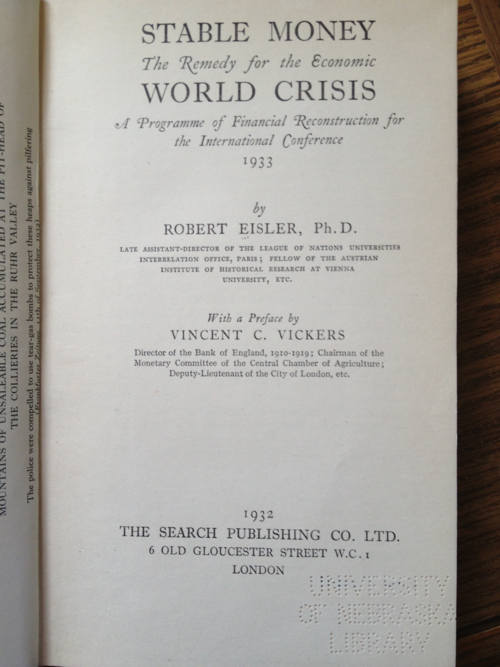
Robert Eisler—Stable Money: The Remedy for the Economic World Crisis

blog.supplysideliberal.com tumblr_inline_mme6wwWP1S1qz4rgp.png

The story [of electronic money as a way to end recessions quickly and end inflation forever] really goes back to 1932, in the middle of the Great Depression. A guy named Robert Eisler realized that they could get out of the great depression if they distinguished between bank money and paper money.

That is how I began my remarks at the Cryptocurrency Conference I participated in this past Tuesday. I learned about Robert Eisler from posts by Willem Buiter, in which Willem Buiter gives the modern theory of eliminating the zero lower bound.

One of the audience mentioned Silvio Gesell, who is much better known because John Maynard Keynes talked about him in his book The General Theory of Employment, Interest and Money(You can see the passage in my post on Silvio Gesell here.) But I see my proposal for eliminating the zero lower bound as closer in spirit to Robert Eisler’s proposal, first because he emphasizes an exchange rate between bank money (=electronic money now) and paper currency, and second, because he envisioned the bank money as having a stable value in relation to the goods and services that people buy. By contrast, instead of being comfortable with an exchange rate between bank money and paper money, Silvio Gesell proposed a system that encouraged people to buy stamps to put on the depreciated paper money to bring it up to par, and Silvio put less stress on having at least one type of money that maintained a stable value in relation to goods and services.  

Needless to say, Robert Eisler’s proposal is far from identical to mine. The biggest difference is that Robert Eisler imagined international fixed exchange rates in bank money coexisting with flexible exchange rates between bank money and paper currency. Also, Robert Eisler is far from clear about the necessity to keep the level of economic stimulus just right if the bank money is to keep a stable value. He writes as if using paper money price indices to set the exchange rate would be enough to yield a stable value for the bank money. Finally, he does not emphasize as I would the great importance of encouraging everyone to use the bank money as the unit of account. Indeed, in what he writes, he does not himself always use the bank money as the numeraire, and so sets a bad example in relation to what I consider the crucial unit of account function of the stable-value bank money. Nevertheless, in the most important respects, Robert Eisler anticipated the kind of monetary system I advocate.  

In a tweet, I called Robert Eisler the “grandfather of emoney monetary policy.” The father of emoney monetary policy is Willem Buiter, who first explained the principles clearly. (Also see the children’s fairy tale about Willem Buiter’s role.) 

Robert Eisler’s book Stable Money is not available on Amazon, and even the University of Michigan library system had to ask for an interlibrary loan from the University of Nebraska library in order to put a copy in my hands. I consider what he has to say important enough that I scanned the key chapter, available at this link. For those who prefer a modern font, I also typed out the key passage, comprising most of that chapter, which lays out Robert Eisler’s proposal for a new paper currency policy. (I put footnotes in square brackets at the appropriate points.) 

Here is Robert Eisler, Stable Money: The Remedy for the Economic World Crisis. A Programme of Financial Reconstruction for the International Conference 1933. Chapter XVII: Compensating the Effects of Inflation on the Cost of Living, pp. 232—247:


The present writer himself would condemn any scheme of monetary reorganisation which began by raising the purchasing power of one group at the expense of another. [Cp. Sir William Beveridge, Unemployment, p. 416: ‘The absorption of the unemployed in a temporary boom could probably be achieved very rapidly by a government prepared for inflation, but the inevitable after-effects of such a policy rule it out.’]

Fortunately, the proper method of for avoiding this and for counteracting automatically and continually the above enumerated evils of inflation is quite well known ever since, in 1747, Massachusetts Bay Colony introduced a simple ‘tabular standard’ based on the prices of wheat, meat, leather and wool in order to compensate for the effects of the inflation of the ‘Colonial Notes’ circulation on the revenues of its creditors, officers and soldiers. [Cp. Willard C. Fisher, ‘Tabular Standard in Massachusetts History,’ Quarterly Journal of Economic, 1913, pp. 415-417.]

Nothing is necessary but the introduction of a new, very simple monetary law in all countries willing to participate in the proposed currency expansion scheme—a law extending the well-known principle of ‘index-wages’ to all existing contracts in terms of money.

The legislation would provide that every monetary obligation in force at a given date—all contracts concerning wages, salaries and appointments, all laws fixing taxes, rates and duties, all stipulations concerning insurances, bank deposits or credits, loans or mortgages, rent or interest, all deeds of sale, all commercial bills, etc.—should be carried out with due regard to the actual purchasing power of the national money at the time when the payment stipulated is effected, the temporary purchasing power of the money being ascertained by means of index-numbers representing the average retail price [Only retail prices affect the owners of contractual income whom we want to protect (cp. On the whole index-problem, below, pp. 248-271).] of a fair number of consumable goods, the cost of rents, [Rent-restriction, originally intended to compensate the effects of war-time inflation and labour shortage in the building trade, which still exists in most countries, becomes superfluous as soon as proper weight is given everywhere in the calculation of the cost-of-living index to the cost of adequate housing. The importance of this as an element in the solution of the housing-problem is obvious.] rates, taxes, local transport, and elementary education at that particular moment in terms of the appropriate monetary unit. Such legislation would be tantamount to redefining the monetary unit of the U.K. or of the U.S.A. in case of their joining the proposed monetary federation. The following is a tentative draft of the proposed law:

The monetary unit of the currency of the United Kingdom/U.S.A. is the pound sterling/U.S.A. dollar.

The pound sterling/U.S.A. dollar is the Bank of England/Federal Reserve Bank note which was equivalent to 122.24719 grains/23.22 grains of fine gold at the London gold price of the 18th of September 1931.

The pound sterling/U.S.A. dollar note is legal tender to the extent of its actual purchasing-power.

The term ‘actual purchasing-power’ is defined as the reciprocal value of the cost-of-living index obtaining on the day of payment.

The cost-of-living index is calculated on the basis of the average costs of the following commodities: … of local transport, of rents, taxes and rates, and of the expenses for elementary education.

Through such a law the two functions of money—its use as a medium of exchange (legal tender) and its use as a means of accumulating capital (deferred purchasing power) or contractual income for the future—would henceforward be separated more completely than now. Even to-day bank-money and securities are generally used for the purpose of accumulation, and the keeping of considerable amounts of ready cash (hoarding of gold as well as of paper) is penalized by the loss of interest on that sum of money and is therefore avoided as much as possible by every intelligent steward of moneys—except in periods when a progressive slump in prices promises to compensate the hoarder for the small interest he might get on the over-full market for short loans. During periods of credit and currency expansion the penalty for letting money lie idle is aggravated by the certainty of seeing it constantly depreciation.

Under the new system there would be two sorts of money: (1) legal tender, called a pound or a U.S. dollar of ‘current money’ [The term ‘current money’ is well known to legal practice and theory as the equivalent of ‘legal tender’ as opposed to divisionary money which need not be accepted in unlimited quantities.] or money proper (£ cr. or $ cr.) and (2) bank or contract money of account, called a pound or dollar banco [The history of the term is told in W. F. Spalding’s article ‘Pound Banco’ concerning the author’s address to the Parliamentary Finance Committee in The Times Trade and Engineering Supplement of February 27th, 1932. The expression goes back to the twelfth century: the idea of a stable money is an ancient Roman invention (cp. Eisler, Das Geld, Munich, 1924, pp. 201 and 211f.)] (£ bo. or $ bo.). Money banco would be obtained by concluding a contract about a future payment of money proper, or by depositing ‘current money’ with a bank or similar institution. Current money would be exclusively used for small transactions between persons not well know to each other or not in possession of a bank account, especially for the payment of wages, transport fares and occasional retail purchases. All other payments would be effected by means of bank-money, that is by cheques or transfers of money banco. All prices in catalogues of shops selling goods of which the price does not vary much (e.g. books, clothes, jewellery, cigars, tobacco, wines) would be marketed in money banco. The index multiplicator of the week would be affixed to the desk of the cashier, who would calculate by means of simple multiplication or conversion tables published in the Sunday papers the sums due in ‘current money’. This is how retail business, inn and hotel-keeping was done in Germany at the height of the inflation in 1923, when the ‘stable mark’ was introduced as a money of account alongside the paper mark used as ‘current money’.[This simple expedient was criticized as ‘a nightmare’ by Prof. Edwin Cannan in his review of the author’s book, This Money Maze in the Economic Journal of 1932. We should like very much to put it to the vote of all shop assistants, however, whether they would object to this little extra work if they could thus be permanently freed from the menace of unemployment.] All bank and business accounts would, however, be calculated without any additional complication in money banco, current money being exchanged against bank-money by special tellers[Keeping special ledgers for ‘cash bought and sold’ as the money changing cashier of an English Cook’s office or of a continental bank.] only in so far and as soon as a client wanted to pay in or draw out current money. In each country the external exchanges between the national and foreign bank-moneys would be pegged,[See above, Chap. xiv.] but a variable internal exchange rate between current and bank money would be determined by the cost-of-living index.

The distinction between current money and ‘pounds banco’ and the use of an Italian word seem to arouse the distrust of the present inhabitants of Lombard Street, although they have no objection to the Bank of England being owned by a merchants’ Compagnia.[Abbreviated, Compa. on the notes of the Bank of England.] Mr. Alec Wilson, the well-known lecturer and propagandist of the League of Nations Union, has therefore suggested a simple and perhaps, to Englishmen, more acceptable way of distinguishing the unit of current money from the unit of ‘money-of-account’. The British public is quite accustomed, ever since the memorable 21st of September, 1931, to seeing in the popular papers ‘how many shillings the £ is worth’ on a given day. In these most misleading statements,[Cp. Above, p. 152] which are intended to keep alive the ‘gold mentality of the ignorant masses’, the equation between a £ and so many shillings is meant to tell the reader how many hypothetical ‘gold shillings’—if such a gold coin of 122.245/20 = 6.11235 grains did exist—an inconvertible paper pound would buy in London, Paris or New York.  In an analogous, but more realistic way we might henceforward decide to call the units of current money—the medium of exchange for petty trade and for paying out wages—‘shillings’ and ‘pence’ as usual, or ‘shillings’ and ‘pence cash’, reserving the term ‘pound’ or ‘pound cheque’ for the unit of bank-money used for all the more important transactions. The present £ notes would have to be withdrawn and exchanged against 5s., 10s., 20s., 100s., 200s. and 1,000s. notes corresponding to the continental type of bank-notes. Fractions of the unit of the bank-money of account would not be expressed in shillings but written out as decimal fractions of the £–e.g. £4.2 (meaning £4 4s. at the index 100).


TWENTY SHILLING

This twenty shilling Note of the Bank of England equivalent to one pound sterling, that is 122,247 grains of fine gold at the legal price of the 18th of September 1931, is legal tender to the extent of its actual purchase-power. The figure determining the purchase-power of this note on the day of payment, being the reciprocal value of the cost-of-living index in the United Kingdom of Great Britain at that date, will be published at least each Sunday by the British Board of Trade. The Bank of England promises to exchange its notes at sight against gold ingots of 400 oz. standard fineness at the gold-market price of the day and to buy gold at any time and in any quantity at the legal price of the 1st of January 1931, that is £1,500 13s. 4d. bank-money[It is equally possible to stabilise gold at the lowest market price of the day of the ratification of the international agreement printed below, App. V, and that is, at a figure round about £ 6 bank-money for the fine ounce (see above, p. 165, note 1). In this case speculation would be diverted from the commodity market to the gold-market, which would be desirable from the consumer’s point of view.] for the standard ingot of 400 ozs. Troy,

Act of Parliament of the __th of ______1933.


The pound would thus become again what it was when it meant a pound weight of silver coins, that is, a purely theoretical unit of account.[Curiously, Mr. Alec Wilson has hit, without knowing it, upon a system of currency expansion which is almost as old as the conception of the money banco. Cp. The author’s history of money Das Geld, p. 181, on the sixteenth century (unadulterated) Rhenish goulden, equivalent to more and more (debased) divisionary money (kreutzer): this was the oldest attempt to have a full-weight legal tender ‘principal currency’ alongside of a slowly depreciating expansible token currency for everyday trading.] This would be desirable because the proposed scheme has often been erroneously criticized as an attempt to introduce a double currency, which would bring ‘Gresham’s law’ into play. If Mr. Wilson’s suggestion is adopted, it will be seen that, as before, only one currency, consisting of shilling notes and shilling and pence token-coins, exists and circulates, the £ being merely the theoretical stable unit measuring credit, i.e. bank-money. Gresham’s law would immediately become operative if £ notes (£ bo.  notes of ‘stable’ value) were issued alongside of 10s., 20s., 100s. (or s. cr.) notes. In this case the two kinds of currency would not circulate together, the £ bo. notes being hoarded and the £ cr. Or shilling notes being eventually repudiated. Nothing of this kind can happen as long as the privileged banks do not issue anything but ‘current’ money proper, i.e. shilling notes. 

If the use of the decimal fractions were found too radical an innovation, the graphical expression £4,4/20 could be adopted, an odd penny being written as 1/240, a halfpenny as 1/480, a farthing as 1/960.

The proposal is, then, that we should have cheques, bills, promissory notes, IOUs, receipts, and any other documents of a similar nature expressed in pounds, one £ being equivalent to a number of shillings and pence of actual currency directly indicated by a cost-of-living number. If the use of decimal fractions were rejected, the basis of the British cost-of-living index would no longer be called 100—the index figure rising per cents to 101, 102, 103 …, but the scale would start at 240, the figure rising by 1/240 (corresponding to a penny in the £), and if necessary by 1/480 or 1/960, a halfpenny or a farthing in the £.[Englishmen are already used to reckoning rates and taxes by so many shillings and pence in the pound.]

A shopkeeper would keep over his cash registering machine a notice containing a space for inserting a statement of the currency standard at the time. It would be something like this:


For the convenience of our regular customers our prices are marked in £ and fractions of £. These figures should be used when writing out cheques and are put down by us in all our accounts and bills. Clients paying in cash will kindly note that to-day the value of the £=21s. 6¾d.


Beside this placard a copy of the corresponding printed conversion table[A specimen is given in App. IV.  App III shows a specimen butcher’s bill for two weeks.] might be affixed for the public to check the calculation of the cashier or vendor.

The price of single tram-, bus- and underground railway-tickets could not of course be adjusted to slight percentage variations of the purchase-power of current money. They would be sold—as they are to-day in Paris—in little folders, each containing a dozen penny ride tickets for 6 francs = 1/20 £, single tickets being sold at a considerably higher price (e.g. 1½d. for a penny ticket). Since local transport costs are included in the cost-of-living index,[Above, p. 233, §5] it does not matter if the single ticket price has to be raised more than absolutely necessary in terms of farthings.[During the German and French inflation all forms of transport were run at a loss, because fares were always adjusted too late to the rate of monetary depreciation. Under the proposed system the profits of the local transport services would be somewhat higher than normal, this super-profit compensating the outlay on new ticket-selling and money-changing machinery. At first a larger issue of farthings coinage would probably be convenient for purely psychological reasons, in order to avoid such small prices as penny fares being raised immediately by halfpennies, i.e. by 50%, because no smaller coins are available. ]

If groceries, butchers’ meat and similar goods are sold on credit, the shillings and pence figures may provisionally be put down in the ledger with the date and the index (of the week or of the day), to be added and converted into pounds at a convenient time by the book-keeper who writes out the customers’ bills. 

Current money will, of course, slowly but constantly[Not, of course, for ever—but until the optimal price-level is reached. See below, pp. 280f.] depreciate through the expansion of credit and currency necessary to meet the requirements of increasing production and consumption, the rate of increase being no longer limited except by the necessity of expanding the expenses of the various countries in due proportion to their actual spending power as measured by the volume of their present gold-standard currencies and by the physical limits of production. This will naturally force commercial and clearing banks to diminish as far as possible their cash reserves by increasing their balances at the National Banks,[These balances would, of course, be expressed in terms of bank-money (£ bo.) and convertible into actual cash at the index-rate of the day. The Macmillan Report (p. 146, § 343) has already pointed out that by establishing depots of its notes in various parts of the country the Bank of England could considerably increase the balances which the joint-stock and clearing banks keep with its Banking Department and diminish the need for till-money kept by the banks in their own vaults. The arrangement suggested below (p. 240, n. 3) and the increased circuit-velocity would probably enable the bank to provide the necessary amount of current money without raising the maximum limit of note issue above the figure of £400,000,000 recommended by the Macmillan Report (l.c.). On the other hand, the joint-stock banks certainly would not care to keep to the old ratio of 1:11 between deposits and ‘cash in hand’, but would substitute ‘balances with the Bank of England’ for most of their cash.] and all private people to spend or to deposit current money as quickly as possible. In this way the circuit velocity of currency, which is now one of the most intractable actors of monetary instability, will always be maintained at its maximum value, i.e. stabilized as far as possible, and the maximum of available credit will be automatically placed at the disposition of traders and producers. 

Currency reformer like Sylvio Gesell, the ancestor of the ‘Free Credit’ school, have tried to obtain this desirable result by the imposition of a weekly stamp-duty on bank notes. Leaving aside the foolish idea that such a duty could annihilate the receipt of interest on loans, and disregarding the intolerable inconvenience of having constantly to stick stamps on every bank-note, we may observe that a tax on currency simply produces a constantly depreciating money, which is the characteristic feature of inflation. The idea of a ‘dwindling’ monetary unit was first conceived in Brandenburg in the fourteenth century.[See Eisler, Das Geld, p. 117, on the ‘shophel’-pennies, of which a growing quantity (12 in the 1st, 13 in the 2nd, 14 in the 3rd, 15 in the 4th quarter and 16 in the new year) were equivalent to a shilling silver. About ordinary inflation being a crude form of taxation, see above p. 193, note 1, and J. M. Keynes, Monetary Reform, pp. 42.f] In 1927 the ‘Reichsbund Deutscher Technik’—the German political organization of civil engineers—proposed[Absatzstockung, Arbeitslosigkeit und ihre Beseitigung, Schriften d. R. D. T. Heft II, p. 14.] to introduce a ‘stable mark’ (Festmark) and a constantly (slightly) depreciating ‘currency mark’ (Zahlmark), the growing rate of exchange between the two being fixed by the government with regard to the price-index and with the purpose of flattening out the trade-cycle.[L.c., p. 22.] The author of this idea thought that you could have deposits of ‘current money’ on running account with the banks, failing to see that this contradicts the idea of a stable ‘contract money’ of account, since bank deposits constitute a contract. But otherwise the idea of preventing hoarding by ‘mild’ compensated inflation is absolutely sound and can be realized in the simplest way by the measures suggested above.

The slight automatic profits which the Central Banks will make at the expense of all those obliged through their particular trades to keep a certain amount of ready cash in their tills, but prevented by all kinds of accidental circumstances from immediately exchanging their surplus cash for bank-money,[If indices were published each Sunday, all loss could be avoided by depositing surplus cash at the banks every Saturday, as soon as shops were shut. Commercial banks would deposit their surplus cash at the next Central Bank branch office. In each town one big bank or post office could function as such a branch, the cashier being preferably a Bank of England official, paid by the joint-stock bank or the post office.] will serve to cover the cost of printing the bank-notes, the remaining surplus being heavily taxed or entirely appropriated by the state, which is—though [sic] conferring on the Central Bank the privilege of issuing notes—the ultimate source of this profit. 

The power of bank-money to purchase consumable goods would be absolutely constant, even in periods of credit or currency expansion.

Wages and salaries, interest and rent being fixed in bank-money, i.e. subject by statute to regular increase corresponding to an eventual rise in the index figures, the (nominally) rising price-level will in no way diminish the real wages of the manual and intellectual worker or the income of the rentier, nor will it increase the wages-bill of the employer.[It does not matter in the least to the employer how much current money the wage-earner will cash at the bank for his weekly wage-cheque of, say, £3 or £4. The employer buys his materials, etc., sells his product, and pays his wages with cheques—i.e. bank-money; the cost-of-living index does not interest him one way or another, except in his capacity as a householder.] Conversely, the real cheapening of production through the increase of output and the proportionate diminution of overhead charges made possible by increased consumption would accrue in the shape of higher profits to the entrepreneur, so that he[On this question cp. Also above, p. 29, last §.] will be able to spend or to reinvest on a larger scale and thus create further opportunities for employing labour in the production of new capital goods and in the luxury trades. 

In terms of this bank-money the price of each individual commodity or service will vary as before in comparison with the price of any other or in relation to the average price of all commodities. But this average—the so-called retail price-level of consumable goods—is practically stabilized within very narrow limits, that is to say, it can only vary during the interval between the publication of two successive cost-of-living indices. Since the cost-of-living index is a retail price index based on figures which move much more slowly than the ‘reagible’ wholesale prices, the movements which are possible between successive index-calculations based on the market prices of each Saturday—the day following the Friday evening wage-payments in current money or in wage-cheques—are practically negligible. 

Readers who remember the vertiginous price-movement on German, Austrian and Polish retail markets in the heyday of inflation may be in inclined to imagine that equally rapid price-movements would take place under the influence of a compensated currency-expansion. They forget that these price-movements were caused by a demand for commodities which was artificially stimulated because people were prevented from converting current into stable money, that is, into claims on stable purchasing power. Under the new system price-rings of traders will still be able to fleece the customer to a certain extent, but the practice will be limited by the competition of outsiders and of the co-operative stores.

If the reader will take the trouble to look at the curves describing the typical effects of a classic currency inflation,[Eisler, Das Geld, Munich, 1924, fig. 128, p. 252 (our pl. 8). Only the later part of the curves shows the hyperbolic shape determined by the ‘quantity law’, according to which a rapid initial depreciation should gradually slow down. At the beginning, the movement follows, on the contrary, Fechner’s law of psychological effect: beginning slowly, it gains gradually in speed and momentum.] he will find that prices are rising in a rather sluggish way at the beginning and that a rapid depreciation of the currency does not set in until the late phase of the movement.

If the slow and unimportant initial depreciation of current money is compensated from the start by the facility of converting current money either into commodities (which are depreciating not only because they are perishable and cannot be kept free of ‘carrying costs’, but also because of the rapidly increasing production) or into stable bank-money, it is highly probably that the movement of nominal prices will be slow and rather regular. If the contrary should happen through the panicky reaction of people who remember the days of former inflations, it would not matter, because the only untoward consequence of a rapid depreciation of current money would be the need to publish bi-weekly or even daily index figures for a short time until the public got accustomed to the new mechanism. 

On first consideration, the expert reader will be inclined to object that the use of a money of account alongside current money is not a new invention, and that all previous attempts to introduce such a double standard have been failures, as is proved by the fact that it has always disappeared after a short time. At the height of inflation in 1923, Germany tried to introduce a money-of-account, variously called Festmark or ‘gold-mark’, and attached to the U.S.A. dollar. In a similar way Poland had in 1922 its zloty, which was at first nothing but a money-of-account equivalent to the Swiss franc.

Quite recently (14th August 1931) Hungary has introduced, in view of the beginning of the depreciation of its ‘pengo’ notes a theoretical ‘gold pengo’ to serve as standard of all private and public monetary contracts and obligations: in this way it was hoped to maintain Hungarian gold prices and contractual obligations on a par with those in gold-standard countries.[The law has proved mere ‘eye-wash’ because the Hungarian National Bank maintains a pretence of being ‘on par’ by means of exchange restrictions.] All these various moneys-of-account were and are, however, entirely independent of the commodity price-level of the country.

If gold appreciates internationally, Hungarian prices must all fall further in gold-pengos and the total burden of contractual claims established in the past on a gold-standard basis will continue to grow more and more unbearable. If gold were to depreciate internationally, Hungarian gold-pengo prices would rise. If the national gold claims are not constantly convertible by the National Bank into foreign gold-exchange, such claims will be sold abroad at a discount. When this discount becomes known within the country, the legal gold claims de facto depreciate and prices begin to rise, even in terms of national gold claims, in the same proportion as they would rise in paper money according to the quantity law. As soon as this happens, gold-pengos become merely larger denominations of ordinary pengo notes, which means that they become quite superfluous. If, However, and as long as they remain convertible into gold-exchange, the elasticity of the total circulation—bold notes plus ordinary notes—is limited by the gold-exchange reserves of the country, just as if only a single currency existed.

The maintenance of legal index-wages and salaries in one country is of course impossible beyond the limits set by the competition of other countries. Index-wages cannot be maintained nationally with the exception of those in the so-called sheltered industries. In the other industries the basic ‘gold’-wages must be reduced under the pressure of foreign competition.

It follows (a) that national compensated currency systems cannot be permanent; (b) that a national money-of-account legally defined on the basis of the gold parity with money of a gold-standard country cannot be maintained at par without sufficient gold-exchange reserves; © that therefore the stability of the general price-level, the gold value of rents, taxes, wages, etc., defined in terms of such gold notes, is no more stable than if they were defined in terms of ordinary inconvertible paper. In other words, there is no way of stabilizing nationally the retail price-level or reciprocally the purchase-power of a national money. 

The bank-moneys (banco talers, ducati di Banco,etc.), of the Venetian, the Hambourg and other early clearing banks, known to historians of the monetary system,[Eisler, Das Geld, p. 213] were nothing but bank transfers of fixed weights of metallic gold or silver deposited in the bank vaults; the banker had a private money distinct from the continually depreciated money of the various states, or rather their rulers, and comparable to the modern gold and silver certificates of the U.S.A. Treasury, which are covered by gold, dollar for dollar. These forms of bank-money were used exclusively between wholesale merchants and never used as contract-money for stabilising wages or retail prices. The purchase-power of such bullion transfers varied, of course, with the quantity of gold or silver entering into world circulation in a given period and with the circuit-velocity of the transfers. As soon as these banks began to give credits and to depart from the 100% proportion of metallic reserves, the purchase-power of their notes became subject to the quantity law and began to show all the symptoms of the ‘inherent instability of credit’.

While it is obvious that a national, as well as an international, money-of-account based on a gold parity relation is incapable of stabilising the general price-level nationally or internationally, this is not at first sight so clear in the case of a national money of account based on a tabular commodity standard of the type of the primitive system applied in eighteenth-century Massachusetts.[Above, p. 232, n. 2.] This system was tried in Russia in 1922 in the form of the so-called ‘goods rouble’,[See G. R. Hawtrey, Currency and Credit, London, 1930, p. 423; Eisler, Das Geld, p. 32.] only to be abandoned very soon in favour of a gold claim currency (the tchervoncy or ‘goulden’ notes). The explanation is very simple in this case too. In order to finance a country’s imports, accumulated claims in national money must be exchangeable without loss into monetary claims in foreign countries. Since the fixed quantity of commodities and services to which a national claim based on a tabular standard at a constant retail price[In the system proposed above, pp. 232f, the unit of bank-money is not equivalent to a quantity of goods bought and sold internationally at fixed wholesale prices, but to a ‘basketful’ of consumable goods at a fixed retail price. The transfer of such money is useful only to a tourist, a consumer wanting to acquire a fixed claim to the means for maintaining a certain standard of life in a given country, not to a trader, wanting to export or import a quantity of goods wholesale.] cannot itself be freely transferred like gold into another country such a claim must be convertible into a freely and cheaply transportable quantity of gold or gold-exchange or into a foreign warehousing warrant for which an equal quantity of goods and services can be obtained at a fixed wholesale price in other countries. If this is not the case, such a claim will be offered abroad for what it will fetch. The price in terms of gold or gold-exchange or foreign goods warrants which the seller will be able to obtain for such a claim, will fall with the growing value of the imports needed by a country and with the diminishing quantity of its exports. As soon as the foreign exchange value of such a claim has fallen below par, it will not be exchanged against gold claims, but at a discount, even within the country itself. In other words, increased exports will diminish the quantity of goods offered in the home markets and thus raise the real banco prices of all commodities. This will of course destroy the inherent essential stability of the purchase-power of a monetary claim based on the nation cost-of-living index. The internal purchase-power of such a claim will in the last instance depend on the quantity of purchase-power in gold or gold-exchange standard countries, against which it can be exchanged at home or abroad at a given moment. That is to say, the country’s money-of-account will lose all connection with the cost of living and the internal price-level and attach itself automatically to the purchase-power of foreign gold-exchange. Hence the money-of-account of a country depending on the trade with gold-standard countries cannot be anything but a given quantity of gold or gold-exchange, and nothing can be gained by the national introduction of a commodity-standard except a slight, temporary slowing down of the inevitable transfer of purchase-power from the rentier and the wage-earner to the entrepreneur, which takes place whenever credit and currency are expanded. 

In other words: there is no way of stabilising nationally the general price-level or reciprocally the purchase-power of a national money.

The first condition for the stabilization of the general price-level and of the national purchase-power of a currency is the international stabilization of the exchanges through the parallel, proportionate and synchronic development of production and consumption in the various countries by means of proportional supplementary budgets and the preliminary exchange of mutual stabilization credits.[Above, pp. 194ff.] If these indispensable conditions are realised by international treaty, the simultaneous application of the tabular standard in each country is the necessary complement of the measures stated. Since all previous experiments with index-currencies cannot be used as an argument against the possibility of organizing an expandable currency of monetary units with stable purchase-power by means of a logical co-ordination of the three above-explained measures. 

Another prima facie objection to the proposed system is based on the fact that the cost of living is naturally very different in the various countries which might wish to participate in such a monetary reorganisation.[The so-called purchase-power equation applies only to the wholesale prices of goods bought and sold internationally, not to the retail prices of local products or services. Unilever Ltd. Have had very interesting figures compiled illustrating the comparative cost of maintaining in various European countries a ‘typical’ English standard of life corresponding to English ‘earned’ incomes ranging from £500 to £3000 (‘International Middle Class Living Costs’, The Economist, November 8th, 1930).] The obvious answer is that, equally so, within each country the cost of living differs in various cities, towns and villages. In Germany, officials are paid varying ‘local supplements’ to their wages, according to whether they have to live in the capital or in a cheap provincial town. Nobody would expect the difference in the local purchase-power of money having any other effect, but that impoverished rentiers occasionally migrate from Berlin to Pasewalk. 

The cost-of-living variation cannot cause any exchange fluctuations[See J. M. Keynes, A Treatise on Money, vol. I, p. 73: ‘There is no justification even in the long run for any precise necessary or immediate relationship between changes in the rate of exchange of currencies of two countries and the changes in their Consumption Standards relatively to one another.’] in the proposed system, since international trade is carried on exclusively by means of bank-money (bills of exchange, cheques and bank transfers). It does not matter in the least if, beside the pegged exchanges for travellers’ cheques and letters of credit, a variable rate exists for the negligible business of exchanging national against foreign small bank-notes and coins. The continental use of large dollar-notes for hoarding purposes would, of course, disappear very quickly, nobody being the worse for it.

Experience has shown, moreover, that in countries with pegged exchanges, like Egypt and the U.K., the national price-levels will rise and fall together.

Leaving aside such big divergences as are bound to occur in times of war under any system and which would disturb the functioning of any international monetary standard, the differences in the parallel evolution of the various national costs of living in peace-time will not upset the stability of the exchanges any more than they do now.

As long as the exchanges are maintained at par by the above-explained procedure, it does not matter in the least whether the different countries are using exactly the same index figures for exchanging national bank-money into national current money, since nothing but bank-money will be sold and bought internationally. Nobody would think of buying large quantities of another country’s continually depreciating current money if he can always get the foreign stable bank-money by means of a cable transfer or a traveller’s cheque, or by having a bill of exchange discounted by a banker.

Cryptocurrencies: Is the Dollar Doomed? Video of a Discussion Between Miles Kimball, Justin Wolfers and Matt Yglesias on Electronic Money

Justin Wolfers, Matt Yglesias and I had a panel discussion on Bitcoin and monetary policy at the New America Foundation’s Cryptocurrency Conference last Tuesday (February 11, 2014). You can see the video above. Here are my favorite tweets tweeted during our discussion. Also, Alex Kendrick tweeted a very kind recommendation of the video above. 

In addition to going to D.C. for this conference, I did a piece in Slate in connection with this conference: “Governments Can and Should Beat Bitcoin at Its Own Game.”

You can see videos of the other events at the Cryptocurrency Conference here. 

John Stuart Mill on Rising Above Mediocrity

What makes the blogosphere powerful is that, with patience, it is possible for anyone who has something worthwhile to say (as well as many others) to find an audience. Anyone who does succeed in finding an audience should aspire to have a good effect on the world. In setting standards for oneself, it is useful to remember that most public discourse is mediocre. John Stuart Mill talks eloquently of the powerful forces toward mediocrity in public discussions in On Liberty, Chapter III: “Of Individuality, as One of the Elements of Well-Being,” paragraph 13:

In sober truth, whatever homage may be professed, or even paid, to real or supposed mental superiority, the general tendency of things throughout the world is to render mediocrity the ascendant power among mankind. … In politics it is almost a triviality to say that public opinion now rules the world. The only power deserving the name is that of masses, and of governments while they make themselves the organ of the tendencies and instincts of masses. This is as true in the moral and social relations of private life as in public transactions. Those whose opinions go by the name of public opinion, are not always the same sort of public: …  But they are always a mass, that is to say, collective mediocrity. And what is a still greater novelty, the mass do not now take their opinions from dignitaries in Church or State, from ostensible leaders, or from books. Their thinking is done for them by men much like themselves, addressing them or speaking in their name, on the spur of the moment, through the newspapers. I am not complaining of all this. I do not assert that anything better is compatible, as a general rule, with the present low state of the human mind. But that does not hinder the government of mediocrity from being mediocre government. No government by a democracy or a numerous aristocracy, either in its political acts or in the opinions, qualities, and tone of mind which it fosters, ever did or could rise above mediocrity, except in so far as the sovereign Many have let themselves be guided (which in their best times they always have done) by the counsels and influence of a more highly gifted and instructed One or Few. The initiation of all wise or noble things, comes and must come from individuals; generally at first from some one individual. The honour and glory of the average man is that he is capable of following that initiative; that he can respond internally to wise and noble things, and be led to them with his eyes open. I am not countenancing the sort of “hero-worship” which applauds the strong man of genius for forcibly seizing on the government of the world and making it do his bidding in spite of itself. All he can claim is, freedom to point out the way. The power of compelling others into it, is not only inconsistent with the freedom and development of all the rest, but corrupting to the strong man himself. It does seem, however, that when the opinions of masses of merely average men are everywhere become or becoming the dominant power, the counterpoise and corrective to that tendency would be, the more and more pronounced individuality of those who stand on the higher eminences of thought. It is in these circumstances most especially, that exceptional individuals, instead of being deterred, should be encouraged in acting differently from the mass.

The balance in this passage between elitism and a democratic attitude deserves note. While public intellectuals of wisdom and integrity are needed to get the ball rolling, regular folks can recognize nobility of character and the quest for wisdom when they see it: “The honour and glory of the average man is that he is capable of following that initiative; that he can respond internally to wise and noble things, and be led to them with his eyes open.”

Of course, people are also often subject to inappropriate hero-worship, as John says. But I think the greatest danger of inappropriate hero-worship comes when there are too few worthy heroines and heroes around. Believing that John was a bit too pessimistic about human potential, I hope that many of you who read this will aspire to become worthy heroines and heroes.

Joseph Simon: Detroit Continues Its Comeback

This is one of two guest posts today from students in my “Monetary and Financial Theory” class. Joseph Simon wrote an excellent post on the internal class blog about what has been happening to Detroit. He gave me permission to share it with you. Here is what Joseph has to say: 


There has been some recent buzz about the continuous upswing Detroit has in its’ hand. A previous post of mine a couple weeks back talked about the donations of several foundations helping to save the Detroit Institute of Art and the famous painting and other pieces of work that are currently on display. Throughout the New Year, Detroit has continued to make progress. With the recent help of Detroit’s emergency financial manager, Kevyn Orr, and Mike Duggan, the new mayor, Detroit continues to move forward.

Leaders like Kevyn Orr have been working on the city’s debt in many ways. Even though it may not be a proud thing to talk about in my opinion, Detroit has found a way to cut back its debt; Detroit has recently filed a lawsuit and is suing “to invalidate several Wall Street deals that allowed the city to borrow more than $1.4 billion in 2005 for its underfunded pension plans, arguing that the agreements were illegal and shouldn’t be repaid,”according to the Wall Street Journal. This would truly be a huge debt settling deal if the city could pull this off and I believe they have a very valid point in their argument. The lawsuit said that deals were done “at the prompting of investment banks that would profit handsomely from the transaction,” and that former mayor, Kwame Kilpatrick, led the city to borrow more than the state’s debt limit, resulting “in the creation of city debt that was not authorized by state law.” Bond insurers and investors from the deal in 2005 would lose a great deal of money from the lawsuit and have not yet responded to it.

Aside from past problems that some are dealing with, all other big names in the state of Michigan having been excited about what Detroit can be in the near future. “Detroit is a comeback city already,” Governor Rick Snyder said while, according to the New York Times,“he announced a plan to attract 50,000 highly skilled immigrants to the city.” Mike Duggan has also contributed by working on increasing the city’s tax base. In his first speech in office, he asked frustrated residents to give his new administration six months to improve neighborhood conditions. Dan Gilbert, the founder and chairman of Quicken Loans, is one of the top names in trying to bring back Detroit. “In a way, there is something about hitting bottom. Until you hit bottom, people are reluctant to invest,” Gilbert said. Gilbert has tried to market the city’s suffering reputation as a major selling point by televising a commercial called “Opportunity Detroit” during a World Series game in 2012 and continues to do so.

Detroit is truly a city on the rise that is planning to make a comeback. Not only are they working on plans to relieve a little of their debt, but they are also looking to make a profit. With help from Senator Rand Paul, a possible candidate for the 2016 Republican presidential nomination, Detroit could very well do so. Paul has a well-established plan that will spur job creation in high unemployment areas.

“My economic stimulus plan for Detroit would leave over a billion dollars in Detroit’s economy and would stimulate Detroit. There is no other plan on the table and there’s not going to be the some grand bailout that’s going to go through Congress, other than my plan, if my plan would pass. I think it’s the only one that politically could pass.”

While Paul talked about his plan at the Detroit Economic Club, he went on to say that he would “set ultra-low tax rates and lift some government regulations in any Zip code in which the unemployment rate is more than one-and-a-half times the national average.” Not only are people working on relieving the debt of Detroit or trying to bring opportunity to Detroit, others like Senator Rand Paul from Kentucky are trying to look at the economic value Detroit has and potentially make it into a profit bound city.

To many outsiders, the city of Detroit does not look very promising. But I can assure you that today we have the right leaders who will bring the city back. There are many great opportunities that have continued to pour into the city from entrepreneurial start-ups to companies like Quicken Loans moving from the suburbs to Downtown. As we move out of the cold harsh winter, the year to come has a very promising outlook for Detroit.

Jessica Hammer: The World Poverty Situation is Better Than You Think

My students continue to write excellent blog posts on an internal blog for my “Monetary and Financial Theory” class, and have been good enough to give me permission to publish them here. This Saturday, I want to share the two I liked best this past week. Jessica Hammer’s post gives an excellent synthesis about the world poverty situation. 


It is very common for us to hear, and say, that the world’s most pressing issues are war, disease, poverty, etc. Indeed, these are problems humanity faces today, and has been facing for all of history. Complex, far-reaching complications like these deserve our attention always. But the focus of this post is on poverty, in which we have made colossal improvements, despite popular belief.

The kind of poverty with which we are concerned is absolute poverty, not relative (which measures well-being compared to others in the same area). The World Bank defines poverty as “pronounced deprivation in well-being. The conventional view links well-being primarily to command over commodities, so the poor are those who do not have enough income or consumption to put them above some adequate minimum threshold.” That threshold has been defined as $1.25 per day (although $1.50 or $2.00 per day are at times used instead).

First, people tend to focus on the negative statistics of poverty. Of course the fact that in 2010, 21% of households in developing countries lived below the extreme poverty line ($1.25 per person daily), deserves our attention and is not to be understated. But the usually-overlooked side of the statistic reveals that just 30 years earlier (in 1980) the figure was at 52%. That is quite an astonishing improvement in such a short period of time. An article from the New York Times has a very optimistic take on this issue. It quotes that “In April, the Development Committee of the World Bank set the goal of ending extreme poverty by the year 2030. More recently, the United Nations General Assembly working group on global goals concluded that “eradicating poverty in a generation is an ambitious but feasible goal.””

Many popular myths about poverty often undermine the potential to eradicate it. An article from the WSJ explains the three main ones: that poor countries are doomed to stay poor, foreign aid is a waste, and saving lives leads to overpopulation. To say that poor countries are doomed to stay poor is to have a very ignorant take on history. Many of the world’s richest, and fastest-growing countries today were once very poor (such as South Korea, China, Thailand, Brazil, Peru, Mexico, and India). This is not to say that poverty traps are not real, they very much are. But it is quite possible to overcome them. The article predicts that “by 2035, there will be almost no poor countries left in the world.” This is a very ambitious prediction, of which I too am skeptical, but experts seem to agree with the general positive trend of eradicating poverty in the 21st century.

Also, as the article outlines, foreign aid is a significant factor in getting countries out of poverty traps. The issue of corruption is evident, but it is not significant enough to stop helping these countries altogether. The article states “we’ve heard plenty of people calling to shut down aid programs if one dollar of corruption is found. But four of the past seven governors of Illinois went to prison for corruption, and no one is demanding that Illinois’s schools be shut down or its highways closed.” It is also not the case that countries become dependent on aid–Brazil, Mexico, Chile, Costa Rica, Peru, Thailand, Mauritius, Botswana, Morocco, Singapore and Malaysia have grown so much that they barely receive aid today. This being said, there is much debate about whether aid is actually helpful. Kenneth Rogoff summarizes the argument against foreign aid, stating that it is often misdirected, misused, it puts a strain on local resources, and that most of today’s biggest economies grew without the help of aid. (Thanks to Max Huppertz for the link to this). Unfortunately, it is difficult to know the effects of aid with certainty. However, it is true that under-developed countries today are trying to emerge into existing global markets, whereas growing countries in the past basically created the global markets.

Lastly, the idea that saving people will lead to overpopulation is, in my opinion, the most ridiculous one. Not only is it inhumane, but it is entirely wrong. As countries develop, their death rates fall and birth rates fall soon after. The general trend indicates that development leads to a sharp decrease in population growth. Many of the world’s richest countries today are in fact headed in a negative population-growth direction (like Germany). It is simply not true that feeding poor people will just produce more poor people. Education, medicine, and contraception are the key to reducing birth rates, for which aid is often necessary.

In sum, the eradication of poverty is much more feasible than we tend to think. The myths we often use to disprove the idea of eradication, are found to be completely wrong. Looking at the vast improvement in poverty over the past 50 years is not reason to sit back and feel accomplished, it is reason to work harder to eradicate it because the end is in sight. Of course, there will always be “poor” people compared to others (i.e. inequality)–which is a separate issue. But the poor we are concerned with (for now) are ones who cannot eat enough to work, and live. Putting an end to this kind of poverty will propel countries into development, and make everyone in the world better off.

Marriage 101

I recommend Christine Gross-Loh's Atlantic article about the “Marriage 101” course at Northwestern University. Christine interviewed Alexandra Solomon, one of the professors teaching the class. Though my only qualifications for speaking to these issues are having read several books about marriage and experience from my own marriage, now in its 30th year, here are some of the passages that resonated for me.

  • “The foundation of our course is based on correcting a misconception: that to make a marriage work, you have to find the right person. The fact is, you have to be the right person,” Solomon declares. “Our message is countercultural: Our focus is on whether you are the right person. …
  • … students keep a journal, interview friends about their own weaknesses, and discuss what triggers their own reactions and behaviors in order to understand their own issues, hot buttons, and values. “Being blind to these causes people to experience problems as due to someone else—not to themselves,” Solomon explains. “We all have triggers, blind spots, growing edges, vulnerabilities. The best thing we can do is be aware of them, take responsibility for them, and learn how to work with them effectively.”
  • Maddy Bloch, who took the course two years ago [:] “… in an intimate relationship each person holds a tremendous amount of power that you can easily turn on someone,” she says. “This is why relationships require a lot of mutual trust and vulnerability.”
  • … blaming, oversimplifying, and seeing themselves as victims are all common traits of unhappy couples and failed marriages. They aim to teach students that rather than viewing conflicts from a zero-sum position, where one wins and one loses, they would benefit from a paradigm shift that allows them to see a couple as “two people standing shoulder to shoulder looking together at the problem.”
  • … one of many concrete conflict-resolution skills that they teach is to frame statements as “X, Y, Z” statements, rather than finger pointing: When you did X, in situation Y, I felt Z. In other words, calmly telling my husband that when he left his clothes on the bathroom floor in the morning because he was late for a meeting, I felt resentful because I felt he didn’t notice that I was busy too, would lead to a better outcome than if I were to reactively lash out and accuse him of being a messy and careless slob. “‘You’ statements,” Solomon explains, “invite the other partner’s defensiveness, inviting them to put their walls up.” So too do words (tempting though they may sound in the moment) such as “always” or “never.”

Here are a few of my own thoughts on marriage:

  1. There are a huge number of dimensions on which one might wish to be well-matched with one’s spouse. There is no way you are going to be well-matched on all of those dimensions. When you get annoyed at some dimension of incompatibility, remind yourself of the many other dimensions on which you are compatible. And when choosing a spouse, try to make sure that you are compatible on the very most important dimensions–and realize that dimensions in which you are relative incompatible to begin with are likely to stay that way. One of the key dimensions on which my wife Gail and I are well-matched is in both being on a constant quest for self-improvement, including self-improvement in ways that can help our relationship. We are also well-matched on conscientiousness. A dimension on which we will never be well-matched is that I love economics, while Gail’s enthusiasm for economics is limited to the fact that it makes me happy.
  2. The reputation you have built up with your partner for telling the truth about objective facts is a precious asset in any relationship. If you are clever enough, there is bound to be some way to tell the truth. (If you can’t think straight, say "I can’t talk about this right now,” rather than lying.) The more subjective realm of revealing what is in your heart is trickier; seize moments when you will be able to express yourself well and be well understood. It is worth working toward being known.
  3. In an argument, if each partner comes back with 101% of the irate heat the other just gave, things will explode. But if each partner ratchets down the intensity to 99% of the intensity of the last remark, things will eventually calm down.* So a small difference in reaction pattern can be the difference between an explosion and something that simmers down.

* Math note: To pursue the logic a bit more, if your partner is coming back with 125% intensity on each round, you are going to have to return less than 80% intensity on each round to avoid an explosive chain reaction. (The two numbers have to multiply to less than 1, with % treated as just another name for 1/100. In this example, 125% =1.25, 80% = .8, and 125% * 80% = 1.25 * .8 = 1.)  

Bibliography

Of the books I have read about marriage, the ones I recommend most are 

Ezequiel Tortorelli: The Trouble with Argentina

blog.supplysideliberal.com tumblr_inline_n0repjcIxl1r57lmx.jpg

United States newspapers indicate that something big is going on in Argentina, but don’t give much detail. So I asked Ezequiel Tortorelli (who has a Twitter presence I admire) if he would be willing to write a guest post on Argentina’s situation. I am grateful to Ezequiel for agreeing. Here it is: 


South America’s second economy is back in the news again. After defaulting on about $90 billion of its debt in 2001, growth resumed in Argentina and by 2005 GDP was back at pre crisis levels. The government of President Nestor Kirchner got lots of praise, esencially from the hetherodox side. But while the country was growing at a “Chinese pace” many issues were brewing up.

Argentina regained the attention of the international press as the new year began due to a currency crisis. The peso was the currency that received the biggest hit in the emerging markets basket.

The thing is that Argentina shouldn’t be making the headlines as one of the most troubles countries of the ongoing Emerging Markets currency crisis “triggered” by the Federal Reserve’s tapering. Although it doesn’t help, it is highly debtable that the EM’s are facing a potential crisis due to the Fed’s actions. More so in the case of Argentina, which is almost completely detached of any QE/tapering ramifications: 

As we can see here, it is pretty clear that QE “hot money” almost didn’t visit Argentina at all. Moreover, in the first chart the peso’s different downward trend illustrates a government controlled exchange rate. The Kirchner administration refused to admit devaluation (as inflationary pressures mounted) and they set a course of a very gradual, but constant, fall of the peso against the dollar. The Central Bank was losing international reserves way too fast and when the January taper “event” arrived they let the peso ride with the market forces, devaluing almost 20%.

But in order to explain how Argentina got to charts 1 & 2 we shall go further back in time and slowly but patiently explain a series of unfortunate government intervention measures. In October 2011, as President Cristina Fernandez de Kirchner got re elected a run against the over appreciated peso began, and foreign exchange controls were put in place to try and stop the dollar reserves bleeding. Then, in January 2012, imports were restricted via the implementation of non automatic licenses. The validation of those licenses basically depended on importers  proving exports to offset the outgoing dollars on import operations. This regulation lasted (and some of it remains) until last year.

The dollar soared in the black market, FX controls got tighter, but, guess what? The government’s“let’s save Central Bank dollars” plan wasn’t working at all:

To complicate things further, foreign corporations were already banned from repatriating their earnings. This led to mind blowing cases of malinvestment. The government tried to keep dollar reserves stable in the most incredible ways, and while they were failing to do so, a bigger failure was taking place. Let’s take a look at FDI in Latin America for 2011 and 2012:

Argentina ranks at the bottom with Peru, with an economy that is 2,4 times bigger.

A crashing currency, FX controls, fleeing capital, lack of FDI and as you might have expected: inflation. Lots of it. And what’s even worse, the government intervened in 2007 the public agency that releases the inflation figures, and they have been lying ever since. This led to private consultants and provincial governments becoming the most trustful source for inflation data.

In this chart you can see the federal government’s reported inflation (black line) and the average reported by provincial governments (red line).

By May last year the gap was just over 15%. Since the peso’s January devaluation expectations have gone up and private consultants are estimating a 5% inflation reading for the month. In an even sadder note, the government and the intelectuals which endorse it, fiercely deny that monetary expansión has any relation with inflation. They put the blame on speculation, by banks and business.

This leads us to two very important charts:

As we all know, monetary expansión generates inflation. Especially when it takes the form of “helicopter money” and especially when an economy is short on the supply side, rather than the demand side. In the US, a big monetary expansion took place since the last crisis but most of that money is parked in the Fed as excess reserves. The US economy is still underperforming on the demand side. Argentina is short big time on the supply side. The Kirchner administration model has relied heavily on consumption , but there are no savings to be channeled to investment, and with high inflation, FX controls and extensive regulation there is no way to compensate for the lack of savings as no money comes in from abroad. A stark comparison with Chile can be made in terms of credit/GDP:

Credit/GDP is at levels not seen since the severe 2002 recession.

Argentina’s populist policies are reaching its end game. Inflation continues to soar, the government was forced to devalue the peso as international reserves keep falling fast and external financing for a growing budget deficit (government spending stands at almost 50% of GDP!) which is now near to 5% of GDP seems unlikely if no major chances are undertaken. Spending must be curbed, the country needs a supply side revolution that spurs investment and productivity.

Argentina is back in the news, but the Feds’s tapering which is rocking EMs currencies is a complete non-factor for the country. Problems go deeper, are much more serious and time is running out. If the government does not react in time another hyperinflation episode like the one that took place 25 years ago cannot be ruled out. 

Ezequiel Tortorelli will soon graduate from the Universidad de Buenos Aires Law School and is cofounder of the digital advertising agency Adyouwish, which recently added branches in Mexico City and Santiago, Chile to the original branch in Buenos Aires. He represented Argentina at the Model UN in Geneva in 2009. He has always loved economics.

Quartz #44—>The Case for Gay Marriage is Made in the Freedom of Religion

Link to the Column on Quartz

Here is the full text of my 44th Quartz column, “The case for gay marriage is made in the freedom of religion,” now brought home to supplysideliberal.com. It was first published on January 11, 2014, 2013. (Based on pageviews in a column’s first 30 days, it is currently my 4th most viewed column ever.) Links to all my other columns can be found here.

This column is a followup to my Christmas column “That baby born in Bethlehem should inspire society to keep redeeming itself.”

I want to make it clear that I am not making a narrowly legal argument in this column. It is addressed at least as much to current and future voters and legislators as to lawyers crafting arguments for judges.

If you want to mirror the content of this post on another site, that is possible for a limited time if you read the legal notice at this link and include both a link to the original Quartz column and the following copyright notice:

© January 11, 2014: Miles Kimball, as first published on Quartz. Used by permission according to a temporary nonexclusive license expiring June 30, 2015. All rights reserved.


Freedom of religion is a hard-won principle. In Europe, the wars of religion raged for over a century before the Peace of Westphalia  solidified freedom of religion for rulers in 1648. Freedom of religion for ordinary citizens was much slower in coming: the Bill of Rights to the US Constitution was a huge advance in that sphere.Then it took the US Civil War for the principle to be firmly established in the 14th amendment that the key provisions of the Bill of Rights apply to state laws as well: “nor shall any State deprive any person of life, liberty, or property, without due process of law.”

The reason so much blood was shed before the principle of religious freedom was established is that it’s not a principle that comes naturally to the human mind. If a behavior or belief deeply offends God or the gods, then it doesn’t seem right to tolerate it. And if a behavior or belief will bring eternal damnation down on the heads of those involved (and those they might influence), then doesn’t the solicitous kindness of tough love demand doing whatever it takes to pull them away from that behavior or belief?

Within the United States, ground zero in the battle for freedom of religion is in Utah, where US District Court Judge Richard Shelby Federal judge ruled on Dec. 20, 2013 that Utah could not prohibit gay marriage. Utah is appealing, in a move that could put the case on a fast-track to the Supreme Court.

Gay marriage is a matter of religious freedom for two reasons: First, a substantial component of the opposition to legalizing gay marriage is religious in origin. This is particularly true in Utah, where the Mormon Church has taken a lead role in opposing gay marriage. Leave aside religious objections to gay marriage and what remains would be unlikely to garner much respect. As Judge Shelby reminded us in his opinion, “the regulation of constitutionally protected decisions, such as … whom [a person] shall marry, must be predicated on legitimate state concerns other than disagreement with the choice the individual has made.” It is easy to come up with religious concerns about gay marriage; not so easy to come up with “legitimate state concerns.”

What’s not said as often is that gay marriage is itself an exercise of religious freedom. As many with good marriages know from experience, marriage is one of the most powerful paths toward spiritual growth. A good spouse helps one to see the aspects of oneself that one is too blind to see, and inspires efforts to be a better person. And when two human beings  know each other so well, and interact so thickly, the family they create is something new and wonderful in the world, even when there are no children in the picture. And for those who do choose to have children, but cannot bear their own biologically, adoption is a tried and true path.

To those who would dispute that the freedom to marry the one person you love above all others is a matter of religious freedom, let me argue that if I am wrong that this is a matter of religious freedom, it is a freedom that should be treated in the same way. In his influential book A Theory of Justice (p. 220), John Rawls made this argument:

“This idea that arose historically with religious toleration can be extended to other instances. Thus we can suppose that the persons in the original position know that they have moral convictions although, as the veil of ignorance requires, they do not know what these convictions are. … the principles of justice can adjudicate between opposing moralities just as they regulate the claims of rival religions.”

Rawls’s point is that when something touches on a fundamental liberty—as the choice of whom to marry certainly does—people gain so much from that freedom they would not sell that freedom for anything. Imagine a time before you knew whether you would be gay or not—for many a time within actual childhood memory. Would you trade away the right to marry whom you choose for the right to prevent others from marrying whom they choose? No! Almost none of us would.

At the founding of our nation, we the people struck a bargain to live and let live in matters of religion. That freedom includes the freedom to believe that God frowns on gay marriage. But it does not include the freedom to impose one’s own view of God’s law as the law of the land—unless one can make a compelling argument that speaks to people of the whole range of different religious beliefs—or as John Rawls expresses it, “by reference to a common knowledge and understanding.” I know that my own religious beliefs make legalizing gay marriage an important part of the path toward God ([1,] [2,] [3]). In our republic, the way to arbitrate between warring religious beliefs is to privilege freedom.

I am always moved when I read stories of happy gay couples after legalization of gay marriage in one more state. I wish everyone could feel that way. But that is not the world we live in. For some, allowing a man to marry a man or a woman to marry a woman comes hard. But I ask them to do so in order to maintain the principles that guarantee their own freedom in matters close to their hearts.

Reply to Bill Woolsey on the Possibility of Ending Recessions and Ending Inflation with Electronic Money and Negative Interest Rates

blog.supplysideliberal.com tumblr_inline_n0qy2vNmDH1r57lmx.jpg

Link to Bill Woolsey’s post “Miles Kimball on Ending Recession and Inflation" on his blog Monetary Freedom

On Friday (February 7, 2014), Bill Woolsey posted a serious discussion of my proposal to eliminate the zero lower bound on his blog. Overall, Bill’s review is quite positive. First, he agrees that eliminating the zero lower bound would allow central banks to bring trend inflation down to zero. Here is Bill’s account of my reasoning:

Kimball also says that electronic money will end inflation.   Here he depends heavily on the notion that the reason for having trend inflation is to keep nominal interest rates higher on average and reducing the chance of hitting the zero nominal bound. In other words, again, the "problem” with zero trend inflation is that it interferes with central banks’ “business as usual."  That is, focusing on periodic changes in a short and safe interest rate.  

Bill emphasizes the significance of what he calls a ”‘bills-only’ monetary policy.“ That is, under my proposal "A central bank can focus on a short and safe interest rate,” making it possible to conduct monetary policy

  1. by open market operations involving 3-month Treasury Bills or the equivalent, along with correspondingly
  2. changing the interest rate on reserves held with the central bank, and I would add
  3. changing the central bank’s lending rate and
  4. changing my systems novel policy lever: the paper currency interest rate created by a crawling peg exchange rate with electronic money.

Although I think we agree on the value of eliminating the zero bound, Bill and I disagree about the optimal monetary policy after that constraint is removed. Bill also questions whether every recession is amenable to amelioration by appropriate monetary policy.

Returning to the Great Moderation

Bill is responding most directly to my Wonkblog interview with Dylan Matthews. Bill points out that Dylan’s title “Can We Get Rid of Inflation and Recessions Forever?” is overhyped. I agree. Indeed, I distanced myself from Dylan’s title by answering Dylan’s title question this way:

  • Yes, by changing the way we deal with paper currency, we can safely have inflation hover around zero, instead of hovering around 2% per year.  
  • No, we can’t prevent all recessions, but we can make them short if we are prepared to use negative interest rates. If we repeal the zero lower bound, we should be able to do at least as well as we did during what macroeconomists called The Great Moderation: the period from the mid-1980s to the first intimations of the Financial Crisis that culminated in 2008.  
  • Indeed, with sound policy we should be able to stabilize the economy somewhat better than during The Great Moderation, both because we keep learning more about the best way to conduct monetary policy and because eliminating the zero lower bound makes it safe to strengthen financial regulation and thereby prevent some of the shocks that might cause recessions.   

But I go further than Bill’s judgment that negative interest rates could “at best make potentially deep recessions that drive the nominal interest rate to zero a bit milder.” In addition to arguing that eliminating the zero lower bound plus high equity requirements for financial firms will allow us to at least the level of stability experienced during the great moderation,

in “America’s Big Monetary Policy Mistake: How Negative Interest Rates Could Have Stopped the Great Recession in Its Tracks,” I write

Even without the ZLB, there would have been some hit from the financial crisis that ensued with the bankruptcy of Lehman Brothers on Sept. 15, 2008, but negative interest rates in the neighborhood of 4% below zero would have brought robust recovery by the end of 2009.

Are There Supply-Side “Recessions”?

Bill raises another interesting issue about the ability of monetary policy unhobbled by the zero lower bound to tame recessions. He writes:

I don’t think all recessions are associated with the zero nominal bound.   Surely, there are some supply side recessions.

Actually, contrary to conventional wisdom, I am not persuaded that there are many events commonly called “recessions” that have supply-side causes, except when supply shocks led to inappropriate monetary policy responses. For example, bad (in the sense of worse-than-average) technology shocks cause outcomes much worse than recessions lasting for the same length of time, but in our AER paper “Are Technology Improvements Contractionary?” Susanto Basu, John Fernald and I find that these outcomes don’t look like typical recessions at all. Just look at the impulse responses we find from technology shocks and compare that to the typical notion of a recession. (The graphs are for positive technology shocks. Mentally flip the graphs upside down for negative technology shocks.) Terms like Tyler Cowen’s book title The Great Stagnation express well the effects of slowdowns in technological progress. The word “recession” just doesn’t capture the real-world effects of a slowdown in technological progress, either in ordinary English usage, or in NBER dating. (Let me hold off on saying more until some future post focusing on this issue.)

The other usual suspects for supply-side recessions are a recession caused by oil shocks. But my former and current colleagues Bob Barsky and Lutz Kilian argue in “Oil and the Macroeconomy Since the 1970s” that instead of being prime movers, oil price shocks are often caused by monetary policy actions. Loose monetary policy lowers interest rates, increasing the present-discounted-value of oil left in the ground to be extracted later, and so pushes up oil prices now. If monetary policy tightens thereafter, the high oil prices caused by the loose monetary policy can inappropriately get the blame for the economic contraction that results. (Those who want to dig deep into this issue should pay attention to Lutz’s other research on oil shocks as well.)  

Long-Run and Short-Run Price Level Targets

Bill and I agree that even after trend inflation has been brought down to zero appropriate monetary policy will involve some short- to medium-run fluctuations in the price level. In my Slate column last Monday, “Governments Can and Should Beat Bitcoin at Its Own Game,” I write that after eliminating the zero lower bound, a central bank should “bring its inflation target down to zero over the course of 15 years and to forever afterward keep the value of a dollar in terms of goods and services within an unchanging narrow band.” I am imagining a band going, say, 5% either way in non-emergency situations, extending to maybe 10% either way in emergencies, in which the price level being targeted in the long-run could fluctuate, if necessary. One reason this is necessary is that the price level that should be targeted in the short run may be different from the price level that should be targeted in the long run. For example optimal monetary policy probably involves the short-run stabilization of a price index emphasizing (a) especially sticky prices (since the need to move sticky prices causes frictional distortions one way or the other) and (b) prices for goods that have a higher elasticity of intertemporal substitution (roughly goods whose demand is more responsive to interest rates). But for long-run planning purposes, stability of some version of the consumer price index may be most important. Differential trends can be accommodated by a trend in the short-run target price with no trend in the long-run target price. But stochastic movements in the ratio between the two price indices need to be accommodated by some willingness to let the long-run price index fluctuate within a band.    

How Should Monetary Policy Respond to Supply-Side Disturbances?

When it gets to the details of how to allow the price level to vary in the short-run, Bill and I differ. But this is a disagreement about optimal monetary policy that doesn’t have that much to do with eliminating the zero lower bound. Whatever one’s views on optimal monetary policy in the absence of the zero lower bound, it should improve over optimal monetary policy when facing the extra constraint of the zero lower bound. There may be some whose preferred monetary policy cannot win out in a reasoned policy argument who need the zero lower bound to get what they want. But those of us willing to come together on a consensus or compromise monetary policy based on the outcome of reasoned deliberation among people who disagree should bet on the virtues of the outcome of such a deliberation unfettered by the zero lower bound over the outcome of such a deliberation taking the zero lower bound as a constraint.

In any case, Bill raises an issue about optimal monetary policy worth discussing. He writes:

I favor a stable price level on average, but I think that the price level should rise with adverse supply shocks and fall with favorable supply shocks.   Trying to keep the price level fixed would result in deeper recessions with adverse supply shocks and tend to cause booms with favorable supply shocks, even with electronic money.   Negative interest rates to prevent unusually rapid growth in productivity from causing deflation seems like a very bad idea.    

The theory of optimal monetary policy is fairly straightforward on this. There are some costs from leapfrogging of sticky prices over one another. Those militate in favor of keeping an index of sticky prices steady. Aside from that, the key is stabilizing the distance of output from the “ideal” level of output that would be optimal in the absence of worries about inflation.

Technology shocks. Technology shocks are by far the most important supply shock. Technology shocks often leave the magnitude of distortions in the economy unchanged, so that the natural level of output consistent with stable inflation changes by roughly the same percentage as the ideal level of output. If the natural level of output changes in tandem with the ideal level of output, then (among non-inflationary policies) keeping the economy the natural level of output is what stabilizes the distance away from the ideal level. So (contrary to Bill’s intuition) optimal monetary policy really should accommodate increases in output driven by favorable technology shocks, and lower output driven by unfavorable technology shocks. And staying at the natural level of output typically does involve stabilizing a short-run price target for some index emphasizing sticky prices. 

Oil shocks. Although actual monetary policy responses to oil shocks are probably very different from responses to technology shocks, optimal monetary responses to oil shocks are similar. As Susanto Basu, John Fernald, Jonas Fisher and I argue in “Sector-Specific Technical Change,” if terms of trade worsen, the effect the economy once all prices adjust will be just like the effects of a bad technology shock. Optimal monetary policy is likely to involve quicker adjustment toward the situation that will prevail in any case once prices adjust. Since oil prices are flexible, the quickest way to get to the relative prices that will prevail in the medium-run is to have those flexible oil prices adjust, while the short-run price index emphasizing sticky prices stays unchanged. (This is why I am in favor of the Fed’s emphasis on “core inflation,” though I think the Fed does too little to focus on the especially important prices associated with especially interest-rate-sensitive goods.)

Preference and Household Technology Shocks. Preference shocks or the shocks to the technology of household production that have similar effects would not typically change the size of distortions in the economy in a big way. So ordinarily the correct monetary policy response to them, too, would be to stay at the natural level of output. 

Marginal Tax Rate Shocks, Unionization Shocks and Industrial Organization Shocks. That only leaves things like changes in marginal tax rates, unionization shocks, and what I like to call “industrial organization” shocks that change the size of the gap between ideal output and natural output by changing the level of distortions in the economy. (Even temporary deficit-financed changes in government purchases tend to leave the level of distortions unchanged if the tax changes necessary to finance them are spread out over a long-enough period of time.) Optimal monetary policy in response to such shocks could lead to some output stabilization relative to the movements in the natural level of output, and corresponding movements in the price level within its band.  

Free Banking? 

Bill is much more of an advocate of free banking than I am. Like JP Koning, he makes the point that free banking would be unlikely to create a zero lower bound.  

… I favor the private issue of hand-to-hand currency.   As long as private currency isn’t government insured, the interest rate on central bank reserves and Treasury-bills might be quite negative before anyone decides that bank-issued currency is a better store of wealth.  

It may be that by creating a zero lower bound, central banks and their early precursors have, overall, done more harm than good. But to me it seems within reach to have the benefits of central banks without the serious harm of a zero lower bound. As I wrote in “How governments can and should beat Bitcoin at its own game,”

Keeping the value of money constant over time is difficult and requires strong, capable institutions like central banks.

All the arguments that free banking gets monetary policy right seem to me only arguments that certain forces work in the right direction, not that those forces actually get things where they should be.

Suspension of Currency Payments?

Bill is much more favorable toward suspensions of currency payments than I am. He writes:

Kimball is very skeptical of suspending currency payments as a solution to the zero nominal bound.   Perhaps the reason I find it less troubling is that I know that free banks in the 18th century had an option clause to allow the suspension of currency payments.   Governments interfered with freedom of contract, and the option clause disappeared.   But in practice, suspensions occurred regularly in the 19th century.   They were just illegal.

I fully agree that suspension of convertibility between bank money and hand-to-hand currency eliminates the zero lower bound (as long as bank interest rates are allowed to go negative). But I don’t relish the thought of a jagged diffusion process for the relative price of paper money and electronic money, let alone a jagged diffusion process plus Poisson jumps. By having the central bank choose the paper currency interest rate for the next few weeks at each of its regular meetings, my recommended policy makes the exchange rate between paper money and electronic money not only continuous but differentiable on every day except the days on which the monetary policy committee meets. I very much like what Marvin Goodfriend says about suspensions:

In principle, as an alternative to imposing a carry tax on currency, banks could agree to suspend the payment of currency for deposits whenever a carry tax was imposed on electronic reserves at the central bank. Currency and deposits each have a comparative advantage in making payments. Currency is more efficient for small transactions made in person, and checkable deposits are useful for making larger payments at a distance. The respective demands for the two monies would be well-defined. The imposition of a negative nominal interest rate coupled with a suspension would cause the deposit price of currency to jump to the point that the expected negative deposit return to holding currency matched the negative nominal rate on deposits.

This mechanism is reminiscent of the temporary suspensions that occurred in the US prior to the establishment of the Federal Reserve. For instance, currency went to a few percent premium over deposits for a few months during the suspension that occurred in the aftermath of the banking panic of 1907.

Suspending the payment of currency for deposits would avoid the cost of imposing a carry tax on currency. After the initial capital gain, however, currency would bear the same expected negative return as deposits. Moreover, the proposal would involve the inconvenience of dealing with a fluctuating deposit price of currency. Furthermore, the possibility of making a capital gain on currency relative to deposits when a suspension occurs would create destabilizing speculative runs on the banking system. Such attacks would be annoying and costly for banks. Effort invested in attacking banks would be a waste of resources from society’s point of view. 

Despite how leery I am about suspension of convertibility between electronic money and paper currency, it may have real importance as a threat point for relatively independent central banks that already have the legal authority for such suspensions, but do not yet have the legal authority for the policies I recommend.

Final Words

I appreciate Bill’s thoughtful discussion of my proposal for eliminating the zero lower bound. In replying, I have been drawn into a useful discussion of business cycle theory and optimal monetary policy, raising many issues that I hope to address at greater length in future posts, over many years of blogging to come.  

Ending recessions quickly and ending long-run inflation forever is a worthy, but limited goal. As I wrote in “Governments Can and Should Beat Bitcoin at Its Own Game”:

… make no mistake: Giving electronic money the role that undeserving paper money now holds will only tame the business cycle and end inflation. Fostering long-run economic growth, dealing with inequality, and establishing peace on a war-torn planet will remain just as challenging as they are now. But every time one set of problems is solved, it allows us to focus our attention more clearly on the remaining problems. It is time to step up to that next level.

Noah Smith: Go Ahead and Believe in God

I am delighted to host another religion post by Noah Smith, the second-most-frequently-appearing preacher on supplysideliberal.com. This one I don’t fully agree with; my comments appear after Noah’s post. Noah:


Facts are the enemy of truth!
— Miguel de Cervantes*

Suppose you had a chip in your brain that could let you believe, or disbelieve, anything you wanted to. Now look at the nearest wall. You probably believe that the wall exists - that it’s real, that it’s there, and that if you walked toward it, you’d eventually bump into it. But suppose that, with your awesome chip, you could make yourself disbelieve in the wall. Would you?

Well, it might be a bad idea to do so. Because then you’d be putting yourself in danger - if you walked into the wall, you would get hurt, whether you believed the wall was real or not. It’s simply convenient and useful to believe in the wall’s existence.

This idea is called "pragmatism”, and it gives us a handy answer to the old question of “What if none of this is real, and we’re all in the Matrix?” Pragmatism says that “real” is really just “real enough”. Walking into a wall in the Matrix hurts just as much as walking into a real wall would. It behooves you to believe in the wall.

So should you believe in God or not? Some atheists tell us that we shouldn’t believe in God because there’s no evidence of God’s existence. You may stub your toe on a wall, they say, but if the past is any guide, you will not stub your toe on God.

But these atheists are not thinking pragmatically. Even if they’re right that there’s no evidence of God, that does not necessarily mean that it’s a bad idea to believe in God.

Assuming that the atheists are right - that there is no evidence for or against God’s existence, and never will be - what will happen if you do believe in God? Well, there might be some positive consequences. You might feel better about the world. You might fear death less. You might have more of a reason to do good things for other people.

These consequences would be a lot more positive than, say, avoiding stubbing your toe on a wall.

Of course, atheists might point out that there could also be negative consequences of believing in God. You might become self-righteous. You might become violent against people of other religions. You might become lazy, believing that the next life matters more than the one you’re living now.

But there is a way to avoid these dangers: Don’t subscribe to a religious dogma. Pick and choose your religious beliefs. Yes, we are all born with the ability to do this - we don’t need any chip in our brain. Don’t believe that God tells you that you’re superior to other people. Don’t believe that God commands you to wage holy war against the infidel. Don’t believe that God trivializes the life you’re living now.

But for many people, believing in God can make their lives better. If you’re one of these people, then go for it. Believe in God. And believe in a God that tells you to do stuff that’s good for your life - to treat other people well, be happy, work hard, etc. Believe these things not because you have evidence for them, and not because you desire them to be true, but because it behooves you to believe them.

“OK,” you may say, “but I’m not a pragmatist. I’m a positivist. I believe only in things I have evidence for. I value objective truth.” Fine, Mr. Positivist. I will not denigrate your epistemology. Have fun wondering whether or not you live in the Matrix!


Miles: I am enough of a believer that it is a religious duty to believe the truth that I don’t don’t agree, but I will have to think deeply for some time for sound reasons why I don’t agree–that in any case you are on to something deep. Then I can do a religion post of my own sometime later giving my answer.

Of course, the beautiful irony is, by believing it is a religious duty to believe the truth, I am doing exactly the sort of thing Noah recommends!

Enkhjargal Lkhagvajav: John Taylor is Wrong—Inequality *Is* Holding Back the Recovery

Enkhjargal Lkhagvajav, who goes by “Enjar"

Enkhjargal Lkhagvajav, who goes by “Enjar"

The students in my “Monetary and Financial Theory” course at the University of Michigan write 3 posts per week on an internal class blog. I liked Enjar’s post so much that I asked if I could publish it here as a guest post. Enjar said yes. I think you will find the analysis interesting. Here is what Enjar has to say:


Rising Inequality Explains the Weak Recovery, Not Vice Versa

In this article, I will not passionately try to convince you of the post title [in bold, just below the row of asterisks]. Instead, I will make points on how John B. Taylor’s argument on the topic fails under more scrutiny. In his article in the Wall Street Journal, titled ”The Weak Recovery Explains Rising Inequality, Not Vice Versa”, John B. Taylor makes following use of data to make his point that today’s inequality isn’t a cause of the type of recovery we are witnessing. First, he explains what the people who he is arguing against say: the slow recovery has been a result of growing inequality. He writes down their argument as follows:

“The key causal factor of the middle-out view is that a wider income distribution slows economic growth by lowering consumption demand. Saving rates rise and consumption falls if the share of income shifts toward the top, according to middle-out reasoning, because people with higher incomes tend to save more than those with lower incomes.”

And then he goes on to counteract this view by data he collected and put some make up on. He gives what his data shows:

“The data for the recovery since mid-2009 do not support this view. The 5.4% overall savings rate during this recovery is not high compared with the 8.4% average since 1960. It is relatively low compared to past recoveries, such as the 9.3% savings rate during a comparable period during the recovery in the early 1980s.”

In my curiosity, I was able to look at the data he worked on. It is data on personal saving ratio-the ratio of personal saving to disposable personal income. The following graph shows what the saving rate has been.

John Taylor is correct on that the saving rate has been averaging 5.4% since the end of the latest recession. However, when he tried to compare this rate to the 8.4% average rate since the 1960, he makes wrong comparison. Due to the general downward trend of this rate over the last decades, he shouldn’t compare this 5.4% average rate of saving during the recovery to the all time average saving rate. But if we compare the 5.4% average rate during the recovery with the average saving rate between the end of 2001 and the start of the recession, which is 3.9%, we can see that the saving rate today is higher than its pre-recession level. Therefore, we have just disproved his claim by using the same argument he tried to use. In other words, with data on how the income inequality has grown, we have further see that the saving rate also increased after the recession.

Hence, we are able to claim that the increase in inequality indeed increased the saving rate; therefore, the total consumption demand has declined, which is exactly what the people he argued against said.

One could argue that increased personal saving rate isn’t caused by the increasing inequality . It is possible that because people might be willing to save more than what it was saving before the crisis to use their saving when another crisis comes during the recovery and uncertainty. Therefore, one could say inequality isn’t playing a much role in hindering a recovery today.

However, this surge in the saving rate after any given recession has been witnessed only twice, once after 2001 and again after 2007-2009 recessions.  The prior recoveries experienced the saving rate which was actually lower than its level before the crises. If we look at the average saving rate between November 1970 and November 1973, it was 12.8% which is higher than the saving rate after the recession, between April 1975 to December 1979, which is 10.8%. The same decrease in the saving rate was seen also during the early 1980′s recovery. We can see this trend of decrease in the saving rate following any recession in the above graph except for the last two recoveries. In last two recoveries, the saving rate surged and stayed at the higher level than it was before the recessions.

In my very first blog post, I compared the income inequality during the pre-recession periods for the Great Depression and the Great Recession and argued the recovery the economy is going through now is unhealthy one. One could agree with John Taylor on that the weak recovery is causing the widening inequality and the first problem policymakers should tackle is to boost the recovery by any means. However, the increasing inequality could be the heart of the problem, and the policymakers should prioritize equality to change the speed of the recovery. But how the inequality must be tackled should be devoted to a number of blog posts itself. I believe recent discussions and steps toward solving the inequality is a way to fasten the recovery.

Jeff Smith: Why I Won't Sign a Petition to Raise the Minimum Wage

Link to this post on Jeff’s blog

I want to thank my colleague, labor economist Jeff Smith, for permission to mirror his post here.

You can see what I have to say about the minimum wage on my Labor & Industrial Organization sub-blog. Here is what Jeff has to say:


This post is about why I will not be adding my name to the current petition of economists in favor of increasing the US minimum wage, which you can view (and add your name to, if you are a Ph.D. economist) here.

The current list features some heavy hitters (e.g. Larry Summers and Larry Katz), some usual suspects (e.g. Robert Reich) and some (to me anyway) surprises (e.g. Melissa Kearney and Angus Deaton).

Here is the petition’s survey of the state of play of the empirical research:

In recent years there have been important developments in the academic literature on the effect of increases in the minimum wage on employment, with the weight of evidence now showing that increases in the minimum wage have had little or no negative effect on the employment of minimum-wage workers, even during times of weakness in the labor market. Research suggests that a minimum-wage increase could have a small stimulative effect on the economy as low-wage workers spend their additional earnings, raising demand and job growth, and providing some help on the jobs front.

Oddly, for a petition from (mostly) academic economists, no citations to the literature are provided to support these claims.

Even more oddly, the research summary fails to distinguish between employment effects in the short-run, which can be estimated using compelling partial equilibrium identification strategies, and employment effects in the long-run, which generally cannot. Unfortunately, the compelling evidence we have about low short-run employment effects is largely irrelevant to policy, which should concern itself with long-run effects. My favorite minimum wage paper shows that small short-run effects are quite consistent with large long-run effects.

In addition to concerns that the short-run effects may differ substantially from the longer run effects due to delayed capital-labor substitution and other factors, I have three other concerns about the minimum wage:

1. It is poorly targeted relative to alternative policies such as the Earned Income Tax Credit (EITC). And, yes, I am familiar with the argument that the minimum wage and the EITC are complements; what is thin on the ground, so far as I am aware, is evidence of the empirical importance of this argument.

2. As pointed out recently by Greg Mankiw, it distributes the costs of the increased minimum wage in a less attractive way than alternative policies such as the EITC, which implicitly come out of general tax revenue.

3. Most importantly, raising the minimum wage fails to address the underlying issue, which is that many workers do not bring very much in the way of skills to the labor market. Rather than having a discussion about raising the minimum wage, we should be having a discussion about how to decrease the number of minimum wage workers by increasing skills at the low-skill end of the labor market. This would, of course, mean challenging important interest groups. It is also a bigger challenge more broadly because it is less obvious how to do it. But that is the discussion we should be having because that is the one that will really help the poor in the long run, in contrast to a policy that feels good in the short run but only speeds the pace of capital-labor substitution in the long run.

Wonkblog Interview by Dylan Matthews: Can We Get Rid of Inflation and Recessions Forever?

Link to the interview on Wonkblog

I am delighted to have Dylan Matthew’s permission to mirror here in full his  extremely skillful writeup on Wonkblog of his interview with me. The theme of the November 14, 2013 interview is eliminating the zero lower bound on nominal interest rates by making electronic money the unit of account and legal tender.  Dylan’s piece provides the most accessible explanation of the nuts and bolts of my proposal for how to get the negative interest rates I have argued we desperately need in our monetary policy toolkit.

After the text of Dylan’s writeup, I give a direct answer to the question in Dylan’s title. 


Miles Kimball is a professor of economics at the University of Michigan, focusing on business cycle theory (including monetary economics), the economics of uncertainty, cognitive economics and the economics of happiness. He writes the blog Confessions of a Supply-Side Liberal and on Twitter as @MilesKimball.

Recently, Kimball has developed a proposal to use electronic money to enable central banks to set negative nominal interest rates, which would have major implications for monetary policy and economic policymaking generally. See here and here for writings of his outlining the idea, and here for the PowerPoint he has delivered to a number of central banks, including the Bank of England, the Bank of Japan, the Danish Nationalbanken, and the Federal Reserve.

The idea has gained traction in response to a speech in which Larry Summers argued the inability of interest rates to go negative could cause secular stagnation like that Japan has suffered during the last two decades. Kimball and I spoke on the phone Thursday about his proposal; an edited transcript follows.

For readers who may not be familiar with monetary policy — what is the problem that electronic money solves? What’s the issue it helps us overcome?

If you ever have a situation where the interest rate needed, in order to get back to full employment, is less than zero, then you’re in trouble, because your path is blocked. We’ve blocked the economy’s ability to get itself in balance by not having negative interest rates.

People are shocked by negative interest rates, and you have to explain to people what those are. It basically means you’re paying a storage company — the bank — to store your money, and there are circumstances where that’s the way the economy should work.

Many times, the economy desperately wants people saving, and interest rates will be positive and strong, but you get other periods of time when people are actually reluctant to borrow, because companies are scared of whether they can make a good profit by investing and buying new equipment or building a factory, and people are scared to buy automobiles or build a home.

There are situations where people are really scared to invest at an interest rate of zero. There’s some interest rate where they would invest, but it would have to be lower. You have situations where people are saving a lot because they’re scared, but they’re not spending a lot, and the way to correct that imbalance is for that interest rate to go down until things right themselves.

That way, you’re encouraging people to borrow and invest, and telling people that what we need is not for you to save — saving in general is a great thing, but right now that is not what the economy needs. You should be rewarding savers a lot, but there are these temporary periods of time where people are saving too much, and you want to give some encouragement to people to stimulate the economy. Every bit of a negative interest rate is making it so that savers get less and making things easier for borrowers. Like any change in prices, it helps some people and hurts others, but in a broader sense by getting employment back in gear, it helps everyone.

Just to be crystal clear — which interest rates are we talking about? Are we talking about credit card interest rates, car loans, mortgage loans, small business loans? All of the above?

There are a lot of different interest rates. What you want to have happen is for all the interest rates to go down in tandem. We’re talking about short term interest rates, because the virtue of short term interest rates is they’re a way to get stimulus right now, when we need it, as opposed to two or three years from now, when we don’t need it as much. When you operate on long term interest rates, the trouble you run into is that it’s very difficult to stimulate the economy now without also stimulating it later. You have to convince people that you’re willing to stimulate the economy later a bit more than would normally make sense.

By contrast, the short term interest rates can control the rate of the stimulus. You can have the stimulus go away when it would be excessive. If any of the many interest rates are blocked and can’t go down to their natural equilibrium level, you’ll have a problem. You need the whole range of interest rates freed up.

All right, so there are some times when you want one or more interest rates — on mortgages, small business loans, credit cards, whatever — to go below zero. We want people to be able to borrow $200,000 to buy a house and pay back only $190,000, if that’s what the market rate ought to be.

How does electronic money let us do that? How does it let us go negative?

More and more, we’re doing transactions electronically: credit cards, debit cards, etc. With bank money, it’s easy to have negative interest rates. It’ll take a little getting used to, since the account balance is gradually declining over time. Banks may call this “carry charges” or something like that. If you just let the money sit in the bank and there are negative rates, it will gradually decline. As long as something’s a number in an account, it’s very straightforward to have those numbers gradually decline, however shocking that feels.

With paper money, it takes a little more engineering. It’s not particularly hard, but it does take more than just having numbers in the account go down. If you’re a bank, and you can force the government to lend to you at a zero interest rate by having it give you paper money in exchange for electronic money, why would you ever lend to someone paying an interest rate less than zero? What’s causing the problem is that we’re forcing the government to accept that deal. We’ll take anybody’s electronic money and let them turn it into as much paper money as they want earning a zero percent interest rate. That’s what’s creating this inability to make interest rates negative.

So what the government needs to do is make it possible for paper money to have an interest rate that’s less than zero. Let’s say you needed a negative 5 percent interest rate. You’d say, “Today a paper dollar is worth the same as an electronic dollar, but in a year it’ll be worth 95 electronic cents.” That means that if you went to your bank, and withdrew 95 cents from your account, you’d get a paper dollar. If you deposited a paper dollar, you would have 95 cents added to your account. In all respects the paper dollar would be worth 95 cents.

This wouldn’t go on forever, because at some point the higher interest rate would be appropriate, and you could have paper currency gradually gain in value until a paper dollar is equal to an electronic dollar again. A lot of the time it would be exactly like it is now in terms of the relative value of paper and electronic dollars. The paper dollar would gradually depreciate in value, and then come back up to normal. The Fed would be choosing a paper currency interest rate. It could be negative, it could be positive, it could be zero.

What do we need to do to transition to this kind of system, with an exchange rate between electronic and paper dollars?

I think everybody agrees that the political realities are that it’s unlikely we’ll do this tomorrow, but I think it’s extremely important to work toward this. Who knows when the next crisis will happen? We need to be prepared. If the politics of this are such that it’s not in the politically feasible toolkit now, we’ll work to get it in the toolkit in the future. We need to be getting people used to the idea.

We can do a lot to make this easier by encouraging a lot of transactions to go through electronic money. It ought to be the policy of all the governments in the world to do all they can to speed the transition to doing the vast majority of transactions electronically. The other thing is to firm up the status of electronic money as legal tender. Debt repayment should be done in electronic terms, and we should make sure commercial law is supportive of that. You want to do a lot of things to establish that the normal way a lot of transactions go, and the way that legal contracts are drawn up, is on the basis of electronic money as the real thing.

You don’t have to do anything to actively discourage people from using paper money but you do want to smooth the road to electronic money being a real thing, and the government working in terms of electronic money, and legal terms being in terms of electronic money. A lot of that is easy when you get it done when everything’s at par. It clarifies how things would happen when you went off par, and that if you ever did go off par, electronic money would be the real thing. Anything you can do to firm up the legal status of electronic money as the real thing makes it easier to do what it takes to go to negative interest rates. There are a large number of preparations we can do to make this feasible.

What’s the Fed’s role here? If I’m Janet Yellen, what can I do to set a system like this up?

There’s plenty you can do. There are electronic wallet companies who need to get regulatory approval for things, and there are going to be issues with them. The Fed needs  to see companies introducing and making a better electronic wallet as being on the side of the angels for economic policy.

But I think that a lot of this can be done by law professors. There are law professors who put together commercial codes, and they ought to be talking about these issues, and encouraging people to write debt contracts that are explicit about paying in electronic terms. It’s not all government action. Much of it is businesses and lawyers thinking through how to make the world work when a lot of things are done electronically, and making it clear that the electronic money is the real thing, and being clear that there could be a moment in the future where a macroeconomic emergency makes it so that a paper dollar is not worth the same amount as an electronic dollar.

Lawyers try to be aware of a lot of things that are relatively unlikely. If they realized how serious the discussions are about this kind of thing at central banks, they’d be doing more to get prepared.

How serious are the discussions? What’s the typical central banker’s view on this, would you say?

Nobody I’ve talked to disputes that it will work, technically. Nobody’s had a serious dispute about that. It’s something that people at central banks are very interested in. Nobody thinks this can be done tomorrow in any politically feasible sense, so it’s not like there’s any news emanating from central banks on that front, but from a technical and intellectual point of view, everyone I talk to at every central bank takes it seriously.

How do the nuts and bolts of this work, practically? How do you make it such that a paper dollar is worth 95 cents?

Let me start by talking about where the zero lower bound comes from. Where does the inability of the central banks to lower interest rates below zero come from? It comes from this possibility of massive paper currency storage, where instead of having money in the bank you store cash in a storage locker or something where it earns a 0 percent return. Doing that has three steps: (1) taking it out of the bank (2) storing it and (3) putting it back into the bank and turning it into bank money again. You can attack any of those three steps.

You could attack the withdrawal stage, and say you can’t take it out, or have a fee on withdrawal, or say you’re not printing any more paper money, but there are several disadvantages to that. One of them is that you actually want people to take paper money out of the bank if you want stimulus for the economy. But also people would be really freaked out, People like the idea that they can always just take their $5,000 out of the bank if they really want to. There’s also a legal problem. It sounds a lot like a taking. You had this money in the bank, and they’re taking it away from you. I just think that looks really bad. If you stop the printing of paper money entirely, it makes cash into an exotic financial security, and its value would go up and down in a jagged way, like the stock market. That seems like a minor disaster to me.

The second thing you could go after is storage. That’s a low tech thing, but criminal syndicates are very experienced in obtaining whatever economies of scale there are to be had in storing paper money. So it’s not really feasible to discourage storage by having some kind of tax on it, or making it illegal

The way to go after massive currency storage is to go after the deposit of paper currency into the bank. To get cash’s zero percent interest rate, you have to take the cash out when it’s at par with electronic money and put it back in at par, but if you put it back in and it’s worth less than electronic money, then you don’t get a zero interest rate.

Let’s say that the interest rate for both bank and paper money is negative 5 percent. If you have 100 dollars in the bank, it’ll become 95 dollars. That’s shocking, but it’s needed by the economy to encourage people to invest and spend instead of people just having piles of money sitting there doing nothing.

So what about paper currency? Well, the money in the bank is going to turn from $100 to $95, so you take out $100 and keep it for a year, and then you put it in the bank again and it becomes $95. In no way is the paper currency being disadvantaged; it’s treated exactly the same as bank money. It’s earning a negative five percent interest rate just like money in the bank. You’re making it fair between people keeping money in the bank and people who need paper currency. There’s no way to hide from the negative interest rate, so to earn a decent return they’d need to go out and invest in real stuff in the economy.

But let’s say I take all my cash out and just live off cash for as long as the interest rate is negative, and only deposit it when paper and electronic money are back at par. Isn’t that a way around this?

That’s actually something I emphasize. It’s great if people just want to save the paper money until the crisis is over. There is no problem with that. The problem is not the zero interest rate, it’s that you can earn a zero interest rate in unlimited amounts, over any horizon. The short term interest rates really matter. The paper money is likely to come back to par with electronic money, so you could save that way, but it’s important that temporarily the interest rates are able to be negative.

But what if I’m not just saving, and I’m buying groceries and whatever with the cash. Doesn’t that cause a problem?

Well, retailers might not apply the same exchange rate between paper and bank money as the banks, but they need to deposit their earnings too, which means it won’t be in their interest to treat cash exactly the same as electronic money. So in effect you’ll be subject to changing interest rates when you buy goods and services. You can’t escape that by doing everything in cash.

So, in theory at least, this could eliminate recessions if central banks are able to use negative rates to spur enough investment and spending to get the economy back to normal quickly. But you argue it could eliminate inflation too. How would that work?

Why do we have a 2 percent inflation target? Well, Bernanke says it’s because of the zero lower bound. We may need to get interest rates to be 2 percent below inflation, and if inflation is 2 percent, then you can get interest rates below inflation, but if it’s 0, you can’t get interest rates below inflation. The Fed is very clear about the fact that it chooses to do 2 percent inflation because it’s worried about the zero lower bound.

In practice, we’d choose zero inflation. In my presentation to central banks, I go through the costs and benefits of inflation, and other than steering away from the zero lower bound, there aren’t many benefits to it. There are people who quite seriously argue that we need inflation so companies can cut real wages when necessary, but other than that, steering clear of the zero lower bound is the big reason we have inflation. And there are a lot of reasons to not like inflation.

There are some quite serious proposals to raise our level of inflation. 2 percent isn’t enough, because we still run into the ZLB. Larry Ball, Brad DeLong, Paul Krugman, Ken Rogoff — they’ve all proposed this. There are quite serious voices calling for four percent rather than two; that’s the number they hit on.

With electronic money, you get the benefit of inflation, of steering clear from the zero lower bound, without the destructive aspects. With inflation, you’re constantly changing your economic yardstick. Using Greg Mankiw’s example, suppose we said a yard is 36 inches today, but next year it’s 35 inches. That’s a big miss. The thing you’re measuring in is the electronic dollar, and if there’s zero inflation there, you have a constant yardstick.



My answer to the question in Wonkblog’s title, “Can We Get Rid of Inflation and Recessions Forever?” is 

  • Yes, by changing the way we deal with paper currency, we can safely have inflation hover around zero, instead of hovering around 2% per year.
  • No, we can’t prevent all recessions, but we can make them short if we are prepared to use negative interest rates. If we repeal the zero lower bound, we should be able to do at least as well as we did during what macroeconomists called The Great Moderation: the period from the mid-1980s to the first intimations of the Financial Crisis that culminated in 2008.
  • Indeed, with sound policy we should be able to stabilize the economy somewhat better than during The Great Moderation, both because we keep learning more about the best way to conduct monetary policy and because eliminating the zero lower bound makes it safe to strengthen financial regulation and thereby prevent some of the shocks that might cause recessions.