Daniel Bergstresser on Religion, Past and Future

I was very pleased with the warm reception that my sermon “The Message of Mormonism for Atheists Who Want to Stay Atheists” has had since I posted it on supplysideliberal.com. One of the most thoughtful reactions I got back was from Brandeis Finance professor Daniel Bergstresser. I encouraged him to expand his response into a guest religion post. I was especially intrigued by his prediction about the future of Mormonism. Here is what Daniel has to say.


On January 14, 1697, Revered Samuel Willard of the Third Church in Boston read aloud in church an apology from church member Samuel Sewall. Five years earlier Judge Sewall had served on a panel of nine judges in Salem; this famous panel condemned to death twenty people accused of witchcraft. Five years later, on a day of church-wide fasting and reflection, Judge Sewall acknowledged his grave errors during these misguided proceedings and made a plea for forgiveness for his role in them. If July 4, 1776 is viewed as the birthday of independence in this country, January 14, 1697 could also be commemorated as a milestone in the history of humility. 

Churches, even churches with continuous institutional histories, change over time. The Third Church in Boston continues to exist and thrive, although it has changed a great deal since the 1692 Witch Trials and Judge Sewall’s subsequent apology. The church is now served by its twentieth senior minister, the Reverend Nancy Taylor. Known now as the Old South Church in Boston, the church is a member of the United Church of Christ, a progressive Congregationalist Protestant denomination.  Over the years the Church has played an important role in American history. One example is the (original) Tea Party, which was organized by church deacon Samuel Adams at the Old South Meeting House in 1773.     

Miles Kimball’s recent post on religion highlighted his own spiritual journey from the Mormon faith to his current membership in a Unitarian Universalist congregation. The post also noted the rapid pace at which Mormon doctrine has evolved, and noted in particular the change in official Mormon doctrine on the membership of Black men. I was interested in this post, and am more generally sympathetic to Miles’ ongoing open discussion of religion on his blog. I emailed back to Miles some thoughts, which he invited me to post as a guest post on this blog.

I feel that it is appropriate to acknowledge my own views on religion. I was raised in what is sometimes referred to as a ‘Mainline’ Protestant faith. The term Mainline is probably inaccurate and certainly lacking in humility, but the church denominations that cluster under that label share some important characteristics and the label is therefore useful.  I am an observant and active member of the Old South Church mentioned above.

Although I am extremely enthusiastic about interfaith dialogue, this enthusiasm should not be confused with holding the point of view that all faiths are fundamentally the same. I am humble about the likely underlying reason why I follow my faith – I am a mainline Protestant, as were my father and mother, as were their fathers and mothers, as were their fathers and mothers. The principle of symmetry suggests to me that if I had been born to a line of Buddhists I would be an observant Buddhist. There are some limits to this symmetry – it is hard for me to imagine being an enthusiastic participant in a religion that requires literal belief in events that are extremely implausible or even demonstrably false.

In any case, the faiths are different in important ways, and to ignore these differences can be lazy and disrespectful. One could construct a set of dimensions along which different faiths differ.  I will make little effort to distinguish between ‘faith traditions’ and ‘philosophical traditions,’ so at the risk of causing offense I will attempt to be broad in my taxonomy that follows. This means that I will consider both philosophical traditions such as Stoicism and faith traditions such as Christianity.

One important characteristic of faith traditions is the tilt towards community versus the tilt towards individual. Both the Mormon faith and the United Church of Christ are characterized by a high degree of focus on the community over the individual. These two faiths can be distinguished from the Objectivist philosophy of Ayn Rand. Objectivism tilts towards celebrating the individual over the community. This difference is important, and the recent phenomenon of prominent American political leaders professing to be followers of both Jesus Christ and Ayn Rand mystifies me.  Christianity and Objectivism appear to me to be almost perfectly incompatible. While it is possible that my view reflects some intellectual or spiritual limitation, Ayn Rand herself appears to have shared my point of view on the incompatibility of these two worldviews.

A second differentiating characteristic is the degree to which honest and well-intentioned doubt is tolerated or even encouraged among members. It is the sacred tradition of the United Church of Christ that Jesus, Son of God, was born into extremely humble circumstances. This tradition holds that he spent his life in a ministry defined by the radical embrace of diversity, bringing love to people who were traditionally the outsiders of society.

This faith tradition can be distinguished from others that emphasize the importance of a literal understanding of the Bible. For example, I do not care if the stories at the core of my faith tradition are true in any literal sense.

To me and many others in my faith tradition, the question of literal truth is a distraction from the underlying message. The important part is that we collectively celebrate a deity who was born to an unwed homeless refugee mother. That message has important and obvious consequences for the way that I aspire to live. 

This comfort with doubt about the literal ‘truth’ of events depicted in the Bible is not unusual within the United Church of Christ. It would be less typical in many other Christian faith traditions. It would also, in all likelihood, have been an extremely unusual and potentially dangerous point of view in my own church when it was founded 340 years ago.  

A third dimension is the degree to which faith traditions support a ‘transactional’ view of the behavior of their deity or deities. Religious practice in the Voodoo tradition, some types of modern Wiccan practice, and the Christian ‘Prosperity Gospel’ appear to me to support a view of deities who are receptive to specific prayers for material well-being, the destruction of enemies, or other material goals. This transactional deity is foreign to my own tradition. Most participants in my own faith tradition would be uncomfortable with the image of a deity who exists to serve us in such specific and particular ways. I am reverent enough of my own tradition to view serious prayer for specific material goals with something stronger than mere skepticism. In this regard, my own tradition is more similar to certain strands of Buddhist and Ancient Stoic practice than to the faith traditions of some of my fellow Christians – in particular those Christians who worship a deity who listens attentively to their prayers as he decides how to influence both major and minor human events.

Or, as a Muslim friend has explained to me: ‘In Islam, the opposite of faith is ingratitude.’ I am a Christian, but this point of view resonates with me. I have to confess that I am alarmed by the idea of specific prayers for things that I don’t have. Those specific prayers can crowd out the essential and more general prayer of gratitude. 

A fourth dimension along with faith traditions differ has to do with their governance structures. I was raised in the Methodist church, a mainline Protestant denomination that is highly centralized.  In a Methodist church, your minister is assigned to you by your Bishop. Your minister, should he or she want to remain a Methodist minister in good standing, is absolutely bound to follow the denomination’s rules on a number of important matters. For example, a Methodist minister is absolutely not free to marry a man to a man, or a woman to a woman. This is true even if 100 percent of the members of their specific church are in favor of blessing such a union.

The United Church of Christ, on the other hand, is a confederation. The local church establishes their bylaws, manages their affairs, and hires their minister independently. This federated structure has important benefits and costs. This flexibility has allowed the United Church of Christ to avoid the schism over gay marriage that appears inevitable in the United Methodist Church. My transition from membership in a Methodist church to membership in a Congregationalist UCC church does not amount to anything close to a conversion, but it is a transition. Both Methodists and Congregationalists are part of a larger Mainline Protestant family, and individual churches and people within those traditions are extremely diverse.  

I think that gay marriage is an important topic, and I think that religious schisms should only occur over important topics. My own view – one that I believe to be widely shared among other members of the Old South Church – is that it is absolutely appropriate and consistent with our faith traditions to bless and celebrate permanent unions between two people, regardless of their gender. This is something much stronger than mere tolerance – it is active celebration of diversity.

Faith guides my view here. Kindness, tradition, and reason are all important. Most of the time kindness, reason, and tradition will all lead us in the same direction. There are times when they come into conflict. Faiths differ on the weight they apply to these competing priorities. My own faith is that we should apply the following prioritization: first kindness, then reason, then tradition. This is not to say that tradition is unimportant. But when, upon prayerful collective consideration, tradition appears to come into conflict with kindness, my own view is that kindness should win. My enthusiastic support of gay marriage thus comes not in spite of but because of my faith.

This leads to the next-to-last distinction between different faith traditions that I intend to discuss: the extent to which these systems of belief are now ‘closed’ to new revelation. The Mormon faith occupies an interesting extreme, with a process for ongoing revelation through a restored and ongoing line of prophets. Although the process is somewhat opaque to me as an outsider, the evident result can be rapid changes in church doctrine. The process in the Mormon faith appears to differ from the evolutionary process that governs my own church. In the United Church of Christ, it is official church doctrine that, as we put it, ‘God is still speaking.’ It is our view that there is and will continue to be new meaning to be extracted from our sacred texts as history proceeds. As John Robinson, pastor to the Pilgrims who set forth on the Mayflower, said: ‘Do not cling to where Calvin and Luther left us. God hath yet more light and truth to break forth from God’s Holy Word.’ The process that governs this evolution in understanding is not mysterious or esoteric; it just involves prayerful debate, study, and discussion.

The last distinction that I will mention is the comfort that different faiths have in proselytizing. The Mormon faith is distinguished by its emphasis on missionaries and winning new converts to their faith. Members of the Mainline Protestant churches are often uncomfortable proselytizing. I believe that proselytizing among members of other faiths is ill-conceived and demonstrates a lack of humility. This point of view has been widely shared by other members of my denomination, including the prominent theologian Reinhold Niebuhr. This point of view, however, does not reflect any failure to appreciate the distinct history of my religious traditions and their continuing relevance for me.

Miles’ post on the evolution of the Mormon faith stirred something in me, and so I dropped him a line which became this longer line. In a nutshell, as both an enthusiastic American and a person of faith, I think that it is important to pay reverent and respectful attention to the Mormon faith.  In any case, if current trends hold up, our grandchildren or great-grandchildren could well be Mormons. So rational dynastic self-interest motivates learning more. This is particularly true given the Mormon practice of offering baptism to long-deceased ancestors. As long as there is a good chance that one of my well-intentioned converted descendants will attempt to baptize me into the Mormon faith, I feel that I enjoy some license to make observations about this faith and its rapid and impressive development. As an interested and respectful outsider, I will make the following observations:

  1. The Mormon faith is growing rapidly. If we are humble about the potential that God is at work in the world, then it follows that there may be something about that growth that suits God’s purposes, however inscrutable these purposes are to us. If we can make an analogy between America and the Roman Empire, perhaps the LDS church will be our empire’s Roman Catholic Church. Food for thought. 
  2. I certainly acknowledge a tension between my respect for the rapidly growing Mormon faith and my own deep and discomfort with proselytizing among believers in other traditions. I am also no longer comfortable allowing my own (probably just aspirational) humility to prevent me from articulating clearly what my own tradition and beliefs are.  I acknowledge the underlying silliness involved in crafting a long note, intended for public consumption, on the role of humility in faith.
  3. Mormon doctrine appears to this outsider to be capable of rapid change – more rapid even than the transformation in my own tradition that has turned witch-killing Puritan fundamentalists into enthusiastically ecumenical Mainline Protestants. The process that governs this change appears, at least on the surface, to differ from the process that governs change within my own UCC tradition.  
  4. There are important distinctions between religious traditions that should not be papered over or ignored. The Mormon Church and my own faith tradition are very different. But the two traditions stand in decided opposition to more individualist traditions as well as the philosophies of nihilism and radical atheism. The non-avoidable differences between the United Church of Christ and the Mormon Church on the question of gay marriage highlight the importance that marriage and stable families play in both traditions.
  5. As a progressive and observant Christian, I am troubled by the ongoing decline of the Mainline Protestant churches as a group. I believe that the Mainline traditions, which emphasize respect and equality across our very different religious traditions, the separation of church and state, kindness, reason, tradition, and social justice, have important things to contribute to our society’s various ongoing debates.


Dylan Matthews: The Only Kid's Book You Need to Understand the Federal Reserve

blog.supplysideliberal.com tumblr_inline_my9mmwPnf01r57lmx.png

I was delighted to see Dylan Matthews featuring in Wonkblog the children’s monetary policy storybook Donna D'Souza and I put together. Dylan accompanied the storybook with these very kind words:

Miles Kimball is one of the most consistently creative economists working these days, and so it’s our luck that he’s taken to writing for a popular audience. His latest work is a foray into kid’s lit, summarizing the basics of how central banks respond to economic downturns in a children’s coloring book (see above).

I have made an effort to promote our storybook in a new medium: with my daughter Diana’s technical assistance, I made and posted three YouTube videos of the storybook:

John Stuart Mill and C. S. Lewis on Originality

Originality is the opposite of orthodoxy. As such, originality is much more controversial in practice than the ritual praise our culture heaps on originality would suggest. So when face to face with an actual instance of originality, it is worth remembering what John Stuart Mill wrote about originality in On Liberty chapter III, “Of Individuality, as One of the Elements of Well-Being,” paragraph 11:

… originality is a valuable element in human affairs. There is always need of persons not only to discover new truths, and point out when what were once truths are true no longer, but also to commence new practices, and set the example of more enlightened conduct, and better taste and sense in human life. This cannot well be gainsaid by anybody who does not believe that the world has already attained perfection in all its ways and practices. It is true that this benefit is not capable of being rendered by everybody alike: there are but few persons, in comparison with the whole of mankind, whose experiments, if adopted by others, would be likely to be any improvement on established practice. But these few are the salt of the earth; without them, human life would become a stagnant pool. Not only is it they who introduce good things which did not before exist; it is they who keep the life in those which already existed. If there were nothing new to be done, would human intellect cease to be necessary? Would it be a reason why those who do the old things should forget why they are done, and do them like cattle, not like human beings? There is only too great a tendency in the best beliefs and practices to degenerate into the mechanical; and unless there were a succession of persons whose ever-recurring originality prevents the grounds of those beliefs and practices from becoming merely traditional, such dead matter would not resist the smallest shock from anything really alive …

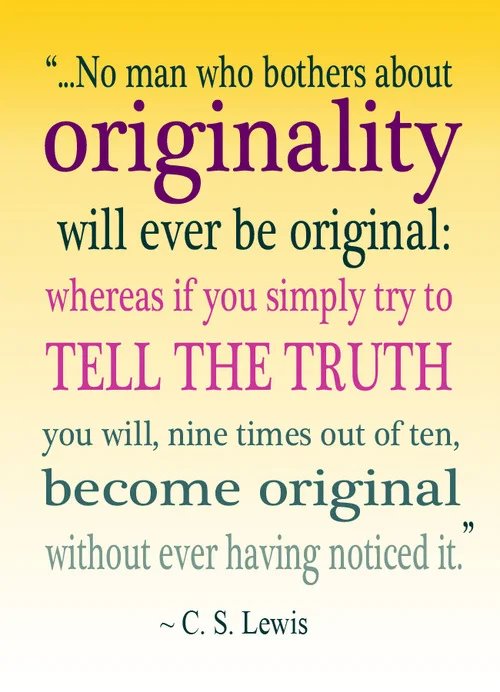
For those who value originality of the world-improving kind John Stuart Mill writes of, C. S. Lewis gives good advice in Emily Sutherland’s poster at the top of this post. (I like the way Emily polishes this gem from the original passage.) What C. S. Lewis says reminds me of something I often say to myself in touchy situations: “If I think hard enough, there has to be some way to get away with telling the truth.”

Geometric Coin Sculptures

From junkculture: "Complex Geometric Forms Made from Coins Notched and Joined Together.“ Geometry never gets old.

h/t dianakimball

Quartz #37—>Larry Summers Just Confirmed that He is Still a Heavyweight on Economic Policy

blog.supplysideliberal.com tumblr_inline_mxg4q2fgBa1r57lmx.png

Link to the Column on Quartz

Here is the full text of my 37th Quartz column, “Larry Summers just confirmed that he is still a heavyweight on economic policy,” now brought home to supplysideliberal.com. It was first published on November 15, 2013. Links to all my other columns can be found here.

If you want to mirror the content of this post on another site, that is possible for a limited time if you read the legal notice at this link and include both a link to the original Quartz column and the following copyright notice:

© November 15, 2013: Miles Kimball, as first published on Quartz. Used by permission according to a temporary nonexclusive license expiring June 30, 2015. All rights reserved.


Janet Yellen was in the hot seat yesterday before the Senate Banking Committee. Due to a remarkably public vetting process, the presidential nomination for US Federal Reserve Chair that put her there also constituted a comedown for Yellen’s principal rival for the job: Larry Summers. At an International Monetary Fund Conference in honor of former Bank of Israel Governor—and earlier IMF chief economist—Stan Fischer on Nov. 8, Summers made a strong bid for continued relevance to economic policy-making as a private citizen with a trenchant speech. (David Wessel gives an overall report on the conference in this Wall Street Journal article.) Here is the speech:

Summers begins by crediting Fischer for inspiring him to be a macroeconomist, saying this of Fischer’s graduate course on Monetary Economics at MIT:  “It was a remarkable intellectual experience. And it was remarkable also because Stan never lost sight of the fact that this was not just an intellectual game: getting these questions right made a profound difference in the lives of nations and their peoples.” Summers transmitted that attitude to me as one of my professors at Harvard, and I have tried to hand it on to my own students.

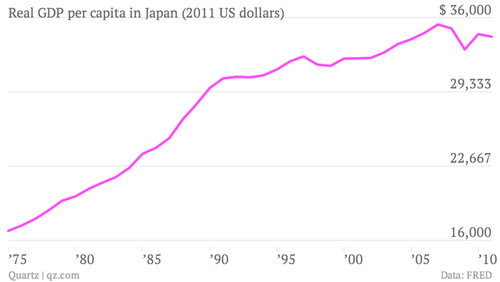
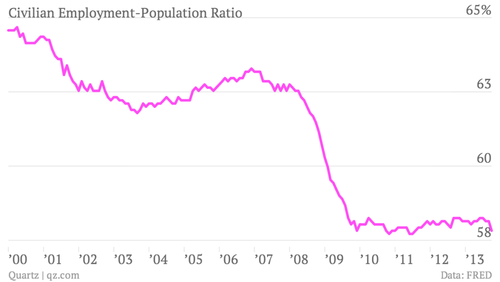
After his praise of Fischer, Summers gives a conventional account of the financial crisis in the fall of 2008 and the largely successful efforts to contain that crisis. But the rest of his speech goes in surprising directions. Summers emphasizes the possibility of “secular stagnation” like that the Japanese economy has suffered in the last two decades. The extent of Japan’s stagnation is breathtaking: In 2013, the Japanese economy is only half the size economists in the 1990’s predicted it would be by now. Even here in the US, GDP is falling further and further behind what we would have predicted just a few years back, and the fraction of the population that has a job has hardly recovered at all in the past four years, despite the fact that the financial crisis was well-contained by November 2009.

What lies behind the stagnation the Japanese economy has suffered in the last two decades and that Summers fears for the United States? He suggests this:

Suppose that the short-term real interest rate that was consistent with full employment had fallen to negative 2% or negative 3% sometime in the middle of the last decade.

With a 2% rate of inflation, an interest rate 3% below inflation would be a negative 1% interest rate in ordinary terms (what macroeconomists would call a -1% nominal interest rate.) But conventional monetary policy can’t reach an interest rate as low as -1%, because anyone can lend as much as they want to the government at 0% by piling up paper currency. This is the zero lower bound on nominal interest rates that macroeconomists justly obsess over. The zero lower bound creates situations where interest rates seem low, but are not low enough to put the economy in high gear.

In the years before the financial crisis, financial excess propped the economy up without ever getting to the kind of excess demand that would push unemployment down to unsustainably low levels and cause higher inflation. In Summers’ words:

Even a great bubble wasn’t enough to produce any excess of aggregate demand…Even with artificial stimulus to demand, coming from all this financial imprudence, you wouldn’t see any excess.

After the financial crisis, the end of financial excess left too little demand and stagnant employment.

What can be done? It isn’t easy to fix things:

  • People grudgingly tolerate zero interest rates for years on end. But that is not enough.
  • It is hard to keep running huge budget deficits year after year after year—and Japan’s experience with trying to escape stagnation by government spending casts doubt about whether that would do the job.
  • There are serious concerns about doing quantitative easing for years with no end in sight.
  • Finally, Summers points out that the very financial regulations that could prevent another financial crisis tend to drive the interest rates people earn when they save further below the interest rates they pay when they borrow, effectively tightening the zero lower bound.

Here is Larry Summers’s conclusion, which stops just short of what the US and the world economy needs—a solution:

It is not over until it is over…We may well need, in the years ahead, to think about how we manage an economy in which the zero nominal interest rate is a chronic and systemic inhibitor of economic activity, holding our economies back, below their potential.

So let me return to versions of two of the questions I posed at the end of July, in “Three big questions for Larry Summers, Janet Yellen, and anyone else who wants to head the Fed.”

  1. Why not eliminate the zero lower bound entirely by changing the way we handle paper currency?
  2. Couldn’t we afford to have much stricter financial regulations—in particular high equity (“capital”) requirements—to avoid a future financial crisis if the zero lower bound were no longer a problem?

Though crucial, diagnosing a problem is not enough. Every diagnosis suggests places to look for a cure. If the zero lower bound is the problem, then getting rid of it is an obvious solution. The economists I talk to, including the many economists I have talked to in central banks around the world, recognize that the real difficulties in eliminating the zero lower bound are political difficulties rather than technical difficulties. So the major economies of the world and the many smaller ones that face the zero lower bound have a choice: politics as usual, with a real chance of secular stagnation, or paving the way for negative interest rates. Politics will stay the same until a critical mass of people do what it takes to make them different. Summers proved at the IMF conference that he is still an economic policy heavyweight—someone who could contribute a lot toward reaching that critical mass in the war against the zero lower bound, if he is willing to join the fight.

Gather 'round, Children, Here's How to Heal a Wounded Economy

blog.supplysideliberal.com tumblr_inline_mxyhvcFHmK1r57lmx.png

Here is a link to my 41st column on Quartz: “Gather round, children, here’s how to heal a wounded economy." It could also be called "Electronic Money: The Coloring Book.”

Thanks are due to Donna D'Souza for her help in the cause of healing the economy, starting with education about electronic money.  

In case there are any problems with the SoundCloud links in the Quartz column, here is the audio of me reading the story aloud and the audio of me singing the operatic ballad that has the words of the story as the lyrics.

Since I began writing about electronic money, many people have told me that the biggest issues with serious negative (nominal) interest rates and the subordination of paper currency to electronic money needed to make them possible are political issues. I agree. I have thought that the way to change the politics of negative interest rates is to keep explaining them, from many different angles. This is the children’s storybook angle.

I think our storybook/coloring book works as a children’s story. There is an attempt to solve a problem that fails, then there is a twist that solves the problem from an unexpected direction–using a seeming curse that is actually a blessing. See what you think.

Reactions

Greg Mankiw writes on his blog:

If my favorite textbook hasn’t simplified things enough for you…

My friend and former student Miles Kimball takes a stab at explaining some basic macroeconomics through the vehicle of a child’s storybook.

Gerald Seib and David Wessel, in the Wall Street Journal, write:

University of Michigan economist Miles Kimball posts a downloadable coloring book and colored-in storybook to explain his simplified version of how the macro-economy and monetary policy work. [Quartz]

Noah Smith: You Are Already in the Afterlife

This is Noah Smith’s 2d guest religion post on supplysideliberal.com. I love this one almost as much as his 1st:

“God and SuperGod.”

 The Roman emperor and philosopher

Marcus Aurelius said something similar

to what you see below, but I like Noah’s version better:


If you ever want to freak yourself out, just sit there and think hard about what it’s like to be dead. Not “playing a harp in Heaven” dead, or even “roasting in a lake of fire in Hell” dead, but really dead. Just no more thoughts, forever and ever and ever and ever. 

Doesn’t that send a shiver down your spine? That’s called self-preservation instinct. No wonder people like to believe in an afterlife, right? Everyone wants to live forever

Now let’s think about something much less scary. Try to remember what it was like to be a 5-year-old (or if that challenge is too hard, try to remember–really remember–what it was like to be you 10-years ago). Of course you can remember snippets - the feel of a set of toy blocks, or the sound of your mom’s voice, or the shape of your kindergarten classroom. But I bet you can’t remember what it was really like to experience life, moment-to-moment, as a 5-year-old. How would the 5-year-old you react to this blog post? Would (s)he be comfortable in the chair you’re sitting in right now? What would (s)he be looking forward to right now? 

You may be able to guess at the answers to these questions, but the truth is, you don’t know. The experience and feeling and “qualia” of being a 5-year-old you is gone forever. You will never again perceive the Universe the way the 5-year-old you did. In other words, the 5-year-old you is dead. Really, truly gone from the Universe. The 5-year-old you will never think another thought. 

Even if you go to Heaven. 

So don’t be so afraid of Real Death. It’s something you’ve already experienced - not just once, but an indeterminate number of times. You, right now, are a living person, but because you’re living and growing and changing, you’re dying at the same time. Death is an old friend. 

Now think about what this means for the afterlife. Heaven is a comforting thought because it quiets our self-preservation instinct. But what would happen if we really went to Heaven? Either we’d have experiences similar to those we had when alive (flying around, playing a harp, eating infinite Doritos without getting fat, whatever), or we won’t. But if we experience things, those experiences will change us. Then eventually we won’t be the same person anymore. The soul may be eternal, but the part of you that’s really you just can’t stick around. 

So it doesn’t really matter if there’s an afterlife or not, does it? Life is change, and change is death. The process of living is the process of dying. 

So what does this mean for our lives? It means we shouldn’t spend much time worrying about death. And it also means we shouldn’t put our hopes in a better life in the next world. This is the world. This is life. You’re awake and alive and thinking things right now. Isn’t that amazing?


Interview by Joseph Sotinel for the French Website BFMBusiness about Electronic Money (with a Translation of My Bit)

blog.supplysideliberal.com tumblr_inline_mxnqjoS9O01r57lmx.png

I was interviewed on Wednesday (December 11, 2013) by Joseph Sotinel of BFMBusiness for an article on electronic money: “Les banques traditionnelles vont-elles être tentées par le bitcoin?” (“Are traditional banks going to be tempted by bitcoin?”) The article, like the title, is in French. Here is what I am quoted as saying:

Une monnaie électronique permettrait des taux d'intérêts négatifs

Mais un acteur manque pour élaborer une monnaie électronique: les banques centrales. “On ne peut pas avoir de monnaie gérée par un algorithme ou un robot aujourd'hui sans avoir d'inflation”, explique Miles Kimball, avant d'ajouter: “Le bitcoin, en soi, n'est pas très utile, mais montre ce qui peut être fait.”

Selon lui, si les banques centrales se convertissaient aux monnaies électroniques, elles gagneraient de nouveaux outils monétaires, comme la possibilité de fixer des taux directeurs négatifs.

“Il faudrait alors des régulations financières très strictes”, reconnaît l'universitaire. En attendant, son idée gagne du terrain. En septembre, la Banque de France l'a accueilli pour un séminaire au sujet de la monnaie électronique.

But I didn’t say that, because my French isn’t that good! Here is my translation, done with the help of Google translate, having listened and talked back to the three levels of Pimsleur’s French CD’s–and knowing what I said in the first place. 

Electronic Money Permits Negative Interest Rates

But there is one category of actor that has failed to develop electronic money: central banks. Today, we cannot have money managed by an algorithm or a robot without inflation [or deflation], explains Miles Kimball, before adding: “Bitcoin would not work very well in that regard, but it shows what can be done.”

According to him, if central banks converted to electronic money, they gain new monetary tools, such as the possibility of setting negative rates.

“It would then be appropriate to have very strict financial regulation,” recognizes the university professor. Meanwhile, his idea is gaining ground. In September, the Bank of France hosted him for a seminar on electronic money