Can Taxes Raise GDP?

I appreciate Scott Sumner’s post, “A Kindred Spirit,” and Karl Smith’s post “Welcome Miles Kimball, Now Let’s Set the Record Straight on Taxes.”   Karl Smith raises the issue of whether taxes can raise GDP and rightly points out that a substantial income effect means that taxes can raise GDP.  Indeed, it is a standard result in Real Business Cycle Theory that once prices adjust, extra lump-sum taxes to finance, say, an expensive war, will raise GDP by making everyone feel poorer so that they work harder.   A simple lump-sum tax is a tax that falls equally on everyone in dollar terms:  say every adult needs to pay $5000 per year.

Continuing to think about very simple models and government spending on something like an expensive war, what about a consumption tax that is a certain percentage of everyone’s consumption?  On the one hand this makes people feel poorer so they want to work more, but on the other hand, what someone can buy with an extra hour of work is less, so they want to work less.  The standard view is that these two effects will roughly cancel each other out.  So the amount people want to work–and thus GDP in this simple model–will stay about the same.  Matthew Shapiro and I take exactly this standard view in our paper “Labor Supply: Are the Income and Substitution Effects Both Large or Both Small?”   The basic argument for the standard view is that to households, a consumption tax looks a lot like a wage cut.  And we have a lot of information about what higher or lower wages do to desired work hours.  Among people who have to live on their own wages, there is surprisingly little difference in how many hours people want to work based on whether they have high wages overall or low wages overall over the course of their lives.  

Scott Sumner replies to Karl Smith, saying among other things:

It’s true that measured GDP might not fall if the money is wasted (as poorer people tend to work harder.)  But that’s not much of an argument for big government.

Scott Sumner is absolutely right that any unnecessary government expenditure is to be lamented.  Robbing people of their leisure time as well as of the wherewithal to spend on household wants and needs for no good purpose is a crime.  

But suppose the war really is necessary–or that the President has decided on the war and that as his economic advisor the only thing you get to decide is how to pay for the war.  What would be the best way to pay for the war if everyone in the economy had the same income level so that poor vs. rich weren’t an issue?  

With everyone at the same income level, a lump-sum tax is fair.  It raises GDP.  The lump-sum tax leads everyone to take some of the hit from having to finance the war in lower consumption and some of the hit from having to finance the war in less leisure time.  Less time away from work leads to higher GDP as more hours at work make it possible to produce more.  Guns are counted in GDP as well as butter, and gun production goes up more than production of consumption goods such as butter goes down.  

By contrast, the consumption tax with its tax distortion pushes everyone to take all of the hit from having to finance the war in lower consumption, and none of the hit in less leisure time.  Production of consumption goods such as butter goes down so much that GDP stays the same even though production of guns goes up.  This is inefficient.  The production of guns is the same in both cases.  But it is less painful to cut back some on leisure and some on consumption (what happens with the lump-sum tax) than to take the whole hit in consumption (what happens with the consumption tax).  

So the bottom line is that, other than a concern with redistribution, a distortionary consumption tax to finance a war that leaves GDP the same is less efficient than a non-distortionary lump-sum tax to finance a war that has GDP go up to help make the war effort possible without sacrificing as much consumption.  

The broader message is that taxes can be bad even if they don’t lower GDP.

Balance Sheet Monetary Policy: A Primer

This is the First Post in the Monetary Policy Thread

In my first post, “What is a Supply-Side Liberal,” I promised to show that there is no shortage of powerful tools to revive both the U.S. economy and the world economy.  In my second post, I started to fulfill that promise by proposing “federal lines of credit” as a way of stimulating consumption without adding much to the national debt.  Federal lines of credit represent a policy somewhere between traditional fiscal policy and traditional monetary policy.   In this post, I turn to monetary policy proper.  Many of the currently most controversial issues about monetary policy revolve around principles that are easy to misunderstand, especially in unfamiliar situations like the current economic situation.  So I need to explain these principles carefully.  Trust me, even though they may seem basic, I will need these principles in the form I am laying them out in order to untangle the knots of current controversies in this and later posts.  

To increase aggregate demand by monetary policy, my version of the basic principle is already known to devotees of Noahpinion.com, my brilliantly creative student Noah Smith’s blog.  In “What I Learned in Econ Grad School, Part 2,” Noah reports me as saying that to stimulate an economy like Japan’s anytime in the last 20 years, or the U.S. or Europe now, the procedure to follow is “Print money and buy stuff!” Let me modify that a little to this:

WHEN BELOW NATURAL OUTPUT: PRINT MONEY AND BUY ASSETS!

Each part of this slogan is important:

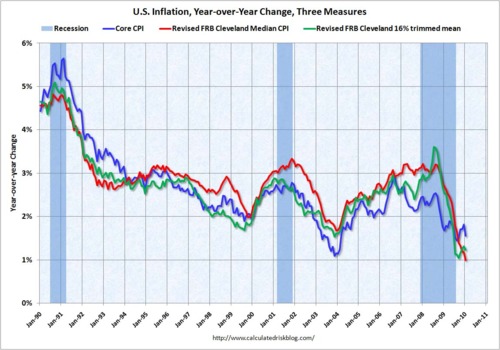
WHEN BELOW NATURAL OUTPUT” means that aggregate demand needs to be reined in to keep it in line with the “natural level of output” just as often as it needs to be stimulated.  The “natural level of output” is the level of output at which core inflation will be steady. Above the natural level of output, core inflation rises.  Below the natural level of output, core inflation falls.  This can be seen in the graph below which shows recessions by shading and core inflation by the blue line.  Note that the graph stops at the beginning of 2010.  (Thanks to Alexander Wolman for pointing this out.)  I will put off any attempt to parse the current situation until another post.  Let me say only that the current situation is a little hard to read, but the European debt crisis could easily make things worse, and lead to a situation in which additional stimulus is clearly called for.  

“PRINT MONEY" means that the Federal Reserve System creates dollars as a bookkeeping entry to buy the assets from someone.  The right to create dollars out of nothing is the source of the Fed’s power.  Whoever sold the assets then has dollars that didn’t exist before.  That person who has the new electronic money then has the right to ask the Federal Reserve System for the type of green pieces of paper in our pockets that say "Federal Reserve Notes” on them.   Because banks are required to keep a certain fraction of any deposit as green pieces of paper in their vault or have the electronic equivalent in an account with the Fed as a reserve requirement, the amount of money created by the Fed matters.  Money created directly by the Fed is called high-powered money and is closely related to what are called Federal funds.  The interest rate paid by banks for the high-powered money they need is called the Federal funds rate.  

Let me mention one more thing.  What everyone else calls “the interest rate,” economists call the “nominal interest rate” to distinguish it from the “real interest rate” which is a concept much more beloved by economists (including me) than the lowly concept of the nominal interest rate.  But in the context of monetary policy right now, the nominal interest rate is getting its time in the limelight because a nominal interest rate of zero is the rate of interest earned by the green pieces of paper we are so fond of.    

Not too long after Lehman Brothers went bankrupt in September, 2008 the Fed brought the Federal funds rate down very close to zero.  How did it do this?  As a matter of supply and demand, in the short run at least, the more high-powered money the Fed creates, the less banks will pay in interest to have the high-powered money they are required to have.  So the Federal funds rate falls when the Fed “prints” or electronically creates money.  But there is a limit.  Even if a bank doesn’t need the green pieces of paper to meet its reserve requirement, these green pieces of paper buried in the backyard or stuffed in a mattress, or left in a vault–or the electronic equivalents floating around in the Federal Reserve Systems piece of cyberspace–earn an interest rate of zero.   So no one will lend the green pieces of paper at a rate lower than zero.   So when the Fed funds rate gets down to zero, any extra high-powered money the Fed creates just piles up in bank vaults or in cyberspace.   The banks won’t lend to each other at an interest rate (more than a tiny bit) lower than zero and they won’t lend to companies or families at a rate lower than zero because the banks can earn zero by just keeping the green pieces of paper in their vaults. This principle is called thezero lower bound on the nominal interest rate.  

So, interestingly enough, once the nominal Fed funds rate is zero, the level of the money supply doesn’t matter very much any more!   The reason is that money sitting in a bank vault doing nothing (which is exactly where a lot of it will sit and what it will do if the nominal interest rate is zero) doesn’t have much effect on the economy.  The one way the level of the money supply does matter is that if the nominal Fed funds rate ever rises significantly above zero again, that money could wake up and overstimulate the economy if the Fed doesn’t vacuum it up by sellingassets to get back the money and annihilate it at that point.  But the Fed is perfectly capable of doing that if the economy recovers.  Also, as an alternative to selling assets to get the money back and annihilate it, the Fed now has the power to pay banks more than a zero nominal interest rate on the electronic high-powered money if the Fed chooses, so that banks would want to leave the high-powered money dormant and the money would not wake up.  

The key point for current controversies is that money will not overstimulate the economy and cause inflation if it is sleeping in bankvaults, which is exactly what it will be doing if the Fed funds rate is zero.So the only reason to fear a large supply of high-powered money in the current situation is if you don’t trust the Fed to realize that when the economy is recovering it needs to vacuum up the high-powered money, or raise the interest rate it pays on high-powered money to keep that money asleep.  Alan Blinder made this point in an excellent Wall Street Journal piece “In Defense of Ben Bernanke” a while back.  He wrote: 

To create the fearsome inflation rates envisioned by the more extreme critics, the Fed would have to be incredibly incompetent, which it is not.

So if a larger money supply doesn’t do much when the Fed funds rate is already zero, how does the Fed stimulate the economy after that point?  The answer is in the last part of the slogan: "BUY ASSETS!“  Whenever the Fed buys any asset, its price goes up.  You can think of it as the Fed adding to the demand for the asset or subtracting from the supply of the asset in private hands.  Either way, when the Fed buys an asset, its price goes up.  

What then?  One of the most useful facts in all of Finance comes into play.  For assets, a higher price is basically the same thing as a lower interest rate.  This is easiest to see for a relatively simple asset such as a Treasury bill.  When first sold, a Treasury bill is a promise by the U.S. Treasury to pay $10,000 three months from now.  To make things easy, let me do some arithmetic with very high interest rates.  First, suppose that you could buy the Treasury bill for $5,000.  Then in three months you would be able to turn $5,000 into $10,000.  So in three months you earned an extra $5,000 or 100% of the $5,000 you started with.  Now, suppose the price of the Treasury bill went up, so you had to pay  $8,000.  Then in three months you would be able to turn $8,000 into $10,000.  So in three months you earned $2,000 or 25% of the $8,000 you started with.  The increase in the price of the Treasury bill from $5,000 to $8,000 reduced the three-month interest rate on Treasury bills from 100% to 25%.  (The annual compounded interest rates would be much bigger.)  

So any time the Fed buys an asset, it pushes up its price, which lowers its interest rate.  Normally, what the Fed buys when it prints money is Treasury bills.  But the Treasury bill rate is so strongly affected by the Fed funds rate that the Treasury bill rate would have gone down because the Fed funds rate went down anyway.   So the fact that buying Treasury bills raises their price and therefore lowers their interest rate a little beyond what would happen as a result of the decline in the Fed funds rate alone is only a footnote for monetary policy.  What is more, by the time the Fed funds rate is close to zero, the Treasury bill rate is also close to zero as well.  So buying Treasury bills doesn’t provide any way around the zero lower bound on the nominal interest rate.  To get an interest rate lower than zero on a Treasury bill, you would have to pay more than $10,000 now for a promise of $10,000 in three months.  And no one is going to pay, say, $10,010 now for a promise of $10,000 in three months since anyone can get $10,000 in three months at a cost of only $10,000 now, simply by burying the $10,000 for three months.  

But when the Fed buys other assets that have interest rates that are not so closely tied to the Fed funds rate, the fact that buying the asset raises its price and lowers its interest rate becomes very important.  As long as any asset has a nominal interest rate above zero, buying that asset will raise its price and lower its interest rate.  And there are a lot of assets in the world.  Once the Fed buys these assets the values get written on a document called the Fed’s balance sheet.  So when the Fed is changing interest rates through the ”BUY ASSETS!“ part of the slogan rather than through the ”PRINT MONEY" part of the slogan, it is balance sheet monetary policy.   The Fed may be both printing money and buying assets, but if the nominal Fed funds rate is zero, it will only be the buying of the assets and putting them on its balance sheet that will be affecting interest rates, not the printing of the money.  

To give one more example, in September 2011, the Fed did something more complicated: something called “Operation Twist”.  Operation Twist involved a combination of selling Treasury bills and other short-term Treasuries to get money to buy long-term (6-30 year) Treasury bonds.  Since the interest rate on Treasury bills was already pressed fairly hard up against the zero lower bound, lessening the pressure a little still left the interest rate on Treasury bills close to zero.  But the long-term Treasury bonds had interest rates quite a ways above zero, and buying them pushed up their prices and lowered their interest rates.  

All interest rates matter for the economy, so lowering almost any interest rate will stimulate the economy.  And all interest rates affect all other interest rates, so lowering any interest rate tends to lower all other interest rates, at least a little bit.  So the last key question for this post is “What are the limits on the Fed’s ability to lower interest rates by buying assets and raising their prices?”  And here I mean technical limits, aside from any political considerations–and for now, aside from the legal limits on what the Fed is allowed to buy (more on that later).  Also, since I am hoping that careful (and repeated) explanations of how all of this works can reassure people, I am also leaving aside any effects that come from people misunderstanding and getting scared by, say a large money supply–even when most of the money is asleep and the Fed is waiting to pounce on it and take care of it when the money wakes up.  

Since the Fed can print as much money as it needs to buy assets, even trillions upon trillions of dollars if need be, there are only two technical limitations to the Fed’s ability to lower the interest rates on assets by buying them and raising their prices:

  1. lf the nominal interest rate on the asset gets down to zero, the Fed can’t go any further on that asset.  It has to find some other asset that has a nominal interest rate above zero to buy.  
  2. It is logically possible that sellers might sell all of a particular asset to the Fed before its interest rate gets down to zero.  Then it has to find some other asset to buy that it doesn’t already have all of.  Notice that this only happens when people don’t feel they really need that particular asset very badly, otherwise they wouldn’t sell it to the Fed so cheaply.  So nothing bad happens as a result of the Fed buying all of an asset that people are willing to let go of that easily.  (Remember that an interest rate above zero has to be associated with a lower price than what the asset would have at an interest rate equal to zero.)  

What if the Fed bought all of the assets in the world other than money and the economy still didn’t have enough stimulus?  Then companies would create additional assets to sell to the Fed, which would amount to the Fed making loans at a slightly more favorable interest rate than companies had been getting before.  This would stimulate the economy more.  

What if all the assets in the world got down to a zero nominal interest rate and the economy still didn’t have enough stimulus?  Then, and only then, we would be in deep, deep trouble on the aggregate demand front from which there would be no escape through monetary policy.  But we are far, far away from that situation.  Simple economic models studied by economists often have this happen because they have so few types of assets in them, but the real world has a huge number of different types of assets, some with nominal interest rates that are still very far from zero.  

Let me end by reminding you of the "WHEN BELOW NATURAL OUTPUT“ part of the slogan.  Just because the Fed has the power to create a huge amount of additional aggregate demand doesn’t mean that this is a good idea.  What we need is just the right a amount of extra aggregate demand.  Suppose that because of the European debt crisis we do end up clearly needing a moderate amount of additional stimulus sometime in the near future.  With the stimulative effects of printing money out of commission at the zero nominal interest rate, it might take a huge amount of asset buying (much more than the Fed has done already) to get the moderate amount of extra aggregate demand it will take to get output up to its natural level.  But what’s wrong with that?  As long as the Fed stands ready to pounce on the extra money it creates to buy the assets when that money wakes up, there is no serious problem with doing a huge amount of asset buying to get a moderate amount of extra aggregate demand.  I am not claiming there is no risk to doing this, since we are new to serious use of balance sheet monetary policy, and all new things carry some risk.  But there is also risk in not stimulating the economy if it needs stimulus.


Getting the Biggest Bang for the Buck in Fiscal Policy

Last week, on Monday, May 14, I was one of ten outside academics invited to present a briefing to the Board of Governors of the Federal Reserve on the topic of consumption.  All of the Governors, Eric Engen, the Federal Reserve Board economist who had organized the briefing, and all ten academics were seated around the gigantic oval table where the Federal Open Market Committee (FOMC) makes monetary policy decisions.  Bob Hall, a Stanford Professor who is one of my favorite macroeconomists, was the moderator.  

In my ten-minute presentation, I proposed an addition to the toolkit of fiscal policy: “Federal Lines of Credit” or FLOC’s.  Here is the idea.  Imagine that the economy is in a recession and the President and Congress are contemplating a tax rebate.  What if instead of giving each taxpayer a $200 tax rebate, each taxpayer is mailed a government-issued credit card with a $2,000 line of credit?  ($4,000 for a couple.)  Even though people would spend a smaller fraction of this line of credit than the 1/3 or so of the tax rebate that they might spend, the fact that the Federal Line of Credit is ten times as big as the tax rebate would have been means it will probably result in a bigger stimulus to the economy.  But because taxpayers have to pay back whatever they borrow in their monthly withholding taxes, the cost to the government in the end–and therefore the ultimate addition to the national debt–should be smaller.  Since the main thing holding back the size of fiscal stimulus in our current situation has been concerns about adding to the national debt, getting more stimulus per dollar added to the national debt is getting more bang for the buck.  

I have a new paper that spells out the argument in greater detail.  It has the same name as this post.  Here it is:  “Getting the Biggest Bang for the Buck in Fiscal Policy.”

In Europe right now, the corresponding National Lines of Credit would be even more helpful.   In my paper “Getting the Biggest Bang for the Buck in Fiscal Policy”  I write:

Austerity and traditional fiscal stimulus can only be reconciled by the difficult two-step of spending more or taxing less now while promising to spend less or tax more in the future.  By contrast, it is perfectly possible to combine an immediate or relatively-quickly-phased-in austerity program with the issuance of large national lines of credit to counteract the negative aggregate demand effects of the austerity program.  (Some countries may be close enough to being shut out of credit markets themselves that they might need an outside loan to be able to provide national lines of credit to their citizens.) Politically, these lines of credit could be explained as a way to cushion the blow of an austerity program on household budgets as well as providing macroeconomic stimulus. 

I stayed in D.C. the rest of the week to work with my coauthors Claudia Sahm and Brendan Epstein and talk to other economists I know there.  Tuesday, the day after the briefing to the Board of Governors of the Federal Reserve System, I got a call from Bill Greider, a columnist at The Nation who has taken a special interest in the Fed.  (He has written a book about the Fed, Secrets of the Temple, and many articles about the Fed, including the recent article “The Fed Turns Left” about the Fed’s support for fiscal stimulus.)  Bill Greider said he had heard about my Federal Lines of Credit proposal the day before and wanted to interview me.  Late Wednesday afternoon I walked from the Federal Reserve Board to Bill’s office on K Street.  For well over an hour, he interviewed me and kept me well entertained with his avuncular style in his unkempt office.  If he writes anything based on that interview, I will make sure to post the link.

What is a Supply-Side Liberal?

As an Economics professor, thinking about public policy is a big part of my job, both in teaching and research.  The work of the ivory tower has given me some distance from the rough-and-tumble of daily political debate, but has called on me both to face the enduring dilemmas of public policy and to identify areas where technical solutions are available, but not generally understood.  

As for areas where technical solutions are available but not generally understood, one of the most important is in stabilization policy.  It does not seem to be generally understood that there is no shortage of powerful tools to revive both the U.S. economy and the world economy.  This is true despite (A) short-term interest rates already being close to zero in the U.S. and many other countries and (B) most countries not being able to afford to add much to their national debt.  I will post on this point soon.   

Among the enduring dilemmas of economic policy the most important is the conflict between efficiency and equity.  In calling myself a supply-sider I am saying that I believe the harm to the productive performance of the economy caused by taxes and regulations is serious (though seldom serious enough that a reduction in taxes would raise revenue).  In calling myself a liberal, I am saying that in addition to an attachment to the liberty, limited government, constitutionalism, and rule of law emphasized by Classical Liberalism,  I hold to a view based on both classic Utilitarianism and contested elements of modern economic theory that, generally speaking, a dollar is much more valuable to a poor person than to a rich person, and that therefore, there is a serious benefit to redistribution that must be weighed against the serious distortions caused by the usual methods of redistribution.     

Economists have identified two numbers that are central in governing the size of distortions caused by taxes and the benefits of redistribution: 

  1. Tax distortions are governed in important measure by the the consumption-constant elasticity of labor supply.  The consumption-constant elasticity of labor supply measures how much less workers want to work when what they earn is taxed, but the tax revenue is recycled back to them in one form or another of government benefit they can get regardless of how little they work.  Matthew Shapiro and I argue in our paper “Labor Supply: Are the Income and Substitution Effects Both Large or Both Small?" that the consumption-constant elasticity of labor supply is large.  Even leaving aside the decision of whether to work or not and just focusing on how many hours to work, we found a consumption-constant elasticity of labor supply equal to one and a half.  
  2. The benefits from redistribution are governed by what I will call the degree of inequality aversion.  In a research project that began in 2005 but is still ongoing, Fumio Ohtake, Yoshiro Tsutsui and I put some extra questions on the University of Michigan Survey of Consumers (the survey behind the Reuters/University of Michigan Consumer Sentiment Index).  We asked the people answering the survey first "It is often said that one thousand dollars is worth more to a poor family than to a rich family.  Do you agree?” Over 90% of everyone agreed.  Then we went on to ask them questions such as this:  "Think of two families like yours, one with half the income of your family and one with the same income as your family.  Which would make a bigger difference, one thousand dollars to the family with half your family’s income or four thousand dollars to the family with an income like yours?“  More than half of everyone answering the survey said that $1000 would make a bigger difference for the poorer family than $4000 for a family at their own income level.  As analysis ably assisted by Daniel Reck and Fudong Zhang confirms, this implies a degree of inequality aversion above two.  An inequality aversion of two would mean that if you double someone’s income the value of an extra dollar will drop to a quarter of what it was.  So $4000 to the family with twice the income looks like $1000 did to the family with the lower income.  The short summary is that most people believe that dollars are worth a lot more to the poor than to the rich when they are asked in a context not immediately connected to public policy.  But the public policy implications of this belief are dramatic when coupled with a view that making a net positive difference in people’s lives overall (added up across people) is a legitimate goal of public policy.    

Perhaps because of cognitive dissonance, it is common for people to either believe (a) that tax distortions are serious and redistribution is of questionable value OR (b) redistribution is valuable and the distortions induced by taxes are small. My belief is that (c) tax distortions are serious AND redistribution is valuable.  That makes me a supply-side liberal.