How Unhealthy are Red and Processed Meat?
A large share of articles on diet and health read as if good health were people’s only objective. But almost all of us eat things we believe are bad for us because they are very tasty. I have done my best to convince you, my readers, that on any ordinary day, sugar just isn’t worth it, despite how delicious it is. What about red and processed meat? Are they bad enough that you should stay away from them?
Worrying about animal welfare or the effects of animal husbandry on climate change could easily tip the balance toward being a vegetarian or vegan. What follows is for those whose main concern about meat is its effects on their own health.
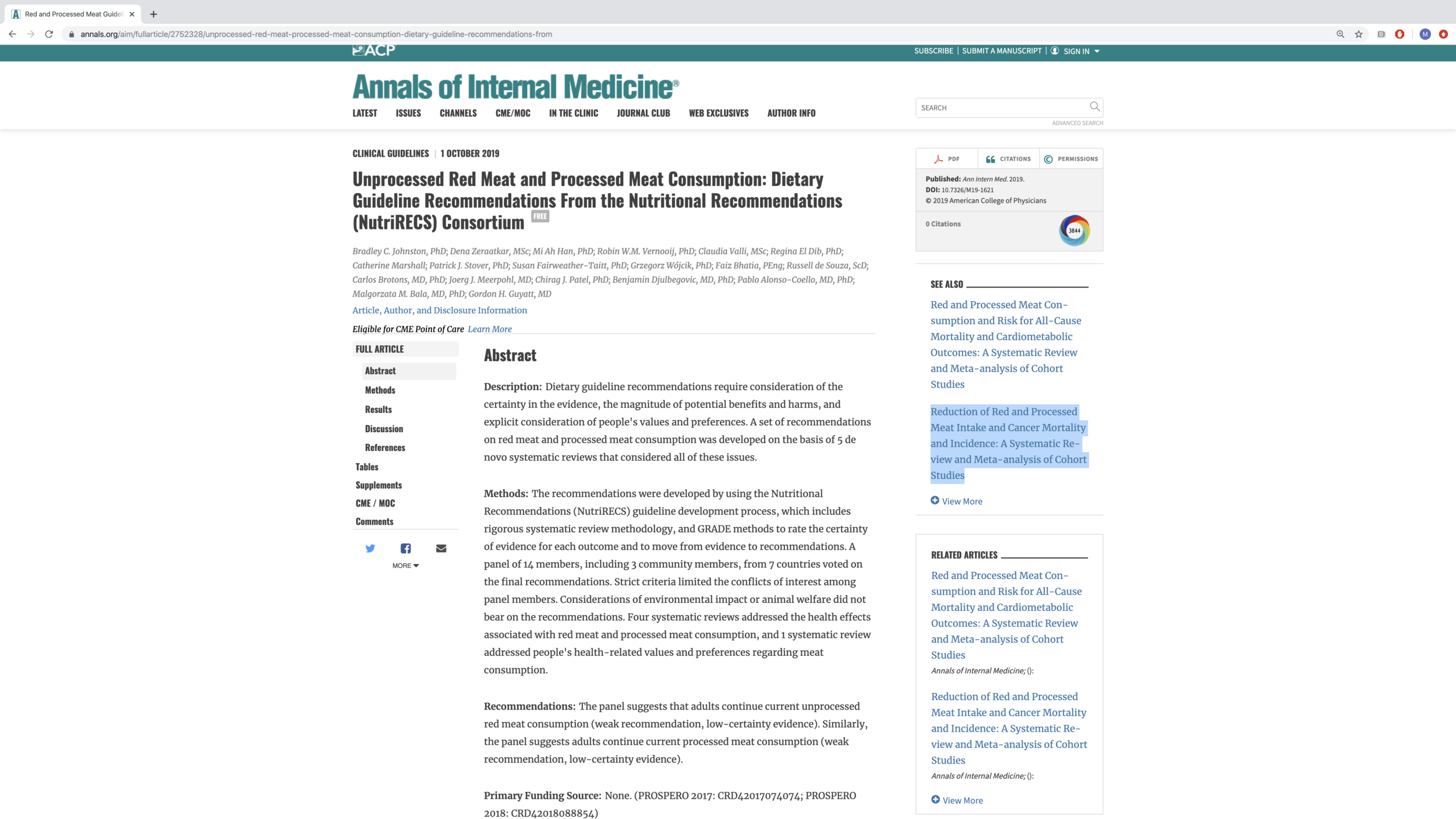
Using panels of lay-people as well as experts in order to judge any harm of meat-eating in comparison to the pleasure from meat-eating, the article shown above, “Unprocessed Red Meat and Processed Meat Consumption: Dietary Guideline Recommendations From the Nutritional Recommendations (NutriRECS) Consortium” by Bradley C. Johnston et al. says you don’t need to change your meat-eating habits. I come down more toward advice to eat meat quite sparingly. Let me lay out the views of Bradley C. Johnston et al. and my reaction.
A Summary of Evidence on the Health Effects of Meat Eating
The key to the recommendation of the panels organized by Bradley C. Johnston et al. is the summary of the scientific evidence, which boils down to saying the health benefits from a substantial reduction in meat consumption are likely to be quite modest. To make the summary of evidence easier to read, let me put their words verbatim into bullet points and omit the references they give—and their mention of results for dietary patterns correlated with, but not specific to meat. In the subsection “Evidence Summary for Harms and Benefits of Unprocessed Red Meat Consumption,” they say:
For our review of randomized trials on harms and benefits (12 unique trials enrolling 54 000 participants), we found low- to very low-certainty evidence that diets lower in unprocessed red meat may have little or no effect on the risk for major cardiometabolic outcomes and cancer mortality and incidence.
Dose–response meta-analysis results from 23 cohort studies with 1.4 million participants provided low- to very low-certainty evidence that decreasing unprocessed red meat intake may result in a very small reduction in the risk for major cardiovascular outcomes (cardiovascular disease, stroke, and myocardial infarction) and type 2 diabetes (range, 1 fewer to 6 fewer events per 1000 persons with a decrease of 3 servings/wk), with no statistically significant differences in 2 additional outcomes (all-cause mortality and cardiovascular mortality).
Dose–response meta-analysis results from 17 cohorts with 2.2 million participants provided low-certainty evidence that decreasing unprocessed red meat intake may result in a very small reduction of overall lifetime cancer mortality (7 fewer events per 1000 persons with a decrease of 3 servings/wk), with no statistically significant differences for 8 additional cancer outcomes (prostate cancer mortality and the incidence of overall, breast, colorectal, esophageal, gastric, pancreatic, and prostate cancer).
In the subsection “Evidence Summary for Harms and Benefits for Processed Meat,” they say:
No randomized trials differed by a gradient of 1 serving/wk for our target outcomes.
With respect to cohorts addressing adverse cardiometabolic outcomes (10 cohort studies with 778 000 participants providing dose–response meta-analysis), we found low- to very low-certainty evidence that decreased intake of processed meat was associated with a very small reduced risk for major morbid cardiometabolic outcomes, including all-cause mortality, cardiovascular mortality, stroke, myocardial infarction, and type 2 diabetes (range, 1 fewer to 12 fewer events per 1000 persons with a decrease of 3 servings/wk), with no statistically significant difference in 1 additional outcome (cardiovascular disease).
For cohort studies addressing adverse cancer outcomes (31 cohorts with 3.5 million participants providing data for our dose–response analysis), we also found low- to very low-certainty evidence that a decreased intake of processed meat was associated with a very small absolute risk reduction in overall lifetime cancer mortality; prostate cancer mortality; and the incidence of esophageal, colorectal, and breast cancer (range, 1 fewer to 8 fewer events per 1000 persons with a decrease of 3 servings/wk), with no statistically significant differences in incidence or mortality for 12 additional cancer outcomes (colorectal, gastric, and pancreatic cancer mortality; overall, endometrial, gastric, hepatic, small intestinal, oral, ovarian, pancreatic, and prostate cancer incidence).
Bradley C. Johnston et al. note that results look stronger for dietary patterns correlated with meat-eating than when looking specifically at meat-eating. This calls into question whether meat-eating itself is a problem as opposed to something else that meat-eaters on average tend to do more than others—beyond eating meat.
My Reaction to “Unprocessed Red Meat and Processed Meat Consumption: Dietary Guideline Recommendations From the Nutritional Recommendations (NutriRECS) Consortium”
As I say in
Meat Is Amazingly Nutritious—But Is It Amazingly Nutritious for Cancer Cells, Too?
How Fasting Can Starve Cancer Cells, While Leaving Normal Cells Unharmed
I worry that animal protein is especially nutritious for cancer cells. But the short version of that story is that sugar and certain amino acids, such as glycine, are especially easy for cancer cells to metabolize. If you keep your consumption of both animal protein and sugar very low, it will make it very hard on cancer cells and pre-cancerous cells. But cutting animal protein consumption in half while continuing sugar consumption full-speed may not put that much stress on cancer cells and pre-cancerous cells.
The bottom line of this logic is that cutting back on meat consumption may have a much bigger positive health effect for those who have gone off sugar than for those who haven’t. Unfortunately, few enough people have gone off sugar that the bulk of the evidence discussed by Bradley C. Johnston et al. doesn’t speak to this possibility.
Moreover, if you have gone off sugar, then when you eat meat might have just as big an effect as the total amount. Occasional meals with a lot of meat with a week or two going by with not meat might be much harder on cancer cells and pre-cancerous cells than eating the same amount of meat a little each day to keep the cancer cells and pre-cancerous cells going.
I know a lot less about how animal protein affects cardiovascular outcomes, if you do want to continue eating meat, it is worth knowing that fasting—a period of time with no food (but continuing to drink water)—gives your body a chance to repair itself, taking apart defective cells and using the parts for other cells that are in better shape. A lot isn’t known, but to me that makes it sound hopeful that damage that has already been done might be repaired if you make fasting part of your regimen. On fasting, see:
Conclusion
Bradley C. Johnston et al. effectively provide reasons why if you are only worried about the effects on your health you should consider going off sugar (and other easily digestible carbs such as potatoes, rice and bread) a higher priority than reducing red and processed meat consumption. But once you have managed to go off sugar, I recommend that you don’t eat meat every day. And it is likely to be a good idea to have days when you refrain completely from eating any animal products, or go beyond that and fast.
For annotated links to other posts on diet and health, see:
Scott Alexander: Stop Confounding Yourself! →
This is closely related to my posts “Adding a Variable Measured with Error to a Regression Only Partially Controls for that Variable” and Statistically Controlling for Confounding Constructs is Harder than You Think—Jacob Westfall and Tal Yarkoni. A reader pointed me to this. It has a very nice example of confounding in it.

Daniel Burns on Liberal Practice v. Liberal Theory
“Liberal Practice v. Liberal Theory” is a long-read via John Davidson. The title of this post is a link. It is related to my political philosophy posts, for which links are collected here:
Here are my favorite two passages. This one is Daniel Burns himself:
Eventually, our future statesmen must also be formed by studying the many non-ideological texts within the tradition of American political thought, of which the Federalist Papers remain the unsurpassed exemplar. And they must be formed by reading, without help from any ideological narrative or cheat sheet, the texts on politics that formed the thinking of American statesmen from James Madison to George Kennan and beyond. This means reading the classics above all: Thucydides, Plato, Xenophon, Aristotle, Cicero, Livy, Plutarch, Tacitus, and others. That was, after all, the education that allowed our founders to read Locke with such marvelous selectivity. (The University of Dallas, where I teach, is one of a handful of schools where these texts remain at the heart of the politics curriculum.)
The classical educators of statesmen show us the real alternative to liberal ideology. They teach us how to conduct a non-ideological appraisal of our own liberal politics with a view to preserving and improving it. With Xenophon we ask, who constitutes the American ruling class, and how are they educated? With Thucydides we ask, where are the seeds of civil strife within our community, and how well are we keeping those seeds dormant? With Aristotle we ask, what views does our community pass on to its children? What moral and mental habits does it instill in them? With Plato we ask, how well does our community foster the things that make human life worth living, including love, friendship, and family? How well does it make space for things higher than politics, including knowledge, divine worship, and human excellence in general? With Cicero we ask, in light of our answers to questions like these, how can we make the best of the admirable but imperfect regime we find ourselves in? By what concrete policies can we encourage its strengths while discreetly shoring up its weaknesses?
This is Daniel Burns’s quoting Alexis de Tocqueville:
In every age, what has so strongly seized on the hearts of certain men is the attraction of freedom itself: its own charm, independent of its benefits. It is the pleasure of being able to speak, to act, to breathe without constraint — under the government only of God and the laws. Anyone who seeks in freedom something other than itself is made to serve.
Should Those Whose Main Symptom is Chest Pains Get Stent or Bypass Surgery?
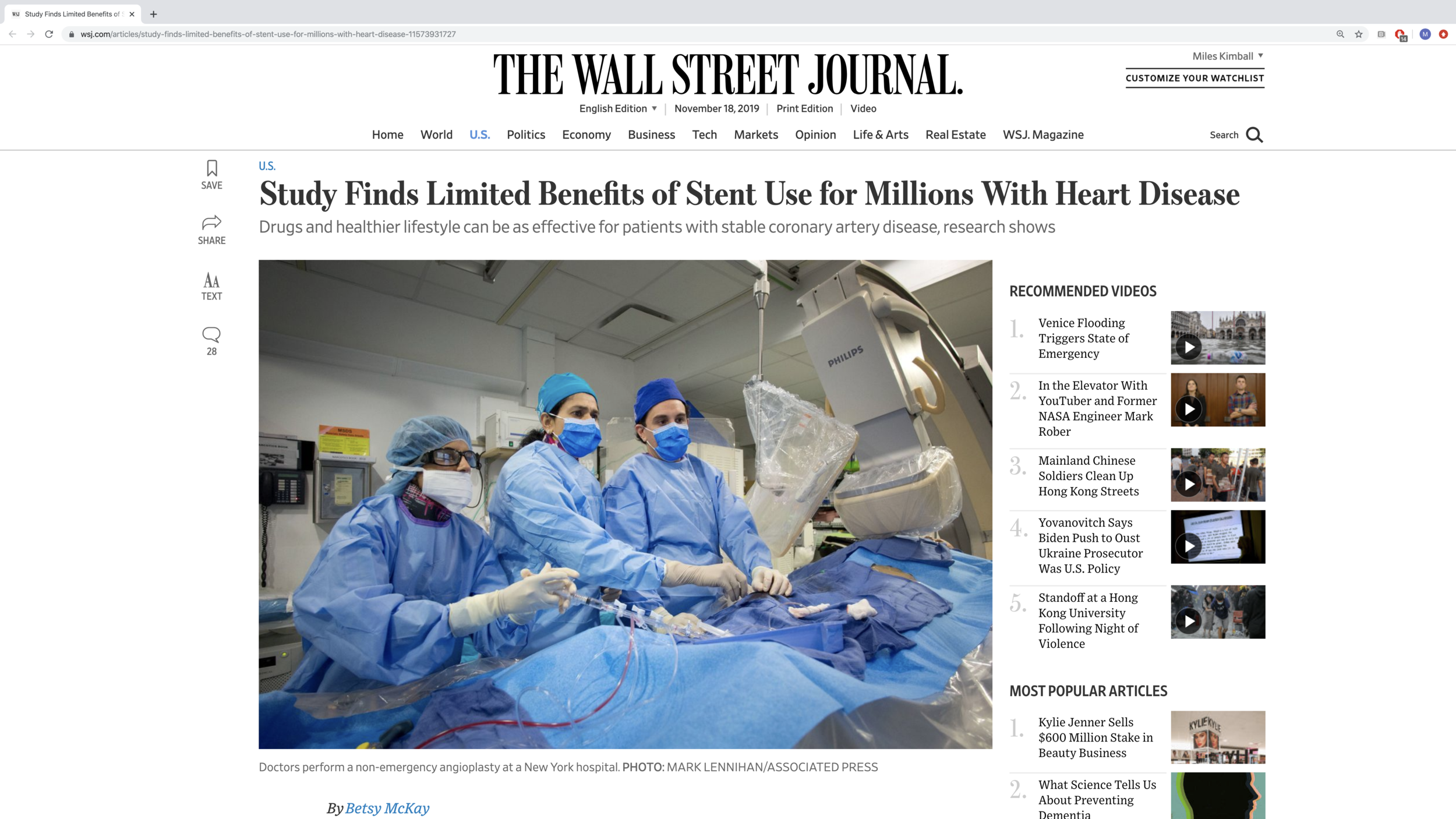
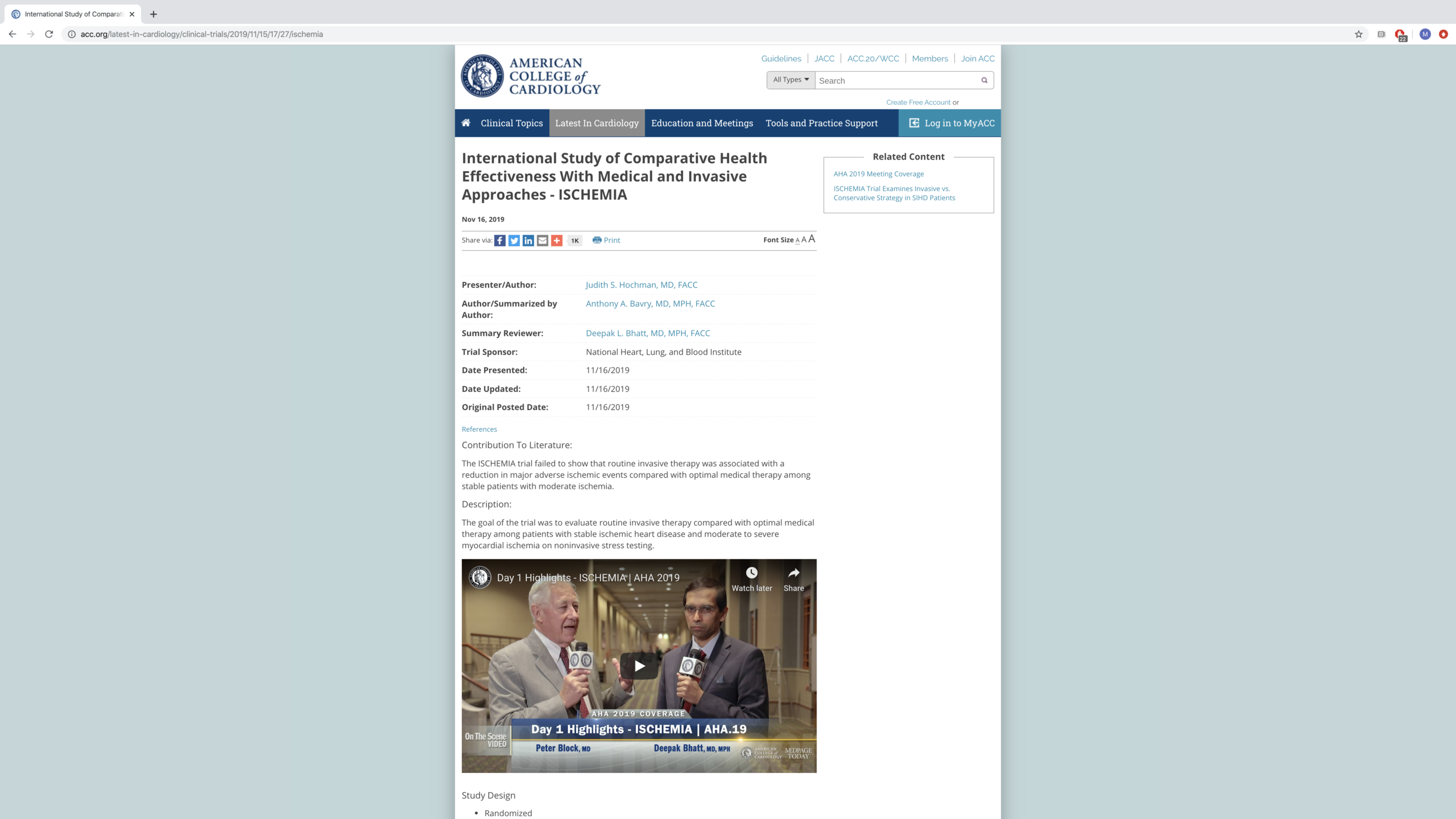
The Monday November 18, 2019 Wall Street Journal was one of many news outlets to report on the preliminary results of the ISCHEMIA study of whether individuals with chest pains, but mild test results, should have surgery to put in a stent or a bypass—as well as pursuing lifestyle changes, statins and blood thinners such as aspirin—or whether they should only pursue lifestyle changes and drug treatment. These results were reported an American Heart Association conference presentation. There doesn’t seem to be a full-scale paper. The website for that presentation is shown above.
One thing to note is how big the confidence intervals are given the rarity of big medical events over even over 3.3 years in this population. Betsy McKay assumes in writing her Wall Street Journal article “Study Finds Limited Benefits of Stent Use for Millions With Heart Disease” assumes its readers cannot understand p-values or confidence intervals. Here is what the presentation website says:
The primary outcome of cardiovascular death, myocardial infarction, resuscitated cardiac arrest, or hospitalization for unstable angina or heart failure at 3.3 years occurred in 13.3% of the routine invasive group compared with 15.5% of the medical therapy group (p = 0.34). The findings were the same in multiple subgroups.
The p-value for a 2.2 percentage point difference implies that for a difference to be significant at the 5% level would have required a 4.5 percentage point difference in probability of a bad medical event.
The statistical imprecision of the result is also indicated by the opposite-direction results for the two most severe of the four bad medical events:
Cardiovascular death or myocardial infarction: 11.7% of the routine invasive group compared with 13.9% of the medical therapy group (p = 0.21)
No statistical test is reported on the presentation website for this result:
Quality of life outcomes: Improvement in symptoms was observed among those with daily/weekly/monthly angina, but not in those without angina.
I suspect the following is also statistically quite unclear. From the head of the ISCHEMIA study, as quoted in Betsy McKay’s Wall Street Journal article:
Six months into their treatment, the group with invasive procedures suffered a heart attack or other event at a higher rate—5.3%—than the group receiving medical therapy only, at 3.4%, suggesting complications from the procedures, Dr. Hochman said.
Given the statistical imprecision, it was easy to various scientists to interpret the results differently. The following two quotations from Betsy McKay’s Wall Street Journal article argue for a change in medical practice (bullets added to indicate separate passages):
“You won’t prolong life,” said Judith Hochman, chair of the study and senior associate dean for clinical sciences at the New York University Grossman School of Medicine.
“This shows the safety of not panicking when you see a positive stress test,” said Jay Giri, a practicing interventional cardiologist and associate director of the Penn Cardiovascular Outcomes, Quality, and Evaluative Research Center at the University of Pennsylvania Perelman School of Medicine.
The results show “there is no compelling benefit to proceeding with these invasive procedures in people with stable symptoms as opposed to people with a heart attack,” [Steven Nissen, chief academic officer of the Heart and Vascular Institute at the Cleveland Clinic] said.
But this quotation interprets the study as support for the status quo:
Kirk Garratt, chief of cardiology at health system ChristianaCare in Wilmington, Del., and a past president of the Society for Cardiovascular Angiography & Interventions, said the study reinforces current practices for stable patients, and shows the benefits of procedures for people who are bothered by frequent chest pain. “People don’t want to be limited by their heart problems,” he said.
The two interpretive statements Betsy McKay quotes that seem most on target to me are these:
“Statins and aspirin are critically important,” [Judith Hochman] said. “We need to understand better how to get people to modify their risk factors.” Lifestyle changes can be hard to make and sustain, she said.
… large blockages, while frightening, don’t generally cause heart attacks, some research shows. They are caused instead more by ruptures in smaller, softer pieces of plaque that aren’t always visible on a scan.
Medicines have improved over the past several years and shrink those dangerous small plaques, said Steven Nissen.… “The reason medical therapy is triumphing is that it’s treating the entire artery,” he said. “This is a systemic disease, not a local disease.”
According to Betsy McKay, the drug and lifestyle changes urged in both arms of the study are “cholesterol- and blood-pressure-lowering drugs, smoking cessation and changes in diet.” She does not mention aspirin.
It is not considered a good idea to use statins, blood pressure drugs or aspirin if one has no risk factors. (If you want to try a little blood thinning, cinnamon or turmeric might be safer than aspirin.) But improvements in diet are safe enough to try before you have any symptoms. Of course, there is a great deal of debate about which direction is an “improvement in diet.” For my current views, see all of the other posts I have lined up links for here:
I hope to learn much more about the determinants of heart disease as I read more.
The Federalist Papers #2 A: John Jay on the Idea of America
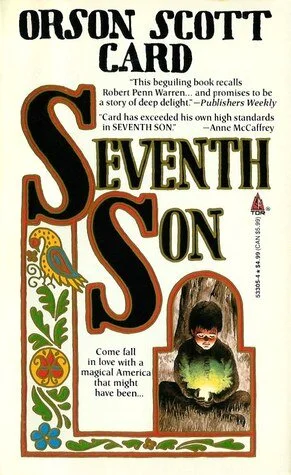
In his fantasy alternate history of America and the origins of Mormonism, Seventh Son, Orson Scott Card attributes the idea of “America” to Ben Franklin. The idea of America was the notion that all of the 13 colonies were part of something larger. The idea of America was there in the real world as well, in 1787. In the first half of The Federalist Papers #2, John Jay called on this idea of America.
The heart of John Jay’s appeal to the idea of America is in these five passages:
It is well worthy of consideration therefore, whether it would conduce more to the interest of the people of America that they should, to all general purposes, be one nation, under one federal government, or that they should divide themselves into separate confederacies …
… independent America was not composed of detached and distant territories, but that one connected, fertile, widespreading country was the portion of our western sons of liberty.
Providence has been pleased to give this one connected country to one united people--a people descended from the same ancestors, speaking the same language, professing the same religion, attached to the same principles of government, very similar in their manners and customs, and who, by their joint counsels, arms, and efforts, fighting side by side throughout a long and bloody war, have nobly established general liberty and independence.
… an inheritance so proper and convenient for a band of brethren, united to each other by the strongest ties, should never be split into a number of unsocial, jealous, and alien sovereignties.
To all general purposes we have uniformly been one people each individual citizen everywhere enjoying the same national rights, privileges, and protection. As a nation we have made peace and war; as a nation we have vanquished our common enemies; as a nation we have formed alliances, and made treaties, and entered into various compacts and conventions with foreign states.
John Jay acknowledges that he is appealing to a widespread sentiment rather than trying to create a new sentiment: “Similar sentiments have hitherto prevailed among all orders and denominations of men among us.” Famously, at the time of the Civil War, Robert E. Lee, among others, felt a greater loyalty to their State than to “America.” But loyalty to “America” was already something of a tug to the heart of many then and back in 1787.
Just as many Americans in the 18th and 19th centuries felt both a tug of loyalty to their state and to America as a whole, many of us in 2019 feel a tug of loyalty both to our nation and to cross-national values such as human rights and truth, or to a cross-national religion. Some feel loyalty toward both their nation and to supranational ideas like the idea of “Europe” embodied in the European Union. Important world events are now being driven by the balance of power in loyalties within individual hearts between national, subnational, supranational, religious and general human loyalties. What lies behind the relative strength of each of these loyalties in individual hearts deserves much more study and much more pondering than it has received. I said an early version of this in my June 29, 2016 column, “Nationalists vs. Cosmopolitans: Social Scientists Need to Learn from Their Brexit Blunder.” Events since then have only reinforced the importance of understanding the tug of various loyalties in individual hearts.
John Jay did not put the idea of America into the hearts of his readers, but he evokes it well. Here is the complete text of the first half of The Federalist Papers #2, showing the context for the passages I quote above:
Concerning Dangers from Foreign Force and Influence
Author: John Jay
To the People of the State of New York:
When the people of America reflect that they are now called upon to decide a question, which, in its consequences, must prove one of the most important that ever engaged their attention, the propriety of their taking a very comprehensive, as well as a very serious, view of it, will be evident.
Nothing is more certain than the indispensable necessity of government, and it is equally undeniable, that whenever and however it is instituted, the people must cede to it some of their natural rights in order to vest it with requisite powers. It is well worthy of consideration therefore, whether it would conduce more to the interest of the people of America that they should, to all general purposes, be one nation, under one federal government, or that they should divide themselves into separate confederacies, and give to the head of each the same kind of powers which they are advised to place in one national government.
It has until lately been a received and uncontradicted opinion that the prosperity of the people of America depended on their continuing firmly united, and the wishes, prayers, and efforts of our best and wisest citizens have been constantly directed to that object. But politicians now appear, who insist that this opinion is erroneous, and that instead of looking for safety and happiness in union, we ought to seek it in a division of the States into distinct confederacies or sovereignties. However extraordinary this new doctrine may appear, it nevertheless has its advocates; and certain characters who were much opposed to it formerly, are at present of the number. Whatever may be the arguments or inducements which have wrought this change in the sentiments and declarations of these gentlemen, it certainly would not be wise in the people at large to adopt these new political tenets without being fully convinced that they are founded in truth and sound policy.
It has often given me pleasure to observe that independent America was not composed of detached and distant territories, but that one connected, fertile, widespreading country was the portion of our western sons of liberty. Providence has in a particular manner blessed it with a variety of soils and productions, and watered it with innumerable streams, for the delight and accommodation of its inhabitants. A succession of navigable waters forms a kind of chain round its borders, as if to bind it together; while the most noble rivers in the world, running at convenient distances, present them with highways for the easy communication of friendly aids, and the mutual transportation and exchange of their various commodities.
With equal pleasure I have as often taken notice that Providence has been pleased to give this one connected country to one united people--a people descended from the same ancestors, speaking the same language, professing the same religion, attached to the same principles of government, very similar in their manners and customs, and who, by their joint counsels, arms, and efforts, fighting side by side throughout a long and bloody war, have nobly established general liberty and independence.
This country and this people seem to have been made for each other, and it appears as if it was the design of Providence, that an inheritance so proper and convenient for a band of brethren, united to each other by the strongest ties, should never be split into a number of unsocial, jealous, and alien sovereignties.
Similar sentiments have hitherto prevailed among all orders and denominations of men among us. To all general purposes we have uniformly been one people each individual citizen everywhere enjoying the same national rights, privileges, and protection. As a nation we have made peace and war; as a nation we have vanquished our common enemies; as a nation we have formed alliances, and made treaties, and entered into various compacts and conventions with foreign states.
Don’t miss:
You can find links to my other political philosophy posts here:
National Well-Being Indexes and Goodhart’s Law

Dan Benjamin, Kristen Cooper, Ori Heffetz and I were invited to write a response to “A happy choice: wellbeing as the goal of government, by Paul Frijters, Andrew E. Clark, Christian Krekel and Richard Layard. Our title is “Self-Reported Wellbeing Indicators Are a Valuable Complement to Traditional Economic Indicators but Aren’t Yet Ready to Compete With Them.” Our abstract gives our basic reaction:
We join the call for governments to routinely collect survey-based measures of self-reported wellbeing and for researchers to study them. We list a number of challenges that have to be overcome in order for these measures to eventually achieve a status competitive with traditional economic indicators. We discuss in more detail one of the challenges, comprehensiveness: single-question wellbeing measures do not seem to fully capture what people care about. We briefly review the existing evidence, suggesting that survey respondents, when asked to make real or hypothetical tradeoffs, would not always choose to maximize their predicted response to single-question wellbeing measures. The deviations appear systematic, and persist under conditions where alternative explanations are less plausible. We also review an approach for combining single-question measures into a more comprehensive wellbeing index — an approach that itself is not free of ongoing theoretical and implementational challenges, but that we view as a promising direction.
Of things that didn’t make it into the final version of our paper, my favorite was the bit about Goodhart’s Law as applied to measures of national well-being. The current incarnation of the Wikipedia article on “Goodhart’s Law” introduces Goodhart’s Law as follows:
Goodhart's law is an adage named after economist Charles Goodhart, which has been phrased by Marilyn Strathern as "When a measure becomes a target, it ceases to be a good measure."
There is more than one mechanism through which a target can cease to be a good measure. Understanding different mechanisms behind the Goodhart’s Law tendency is useful. The second paragraph in the quotation below is the bit about Goodhart’s law. To give context, I include the first paragraph below and the section heading. (The first paragraph below survived in the final paper mostly unchanged.)
Some risks of relying on single-question wellbeing indicators
One might conjecture that since responses to happiness or life satisfaction questions plausibly capture more of what people care about (despite not being fully comprehensive), they at least improve on traditional economic indicators. Whether this conjecture is true depends on whether people’s responses to these survey questions accurately weight the dimensions of wellbeing relative to each other. This remains an open question, but some of the evidence is negative. For example, in our hypothetical-choice paper mentioned above (Benjamin, Heffetz, Kimball, and Rees-Jones, 2012), we find that people are more likely to choose options involving higher income than to think that these options will increase their life satisfaction or happiness—suggesting that the survey measures underweight consumption of market goods relative to other dimensions of wellbeing. In other words, while traditional wellbeing indicators likely overvalue income and consumption, single-question well-being indicators seem to swing too far in the opposite direction, undervaluing them.
Even if a single-question wellbeing indicator currently serves as a good proxy for overall wellbeing, if it misweights the dimensions of wellbeing relative to people’s own preferences then it will cease to be a good proxy once adopted as a policy target. The general principle has been expressed as “Goodhart’s Law” (Goodhart, 1975): when a measure that historically has been a good proxy for the underlying objective becomes a target, its properties change so much that it ceases to be a good proxy for the underlying objective (see also Holmstrom and Milgrom, 1991). For example, if people’s life-satisfaction ratings underweight (relative to people’s true preferences) the future, the welfare of people from other countries, or the welfare from market activity, then the government may spend too little on education, on foreign aid, or on things like basic income support—making life satisfaction, over time, a worse measure of preferences. In such scenarios, even if a government is well-intentioned, budget constraints mean that a policy goal of maximizing life satisfaction will, in effect, be searching for things that are likely to improve life satisfaction relative to other dimensions of well-being. To guarantee that there is no way for a single-question indicator to backfire as a policy target, one must be sure there is no way for that measure to go up while overall wellbeing goes down.
Philip DiStefano Interviews John Kasich about the Current State of Politics
I take John Kasich seriously because of our survey results suggesting he would have been elected President of the United States in 2016 by a voting mechanism that had voters rate Hillary Clinton, Ted Cruz, John Kasich, Bernie Sanders and Donald Trump on a 0 to 100 scale and then adding up the ratings after standardizing all the ratings to have mean zero and variance 1. On that, see our post “Dan Benjamin, Ori Heffetz and Miles Kimball—Repairing Democracy: We Can’t All Get What We Want, But Can We Avoid Getting What Most of Us *Really* Don’t Want?” The 5 and a half minute video above is both interesting in its content and gives a good sense of why John Kasich was one of the least hated candidates in 2016.
Cost Benefit Analysis Applied to Neti Pot Use
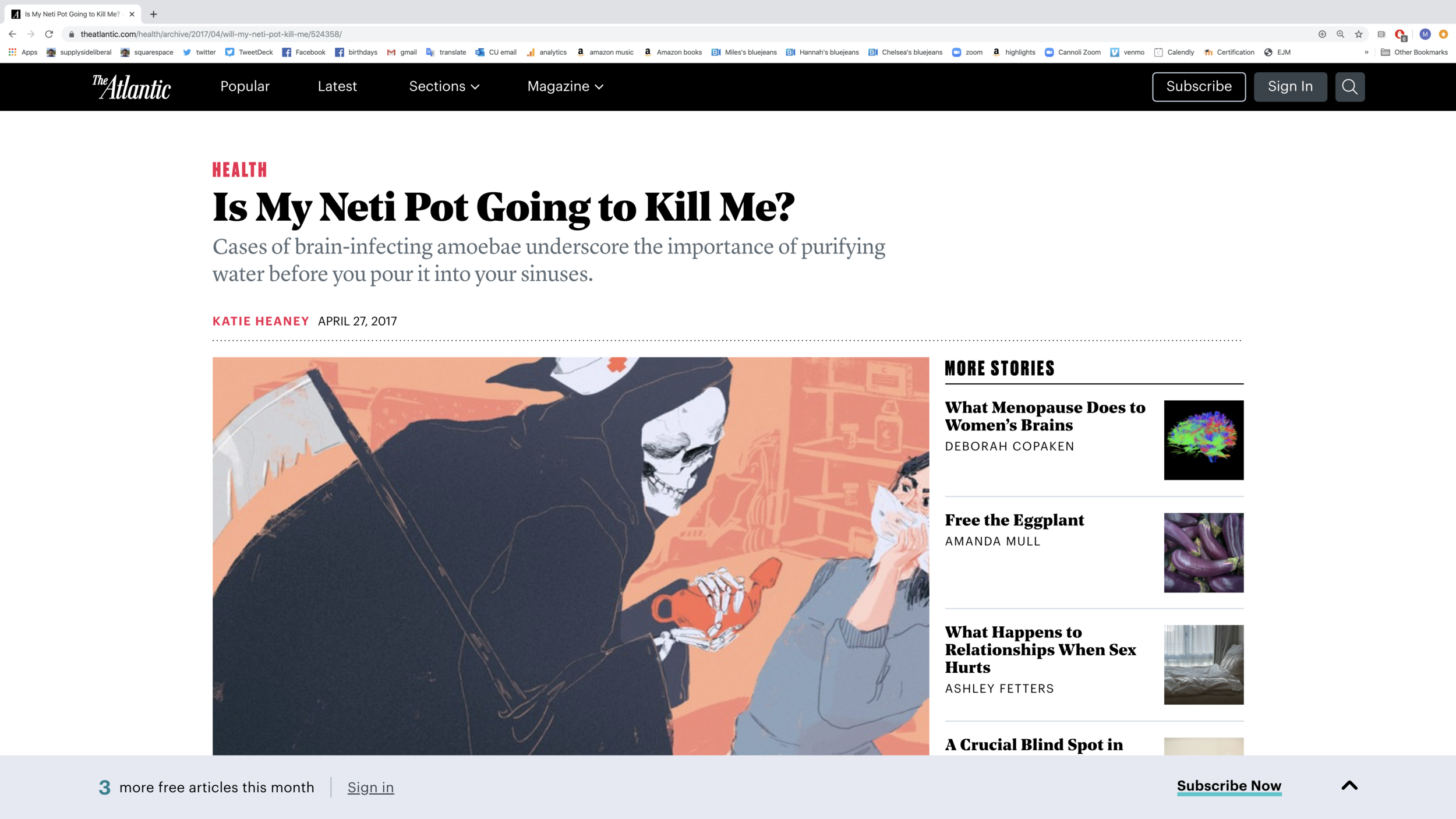

Link to the article shown just above
I have nonallergic rhinitis. I have had great success keeping it under control with 10 milligrams of Cetirizine (one brand is Zyrtec) every night and using a neti pot to wash out my nasal passages twice a day, night and morning. My neti pot ritual has been pretty simple: use the little spoon provided with certain brands of neti pots to measure out and stir non-iodized salt into warm tap water. (Iodized salt burns and isn’t a good idea.) Then tip my head and pour the salted water into one nose and out the other. Blow my nose as needed—which is a lot. Reverse directions and repeat. Stop when the water is gone. Then I’m done.
But with the latest report of a woman dying from a freshwater amoeba infection (see above), I am being urged by those close to me, as well as by authorities to use only distilled or boiled water instead of tap water. (Of course, the boiled water needs to be allowed to cool before use!)
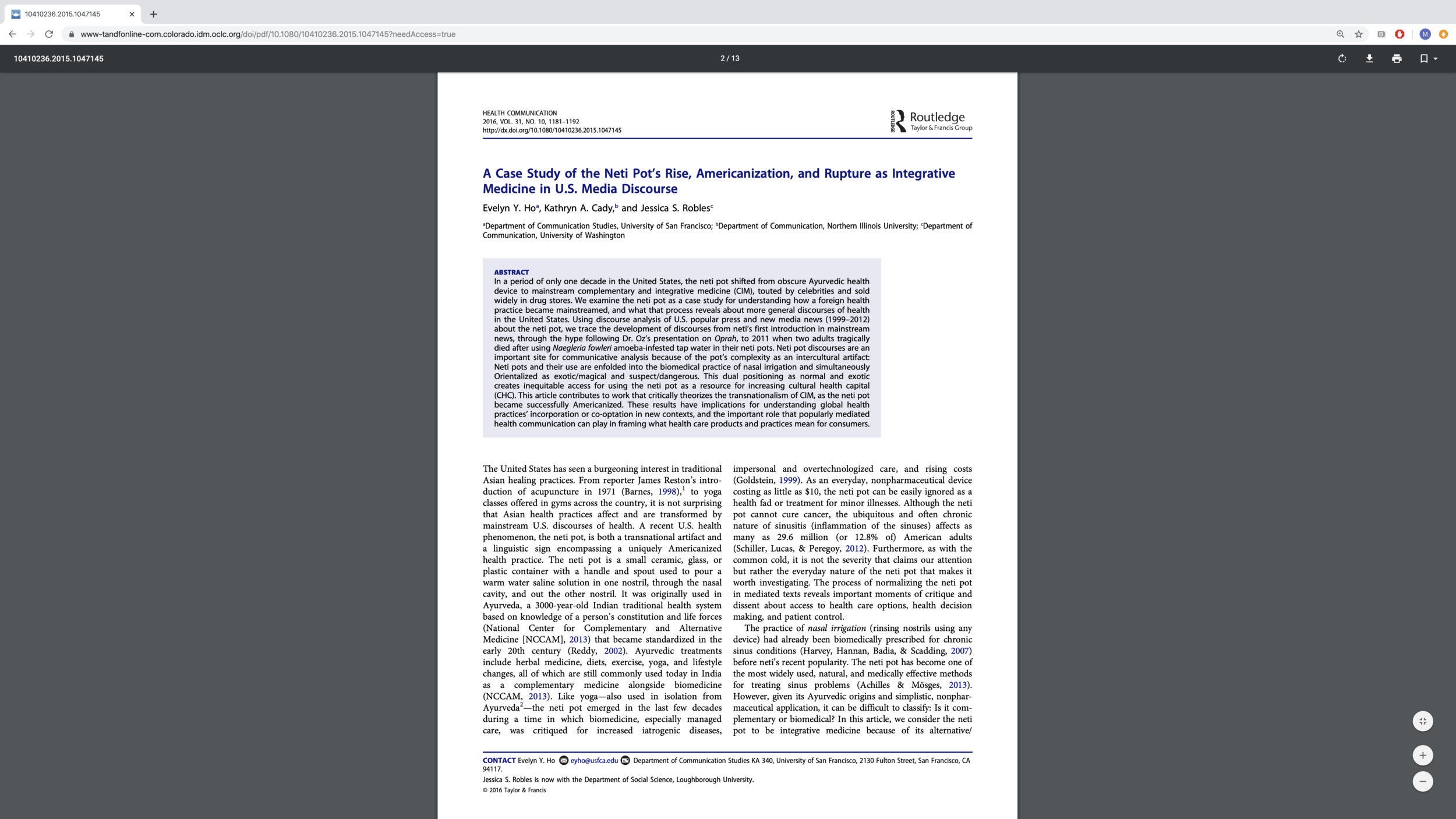
I’m not the only one using a neti pot and having to think about whether it is worth the trouble to use distilled or boiled water. Neti pots became fairly popular after Oprah touted them. On that, see “Yahoo! Reveals Oprah’s Effect on Web Searches” and the academic article below:
Let me approach my decision using the tools of cost-benefit analysis. Over a number of years’ time, there have been 4 widely publicized reports of brain-eating amoebae cases in the United States attributed to neti pot use by doctors. There are two types of brain-eating amoebae that have been blamed: Naegleria fowleri and now Balamuthia mandrillaris. (Technically, Naegleria fowleri is a “shapeshifting amoeboflagellate excavata,” not an amoeba.) Wikipedia currently says that Naegleria fowleri “is typically found in bodies of warm freshwater, such as ponds, lakes, rivers, and hot springs.” Balamuthia mandrillaris “is believed to be distributed throughout the temperate regions of the world” in the soil and water.
In order to get a number for the annual risk of neti-pot use with salted tap water, I need to guess number of people using neti pots with salted tap water, the number of brain-eating amoeba cases per year due to neti pots, and the fraction of those brain-eating amoeba cases from neti pot use that are due to people using unsalted tap water. This distinction matters because, salt might kill or weaken freshwater amoebae. From “Is My Neti Pot Going to Kill Me?” shown above:
It’s not just about avoiding irritation, either—achieving the proper salinity protects you from microorganisms that can’t survive in saltwater, like Naegleria fowleri. “It's a freshwater thing,” says Iaquinta.
Brain-eating amoeba cases due to neti pot usage are sensational news, so let me assume that most such cases are well-reported. To lean on the high side, let’s suppose there are on average 3.25 such cases per year in the US. Unfortunately, I can’t find any numbers on neti-pot usage by googling around. And the number of people who use tap water instead of distilled water will be even harder to find out. (I’d be glad for help!) Let me suppose that 1% of the US population is using neti pots with tap water. That is about 3.25 million people. And since doing neti pot without using salt is very unpleasant (I’ve made the mistake a few times), let me simplify by imagining that all neti pot users put salt in. That last assumption makes the risk estimate higher than it would otherwise be. One last assumption that makes the incremental risk estimate higher than it otherwise be is to assume that someone who uses a neti pot with distilled or boiled water faces no risk. Putting all of that together gets me to a literal one-in-a-million risk annually. And you can see how changing the assumptions would change the incremental risk estimate.
How bad is a one-in-a-million annual risk? Economists use a concept called “the value of a statistical life” to turn such a tiny risk into dollars. $10 million is a relatively high number for the value of a statistical life. (See various estimates down at the bottom of the Wikipedia article “Value of life.”) A one-in-a-million annual chance of a $10 million hit is a cost of $10 per year. Think of that $10 million value of a statistical life as applying to someone with a US median level of income. Then whether someone at the median level of income should take the trouble to use distilled or boiled water should depend on whether they assess the time, money and trouble of using distilled or boiled water as more or less than the $10 per year cost from brain-eating amoeba risk of not using distilled or boiled water. I suspect that most people at a US median income would judge the time, money and trouble cost of using distilled or boiled water instead of tap water to be greater than $10 a year. So it is a reasonable decision to use tap water (with salt, of course, since it is very unpleasant not to use salt). Note that since the risk is entirely to oneself, some of the ethical concerns with using the value of a statistical life for cost-benefit analysis that show up in contexts where one is making a decision for others are muted in this context.
Getting the cost-benefit calculations right is important not only because many people may be making unwarranted expenditures of money, time and trouble, but also because some people who could benefit from using a neti pot may be discouraged from doing so because they think they have to used distilled or boiled water.
Those who are above the median income could reasonably think that they can afford to pay more for probabilities of their own survival at more than $10 million for a life (= $100,000 for each 1% chance). But the time and trouble costs of using distilled or boiled water would also be higher for those at higher incomes who also have higher hourly wages or a higher hourly dollar valuation of time for any other reason. Theoretically, if the marginal utility of a dollar declines faster than 1% for every 1% increase in consumption (as I believe it does), then the value of a statistical life should go up more-than-proportionately with the level of consumption. (The total util value of a life should go up some with a higher level of consumption; and likely much more importantly quantitatively, one then converts utils into dollars using the reciprocal of the marginal utility of consumption.) On average, a more-than-proportionate increase in the value of a statistical life with the level of consumption should make the dollar value of a statistical life go up faster with income than the value of time. And some of the cost of using boiled or distilled water is a cost in money. So among neti-pot users, if people are somewhat rational, I would expect more high-income folks to go to the trouble of using boiled or distilled water than moderate-income folks. (A tendency toward following the average practice within a society would reduce this effect, but shouldn’t eliminate it.) The ultra-rich who also have ultra-high levels of consumption could have their employees take on almost all of the extra time and trouble cost of using distilled or boiled water instead of tap water, and so should probably use boiled or distilled water.
All of that makes it a nonobvious decision for me, personally, whether to go to the trouble of using boiled or distilled water. It all depends on how easy and fast the procedure can be made when using boiled or distilled water. But what is obvious is that I shouldn’t stress myself out about this decision. It’s not a big deal either way. (On the costs of decision-making, see “Cognitive Economics.”)
Let me note that doing the cost-benefit analysis I sketch out above more carefully would be a great senior-thesis project of an undergraduate in economics. But it would take some legwork.
For annotated links to other posts on diet and health, see:
Miles Kimball on `The 7 Principles of Unitarian Universalism'

The Flaming Chalice, symbol of Unitarian Universalism
Note: This is a major update of my November 18, 2012 blog post “The 7 Principles of Unitarian Universalism,” adding my own take on things. I will implement this update at the original location as well.
I have mentioned on this blog that I am a Unitarian Universalist. The website for the Unitarian Universalist Association has a nice summary of the principles and sources of Unitarian Universalism. Let me reflect on what each one means to me. I’ll give the official statement uninterrupted, then comment. I hope that in, some measure, my blog reflects these principles.
There are seven principles which Unitarian Universalist congregations affirm and promote:
The inherent worth and dignity of every person;Justice, equity and compassion in human relations;Acceptance of one another and encouragement to spiritual growth in our congregations;A free and responsible search for truth and meaning;The right of conscience and the use of the democratic process within our congregations and in society at large;The goal of world community with peace, liberty, and justice for all;Respect for the interdependent web of all existence of which we are a part.
Unitarian Universalism (UU) draws from many sources:
Direct experience of that transcending mystery and wonder, affirmed in all cultures, which moves us to a renewal of the spirit and an openness to the forces which create and uphold life;Words and deeds of prophetic women and men which challenge us to confront powers and structures of evil with justice, compassion, and the transforming power of love;Wisdom from the world’s religions which inspires us in our ethical and spiritual life;Jewish and Christian teachings which call us to respond to God’s love by loving our neighbors as ourselves;Humanist teachings which counsel us to heed the guidance of reason and the results of science, and warn us against idolatries of the mind and spirit;Spiritual teachings of earth-centered traditions which celebrate the sacred circle of life and instruct us to live in harmony with the rhythms of nature.
These principles and sources of faith are the backbone of our religious community.
Let me discuss each principle in turn.
1. The inherent worth and dignity of every person: These days I feel keenly the denial from many quarters of full humanity to those born elsewhere, particularly if they are poor and don’t yet speak English well. One of my best statements about immigration is “"The Hunger Games" Is Hardly Our Future--It's Already Here.” I also have a sermon on the general tendency to divide the world into “Us and Them.”
For economists, a routine way of denying the inherent worth and dignity of each person is to do a cost-benefit or welfare analysis, that without comment, puts a weight of zero on non-citizens. My alternative is “The Aluminum Rule”:
When acting collectively–or considering collective actions–put a weight on the welfare of human beings outside the in-group at least one-hundredth as much as the welfare of those in the in-group.
Because of the rampant poverty in the world, the Aluminum Rule would lead to dramatically different policies than putting a weight of zero on the out-group.
2. Justice, equity and compassion in human relationships: When I read the words “justice,” and “equity,” I think of John Rawls’s book A Theory of Justice, which to me points toward the broader class of mathematically formal social welfare functions—which is a serious research interest of mine in my work with Dan Benjamin, Ori Heffetz and Kristen Cooper toward building national well-being indexes.
Beyond that, “justice” to me means this principle, distilled from blogging my way through on liberty and John Locke’s 2d Treatise—see “John Stuart Mill’s Defense of Freedom” and also “Miles Kimball on John Locke's Second Treatise,” from which the following quotation is taken:
… no government action that clearly both reduces freedom and lowers overall social welfare is legitimate, regardless of what procedural rules have been followed in its enactment.
When, as is often the case, freedom is abridged in order to enrich the lives of the rich and impoverish the lives of the poor, it makes me burn with indignation. I give some examples of policies in this category that treated by all too many people as innocent in “‘Keep the Riffraff Out!’”
The word “compassion” makes me think of my own behavior much closer to home. Do I care about the people I deal with every day as much as I should? Do I strive to understand where they are coming from and what matters to them? (See “Liberty and the Golden Rule.”) Do I treat them right, both in doing my duty and looking for cases in which a modest effort on my part could benefit them greatly? Am I fulfilling my long-run duty to develop my social skills to the extent I reasonably can in order to be a warmer and more positive presence for others?
3. Acceptance of one another and encouragement to spiritual growth in our congregations: Each of us is different. Each of us has something that can be made fun of. Each of us could be made an outcast. I have my own stories of being treated at times as less than fully human because of my nerdly leanings. Those remembered moments still hurt, even decades later. Other people have their own stories of being made to feel less than fully human. To me “acceptance of one another” means a lot less of that happening.
To me, the interesting thing about “spiritual growth” is that I don’t know what it means. But that’s OK. As I wrote in “An Agnostic Grace”:
Religion is the “everything else” category in our existence in human societies and as individuals after parceling out the things people understand fairly well about human life—just as “natural philosophy” used to be the “everything else” category after parceling out as natural sciences the things people were beginning to understand fairly well about the natural world.
The same can be said for “spiritual” in the way it is used by nonsupernaturalists: “spiritual” refers to important things—many of them very, very positive—that we don’t fully understand yet. Spiritual growth is coming to a somewhat better understanding of those things and using that understanding to better our lives. To encourage one another in spiritual growth requires a sensitivity to things others are striving for or struggling with that may be hard for them to articulate. Let’s respect the things that people feel in their gut but can’t yet express very well, and give time for words to be put to those things.
4. A free and responsible search for truth and meaning: One of the glories of the U.S. Constitution is that it guarantees freedom of religion. (One of its shames was that it winked at slavery.) What is rare and precious beyond that is to have freedom of religious belief within the walls of a house of worship. I have that in Unitarian Universalism. I can believe as I believe and it is OK with everyone within a UU congregation. And I accord the same privilege to others. For example, I was fascinated rather than distressed to have Wiccan believers as full fellow members of the First Unitarian Universalist Congregation of Ann Arbor.
Truth is a sacred word to me. I left my previous religion in large measure because I felt my religious leaders (including very high-ranking leaders) had lied to me. In my career as an economist, the sacredness of truth shows up in a strong desire to urge statistical practices that put the truth ahead of careerist scientific advancement or confirmation of an ideology.
“Meaning” suggest to me both deep introspection into my own values and “Leaving a Legacy” by doing good that extends beyond one’s immediate circle. But “meaning,” like “spiritual” also points to the transcendent things that I don’t understand very well. I would like more transcendence in my life, and I don’t have much of a clue what that means. But I think the quest for transcendence, in balance with my other values, will lead to something bright and beautiful.
5. The right of conscience and the use of the democratic process within our congregations and in society at large: To me democratic values, and “the right of conscience,” means that I don’t have to bow the knee to anyone (unless I choose to do so out of freely-arrived at, deeply-felt respect). Human beings have evolved adaptations for hierarchy. But it is possible for each of us to insist on being treated as an equal and to treat others as equals. There are many intellectually interesting issues—not all of them resolved—on the question of in what sense should we be treating one another as equals. But what I am sure of is that we can and should be insisting on equality and treating others as equal to a greater extent than we do.
6. The goal of world community with peace, liberty, and justice for all: War is hell. Slavery is hell. Poverty is hell. They are hell when they happen in other countries just as much as if they happen in ours. Working to make war, slavery and poverty much rarer than they are in the world is a noble goal. And having the world sliced up into pieces with a majority of the world’s people only allowed to go into a few of those pieces is truly unfortunate.
7. Respect for the interdependent web of all existence of which we are a part. As I get older, plants and nonhuman animals intrigue me more and more. Some of our quest for meaning is likely to run through a contemplation and appreciation of plants and other animals.
Now, our planet is in danger of getting distressingly hot due to human action. We should take that seriously with serious measures (such as a carbon tax or a worldwide ban on burning coal) that go far beyond the symbolic. This doesn’t mean that we need to turn against capitalism. The best ways to take care of our precious planet, with plants, other animals, and us on it, is by using the price system and the creative potential of capitalist institutions, along with appropriate government measures.
To me, “the interdependent web of all existence” also includes the rest of the universe beyond our planet. Particularly valuable for contemplation are the many planets now being discovered beyond our solar system. (See “Exoplanets and Faith.”)
Conclusion: Besides being repelled by lies, I left my previous religion for Unitarian Universalism because its theological underpinnings felt too small. I felt the universe, and even our still tentative understanding of the universe, had a grandeur missing from what I was taught in that Church. When I was still a believer in Mormonism, I resolved (in the abstract) that I would only leave it for something that was bigger and better. Although Unitarian Universalism has a certain minimalism to it, it not only allows, but encourages the freedom of thought that allows all the best and and most wonderful thinking that has been done throughout human history in. That is truly grand.
Don’t miss these Unitarian-Universalist sermons by Miles:
By self-identification, I left Mormonism for Unitarian Universalism in 2000, at the age of 40. I have had the good fortune to be a lay preacher in Unitarian Universalism. I have posted many of my Unitarian-Universalist sermons on this blog.
Also, you can see other posts on religion, philosophy, humanities, culture and science by clicking on this link:
http://blog.supplysideliberal.com/tagged/religionhumanitiesscience