Trimming Truancy →
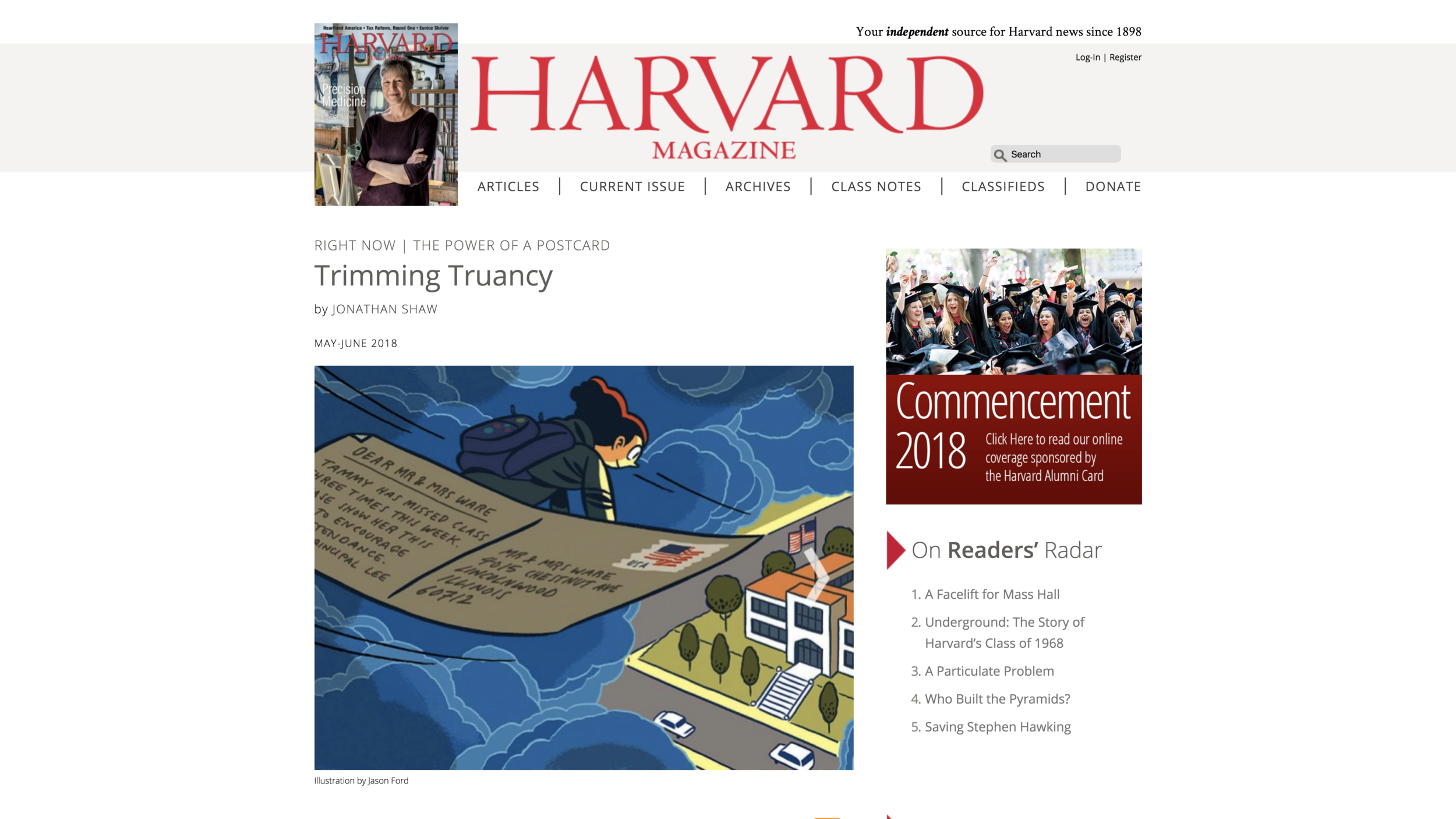
We should all love easy interventions that make a big improvement. Todd Rogers of Harvard's Kennedy School of Public Policy can reduce skipping school by 10% to 15% with a few postcards: a cost of $5 to $10 per extra day of school attended.
Michael Lowe and Heidi Mitchell: Is Getting ‘Hangry’ Actually a Thing?

OxfordDictionaries.com explains the word "hangry" this way:
It is only in the 21st century that the word hangry, a blend of hungry and angry used colloquially to mean ‘bad-tempered or irritable as a result of hunger’, has entered common use. However, the earliest known evidence for the word dates from 1956, in an unusual article in the psychoanalytic journal American Imago that describes various kinds of deliberate and accidental wordplay.
As a noun for being hangry, the word "hanger" can work when spoken with a hard g, but in print it is too confusing , so here I'll nominalize "hangry" to "hangriness." (The other alternative is "hangry" as a noun as well as an adjective.)
Hangriness is a real thing. The Wall Street Journal's Heidi Mitchell interviewed Michael Lowe, a psychologist interested in eating disorders for an August 29, 2018 article:
The popularity of the term hangry has outstripped the scientific research on it, Dr. Lowe says. He agrees that food deprivation can contribute to “a hypersensitivity to react to things you wouldn’t react to much or at all when you’re not hungry.” However, food deprivation exacerbates other feelings, too. “If we had a list of 10 negative emotions, my guess is that as people get hungrier, the scores of most of the negative emotions would go up, not just anger,” he says.
Just after we begin eating, blood-sugar levels rise sharply, then gradually decline for hours until we eat again. “At some point, one starts to experience falling glucose levels and stomach growling and other signs of energy deprivation that trigger an alarm in the brain,” Dr. Lowe says.
Some of the best evidence for the reality of hangriness or the broader set of psychological effects of low blood sugar is from three business school professors: Shai Danziger, Jonathan Levav, and Liora Avnaim-Pesso. Michael Lowe summarizes their Proceedings of the National Academy of Science of the USA article "Extraneous factors in judicial decisions" as follows:
Dr. Lowe also points to a study of eight Israeli judges who granted 65% of convicts’ parole requests in the morning and after a snack break, but almost none at day’s end. “Someone who is very hungry and irritable is likely to react more harshly” than his or her well-fed co-worker, he says.
Michael Lowe knows something about the effects of being hangry. And I don't doubt that it is a reflection of low blood sugar. But Michael is not as clued in as he should be about the causes of low blood sugar. As I wrote in "How Sugar Makes People Hangry":
A big cause of low blood sugar is when you have eaten sugar, refined carbs or some other food with a high insulin index a couple of hours earlier. When sugar, refined carbs or something else high on the insulin index causes insulin to spike, that insulin causes blood sugar to be removed from the bloodstream (some to the muscles and some to be stored as fat in the fat cells). It is like waking up from being asleep at the wheel, seeing you are drifting off to the right, and then overcorrecting to the left.
So, a good way to reduce the chances of blood sugar low enough to make you "hangry" is to avoid sugar, refined carbs and other foods high on the insulin index.
On the insulin index, see "Forget Calorie Counting; It's the Insulin Index, Stupid." My own experience, and that of others, is that when they eat low on the insulin index, they can go 24 hours without eating without getting hangry. So Michael is assuming a currently customary high-insulin-index diet when he told Heidi Mitchell (in her paraphrase):
There’s everyday hunger people feel five hours or so after a meal, called homeostatic hunger. There’s also hedonic hunger, which happens to some people because they become accustomed to eating simply for pleasure, so they often think about food.'
What Michael calls everyday homeostatic hunger comes on much sooner (five hours in his telling) and is much stronger for all but a minority of people these days because they are eating sugar, easily digestible carbs and other foods high on the insulin index.
Michael mentioned the Minnesota Starvation Experiment, but missed one of the main messages of that experiment:
He cites the famous 1945 Minnesota Starvation Experiment as an extreme example: Of the male volunteers who lost 25% of their body weight in six months, most reported irritability and a decrease in mental ability.
A key to understanding why the experience of men in this experiment was so horrible is what they were eating—carbs high on the insulin index:
Their diet consisted of foods widely available in Europe during the war, mostly potatoes, root vegetables, bread and macaroni.
If they had been eating a diet low in easily digestible carbs—or eating nothing—they could have made up for fewer food calories by burning their own fat without much discomfort, as long as they had a reasonable amount of body fat left. (In the Stanford DIETFITS study I talk about in "Why a Low-Insulin-Index Diet Isn't Exactly a 'Lowcarb' Diet" and "Against Sugar: The Messenger and the Message" people replaced easily digestible carbs with either complex carbs like vegetables or with dietary fat. Either diet worked well.)
Michael's lack of understanding of the role of easily digestible carbs in causing low blood sugar also leads him astray in the stories he tells about our ancestors. Eating in an era before processed foods, before humans had come across potatoes in the Americas, and before grain was domesticated, I argue they would have gotten hangry mainly when their stores of body fat ran low, not when they simply had to go a few days without food while they had plenty of body fat left—a genuinely dangerous and often desperate situation. But processed foods, potatoes and grain have made us feel desperate for food in situations that aren't really desperate at all. (On processed food, see my post "The Problem with Processed Food.")
Not understanding the role of easily digestible carbs and other foods high on the insulin index in hangriness, Michael gives bad advice:
To avoid feeling hangry, Dr. Lowe recommends distributing food intake evenly across the day.
I talk about formal and informal evidence that substantial periods of time with no food are a key to relatively painless weight loss in these posts, among others:
You don't need to snack constantly to avoid feeling hangry. Just avoid easily digestible carbs and other foods high on the insulin index. And if despite this claim, you are worried you might feel hangry, you can carry around some nuts anywhere in a ziploc bag (but don't go for cashews or peanuts, neither of which are true nuts and both of which have problems). See "Our Delusions about 'Healthy' Snacks—Nuts to That!" That can also help you deal with temptations, as I point out in "Letting Go of Sugar."
The bottom line is that if you feel hangry with any frequency, it is an urgent sign that you need to fix your diet. There are many other reasons to feel negative emotions, including anger, but human beings weren't meant to feel seriously hangry except in genuinely desperate situations. If you do feel hangry with any frequency, take it as a sign you are probably eating badly.
Don't miss these other posts on diet and health and on fighting obesity:
Heidi Turner, Michael Schwartz and Kristen Domonell on How Bad Sugar Is
How Fasting Can Starve Cancer Cells, While Leaving Normal Cells Unharmed
Meat Is Amazingly Nutritious—But Is It Amazingly Nutritious for Cancer Cells, Too?
Anthony Komaroff: The Microbiome and Risk for Obesity and Diabetes
Using the Glycemic Index as a Supplement to the Insulin Index
The Case Against the Case Against Sugar: Seth Yoder vs. Gary Taubes
Carola Binder: The Obesity Code and Economists as General Practitioners
Jason Fung: Dietary Fat is Innocent of the Charges Leveled Against It
Faye Flam: The Taboo on Dietary Fat is Grounded More in Puritanism than Science
Confirmation Bias in the Interpretation of New Evidence on Salt
Putting the Perspective from Jason Fung's "The Obesity Code" into Practice
'Forget Calorie Counting. It's the Insulin Index, Stupid' in a Few Tweets
Julia Belluz and Javier Zarracina: Why You'll Be Disappointed If You Are Exercising to Lose Weight, Explained with 60+ Studies (my retitling of the article this links to)
Analogies Between Economic Models and the Biology of Obesity
Debating 'Forget Calorie Counting; It's the Insulin Index, Stupid'
Also see the last section of "Five Books That Have Changed My Life" and the podcast "Miles Kimball Explains to Tracy Alloway and Joe Weisenthal Why Losing Weight Is Like Defeating Inflation." If you want to know how I got interested in diet and health and fighting obesity and a little more about my own experience with weight gain and weight loss, see my post "A Barycentric Autobiography."
John Locke: Government by the Consent of the Governed Often Began Out of Respect for Someone Trusted to Govern

Even when everyone feels in their bones that legitimate government must be by the consent of the governed, it is only the experience of misrule that leads to formal constitutions or bylaws, written or not. In my experience now in two different Economics Departments—at the University of Michigan and the University of Colorado Boulder—I have seen how willing professors are to have streamlined decision-making if they agree with the policies decided on. Passionate objections about procedure almost always arise out of substantive disagreements with what was decided.
In Sections 111-112 and the associated not in his 2d Treatise on Government: “Of Civil Government” (in Chapter VIII, "Of the Beginning of Political Societies"), John Locke writes of how willing people are to have a monarch when they trust and look up to that monarch:
§. 111. But though the golden age (before vain ambition, and amor sceleratis habendi, evil concupiscence, had corrupted men’s minds into a mistake of true power and honour) had more virtue, and consequently better governors, as well as less vicious subjects; and there was then no stretching prerogative on the one side, to oppress the people; nor consequently on the other, any dispute about privilege, to lessen or restrain the power of the magistrate, and so no contest betwixt rulers and people about governors or government: yet, when ambition and luxury in future ages [see Note 1 below] would retain and increase the power, without doing the business for which it was given; and aided by flattery, taught princes to have distinct and separate interests from their people, men found it necessary to examine more carefully the original and rights of government; and to find out ways to restrain the exorbitances, and prevent the abuses of that power, which they having intrusted in another’s hands only for their own good, they found was made use of to hurt them.
§. 112. Thus we may see how probable it is, that people that were naturally free, and by their own consent either submitted to the government of their father, or united together out of different families to make a government, should generally put the rule into one man’s hands, and chuse to be under the conduct of a single person, without so much as by express conditions limiting or regulating his power, which they thought safe enough in his honesty and prudence; though they never dreamed of monarchy being Jure Divino, which we never heard of among mankind, till it was revealed to us by the divinity of this last age; nor ever allowed paternal power to have a right to dominion, or to be the foundation of all government. And thus much may suffice to shew, that as far as we have any light from history, we have reason to conclude, that all peaceful beginnings of government have been laid in the consent of the people. I say peaceful, because I shall have occasion in another place to speak of conquest, which some esteem a way of beginning of governments.
Note 1. At first, when some certain kind of regiment was once approved, it may be nothing was then farther thought upon for the manner of governing, but all permitted unto their wisdom and discretion which were to rule, till by experience they found this for all parts very inconvenient, so as the thing which they had devised for a remedy, did indeed but increase the sore which it should have cured. They saw, that to live by one man’s will, became the cause of all men’s misery. This constrained them to come unto laws wherein all men might see their duty beforehand, and know the penalties of transgressing them. Hooker’s Eccl. Pol. l. i. sect. 10.
As I think of the history of bad kings and queens, I marvel at the motivations that drive people to become bad rulers. But I believe Lord Acton's adage:
Power tends to corrupt and absolute power corrupts absolutely.
I have not held a lot of administrative power in my life, nor do I think, relative to the overall distribution, I am all that power-hungry. But during my stint as Associate Chair for Administration at the University of Michigan I noticed on at least one occasion the temptation to exercise power badly, out of pique. It struck me because it seemed so alien to my self-image. But position creates potential for corruption, in small cases as well as big ones.
For links to other John Locke posts, see these John Locke aggregator posts:
Peter Conti-Brown: The President Crossed a Line in Commenting on Interest Rates. The Fed Needs to Redraw It.
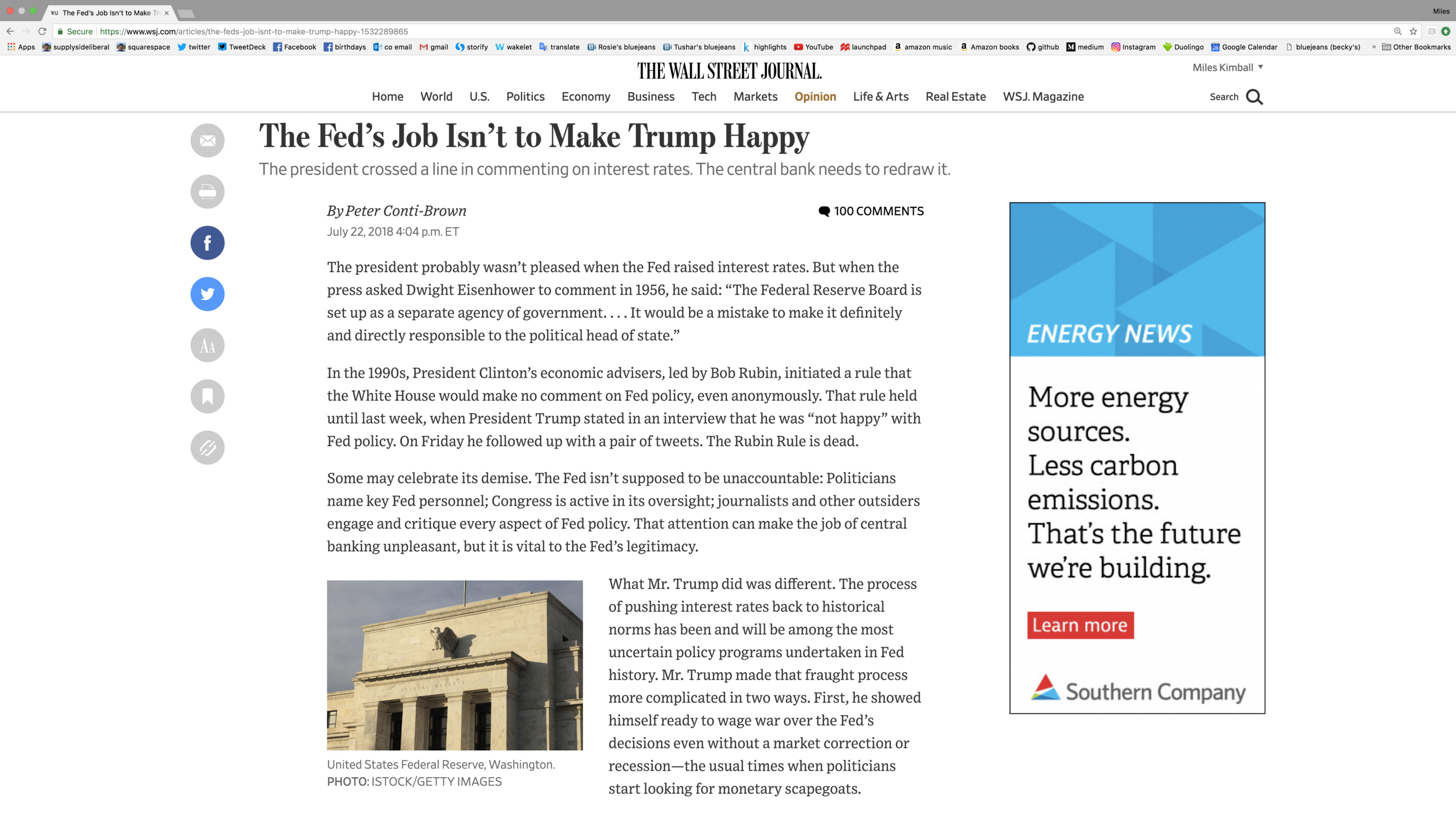
I am grateful to Peter Conti-Brown for permission to make his latest Wall Street Journal op-ed a guest post here. Here is what he has to say:
The president probably wasn’t pleased when the Fed raised interest rates. But when the press asked Dwight Eisenhower to comment in 1956, he said: “The Federal Reserve Board is set up as a separate agency of government. . . . It would be a mistake to make it definitely and directly responsible to the political head of state.”
In the 1990s, President Clinton’s economic advisers, led by Bob Rubin, initiated a rule that the White House would make no comment on Fed policy, even anonymously. That rule held until last week, when President Trump stated in an interview that he was “not happy” with Fed policy. On Friday he followed up with a pair of tweets. The Rubin Rule is dead.
Some may celebrate its demise. The Fed isn’t supposed to be unaccountable: Politicians name key Fed personnel; Congress is active in its oversight; journalists and other outsiders engage and critique every aspect of Fed policy. That attention can make the job of central banking unpleasant, but it is vital to the Fed’s legitimacy.
What Mr. Trump did was different. The process of pushing interest rates back to historical norms has been and will be among the most uncertain policy programs undertaken in Fed history. Mr. Trump made that fraught process more complicated in two ways. First, he showed himself ready to wage war over the Fed’s decisions even without a market correction or recession—the usual times when politicians start looking for monetary scapegoats.
Second, the perception of the Fed’s decision-making will change immediately. To be sure, the substance of those decisions won’t be so easily swayed. The Fed won’t fold after one tart presidential comment; Chairman Jay Powell and his colleagues are made of sterner stuff than that. More plausibly, the Fed could overreact and seek to assert its independence by raising rates more quickly than is warranted. That would be a mistake, and it’s still unlikely.
In central banking, though, appearance matters as much as substance. How will the Fed’s decisions be perceived by markets and in political campaigns, in boardrooms and in newsrooms? If the Fed slows rate increases on the merits, the public now is likely to declare a Trumpian victory. If it speeds those increases, it may invite a Trumpian war. Either result would be devastating.
The Fed’s instincts will be to hide from this fight. Instead it should confront it. Central bankers should not give marble-mouthed nonresponses to the inevitable questions about the Trump administration. They should instead be clear with the usual assurances that the Fed hasn’t altered its course based on political pressures. And they should expand on the virtues and fragility of Fed independence and explain that these traditions are mostly for politicians, not central bankers, to honor.
Fed accountability, legitimacy and independence are fragile but valuable ideals that reinforce each other. The president crossed a line last week; the Fed should not be shy in attempting to redraw it.
Mr. Conti-Brown, an assistant professor at the University of Pennsylvania’s Wharton School of Business, is author of “The Power and Independence of the Federal Reserve” (Princeton University Press, 2016).
Does Sugar Make Dietary Fat Less OK?

I have defended dietary fat as healthy in many blog posts, including
- Jason Fung: Dietary Fat is Innocent of the Charges Leveled Against It
- Which Is Worse for You: Sugar or Fat?
- Faye Flam: The Taboo on Dietary Fat is Grounded More in Puritanism than Science.
But there is one circumstance in which dietary fat might not be so great: if you are still eating sugar. In last week's post, "Heidi Turner, Michael Schwartz and Kristen Domonell on How Bad Sugar Is" I quote this:
Schwartz agrees that sugar can cause major health problems, but says it isn’t acting alone. The most potent way to activate the brain’s reward system is actually by combining sugar with fat, he says. And much of the American diet contains both of these components.
There is a claim here about complementarity in badness: that is, in the presence of sugar, dietary fat is worse than in the absence of sugar. I take the view that in the absence of sugar, dietary fat—other than the big mistake of transfat—is quite healthy. But it is logically possible that dietary fat combined too close in time to sugar is unhealthy. Let me spin out a possible theory. I should say first that I am not really persuaded by the "overwhelmingly rewarding" theory that Michael Schwartz is putting forward. Sugar is extremely rewarding. Fat is extremely rewarding. Is the combination of sugar and fat that much more rewarding than sugar in combination with nonfat foods or fat in combination with nonsugar foods?
Instead, let discuss things from the standpoint of the satiation to calorie ratio I talk about in "Letting Go of Sugar." Dietary fat by itself, or in combination with other foods low on the insulin index (see "Forget Calorie Counting; It's the Insulin Index, Stupid") is quite satiating: it will make you feel full quite fast. But sugar has a negative satiation to calorie ratio: it makes you feel less full. So add enough sugar to your dietary fat, and the dietary fat's normal tendency to make you feel full will be neutralized.
The idea that sugar neutralizes the tendency of dietary fat to make you feel full still doesn't seem to make dietary fat any worse than anything else combined with sugar. But what if, in addition to the mechanisms that normally make dietary fat satiation, there is a volumetric mechanism that makes you full if there is a high volume of food in your stomach. It would make sense that sugar can neutralize some mechanisms that make you feel full, but it can't neutralize the volumetric mechanism. But dietary fat doesn't have a lot of volume per calorie, so if the normal mechanism that makes dietary fat so very satiating is neutralized, there isn't a volumetric backup mechanism for fat. Sugar gets past the main safeguard that makes you not want to overeat dietary fat and that's it.
Solution? Don't eat sugar. See "Letting Go of Sugar" for how to get there. Sugar is bad whether or not it is combined with dietary fat. Even on the theory above, dietary fat is only bad when combined with sugar.
Don't miss these other posts on diet and health and on fighting obesity:
- Stop Counting Calories; It's the Clock that Counts
- 4 Propositions on Weight Loss
- Forget Calorie Counting; It's the Insulin Index, Stupid
- Obesity Is Always and Everywhere an Insulin Phenomenon
- The Problem with Processed Food
- Anthony Komaroff: The Microbiome and Risk for Obesity and Diabetes
- Letting Go of Sugar
- Heidi Turner, Michael Schwartz and Kristen Domonell on How Bad Sugar Is
- Prevention is Much Easier Than Cure of Obesity
- Which Is Worse for You: Sugar or Fat?
- Our Delusions about 'Healthy' Snacks—Nuts to That!
- My Giant Salad
- Using the Glycemic Index as a Supplement to the Insulin Index
- How Fasting Can Starve Cancer Cells, While Leaving Normal Cells Unharmed
- Why You Should Worry about Cancer Promotion by Diet as Much as You Worry about Cancer Initiation by Carcinogens
- Good News! Cancer Cells are Metabolically Handicapped
- How Sugar, Too Much Protein, Inflammation and Injury Could Drive Epigenetic Cellular Evolution Toward Cancer
- Meat Is Amazingly Nutritious—But Is It Amazingly Nutritious for Cancer Cells, Too?
- The Keto Food Pyramid
- Sugar as a Slow Poison
- How Sugar Makes People Hangry
- Why a Low-Insulin-Index Diet Isn't Exactly a 'Lowcarb' Diet
- Hints for Healthy Eating from the Nurse's Health Study
- The Case Against Sugar: Stephan Guyenet vs. Gary Taubes
- The Case Against the Case Against Sugar: Seth Yoder vs. Gary Taubes
- Gary Taubes Makes His Case to Nick Gillespie: How Big Sugar and a Misguided Government Wrecked the American Diet
- Against Sugar: The Messenger and the Message
- A Conversation with David Brazel on Obesity Research
- Magic Bullets vs. Multifaceted Interventions for Economic Stimulus, Economic Development and Weight Loss
- Nina Teicholz on the Bankruptcy of Counting Calories
- Mass In/Mass Out: A Satire of Calories In/Calories Out
- Carola Binder: The Obesity Code and Economists as General Practitioners
- Carola Binder—Why You Should Get More Vitamin D: The Recommended Daily Allowance for Vitamin D Was Underestimated Due to Statistical Illiteracy
- Jason Fung: Dietary Fat is Innocent of the Charges Leveled Against It
- Faye Flam: The Taboo on Dietary Fat is Grounded More in Puritanism than Science
- Diseases of Civilization
- Katherine Ellen Foley—Candy Bar Lows: Scientists Just Found Another Worrying Link Between Sugar and Depression
- Ken Rogoff Against Sugar and Processed Food
- Kearns, Schmidt and Glantz—Sugar Industry and Coronary Heart Disease Research: A Historical Analysis of Internal Industry Documents
- Eating on the Road
- Intense Dark Chocolate: A Review
- In Praise of Avocados
- Salt Is Not the Nutritional Evil It Is Made Out to Be
- Confirmation Bias in the Interpretation of New Evidence on Salt
- Whole Milk Is Healthy; Skim Milk Less So
- Is Milk OK?
- How the Calories In/Calories Out Theory Obscures the Endogeneity of Calories In and Out to Subjective Hunger and Energy
- Putting the Perspective from Jason Fung's "The Obesity Code" into Practice
- 'Forget Calorie Counting. It's the Insulin Index, Stupid' in a Few Tweets
- Julia Belluz and Javier Zarracina: Why You'll Be Disappointed If You Are Exercising to Lose Weight, Explained with 60+ Studies (my retitling of the article this links to)
- Diana Kimball: Listening Creates Possibilities
- On Fighting Obesity
- The Heavy Non-Health Consequences of Heaviness
- Analogies Between Economic Models and the Biology of Obesity
- Debating 'Forget Calorie Counting; It's the Insulin Index, Stupid'
- Podcast: Miles Kimball Explains to Tracy Alloway and Joe Weisenthal Why Losing Weight Is Like Defeating Inflation
Also see the last section of "Five Books That Have Changed My Life" and the podcast "Miles Kimball Explains to Tracy Alloway and Joe Weisenthal Why Losing Weight Is Like Defeating Inflation." If you want to know how I got interested in diet and health and fighting obesity and a little more about my own experience with weight gain and weight loss, see my post "A Barycentric Autobiography."
Eric Morath Defines Full Employment
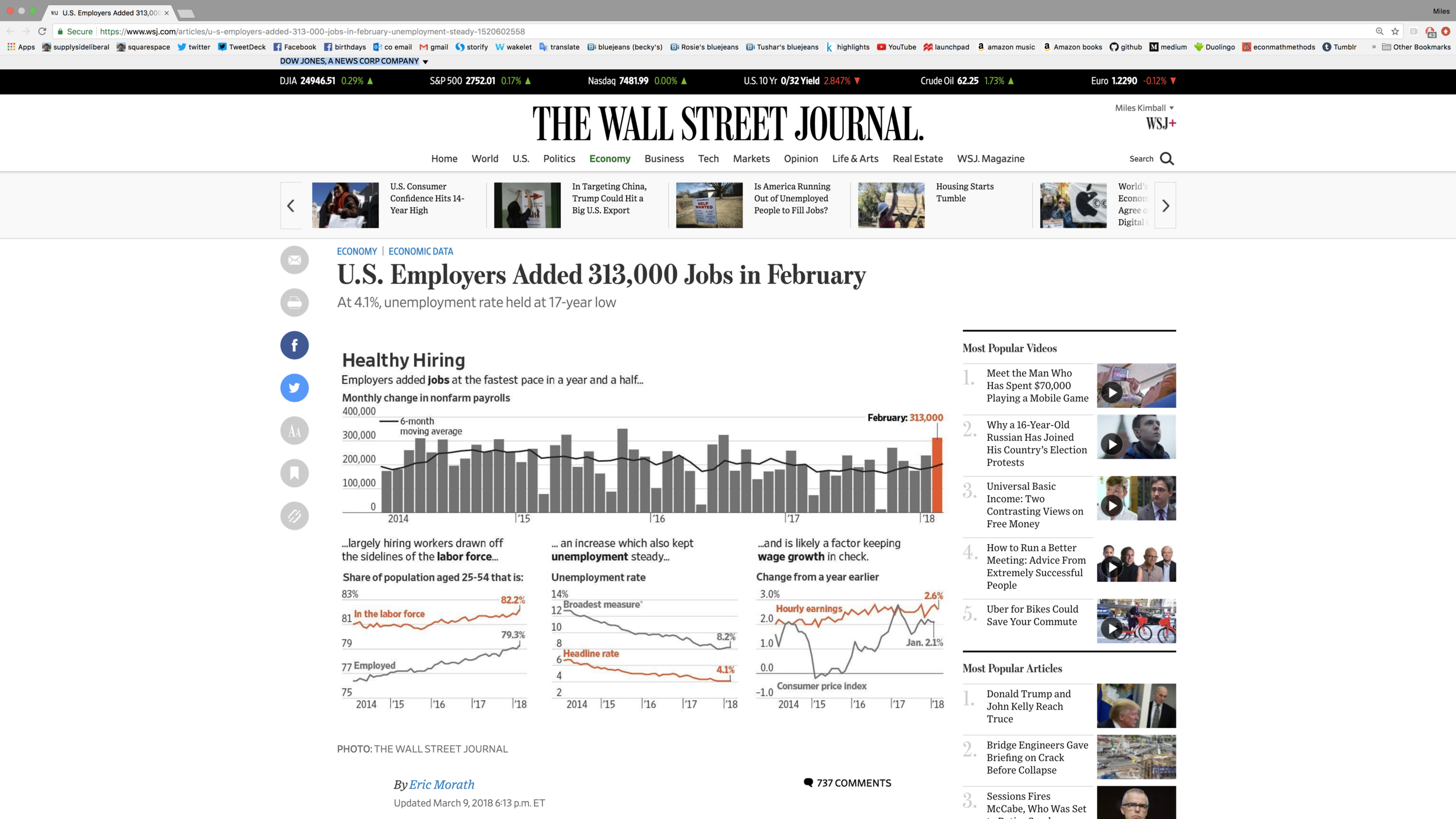
In the article above, Eric Morath gives a nice definition of "full employment," which means the same thing as "the natural level of employment":
Full employment is the term economists use to describe a sweet spot in the economy—a point in a business cycle when unemployment is very low, but not so low that it starts stoking severe wage and price inflation. The Fed’s goal is to keep the economy in that sweet spot for as long as possible.
Heidi Turner, Michael Schwartz and Kristen Domonell on How Bad Sugar Is
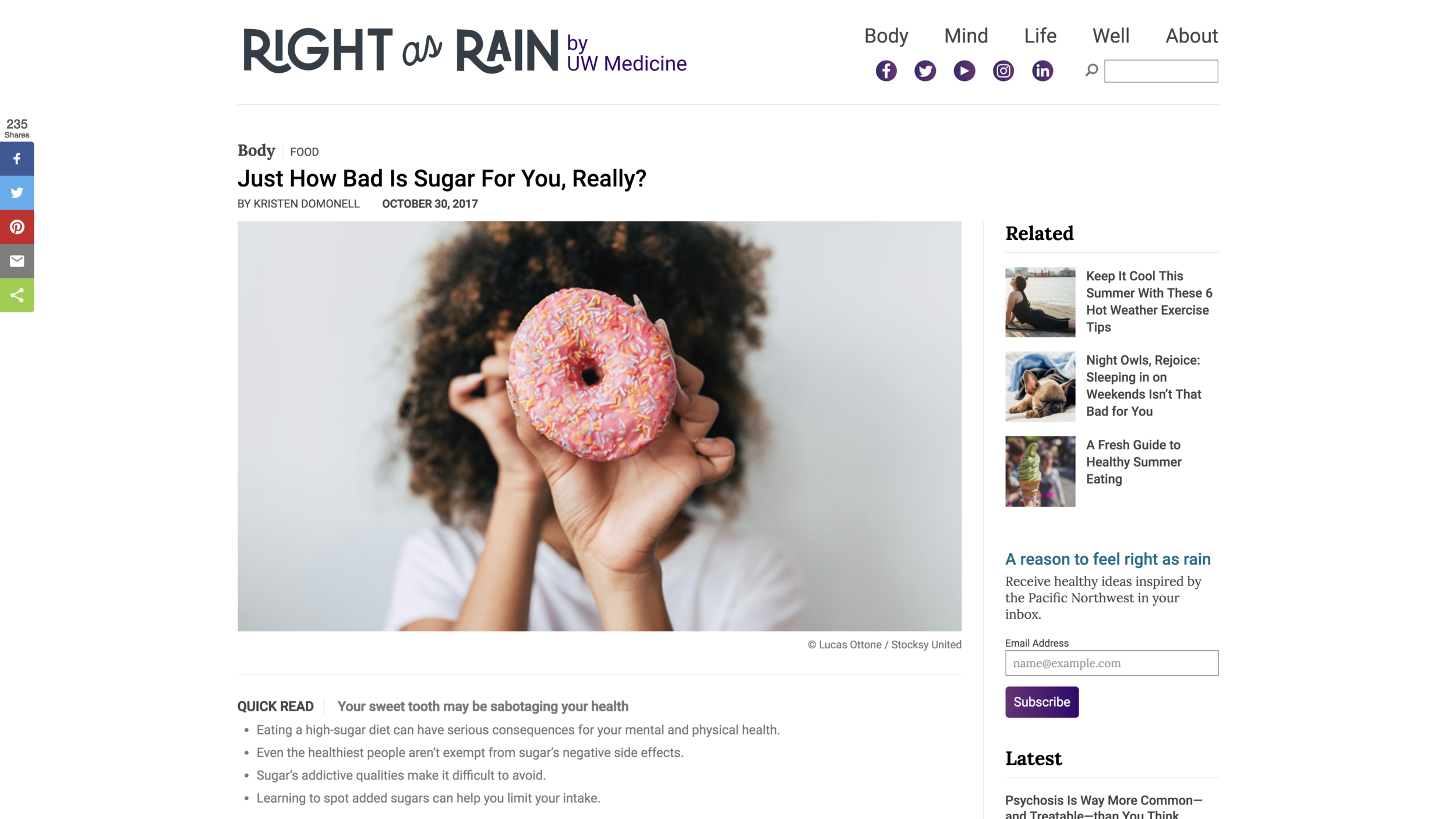
Heidi Turner is a medical nutrition therapist at The Seattle Arthritis Clinic. Michael Schwartz, M.D. is director of the University of Washington Medicine Diabetes Institute and the Nutrition Obesity Research Center there. Kristen Domonell interviewed both of them about sugar for the University of Washington Medicine website. Here are some highlights (bulleting added):
Heidi Turner
- Sugar is the universal inflammatory ... Everyone is sugar intolerant.
- Addictive qualities aside, there’s also a large social element at play, says Turner. Bad day? Turn to sugar. Celebration at work? Just add sugar. It’s both delicious and comforting, which is part of the reason it’s so hard to get away from, she says.
Michael Schwartz
- The most potent way to activate the brain’s reward system is actually by combining sugar with fat, [Schwartz] says. And much of the American diet contains both of these components.
- I wouldn’t say people become dependent on it in the way they become dependent on a drug,” says Schwartz. “But for some people, the anticipation of eating something that is highly rewarding becomes an important focus for how they live each day.”
Finally, based on these interviews, Kristen Domonell herself writes:
- Eating a diet that’s high in added sugar is bad news for your heart, according to a major 2014 study. The researchers found that eating more than the recommended amount of added sugar [in this case 25 grams a day for women, 36 grams for men and 12 grams for children] may increase your risk of dying from heart disease. Even if you go to the gym and eat your greens regularly, you aren’t immune from the effects of sugar on your health. Eating a high-sugar diet can set you up for disease, even if you’re otherwise healthy, according to a new study. Researchers found unhealthy levels of fat in the blood and livers of men who ate a high-sugar diet, which may increase the risk of heart disease, they report.
- And while many people eat sugar as a pick-me-up, it could be having the opposite effect. One recent study found that men who ate a high-sugar diet were more likely to develop depression or anxiety than those who ate a diet lower in sugar.
- Sugar is hiding out where you least expect it—in everything from dressings and sauces to whole grain bread.
I really like the quotations above. But let me detail things in the article I disagree with. First, whole fruit is more problematic than they suggest. Most types of fruit have quite a bit of sugar in them, and despite the fiber content, most types of fruit have a substantial insulin kick. I discuss this in "Forget Calorie Counting; It's the Insulin Index, Stupid."
Second, the "recommended amounts of sugar" (25 grams a day for women, 36 for men and 12 for children) give the wrong idea that eating a little sugar is going to be OK. I discuss in "Letting Go of Sugar" why it is better to cut out sugar almost entirely.
In the same vein, it is strange when Kristen writes:
In other words, if you’re forced to choose between white table sugar and honey, go for the honey. But if it’s a choice between honey or no sugar at all, going sugar-free is your best bet.
The likelihood that someone will put a gun to your head and say "Eat either the table sugar or the honey, or I'll shoot" is quite low.
Finally, Michael Schwartz buys into what I think is a faulty evolutionary story:
Back when food was way scarcer, our ancient ancestors needed to take every advantage they had to consume high calorie foods. So the human brain evolved to perceive sugar—and fat—as very rewarding, says Schwartz. Today, our brains are still wired for feast or famine, even though you can buy thousands of calories of food for a couple bucks at the local convenience store.
Other than for hibernation, animals in the wild don't get terribly fat. There is a good reason. Being too fat would make the animal slow, which is bad for a predator and bad for a prey. In the environment of evolutionary adaptation, humans too, played the roles of predator and prey, and it wouldn't have paid to be too fat. The trouble for us is processed food, which didn't exist in the environment of evolutionary adaptation. On this, see "The Problem with Processed Food." In designing processed food in an effort to get people to eat a lot and buy a lot of each particular product, the food industry puts sugar into almost everything. That is a good indication of the power of sugar.
Don't miss these other posts on diet and health and on fighting obesity:
- Stop Counting Calories; It's the Clock that Counts
- 4 Propositions on Weight Loss
- Forget Calorie Counting; It's the Insulin Index, Stupid
- Obesity Is Always and Everywhere an Insulin Phenomenon
- The Problem with Processed Food
- Anthony Komaroff: The Microbiome and Risk for Obesity and Diabetes
- Letting Go of Sugar
- Prevention is Much Easier Than Cure of Obesity
- Which Is Worse for You: Sugar or Fat?
- Our Delusions about 'Healthy' Snacks—Nuts to That!
- My Giant Salad
- Using the Glycemic Index as a Supplement to the Insulin Index
- How Fasting Can Starve Cancer Cells, While Leaving Normal Cells Unharmed
- Why You Should Worry about Cancer Promotion by Diet as Much as You Worry about Cancer Initiation by Carcinogens
- Good News! Cancer Cells are Metabolically Handicapped
- How Sugar, Too Much Protein, Inflammation and Injury Could Drive Epigenetic Cellular Evolution Toward Cancer
- Meat Is Amazingly Nutritious—But Is It Amazingly Nutritious for Cancer Cells, Too?
- The Keto Food Pyramid
- Sugar as a Slow Poison
- How Sugar Makes People Hangry
- Why a Low-Insulin-Index Diet Isn't Exactly a 'Lowcarb' Diet
- Hints for Healthy Eating from the Nurse's Health Study
- The Case Against Sugar: Stephan Guyenet vs. Gary Taubes
- The Case Against the Case Against Sugar: Seth Yoder vs. Gary Taubes
- Gary Taubes Makes His Case to Nick Gillespie: How Big Sugar and a Misguided Government Wrecked the American Diet
- Against Sugar: The Messenger and the Message
- A Conversation with David Brazel on Obesity Research
- Magic Bullets vs. Multifaceted Interventions for Economic Stimulus, Economic Development and Weight Loss
- Nina Teicholz on the Bankruptcy of Counting Calories
- Mass In/Mass Out: A Satire of Calories In/Calories Out
- Carola Binder: The Obesity Code and Economists as General Practitioners
- Carola Binder—Why You Should Get More Vitamin D: The Recommended Daily Allowance for Vitamin D Was Underestimated Due to Statistical Illiteracy
- Jason Fung: Dietary Fat is Innocent of the Charges Leveled Against It
- Faye Flam: The Taboo on Dietary Fat is Grounded More in Puritanism than Science
- Diseases of Civilization
- Katherine Ellen Foley—Candy Bar Lows: Scientists Just Found Another Worrying Link Between Sugar and Depression
- Ken Rogoff Against Sugar and Processed Food
- Kearns, Schmidt and Glantz—Sugar Industry and Coronary Heart Disease Research: A Historical Analysis of Internal Industry Documents
- Eating on the Road
- Intense Dark Chocolate: A Review
- In Praise of Avocados
- Salt Is Not the Nutritional Evil It Is Made Out to Be
- Confirmation Bias in the Interpretation of New Evidence on Salt
- Whole Milk Is Healthy; Skim Milk Less So
- Is Milk OK?
- How the Calories In/Calories Out Theory Obscures the Endogeneity of Calories In and Out to Subjective Hunger and Energy
- Putting the Perspective from Jason Fung's "The Obesity Code" into Practice
- 'Forget Calorie Counting. It's the Insulin Index, Stupid' in a Few Tweets
- Julia Belluz and Javier Zarracina: Why You'll Be Disappointed If You Are Exercising to Lose Weight, Explained with 60+ Studies (my retitling of the article this links to)
- Diana Kimball: Listening Creates Possibilities
- On Fighting Obesity
- The Heavy Non-Health Consequences of Heaviness
- Analogies Between Economic Models and the Biology of Obesity
- Debating 'Forget Calorie Counting; It's the Insulin Index, Stupid'
- Podcast: Miles Kimball Explains to Tracy Alloway and Joe Weisenthal Why Losing Weight Is Like Defeating Inflation
Also see the last section of "Five Books That Have Changed My Life" and the podcast "Miles Kimball Explains to Tracy Alloway and Joe Weisenthal Why Losing Weight Is Like Defeating Inflation." If you want to know how I got interested in diet and health and fighting obesity and a little more about my own experience with weight gain and weight loss, see my post "A Barycentric Autobiography."