Daniel Herriges Digs Deep into the Preferences that Matter for a 'Traffic Problem'

I liked this piece. I recommend you read the whole thing, but here is a taste:

The good news is, if our traffic problem is one of driver frustration and not one of travel time or total volume, we can improve things much more easily than we can alter absolute travel time or total volume. Changing the latter two things is a Sisyphean task, given the reality of induced demand and Marchetti's constant. But fixing the frustration piece? The toolkit is right in front of us, as evidenced by the experience of driving on well-designed two-lane urban streets that already exist. In this context, we drive at a moderate but steady speed, an experience which doesn't feel chaotic or unsafe, and which offers lively streetscapes and scenery to look at.

This realization leaves us free to advocate for high-quality, compact development—development which creates destinations that are pleasant to spend time at on foot, and that reduces the need to hop in a car in the first place—without adopting the misguided fear that such development is going to unleash Carmageddon.

Markus Brunnermeier and Yann Koby's "Reversal Interest Rate"

Markus Brunnermeir and Yann Koby's paper "The Reversal Interest Rate" has a title and an abstract so intriguing for those interested in negative interest rates that I need to discuss it. Here is the abstract:

The "reversal interest rate'' is the rate at which accommodative monetary policy "reverses" its effect and becomes contractionary. The reversal interest rate depends on various factors: (i) banks' asset holdings with fixed (non-floating) interest payments, (ii) degree of interest rate pass-through to loan rate and deposit rate, (iii) amount of bank's whole sale funding. Quantitative easing (QE) increases the reversal rate. QE should only employed after interest rate cut is exhausted. Moreover, low interest rates beyond the time when fixed interest rate mature undo its effectiveness, suggesting a different forward guidance policy.

Ruchir Agarwal and I had a chance to talk to Markus Brunnermeier at the Bank of International Settlements when we went to present our paper "Breaking Through the Zero Lower Bound" there on November 17, 2016

Markus was very gracious in our conversation. Ruchir and I explained our interpretation that the Markus and Yann's "reversal interest rate" was all about the effects of low interest rates on bank profits and therefore bank balance sheets. (This is along the lines of my post "What is the Effective Lower Bound on Interest Rates Made Of?") Markus agreed with that interpretation, and with the idea that central banks can help counteract the profit and balance sheet effects of negative interest rates with other policies. 

What this means is that the reversal interest rate can be pushed down as low as needed if steps are taken to to keep bank balance sheets healthy. One possible step to maintain bank profitability and bank net worth in a negative interest rate environment is to reduce the paper currency interest rate, so that banks are able to lower the rates they pay depositors without having to worrier about depositor flight into paper currency. This approach is in line with what I write in "If a Central Bank Cuts All of Its Interest Rates, Including the Paper Currency Interest Rate, Negative Interest Rates are a Much Fiercer Animal."

Another possible step to maintain bank profitability and bank net worth is for the central bank to effectively make transfers to private banks. Tiered interest on reserve formulas in which higher interest is paid on reserves up to a certain level is one way to do this. The Swiss National Bank and the Bank of Japan both do this. Loans from the central bank to private banks at below market interest rates are another way to effectively make transfers to the private banks. The European Central Bank does this. Thus, effective transfers from the central bank to private banks are already current policy for many central banks that have used negative interest rates. So this is a highly relevant type of policy.

I talk about an interesting variant on the tiered interest on reserves approach in these posts:

It seems likely that inventive central bankers could easily come up with other mechanisms for effectively transferring funds to private banks to keep their profits and net worth healthy, and so avoid a binding reversal interest rate. Thus, though the concept of a "reversal interest rate" is quite intriguing, it is not a serious barrier to negative interest rate policy. Rather, the concept of a "reversal interest rate" points to the operational importance of central banks keeping an eye on bank profits and bank balance sheets when lowering interest rates. 

In keeping with an attention to bank balance sheets, it can't be emphasized too much that negative interest rate policy is highly complementary with high capital conservation buffers for banks that keep banks from making their balance sheet weaker by paying dividends or buying back stock unless the balance sheet is very strong to begin with. On this, see


John Locke: Lions and Wolves and Enemies, Oh My

The "Lions and Tigers and Bears, Oh My" scene in the Wizard of Oz

As I wrote in "John Locke: Theft as the Little Murder" in his 2d Treatise on Government: On Civil Government, John Locke often used murder as a metaphor for other crimes. In section 16 of his 2d Treatise on Government: “On Civil Government,” he uses a similarly extreme case to bolster the legitimacy of punishment: considering the case of a determined, deadly, and irreconcilable enemy and comparing such an enemy to a dangerous lion or wolf:

The state of war is a state of enmity and destruction: and therefore declaring by word or action, not a passionate and hasty, but a sedate settled design upon another man’s life puts him in a state of war with him against whom he has declared such an intention, and so has exposed his life to the other’s power to be taken away by him, or any one that joins with him in his defence, and espouses his quarrel; it being reasonable and just, I should have a right to destroy that which threatens me with destruction: for, by the fundamental law of nature, man being to be preserved as much as possible, when all cannot be preserved, the safety of the innocent is to be preferred: and one may destroy a man who makes war upon him, or has discovered an enmity to his being, for the same reason that he may kill a wolf or a lion; because such men are not under the ties of the common-law of reason, have no other rule, but that of force and violence, and so may be treated as beasts of prey, those dangerous and noxious creatures, that will be sure to destroy him whenever he falls into their power.

The logic as stated is for a situation of your life or mine. You could walk away and defuse the situation. I cannot, because you would pursue me. So it is legitimate for me to do whatever it takes to incapacitate you so you cannot kill me, including killing you, if that is necessary. 

In cases of lesser danger, the significance of this passage is in justifying doing what is necessary to deter someone from preying on the innocent with impunity—especially if that deterrent action harms only the guilty. I discuss the principles for these cases of lesser danger in the two posts

Francis Bacon on the Value of Talking Things Over

"...whosoever hath his mind fraught with many thoughts, his wits and understanding do clarify and break up, in the communicating and discoursing with another; he tosseth his thoughts more easily; he marshalleth them more orderly, he seeth how they look when they are turned into words: finally, he waxeth wiser than himself; and that more by an hour’s discourse, than by a day’s meditation."

--Francis Bacon, in "Of Friendship"

Tim Harford: Facts Without Curiosity are Dead

Most of Tim Harford's post "The Problem with Facts" is quite discouraging for those of us not eager to live in a posttruth era. But there is one ray of hope: curiosity. Tim writes:

What Kahan and his colleagues found, to their surprise, was that while politically motivated reasoning trumps scientific knowledge, “politically motivated reasoning . . . appears to be negated by science curiosity”. Scientifically literate people, remember, were more likely to be polarised in their answers to politically charged scientific questions. But scientifically curious people were not. Curiosity brought people together in a way that mere facts did not. The researchers muse that curious people have an extra reason to seek out the facts: “To experience the pleasure of contemplating surprising insights into how the world works.”

Thus, those who love the truth need to figure out how to spark curiosity in as many people as possible. 

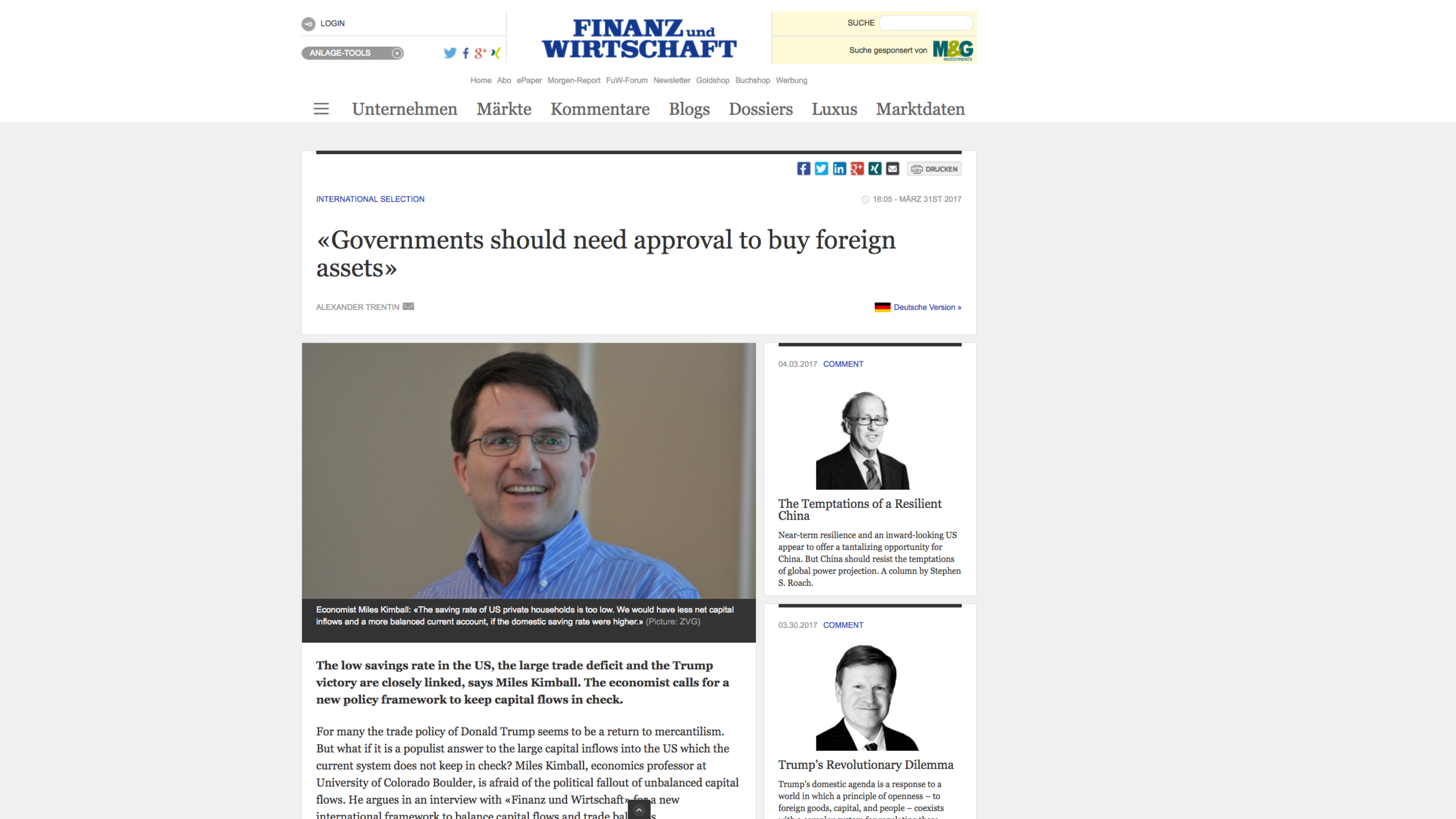
Alexander Trentin Interviews Miles Kimball about Establishing an International Capital Flow Framework

I love talking to Alexander Trentin. Last week, Alexander called to talk about negative interest rates, but our conversation turned to trade, and to the need for international arrangements about government-generated international capital flows. Here is the essence of our conversation. Alexander's words are in italics or bold. Miles's words are in regular text. 


The low savings rate in the US, the large trade deficit and the Trump victory are closely linked, says Miles Kimball. The economist calls for a new policy framework to keep capital flows in check.

For many the trade policy of Donald Trump seems to be a return to mercantilism. But what if it is a populist answer to the large capital inflows into the US which the current system does not keep in check? Miles Kimball, economics professor at University of Colorado Boulder, is afraid of the political fallout of unbalanced capital flows. He argues in an interview with «Finanz und Wirtschaft» for a new international framework to balance capital flows and trade balances.

Professor Kimball, what is your opinion on the trade policy of the Trump administration?
Trump’s advisor Peter Navarro thinks that trade deficits cause capital inflows, which is not the way it works.

But if a country is importing more than it exports, it is running a current account deficit.
Yes, but the causality is the other way round. The trade balance is caused by capital flows. The capital markets determine if capital is flowing into the US. The net amount of goods and services purchased by the US from foreign countries must be equal to the net inflow of capital into the US. The net capital inflows into the country cause the current account deficit and net imports.

Does that mean measures to stop imports like the proposed border adjustment tax will not work?
Some economists suspect that dollar appreciation would fully cancel out the effect of such a tax. But I don’t think that is the new equilibrium. I hate to say it, but the likely combination of «border adjustment» and dollar appreciation might still help the trade position of the US. The reason is that if the dollar appreciates, inflows of funds from the rest of the world determined in the capital market as euro, yen or renminbi flows would become smaller when translated into dollar values. The capital flows into the US would therefore shrink in size and the current account deficit would be reduced.

It is only a currency effect then?
In other words, even though capital flows are determined in the currency where they originate by capital market forces that wouldn’t be affected much by border adjustment plus dollar appreciation, when translated into dollar values, the capital inflow into the US could be reduced.

What kind of other measure would help to balance trade?
The saving rate of US private households is too low. We would have less net capital inflows and a more balanced current account, if the domestic saving rate were higher. An easy way to raise US national saving would be to require firms to automatically enroll their employees in 401(k) retirement plans. I wrote about this in my column «How Increasing Retirement Saving Could Give America More Balanced Trade

Should every country introduce such encouragements to achieve a higher saving rate?
Many of those who favor automatic enrollment emphasize only the benefits to the individual saver. But increasing the domestic saving rate also has macroeconomic benefits. But of course increasing the saving rate is only appropriate for some countries. While the US needs a higher saving rate, some countries already have very high saving rates.

Why is it so important to have balanced trade?
Politically, balanced trade is a very different animal from unbalanced trade. If trade had been more balanced, Americans would have been more accepting of arguments for free trade. The noticeable effect of the trade deficit was the loss of jobs in certain industries. Swing states which voted for Trump were the especially affected by such job losses. There are many other factors in Trump’s victory, but holding those other factors fixed, unbalanced trade resulting from strong capital inflows provided the margin of victory for him. If the US had no trade deficit, Donald Trump would not be President of the United States.

But not everybody loses from capital inflows, right?
Yes, there are winners and losers of unbalanced trade. Winners are the consumers who get cheaper goods. But losers are often not completely compensated for their losses. Countries are not one big happy family, but a composite of different people in different situations. In theory, trade deficits now lead to trade surpluses in the future. When the borrowing from other countries is paid back, trade-related jobs would be created in abundance. But when will this happen? The US current account deficit has persisted for many decades. Any reversal of the current account deficit seems to be way off in the future.

Are capital inflows coming into the US just looking for better investment opportunities?
These are often not private capital flows. Governments are pushing up their net exports by buying foreign assets. And when governments buy foreign assets unilaterally it is currency manipulation. Up until the recent past, China was a major culprit, increasing its foreign exchange reserves until 2014. Switzerland is doing the same thing, but gets away with it because it is a small country. But in relation to its GDP, Switzerland is as bad as China was in terms of buying foreign assets. My personal views on the importance of this have shifted now that I have seen the political effects on the US of China’s currency manipulation.

The Swiss National Bank can keep the exchange rate from appreciating by buying foreign assets or lowering the interest rate. Are both measures currency manipulation?
No, reducing interest rates is not currency manipulation. Buying foreign assets is a beggar-thy-neighbor policy, while lowering rates is not. If two countries buy each other’s bonds to depreciate their exchange rates, they cancel out each other’s efforts and there is no net effect. But if all countries lower their interest rates, it is a global monetary expansion and pushes up global aggregate demand.

Should currency manipulation be forbidden?
No, but we need an international capital flow framework in which such things are negotiated. Under such a framework, governments would have to get approval to buy assets in another country. This would probably not stop commodity exporters like Saudi-Arabia from buying foreign assets. But it would bring industrial countries like Switzerland under pressure when they keep their exchange rate low by currency manipulation. Of course, the international capital flow framework should not be limited to rules about direct government purchases of foreign assets. It should involve broader negotiations about other policies to keep international capital flows more nearly in balance and therefore to keep trade surpluses and trade deficits in check.

What policies could achieve such goals?
Here I have in mind policies that affecting saving, consumption and portfolio choices, such as the automatic enrollment regulations when higher saving is called for, and the perennial calls for China to institute more of a social safety net so that Chinese households will feel it is safe to save less and consume more. Capital flows are an area where international policy coordination is much more important than central bank interest rate policy, where it is fine for each central bank to focus narrowly on what is good for its own country. It is my hope that an international capital flow framework with a combination of rules about government purchases of foreign assets and coordination on policies to raise or lower the saving rate in each country can help establish and preserve an international system based on free trade and open capital markets for everyone except governments.

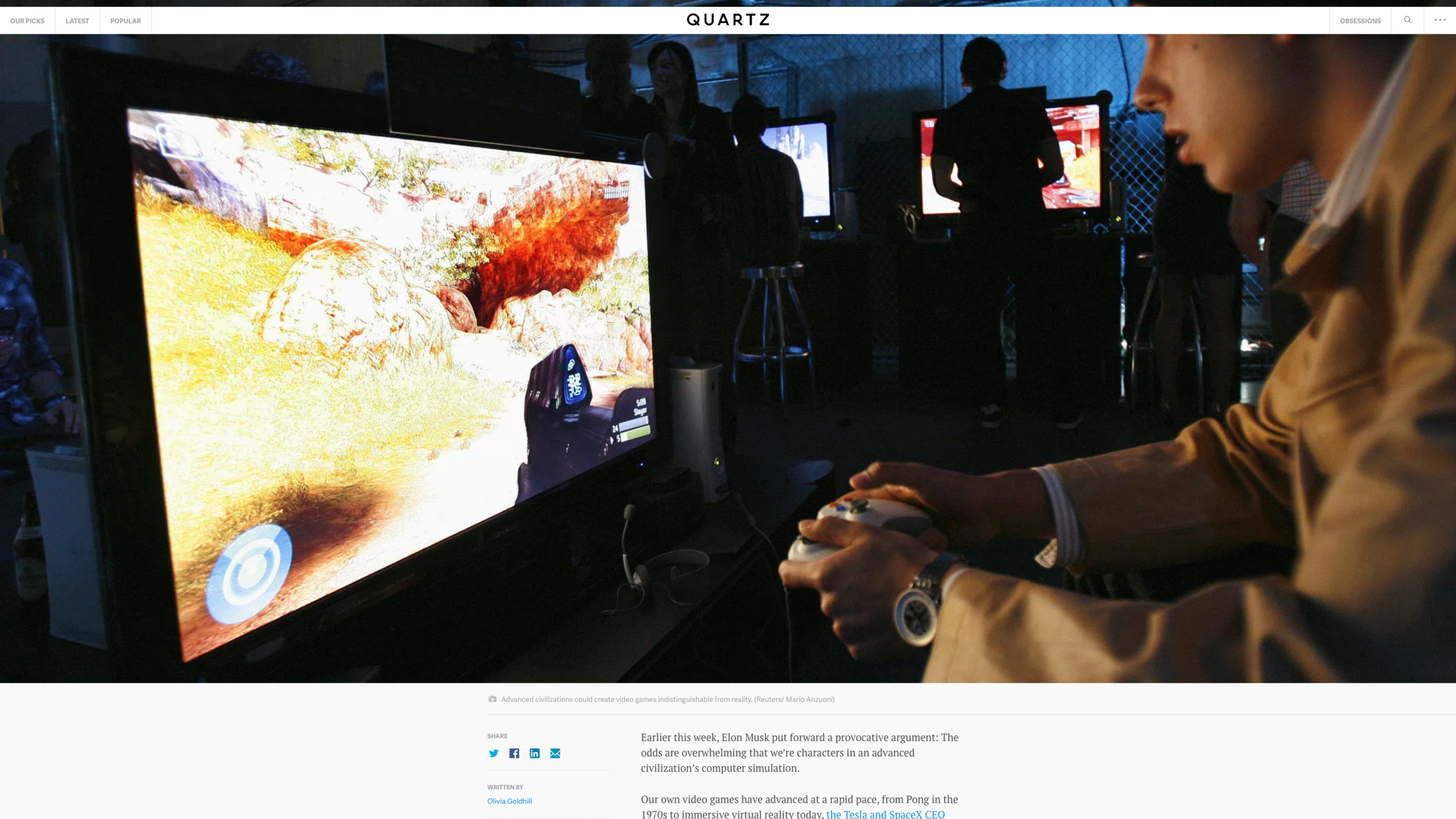
An Interview with Nick Bostrom about His Argument That We May Well Be Computer Simulations

In "Teleotheism and the Purpose of Life" I wrote:

Traditional Christian theology, put into a hard science fiction straightjacket, is like the idea that we are all software programs inside a superbeing’s computer.  There is no way to know this is not true.  If it is true, miracles would just be a special case in the programming.  The normal laws of nature could be as simple and regular as they are simply because that was easier than programming more complex laws for the default case. 

The link above is to an interview with Oxford philosopher Nick Bostrom, who argues we should take this possibility seriously. 

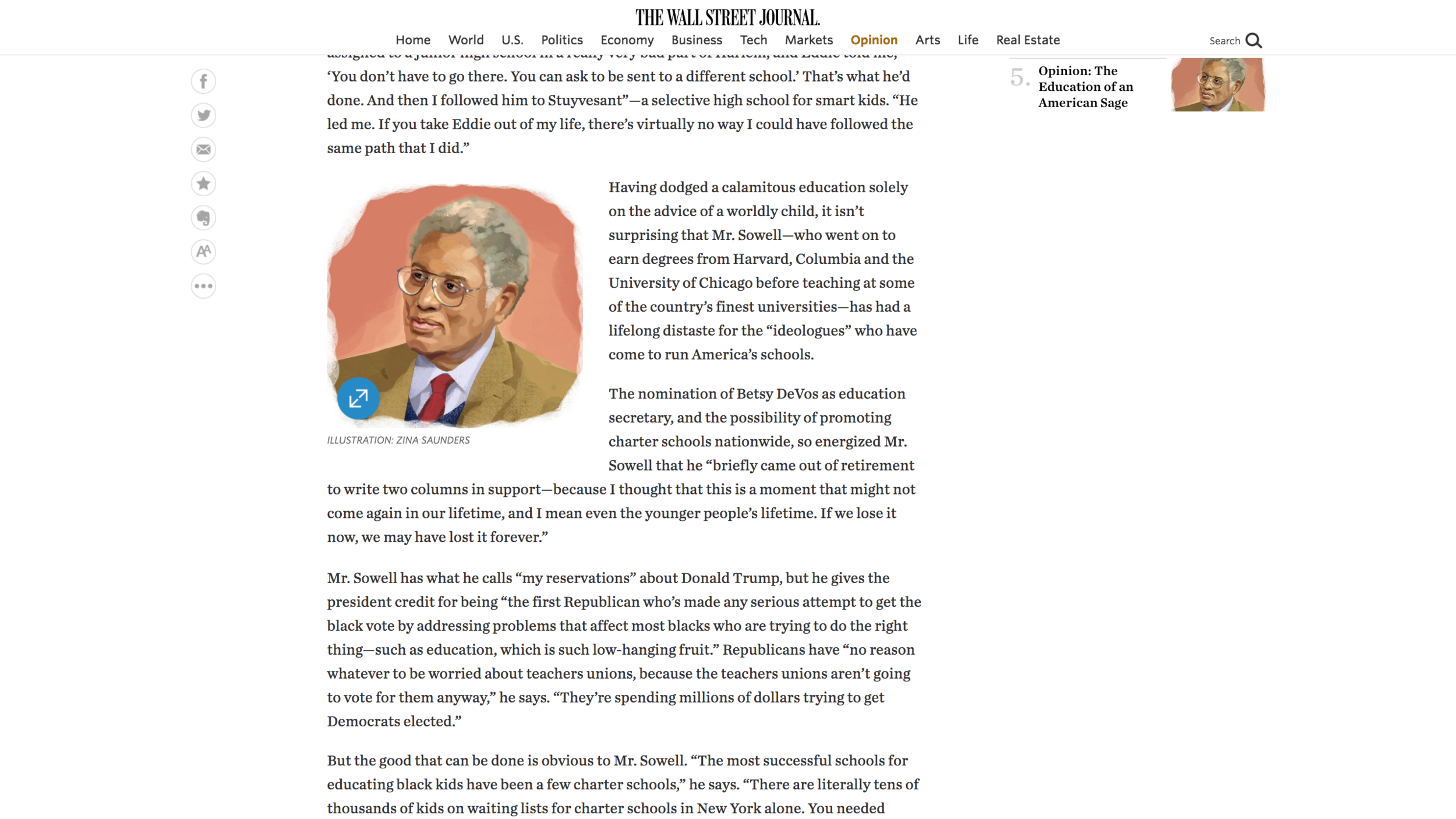
Thomas Sowell on How to Succeed as an Ethnic Minority

"What’s disheartening, though, is that when you study ethnic groups around the world, the ones that are lagging behind are those where their leaders always tell the same story: that it’s other people holding you back, and that therefore you need to stand against those other people and resist their culture. But that culture may be the key to success. ...

Hume urged Scots to learn the English language... He didn’t do that because his job was that of an ethnic leader. He did it because he was an intellectual. ... One of the most miraculous advances of a people occurred in Scotland from the 18th century into the 19th, ... A wholly disproportionate share of the leading British thinkers was Scottish. I mean Adam Smith in economics, Hume in philosophy, Sir Walter Scott in literature, James Watt in engineering. You can run through the whole list. A people who were really far behind in one century had suddenly come out of nowhere and were on the forefront of human progress.

“[African Americans] can be [like the Scots in this way,] and for those who haven’t gotten into this corrosive new culture, they’re already doing that. But it’s going to be very hard. Both the media and academia promote the idea that people fall behind because others are holding them back.”

--Thomas Sowell

The Reserve Bank of Australia is Facilitating Cashless Payment but Needs to Do More to Bring Fees Down

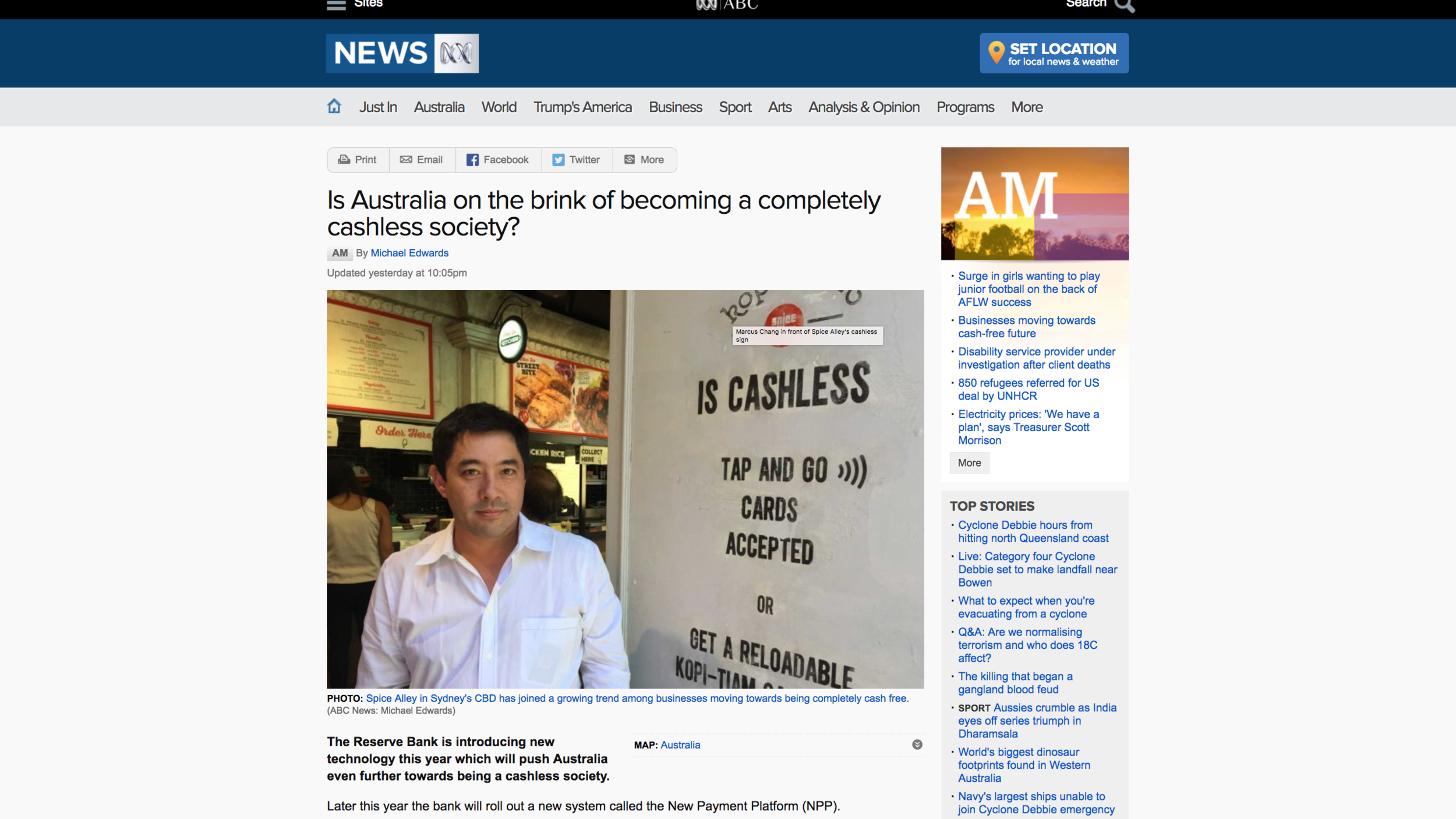
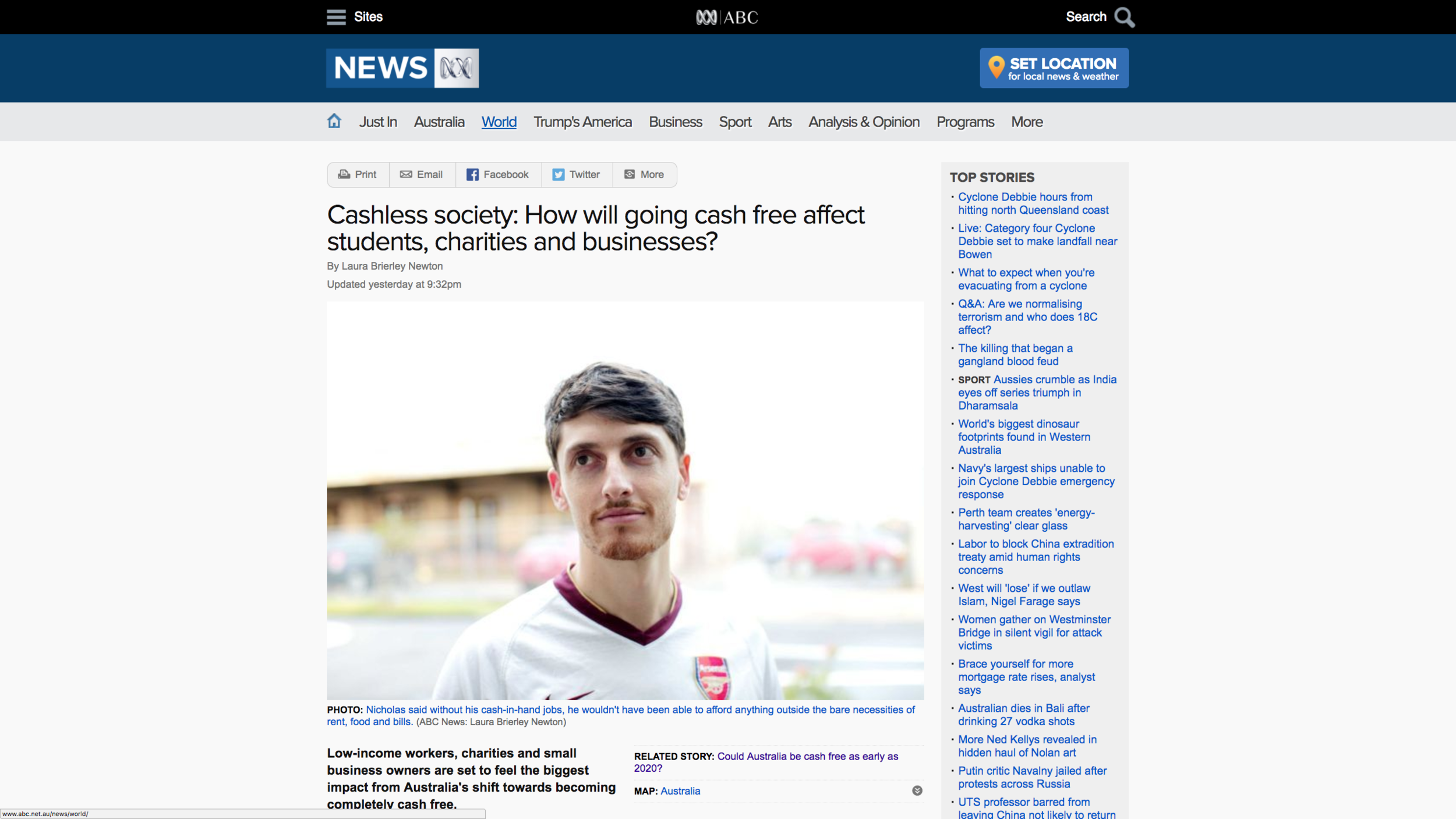
The Reserve Bank of Australia is setting up a "New Payment Platform" to make cashless payments easier. This is a good development. Thanks to my brother, Joseph Kimball for pointing me to the article at the top, as he points me to so many other useful articles. 

There are two interesting things to note about this Australian initiative. First, the benefits of a possible future cashless economy for tamping down tax evasion are being emphasized in Australia. This is an emphasis right out of Ken Rogoff's book The Curse of Cash, which I wrote about here.

Second, there is too little discussion of the benefits of bringing down fees for cashless payments by if financial technology innovators are allowed to use the New Payment Platform. The top article above doesn't mention fees at all. The bottom article mentions that some retailers are leery of going more to cashless payment because they pay fees of 1.3% to 1.5%, writing as if that level of fees would continue into the future. That is not the way it should be.

The Reserve Bank of Australia should do all it can to overthrow the credit card oligopoly by making it easy for financial technology innovators to use the New Payment Platform. I suspect that a 1.3 to 1.5% decrease in the GST ("Goods and Services Tax") would be quite popular in Australia. A reduction in cashless payments fees to a nominal amount would have a similar effect on the Australian economy and Australian households—with the one difference that services provided by the government and the Australian government's credit rating can be preserved since the credit card companies take the hit rather than the government budget.

There are some fixed costs to a payment system. It is quite appropriate for the government to pay those fixed costs, then allow financial technology innovators to plug into the system at marginal cost. The lower fees, leading to greater use of cashless payments will ultimately help tax revenue more than enough to make up for paying that fixed costs and then letting competition among financial firms do the rest. 

Incumbent financial firms will want the government to put obstacles in the way of new competitors. A simple rule can avoid this. If any new financial firm demonstrates that it has 100% of its assets in reserves with the Reserve Bank of Australia, it should face only regulations about dealing fairly with consumers and about reporting potentially criminal activity, and should be exempt from other banking regulations. 

Human Beings as Social—and Trading—Animals

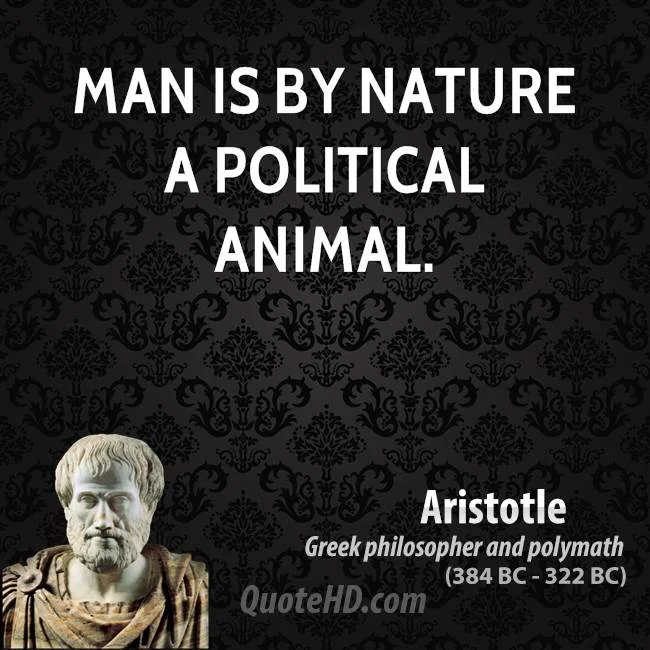
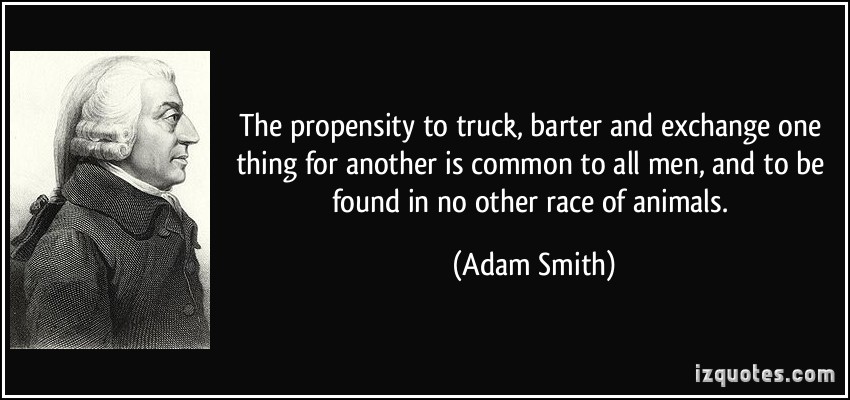
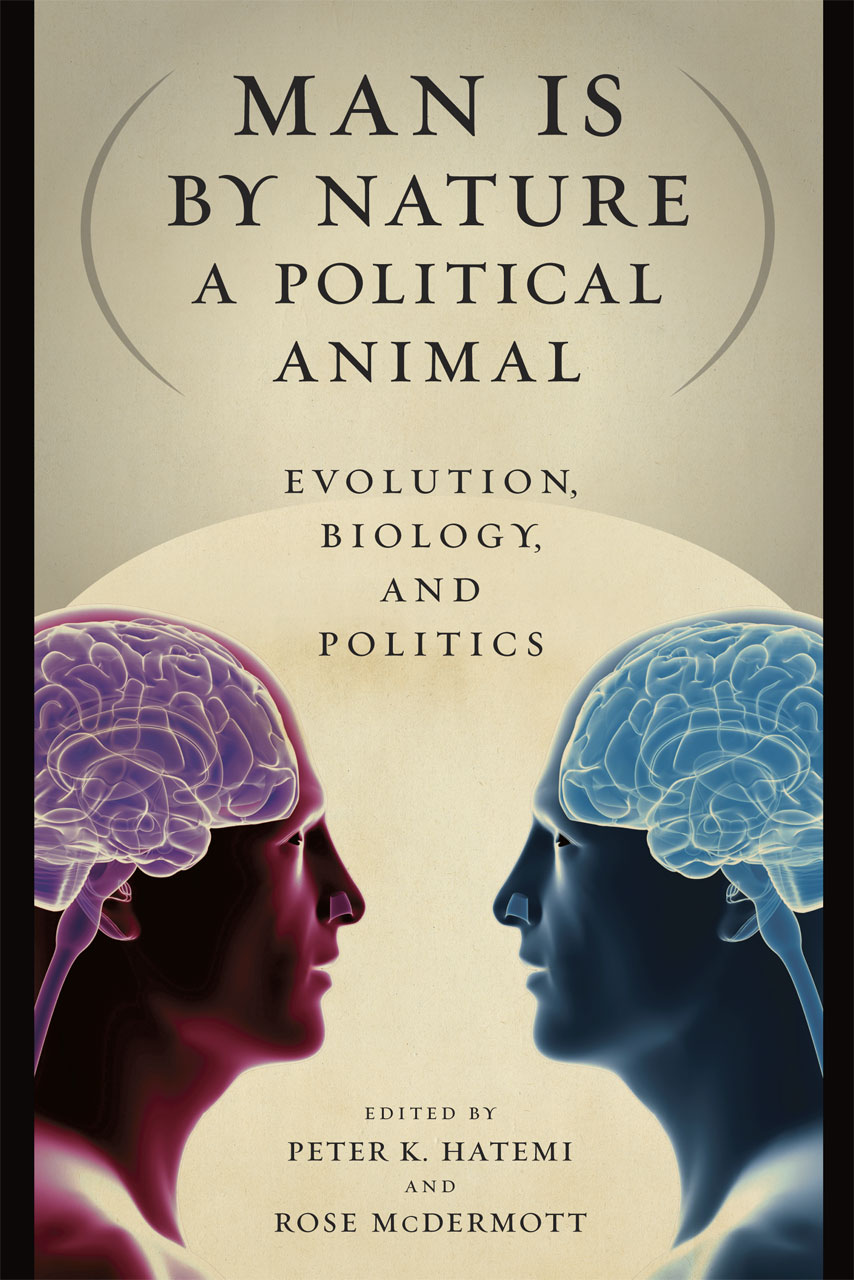
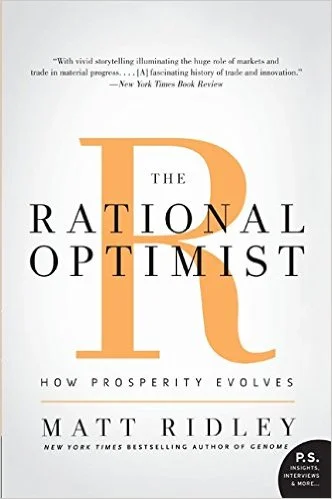
Aristotle famously said that human beings are political animals. Adam Smith said that human beings are trading animals. I believe both claims are right, in a quite literal sense: human being are evolved to live in groups and to trade with one another. Being able to navigate issues that arise when living in groups and being able to execute trades with others are evolutionary adaptations in same way that the even more basic instincts of interest in food and sex are evolutionary adaptations. The books above pursue these two themes of human beings as social animals and human beings as trading animals.

There are many who doubt the existence of "natural law." Natural law may be quite incomplete and fail to answer many key questions we face, but evolutionary adaptations for living in groups and for trading provide at least some limited corpus of "natural law" written on our genes. (Though when I say "written on our genes" I mean written on the genes of the majority of us who are not sociopaths.)

John Locke, in section 15 of his 2d Treatise on Government: On Civil Government, has a nice quotation from Richard Hooker on human beings as social animals:

To those that say, there were never any men in the state of nature, I will not only oppose the authority of the judicious Hooker, Eccl. Pol. lib. i. sect. 10. where he says, “The laws which have been hitherto mentioned, i. e. the laws of nature, do bind men absolutely, even as they are men, although they have never any settled fellowship, never any solemn agreement amongst themselves what to do, or not to do: but forasmuch as we are not by ourselves sufficient to furnish ourselves with competent store of things, needful for such a life as our nature doth desire, a life fit for the dignity of man; therefore to supply those defects and imperfections which are in us, as living single and solely by ourselves, we are naturally induced to seek communion and fellowship with others: this was the cause of men’s uniting themselves at first in politic societies.” But I moreover affirm, that all men are naturally in that state, and remain so, till by their own consents they make themselves members of some politic society; and I doubt not in the sequel of this discourse, to make it very clear.

One thing Hooker seems to take for granted, but is in fact quite remarkable, is the capacity of human beings to make solemn agreements and have those agreements mean something. The ability to make and keep promises—even if not 100 percent of the time—is an amazing ability that does a lot to help make us who we are. This ability to make and keep promises is crucial both for human beings as political animals and for human beings as trading animals.