Why Financial Stability Concerns Are Not a Reason to Shy Away from a Robust Negative Interest Rate Policy
Because the Great Recession was triggered by the Financial Crisis of 2008, financial stability concerns have been high on the agenda of central banks. Indeed, some central bankers now worry about avoiding financial instability every bit as much as they worry about avoiding inflation and unemployment. So it is worth directly addressing financial stability concerns that some central bankers have about a robust negative interest rate policy. 

The particular concern many people have is that lower interest rates might increase financial instability. There are several possible mechanisms for this: 

  • The simplest is that lower interest rates might make asset prices go up and this allows households and firms to borrow more without exceeding legal or customary ceilings on leverage. Then if the asset prices ever go back down, bankruptcy could be near at hand.
  • The second is “reaching for yield” caused by institutional settings or psychological mindsets in which there is effectively a target expected return or “yield,” and the amount of risk bearing is adjusted in order to meet that expected return target. (See “Contra John Taylor” and “Reaching for Yield: The Effects of Interest Rates on Risk-Taking.”)
  • The third is that low interest rates magnify the importance of the relatively distant future on the present value of an asset. Opinions on the relatively distant future are likely to differ from investor to investor and to change quite a bit over time even for the same investor. Because there is so little to go on, the human penchant for responding to stories can have relatively free play. (See “Robert Shiller: Against the Efficient Markets Theory” plus “Dr. Smith and the Asset Bubble.”)
  • The fourth is that as interest rates fall, it becomes attractive to banks and other financial institutions to provide credit to people who previously were not considered creditworthy.   

Although these are genuine concerns, it would be a mistake to let these concerns paralyze monetary policy–as they easily could: in “Monetary Policy and Financial Stability” I argue that central transmission mechanisms for monetary stimulus work through pushing up asset prices and relaxing credit constraints for those who previously had a hard time getting a loan. 

As I discussed in “Meet the Fed’s New Intellectual Powerhouse,” to the extent that risk premia go down, showing a greater appetite for risk–or less fear of risk–it is appropriate to raise the safe interest rate; and conversely it is appropriate to lower the safe interest rate when risk premia go up–even aside from financial stability concerns. But I want to argue that if unemployment is high and inflation is low, it is appropriate to cut interest rates (even into the negative region) to stimulate the economy even if risk premia stay the same.    

Three Arguments for a Robust Negative Interest Rate Policy Even in the Face of Financial Stability Concerns

1. High Equity Requirements are Powerful Enough to Mitigate Financial Stability Concerns. I view equity requirements (sometimes called “capital” requirements)–or equivalently leverage limits–as being powerful medicine to raise financial stability. If people are betting their own money by holding stock rather than borrowing money that someone expects back in full, any decline in the value of a bank, business, or other asset will be absorbed by the stockholders. Then there is no bankruptcy, no contagion, and no temptation for the government to do a bailout, because no debt is being defaulted on. I feel as passionately about the need for high equity requirements as I do about the need to have deep negative interest rates (including negative interest rates on paper currency) in the monetary policy toolkit. Here are links to some of what I have said about the importance of having high equity requirements: 

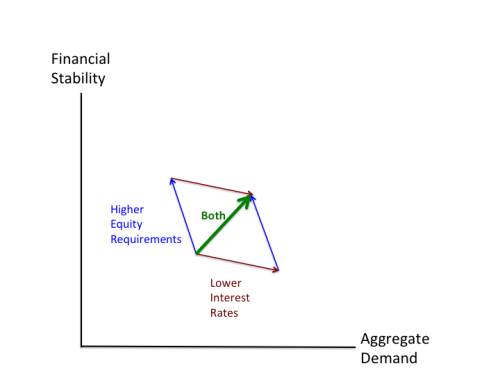
Why negative interest rates should be combined with high equity requirements: In times when unemployment is high, output is below its natural level, and inflation is coming down, low interest rates–and often negative interest rates–are called for. But negative interest rates are much safer in conjunction with high equity requirements. Conversely, when financial instability threatens, high equity requirements are called for, but they are safer when negative interest rates are ready to hand to deal with any negative aggregate demand effects of the high equity requirements. 

At the top of this post, I diagram the idea that high equity requirements have a big positive effect on financial stability, but some negative effect on aggregate demand, while negative interest rates (or more generally low interest rates) have a big positive effect on aggregate demand, but have some effect in reducing financial stability. This means that if high equity requirements and negative interest rates are combined, it is possible to get both more financial stability and more aggregate demand. Low interest rates can more than make up for the reduction in aggregate demand caused by higher equity requirements, while the high equity requirements more than make up for the reduction in financial stability from the negative interest rates. 

2. Negative Short-Term Interest Rates Raise Long-Term Interest Rates. Long-term interest rates matter more for asset prices than short-term interest rates. Therefore, those concerned about financial stability should worry most about low long-term interest rates. There are two reasons the ability to generate a brief period of deep negative short-term interest rates should raise long-term interest rates. The first is that a brief period of deep negative short-term rates is the path to economic recovery if the economy is in a deep recession or a potentially long-lasting slump. Businesses and households are much more eager to borrow when the economy looks healthy than when it looks sick. So interest rates tend to be higher when the economy is doing well than when it is doing badly. It may seem paradoxical that negative rates are the path to higher interest rates, but the paradox is dissolved when one realizes that economic recovery is in between. Because it is the long-term rates that matter most for asset prices, an extended period of years and years of zero interest rates is much more dangerous for financial stability than a brief period of deep negative rates followed by a return distinctly positive interest rates. One of the worst things for financial stability is an unending slump with the economy stuck at an unwisely maintained zero lower bound. 

The second reason having deep negative interest rates in the toolkit allows higher long-term interest rates is that eliminating the zero lower bound and thereby bringing the possibility of deep negative interest rates into the picture means that quantitative easing is no longer needed. As practiced in recent years in the US, the UK and Europe, quantitative easing has involved pushing down long-term interest rates relative to short-term interest rates. This gives a high ratio of pushing asset prices up (”asset price inflation”) relative to the aggregate demand it provides. I claim that cutting short-term rates has a better ratio of extra aggregate demand provided to effect on asset prices. (I owe you an entire post on this point.) 

3. Short of Monetary Policy that Allows a Perpetual Slump, the Medium- to Long-Run Real Interest Rate Situation is Not Affected by Monetary Policy. 

Because central banks operate in important measure by changing interest rates in the short-run, many people think that they determine real interest rates in the medium- and long-run. But unless a central bank allows a perpetual slump, with output continually below the natural level, what happens in the medium- and long-run in real terms is not much affected by what the central bank does. That includes not just what happens to economic growth in the medium- and long-run, but also what happens to the real interest rate. (See “Mario Draghi Reminds Everyone that Central Banks Do Not Determine the Medium-Run Natural Interest Rate.”) So whatever the effect of real interest rates in the medium- and long-run on financial stability, that effect real interest rates in the medium- and long-run is beyond the power of monetary policy to affect–except to the extent the central bank makes things worse for financial stability by allowing a perpetual slump or better for financial stability by escaping a perpetual slump (Argument 2 above). 

If medium- to long-run forces are causing financial instability, this must be fought with non-monetary tools. High equity requirements are the first line of defense. If greater financial stability is desired than high equity requirements (and perhaps a few complementary financial rules) alone can provide, another useful supplementary remedy is a contrarian sovereign wealth fund. (See “Roger Farmer and Miles Kimball on the Value of Sovereign Wealth Funds for Economic Stabilization.” Ever since I wrote “Q&A on the Financial Cycle” I have been aware that even if the economy is kept at the natural level of output at all times so that the business cycle has been stabilized, there would remain the issue of stabilizing the financial cycle if there are noise traders or other forces–such as some version Minsky mechanisms–that continue to cause a financial cycle even in the presence of high equity requirements.)

Conclusion

Negative interest rates are no panacea. They merely make it possible for decisive movements in short-term interest rates to accomplish the basic purpose of monetary policy: keeping the economy in medium-run equilibrium with output at the natural level. 

Negative interest rates are a marvelous solution to empowering monetary policy to do its job, but negative interest rates are no economic policy panacea because monetary policy can’t do everything. In addition to not being the answer to generating long-run economic growth, monetary policy alone can’t create financial stability except at the cost of a sluggish economy. High equity requirements and other approaches to gaining greater financial stability are needed in addition to monetary policy to get good results. Fortunately, since aggregate demand is no longer scarce when deep negative interest rates are available, any drag on aggregate demand from higher equity requirements is not a serious concern. So it is reasonable to push quite far toward higher equity requirements in order to ensure financial stability.

Update: “Long-Run” vs. “Long-Term.” In the discussion of interest rates in the medium- to long-run above, it would be easy to confuse “long-run” with “long-term” and to confuse “medium-run” with “medium-term,” which in turn would make the argument hard to understand. The “medium-run” as the economic concept I mean is a period from about 3 to 12 years out, while the “long-run” is a period beyond 12 years or so. Going toward brevity in my terminology, the short-run is a period from 1 to 3 years out, while the ultra-short run is a period from now to 1 year out.  

By contrast, according to the usual terminology in financial markets, “medium-term interest rates” might be interest rates available now covering a period from now to 2 years from now, or from now to 5 years from now. And interest rates available now covering a period from now to more than 5 years from now would typically be called “long-term” interest rates. Thus, most of the span covered by medium-term interest rates available now is what I would call the “short-run.” And the short-run is even an important part of the span covered by long-term interest rates available now. 

My claim is that short-term forward real (inflation-adjusted) rates from 3 to 12 years out, and certainly beyond 12 years out should be mostly unaffected by any predictable monetary policy unless the central bank is allowing a perpetual slump by not breaking through the zero lower bound.
The K-12 Roots of Moral Relativism

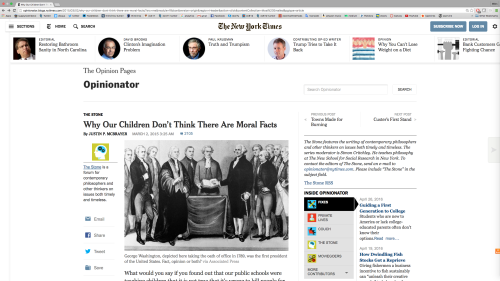
Link to the March 2, 2015 New York Times article “Why Our Children Don’t Think There are Moral Facts” by Justin P. McBrayer

When I was in college, I had many discussions over breakfast, lunch and dinner in Quincy House about whether there was any such thing as truth. My classmates were very quick to take a relativist line, while I argued that there was such a thing as truth. Justin McBrayer, in the article linked above, explains why not only my classmates, but most young adults are so well prepared to take the relativist line. He writes:

When I went to visit my son’s second grade open house, I found a troubling pair of signs hanging over the bulletin board. They read:

Fact: Something that is true about a subject and can be tested or proven.

Opinion: What someone thinks, feels, or believes. …

… students are taught that claims are either facts or opinions. …

Kids are asked to sort facts from opinions and, without fail, every value claim is labeled as an opinion. …

In summary, our public schools teach students that all claims are either facts or opinions and that all value and moral claims fall into the latter camp. The punchline: there are no moral facts. And if there are no moral facts, then there are no moral truths.

Thought of as abstract philosophy, this may not be a very deep position, but it may not seem much worse than many other areas of shallow teaching. But Justin argues that a simplistic belief in moral relativism can have a corrosive effect on moral judgments and even on behavior: 

The inconsistency in this curriculum is obvious. For example, at the outset of the school year, my son brought home a list of student rights and responsibilities. Had he already read the lesson on fact vs. opinion, he might have noted that the supposed rights of other students were based on no more than opinions. According to the school’s curriculum, it certainly wasn’t true that his classmates deserved to be treated a particular way — that would make it a fact. Similarly, it wasn’t really true that he had any responsibilities — that would be to make a value claim a truth. It should not be a surprise that there is rampant cheating on college campuses: If we’ve taught our students for 12 years that there is no fact of the matter as to whether cheating is wrong, we can’t very well blame them for doing so later on.

Indeed, in the world beyond grade school, where adults must exercise their moral knowledge and reasoning to conduct themselves in the society, the stakes are greater. There, consistency demands that we acknowledge the existence of moral facts. If it’s not true that it’s wrong to murder a cartoonist with whom one disagrees, then how can we be outraged? If there are no truths about what is good or valuable or right, how can we prosecute people for crimes against humanity? If it’s not true that all humans are created equal, then why vote for any political system that doesn’t benefit you over others?

The irony is that the urge to separate out facts from opinions or facts from values stems itself from an important value: the value on telling truth according to one’s best judgement of the science, even if telling the truth does not seem likely to move the debate about a political or moral issue in the direction one believes in. This in turn is grounded in the belief that involving many well-intentioned people who have different points of view in the attempt to grind out moral truth in a serious moral debate based on true facts is much more likely to home in on the relevant moral truth than short-circuiting the debate by deception in order to favor one’s own heartfelt views. In moral matters, telling the truth is a sign of respect for other human beings and the value of their views, too.

Mario Draghi Reminds Everyone that Central Banks Do Not Determine the Medium-Run Natural Interest Rate

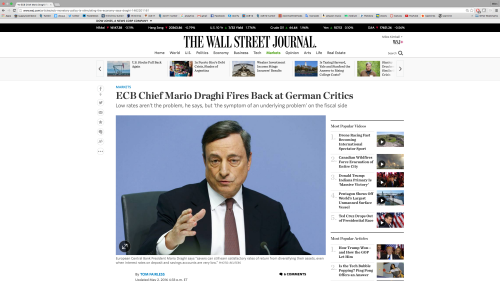
Link to the May 2, 2016 Wall Street Journal article “ECB Chief Mario Draghi Fires Back at German Critics” by Tom Fairless

Many complaints about central bank policy seem to assume that the medium-run natural interest rate is under a central bank’s control. It isn’t. 

In “The Medium-Run Natural Interest Rate and the Short-Run Natural Interest Rate” I define the medium-run natural interest rate as follows:

  • medium-run natural interest rate: the interest rate that would prevail at the existing levels of technology and capital if all stickiness of prices and wages were suddenly swept away. That is, the natural rate of interest rate is the interest rate that would prevail in the real-business cycle model that lies behind a sticky-price, sticky-wage, or sticky-price-and-sticky-wage model.

In the standard view of monetary policy, which is the view that I take, other than keeping the long-run level of inflation low, a central bank’s principle and crucial job is to get the economy as close as possible to the medium-run equilibrium that corresponds to what an economy would do if all prices and wages were perfectly flexible. That is, a central bank’s job is to (1) keep the long-run inflation rate low and (2) do as much as possible to undo the effects of sticky prices and sticky wages on the real variables of the economy. 

By this definition of the medium-run equilibrium, the central bank no control over the real variables in the medium-run equilibrium, other than things such as real money balances in the medium-run equilibrium. And since there is only one level of aggregate demand the gets the economy to the medium-run equilibrium–that is, saying “medium-run equilibrium” already stipulates a level of aggregate demand–the role of real money balances in the medium-run natural equilibrium is quite unexciting.

Using this terminology, hardcore “Real Business Cycle Theory” posits that the economy is always in the medium-run equilibrium, because prices and wages are almost perfectly flexible. But in discussing the nature of the medium-run equilibrium, the question of whether this is true or not is actually immaterial. The medium-run equilibrium is what would happen if the Real Business Cycle Theorists were right, whether they are or not. But the medium-run equilibrium is also close to what would happen if a central bank did a truly excellent job of monetary policy–better than any existing central bank so far, but within the range of possibility.   

If output is below its medium-run equilibrium level, the medium-run natural interest rate is likely to be above the current level of the interest rate. The reason is that businesses and households don’t like to invest when the economy is in a slump. Getting out of the slump tends to raise the interest rate. As I explain in “The Medium-Run Natural Interest Rate and the Short-Run Natural Interest Rate” and “On the Great Recession,” in a slump the path to raising the interest rate up to its higher medium-run equilibrium level is–somewhat paradoxically–through a path of cutting the interest rate in order to bring output up. Once output comes up, the interest rate will come up too. So Anyone who wants a higher interest rate should want the central bank to use a sharp reduction in interest rates for a few quarters in order to bring recovery and a sustainably higher interest rate. To try to go straight to a higher interest rate will push the economy into a worse slump and require lower interest rates to get on track–quite counterproductive from the point of view of those who want higher interest rates. 

Many people don’t understand the limitations of central banks. If they want higher interest rates, they think central banks can go there directly without serious side effects. That doesn’t work. In a slump, central banks need to get to higher interest rates by the proper path of cutting interest rates until the economy recovers; then interest rates can and should be raised. Raising interest rates first is like a sugar high for savers, that will lead to a crash when interest rates then have to be cut to stave off a double-dip recession.    

Just because central banks can’t affect the medium-run natural interest rate that is where things go if they do their jobs doesn’t mean there isn’t any reason to complain about low interest rates. In particular, low medium-run natural interest rates can be a symptom of a low rate of technological progress, which is definitely something to complain about–and something to do something about, by making sure that we fund basic research at a much higher level than we currently do and by making sure we don’t let regulations crush new firms doing new things in promising new ways. 

Less obviously a good thing, increases in government debt can raise the medium-run natural interest rate. And increases in the willingness to take risks can raise the medium-run natural interest rate, which I think is a good thing as long as people are really taking those risks themselves rather than angling to be bailed out by taxpayers. 

Draghi’s Speech

On his recent Asian trip, Mario Draghi, head of the European Central Bank (ECB), defended the ECB from attacks by the powerful argument that a central bank does not control the medium-run natural rate. Here are three key passages from the Wall Street Journal article linked at the top of this post:

1. “There is a temptation to conclude that…very low rates…are the problem,” Mr. Draghi said. “But they are not the problem. They are the symptom of an underlying problem.”

The global savings glut, Mr. Draghi said, is being perpetuated by economies in Asia and in the eurozone, notably Germany. “Our largest economy, Germany, has had a [current account] surplus above 5% of GDP for almost a decade,” Mr. Draghi said. 

2. In unusually blunt criticism last month, German Finance Minister Wolfgang Schäuble called for an end to easy-money policies … suggesting [the ECB’s] low interest rates had hurt savers.

Mr. Draghi directed criticism directly back at Berlin. “Those advocating a lesser role for monetary policy or a shorter period of monetary expansion necessarily imply a larger role for fiscal policy”

3. Mr. Draghi stressed that the ECB’s policies are helping savers, and said governments, not central banks, should address the underlying economic causes of low rates. He also urged savers in Germany to boost their returns by diversifying their investments, mimicking their counterparts across the Atlantic.

“U.S. households allocate about a third of their financial assets to equities, whereas the equivalent figure for French and Italian households is about one- fifth, and for German households only one-tenth,” Mr. Draghi said.

Let me interpret these statements. 1. Mario Draghi effectively says that medium-run international capital flows affect the medium-run natural interest rate. 2. Mario Draghi effectively says that to get the medium-run equilibrium requires closing the output gap either through monetary or fiscal policy. He criticizes German fiscal policy. But the criticism of German fiscal policy is not necessary for the point. The point is just that if fiscal policy doesn’t do it, then monetary policy needs to. As I have pointed out many times, monetary policy is more reliable, simply because it is not tangled up in politics. A sensible approach is to take what fiscal policy one can get politically (after whatever advice one wants to give), then do the rest of the job with monetary policy. 3. Mario Draghi effectively reminds savers that a healthy economy tends to raise interest rates compared to a slump, then makes the interesting point that expected rates of return can be raised by taking on more risk. There is a more subtle point Mario Draghi doesn’t make: if more people raised the expected rate of return on their savings by taking on more risks, then the risk-free rate for those who don’t want to take on those risks is also likely to be higher. The worst thing for savers is if they aren’t eager to take risks and no one else is eager to take risks either. Then everyone tries (unsuccessfully, given limited supply) to crowd into the risk-free assets and lowers their rate of return (or something even worse happens if the central bank doesn’t do its job of keeping the economy as close as possible to the medium-run equilibrium).  

The bottom line is that it is crucial to understand what central banks can and can’t do. Central banks can get the economy close to the medium-run equilibrum, which entails lowering interest rates to raise them (after recovery) and raising interest rates to lower them (after reining in an overheated economy). But central banks cannot determine the interest rate that prevails once they have done their job. To repeat, central banks cannot determine the interest rate that prevails in the medium-run equilibium any more than they can keep output permanently above its medium-run equilibrium. 

As I write in “The Deep Magic of Money and the Deeper Magic of the Supply Side,” the supply side is the place to turn to raise the natural level of output that prevails in the medium-run equilibrium. But those who agree about the supply-side roots of the natural level of output need to also remember that the supply side is the place to turn to raise the natural interest rate that prevails in the medium-run equilibrium. Monetary policy can’t do it. 

Note: The argument of this post is important in the later post “Why Financial Stability Concerns Are Not a Reason to Shy Away from a Robust Negative Interest Rate Policy.” In that later post, you may find the update at the end, “Long-Run” vs. “Long-Term” helpful.

Is the Swiss National Bank Ready to Limit Convertibility of Electronic Money to Paper Currency?

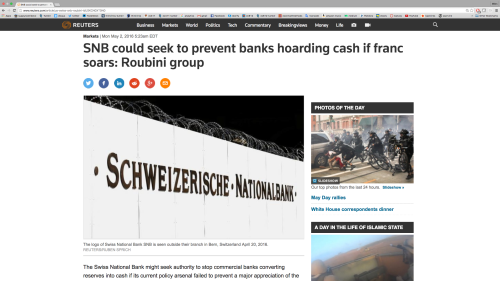
Link to May 2, 2016 Reuters article “SNB could seek to prevent banks hoarding cash if franc soars: Roubini group.”Thanks to Makoto Shimizu for pointing me to this article.

Yesterday, Reuters reported

The Swiss National Bank might seek authority to stop commercial banks converting reserves into cash if its current policy arsenal failed to prevent a major appreciation of the franc, economist Nouriel Roubini’s research group said [in a] report published by the group on Monday after a meeting with SNB officials …

One option would be to prevent banks from switching reserves into cash. That would require a new law, but the Roubini Global Economics report said SNB officials “were confident that the legislation could be changed …to give the bank this authority”.

I find this intriguing because the heart of my proposal to eliminate the zero lower bound is to generate a negative paper currency interest rate when necessary by having the exchange rate giving the value of paper currency relative to electronic money that applies at the cash window of the central bank gradually depreciate over time. So any change in the ability of private banks to exchange reserves for paper currency or paper currency for reserves at the cash window of the central bank is of great importance as a precedent. 

The most natural reading of the Reuters description is that banks would no longer be able to convert electronic reserves into paper currency. That is equivalent to making the “ask” price for paper currency at the cash window of the central bank prohibitively high. In all likelihood, forcing private entities to get paper Swiss francs (with a face interest rate of zero) from each other rather than the central bank would make the market value of paper Swiss francs in a negative rate environment rise above par. 

On problem with a policy that makes the value of paper currency go above par is that anticipation of this policy could lead to the very hoarding of paper currency that the actual institution of the policy is meant to inhibit. By contrast, my proposal of having the value of paper currency start at par and then gradually depreciate below par (both bid and ask prices for paper currency gradually going down) works fine, without any such side effects, even if fully anticipated. It is also less disruptive than making paper currency scarce. 

One thing I have not emphasized enough about my proposal is that it can be seen as flooding the market with paper currency more and more over time, and thereby making the rate of return on paper currency lower. Thus, it is the opposite of a policy of trying to make paper currency scarce. My recommended policy would make paper currency abundant, but give it a low rate of return because of its gradually increasing abundance. There is a sense in which this is like a helicopter drop of paper currency to those who hold electronic money without any helicopter drop of electronic money. So as long as electronic money provides the unit of account, this helicopter drop creates the good “inflation”–inflation relative to paper currency–without creating any of the  bad inflation–inflation relative to the unit of account, which in this case is the electronic Swiss franc. This careful targeting of having higher “inflation” where needed to eliminate the danger of people pulling money out of banks and shifting into paper currency without all the disruption of true inflation (relative to the unit of account) is a great virtue of going off the paper standard.  

I have some hopes that Reuters, and perhaps the Roubini group, have misunderstood what the Swiss National Bank intends–and that they, in fact, intend to move in the direction of what I have proposed. Indeed, I have a genuine hope that the staff at the Swiss National Bank has studied carefully the things I have written about eliminating the zero lower bound that are collected in “How and Why to Eliminate the Zero Lower Bound: A Reader’s Guide.” And I am hoping to arrange a second visit (my first was on July 15, 2014) to the Swiss National Bank sometime in Fall 2016 to discuss different approaches to eliminating the zero lower bound.  

Beyond Pro-Government and Anti-Government

In countries that manage to escape worse problems (such as serious ethnic divisions) and even in many that do have worse problems, the main political parties are often arrayed on a spectrum from lower-tax, lower-spending, less government regulation parties to higher-tax, higher-spending, more government regulation parties. In these countries, the unending struggle about long-run fiscal policy tends to interfere with short-run fiscal stabilization as well–one reason monetary policy unconstrained by a zero lower bound is so valuable. But the unending struggle between those for bigger vs. those for smaller government also often gets in the way of sound policy that would have the government act when it should and leave people alone when it should. Distinguishing when the government should act and when it should leave people alone is the central theme of John Stuart Mill’s On Liberty. In the 8th paragraph of the “Introductory” to On Liberty, he writes:

In England, from the peculiar circumstances of our political history, though the yoke of opinion is perhaps heavier, that of law is lighter, than in most other countries of Europe; and there is considerable jealousy of direct interference, by the legislative or the executive power, with private conduct; not so much from any just regard for the independence of the individual, as from the still subsisting habit of looking on the government as representing an opposite interest to the public. The majority have not yet learnt to feel the power of the government their power, or its opinions their opinions. When they do so, individual liberty will probably be as much exposed to invasion from the government, as it already is from public opinion. But, as yet, there is a considerable amount of feeling ready to be called forth against any attempt of the law to control individuals in things in which they have not hitherto been accustomed to be controlled by it; and this with very little discrimination as to whether the matter is, or is not, within the legitimate sphere of legal control; insomuch that the feeling, highly salutary on the whole, is perhaps quite as often misplaced as well grounded in the particular instances of its application. There is, in fact, no recognised principle by which the propriety or impropriety of government interference is customarily tested. People decide according to their personal preferences. Some, whenever they see any good to be done, or evil to be remedied, would willingly instigate the government to undertake the business; while others prefer to bear almost any amount of social evil, rather than add one to the departments of human interests amenable to governmental control. And men range themselves on one or the other side in any particular case, according to this general direction of their sentiments; or according to the degree of interest which they feel in the particular thing which it is proposed that the government should do, or according to the belief they entertain that the government would, or would not, do it in the manner they prefer; but very rarely on account of any opinion to which they consistently adhere, as to what things are fit to be done by a government. And it seems to me that in consequence of this absence of rule or principle, one side is at present as often wrong as the other; the interference of government is, with about equal frequency, improperly invoked and improperly condemned.

As examples of where it can sometimes be hard for people to distinguish appropriate government action form inappropriate action there are many very different types of rules that go under the heading of “government regulation,” some good, some bad. Part of what is called government regulation–such as high equity requirements for banks–is a matter of clearly delineating property rights. Other regulations simply spell out what terminology should be used so that people are not deceived by others they are selling to or buying from. Other government regulations are inappropriate meddling. And yet other regulations are even worse: they are government-enforced restraints on trade that boost profits at the expense of people getting what they want and need from robust competition. Here local governments are often the worst offenders. On this, see “John Stuart Mill: The Central Government Should Be Slow to Overrule, but Quick to Denounce Bad Actions of Local Governments.” 

Scott Adams on Donald Trump's Powers of Persuasion

Even those who hate what Donald Trump stands for–or doesn’t stand for–should study and understand his techniques. (Of course, any decision to actually use his techniques should be subjected to very careful ethical deliberation.) ‘Dilbert’ creator Scott Adams is a longtime student in the powers of persuasion, and he believes Trump has been 'pitch-perfect’ so far in deploying those powers. 

David Pagnucco: The Eurozone and the Impossible Trinity

Link to David Pagnucco’s Linked In homepage

I am pleased to host another student guest post, this time by David Pagnucco. This is the 13th student guest post this semester, rounding out the semester. You can see all the student guest posts from my “Monetary and Financial Theory” class at this link.


European Union countries considering to join the Eurozone must evaluate the major risk of forgoing their sovereign monetary policy before adopting the euro.

Joining the Eurozone poses numerous risks and benefits for European Union countries outside the zone. In Rick Lyman’s article, leaders from non-Eurozone countries evaluate the risks they face in joining the Eurozone. Some of the major recent factors countries are assessing include political attitudes, the Greek crisis, and domestic fiscal set backs. In order to weigh these risks and benefits, the impossible trinity can be used to describe them. The impossible trinity illustrates that a nation cannot have free capital flows, a sovereign monetary policy, and a fixed exchange rate at the same time. They must choose a position and sacrifice one of the policies.

For example, Eurozone members are at position a in which their single currency allows them to have free capital flows and a fixed exchange rate. On the other hand, European Union members not in the Eurozone are at position b, in which their differing domestic currencies allow them to have free capital flows and a sovereign monetary policy. One of the main goals in creating the European Union was to create a single unified market with free capital flows, and all European Union members share this aspect. However, with the creation of the euro, Eurozone members lose control of their domestic monetary policies. This is the greatest risk facing non-Eurozone members, as they no longer can change their money supply to stimulate or slow down their economies’ growth according to their own preferences.

The European Central Bank creates the central monetary policy for Eurozone members, and a governing council member, Philip Lane, stated that the ECB will continue to increase its government bond purchases. This will ultimately increase the supply of the euro and decrease interest rates, resulting in lower borrowing costs for households and firms that will help stimulate the economy. If the ECB sets the monetary policy for all Eurozone members, what happens if a country within the Eurozone does not want the ECB’s particular policy? This is a major dilemma for countries considering to join the Eurozone. Countries outside the Eurozone may have differing preferences on interest rates, inflation, and unemployment than the ECB’s established policy. For example, consider if Poland were to adopt the euro. If the ECB is using the expansionary monetary policy described by Philip Lane, Poland will be required to partake in it. If Poland does not want this policy, they will ultimately need to counter the ECB’s policy in a more complex way such as increasing taxes to deter economic growth.

Non-Eurozone countries, besides Britain, must adopt the euro at some point in the future, and the timing of the decision is critical because these countries’ economies must be stable and have basic economic convergence to have a successful change over to the euro. They need convergence in areas such as debt levels, GDP, and unemployment to ensure that the ECB’s policies are effective. Overall, the decision to switch to the euro is a major change, and new members must be sure their economies are ready for the switch.

Andrew Cuatto: Deus Ex Helicopter—Not

Link to Andrew Cuatto’s Linked In homepage

I am pleased to host another student guest post, this time by Andrew Cuatto. This is the 12th student guest post this semester. You can see all the student guest posts from my “Monetary and Financial Theory” class at this link.


Greg Ip is overstating the effectiveness of helicopter money as a tool for jump-starting the economy.

With world economies still sluggish, more and more people are claiming that central banks are out of ammo in their fight against recessions. This has lead to an increase in calls for adopting less conventional monetary policy; something the Fed did when it used quantitative easing in response to the Great Recession. In a recent article in the Wall Street Journal Greg Ip explains how one of these policies, helicopter money, could be a viable solution for countries struggling with slow growth and looming deflation. However, Mr. Ip completely ignores the presence of the zero lower bound and overstates the effectiveness of helicopter money as a practical tool for jump-starting an economy.

Renowned economist Milton Friedman first coined the term “helicopter money” and simply put, it is a way of giving money directly to citizens. It works by the government issuing bonds to the central bank, which buy them using newly printed money. The central bank then promises never to sell the bonds or withdraw the newly created money from circulation. The government gives that money to its citizens and the central bank returns the interest earned on the bonds to the government.

As Miles clarified in “Helicopter Drops of Money Are Not the Answer,”

Printing money and sending it to people is equivalent to printing money to buy Treasury bills and then selling those Treasury bills to raise funds to send to people. Written as an equation:
printing money and sending it to people =
printing money to buy Treasury bills
+ selling Treasury bills to get funds that are sent to people
Here is the same equation, with the usual policy names attached:
helicopter drop = standard open market operation + tax rebate

Understanding helicopter money as a tax rebate financed by a standard open market operation makes it easier to see the limitations of this tool. Near the effective lower bound–the interest rate at which paper currency is a very close substitute for Treasury bills, even after accounting for storage costs , standard open market operations are not effective because they cannot push the interest rate any lower to stimulate spending. This means that a helicopter drop is now essentially just a tax rebate, and while tax rebates do impart some stimulus they are not nearly as effective as desired because not everyone spends the windfall.

As explained by a 2009 survey done by UM’s Matthew Shapiro:

Only one-fifth of respondents to a rider on the University of Michigan Survey Research Center’s Monthly Survey said that the 2008 tax rebates would lead them to mostly increase spending. Almost half said the rebate would mostly lead them to pay off debt, while about a third saying it would lead them mostly to save more. The survey responses imply that the aggregate propensity to spend from the rebate was about one-third, and that there would not be substantially more spending as a lagged effect of the rebates. Because of the low spending propensity, the rebates in 2008 provided low “bang for the buck” as economic stimulus.

What’s troubling is that despite the limitations of helicopter money, limitations that even Mr. Ip acknowledges, it seems to be gaining traction as a potential policy. European Central Bank chief Mario Draghi has said

… helicopter money is an interesting idea currently being explored by various economists. While this is certainly not an endorsement, he is not dismissing the possibility of helicopter money due to the perception that their latest attempt, negative interest rates, is already failing.

Rather than explore this radical and less efficient option, the ECB should work to strengthen their negative interest rate policy by, as our Miles suggests, establishing the electronic euro as the unit of account and introducing an exchange rate between paper and electronic currency. That way the negative rates can affect paper money as well and there will be no place to hide from the negative interest rates other than through physical investment or abroad–which would increase net capital outflows and in turn increase aggregate demand as desired.

Luckily there seems to be some growing consensus that negative interest rates can be a very powerful and effective instrument for monetary stimulus. Just last week International Monetary Fund Chief Christine Lagrande said that while we should closely monitor the potential side effects of negative interest rates these subzero rates are in fact a net positive for the global economy. This means that with negative rates it is possible to have an overall boost in world aggregate consumption as opposed to the very small bump given by helicopter drops.  

In theory, helicopter money would work, but it is not the most efficient option central banks have for battling recessions. Once people realize that powerful tools necessary to stabilize the economy are there, in the form of negative interest rates, helicopter drops will no longer get so much attention.  

Suparit Suwanik: Hope for a Phase-out of the 500 Euro Note

Link to Suparit Suwanik’s blog “Through the Eyes of a Central Banker”

I am pleased to host another student guest post, this time by Suparit Suwanik. This is the 11th student guest post this semester. You can see all the student guest posts from my “Monetary and Financial Theory” class at this link. This is Suparit’s second guest post. Don’t miss “Suparit Suwanik: Putting Paper Currency In Its Proper Place.”


With the world still suffering from the economic slowdown, it is good to see many major central banks, including the European Central Bank, implementing negative interest rates. This creates wide speculations on change in related policy, that is, paper currency. The change in cash policy is a necessary condition to release the power of negative interest rates. From what I wrote in “Putting Paper Currency In Its Proper Place”, stating that from Mario Draghi to Larry Summers, they were planning to get rid of the large notes, for example, €500 notes and $100 bills, until today, here is another development: the German central bank, the Bundesbank, supports a gradual phaseout of the €500 bank note!

Bundesbank President Jens Weidmann once said “the current discussion over [the €500 note] must be kept clearly separate from this monetary policy-motivated discussion on the abolition of cash.” However, in my humble opinion, this is a big step closer to cashless society in the Eurozone. And here are the reasons:

First, it is the Bundesbank, the most influential central bank in the Eurozone, which is normally perceived as very conservative. Its president remains a key player in crafting Eurozone monetary policy at the ECB. If the idea is supported by the Bundesbank, the rest of the central banks in the Eurozone are likely to follow.

Second, it is Germany, where cash payments remain very common and people place a high premium on individual privacy. According to a recent Bundesbank study, 79% of payments in Germany are made in cash – compared with only 48% in Britain. Even among 14- to 24-year-olds, two-thirds say they prefer paying in cash to electronic means. Of course, resistance is expected to be fierce against any change in paper currency. But the resistance will be much lighter if the change is at a gradual, yet steady, pace. In order to unleash the powerful effect of negative interest rates, it is the right time to start changing the policy.

Finally, it remains in doubt whether terrorists or criminals can really be stopped because large notes are eliminated, though it is claimed that the change in paper currency policy will be significant help in hindering money laundering and organized crime. In general, the criminal world tends to use small notes to avoid suspicion from authorities. Though I’m a supporter of negative interest rates, I agree with a German professor, Max Otte, who is strongly against the change in cash policy, that the elimination of the €500 note is becoming ever more likely and constitutes the start of the elimination of cash.

All in all, the sooner the change in cash policy is in effect, the better the economic effect of negative interest rates which the ECB is really hoping for. May the transition to electronic money society be smooth and glorious for the Eurozone!

Responding to Joseph Stiglitz on Negative Interest Rates

Link to the Wikipedia article for Joseph Stiglitz

I thought twice before I tweeted on Monday “Joe Stiglitz is making a fool of himself with his arguments against negative rates” in reaction to his April 13, 2016 Project Syndicate piece “What’s Wrong With Negative Rates?” wondering if I was being too hard on him. But then I thought to myself “I have no problem saying that I make a fool of myself with some regularity.” In particular, I often make of a fool of myself by venturing an opinion in order to see if someone can help me learn if I am wrong, and if so, why. I hope that Joe Stiglitz made a fool of himself in exactly that spirit–in which case I honor him for that.  

What Joe says is complex, so it is best to proceed point by point, even if that occasions some repetition. And it helps in separating the wheat from the chaff; Joe says some things that are correct, even though his bottom line is off target–in particular his final paragraph:

Of course, even in the best of circumstances, monetary policy’s ability to restore a slumping economy to full employment may be limited. But relying on the wrong model prevents central bankers from contributing what they can – and may even make a bad situation worse.

This final paragraph is quite wrong: 

  1. After eliminating the zero lower bound by freeing up the paper currency interest rate from its traditional value of zero, monetary policy alone has more than enough power to return an economy to the natural level of output. 
  2. The insights from standard models should not be dismissed so quickly.
  3. To the extent that central bankers are making a mistake, it is not by going to negative interest rates, but by keeping the paper currency interest rate at zero, with all the attendant strains that causes. 

In what follows, all block quotes that follow will be Joe Stiglitz’s words. 

1. An Aggregate Demand Problem

The underlying problem – which has plagued the global economy since the crisis, but has worsened slightly – is lack of global aggregate demand.

Correct. Lack of aggregate demand is hardly the only problem of the world economy (a slower rate of technological progress than from 1995-2003 may be a bigger problem), but it is a big and pressing problem. 

2. The Zero Lower Bound

Now, in response, the European Central Bank (ECB) has stepped up its stimulus, joining the Bank of Japan and a couple of other central banks in showing that the “zero lower bound” – the inability of interest rates to become negative – is a boundary only in the imagination of conventional economists.

Although the lower bound may not be at zero, a lot of the stresses and strains that are being felt from negative interest rate policy have to do with the fact that the paper currency interest rate has not yet been cut below zero to match target rates and interest rates on reserves. If the paper currency interest rates gets too far above the interest rate on reserves and the target rate, it is hard for banks to make a living on spreads in the way they are used to. In particular, it is hard for banks to lower the interest rates on checking accounts and saving accounts very far below zero without having small-scale depositors significantly raise their paper currency holdings and reduce the funds they hold in checking and savings accounts. The solution is simple: lower the paper currency interest rate, as I discuss in “If a Central Bank Cuts All of Its Interest Rates, Including the Paper Currency Interest Rate, Negative Interest Rates are a Much Fiercer Animal” and lay out in detail in two academic papers and many columns and blog posts I have collected links for in “How and Why to Eliminate the Zero Lower Bound: A Reader’s Guide.”

The so-called “zero lower bound,” should be thought of as a more complex danger of massive paper currency storage and of disintermediation away from the banking system into paper currency that begins to occur when the paper currency interest rate is kept too far above the target rate and the interest rate on reserves. This danger may or may not be well described by the phrase “the zero lower bound,” but it is not a myth. Much of what Joe says in his essay is pointing out that the danger of disintermediation is not a myth. Hence the importance of lowering the paper currency interest rate along with the target rate and the interest rate on reserves. 

3. Why Negative Rates Have Not Brought Full Recovery

Joe writes

And yet, in none of the economies attempting the unorthodox experiment of negative interest rates has there been a return to growth and full employment.

He has a sentence that should have followed immediately, but is several paragraphs further down:

Clearly, the idea that large corporations precisely calculate the interest rate at which they are willing to undertake investment – and that they would be willing to undertake a large number of projects if only interest rates were lowered by another 25 basis points – is absurd.

In other words, the 30 basis point cut in interest rates that the European Central Bank has made is a tiny dosage of negative rates. The effectiveness of negative interest rates has to be judged per basis point. When unhindered by a perceived zero lower bound, it is normal for a central bank in a recessionary situation to cut interest rates by 600 to 700 basis points (that is 6 or 7 percentage points). That is the kind of dosage that can be expected to get results. And go the extent that risk premia rose more during the Financial Crisis than during a normal recession, safe rates need to go enough lower to compensate for those higher risk premia. 

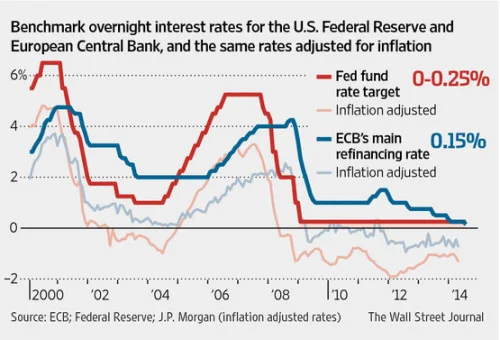
As can be seen from the graph above, the European Central Bank’s target rate was at about 4% in nominal terms at the onset of the Financial crisis. A 7 percentage point point cut would have taken the rate to -3%, which would have done a fairly good job. But a bit lower was probably appropriate given elevated risk premia. -4% in 2009 would have been an excellent policy, well within historical norms for an interest rate cut in a serious recession if one treats interest rates in the negative region on a par with interest rates in the positive region–as makes sense if one is taking the paper currency interest rate down along with other rates, so that spread between the paper currency interest rate and the target rate as small. Thinking of the norm as a 6 percentage point cut but the elevation of risk premia in this episode as 2% would have lead to the same recommendation of a -4% interest rate in 2009. But of course, after going to -4%, the European Central Bank should then have paid attention to the data about whether that was enough or not, and gone down further if need be, less if -4% was too stimulative.  

Note that even without the adjustment for elevated risk premia, the rule of thumb of a 6 percentage point cut to deal with recessions leads to a real interest rate below -2% during the trough if the real interest rate starts out below 4%. For a variety of reasons detailed in Lukasz Rachel and Thomas Smith’s excellent Bank of England blog post “Drivers of long-term global interest rates – can changes in desired savings and investment explain the fall?” the real medium-run natural rate of interest has been falling over the past few decades. So a 6 percentage point cut in interest rates in a recession needs to go down to lower real interest rate than before. For example, it is not at all unreasonable to think that the real medium-run natural rate of interest rate is hovering around .5%, which means that a real interest rate of -5.5% in the trough is appropriate medicine to bring economic recovery. 

Joe says correctly that -2% real interest rates haven’t done the trick:

In many economies – including Europe and the United States – real (inflation-adjusted) interest rates have been negative, sometimes as much as -2%. And yet, as real interest rates have fallen, business investment has stagnated.

Joe is also likely correct that a real interest rate of -3.5% or -4% would not be enough:

A decrease in the real interest rate – that on government bonds – to -3% or even -4% will make little or no difference.

But it is quite wrong to think that if nominal interest rate of -2%, which makes for a real interest rate of -4% at 2% inflation won’t do the trick that one should give up on negative interest rates. If one lowers the paper currency interest rate along with other rates, it is quite possible to have nominal interest rates at -4%, -5%, -6% or even -7% or lower if necessary. And that is the range standard rules of thumb suggest would be necessary–with the lower numbers in that range only necessary if there are unusual problems with the economy–which there might be. 

In “Even Central Bankers Need Lessons on the Transmission Mechanism for Negative Interest Rates” I wrote: “If starting from current conditions, any country can maintain interest rates at -7% or lower for two years without overheating its economy, then I am wrong about the power of negative interest rates.” Despite all the uncertainties about what is going on with key economies in the world, I stand by that statement–with the exception of a non-market economy such as North Korea where there is no true market interest rate. 

4. Will Negative Rates Make Lending Rates Increase?

Joe writes:

In some cases, the outcome has been unexpected: Some lending rates have actually increased.

The reason for raising lending rates in the wake of negative rates on reserves is presumably to increase profits for a bank that has had profits reduced by the negative interest rate on reserves. But the interest a bank earns on its lending to firms and households is enough separate from what it earns on what it lends to the central bank as reserves that if the bank can increase profits by raising its lending rates, it could probably have done that all along. The connection with negative deposit rates would then be that banks might hope governmental authorities will take pity on them, or be concerned enough about their balance sheets because of the negative rates they are paying on reserves that the governmental authorities give the banks less of a hard time about oligopolistically raising lending rates in the negative rate situation than they normally would. But this then boils down to a governmental concern about bank profits and bank balance sheets, which can be addressed in more direct and more productive ways than by allowing banks to exert more oligopoly power. 

5. How to Deal with Worries about the Effects of Negative Interest Rates on Bank Balance Sheets

Joe exhibits concern about the effects of negative rates on bank balance sheets in this passage:

Negative interest rates hurt banks’ balance sheets, with the “wealth effect” on banks overwhelming the small increase in incentives to lend. Unless policymakers are careful, lending rates could increase and credit availability decline.

Since banks live on spreads, the most basic way to avoid hurting bank profits and therefore bank balance sheets is to keep spreads normal. Quantitative easing tends to squeeze key spreads and so departs from that approach. And leaving the paper currency interest rate at zero while cutting the target rate and the interest rate on reserves also departs from that approach. The way to keep things as normal as possible for banks is to lower all government-controlled interest rates in tandem. In its latest move, the European Central Bank at least lowered its lending rates along with the interest rates on reserves. That was intended to be helpful to bank profits, and it is hard to doubt that it is. 

Even if the paper currency interest rate is negative, banks may have trouble explaining to small-scale, unsophisticated depositors why they need to have a negative interest rate on deposits. If banks therefore continue to give zero rates to small-scale, unsophisticated depositors, this is likely to hurt profits in a negative interest rate environment. But for the political acceptability of negative rates, it is in the interest of most central banks to support banks in continuing to give zero interest rates to small-scale, unsophisticated depositors. In “How to Handle Worries about the Effect of Negative Interest Rates on Bank Profits with Two-Tiered Interest-on-Reserves Policies,” I propose that central banks use tiers in the interest on reserves formula to effectively subsidize and incentivize banks in providing a zero interest rate to the first 1000 euros or so of average monthly balances per adult. (I discuss there how some kind of depositor identification is needed in order to avoid double-dipping.) At some cost to the seignorage that a central bank would otherwise gain from negative rates, this helps banks and shields most people (though only a small fraction of funds) from negative deposit rates. 

Of course, if banks were adequately capitalized to begin with, or otherwise have robust profits (perhaps because of very strong oligopoly power, as in Sweden), there may be no need to throw money to banks to help their balance sheets, which reduces but does not eliminate the benefits of subsidizing the provision of zero interest rates to small accounts. 

6. Can Negative Interest Rates Stimulate the Economy When Banks are Broken?

Joe has a passage talking generally about failed models that is a bit hard to interpret, but I think it has to do with his view that banks are central to understanding how the macroeconomy works. 

It should have been apparent that most central banks’ pre-crisis models – both the formal models and the mental models that guide policymakers’ thinking – were badly wrong. None predicted the crisis; and in very few of these economies has a semblance of full employment been restored. The ECB famously raised interest rates twice in 2011, just as the euro crisis was worsening and unemployment was increasing to double-digit levels, bringing deflation ever closer.

They continued to use the old discredited models, perhaps slightly modified. In these models, the interest rate is the key policy tool, to be dialed up and down to ensure good economic performance. If a positive interest rate doesn’t suffice, then a negative interest rate should do the trick.

The evidence for that interpretation comes in this subsequent passage:

It may come as a shock to non-economists, but banks play no role in the standard economic model that monetary policymakers have used for the last couple of decades. Of course, if there were no banks, there would be no central banks, either; but cognitive dissonance has seldom shaken central bankers’ confidence in their models.

I discussed above how to address concerns about bank balance sheets. I also discussed how to deal with increased risk premia: cut the safe rate enough further to compensate for the higher risk premia–that is, to lean towards–in effect–targeting the risky rates that firms and households borrow at rather than the safe rates that a government with reasonable finances can borrow at. This works well even if the negative rates themselves have some effect on the relevant risk premia, since risk premia will not be infinite. (And indeed, the models of credit rationing to which Joe contributed with his academic work say that while a higher loan interest rate may not result in more lending because it can be associated with lower loan quality, a low enough cost of funds for the bank will reduce the amount of rationing.) 

In “On the Need for Large Movements in Interest Rates to Stabilize the Economy with Monetary Policy,” I argue: 

Businesses and banks sitting on idle piles of liquid assets is a telltale symptom of the zero lower bound. Breaking through the zero lower bound restores the functioning of banks. Given negative interest rates those piles of liquid assets (after perhaps earning an initial capital gain), face a low rate of return going forward if they are left in that form. So the banks have to do something. They might simply get involved in financing storage, perhaps through a wholly-owned subsidiary if they didn’t trust anyone else with those funds. And as noted above, storage of long-lived goods alone can bring recovery. But chances are the banks would begin thinking about making loans for regular forms of investment. And the subset of businesses that have their own piles of liquid assets would also begin thinking about using their own money to invest. 

That is, banks look broken when their cost of funds has not been reduced enough to make the cost of funds plus an appropriate risk premium lower than the rates at which there is loan demand. 

Also, while banks are important, they are far from the whole story. Note for example that when firms are sitting on large piles of safe assets, as many have been during the Great Depression, they can invest without a bank being involved at all. They don’t because the risk-adjusted return on projects looks lower to them than the zero or slightly below zero nominal rate they can earn on safe assets. Does Joe Stiglitz really believe that there is a shortage of projects that would look good compared to a safe return of -7% in nominal terms–or -9% in real terms at 2% inflation? In all likelihood there are many projects with a much better return than that, so that going as low as -7% rates would be unnecessary to get strong economic recovery.  

In “Even Central Bankers Need Lessons on the Transmission Mechanism for Negative Interest Rates,” I put the importance of banks in perspective by pointing out that every type of borrower/lender relationship in which the market interest rate declines creates extra stimulus. Banks are parties to many borrower/lender relationships, but far from all. I recommend the detailed treatment in “Even Central Bankers Need Lessons on the Transmission Mechanism for Negative Interest Rates” to those who still think it is all about banks. 

I don’t mean to say banks aren’t important. They are. They just aren’t the whole story. And low enough interest rates can stimulate the economy even if the channels involving banks in their canonical role as lenders to small businesses is obstructed. As I wrote in “On the Need for Large Movements in Interest Rates to Stabilize the Economy with Monetary Policy”: “At the end of the day, low enough interest rates will bring recovery one way or another. If risk premia remained high enough, recovery could come through unusual channels, but it would come.”

7. Wealth Effects

I discussed how to deal with wealth effects on banks themselves above. Joe mentions wealth effects in one other context, writing: 

… older people who depend on interest income, hurt further, cut their consumption more deeply than those who benefit – rich owners of equity – increase theirs, undermining aggregate demand today.

My post “Even Central Bankers Need Lessons on the Transmission Mechanism for Negative Interest Rates” enunciates a key principle about wealth effects: because there are two parties to every borrower-lender relationship, what is a negative wealth effect to one party is a positive wealth effect to the other. And on the whole, borrowers–who tend to get a wealth effect boost from lower rates–are better spenders than lenders. So if all the wealth effects are accounted for rather than cherry-picking a wealth effect here or there, they will be in the direction of greater stimulus from lower rates. Here is the overall story about transmission mechanisms for lower rates, in the negative region as well as the positive region: In any nook or cranny of the economy where interest rates fall, whether in the positive or negative region, those lower interest rates create more aggregate demand by a substitution effect on both the borrower and lender, while other than any expansion of the economy overall, wealth effects that can be large for individual economic actors largely cancel out in the aggregate.

Regardless of how cherry-picked, it is interesting to think whether the borrow-lender relationship of senior citizens lending to big firms and their owners is an exception to the general rule that borrowers tend to be better at spending than lenders–that is that borrowers generally tend to have a higher marginal propensity to consume. It depends on whether the operating arms of the firm pay attention to lower interest rates by lowering the hurdle rate for projects. It is an important question whether firms adjust hurdle rates for investment projects when market interest rates fall, or if only the Chief Financial Officer pays attention to lower market rates (for the sake of purely financial transactions to raise the value of the firm even if the physical things the firm does are held constant). 

But to address the cherry-picking, think of senior citizens who lend instead to the federal government. Lower interest rates reduce the deficit and tend to lead to more government spending fairly directly by deficit reduction rules biting less. Even though senior citizens have a high marginal propensity to consume, I think the effects of deficit numbers on government behavior make the effective marginal propensity to consume of the federal government out of a change in interest expense even higher. Those who like the idea of fiscal stimulus should be happy about this stimulus from negative interest rates–especially since the negative wealth effect is only for the relatively well-off senior citizens who are not just living on social security, but have interest income to live on on top of that.

Also, to point out another aspect of the cherry-picking (even keeping the picked cherry of “senior citizens”), think of senior citizens who are lending to companies, but hold relatively long-term bonds. If many of the bonds have roughly the same maturity as the remaining life-span of a senior citizen, the wealth effects are much reduced since the coupons are locked in. It is senior citizens who have short-term holdings that a good financial planner would warn them against who have trouble with the wealth effects from lower interest rates.

Finally, I question the idea that those near the end of their lives would have such a high consumption response to interest rates, even if they were constrained to hold only T-bills. The reason is that as the end of life approaches, the principal of the debt instruments one holds matters more and more relative to the interest. The last time I refinanced, I got a 10-year mortgage. With that short a mortgage, the need to pay off principal in such a short time means that the monthly payment was not that sensitive to the interest rate. Similarly, with, say, only 10 years left to live, the amount one can afford to take from one’s savings to spend is not that sensitive to the interest rate. One might say that uncertainty makes people act as if they had longer to live than they actually do, but that would have a big effect in reducing the marginal propensity to consume out of wealth that would tend to counterbalance any increased wealth-equivalent impact of a change in interest rates. 

8. Reaching for Yield

Joe worries about the effects of lower interest rates on financial stability:

the perhaps irrational but widely documented search for yield implies that many investors will shift their portfolios toward riskier assets, exposing the economy to greater financial instability.

I owe all my readers a post with the diagram I gave my students on this, but here is its idea: lower rates boost aggregate demand a lot, reduce financial stability only a little; higher equity (capital) requirements boost financial stability a lot, reduce aggregate demand only a little. Combine the two policies: lower rates and higher equity requirements, and you get an increase in both aggregate demand and financial stability–exactly what is needed. Scale that policy up, and you can get as big an increase in both aggregate demand and a quite large increase in financial stability at the same time. These are two great policies that go well together. 

Update: the May 10, 2016 post “Why Financial Stability Concerns Are Not a Reason to Shy Away from a Robust Negative Interest Rate Policy” is the promised post.

9. The Capital/Labor Ratio

Joe makes this interesting argument:

…low interest rates encourage firms to invest in more capital-intensive technologies, resulting in demand for labor falling in the longer term, even as unemployment declines in the short term.

The most basic response is that if monetary policy does its job–getting output back to the natural level–it has no further effect on long-run issues such as this. Indeed, monetary policy has no effect on the medium-run natural interest rate. So if low interest rates in the medium- to long-run are a problem, they are not the province of monetary policy. (Update: See “Mario Draghi Reminds Everyone that Central Banks Do Not Determine the Medium-Run Natural Interest Rate.”)

In this area that is not the province of monetary policy, I think there is more reason to worry about people’s ability to save for retirement in a lower interest rate environment than labor demand in a low interest rate environment. In standard models in which capital and labor are homothetic with only one type of labor, for a given technology, a higher capital/labor ratio raises medium-run labor demand. To the extent that different production methods can be thought of as all part of the same technology, the ability to switch between production methods reduces this positive effect of the capital/labor ratio on labor demand, but does not eliminate it. What is true is that in models with more than one type of labor, capital might raise the demand for some types of labor and reduce the demand for other types. It may be that the types of labor for which demand increases are much better paid than the types of labor for which demand decreases, and that the number of workers demanded goes down as demand shifts toward a few high-quality workers instead of many lower-quality workers. But the amount of this that happens as a result of interest rates is probably small compared to the amount that happens as a result of technological progress and from globalization. And to repeat, monetary policy cannot do much to either bring on or stop such trends since monetary policy has no effect on interest rates once it has done its job of getting the economy back to the natural level of output.  

All of that is in the medium- to long-run. You might say “What about the short-run?” Well, the short run is the province of monetary policy, and negative interest rates are–in cases that look increasingly important–a way to get enough aggregate demand to keep labor demand at a level appropriate to any medium- to long-run situation, so that the short run is not messed up.  


Note: Those interested in the share of capital income might be interested in “The Wrong Side of Cobb-Douglas: Matt Rognlie’s Smackdown of Thomas Piketty Gains Traction.”

As noted above, my bibliographic post “How and Why to Eliminate the Zero Lower Bound: A Reader’s Guide” organizes links to everything I have written about negative interest rate policy.