Julian Smith: Why Tech Companies Don’t Want to Go Public

tumblr_inline_nz67ectuwk1r57lmx_400.png

Link to Julian Smith’s LinkedIn profile

I am pleased to host another student guest post, this time by Julian Smith. This is the 23d student guest post this semester. You can see all the student guest posts from my “Monetary and Financial Theory” class at this link.

Following the text of what Julian wrote initially is a lightly edited version of my Q&A with him. Julian and I think you will find that discussion interesting. 


The tech companies’ startup blueprint for years was to build their business through valuation rounds with venture capital firms before going public and generating profits for shareholders. At the start of the tech boom there were very few “unicorns,” privately held firms with valuations over a billion dollars. Now, the ground appears to be shifting. Tech firms are no longer chasing profits for a potential initial public offering. The firms seem to fear of entering the stock market by many tech firms that are not longer looking for IPO.

The fear of the stock market and lure of private buyers caused a huge spike in the number of unicorns in the tech industry. These companies have not had a lot of success going public according to the Economist article “The rise and fall of the unicorns.” The article lists Square and Etsy as examples of such failures, stating, “It has become clearer that the high valuations firms achieve in private are not always maintained when they go public.” The lack of broad market reception for these firms compared to their venture capital valuations has scared firms away from the stock market. The Economist authors argue, “Many investors in unicorns had bet that a new generation of technology firms would unsettle the old guard, but that has not happened as quickly as they had predicted. Tech giants like Amazon, Google and Facebook have continued to grow impressively, especially considering their already large size; and they have been adept at entering new markets that startups might otherwise have claimed.” Instead of disrupting the norm, the new tech startups have merely settled into the old tech landscape. While this certainly does not make them failures, it does change the investor outlook.

The slipping valuations and dominance of tech giants altered many tech firms’ goal from IPOs to now being bought by another firm. The success that Amazon, Google, and Facebook have enjoyed entering new markets means that successful and innovative tech firms have an abundance of buyers for mergers and acquisitions. In an article for the Wall Street Journal, Telis Demos and Corrie Driebusch describe the transition of tech firms’ objectives, “At least 18 companies have stopped pursuing filed U.S. IPOs this year because they were being acquired, according to a Wall Street Journal analysis of Dealogic figures. That amounts to about 10% of companies that filed for IPOs and either went public or sold themselves this year.” The authors of the article argue that the volatility in the stock market is causing tech companies to shy away from the public market and seek to be bought by these large companies to maintain their valuations.

The inability of new tech firms to displace the established giants has altered the goals of emerging firms. The tech giants have been successful at expanding and adapting to new technologies, eliminating market share for new firms. This means firms can capture more value by joining the larger firms that competing on their own, leading firms to want to be bought rather than going public.


Q&A

Miles: This is fascinating, but I still don’t understand why a tech firm would be more valuable to a private value than in an IPO. Are the private buyers overpaying, is the public irrationally pessimistic, or is the firm really worth more to a private buyer? What paragraph would you have written in answer to that question?

Julian: The private buyers see the tech firms as assets they are adding to their business strategy while investors are expecting firms to disrupt markets and succeed on their own instead. New tech companies have repeatedly failed to disrupt the former giants, so public investors do not see their value. The firms do not create high enough profits to return to shareholders. For the larger buyers, they see much more value in expanding their reach and creating more core competencies. Private buyers derive more value from the expansionary possibilities than public investors can derive from independent investment. 

Miles: How does this create more profits than in a separate firm:

… they see much more value in expanding their reach and creating more core competencies …

Another possibility: are they buying these firms to rein them in so the new firms don’t disrupt?

Julian: I think that’s a valid reason for some companies, but I also think there is a valuation premium from being bought by a private company because they add more value to a firm that already has the infrastructure and knowledge than they do as an independent company. There are a lot of opportunities for synergy and increased efficiency across the evolving tech space for these large firms that simply cannot by captured by a startup with an IPO.

Miles: I see three factors mentioned in the two articles you linked besides the ones you mentioned. In "The rise and fall of the unicorns“ it suggests that some private valuations are sometimes made to look higher than they really are–for example because the investor is given not just a share of equity, but also a put. The Wall Street Journal article you link to, "Forget Going Public, U.S. Companies Want to Get Bought,” suggests that IPO prices have gotten riskier because of overall market volatility associated with uncertainty about what the Fed will do, and have gone down some because of an overall shift in financial investment toward passive funds.

The Wall Street Journal Gets It Right On Negative Interest Rate Policy, Thanks to Tommy Stubbington

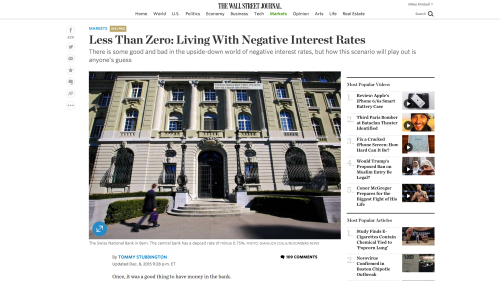
The Wall Street Journal has been slow to understand the potential of negative interest rate policy that I have laid out in various ways. But now, thanks to Tommy Stubbington–who interviewed me at length last Thursday–the Wall Street Journal has done an excellent front page treatment of negative interest rate policy. The whole article is great for giving the current context of negative interest rates in Europe, but below are the passages that most closely reflect Tommy’s interview of me. The first bit below has the same message as the title of my recently published paper “Negative Interest Rate Policy as Conventional Monetary Policy.” The rest should also be familiar to those who follow supplysideliberal.com:

Europe’s economic stagnation has proved so long and intractable that the region’s central banks are cutting interest rates to spur their economies. If it helps to move rates from 1% to 0.5% and 0.5% to 0%, why not try minus 0.5%? …

There is no hard limit on how low they can go. If commercial banks start widely imposing negative rates on retail customers, physical cash might look attractive. After all, it has a rate of 0%, although it isn’t without cost. One needs vaults and guards to store it, and it is no good for buying merchandise online.

Still, some economists said negative rates can be a powerful stimulative tool, if central banks can fully harness them.

Miles Kimball, an economist at the University of Michigan, has been preaching the gospel of deeply negative rates to central banks. When demand for money is low, as it is during a deep recession, Mr. Kimball argues, central banks should make borrowing as easy as necessary, even if that means paying banks to do it.

Mr. Kimball has a novel way around the physical-cash problem: make bank notes less valuable. He proposes that the Federal Reserve set an exchange rate between bills and electronic money. If it wanted, say, a minus 1% rate, it could decree that a $100 bill deposited in a year’s time would yield a $99 credit to a bank account. …

The interest in such schemes isn’t purely academic. With rates still at zero in much of the developed world years into the postcrisis recovery, central bankers may find themselves facing the next recession without much room to cut.

“It’s wrong to say central banks have run out of ammunition,” said Mr. Kimball. “Negative rates can be on tap before the next recession. There’s no limit to how deep we can go.”

Anand Jetha: Cutting the Cable Is Not All That

I am pleased to host another student guest post, this time by Anand Jetha. This is the 22d student guest post this semester. You can see all the student guest posts from my “Monetary and Financial Theory” class at this link. This is Anand’s 3d guest post. His first two were “Slow Progress in Battery Technology Will Hold Back Electric Cars” and “Diamonds are Not Your Best Friend.”


The number of streaming services and subscriptions like Netflix and Sling TV are on the rise. These services and the purchase of a Smart TV have been giving the false illusion that it is cheaper to cut cable services in favor of all streaming.

At one point in the last two years, it’s very likely you have talked to someone who “cut the cable.” They no longer get a contract TV subscription from AT&T, Comcast, or satellite providers like Dish. They say they don’t watch all the channels they get and consequently they don’t understand why they are paying so much for things they don’t use. There are a number of website out there telling you how to do it such as http://www.cutcabletoday.com. It may sound tempting when the “cable cutter” says they only pay $20/month plus taxes for Sling TV and let’s say a Netflix subscription for $9.99/month plus taxes. Sounds great! My question to the cable cutter is, however, how do you watch those services? Do they magically stream on your devices from some magical cloud? Well the obvious answer is no, and they rely on a steady internet connection. Internet still has to be paid monthly through one of those providers that people are trying to avoid.

The problem people face in urban areas is that the cable company that services their area (depending on if it’s a monopoly) generally provides the TV service and internet service in a bundle on 12 or 24-month contracts. These contracts can also be re-signed at the end of the term or a different provider can be selected on their 12 or 24-month contract. Comcast in Ann Arboroffers a 12-month contract with 75 Mbps and 150+ channels for $89.99/month plus taxes. So for someone to cut cable that means they are opting out of the bundle but still will need to keep the internet portion if they plan to stream TV or anything in their home. And if you plan to use multiple devices and a TV at the same time, higher speeds will be a necessary than with the bundle that has cable TV. I don’t see it being feasible for Mom to be checking e-mail, Dad to be watching Monday night football using Sling TV, and two kids watching movies on Netflix or streaming music/videos unless they have a strong internet connection over 50 Mbps. Those plans alone start at $59.99/month for the slowest internet speeds, and then add $20/month for Sling TV and $9.99/month for Netflix bringing the total to about $89.98/month. That’s exactly $0.01 cheaper than the original bundle. And if you’re anything like me, those two services alone will not be able to satisfy your need for also HBO and college sports. These will cost you extra from other streaming services. This does not include the cost of buying the equipment (Google Chromecast, Apple TV, Sling adaptor); I’ll just leave that out of the discussion for now as a fixed cost. Cutting the cable is not a horrible idea as long as cost of internet is reasonable. The more a household wants to say they can cutback because they can just “find it online,” they also need to be able to get “online.”

Vamika Bajaj—Chuck Grassley and Dick Durbin are Wrong: The US Needs More H1B Visas

tumblr_inline_nyugowbpiP1r57lmx_400.png

Link to Vamika Bajaj’s Linked In homepage

I am pleased to host another student guest post, this time by Vamika Bajaj. This is the 21st student guest post this semester. You can see all the student guest posts from my “Monetary and Financial Theory” class at this link.


Tightening H1B visa regulations is economically inefficient. H1B visas do not pose a threat to American jobs, but rather, contributes to the growth of the American economy

There is a lot of discussion about tightening immigration regulations in order to make it harder for non-Americans to obtain H1B visas. The H1B visa is one of the most common visas under which foreigners continue to maintain a legal status while working in the United States. These visas are also known as skilled worker permits; most firms help sponsor their foreign employees to obtain an H1B visa.

Currently, H1B visas are granted by a computer-run lottery, where the probability of winning is only about 30%. Despite this, there has been recent discussion about tightening these regulations even further. For instance, two Senators, (Chuck Grassley and Dick Durbin) are campaigning heavily for making it harder to get H1B visas. Their main argument is that H1B visas are given to workers who are stealing jobs from Americans. They are proposing to make it mandatory for all firms offering H1B visas to first attempt to find Americans to fill those job openings before petitioning for H1B visas for their foreign staff. They also want to ban firms from hiring more people under the H1B visa if half of the company’s staff is already non-American.

But the assumption that H1B visas take jobs from Americans is not warranted. That foreigners are working in America does not necessarily imply that they are stealing jobs from Americans. Of course, I am not claiming that not a single American has ever been displaced by H1B workers. However, I argue that the majority of H1B workers are not displacing Americans, but rather that they are adding direct value to their firm and in turn, the American economy as a whole. In fact, according to the economists Giovanni Peri, Kevin Shih and Chad Sparber, “H-1B visa holders contributed between 10 and 25 percent of the aggregate productivity growth that took place in the United States from 1990 to 2010.” Obviously, economic growth in the economy is beneficial to immigrants and Americans alike.

Furthermore, to argue that Americans are being displaced from jobs by H1B workers would be to assume that a certain proportion of the currently unemployed Americans and the current holders of H1B visas represent close substitutes. But if that were the case, private firms would probably only be hiring Americans anyway. There would be no reason for them to deal with the paper work associated with providing employees with visas, if they could get equally good workers without doing so. It is obvious then, private firms have to see something valuable in a worker to sponsor an H1B visa. 

For example, a very large proportion of IT services in the US are provided by Indians. This is because an important part of the Indian economy, education system and infrastructure cater toward developing a labor supply with strong IT skills. This is not to say that Americans would not be able to provide IT skills and services that are at par with those provided by India. However, this does mean that there is a much larger supply of labor that is highly skilled in the IT sector if Indians are added to the mix. Given this, it should come as no surprise that majority of H1B visas are held by Indians. In fact in 2014, 70% of H1B visas were allotted to Indians, the majority of whom worked in IT firms, including Google, Microsoft and IBM. It would y be economically inefficient to make it difficult for these workers to obtain visas, as they add value to the American economy and pay taxes to the American government.

Another common criticism is that companies hire workers with H1B visas not for their skill, but for the lower wages they are likely to accept. In that sense, they would simply be hiring foreigners because it is cheaper. However, there is certainly no merit to the simple version of this argument. Research conducted by the Brookings Institution revealed that 90% of H1B visa holders have a technical background in STEM related fields. (STEM: Science, Technology, Engineering, Mathematics.) The reason that those with STEM related knowledge hold most of these positions is that such specialized positions are harder to fill. This makes it even more likely that H1B workers are being hired for their skill and are not simply displacing Americans by accepting lower wages. Additionally, there is evidence to support that due to this technical knowledge, the average H1B worker with a STEM related bachelors degree actually makes more than an American counterpart who holds a bachelors degree in any field. So it is more a matter of much extra skill for some extra money than it is less money for the same skill. In any case, H1B visa holders are not reducing wages for those who are at the bottom of the heap, but competing with others who are quite well paid. 

Economic efficiency and social welfare are maximized when demand is met with supply without artificial restrictions. A free labor market would correspond to minimal restrictions in the availability of H1B visas. It is in the interest of private firms to hire those employees whose skills they believe will best match the company’s needs. For this reason, it would be economically more efficient not to tighten rules associated with H1B visas.

Update: There is a lively set of comments on this post on Miles’s Facebook page, here.

Woo Chul Ro: Is a US University Education Worth It for Foreign Students?

Website of the Korean Student Association at the University of Michigan. Despite the troubles Woo Chul Ro is pointing out, the Korean students at the University of Michigan are smiling :)

I am pleased to host another student guest post, this time by Woo Chul Ro. This is the 20th student guest post this semester. You can see all the student guest posts from my “Monetary and Financial Theory” class at this link. This is Woo’s guest post. His first is “Woo Chul Ro: Affirmative Action by US Colleges is Troubling, But Still a Net Plus for Social Justice.”


International student enrollment of US colleges benefits the universities and the US economy, but it is causing an issue for the international students.

US colleges, including our own University of Michigan, pride themselves in enrolling international students and harboring an internationally diverse group of students on the campus. However, the number of international students is controversial because it may crowd out domestic students. But there is another problem with international students in US colleges–a problem for them. In terms of job prospects, they may not be getting their money’s worth. US students are complaining that they are being edged out by international students. But are even the international students being served well?

According to the Wall Street Journal article Foreign Enrollment at US Colleges Hits a Record, the international student enrollment in US colleges as a whole are constantly rising. As of today, 1 in 20 American college students are international students and around half of these international students are from China, India, and Korea. Since I am from South Korea myself, I would like to set the Korean students as an example. The Korean international students are ranked as the third among the number of international student enrollment by origin in the US colleges, according to the article. The combination of cultural significance of education and the belief by the general public that the US colleges teach world-leading education sends more than 60,000 students per year from South Korea to the US.

However, from what I have seen from this school, most international students end up eventually going back to their country after their education. Strict laws enforced by the US government make it much more expensive and complicated to hire international students over domestic students. This is causing an issue on international college students. In South Korea, many of these international students go back to their homeland and have trouble adjusting to the domestic job market. As a matter of fact, Samsung, the largest and the most dominant conglomerate in South Korea, explicitly announced that they will be hiring fewer students who graduated universities abroad due to their lack in efficiency. US education is biased towards how things work in the US, which means the US education may be of less value for international students compared to domestic students. This is not good at all for the foreign students. The domestic students being edged out may not get into the college of their choice, but most of them can get a job almost as well as if they had gone to a higher ranked school. But the international students often find it difficult to survive at the jobs in their home countries due to the unfitting education they received at a foreign university

I once heard a Korean mom interviewing on a Korean television “I would even sell my house to send my child to Harvard.” I think this is exactly what the US colleges are capitalizing on. The interdependent Asian cultures, like China and Korea (combined makes up almost 40% of US international students), think of US schools as a much higher level of education than the domestic education, which is why some Korean families are willing to spend more than 4 times the tuition of top domestic universities to send their kids abroad. However, their education in the US could be valued less than their domestic education. While the US colleges are taking high tuition from international students, this phenomenon could actually be hurting the international students.

Noah Smith: Sunni Islam is Failing

tumblr_inline_ny2ywsMSlo1r57lmx_500.png

In the wake of the terrorist attacks, a lot of predictable Muslim-bashing is coming out of the American right wing. This needs to stop. Muslims are just normal human beings, subject to the same incentives and pressures as the rest of us. The refugees pouring out of Syria are fleeing an unfortunate situation - the violent collapse of their society and the atrocities of the Islamic State. They deserve our help, not our scorn.

But the rise of ISIS, and the wars in Syria, Iraq, Libya, Yemen and Pakistan are the symptom of something big, bad, and important that is happening to the Islamic world. Basically, Sunni Islam is failing at its core mission.

That’s a dramatic, big claim to make. It’s based on a book I read. “Destiny Disrupted: A History of the World Through Islamic Eyes,” by Tamim Ansary makes the case that Sunni Islam is not quite like other religions.

In fact, the word “religion” is a catch-all term that we apply to a bunch of different social institutions, but Buddhism is not like Christianity, which is not like Judaism, etc. Ansary makes the case that Sunni Islam was conceived primarily not as a spiritual institution, but as a temporal one. Instead of establishing connections between humans and God, Sunni Islam was expressly about creating a just, peaceful society here on Earth.

The Arabian peninsula in the 600s was a place of perpetual tribal and city-state violence. Islam, according to Ansary, was conceived as a way to end the violence and unite the world under a peaceful umbrella. A religious judiciary would derive laws from Islam’s founding texts (the Quran and Hadith), which would then have divine authority. Using this divinely authorized jurisprudence, Islamic courts would then create a stable, orderly, peaceful and moral society. Meanwhile, temporal rulers would use military power to expand the zone of Islamic peace. In fact, early Islamic judges declared that the world was divided into the “House of Islam”, under which peace and justice would (ideally) reign, and the “House of War,” which was the rest of the world.

So Sunni Islam was more of a political force than a spiritual one - a replacement for traditional empires like Persia and Rome. For a while, the dream worked - the early caliphates were stable and prosperous, with conflict only at the borders, where conquest was ongoing. But as Islamic conquest bogged down and was halted in Europe, India, and Africa, war turned inward. The Umayyad dynasty was overthrown and the Abbasid dynasty replaced it, then soon fractured into competing emirates and alternative caliphates.

In later centuries, the dream of Islamic peace was again realized in a number of places. The Ottoman Empire, an unusually long-lived and stable regime, united vast swathes of the Middle East and North Africa. Even after its breakup, societies that embraced traditional Islam - most importantly, Saudi Arabia - had low rates of crime and violence while maintaining traditional values. As long as its armies prevailed in the field, Islam was still doing its “job”.

But something has changed. Throughout much of the Islamic world (with the notable exceptions of Bangladesh and Indonesia), violent conflict now prevails. Here, via Wikipedia, is a list of the world’s ongoing major conflicts:

All four of the world’s major wars are mostly Muslims fighting other Muslims. A large percentage of the smaller wars on Wikipedia’s list - about half, by my count - are also primarily Muslims fighting Muslims.

NOT Muslims fighting non-Muslims. Samuel Huntington, author of “The Clash of Civilizations,” declared that Islam has “bloody borders.” That was true in the 600s and 700s, but now it is not Islam’s borders that are bloody. A few conflicts - Kashmir, unrest in Malaysia, the Israel-Palestine conflict, or Islamist terrorism in the West - do feature non-Muslims fighting Muslims, but these are dwarfed in number and size by the wars in which Muslims are fighting and killing each other.

The same is true of Islamist terrorism. Despite operating globally, al Qaeda killed many times as many Muslims as non-Muslims. The same is currently true of Islamist terrorism in general.

In other words, the House of Islam is now the House of War, and it is the rest of the world where peace prevails. If Tamim Ansary is right about Sunni Islam’s core mission, then Sunni Islam is failing dramatically at that mission.

Why is this happening? Obviously, most Muslims - like most humans - are peaceful people who have absolutely no desire for violent conflict. And yet here is the reality that millions in the core Islamic countries of the Greater Middle East, through no fault of their own, are now being forced to live with what you see at the top of this post.

Nor is the culprit the precepts of Islam itself. The current wars in the Islamic world are NOT at all similar to the conquests of Islam’s early empire, which were directed outward.

One reason might be the Resource Curse. The vast oil wealth of the Arabian peninsula, channeled by Saudi moneymen to fundamentalist madrassas around the world, has stoked the growth of a radical Islam. But although countries like Russia and Iran also suffer from the Resource Curse, and have also engaged in some violence, they have not done with Orthodox Christianity and Shia Islam what Saudi Arabia has done with Sunni Islam.

A deeper reason may be modernity. Disruptive technologies overturn established power hierarchies. The information revolution and international migration tend to break down the barriers of closed societies. These changes have proven very stressful for most modern nation-states, and adjustment has often been difficult. But Sunni Islam, which is a much older political system than the modern nation-state, may simply be less flexible with respect to the disruptions of modernity.

Sex culture, transmitted through the internet and migration, places huge strains on traditional morality. The service industry and the global women’s liberation movement make traditional gender roles incredibly hard to maintain. Science challenges religious authorities, while modern capitalism requires a secular legal system that cannot easily derive its principles from the Quran or Hadith.

In other words, Sunni Islam as a system of law and governance may simply be badly adapted for dealing with the pressures of modern technology and economics. The breakdown of the social stability created by traditional Islamic jurisprudence may be behind the rise of increasingly extreme and radical violent extremist elements like al Qaeda and ISIS.

It’s very interesting to note that Shia Islam has not suffered nearly such severe and violent extremism. The Iranian Revolution produced a violent, revisionist regime, but despite abundant oil, Iran is now a stable nation-state whose proxy militias - Hezbollah, the Shia militias in Iraq, and the Houthis in Yemen - are not nearly as religiously extreme, and which have not (recently) attacked the West like al Qaeda and now ISIS have done. This may be luck, or it may be because Shia Islam relies less on the kind of distributed network of religious judges that forms the basis of the Sunni social system. In other words, because theological authority in Shia Islam is more centralized, the Ayatollahs at the center may be able to adapt Shia Islam better to changing circumstances than Sunni Islam has managed. Shia Islam also may have turned itself into something less like a substitute for the state, and more like a standard “religion” analogous to Christianity or Buddhism.

Anyway, whatever the reason, the upshot is that the victims of the Paris terror attacks were not victims of a “clash of civilizations” or an Islamic jihad against the West. They were collateral damage from the collapse of someone else’s civilization - the Sunni Islamic civilization of the Arabian peninsula, North Africa, and Pakistan.

So how should Sunni Islam respond? How should it adjust in order to make itself no longer the House of War? Personally, I think it should think about separating church and state, limiting the scope of religious jurisprudence, and ceding more authority to temporal rulers. In other words, it should become more of a spiritual and moral religion, and less of a social system.

Scott Aldworth: Credit Scores for Micro-Loans from Phone Use Patterns

Link to Scott Aldworth’s LinkedIn homepage

I am pleased to host another student guest post, this time by Scott Aldworth. This is the 19th student guest post this semester. You can see all the student guest posts from my “Monetary and Financial Theory” class at this link.


Silicon Valley startups are making the approval process and distribution of micro-loans easier to individuals in developing countries, and will help these emerging economies grow

Some Silicon Valley-back startups are revolutionizing how creditworthiness is determined in the developing world, looking at new metrics that are different from the traditional measures of credit. Traditional methods of measuring credit are an individuals three credit ratings determined by the three main credit rating bureaus: TransUnion, FICO, and Equifax. The new method, however, uses different data from phone usage.

A simple app that can take all sorts of data - everything from texts, emails, GPS coordinates, social-media posts, to retail receipts - hold correlations with creditworthiness. This new strategy reduces the cost of pulling up a credit score for an individual in a developed country. Even more obscure data, like how often an individual charges their phone or how many incoming texts they receive have patterns that can give signals about their creditworthiness.

The loans are small and are not given by traditional banks. The average loan is only about $30, but these small loans, also known as micro-loans, can give a taxi driver enough money for gas or a fruit stand owner enough money for fresh produce.

Kiva, an organization that lends out micro-loans in emerging economies, gives out loans similar to these at as little at $25. Their deposits also come from generous contributions from the organization’s chapters and individual donors which are then paid back once the loanee can pay back the loan. These micro-loans allow poor individuals in emerging economies to get the money they need to pay for expensive upfront costs of running their business without a credit score that is needed to get a loan from a bank.

Jong Beom Park: Brexit Is a Bad Idea for Both Economic and Security Reasons

tumblr_inline_nyeggfsnqR1r57lmx_500.png

I am pleased to host another student guest post, this time by Jong Beom Park. This is the 18th student guest post this semester. You can see all the student guest posts from my “Monetary and Financial Theory” class at this link. This is Jong Beom’s 2d guest post. His first is “The $28 Trillion Per Year Woman: Benefits of Full Participation of Women in the World Economy.”


Britain will make arguably one of the most substantial decisions in its long history before the end of 2017. As the Tories were re-elected in May 2015, the British Prime Minister David Cameron has declared to hold a referendum whether to remain in or leave the European Union (EU) by 2017, and that day is approaching fast. Cameron’s intention may be to renegotiate its terms with the EU and thereby convince the British public to favor the current state, he is facing a tough opposition domestically from Eurosceptics, led by a money-loaded lobbyist group. Their main argument is that Britain would be able to form new trade relationships outside the EU, while still being able to trade with EU nations, and form its own social and employment laws all without the membership of the EU. But, I would like to argue that the United Kingdom can benefit, both economically and politically, more by remaining in the EU.

From the start, Britain’s road to the EU was rocky. Instead of joining the European Coal and Steel Community (ECSC) when it was first founded in 1951, Britain formed its own trade union, the European Free-Trade Association, with six other smaller countries. Because they were more fortunate economically than other countries in Europe after WWII, Britain had no reason be in a customs union with other European powerhouses, such as Germany and France. Well, in my opinion, now they do. Although its initial intention may have been purely economic, Britain today also attains security benefits from the EU in midst of the migration crisis and recent terrorist attacks in Paris. 

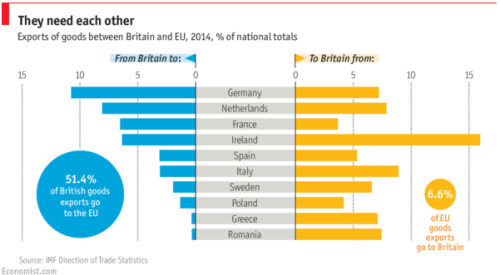
First, to fully understand Britain’s reliance on the EU for its overall exports, look at the figure at the top of this post. As shown in that the figure at the top, Britain exports more than half of its total exports to the EU. Although it would still be able to trade with EU countries without the EU membership, like Switzerland and Norway, Britain would trade 55% more as a member of the EU, according to John Springford of the Centre for European Reform. The EU would inevitably place more restrictions on Britain in trading with its EU members if Britain exits. Eurosceptics argue that Britain could better exploit additional trade opportunities with non-EU countries and use the required budget for its EU membership in the development of new industries. Nonetheless, in my opinion, the possibly of these new benefits without the membership of the EU does not outweigh benefits that Britain is already claiming.

Moreover, in addition to economic benefits, Britain is also enjoying security benefits, especially in the current state of Europe. Today, Europe is more or less in a security turmoil after a series of deadly terrorist attacks in Paris, France. As a nonmember, Britain would have had no role in discussing and collaborating on security measure. Domestic Eurosceptics claim that the EU has a limited influence on Britain’s security because “principle guarantor [of European security] for 70 years has been the North Atlantic Treaty Organization.” Even so, Europe as a whole is facing tougher challenges today than ever before. Following the terrorist attacks in Paris last week, EU, separately from NATO, promised a collective action by the member states, possibly strengthening the EU borders and retaliate against responsible terrorist organizations. In addition, more control over employment and social laws can be achieved without leaving the EU. For member states of the EU, most of their national regulations have been collapsed into one supranational regulation. However, as David Cameron demanded in his letter to the President of the European Council, Donald Tusk, Britain would still be able to fight for more of its own control without leaving the EU. If Britain could retain some control over EU regulations as the EU takes up on Cameron’s demand, it would be an ideal situation for Cameron and pro-EU campaigners at home.

Matthew Hoffman—Corporations Are Not Bluffing: They Are Moving Out

Link to Matthew Hoffman’s Linked In homepage

I am pleased to host another student guest post, this time by Matthew Hoffman. This is the 17th student guest post this semester. You can see all the student guest posts from my “Monetary and Financial Theory” class at this link.


I have written many posts this year regarding taxes, and how for many decades this topic has been hotly debated. Many of my posts have argued for decreasing taxes, as they generally hurt business, cause corporations to increase prices, reduce employment, etc. I understand that we do need taxes to pay for public goods, military products, social benefits, and many more government costs, but the magnitude of these goods and the tax dollars spent for them is a separate debate from which taxes are the least distortionary. Recently, the tax debate has turned towards corporations.

According to the articles Elizabeth Warren’s Tax Warning and Warren wants to hike taxes on big business to raise revenue Democratic Senator Elizabeth Warren has been a staunch opponent to other Democrats who desire to decrease the corporate tax rate. A decrease in the tax would make “the U.S. economy more competitive,” however Senator Warren is not convinced by the corporations’ strategy, in which they “tell a story about high U.S. taxes, demand tax cuts from the U.S. Congress, and threaten to leave the U.S. for good if they don’t get what they want.” In Warren’s opinion, this argument is just a bluff, in which the corporations are simply looking for a decrease in taxes. Instead, Warren argues for an increase in corporate taxes, in order to gain more revenue for the US government. However, as the authors argue, this is no bluff, as corporations have been leaving the US

Recently, in the Wall Street Journal, the article Pfizer and Allergan to Merge in $155 Billion Inversion Deal discusses the merger between two large pharmaceutical corporations: Pfizer and Allergan. This is an example of how I corporations are in fact moving their headquarters to other countries since taxes are too high in the United States. A useful comparison is to how companies so often move their headquarters to Delaware within the United State. Corporations move their headquarters to Delaware becuase corporate taxes are known to be low there. Similarly, corporations will continue by moving headquarters out of the country where corporate taxes are even lower.

The article discusses how the Allergan/Pfizer deal “brings together a diverse stable of drugs, from Pfizer’s cancer medicines and vaccines, to Allergan’s skin-care treatments and eye drugs.” Additionally, given the magnitude of the new company, it is unsure whether the company can be properly managed. It has been hypothesized that the new company will again be split, where the strengths of each new company will be delegated appropriately.

However, this deal supports my argument concerning corporate taxes and ultimately dismantles Senator Warren’s theory. As part of the deal, Pfizer will shift its tax base to Allergan’s home base in Ireland. Even though Pfizer is the larger of the two companies, Pfizer structured the deal so that Allergan would absorb Pfizer in order to pay fewer taxes. In the US, Pfizer was paying a rate of roughly 25%, but in Ireland they will pay about 17-18%. As a result of this move to a foreign country, American jobs will be lost since the headquarters of the company are no longer located in the US.

I don’t understand how Senator Warren can say corporations are bluffing in order to achieve lower taxes, when we see so many corporate inversions. Increasing corporate taxes is not the solution. There is good reason to think decreasing corporate taxes will result in more jobs, more corporations staying in the US, and more foreign investment in the US.

Cyrus Anderson: Making a Market Where None Exists, Google-Style

I am pleased to host another student guest post, this time by Cyrus Anderson. This is the 16th student guest post this semester. You can see all the student guest posts from my “Monetary and Financial Theory” class at this link. This is Cyrus’s 2d guest post. His first is “Hot Property in China.” 


Google’s open sourcing move is laying the groundwork for products based on the company’s renowned infrastructure.

Google recently open sourced its TensorFlow library for artificial intelligence. But why? There are a fair number of open source projects already available for the various AI stuff one might want to do, as well as companies offering services and products in the area. One explanation is altruism and a bit of indirect benefit from the advancement of research. This is possible, but an explanation more fitting for a profit motivated company would be that the open sourcing move was made to build a market for future product releases.

The hardest ingredient to acquire in order to make a market is that of the participants. Google hopes to bring them together by setting standards with its open source platform. Open source will attract more people than offering TensorFlow as a product, in large part because it is free. Since Google is widely recognized, and for its software, it should have little trouble reaching critical mass. From there, the sheer amount of usage will propel it forwards. As with any open source project with sufficiently rigorous standards for contributions, more users means more possible contributors, as well as a larger community that can be leveraged for support on technical issues and whatnot. It also means more pairs of eyes that can uncover problems in the software and provide fixes. These together make a well-built piece of software that will form a standard.

Setting the standards is great, but what does this mean? Just as Google set the standards for search engines and as a result captures mountains of advertising revenues, it may be trying to do the same for AI. The prediction being made here is that widespread adoption of Google’s new open source software will, in the future, provide the company with a market that will more readily buy its AI-related products. This can come in the form of greater recognition leading to greater acceptance of those paid-for things, but even better than that would be greater uptake of new Google products that interfaced with the TensorFlow library due to its already widespread use. 

This is not too hard to imagine- Google released its software, but it has retained many of the bits that make the code fast on hardware. As a Wired article attests, “To be sure, Google isn’t giving away all its secrets. […] it’s not sharing access to the remarkably advanced hardware infrastructure that drives this engine (that would certainly come with a price tag).” Access to the hardware could be offered as a service, such as specially built hardware for TensorFlow operations. This would help Google compete with Amazon’s AWS, as this special purpose could make it cheaper and more powerful for its use cases than the generic computing provided by the current services. As the large companies such as Amazon, Microsoft, and Google build ever more attractive packages for their cloud computing services, their offered computing power will become cheaper, under increasingly flexible terms (e.g. pay for actual computing done, rather than buying hours allotted on the machines). The next step may well be special purpose infrastructure that can cater better to more specific customer needs, in which case Google is poised to make a killing.

Mackenzie Wolfgram: Capital Lease Accounting is Honest Accounting. Operating Lease Accounting is Not

I am pleased to host another student guest post, this time by Mackenzie Wolfgram. This is the 15th student guest post this semester. You can see all the student guest posts from my “Monetary and Financial Theory” class at this link. This is Mackenzie’s second guest post. His first was “Why the $15 Minimum Wage is Bad for the Poor.” 

To fully understand this post, it is helpful to read the definitions of “Capital Lease” and “Operating Lease” on Investopedia.


Itay Kama, one of my accounting professors at the University of Michigan would always tell us, “the main goal of a company’s financial accounting should always be to reflect their economic reality as accurately as possible.” One would hope that companies would take this to heart and make the effort to be as forthright with the public as they could be without regulation forcing them to do, but this is not always the case, and currently one area that the FASB’s standards are being used improperly is the way in which leases are recognized on the balance sheet. Namely, operating leases are reported in a way that allows companies to artificially boost their ratios, especially revenue/assets, and attempt to mislead investors. Luckily for us, changes appear to be underway.

There are two ways that a lease can be documented, as a capital lease, or an operating lease. A capital lease takes into account all of the payments that will take place during the entire lease and shows the present value of these payments as a long term liability, in contrast with this liability the value of the lease to the company is represented as an asset. These balances are depreciated/expensed over the term of the lease in order to reflect the value of remaining lease term, and the amount owed in the future.  An operating lease is on the other end of the spectrum as far as recognition of liabilities and assets, as there is absolutely no recognition of either. Under an operating lease, each year, you will see a credit to cash and a debit to rental expense for the amount that was paid into the lease that year.  That is the only recognition that makes its way onto the balance sheet.  Even though in the economic reality the company has a liability to pay that same amount for the next X amount of years, there is no admission of this, nor is there any recognition of the assets that the company has the right to use over the life of the lease.  This allows companies to have a considerable amount of off balance sheet activity, including the potential to hide both debt and assets.

Since the Operating Lease method of accounting does not recognize either liabilities or assets from leases, companies vastly prefer operating leases to capital leases. The main reason is that it allows for liabilities to be kept off the books, which makes the company look better since it doesn’t appear that they are indebted heavily to those that they have leased assets form.  Although these companies are contractually obligated to pay large amounts of money into the lease each year, they are able to hide this under the operating lease structure. The Wall Street Journal (Michael Rapoport) estimates that if this accounting standard is changed, American companies will have to recognize an additional $2 trillion in leases. This method is also preferred since it helps the revenue/assets ratio. The higher this ratio, the more revenue a company earns from each dollar invested in assets. When this ratio is high, the company is perceived as being more efficient and capable of utilizing assets in a more profitable way than a company with a lower revenue/assets ratio, or asset turnover ratio.

Clearly, managers are hugely incentivized to recognize leased assets under the operating structure.  As long as they are able to avoid breaking any of the following rules, then a lease is an operating lease. A capital lease must be used only if:

  • Ownership. The ownership of the asset is shifted from the lessor to the lessee by the end of the lease period; or
  • Bargain purchase option. The lessee can buy the asset from the lessor at the end of the lease term for a below-market price; or
  • Lease term. The period of the lease encompasses at least 75% of the useful life of the asset (and the lease is noncancellable during that time); or
  • Present value. The present value of the minimum lease payments required under the lease is at least 90% of the fair value of the asset at the inception of the lease.

Clearly, it is very easy to qualify for the operating lease structure.

This method of accounting reflects reality poorly when compared to the capital leases, and companies don’t even get much advantage out of it in the end. Although household investors and smaller operations may take the warped word of the balance sheet, every single credit rating agency, major brokerage, and investment agency is going to go into the footnotes and find out how the true value of their capital leases. Since this information is required to be included in the footnotes of the report, yet can be hidden on the balance sheet as long as they qualify for a capital lease.  The only people who are truly disadvantaged by this system are those less sophisticated investors who don’t have a professional grade grasp of accounting standards and their implications. For these reasons, FASB Chairman Russell Golden is hopeful that the standards will change, this “will give investors, lenders and others a more accurate picture of the financial condition of the companies to which they provide capital.”  In addition to being more accurate, recognizing leases fully will allow companies to depreciate the value of the lease, which will give them a boosted tax shield.

In the interest of forthright accounting, an area that is complicated enough already, I truly hope that this new standards goes through. Unfortunately, when large companies have the potential to lose a lot of money, things tend to be tricky to change. This new rule has already been proposed twice, and shot down both times. Yet I remain hopeful that this will be the time that we are able to pull the trigger on making accounting more honest.

John Stuart Mill: Making the Government More Powerful than Necessary is Inimical to Freedom

Among all the critiques of too much government power, John Stuart Mill’s critique in paragraph 20 of On Liberty “Chapter V: Applications” is one of the most eloquent:

The third, and most cogent reason for restricting the interference of government, is the great evil of adding unnecessarily to its power. Every function superadded to those already exercised by the government, causes its influence over hopes and fears to be more widely diffused, and converts, more and more, the active and ambitious part of the public into hangers-on of the government, or of some party which aims at becoming the government. If the roads, the railways, the banks, the insurance offices, the great joint-stock companies, the universities, and the public charities, were all of them branches of the government; if, in addition, the municipal corporations and local boards, with all that now devolves on them, became departments of the central administration; if the employees of all these different enterprises were appointed and paid by the government, and looked to the government for every rise in life; not all the freedom of the press and popular constitution of the legislature would make this or any other country free otherwise than in name. And the evil would be greater, the more efficiently and scientifically the administrative machinery was constructed—the more skillful the arrangements for obtaining the best qualified hands and heads with which to work it. In England it has of late been proposed that all the members of the civil service of government should be selected by competitive examination, to obtain for those employments the most intelligent and instructed persons procurable; and much has been said and written for and against this proposal. One of the arguments most insisted on by its opponents, is that the occupation of a permanent official servant of the State does not hold out sufficient prospects of emolument and importance to attract the highest talents, which will always be able to find a more inviting career in the professions, or in the service of companies and other public bodies. One would not have been surprised if this argument had been used by the friends of the proposition, as an answer to its principal difficulty. Coming from the opponents it is strange enough. What is urged as an objection is the safety-valve of the proposed system. If indeed all the high talent of the country could be drawn into the service of the government, a proposal tending to bring about that result might well inspire uneasiness. If every part of the business of society which required organized concert, or large and comprehensive views, were in the hands of the government, and if government offices were universally filled by the ablest men, all the enlarged culture and practised intelligence in the country, except the purely speculative, would be concentrated in a numerous bureaucracy, to whom alone the rest of the community would look for all things: the multitude for direction and dictation in all they had to do; the able and aspiring for personal advancement. To be admitted into the ranks of this bureaucracy, and when admitted, to rise therein, would be the sole objects of ambition. Under this régime, not only is the outside public ill-qualified, for want of practical experience, to criticize or check the mode of operation of the bureaucracy, but even if the accidents of despotic or the natural working of popular institutions occasionally raise to the summit a ruler or rulers of reforming inclinations, no reform can be effected which is contrary to the interest of the bureaucracy. Such is the melancholy condition of the Russian empire, as shown in the accounts of those who have had sufficient opportunity of observation. The Czar himself is powerless against the bureaucratic body; he can send any one of them to Siberia, but he cannot govern without them, or against their will. On every decree of his they have a tacit veto, by merely refraining from carrying it into effect. In countries of more advanced civilization and of a more insurrectionary spirit, the public, accustomed to expect everything to be done for them by the State, or at least to do nothing for themselves without asking from the State not only leave to do it, but even how it is to be done, naturally hold the State responsible for all evil which befalls them, and when the evil exceeds their amount of patience, they rise against the government and make what is called a revolution; whereupon somebody else, with or without legitimate authority from the nation, vaults into the seat, issues his orders to the bureaucracy, and everything goes on much as it did before; the bureaucracy being unchanged, and nobody else being capable of taking their place.

(I modernized some of the spelling.) To try to unpack this paragraph, John Stuart Mill’s worries about overly strong government are

  1. rent-seeking
  2. people being focused on pleasing and influencing government officials, with all of the loss of freedom that entails
  3. leaving too few talented organizers in the private sphere
  4. absorbing the consciousness of people of ambition
  5. rule by the civil service, with a lack of full democratic accountability, as one sees for example in Japan. 

This is a serious list of things well worth being concerned about. For a practical alternative to making the government every bigger and more powerful, while still getting the public things done we should get done, see my post “How and Why to Expand the Nonprofit Sector as a Partial Alternative to Government: A Reader’s Guide.” 

Minority Opinions

Today I am grateful to live in a country that is relatively tolerant of people being different and having different views. That is a good thing, because the idea that there is a majority on any substantial combination of views is probably an illusion in the sense that people are consciously or subconsciously tilting their views into conformity with what they perceive to be the norm, while underneath, they may be much less alike than they are pretending to be.  

Within economics, there is an enormous variety of different views. That is an important reason why it is easy to feel that one’s work is underappreciated. Even if one strives mightily to be the best possible economist, and feels one has succeeded, the definition of “best” is dramatically different from one economist to the next. So how one’s paper fares at a journal, for example, depends a lot on the referee lottery: how close the gradient describing “better” that is in the mind of one’s referee is to being in the same direction as the gradient describing “better” in one’s own mind. There is no one unified evaluation criterion. To most of us it seems there should be a uniform evaluation criterion–the standards each one of us personal holds. But that is not the way it is; people are just too different. This is especially true in macroeconomics. I hear that the gradient defining “better” is a bit more similar among different microeconomic theorists than it is among macroeconomists. But even among microeconomic theorists tastes differ greatly from one person to the next. 

When people have different views–especially when they have different views on things that they care about even more than economists care about their own take on the discipline–it is crucial to have a system that allows people with different views to coexist well. Freedom within a relatively minimalist framework to preserve order is one of the best ways to allow people with dramatically different views to coexist well. There are other things that can help, but allowing each person a bubble of freedom around herhimself is the most basic. In comparison to the other alternatives on offer, the United States of America does pretty well at that.

Toward Freedom in Argentina and the Rest of the World

I very much share the sentiment behind the opening sentence to the Wall Street Journal’s op-ed “Reviving Argentina” about the electoral loss of the Peronism in Argentina, but the arithmetic doesn’t work. The editorial board of the Wall Street Journal writes:

History is replete with great nations that decline into tragic despotism and poverty, but less common is the story of national revival and renewed prosperity.

The very first things that could be called “nations” lived in tragic despotism and poverty, and there were no nations that had escaped despotism and poverty. Now there are nations that that have escaped despotism and poverty. So despite some backsliding along the way, transitions for the better have outnumbered transitions for the worse. 

The fact that governance has gotten better over the millenia is a wonder. As I wrote in “Why Thinking about China is the Key to a Free World”

Freedom is a rarity in human history, and still too much of a rarity in the world today. This should be no surprise. Would-be tyrants abound, and it is not easy to establish a system that keeps them all in check.

There is a lot of grim history behind us, but things are better now, and with our efforts, they can be even better in the future.

Note: There are some tricky issues in the accounting (transitions from non-nationhood to nationhood or vice versa, nations splitting into two or amalgamating into one–or if weighted by number of people, birth and death) but a fair accounting should try to make these kinds of transitions neutral for the question at  hand. The bottom line is that things used to be worse than they are now.

Nicholas Pauze: The University of Missouri Protest Shows the Role Money Plays in Social Change

Link to Nicholas Pauze’s LinkedIn homepage

I am pleased to host another student guest post, this time by Nicholas Pauze. This is the 14th student guest post this semester. You can see all the student guest posts from my “Monetary and Financial Theory” class at this link

I had to look up the Wikipedia article “2015 University of Missouri protests” to get enough information to figure out what I thought about the protests. I come down on thinking that university administrators and professors bear a large responsibility to teach students about both the value of respecting all human beings and the value of free speech. The administrators at the University of Missouri did not do this part of their job. The way to teach both the value of respecting all human beings and the value of free speech at the same time is to use free speech to excoriate racism and all other affronts to human dignity in no uncertain terms. 

It is quite possible to say that someone has a right to say something but that they are totally wrong, for the following powerful reasons … To do things right, the arguments against racism need to be reargued powerfully for every new cohort of students, just as the arguments for free speech need to be reargued powerfully for each new cohort of students (and just as, for example, the scientific arguments for evolution need to be reargued powerfully for each new cohort of students). A university is not the place to rely on authority and tradition. Professors and administrators need to make the case to each new cohort of students for the truths that have been discovered over humankind’s existence. If collectively they can’t make the case for key principles that our civilization is founded on, they don’t deserve to be professors and administrators at a university.  

Here is what Nicholas has to say about how things went down at the University of Missouri, and what that means strategically for those who want to foster positive social change: 


Despite the enormous victory that it represented to many, the Missouri protests show that it is only when money is either to be gained or lost that social change takes place in our country.

This past month had a huge victory for civil rights to end discrimination but a victory that points out a big flaw in our society. What seemed to be yet another story of racism and discrimination finally had a happy ending. After nearly a month of protest and a week and a half of a food fast, the president of Missouri decided to step down. Sadly he did so only the day after the football team joined in–putting money into the equation. Despite the enormous victory that it represented to many, the Missouri protests show that only when money is either to be gained or lost is when the most social change takes place in our country.

What happened this past month with protest leading to action and real change should not be ignored or minimized. This represents the power of even just one student choosing to go all out for a cause and how that can inspire real change. The president at Missouri did need to step down. Even though he himself was not racist, his decision not to act had made him ineffective as a leader. When he stepped down he made thousands of people feel that they had been heard for the first time. The unfortunate part of the whole story is that one could argue that Jonathan Butler’s heroic action was not to get the president fired but to get the football team involved. The football team’s decision to join represents potential money loss because forfeiting would cost the school one million dollars.

Once money became involved, change was quick to follow. The Washington Post documented how the team tweeted out Sunday and by Monday the president had resigned. This represents another important example of how social change really happens when money can be lost. It is a sad truth in our society because we have so much protest going on but much is from those who do not have money or influence and thus do not have a voice that is likely to be heard.

Just one other example from the past week shows the inverse of this when Donald Trump hosted Saturday Night Live. There were over 500 thousand signatures from people protesting his hosting. The Huffington post indicated how the outrage was because of the racist comments Trump has been known to say. Yet despite the massive support and even coverage there was no real threat to his hosting Saturday Night Live because the ratings would still be good and no sponsors were threatening to drop out. 

Protests today need to be aimed at the people who control the money flow because as history shows, the money is what guides many of the people who are targets of such protests. The most successful changes we have seen in recent memory come when sponsors speak or when athletes or people of influence speak because unfortunately they are the ones who affect money and that seems far too important in leading to change. In the meantime we need to point out those who say they want change but only respond to money to try to alleviate the need for money to drive change.

Adam Aldeen: The US Should Attack the Root Cause of Companies Relabeling Themselves as Foreign by Ending Its Taxation of Income Earned Overseas

Link to Adam Aldeen’s LinkedIn homepage

I am pleased to host another student guest post, this time by Adam Aldeen. This is the 13th student guest post this semester. You can see all the student guest posts from my “Monetary and Financial Theory” class at this link


On Thursday, the US Treasury Department revealed new rules to prevent U.S. companies from doing corporate tax inversions to reduce their tax bills. The rules aim to make it harder for any American company to avoid paying taxes by relocating to another country. I think this is an unwise decision because it fails to address the underlying issue that causes firms to leave in the first place.

The American tax code is unnecessarily complex, and recent merger and acquisition activity has been high as companies have rushed to take advantage of lower tax jurisdictions. Right wing critics contend that the solution is to lower corporate tax rates, while those on the left tend to want to make it more difficult to leave in the first place. Evidence suggests, that although the U.S. has one of the highest marginal corporate tax rates in the world—at 35 percent—high corporate tax rates are not the driving factor in a firm’s decision to locate overseas. Indeed, because of tax holes in the U.S. tax code, American firms pay an average of 20.3 percent on domestic profits. The real issue is that companies have to pay U.S. tax rates on income earned abroad but can avoid paying taxes on that income until they repatriate it. The end result is companies having stashed  $2.1 trillion of earnings with their foreign addresses. This is a problem because it erodes the US tax base and we should instead be thinking about how to encourage companies to stay here and pay a guaranteed minimum tax.  

The tax on income earned abroad makes US firms less competitive than foreign counterparts because most nations only tax domestically earned profits. Therefore, a foreign owned firm identical to a US firm pays less in overall taxes than an American corporation. This is just a shame because it means that companies are incentivized to not pay American taxes and contributes to a massive loss of tax revenue to the government. Indeed, the OECD estimates that cash hoarding and inversions cost the government nearly $90 billion a year in lost tax revenue.  

A potential solution would be to stop taxing that income earned abroad. After all, almost every other country in the world does not tax its firms on income earned abroad, and doing so would dissolve the major reason firms leave in the first place. An article from the Economist explains that “Making it hard for American firms to invert does precisely nothing to alter the comparative tax advantages of changing domicile; it just makes it more likely that foreign firms will acquire American ones.” I completely agree with this; instead of indirectly addressing this issue, let’s just get at the heart of it and let companies retain their earnings earned abroad while ensuring some sort of minimum tax in the US through a territorial tax system. Moving to a territorial system, explains the Economist, would result in trapped foreign earnings coming back to America and would stem the flow of jobs overseas because American firms would be buying foreign firms instead of foreign firms buying American firms. This would increase the US tax base, and would be a driving force in stimulating an economy in recovery.

Update: There are some interesting comments on Miles’s Facebook page on this post.

Illusion of Choice, Illusion of Consent: The Bite of Apple

Which choice is the default choice can make a big difference for a software companies profits. When Apple notified me it was going to charge me $11.99 a year for iCloud services I didn’t need and never asked for, it was quite annoying that I had to research how to undo things to avoid being charged. I thought they were giving me a lesser of two evils choice of pay $11.99 a year or pay in trouble and bother and time. But it turned out to be worse. I unchecked backup for my iPhone photos–something I had never asked for and didn’t realize was happening. Then I went through the procedure to downgrade (not a well-displayed option at all) and got to the window you can see at the top of this post. I have the “free option” checked, but the “Done” button is grayed out and does not function. So there is no way to save my choice, and as far as I know I am still slated to be charged $11.99 on December 21. 

Note how it says that I am using less than 1 gigabyte, so it wasn’t a problem of lagged recognition of unchecking the photo backup on my iphone. 

I suspect there is a way to fix this by going to my local Apple Store or calling up customer service. But that isn’t fair at all! That is definitely charging me more than $11.99 in time and bother to avoid a $11.99 charge. And maybe if I were more of an expert, I would know what to do, but I am fairly confident that many, many people would have the same problem I had and give up–which means paying up. This is bad enough I think it could easily constitute an anti-trust violation.

This is how well displayed the free option is. The free option is hidden behind the “downgrade options” button. As far as I know, this screen is the only path to the free option.

This is how well displayed the free option is. The free option is hidden behind the “downgrade options” button. As far as I know, this screen is the only path to the free option.