Math Post: Isomorphismes on Transforming a Problem Into Something Easier to Understand
Isomorphismes is one of my favorite Tumblogs. Here is a math post I liked.
Going the long way: What does it mean when mathematicians talk about a bijection or homomorphism?
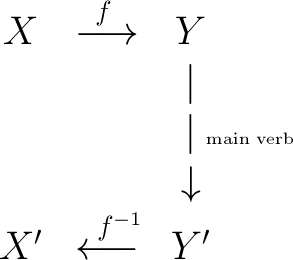
Imagine you want to get from X to X′ but you don’t know how. Then you find a “different way of looking at the same thing” using ƒ. (Map the stuff with ƒ to another space Y, then do something else over in image ƒ, then take a journey over there, and then return back with ƒ ⁻¹.)
The fact that a bijection can show you something in a new way that suddenly makes the answer to the question so obvious, is the basis of the jokes on www.theproofistrivial.com.

In a given category the homomorphisms Hom ∋ ƒ preserve all the interesting properties. Linear maps, for example (except when det=0) barely change anything—like if your government suddenly added another zero to the end of all currency denominations, just a rescaling—so they preserve most interesting properties and therefore any linear mapping to another domain could be inverted back so anything you discover over in the new domain (image of ƒ) can be used on the original problem.
All of these fancy-sounding maps are linear:
Fourier transform
Laplace transform
taking the derivative
Box-Müller
They sound fancy because whilst they leave things technically equivalent in an objective sense, the result looks very different to people. So then we get to use intuition or insight that only works in say the spectral domain, and still technically be working on the same original problem.

Pipe the problem somewhere else, look at it from another angle, solve it there, unpipe your answer back to the original viewpoint/space.
“Going the long way” can be easier than trying to solve a problem directly.